Verbal art in the ecological discourse of two Amazigh/Berber documentaries
Abstract
International audiences have taken an interest in the contestatory aspects of the documentaries La colère dans le vent (Amina Weira, 2016) and Amussu xf ubrid n 96 (Movement on the Road 96) (Nadir Bouhmouch, 2019). However, scholars and critics have largely overlooked the exploration of oral genres in their discourse and imagery, focusing instead on their socially and ecologically engaged approaches. In this article, by contrast, I assume a central position with reference to orality. The analysis of the two documentaries shows that orality serves to construct their discourse and that images strengthen the narrative role of orality. In the first documentary I analyse, La colère dans le vent, the reference to orality functions as a kind of frame narrative: Tuareg storytelling and music provide the framework in which multiple interviewees voice their recollections of past, silenced pollution and express their demands for justice and ecological restoration. In the second documentary, Amussu, poetry functions as a "narrator" and structures the alternation and intertwining of agricultural and militant activities. I thus show that climate change and mining pollution have spurred a renewal of sung poetry and other oral genres in these audiovisual media. In this article, I further delve into the theoretical and ethical issues surrounding the 'subjectivity' of the documentary voices and the ethical perils of documenting humanitarian crises.
Amazigh oral literature; documentary; extractivism; insurgent cinema; Niger; Tuareg; Ait Atta; verbal art; Morocco
Introduction
Seeking inspiration to renew the relationship between humanity and the planet, numerous voices resonate today with principles such as reciprocity and moderation. The ethos of "Share fairly, don't take more than you need, don't waste", as enunciated by Shawna Knight of the of Secwepemc people (Kuin) and deeply rooted in oral literatures across the globe, stands in stark contrast to prevailing (post)industrial consumerism and the mechanistic view of nature as an inexhaustible 'resource' (see Barry 239-61; Descola). Various audiovisual media, including cinema, television, and the internet, allow creators to actively engage in discussions and critiques of the ongoing ecological crisis, occasionally drawing on oral genres. In this article, I delve into the intersection of the Amazigh verbal arts and environmental themes in two documentary films centred on mining and the relationship to the land. Specifically, I scrutinise Amina Weira's 2016 documentary La colère dans le vent (Anger in the wind), henceforth Colère, and Nadir Bouhmouch's documentary from 2019, Amussu xf ubrid n 96 (Movement on the Road 96). Despite the significant critical acclaim these two documentaries have garnered, the investigation into how oral genres are reactivated within the discourse and imagination of Colère and Amussu has been less explored than their committed social and ecological approaches. In this study, by contrast, I reveal that the renewal of sung poetry and other oral genres has been driven by the impacts of climate change and mining pollution, positioning them as central features within contemporary audiovisual productions.
Studying how oral genres are reactivated in the audiovisual context entails questioning how Amazigh oral literature has reacted to historical long-term dynamics. Many researchers and writers in Africa, as well as elsewhere, have pondered the fate of oral literature in the face of social changes and the hegemony of writing and audiovisual media. For instance, researchers have observed that songs related to specific activities and rituals disappear when these activities are no longer practiced (see Foley; Garnier; Merolla, "Introduction: Orality and technauriture of African literatures"). In the Amazigh/Berber domain, the writer and anthropologist Mouloud Mammeri suggested transcribing and translating poems to save them from extinction, even though he added that oral poems then enter a state of "semi-death" because writing cannot replace the vitality and materiality of voice and artistic performance (Poèmes kabyles anciens 10). These concerns are understandable. However, groups and individuals can integrate certain oral styles and genres into other modes of expression (see Kaschula and Mostert). In particular, in this article, I demonstrate that climate change and mining pollution has led to an adaptation and renewal of sung poetry in relation to audiovisual media.
Other crucial theoretical and ethical questions pertain to the position of committed documentaries within the global communication market. The first question concerns their "subjectivity" (Nichols 134, 138). The second concern relates to the perils of documenting poverty and various humanitarian crises to raise awareness and inspire action. Despite the "good intention" of humanitarian documentaries (Srinivasan 204), there are inherent contradictions associated with humanitarian documentaries (Rangan, Immediations: The Humanitarian Impulse in Documentary 156). At the end of this article, I will explore these theoretical issues and evaluate their relevance by examining the documentaries Colère and Amussu, which can be interrogated for their 'humanitarian' discourse, as they operate on multiple registers-addressing local, national, and international audiences.
Finally, it is useful to recall that the Imazighen/Berbers have a historical presence in environments where writing has been prevalent since ancient times, and that the interplay between oral and written languages in North Africa, also called Tamazgha by Amazigh activists, has persisted into modern times (Maddy-Weitzman).1 The colonisers imposed their languages during the colonial era, (French, Spanish, Italian, and English) and emigration to Europe during and after colonisation played a role in disseminating knowledge of several European languages in North Africa (Merolla, "Amazigh/Berber Literature and 'Literary Space'. A contested minority situation in (North) African literatures"). After gaining independence, North African nation-states emphasised Arabisation (as the reinstatement of Arabic in the public space), imposing enduring forms of censure and repression on Amazigh/Berber languages. It took extensive activism and widespread demonstrations for the Amazigh/Berber language to finally attain recognition as a national and official language in Algeria (1995 and 2016) and Morocco (2001 and 2011). Arabisation, however, is still progressing due to the interplay of economic, social, and political factors (Chaker; Maddy-Weitzman).
Mining and pollution in La colère dans le vent and Amussu
Colère and Amussu share the context of pollution caused by mining. In the case of Colère, it occurs at the uranium mine in the Tuareg area of Arlit in Niger. Colère by Weira, a graduate in documentary filmmaking from the Université Gaston Berger in St-Louis (Senegal), has been a critical success (Desquesnes and Vidal; Ellerson; Jarvis; Tcheuyap) and won numerous national and international awards, including the Golden Pepite from Rêve Africain (African Dream), which was held in France in 2021. When asked why she chose such a topic, Weira answered: "with the growing awareness of Nigerien youth [...] we have seen a change in mentality through militant and demanding approaches. As a filmmaker, it was my duty to make this film to support my people in their efforts" ("Amina Weira nous parle de son Film la colère dans le vent").2 Regarding what is specific in her films, Weira says: "When I make my films, I make sure to talk about my culture, whatever the subject I am dealing with. [When] we take 'Anger in the wind', we see these women playing the [single-stringed] violin, [and this] is typical Tuareg [...]" (African Film Festival).
Amussu, which addresses the pollution caused by the silver mine at Imider in Morocco, has also gained national and international recognition (Benidir).3 This documentary encountered some initial obstacles to being screened at national festivals, as the director Bouhmouch, who holds a degree in Film Studies and International Conflict Resolution from the University of San Diego in the United States, refused to comply with the Moroccan film system to obtain permission to film. These difficulties underline the sensitive nature of the documentary, which expresses both eco-social and Amazigh protest (Pierre-Bouthier 67). Amussu is presented by Bouhmouch as a "community" documentary: "You could say that Amussu is the result of tiwiza (mutual aid in Tamazight) and solidarity, not money" (Bouhmouch qtd in Misk, my translation).
The two documentaries inform the viewers that the mines are extremely productive, but the revenues belong to the respective mining companies: the French Areva, owned by the French state, and the Moroccan Managem, whose main shareholder is a holding company owned by the Moroccan royal family.4 In both cases, the populations are impoverished and suffer from the effects of pollution; in particular, water that used to be drinkable is now polluted due to the chemical treatments employed to extract the minerals from the ground. In addition, the country is experiencing a drought, and there is a lack of infrastructure and hospitals (Jarvis; Moujane and Toscane). The city and the region of Arlit, presented in Colère, also suffer from the serious effects of millions of tons of radioactive debris left in the open air. The two documentaries powerfully show the demands of the populations, which El Kahlaoui and Bogaert (186) summarise as follows: "that the wealth generated by mining be used for local development and that the environment be protected". From this perspective, the two documentaries can be seen as responses to specific manifestations of the expanding global extractivism and its connection to cultural dispossession (El Guabli; Henni; Hecht).
At the same time, the two documentaries show how the populations have responded to mining expropriation with different strategies. In Arlit, a new town that has grown up around the mine since the 1970s, the miners, some of whom are Tuareg and others who come from all regions of Niger, have been blackmailed into silence to keep their jobs.5 The prolonged hush about the pollution was only broken with the latest democratic reforms and the first trade union demands. In the case of Imider, the village has maintained and renewed its social structures and has gone from protests that began in the 1980s to the occupation of Mount Alebban in 2011.6 Imider's villagers closed the mine's water pipes to protest against the use and pollution of their water sources by the mine. The occupation lasted from 2011 to 2019. The first response to the occupation of Mount Alebban was police repression, followed by the establishment of several mining posts for Imider's men. One wonders whether this is a form of bargaining on the part of the mining company to avoid confronting the ecological security of the land and its inhabitants.
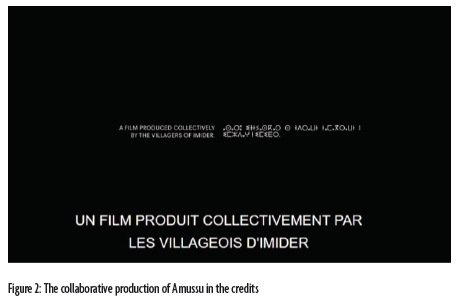
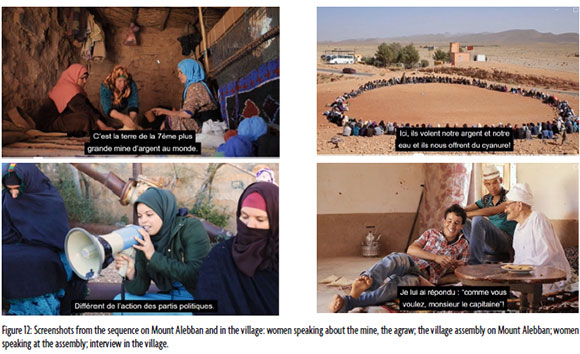
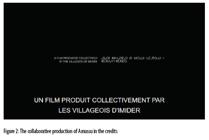
The two documentaries launch a passionate critique of the practices of mining companies from an ecological and social perspective in very different styles. Colère director Weira addresses the issue of Arlit's pollution with an (auto)biographical approach, drawing from her own memory and that of other protagonists. Amussu is a choral and collective documentary, in the sense that Bouhmouch organised workshops on scenography, editing, and post-production for the village. The documentary was created following the instructions of the agraw, the village assembly in which everyone-men, women, and children-participated. The collaborative production of the documentary is highlighted in the credits: "A film collectively produced by the villagers of Imider".
The narrative strategies for integrating orality in Colère and Amussu are also dissimilar. Firstly, I examine the role of songs and narratives in Colère.
La colère dans le vent: Orality as narrative frame
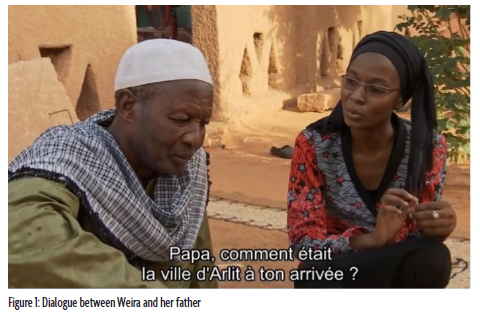
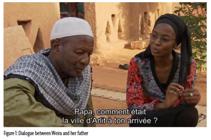
Colère begins and ends with a conversation between the director and her father, Mahmane Weira, in the desert outskirts of Arlit. The documentary's introduction and conclusion also reference oral literature (songs and stories transmitted orally) and Tuareg music, both captured in a desert area. The dialogue between the father and daughter, as well as the reference to orality, functions as a kind of frame narrative. Weira incorporates encounters with the other protagonists within this framework, as each recounts the pollution in Arlit. In this central and quantitatively dominant part of the documentary, a number of encounters take place with elderly miners, as well as with women, craftsmen, and young miners, each expressing the difficulties of their lives exposed to radioactive pollution.
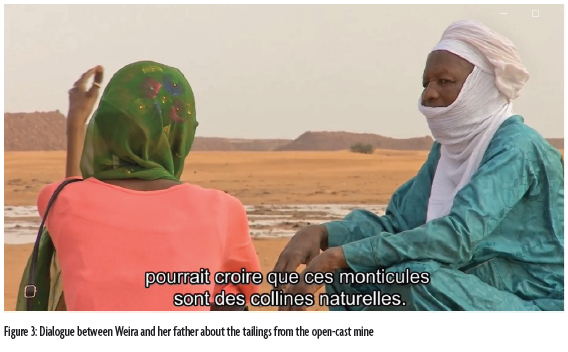
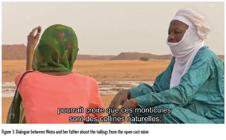
The dialogue between father and daughter is the main thread running through the documentary: At the beginning, Weira asks her father what he thinks about the tailings from the open-cast mine, and at the end she asks him why there is such silence about the pollution in Arlit. She tells him that what she sees and hears "discourages and distresses" her, and that it's time for a change. Her father, who worked as an electrician in the mine, explains that the miners did not initially know that the hills were mining excavation waste and that uranium is radioactive, the effects of which "would impact our children". At the end of the documentary, he recalls the silence of state representatives and emphasises that it was only with democracy that miners gained rights, nodding when his daughter calls for real change.
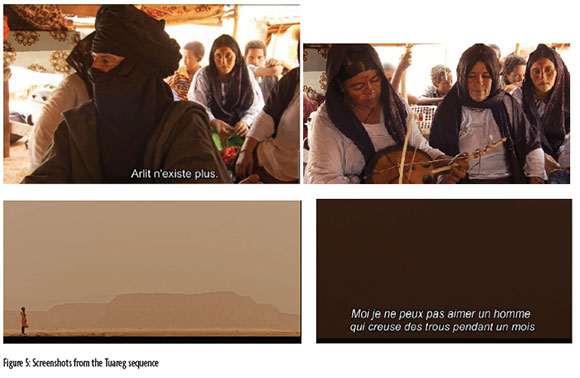
In the context of denouncing pollution, the presence of orality is subtle and has not been addressed by analyses published so far. In my examination, the significance of referencing oral tradition is prominent. As the documentary opens with the conversation between Weira and her father, the viewers see that they are walking in the desert as Weira says: "In principle, this is a Tuareg area" (00.01.03). The transition to the scene of the Tuareg camp near Arlit allows the director to tell the story from the point of view of the Tuaregs and clarify this sense of belonging. Viewers are invited to witness the dialogue between Mahmane Weira and an elderly Tuareg man, surrounded by the men and women of his camp. This scene is followed by music played by the women. The interview and the presence of Tuareg music and songs (see description below) enable the director to place the Tuareg people at the centre of the discourse without burdening the documentary with ethnographic explanations.
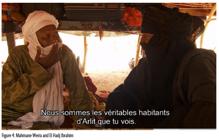
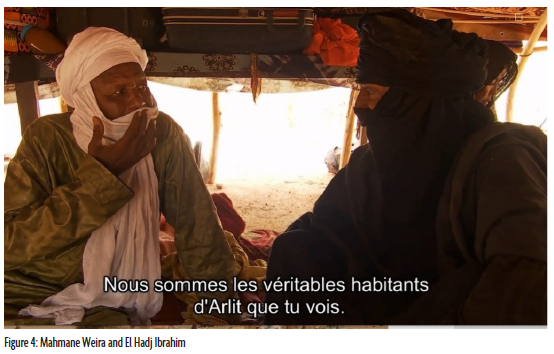
To understand the full impact of such a meeting and the reference to Tuareg oral tradition, one must consider that Mahmane Weira's interlocutor is a Tuareg poet who is very well known in the region. El Hadj Ibrahim, known as Tchibrit, is appreciated for his in-depth knowledge of local history, philosophy, and founding narratives of his community. The poet evokes local history, affirming the pre-existence of the Tuareg in the region when he says: "We are the true inhabitants of Arlit that you see". He recounts how he himself met the first Europeans interested in mining and how he told them the name of the mountain, which they then distorted due to their linguistic ignorance (Arghli = Aghli). In this way, the poet establishes a link between the past and the present, asserting his 'agency' or 'capacity to act': "One day a white man arrived, saw a mountain and asked me its name. I told him it was called Aghli, and the white man wrote Arlit". This modification of the name is fundamental in the poet's narrative to highlight the initial dispossession and exaction suffered by his community. It is well-known that "mapping" and "naming" places and populations were the first steps in colonial appropriation and exclusion. The Tuareg narrator is aware of this as well, and through his story, he not only recalls this ethnographic appropriation but also simultaneously repositions himself and his community at the centre of the action.
The second and more painful dispossession is that of water because the camels drink the water that has been used by the mine and perish. The poet emphasises this with commentary on the lack of economic reimbursement. Therefore, his narrative not only serves to reposition the Tuaregs at the centre of the action but also to assert their right to economic reimbursement: "In that time, there were several types of wild animals; we lived peacefully with our animals. Since the establishment of the mine, our camels have been drinking the water it discharges; they die afterwards and no one reimburses us".
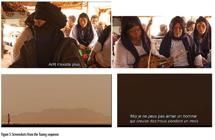
The documentary then highlights the generational difference. In response to Mahmane Weira's question, "What is killing the camels?", the poet tends to respond in a general manner: "Something they eat that harms them", while one of the young women speaks up to explicitly say, "It's the acid [used to extract uranium from the rock that is polluting the groundwater] that kills them". This exchange allows the documentary to emphasise the difference between the veiled language of the poet and the open speech of the young woman about the damage caused by mining pollution. However, the poet agrees with her on the consequences; it's the end of the (their) world: "Arlit no longer exists". There is a transition to the imzad, the monochord violin played by Touareg women, and slowly this sound merges with the image of the city of Arlit and the main part of the documentary.
Just as the poet's story is not anecdotal but helps to reaffirm the rightful presence of the Tuareg in the world of Arlit, the presence of the imzad players is not decorative, either. Their music bears witness to the creativity and beauty of Tuareg culture, as we also see at the end of the documentary. After the last conversation between Weira and her father, her silhouette emerges against the backdrop of the desert, gradually blending with images of a sandstorm dissipating into darkness. The sound of the singing and drumming played by the women of the Tuareg camp is taken up again in these final black sequences. The song takes up the classical lament style to express the theme of the pollution of the territory and of the miners. The text allows us to understand that women use orality as a vector for disseminating urgent themes, such as that of land pollution. The documentary thus highlights the vitality and relevance of Tuareg women's singing, which warns women not to marry miners, but rather "the men of the bush", because miners remain poor.
Oh! I cry my soul, oh my friends,
I call you all in the name of the Almighty,
do not accept the men of the mines (x2)
Because they are cursed,
do not give yourselves to the men of this city,
to the detriment of the men of the bush,
may God help them, because it is hell that awaits us (x2)
I cannot love a man who digs holes for a month,
and comes home every night with only a plastic bag and a box of matches.
The end of the documentary, which consists only of voices and a black background, can be interpreted as a valorisation of the oral word and literature of the Tuareg, and especially its timely relevance, since Tuareg songs speak of the emotions, desires, and problems of their women creators today.
Amussu: Poetry as beginning/end 'formulas' and narrative threads
Amussu tells the story of the occupation of Mount Alebban by Imider's villagers.7 Poetry, storytelling, and oral memory play a full role in the narrative of the documentary. Director Bouhmouch says in an interview that poetry is the "documentary narrator". It indeed serves as the thread that runs through the documentary (Nait Youssef). The narrative strategy of integrating orality in Amussu is structured around the agricultural year, showing the alternation and intertwining of agricultural and militant activities. Although the documentary is not strictly chronological, the presence of songs and tales sets the rhythm of political action as well as of agricultural work throughout the year (Bouhmouch qtd in Misk). One finds elegiac and struggle poetry, work songs, proverbs, riddles, tales, autobiographical accounts that carry the historical memory of the places, and contemporary Amazigh songs. Sung poetry plays a significant role in this, and I will show that it not only contributes to recounting the story of the villagers' resistance against the silver mine but also serves to open and to close the documentary, akin to the formulas used at the beginning and end of folktales.
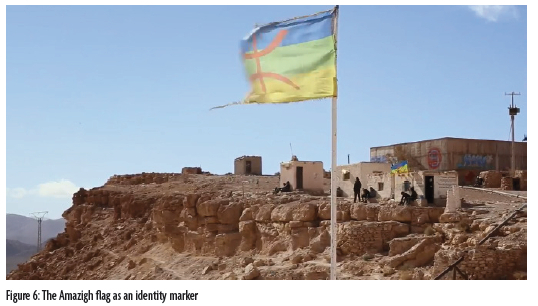
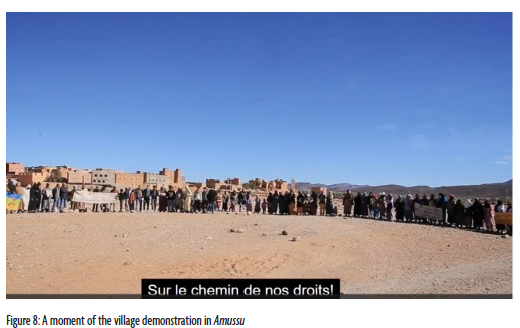
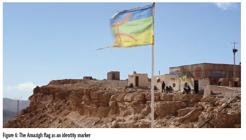
At the beginning, the viewer hears the noise of a helicopter-the sound of police power mentioned later in one of the songs-and then sees its image on the screen. The mention of the year "2011" is directly followed by a long sequence showing protesters walking and chanting slogans, with the voices of men and women alternating. The translation of one of the slogans is: "Repression does not scare us, Death does not deter us" and "Legitimate rights give life to our militancy". An intertitle then explains where the protesters are located ("Commune of Imider, southeastern Morocco") and the reasons for the demonstration: "Africa's most productive silver mine extracts 240 tonnes of purified silver per year using water taken from our villages' aquifers; when our farms began to dry as a result, we revolted". The impression of authenticity of the images is reinforced by the natural sounds of people's voices and laughter (02:39-03:26). Tamazight (the Amazigh variant spoken in the Aït Atta area where Imider is located) is sung and spoken in the documentary, and multiple images show, right from the outset, Amazigh symbols and flags on the house walls and in the demonstrations. "The Amazigh flag is omnipresent and the credits in Amazigh: the non-violent struggle of this village is also that of a culture" (Barlet). The significance of Amazigh symbols and the flag is not explained, but it is readily understood by the local people and other Moroccans. Consequently, the context of pollution is elucidated for the international public, while the assertion of Amazigh identity is not. Under this aspect, one can agree with Chambers and Higbee (15) that Amussu employs several registers to simultaneously address local and global audiences so as to articulate "a sophisticated aesthetic ambition".
Poetry
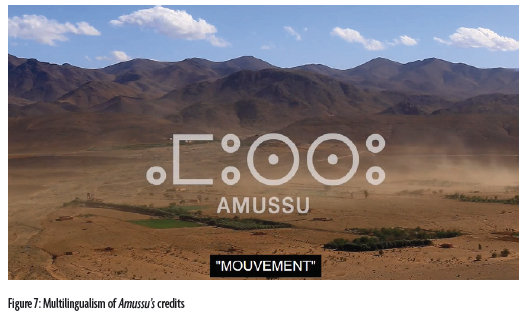
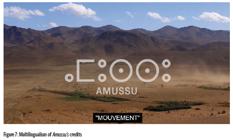
The initial images of the occupation of Mount Alebban are interspersed with the opening credits and the intertitles explaining the cause of the protest, namely the drought caused by the silver mine. The intertitles directly link the protests to the social function of the poet and of oral poetry: "Some of us are Imdiazen [Imdyazen], Indigenous rebel-poets who document the struggle through song" (01:59). This information is displayed on a black background, in three languages: English, French, and Tifinagh, thus addressing the international public and establishing the identity positioning of the documentary right from the beginning.8 Moreover, the use of the first-person plural ("we", "our") conveys the communal effort of the documentary, also underscored in the credits as seen above. The written information goes on to explain that the villagers of Imider have formed the "Movement on the Road 96" association and that the occupation continues in 2017. As the protesters march, a panoramic view of the high mountains begins to pan across the screen. At the same time, the sound of a drum is heard, and the voice of the poet, Yassin Madri, pronounces the first syllable of the poem. The title Amussu appears on the screen, in Tifinagh, in large letters, and in smaller Latin letters (00:03:21). The poet, still off-screen, sings the first stanzas of his poem. Such a transition to singing occurs as the poet begins with a classic expression of trust in God. He then recalls the condition of disobedience through a reference to prison and finally confirms the role of oral poetry indicated in the generic text: that of a form of documentation and testimony.
Rbbi ami cix lucil ad itnba ḍ awa, ad itnba ḍ awa
Waxa tllid a l ḥ abs ussan ad zrin awa, ad zrin awa
Rix ad nsawal anayx ma jran awa, majran awa
I entrusted my affair to the Divine, only to him
Despite prison, time passes
I want to tell what I saw.9
The poet's voice is heard several times in the documentary, but it is not the only one, confirming the collective nature of the spoken word in the film. The viewers listen to oral poetry, whether through female izlan (sung poetry), which either recite traditional verses (as in the first example below), innovate by explicitly referring to occupation and pollution, or through slogans sung in various scenes of protests and occupation.
Female voice: "Oh mother, Mother, I am too far away from you, yet the land remains far. I neither ascended nor descended; I came to heal the void but left with another" (00:15:25)
Female voice: "Oh Mother, I am in prison, guards surrounding me, and the door is locked! Oh, I am locked inside! I cannot see the light! My only hope is [the] divine! O Mother, tell them I have set up camp on top of Alebban". (35:28)
Female voice: "We came to the movement for justice, and found a helicopter threatening us". (01:01:41)
Female voices: "And the Caid, threatening mothers with a gun, see what a man of the law looks like! I thought Mount Alebban was infertile until I came to build a shed on it. The valve is heavier now with the locks we put on it. Now the enemy can say what it wants!" (01:01:50)
Male voices: "Salute and welcome back! To the prisoners for our cause. Oh history, take note! Oh Mustapha, take a rest! We will continue the fight! Oh, history take note! Oh Hamid, take a rest!" (01:28:46)
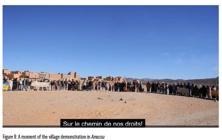
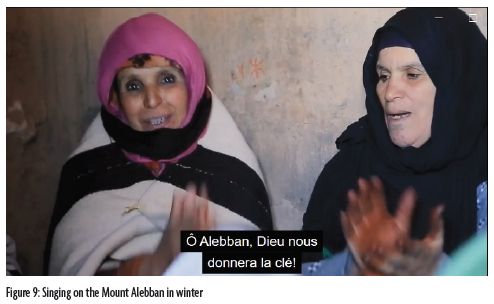
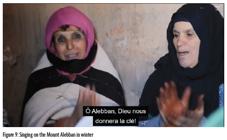
As said earlier, the songs also bring the documentary to a close, during which a long take opens the transition to the mountains in winter, with the date "2008". The images show the Imider protest camp on Mount Alebban, with only a few people outside. The women's voices can be heard singing and, in one of the buildings, the viewers see a group of women around a lkanun (brazier) singing, clapping, and crying out youyous [ululations] (01:33:26). The verses are composed in the literary tradition, adapted to the specific situation of the occupation. The scene ends with a cut to black (01:36:49), as the final credits begin to roll.
Oh Alebban, the Divine will give us a key! [...]
Oh Divine One [...]
Unite me with Alebban, where the children of benevolence stand,
Relieve me with a sunrise, for you did not create us to give up.
May you rise like the moon,
Glorious among the stars;
Oh misery! Has God made you my companion?
But the Divine is capable of all,
Misery cannot be everlasting,
Our sun will surely rise one day.
I walked the road and overlooked [looked over] our village,
the place of my dearest ones.
Tears came down my face.
We climbed this mountain to see the work that awaits when a loved one is stolen.
According to Salime Zakia (1045-6), these poems, sung by women poets such as Aicha and Fadma, challenge mining's commodification of nature by presenting the environment as animate and powerful: they describe the earth, trees, and crops as living beings capable of striking back when wronged. The verses give voice to the poets' love for, and unity with, the Divine, the village, Mount Alebban, and the natural elements of their environment.
Tales
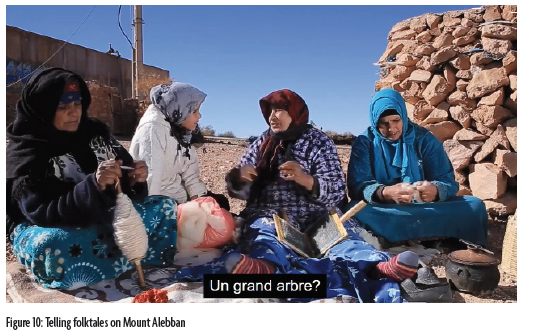
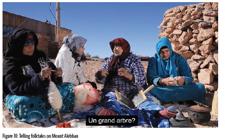
Alternating between work and protest, the documentary also shows the poetic interpretation of a tale that resonates with the daily activity of taking care of chickens (43:49): "One day the rooster said to the farmer, shake the sack and drop a few corn seeds [...]". In a later sequence, the didactic function is emphasised in a story about the end of the world being linked to pollution, using a folktale to talk about the present. As some women card wool, one of them tells the story, and a young girl asks for explanations about the meaning of certain parts. While watching how the story is repeated for the little girl, the viewers themselves perceive the practice not only as entertaining but also as a way of passing on elements of knowledge.
Storyteller: The wise man explains: "This is the state of the end of time".
Young girl: "When is the end of time?"
Storyteller: "It is now" [...] The wise man concludes: "There is no more aman (water), there will be no more aman as long as there is no aman (peace)" [Repetition to make sure the young girl has understood].
Imider's Tafsut festival
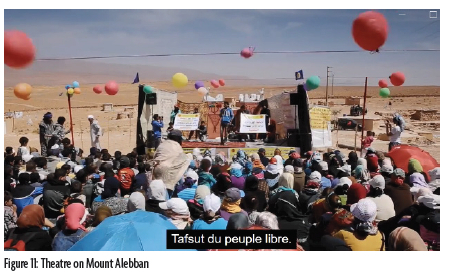
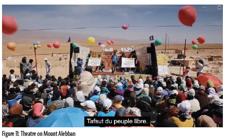
Amussu shows the convergence of the verbal and visual arts in both struggle and leisure. Individual and collective moments of entertainment are depicted, notably at the Imider's Tafsut festival (spring festival) held on Mount Alebban, with theatrical sketches, poetry recitations, and games for adults and children (sporting activities, riddle exchanges, etc.). In the evening, the festival screens documentaries on the fight against pollution and climate change around the world. At the start of the sequence, one of the organisers explains the role of the "creative" approach during the occupation and the struggle against mining-related pollution: "Tafsut is the continuation of our struggle. This edition's slogan is 'Sport, Art, Entertainment', the other facet of peaceful resistance [...]. We also need to develop a creative approach to resist this economic octopus" (46:46).
The Spanish and English voices of the documentaries-on the centrality of water to life and on the pollution caused by gas extraction in Peru and West Africa respectively (54:57)-underscore a global perspective and emphasise international connections. In Amussu, one of the organisers names the group responsible for the evening screenings and conveys their overarching concept. Specifically, the documentary emphasises the group's conviction that cinema can serve as a communal platform for generating, spreading, and exchanging content related to social and ecological rights: "Cinema is for everyone and must stop being elitist; it's a tool that must be available to everyone" (56:20).
The director states that he did not intend to arouse feelings of pity through Amussu, but to highlight "the hope, dignity and resilience of the village" (Bouhmouch qtd in Misk, my translation). Orality plays a major role in this choice-showing how izlan, tales, riddles, and slogans are performed in everyday life, for both educational and entertainment purposes-to support action, to remember and document events, and to express grief about those who were imprisoned. This was a conscious choice not only on the part of the director, but also of the village, which decided what to include in the documentary as an agraw (assembly): "It's more a film about victory and hope than defeat and misery" (Bouhmouch qtd in Misk, my translation).
Conversations
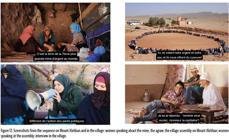
Orality also serves as a means to elucidate the historical and social backdrop surrounding the occupation of Mount Alebban. Conversations among the villagers offer insight into the extent of pollution and injustice faced by the village, shedding light on its resolute pursuit of justice. Instances of this are evident in the interactions between women in the initial segment (8:58); in the recordings during the agraw featuring women's voices (38:46 and 01:13:19); and in the dialogue between the director, the poet, and an elderly man reflecting on memories of colonisation and the ongoing struggles against mining pollution (57:29). The conversations featured in the documentary, which were discussed and agreed upon by the agraw before filming, serve to illustrate/display the insights on mining pollution as products of the villagers' reflections (Shafik 205).
'Modern' song
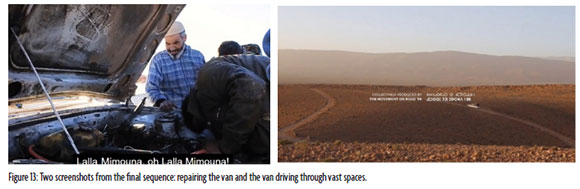
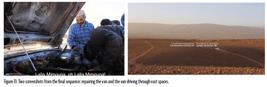
Bouhmouch includes contemporary song in his documentary by using "Lalla Mimouna" (by the Saghru Band) in the scene where a van is restarted. Then, as the credits roll after the women's songs in the final scene, the same van is seen driving along the long roads of the Imider region, and the motif of "Lalla Mimouna" is heard again (01:36:49). Looking at the images-the van driving through vast mountainous and arid spaces first to arrive then to depart-the modern song seems to be tied to the figure and role of the film director:
On the long road,
We walk together;
We climb the hill easily;
Unconcerned about hunger and thirst;
Because our souls are filled;
Unconcerned about hunger and thirst;
Lalla Mimouna, Lalla Mimouna (01.24.09).
Verbal arts in documentary
To return to the first question posed at the outset concerning the fate of oral literature in the face of social change and the hegemony of writing and audiovisual media, the two documentaries help us to counterbalance the idea of the disappearance of orality, showing that the groups producing the verbal arts can integrate them into other modes of expression. As shown above, in Colère, the reference to oral genres and music functions as a frame narrative and enables the director to give a central place to the Tuareg population. In the case of Amussu, the chanting poet introduces and closes the praise and memory of the occupation of Mount Alebban, akin to folktale formulas and other oral genres that are performed during the documentary, not only classical forms such as the recounting of tales, but also new (or renewed) genres. The linguistic choice, the use of Tamazight, is not isolated but integrated by other indicators such as the Amazigh flags and many symbols of the Amazigh existence painted on the walls.
What is interesting about the two documentaries is that oral tradition is not reduced to a mere decorative aspect, nor is it folklorised, with songs and tales commodified and devoid of social depth.10 On the contrary, oral songs and tales are alive in their communities and contribute to the discourse of the documentaries. In both situations, choral narratives emerge through the dialogues between the protagonists, describing pollution both as known in personal and social terms, and as a physical experience felt through their own bodies, marked by illnesses and police violence, while also impacting their environment with the disappearance of trees, animals, and drinkable water.
'Humanitarian' documentaries and 'insurgent' cinema
The second issue mentioned at the outset is the criticism that touches upon the subjective character of the "humanitarian" documentary. Following Nichols (85, 107), scientific and expository documentaries are perceived as committed to objectivity and relying on the presentation of factual information. The question remains as to whether the presumed objectivity of this "information" imparts a particular (dominant) perspective (Trinh 5, 40, 54). On the other hand, participatory and performative documentaries place a strong emphasis on engaging with subjects and their viewpoints, as well as those of the filmmaker. This approach may entail "excessive faith in witnesses" and a "diminished emphasis on objectivity" (Nichols 134, 138). At the same time, the use of the first-person voice-whether singular or plural-is seen by Alisa Lebow (1, 5) as debunking the objectivity/subjectivity debate.
In the case of Colère and Amussu, these two documentaries resolutely opt for the subjective approach, but in a choral and collective form, nurtured in Colère by the filmmaker's personal and family memories. Under this aspect, these documentaries switch to intersubjectivity, from the side of the local population, which serves to reveal the "objective" ecological, economic, and political violence exerted by the mining companies on the territory and its inhabitants. The explicit subjective position contributes to highlighting the opposition between the mining company's interests and the local population's violaged rights. Asked whether she had tried to contact mining company officials, Weira replied:
As far as mining companies are concerned, the answer is 'no': I would have been provided the usual justifications. In reality, it was a deliberate choice on my part. In this film, my aim was to give a voice to the local population [...]. In fact, every time debates are held on this issue, every time reports are published, their opinions lie on the sidelines. (Niang 310, my translation)
In the case of Amussu, the subjective approach belongs to a "revolutionary" strategy adopted by Bouhmouch and a group of other filmmakers. As explained by Jamal Bahmad (135), Bouhmouch and other friends of the 20 February Movement created "Guerrilla Cinema" during the so-called Arab Spring (see Guerilla Cinema).11 The collective emerged as a response to the changing sociopolitical climate and sought to document and share perspectives beyond the confines of state-controlled cinema, structure, and censure. Guerilla Cinema endorsed refusing to apply for permits and state funding, while supporting self-made films, self-production, and free distribution online. As aptly put by Bahmad (136), subjectivity allows the filmmakers to bear witness to history, and at the same time, it shows the impossibility of objectivity: "Bouhmouch and other emerging filmmakers across the region have sought to capture the subjective nature of the revolution from the point of view of its ordinary makers".
An additional concern relates to the ethical aspects of "giving voice" to marginalised people, which characterises humanitarian documentaries (Rangan, "Immaterial Child Labor: Media Advocacy, Autoethnography, and the Case of Born into Brothels" 159). Although the filmmakers (may) have "good intentions" (Srinivasan), the inherent contradictions associated with humanitarian documentaries are raised by the "paradox of participation" in storytelling (Fernandes 31; Kurasawa 2-5; Crosta, Niang, and Tcheuyap). The participation of the "voices" of the marginalised, dominated by economic and political powers and rendered unseen and unheard by both national and global media, supply purpose and legitimacy to engaged documentaries. However, the paradox holds that these documentaries do not succeed in changing the situations they reveal; rather, they succeed in increasing the filmmakers' social capital. In addition, the role and rights of subjects/witnesses in documentaries that discuss poverty and exploitation are not taken into consideration (Winston). Pooja Rangan (Immediations 1) argues that the "humanitarian ethic-giving the camera to the other-invents the very disenfranchised humanity that it claims to redeem". An example is offered in the analysis of a documentary by Zana Briski and Ross Kauffman featuring Indian children living in brothels (because they are prostituted or because their mothers/parents are prostituted) who are given a camera to photograph themselves. The whole endeavour, according to Rangan (Immediations 145-6), diverts attention from "the extent to which Briski's project advocates auto-ethnography, or a process of self-othering through photography". In other words, one should reflect on whether and how the voice heard in humanitarian documentaries is negotiated and recreated to be understood in the terms of the filmmakers and their international (economically and ideologically dominant) audiences. Such critical reflections are usually addressed to Euro-American productions but also extend to international NGO's "humanitarian" documentaries and their directors.
Although these ethical questions may be addressed to the two documentaries, the central message conveyed by Colère and Amussu, i.e. respect for ecological and social rights, is directed primarily to the documentary protagonists and to the local people. In this respect, although both documentaries have multiple registers-as they address local, national, and international audiences-their discourse is not merely 'domesticated' for a global audience (Bouhmouch qtd in Chambers 40). In the case of Colère, the director addresses her questions on social disillusion and the need for change chiefly to her father, living in Arlit, and then to the Niger government. As to Amussu, although Bouhmouch does not "belong" as family origin to Imider, it seems to me ungenerous to view the voices of Imider people in the film as just a form of legitimisation, which finally leads to increasing the social capital of the filmmaker. More than "giving voice" to Imider's people, Bouhmouch provides his knowledge and technical know-how to create a space of audiovisual memory of the occupation of Mount Alebban. Amussu, in this sense, does not presume to change the situation, but to document it. The somewhat "staged" conversations follow the idea of a "collective script".12 Moreover, Bouhmouch's position is particularly supportive as far as the Amazigh component in the language and cultural mosaic of Morocco is concerned: "With a director/mediator who originates himself from an Arabic and not Amazigh-speaking family, the project still situates itself within the ongoing national controversy on how to assess and represent the country's 'indigenous' culture and identity" (Shafik 207).
Finally, Amussu, as I have shown, can be considered an "insurgent" documentary opposing the Moroccan state film network and ideology in its practice and discourse. This kind of documentary cannot change the unequal power relationship within the field, nor can it probably convince the mining company to develop a more responsible attitude toward land, people, and animals. However, Bouhmouch and the Guerrilla Cinema are engaged in changing filmmaking in Morocco, and, simply by making their films, they have already, at least partially, succeeded.
Conclusion
In this article, I have demonstrated how, through different narrative strategies, the two ecological documentaries Colère and Amussu integrate the performance of oral genres. Song and music play a central role, but the documentaries also showcase the richness and variety of the performance of verbal arts in everyday life. Moreover, they both highlight the counter-discourse function of orality. In Colère, personal memory and oral history reposition the Tuaregs at the centre of the history of Arlit, while women's song is valued as an ever-relevant vehicle for expressing the desires and problems of its creators today. In Amussu, the spoken word belongs in the expressive strategy of "insurgent documentary", communicating the events from the point of view of the inhabitants of Imider to support action, to remember and document events, to express mourning for those who have been imprisoned, for the pedagogical teaching of storytelling, and for entertainment. To sum up, orality contributes to structuring the ecological documentaries examined in this article, and the intersection of different media, notably the continuity of oral and audiovisual, is presented in Colère and Amussu as a vigorous and current activity of everyday life.
Works Cited
-
African Film Festival. "Anger in the Wind Q&A with Amina Weira." YouTube. https://www.youtube.com/watch?v=7Opyg8a5kk.
» https://www.youtube.com/watch?v=7Opyg8a5kk -
"Amina Weira nous parle de son Film la colère dans le vent." ACTU Mag. 2019. https://actumag-niger.com/index.php/women-empowerment/281-amina-weira-nous-parle-de-son-film-la-colere-dans-le-vent.
» https://actumag-niger.com/index.php/women-empowerment/281-amina-weira-nous-parle-de-son-film-la-colere-dans-le-vent -
Azergui, Aksil. "Vent rouge : Une poésie grenade." Tamazgha le site berbériste. 23 Jan. 2021. https://tamazgha.fr/Vent-rouge-Une-poesie-grenade.html.
» https://tamazgha.fr/Vent-rouge-Une-poesie-grenade.html -
Bahmad, Jamal. "Insurgent citizenship: Youth, political activism and citizen cinema in post-2011 Morocco." Journal of African Cinemas vol. 11, no. 2, 2019, pp.131-40. DOI: https://doi.org/10.1386/jac_00011_1.
» https://doi.org/10.1386/jac_00011_1 -
Barlet, Olivier. "Gabès cinéma Fen 2020 : pour un nouvel espace documentaire." Africultures. 24 Apr. 2020. https://africultures.com/gabes-cinema-fen-2020-pour-un-nouvel-espace-documentaire-14914/.
» https://africultures.com/gabes-cinema-fen-2020-pour-un-nouvel-espace-documentaire-14914/ - Barry, Peter. Beginning Theory: An Introduction to Literary and Cultural Theory. Manchester U P, 2009.
-
Benidir, Mohammed. "Ce que l'extractivisme fait aux eaux souterraines au Maroc. La mine d'argent d'Imider contestée par ses riverains." EcoRev' vol. 1, no. 54, 2023, pp. 29-49. DOI: https://doi.org/10.3917/ecorev.054.0029.
» https://doi.org/10.3917/ecorev.054.0029 - Bernus, Edmond & Henri Lhote. "Arlit." Encyclopédie berbère, vol. 6, 1989, pp. 885-8.
-
Bouhmouch, Nadir. "Nadir Bouhmouch (Morocco)." In Jamie Chambers, "A Cinema Close to the People: A Critical Symposium on Folk Cinema." Cinéaste vol. 46, no. 3, 2022, p. 40. https://www.jstor.org/stable/27248422.
» https://www.jstor.org/stable/27248422 - Chaker, Salem. Berbères aujourd'hui. Kabyles et Berbères: luttes incertaines. New revised and enlarged edition. L'Harmattan, 2022.
-
Chambers, Jamie & Will Higbee. "Utopian Montage: exploring transnational folk cinemas online during the Covid-19 pandemic as part of the 2020 Folk Film Gathering film festival." Open Screens vol. 4, no. 2, 2021. DOI: https://doi.org/10.16995/OS.8009.
» https://doi.org/10.16995/OS.8009 -
Claudot-Hawad, Hélène. "L'« indépendance » énergétique de la France avec l'uranium du Sahara." Terrestres. 8 Apr. 2022. https://www.terrestres.org/2022/04/08/l-independance-energetique-de-la-france-avec-luranium-du-sahara/.
» https://www.terrestres.org/2022/04/08/l-independance-energetique-de-la-france-avec-luranium-du-sahara/ -
Crosta, Suzanne, Sada Niang, & Alexie Tcheuyap. "Introduction: Les Écosystèmes à l'écran: activisme, représentations et pratiques documentaires en Afrique et sa diaspora." International Journal of Francophone Studies vol. 23, no. 3-4, 2020, pp. 165-74. DOI: https://doi.org/10.1386/ijfs_00015_2.
» https://doi.org/10.1386/ijfs_00015_2 - Descola, Philippe. L'écologie des autres. L'anthropologie et la question de la nature. Quæ, 2011.
- Desquesnes, Naïké & Aude Vidal. "L'uranium de la Françafrique. Voyage au pays des dunes et des becquerels." Z : Revue itinérante d'enquête et de critique sociale vol. 1, no. 13, 2020, pp. 188-95.
-
El Guabli, Brahim. "Dossier Déserts Expérimentaux : Esthétique et Théorisation des Espaces Désertiques au Maghreb." Expressions Maghrébines vol. 23, no. 1, 2024, pp. 7-19. DOI: https://doi.org/10.1353/exp.2024.a930857.
» https://doi.org/10.1353/exp.2024.a930857 -
El Kahlaoui, Soraya & Koenraad Bogaert. "Politiser le regard sur les marges. Le caso du mouvement « sur la voie 96 » d'Imider." L'Année du Maghreb no. 21, 2019, pp. 181-91. DOI: https://doi.org/10.4000/anneemaghreb.5555.
» https://doi.org/10.4000/anneemaghreb.5555 -
Ellerson, Beti. "Table-ronde / Les femmes font bouger les lignes / FCAPA 2016." YouTube. 8 Dec. 2016. https://www.youtube.com/watch?v=clfKoktCgCI.
» https://www.youtube.com/watch?v=clfKoktCgCI - Fernandes, Sujatha. Curated Stories: The Uses and Misuses of Storytelling. Oxford U P, 2017.
- Foley, John Miles. Oral Tradition and the Internet Pathways of the Mind. U of Illinois P, 2012.
- Garnier, Xavier. Écopoétiques africaines. Une expérience décoloniale des lieux. Karthala, 2022.
-
Green, Alan. "Moroccan silver draws miners and protesters." Middle East Eye. 20 Aug. 2015. http://www.middleeasteye.net/features/moroccan-silver-draws-miners-and-protesters.
» http://www.middleeasteye.net/features/moroccan-silver-draws-miners-and-protesters -
Guerilla Cinema. Facebook. https://www.facebook.com/GuerrillaCinema.
» https://www.facebook.com/GuerrillaCinema -
Hafstein, Valdimar Tr. "Intangible Heritage as a Festival; or, Folklorization Revisited." Journal of American Folklore vol. 131, no. 520, 2018, pp. 127-49. DOI: https://doi.org/10.5406/JAMERFOLK.131.520.0127.
» https://doi.org/10.5406/JAMERFOLK.131.520.0127 - Hecht, Gabrielle. Uranium africain, une histoire globale. Le Seuil, 2016.
- Henni, Samia, ed.. Deserts Are Not Empty. Columbia Books on Architecture and the City, 2023.
-
Jarvis, Jill. "Forget Decolonizing: Atomic Visions from the Radioactive Sahara." Representations vol. 162, no. 1, 2023, pp. 125-43. DOI: https://doi.org/10.1525/rep.2023.162.9.125.
» https://doi.org/10.1525/rep.2023.162.9.125 - Kaschula, Russell H. & Andre Mostert. From oral literature to technauriture: What's in a name? Occasional Paper 4, World Oral Literature Project. U of Cambridge, 2011.
-
Kuin, Frank. "'De oude manier van denken werkt niet', en dus hebben inheemse volkeren een prominente rol tijdens de biodiversiteitstop." NRC Handelsblad. 16 Dec. 2022. https://www.nrc.nl/nieuws/2022/12/15/de-mensheid-kan-van-inheemse-volken-leren-hoe-te-nemen-van-de-natuur-2-a4151583.
» https://www.nrc.nl/nieuws/2022/12/15/de-mensheid-kan-van-inheemse-volken-leren-hoe-te-nemen-van-de-natuur-2-a4151583 - Kurasawa, Fuyuki. "How Does Humanitarian Visuality Work? A Conceptual Toolkit for a Sociology of Iconic Suffering." Sociologica vol. 9, no. 1, 2015, pp. 1-45.
-
"La holding royale SNI change de nom et devient Al Mada.". Le Desk. 28 Mar. 2018. https://ledesk.ma/encontinu/la-holding-royale-sni-change-de-nom-et-devient-al-mada/.
» https://ledesk.ma/encontinu/la-holding-royale-sni-change-de-nom-et-devient-al-mada/ - Lebow, Alisa, ed. The Cinema of Me: The Self and Subjectivity in First Person Documentary. Wallflower, 2012.
- Maddy-Weitzman, Bruce. The Berber Identity Movement and the Challenge to North African States. U of Texas P, 2011.
- Mammeri, Mouloud. Poèmes kabyles anciens. Maspero, 1980.
- Merolla, Daniela. "Amazigh/Berber Literature and 'Literary Space'. A contested minority situation in (North) African literatures." Routledge Handbook of Minority Discourses in African Literature, edited by Tanure Ojaideet & Joyce Ashuntantang. Routledge, 2020, pp. 27-47.
-
_____, ed. "Introduction: Orality and technauriture of African literatures." Tydskrif vir Letterkunde vol. 51, no.1, 2014. DOI: https://journals.co.za/doi/abs/10.4314/tvl.v51i1.8.
» https://journals.co.za/doi/abs/10.4314/tvl.v51i1.8 - Merolla, Daniela & Abdelbasset Dahraoui. "Le sentiment d'être chez soi sur les sites amazighs et le 'printemps arabe' : déconstructions et renégociations sur le Web." Les revendications amazighes dans la tourmente des "printemps arabes": Trajectoires historiques et évolutions récentes des mouvements identitaires en Afrique du Nord, edited by Mohand Tilmatine & Thierry Desrues. Centre Jacques-Berque, 2017, pp. 289-322.
- Minh-ha, Trinh T. When the Moon Waxes Red: Representation, Gender and Cultural Politics. Routledge, 1991.
-
Misk, Fedwa. "Amussu est une production collective et participative qui n'implique aucune société deproduction." La vie éco. 5 Jun. 2019. https://www.lavieeco.com/influences/culture/amussu-est-une-production-collective-et-participative-qui-nimplique-aucune-societe-de-production/.
» https://www.lavieeco.com/influences/culture/amussu-est-une-production-collective-et-participative-qui-nimplique-aucune-societe-de-production/ -
Moujane, Omar & Luiza Toscane. "Maroc, l'histoire d'une lutte : «Le mouvement contre la mine d'Imider dure depuis plus de 40 ans »." CADTM (Comité pour l'abolition des dettes illégitimes). 24 Jan. 2019. https://www.cadtm.org/Maroc-l-histoire-d-une-lutte-Le-mouvement-contre-la-mine-d-Imider-dure-depuis.
» https://www.cadtm.org/Maroc-l-histoire-d-une-lutte-Le-mouvement-contre-la-mine-d-Imider-dure-depuis -
Nait Youssef, Mohamed. "La poésie amazighe est le narrateur du film «Amussu»." Albayane. 15 Mar. 2020. https://albayane.press.ma/%EF%BB%BFla-poesie-amazighe-est-le-narrateur-du-film-amussu.html.
» https://albayane.press.ma/%EF%BB%BFla-poesie-amazighe-est-le-narrateur-du-film-amussu.html -
Niang, Sada. "La colère dans le vent: Entrevue avec Amina Weira." International Journal of Francophone Studies vol. 23, no. 3-4, 2020, pp. 307-13. DOI: https://doi.org/10.1386/ijfs_00024_7.
» https://doi.org/10.1386/ijfs_00024_7 - Nichols, Bill. Introduction to Documentary. Indiana U P, 2001.
-
Pierre-Bouthier, Marie. "Possibilité du filmage documentaire des marges berbères au Maroc : Cas comparés des tournages clandestins de La Longue journée (Mohamed Abbazi, 1969) et d'Amussu (Nadir Bouhmouch, 2019)." Regards. Revue Des Arts Du Spectacle no. 24, 2020, pp. 53-70. DOI: https://doi.org/10.70898/regards.v0i24.483.
» https://doi.org/10.70898/regards.v0i24.483 -
Rangan, Pooja. "Immaterial Child Labor: Media Advocacy, Autoethnography, and the Case of Born into Brothels." Camera Obscura vol. 25, no. 3 (75), 2011, pp. 143-77. DOI: https://doi.org/10.1215/02705346-2010-012.
» https://doi.org/10.1215/02705346-2010-012 - _____. Immediations: The Humanitarian Impulse in Documentary. Duke U P, 2017.
-
Salime, Zakia. "A Gendered Counter-archive: Mining and Resistance in Morocco." Development and Change vol. 53, no. 5, 2022, pp. 1035-58. DOI: https://doi.org/10.1111/dech.12726.
» https://doi.org/10.1111/dech.12726 - Shafik, Viola. Resistance, Dissidence, Revolution Documentary Film Esthetics in the Middle East and North Africa. Routledge, 2023.
-
Srinivasan, Ragini Tharoor. "Good Intentions." Cambridge Journal of Postcolonial Literary Inquiry vol. 7, no. 2, 2020, pp 203-9. DOI: https://doi.org/10.1017/pli.2019.37.
» https://doi.org/10.1017/pli.2019.37 -
Tcheuyap, Alexie. "Filming Mother Nature's slow death: Representational pitfalls in African ecodocumentaries." International Journal of Francophone Studies vol. 23, no. 3, 2020, pp. 223-41. DOI: https://doi.org/10.1386/ijfs_00019_1.
» https://doi.org/10.1386/ijfs_00019_1 - Winston, Brian. "The tradition of the victim in Griersonian documentary." New Challenges for Documentary, edited by Alan Rosenthal. U of California P, 1988, pp. 269-87.
- Films
- Bouhmouch, Nadir. Amussu xf ubrid n 96, 2019. (Documentary).
- Briski, Zana & Ross Kauffman. Born into Brothels: Calcutta's Red Light Kids, 2004. (Documentary).
- Weira, Amina. La colère dans le vent, 2016. (Documentary).
Accepted: 11 June 2025
Published: 1 December 2025
2. The theme of the pollution of Tuareg territory due to uranium mining is also present in other creative forms, namely in the collection of poems Vent Rouge (Red Wind) by the poet Hawad (see Azergui).
3. Imider is an Amazigh commune around 300 km south-east of Marrakech. It is part of the Aït Atta confederation at the foot of the High Atlas mountain range between Tinghir and Boumane-Dadès.
4. Two companies, Cominak and Somair, exploited the mining sites. Cominak and Somair were subsidiaries of Areva, of which the French state was the main shareholder, while the Nigerien government owned 36.6% (Jarvis; Claudot-Hawad). SNI (Societe Nationale d'Investissement) changed its name to Al Mada (Green; "La holding royale SNI change de nom et devient Al Mada").
5. Arlit lies 240 km north of Agadez in the desert plains of the Aïr Massif, a traditional nomadic area for the Tuaregs of the Aïr (Kel Tamasheq/Kel Aïr). The town of Arlit was founded after the discovery of the uranium deposit and the inauguration of the plant in 1971. Jarvis (127) writes that "until 2021 [...] one in three lightbulbs in France was powered by uranium extracted from Arlit. Niger is both the third largest exporter of uranium and the poorest country in the world" (italics in original). Tuaregs and Bouzous make up 25% of the workforce (Bernus and Lhote; see Hecht).
6. Mount Alebban is located about 50 km north of the mountainous system of Jbel Saghro, the focal point of the anti-colonial resistance of the Aït Atta confederation. In 1933, it served as the battleground for a decisive confrontation, resulting in the French army defeating the Ait Atta.
7. The inhabitants explain that this measure was taken to oppose the death of the oasis trees and the pollution of the aquifer due to the mercury and cyanide employed to extract silver. The documentary shows that, after the closure of the valve, the drought has decreased, but the pollution has not.
8. Subtitles are in French and English in the version analysed.
9. Literally: "I entrusted my fate to the Divine"; "I would like to talk and see what happened". With thanks to El Houssaine Lazhar for his comments and help with the translations here and in the other sections on Amussu.
10. See different approaches to folklorisation, such as in Valdimar Tr. Hafstein.
11. For the criticism on Amazigh websites about the denomination "Arab Spring", see Daniela Merolla and Abdelbasset Dahraoui.
12. This strategy can raise questions about the relationship between individual voices and the collective pressure (see Barlet; Salime).