The post-2024 election environment - a political environmental and strategic perspective
Abstract
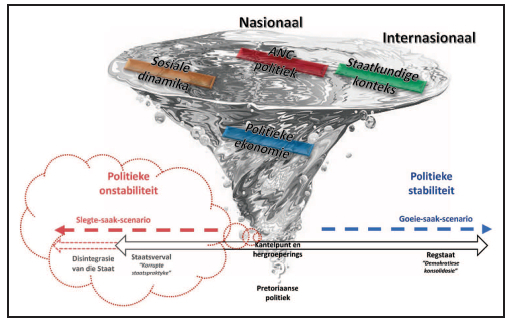
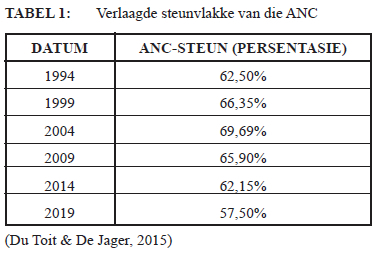
2024 was a year of elections and electoral changes throughout the world. Elections took place in countries like the USA, Britain, Russia, Malaysia, India and many other states, including several African and Southern African States. After 30 years of democracy (and democratic elections) South Africa held its seventh national and provincial elections. With the ANC support declining since 2004 and receiving only 57,9% (down from 69,7% nationally in the 2019 elections and only 47,5% in the local elections measured on a national level), questions were asked about the ANC's ability to achieve an outright majority on a national level as well as concerns about majorities in two of the biggest provinces in the country, namely Gauteng and KwaZulu-Natal (KZN). The 2024 election in South Africa took place against the backdrop of major political, economic and social challenges as well as strong trends of endemic corruption and state capture, implicating senior ANC and government elites. Service delivery was at an all-time low and major challenges regarding the provision of electricity were experienced. Major reconfigurations within the political spectrum also took place with, amongst others, the establishment of the MK under the leadership of former president Jacob Zuma. Electoral surveys, predictions and forecasts differed, with many analysts believing that the ANC would achieve a small but outright majority. However, some electoral surveys and other analysts referred to strong evidence suggesting that the ANC would lose an outright majority and that ANC support could be as low as beneath 40% support on a national level. When the election results were announced at the beginning of June 2024, it sent shock waves throughout the political establishment, with the ANC receiving only 40,13% of the national support and losing their majorities in both Gauteng and KZN, with the Northern Cape a border case. The main aim of this article is to analyse the 2024 election and establish its impact on the political environment and the changes that have taken place since. With an ANC one-party government ruling since 1994 coming to an end, the outcome of the election saw the establishment of a Government of National Unity (GNU) accommodating 10 parties (more than 70% of the national support), representative of the broad political spectrum - but excluding the anti-system MK of Jacob Zuma as well as the radical EFF. By making use of a qualitative approach, a contextual and political environmental analysis will be done by focusing on: • The political, economic and social environment in the build-up to the 2024 national and provincial elections. • Elections in South Africa and the build-up to the 2024 elections. • An analysis of the 2024 elections. • The political outcomes of a changing political environment. • Conclusions and future perspectives. A major conclusion of this research is that South Africa has entered a new phase in its political development, with new rules and challenges, both nationally and internationally. The GNU is currently facing major challenges, and the success or failure of coalition politics is going to be critical for the successful consolidation of democratic practices against the backdrop of fundamental changes nationally, but also on a regional as well as on an international level.
South Africa; 2024 national and provincial elections; democracy; coalition politics; a changing political environment; Government of National Unity
 Thumbnail
 Thumbnail