Measures to address challenges of communal property associations in South Africa: The case of Elandskloof, Western Cape province
Abstract
Communal property associations (CPAs) were introduced in South Africa to provide a governance system that affords communal settlements functional and sustainable land governance. However, CPAs are characterised by numerous land governance challenges. For instance, the lack of institutional capacity within communities results in political decay, consequently jeopardising the sustainability of governance structures. Through the study area of Elandskloof in the Western Cape province, the article analyses the resilience of a communal settlement during its transition to a CPA. The aim is to identify measures to address the problems encountered during the transition process. The study is based on a qualitative design to gather the community members' experiences, perceptions, and behaviours relating to the transition to a CPA. The data-collection approach includes in-depth interviews, observations at a community meeting, and intercept interviews of residents. The data are thematically analysed based on three main themes (psychological, sociological, and philosophical) to show how each aspect influenced the transition to a CPA. The findings indicate that adopting an adaptive or transitional governance approach combined with fit-for-purpose land administration would offer a structured way of managing the social and organisational changes needed to implement effective and sustainable land administration reforms.
communal development; communal property association; fit-for-purpose land governance; sustainable land administration
Abstract
Gemeenskaplike eiendomsverenigings (CPA's) is in Suid-Afrika ingestel om 'n bestuurstelsel te voorsien wat funksionele en volhoubare grondbestuur aan gemeen-skaplike nedersettings bied. CPA's word egter gekenmerk deur talle uitdagings vir grondbestuur. Die gebrek aan institusionele kapasiteit binne gemeenskappe lei by-voorbeeld tot politieke verval, wat gevolglik die volhoubaarheid van bestuurstrukture in gevaar stel. Deur die studiegebied van Elandskloof in die provinsie Wes-Kaap, ontleed die artikel die veerkragtigheid van 'n gemeenskaplike nedersetting tydens sy oorgang na 'n CPA. Die doel is om maatreëls te identifiseer om die probleme wat tydens die oorgangsproses ondervind word, aan te spreek. Die studie is gebaseer op 'n kwalitatiewe ontwerp om die gemeenskapslede se ervarings, persepsies en gedrag met betrekking tot die oorgang na 'n CPA te versamel. Die data-insamelingsbenadering sluit in-diepte onderhoude, waarnemings by 'n gemeenskapsvergadering en onder-skeppingsonderhoude van inwoners in. Die data is tematies ontleed op grond van drie hooftemas (sielkundig, sosiologies en filosofies) om te wys hoe elke aspek die oorgang na 'n CPA beïnvloed. Die bevindinge dui daarop dat die aanvaarding van 'n aanpasbare of oorgangsbestuursbenadering gekom-bineer met geskikte grondadministrasie 'n gestruktureerde manier sal bied om die maatskaplike en organisatoriese veranderinge te bestuur wat nodig is om effektiewe en volhoubare grondadminis-trasiehervormings te implementeer.
1. INTRODUCTION
Land is a vital resource that underpins the economy and well-being of communities (Pinfold & Mokhele, 2023: 1). To achieve land tenure security in communal settlements, official and informal land governance systems must be reconciled, resolving the underlying contradiction between traditional and contemporary, and collective and individual approaches to land governance (Beinart, Delius & Hay, 2017: xi; Hornby et al., 2017: 9).
The Communal Property Association (CPA) Act 28 of 1996 (South Africa, 1996) was implemented to accommodate landholding for farms or state land transferred to communities through the restitution and redistribution processes (Beinart et al., 2017: 24). CPAs typically hold land under the private title, but as a collective group of beneficiaries who form a committee to allocate and manage land (Kingwill, Royston & Cousins, 2017: 62). The establishment of CPAs was a response to political urgency to redistribute land speedily and provide an alternative for communities that do not want the transfer of land to individuals (Ramasodi, 2022: 13). However, there have been numerous problems regarding land allocation and governance within the CPA framework (Vorster, 2019: 5). According to the High-Level Panel on the Assessment of Key Legislation and the Acceleration of Fundamental Change (High-Level Panel, 2017: 153), there are two main ways in which the difficulties faced by CPAs emerge: "the lack of careful establishment of the entities resulting in dysfunctional entities from the beginning; and the lack of support to fledgling entities who have a significant task in ensuring the security of tenure and social development".
The CPA Amendment Bill (South Africa, 2017a) was introduced in the National Assembly to address some of the challenges identified. Among others, the Bill stipulates that a land-use plan and a requirement for consent from the responsible department by the community must be provided, should they intend to encumber, lease or sell their property. In the Bill, it is proposed that the state owns the land rather than the CPAs and that land management be exclusively handled by the CPA. As noted earlier, while establishing rules and a community constitution is a significant step toward the institutional establishment for CPAs, it does not guarantee complete institutional establishment. Effective administrative systems and procedures are also required; without them, the institutions may remain dysfunctional. Effective institutionalisation of CPAs requires several critical elements, including a dedicated budget from the Department of Agriculture, Rural Development and Land Administration. According to the High-Level Panel (2017: 257), registering all land reform holdings as CPAs is essential for institutionalising the communities involved. This registration allows the community to manage land use, land rights, and administration as defined in the CPA's Constitution. It ensures that customary land-management systems are preserved and adapted to meet democratic and constitutional standards. Aligning these practices with the principles of fit-for-purpose (FFP) land administration further supports the development of robust and functional institutions that are integral to achieving effective land governance and community empowerment. FFP land administration focuses on providing flexible and inclusive systems that are tailored to the specific needs and context of a community (Enemark, McLaren & Lemmen, 2021: 2). Registering land-reform holdings as CPAs allows communities to manage their land according to their customary practices while aligning with constitutional principles. This approach ensures that land rights are recognised and protected in a manner that is contextually appropriate, which is a core tenet of FFP land administration. CPAs represent a pivotal mechanism in transitioning informal communal land tenure to a formalised governance structure. This transition is crucial yet fraught with challenges, particularly due to the often-limited institutional capacity within these communities (Hull, 2019: 52). This article examines the resilience of the Elandskloof communal settlement in the Western Cape, South Africa, during its transition to a CPA. It explores the challenges faced by the community as it moves from traditional governance systems to a formalised CPA structure. The article also proposes strategies to address the issues encountered throughout this transitional process.
2.1 Legislative and administrative framework
This section shows the importance of legislative and administrative frameworks in shaping effective land-management systems and ensuring the sustainability of CPAs. The High-Level Panel (2017: 154) recommends that a robust land-administration system be developed in South Africa. The system needs to be linked to a record system in local government and, through the Department of Agriculture, Rural Development and Land Administration's CPA registrar, to the Deeds Office to ensure external oversight of the security of land tenure in CPAs. The proposed Land Records Act (Beinart et al., 2017: 53) aims for a secure form of land rights that is administered internally through a CPA register and externally by the local authority and the Deeds Office. A robust land-administration system such as this will ensure oversight of the security of land tenure in CPAs. The Land Records Act will provide dispute resolution, be affordable, and ensure accessibility to the public (Hull, 2019: 189). The Communal Land Tenure Bill (South Africa, 2017b) provides for transferring off-register land to communities. It proposes a flexible tenure system for communal land and different outcomes for the administration of communal land. The Bill attempts to deal with individual and communal landholding (Beinart et al., 2017: 162). The Bill proves the choice of communalist or traditionalist approaches. Once the process has begun, a land-rights inquirer is appointed, either a government official or any other person. The land-rights enquirer liaises between the community and the Department of Agriculture, Rural Development and Land Administration regarding the nature and extent of land rights and options for securing tenure. Secs. 9 and 17 of the Bill stipulate that a general plan or land-use plan must be developed that indicates the areas to be subdivided. The subdivision will require a land surveyor to survey the plots and register them in the Deeds Office. The cost of the initial survey and registration would be paid by the Department. Sec. 29, 1c, also requires a local register to be kept of land rights and transactions. According to Beinart et al. (2017: 24), this is problematic, as duplicate registers are likely to create discrepancies between the local and national registers. Land administration of registered communal areas must be managed by a CPA, traditional council or any other approved entity. Household forums will provide day-to-day management of land. It is not certain whether the forum is separate from the CPA or the traditional council. A Communal Land Board is also required under secs. 36-39, consisting of members from the provincial House of Traditional Leaders, one from the Department, one from the municipality, and five from the community. The Communal Land Board is an advisory body that assists with the implementation, monitoring, and resolution of disputes. In addition to these three layers of administration, the municipality has significant functions concerning planning and service provision. The department must finance these layers of administration. Beinart et al. (2017: 171) contest that these multiple administrative layers are too complex and unlikely to work. This legislation seems to create major new demands on the Department and introduces too many layers of local administration over land. Kingwill (2018: 12) believes that the current draft of the Communal Land Tenure Bill that it is unlikely that new legislation will fulfil the requirements of enforceable national guidelines and a viable framework of land administration in communal spaces. Tlale (2022: 67) believes that the Communal Land Tenure Bill can partly resolve customary tenure insecurity. It has the potential for the transfer of ownership from the state into the hands of customary communities and provides for the registration of individual land rights.
2.2 Community resilience assessment framework
The framework for assessing the resilience of a communal settlement in transitioning from an informal land governance system to a CPA comprises three elements, namely the psychological, sociological, and philosophical characteristics of a community (Pinfold, 2024: 6). These components offer diverse viewpoints on community resilience that help understand its complexity and the various factors that influence its development.
2.2.1 Psychological aspect
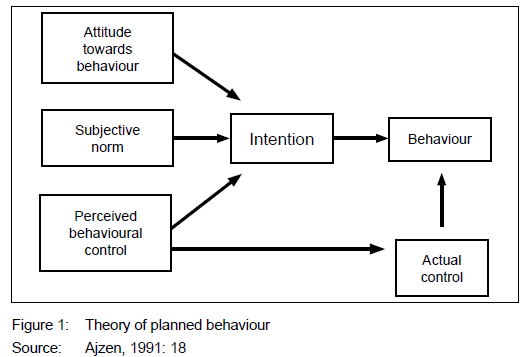
Assessing the psychological aspects of a community provides critical insights into the collective mindset and individual beliefs regarding communal living and land governance. A significant aspect to consider is to what extent residents of a communal settlement intend to continue to support a communal lifestyle. Although communal land governance is rooted in their cultural practices, it is essential to assess the individuals' psychological stance regarding this concept. The problem emerges when younger residents move to cities in search of better opportunities but retain their property rights and membership within the community. This scenario can be analysed by applying the theory of planned behaviour (Ajzen, 1991: 181), which ascertains that, for a person to enact the intended behaviour of living a communal lifestyle, s/he must display a favourable attitude, subjective norm, and perceived behavioural control (see Figure 1). First, residents may develop negative attitudes towards communal living if they perceive it to result in a lack of basic infrastructure or a lower standard of living than in urban areas. Secondly, residents may feel socially under pressure to disapprove of their communal lifestyle in favour of individualism and owning land outright if this is the prevailing subjective norm within the community. Thirdly, residents may perceive that the community cannot effectively govern itself. The residents' perception that the community lacks the necessary governance skills and resources implies a perceived lack of control over the ability to effectively engage in communal governance. This perception can encourage residents to pursue opportunities beyond the community. This perception can coincide with actual behavioural control, where tangible resources, skills or environmental factors hinder the successful governance of the community.
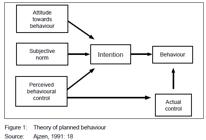
In Figure 1, the theory of planned behaviour suggests that attitude toward the behaviour, subjective norm, and perceived behavioural control influence behavioural intention. The stronger the intention to engage in a given behaviour, the more likely it is to perform that behaviour. Actual behavioural control refers to the extent to which a person has the skills, resources, and other prerequisites needed to perform the behaviour in question.
In the realm of land governance, beliefs encompass a person's convictions regarding the most suitable or just approaches to managing and governing land resources (Roux, 2013: 44). For example, a person might strongly believe that sharing land is important for keeping cultural traditions alive. These beliefs encompass a person's emotions associated with land governance.
Different factors such as cultural background, personal experiences, socialisation, and beliefs shape how people think. These influences greatly affect their preferences, motivations, and decisions about land governance. This way of thinking is important in shaping how people feel, what motivates them, and how they make decisions about land governance. It shows how local culture and outside influences combine to affect how individuals understand and follow rules (Fourie, 1993: 13).
2.2.2 Sociological aspect
Assessing the sociological aspect of a community provides insights into how changes in land governance impact on social relationships, economic prospects, and political stability. The influence of changes on the community's social fabric, institutional roles, and political stability are analysed. It questions institutional change, and the current institution's ability to manage the challenges of the new system. It examines the need to develop or modify institutions to enhance governance. It considers possible contests for control or disagreements between different groups and organisations as they adjust to the new system. A key consideration, in this instance, is how new landownership affects economic prospects for residents who live in the community and empowers residents to engage in various economic activities. New economic prospects for residents are part of modernising society. Political stability must be maintained during the process of modernising society. If political stability is not maintained, it will lead to political decay and chaos (Huntington, 1965: 392). Economic growth requires strong and secure governance that can cope with social mobility arising from new economic opportunities (Fukuyama, 2020). Without effective governance, communities cannot enforce laws, protect property rights, or provide public services, all of which are essential for economic growth.
2.2.3 Philosophical aspect
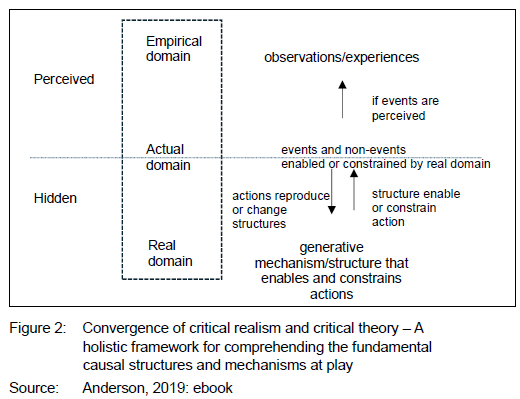
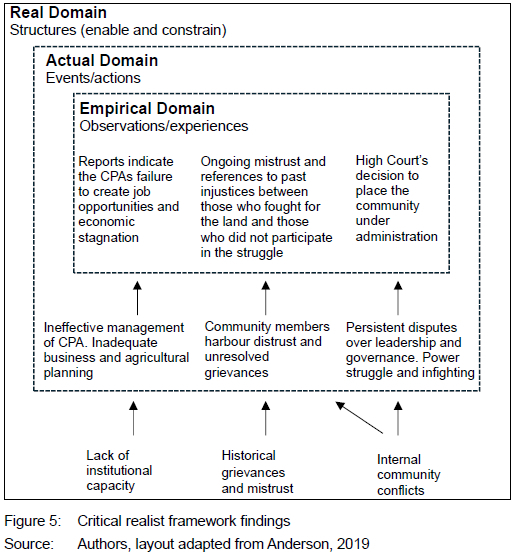
The philosophical aspect of assessing a community's resilience in transitioning to a CPA revolves around exploring the causal structures and emergent mechanisms that guide the community. Causal structures and emergent mechanisms are the underlying structures that lead to noticeable actions, even though they may not be directly observable themselves. Analysing the causal structures and emergent mechanisms that drive the community requires an understanding of the cause-and-effect relationships within the existing system. The critical realism framework proves a comprehensive way to do this (Anderson, 2019). The stratified feature of the critical realist framework contains the real domain, the actual domain, and the empirical domain. The real domain is the deepest strata consisting of the causal structures and emergent mechanisms that produce the actual events in the empirical domain. The causal structures and emergent mechanisms are not observable. The actual domain is above the real domain and is the realm of events and actions that occur whether or not they are observed or experienced. The empirical domain is the surface level that can be measured through empirical research (see Figure 2).
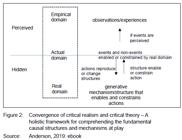
In Figure 2, critical realism posits a stratified ontology consisting of three levels, namely the 'empirical', the 'actual' and the 'real'. The 'empirical' is observable data; the 'actual' may not be observable but regulates the empirical, and the 'real' serves as the foundation for the 'actual' and encompasses the underlying mechanisms that enhance our understanding of the 'actual', even though they are not fully explanatory.
3. STUDY AREA
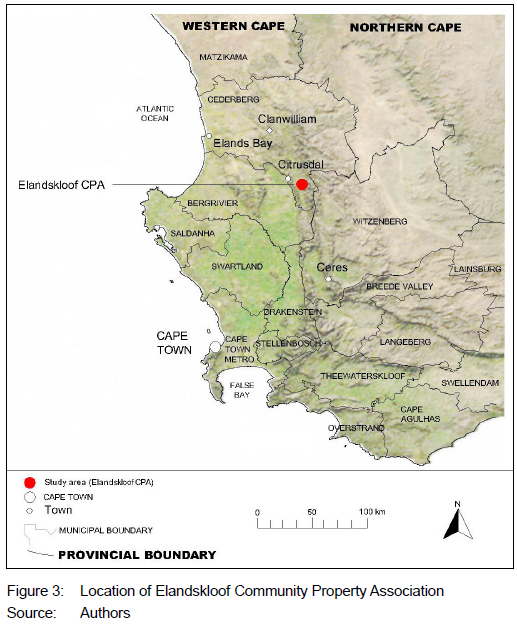
The study focused on Elandskloof, in the Cederberg municipality, Western Cape province (Figure 3), to analyse the resilience of a communal settlement during its transition to a CPA. Registered as a CPA in 1996 (Titus, 2017: 17), Elandskloof was selected for the study because it has experienced political decay, due to the lack of institutional capacity, resulting in the community being put under administration by the government.
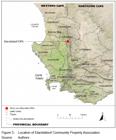
The history of the Elandskloof community is worth noting. The property of Elandskloof was purchased in 1861 and became a Dutch Reformed Church mission. In 1922, the town of Citrusdal was established ten kilometres to the northwest of Elandskloof (Figure 3). The Dutch Reformed Church was established in the town and Citrusdal became the new economic centre. In 1962, the community of Elandskloof was forcibly removed due to apartheid. In 1996, the Land Claims Court Order (LCC 20/96) returned the land to the Elandskloof mission community (Barry, 2011: 139). Elandskloof was the first community in South Africa to successfully have its land restitution case heard by the Land Claims Court and was the flrst community to be registered as a CPA. The land is registered in the name of the Elandskloof CPA in terms of the CPA Act 28/1996 (Barry, 2011: 140). The land-tenure system in the area is based on the system used during the mission years (Barry, 2011: 146). The conflict within the community has become untenable and resulted in the Cape High Court placing Elandskloof CPA under the Director-General's administration in 2005 (Barry, 2011: 139). The failure of the Elandskloof CPA is due to the manner of its establishment. The complexity of managing a CPA and its role in social development was underestimated. This has resulted in a lack of job creation and economic opportunities. Although the community has a comprehensive business plan, the Elandskloof CPA has become dysfunctional and riddled with conflict. The internal strife in the community is partly due to members insisting that management decisions be made democratically, resulting in chaotic general meetings (Titus, 2017: 53). Furthermore, conflicts over membership entitlement and access to power and resources are consistently an issue (Barry, 2011: 140).
4. RESEARCH DESIGN AND METHODS
4.1 Research design
The study was based on a qualitative design to gather the community members' experiences, perceptions, and behaviour, providing insights into the questions of 'how' and 'why' (Tenny, Brannan & Brannan, 2022). There are different qualitative research approaches, including grounded, ethnography, and phenomenology. Although the three are closely linked, the study adopted a phenomenological approach, whose purpose is to analyse a phenomenon from the point of view of those who experienced it, so as to understand the meaning the individuals give to a phenomenon (Teherani et al., 2015: 670), which, in the context of the study, was transition to a CPA. Qualitative research design allows for the use of content and thematic data analysis (Teherani, et al., 2015). In this study, content analysis was used to assess interviewees' sentiments on specific questions. An 'either-or' coding strategy was employed, categorising sentiments as either supportive or critical. After this, using thematic data analysis, responses were categorised based on the community resilience assessment framework in section 2.2 into psychological, sociological, and philosophical themes to show the transition of the Elandskloof community to a CPA.
4.2 Participants and data collection
Three forms of interrelated qualitative data-collection methods were used in the study: in-depth interviews, participant observation, and intercept interviews.
4.2.1
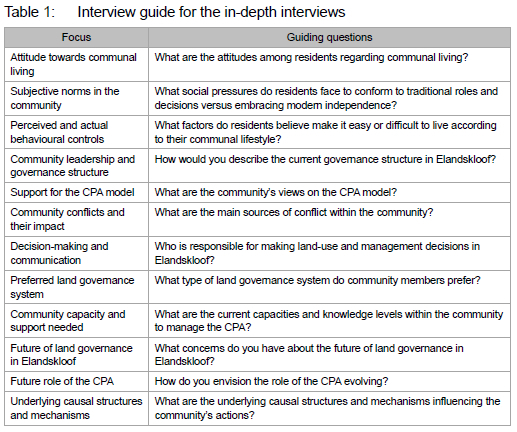
In-depth interviewsIn-depth qualitative interviews were held with two stakeholders engaged with the community. The first respondent was a community leader and former chairperson of the Elandskloof CPA, who had been involved in various capacities, including assisting and mobilising the community to regain their land. The second respondent was a professional adviser, not directly involved with community discussions but assisting with various applications and technical aspects. The two respondents were purposively selected to obtain direct experience and insight into the community's transition process. The questions used to guide the semi-structured interviews were centred on exploring the challenges encountered during the transition to a CPA (Table 1). The semi-structured nature of the interviews allowed flexibility in analysing the overall sentiment regarding the transition to a CPA.
4.2.2
Participant observationTo obtain contextual and first-hand insight into the state of community governance, participant observation was used to analyse the proceedings of the Elandskloof CPA annual general meeting (AGM), held in the Citrusdal community hall on 11 December 2021. The AGM was arranged by the Elandskloof CPA Overseers Committee, and access to the meeting was strictly controlled, allowing only registered Elandskloof community members to attend. Approximately 50 residents attended the meeting. A representative of the Department of Agriculture, Rural Development and Land Administration was in attendance. The meeting lasted approximately four hours and featured a diverse agenda relating to community governance. The researcher attended the AGM to observe and record the proceedings. This observation added depth and authenticity to the research, providing a more accurate and holistic understanding of the community's governance and dynamics. The exercise helped triangulate the in-depth interview responses with first-hand observation of community dynamics and sentiments.
4.2.3 Intercept interviews
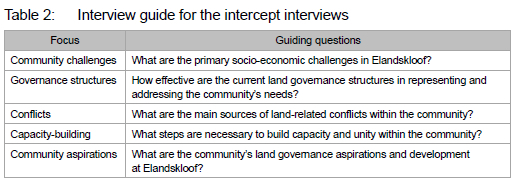
Intercept interviews were conducted with five residents attending the AGM, including members of the Overseers Committee. Discussions with community members allowed the researcher to triangulate further the responses from the interviews with the feelings of the community. An interview guide was designed to gather information that could be intersected with the in-depth interviews. The questions explored the community members' views, perceptions, and aspirations regarding governance, development, and the overall future of Elandskloof (Table 2). Depending on the responses received, probing questions were posed to draw out deeper insights from the participants (Robinson, 2023: 382).
4.3 Data analysis
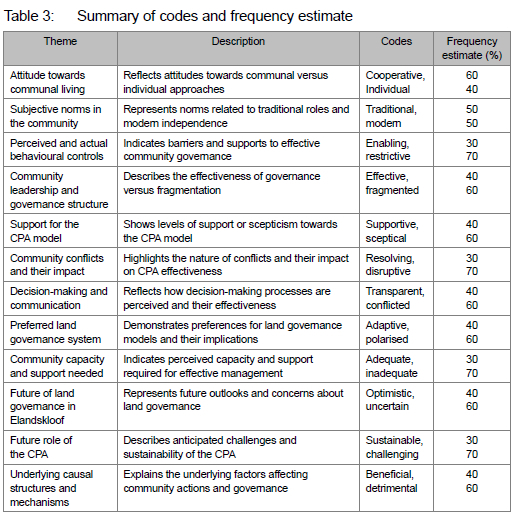
The interviews conducted in the study were recorded and transcribed. A thematic approach was then used to analyse the transcribed data. As noted by Vaismoradi, Turunen and Bondas (2013), the main difference between the qualitative data analysis approaches lies in the quantification of data, wherein frequency analysis is appropriate for content analysis, not thematic analysis. Thematic analysis is concerned with identifying and reporting themes within a dataset (Vaismoradi, Turunen & Bondas, 2013: 400). The respondents' sentiments to specific questions were analysed, by applying an 'either-or' code and a frequency estimate percentage to a response (Table 3).
The sentiment coding shown in Table 3 served as a basis for further analysis. After the first round of sentiment coding ('either-or'), the responses were analysed more deeply to find patterns related to people's attitudes, social structures, and views on governance. During this analysis, patterns and themes were found that matched the psychological, sociological, and philosophical categories. The categorisation of responses into the psychological, sociological, and philosophical themes was informed by the community resilience assessment framework (see section 2.2). Conducting multiple readings of the data enabled the extraction of themes that corresponded to these three categories, employing a thematic analysis approach (Vaismoradi et al., 2013: 400). While all studies inevitably include some degree of error or bias, the goal was to minimise these as much as possible (Mouton, 2008: 113). Although this was a single-coder approach, constant comparison was used to minimise bias and ensure consistency in thematic identification.
5. FINDINGS
5.1 Psychological, sociological and philosophical aspects
5.1.1 Themes identified within the psychological aspect of the assessment framework
Attitude towards communal living: The interviewees revealed that residents have mixed attitudes towards communal living, with some supporting the communal approach, while others preferred individual decision-making and autonomy. The mixed attitudes towards communal living reflected in both 'cooperative' (60%) and 'individual' (40%) codes (see Table 3) suggest a division within the community between those favouring communal approaches and those preferring individual autonomy.
Subjective norms in the community: The interviewees felt that it involves respecting traditional roles and decisions, but there was also a strong sense of independence among certain groups within the community. The combination of 'traditional' (50%) and 'modern' (50%) norms indicate a tension between maintaining traditional roles and embracing modern independence, creating a complex social dynamic.
Perceived and actual behavioural controls: Perceived behavioural controls included attitudes of superiority among certain members, as well as resistance to cooperation and shared learning. Actual behavioural controls involve limitations such as inadequate capacity, ineffective administration, and internal conflicts that hinder decision-making and governance. With restrictive factors accounting for 70% and enabling factors for 30%, the predominance of restrictive elements - particularly resistance to cooperation and administrative inefficiencies -emerge as significant barriers to effective community governance.
5.1.2 Themes identified within the sociological aspect of the assessment framework
Community leadership and governance structure: Interviewees were asked to describe the current governance structure in Elandskloof. One respondent noted that the structure is currently under administration, due to previous failures of the CPA committee. Although elections have been held, persistent issues of mistrust and conflict continue to undermine the governance framework. The respondent characterised the governance structure as being marked by internal divisions and infighting. Despite efforts to implement effective leadership, which were perceived to be successful in roughly 40% of cases, the fragmented nature of the governance system - evident in the remaining 60% of cases - highlights the ongoing challenges related to mistrust and internal conflict.
Support for the CPA model: The interviewees were asked if the Elandskloof community supports the CPA model. It was evident that there were mixed feelings about the CPA model, with some supporting it and others resisting, due to mistrust and past conflicts. Some interviewees acknowledged that there is contention within the community regarding landownership. Some members prefer individual ownership with title deeds, leading to conflicts. The mixed feelings about the CPA model, with both 'supportive' (40%) and 'sceptical' (60%) views, reflect a community divided on the model's effectiveness.
Community conflicts and their impact: When asked about conflicts within the community related to land governance, interviewees identified two primary sources of tension: disagreements between those who fight for the return of the land and those who are not involved in the struggle, as well as generational divisions between older and younger community members. A consensus emerged among the interviewees that the community is marked by infighting, particularly concerning issues of individual versus communal landownership and land allocation. In terms of the impact on the effectiveness of the CPA, interviewees noted that these conflicts significantly undermine the CPA's functionality. They explained that divisions within the community impede cohesive decision-making and hinder progress. While there were some attempts at conflict resolution, with approximately 30% of conflicts addressed constructively, the prevailing nature of the disputes - mainly related to landownership and generational tensions - was described as predominantly disruptive (70%), severely limiting the CPA's ability to operate effectively.
Decision-making and communication: Interviewees were asked who held primary responsibility for land-use and management decisions in Elandskloof. While they identified the CPA committee as the formal decision-making body, they noted significant influence from community members and family dynamics. One participant highlighted the municipal manager's role in facilitating discussions between national departments and the community, often serving as the main point of contact for national government correspondence. When asked about the communication of decisions, interviewees explained that these are typically conveyed through community meetings. However, the reception of these decisions varied, with dissatisfaction from certain groups leading to disruptions. Participants noted that communication often results in misunderstandings and conflicts, complicating efforts to engage in cohesive dialogue and decision-making. Regarding the inclusivity of the decision-making process, interviewees acknowledged its intended inclusivity but cited personal biases and internal conflicts as barriers to effective representation of the entire community. They further pointed out that differing community needs and internal infighting contribute to exclusionary practices and ineffective governance. While some aspects of the process were described as 'transparent' (40%), the predominance of 'conflict' (60%) highlighted the role of personal biases and misunderstandings as major obstacles to effective and inclusive governance.
Preferred land governance system: When asked about the land governance system most suitable for the Elandskloof community, interviewees expressed a preference for a flexible, inclusive model, potentially a hybrid system that integrates both traditional and modern governance practices. Many favoured a unified approach, advocating for collective landownership rather than subdividing land into individual properties. Regarding specific ownership preferences, some interviewees reported resistance to individual freehold ownership, with a clear inclination toward communal or controlled hybrid systems. However, there was also a noticeable divide within the community: some members prefer individual freehold ownership, while others support communal ownership. This mixed response highlights the community's diverse perspectives on the ideal land governance system, with 40% favouring an 'adaptive' hybrid model and 60% reflecting a more 'polarised' stance, either opposing changes to existing tenure rights or supporting communal ownership.
Community capacity and support needed: When asked about the community's capacity to manage the CPA effectively, interviewees expressed concerns that it lacks both the necessary skills and the requisite understanding, emphasising the need for capacity-building and a shift in attitudes to enable effective management. While external organisations and government bodies were identified as potential sources of support, interviewees noted a lack of proactive engagement from the community itself. With 30% of the respondents perceiving the community's capacity as 'adequate' and 70% of the respondents describing it as 'inadequate', the responses highlight a significant gap in both skills and support. This shows the need for substantial capacity-building efforts and more active involvement from the community to ensure effective management of the CPA.
Future of land governance in Elandskloof: Interviewees expressed concern about the future of land governance in Elandskloof, citing ongoing conflicts within the community. They emphasised the need to address residents' attitudes, which encompass collective beliefs, behaviours, and perceptions related to various aspects of communal life. There was a clear recognition of the need for both capacity-building and institutional support to improve governance. While 40% of the interviewees viewed the future of land governance as 'optimistic', the majority (60%) of the interviewees expressed an 'uncertain' outlook, highlighting the persistence of conflicts and underscoring the importance of further capacity-development and institutional support to stabilise the community.
Future role of the CPA: When asked about the future role of the CPA, interviewees expressed the view that significant time and effort will be required for its development. They highlighted the importance of addressing the lack of cohesion and trust, particularly among both current residents and those who no longer live in the area. A common concern was the tendency to move forward without first fully understanding and diagnosing the underlying issues. Without a clear understanding of the problems, effective interventions cannot be implemented, and past mistakes are likely to be repeated. Changes in landownership, interviewees noted, have profound implications for power dynamics, social relations, and community norms. While 30% of the interviewees viewed the CPA's future role as 'sustainable', the majority (70%) of the interviewees described it as 'challenging', emphasising the difficulties in achieving the cohesion and trust necessary for its success.
5.1.3 Themes identified within the philosophical aspect of the assessment framework
Underlying causal structures and mechanisms: Interviewees were asked to identify the underlying causal structures and mechanisms (evident in the real domain) that influence the actions observed in the community (actual domain), and ultimately shape the outcomes seen in the empirical domain. There was a consensus that these underlying factors include historical grievances, mistrust, and differing views on governance. These mechanisms are viewed as shaping the community's actions, contributing to conflicts, administrative failures, and disrupted decision-making. While 40% of the interviewees considered these mechanisms to have a beneficial effect, 60% of the interviewees viewed them as detrimental. The latter group emphasised that historical grievances and mistrust have had a particularly strong negative impact, driving ongoing conflicts and exacerbating administrative challenges.
5.2 Findings of the observation and intercept interviews
This section presents the findings from observations and intercept interviews, structured around the questions outlined in Table 2, and informed by psychological, sociological, and philosophical perspectives.
5.2.1 Psychological perspective
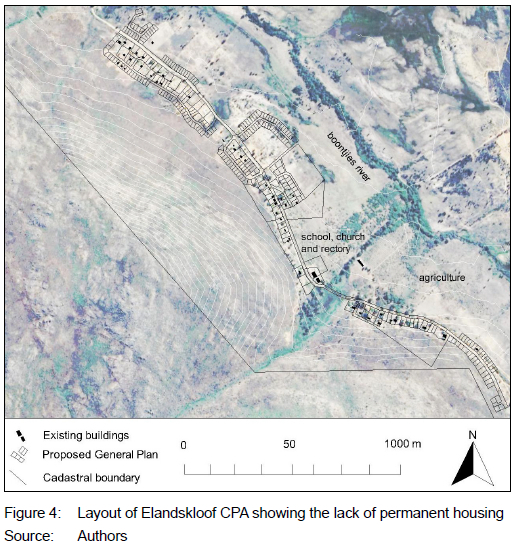
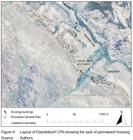
Community challenges: According to the interviewees, the most significant challenge facing the community at Elandskloof is the absence of permanent housing, which has contributed to ongoing conflicts within the community (see Figure 4). Despite this issue, the interviewees expressed cautious optimism regarding the potential realisation of the housing project. Older residents, however, noted a generational divide in the approaches to community development, which they felt required resolution. While the community business plan was being updated annually, the interviewees indicated that there is limited formal employment within Elandskloof. Most of the residents are engaged in seasonal labour on neighbouring farms or depend on government grants for their livelihood.
5.2.2
Sociological perspectiveGovernance structures: The residents reported that annual general meetings (AGMs) have been held annually since 2009. Elandskloof is organised into wards, with each ward committee tasked with making recommendations to the community administrators. However, the interviewees expressed dissatisfaction with this structure, suggesting that the ward committees are ineffective and lack authority. In addition, a committee of emerging farmers was established, but residents noted a key issue: the members of the Elandskloof CPA were dispersed across the country, rather than residing within Elandskloof, which hindered meaningful participation in the AGMs. Despite these challenges, the interviewees emphasised that the community has a clear understanding of its needs, and they believe that a majority vote at the AGM would ensure that these needs are addressed.
5.2.3
Philosophical perspectiveConflicts: The interviewees indicated that conflict within the community largely stems from divisions between individuals who participated in the initial land claim and those who did not. Furthermore, they expressed concerns about the Elandskloof CPA overseers' committee, citing issues of nepotism, a lack of transparency, and a lack of trust. A prevailing sentiment was that being under government administration was not beneficial to the community, with interviewees highlighting the incompetence of officials who, in their view, lack both an understanding of land reform and how to effectively engage with the community.
Capacity-building: The interviewees emphasised the importance of capacity-building among young residents for the long-term success of Elandskloof. They noted that commercial farmers in the surrounding area are willing to offer technical support to the youth; however, the Elandskloof CPA is reportedly hesitant to accept this assistance.
Community aspirations: The community have seen limited infrastructure development, a situation exacerbated by internal conflicts that, according to the interviewees, allow the government to avoid fulfllling its commitment to community involvement. Interviewees suggested that a more unified community will be better positioned to advocate for government action. The general sentiment among participants is a desire to restore productivity to Elandskloof and to work toward revitalising the community.
5.3 Synthesis and discussion
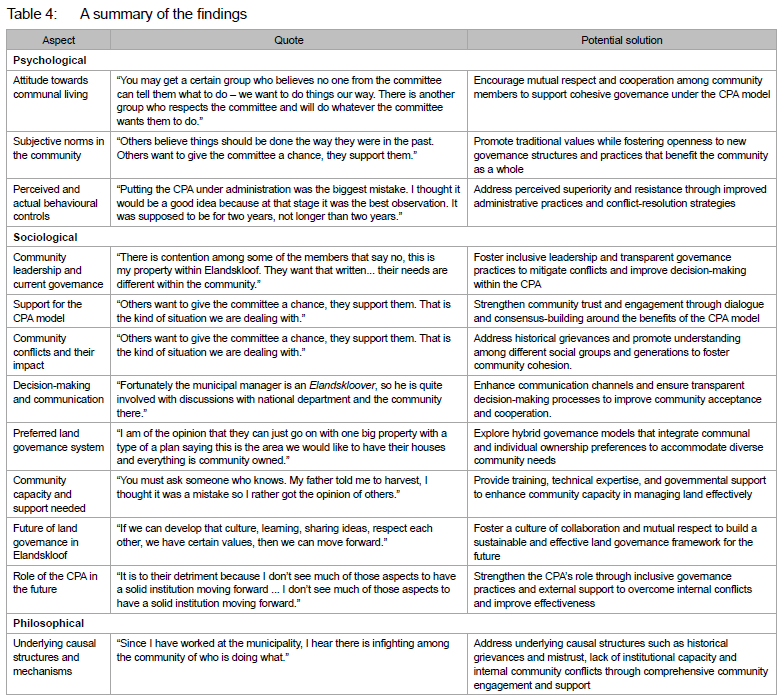
The findings are summarised in Table 4 to highlight the themes identified for each aspect of the assessment framework, a related quote from the qualitative data collected from interviews, and the possible solutions.
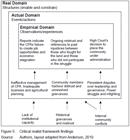
The study's findings revealed that the psychological aspects of the transition require a more positive attitude, perceived social norm, and perceived ability to control communal living under a CPA framework. The sociological aspect indicates a need for capacity-building in governance. A community-structured governance system with external assistance and training is needed to build capacity and improve management skills. The philosophical aspect identified three causal structures and emergent mechanisms in the real domain. A lack of institutional capacity results in the action in the actual domain of inefficient management of the CPA and inadequate business and agricultural planning, which transpires in the empirical domain as a failure to create jobs and perform agricultural planning. Historical grievances and mistrust result in the action in the actual domain of harnessing distrust and unresolved grievances, which transpires in the empirical domain of ongoing mistrust and reference to past injustices between those who fought for the land and those who did not participate in the struggle. Internal community conflicts result in persistent disputes of leadership and governance, power struggles and infighting, which transpire in the empirical domain of the High Court's decision to place the community under administration (see Figure 5).
6. CONCLUSION
This article analysed the transition of the Elandskloof community in the Western Cape to a CPA. The adopted assessment framework comprised three key aspects: the community's psychological, sociological, and philosophical characteristics. The psychological aspect determines the residents' behavioural intention. The theory of planned behaviour was used to explain behavioural intentions crucial in determining if community members will actively participate in and support the transition of their communal land governance from informal arrangements to a formal CPA structure. The sociological aspect investigated the political and institutional capacity of the community. Registration as a CPA aims to modernise communities and bring economic opportunities. Modernisation and economic opportunities require political stability, institutionalisation, and formalisation of governance structures under the CPA framework. The philosophical aspect investigates the underlying causal structures and emergent mechanisms using the stratified feature of the critical realist framework. This uncovers the causal structures and emergent mechanisms in the real domain, leading to actions in the actual domain, which become noticeable in the empirical domain.
The findings of this study suggest that the psychological component of the community resilience assessment framework employed was that the attitude of the residents was in favour of communal living. It was found that the subjective norm in the community reflected an equal divide between traditional roles and embracing modern independence. The findings indicate significant barriers such as internal conflict and ineffective administration. Regarding the sociological aspect of the community resilience assessment framework, it was found that community leadership and governance structure were fragmented. Residents expressed a range of sentiments regarding their support for the CPA. The findings emphasised that conflicts are highly disruptive and undermine the CPA's effectiveness. Regarding the philosophical aspect of the community resilience assessment framework, the lack of institutional capacity, historical grievances and mistrust, as well as internal community conflicts affect how the community functioned. These factors influence the actual behaviour and decisions, which, in turn, lead to the observable outcomes and evidence regarding the community's resilience to adapt and survive.
Given the study's findings, a transition governance strategy can be formulated to oversee the shift from an informal to a more structured and formalised land governance system. This governance approach can effectively manage the social and organisational changes required, using a FFP land administration strategy. Transition management can be effectively integrated with FFP land-administration approaches, by providing a framework for managing the social and organisational changes necessary to implement effective and sustainable land-administration reform.
REFERENCES
2. LITERATURE REVIEW
-
AJZEN, I. 1991. The theory of planned behavior. Organisational Behavior and Human Decision Processes, 50(2), pp. 179-211. https://doi.org/10.1016/0749-5978(91)90020-T
» https://doi.org/10.1016/0749-5978(91)90020-T -
ANDERSON, B.C. 2019. Values, rationality, and power: Developing organisational wisdom. A case study of a Canadian healthcare authority. West Yorkshire: Emerald Publishing. https://doi.org/10.1108/S2059-65612019026
» https://doi.org/10.1108/S2059-65612019026 -
BARRY, M. 2011. Land restitution and communal property associations: The Elandskloof case. Land Use Policy, 28(1), pp. 139-150. https://doi.org/10.1016/j.landusepol.2010.05.007
» https://doi.org/10.1016/j.landusepol.2010.05.007 - BEINART, W., DELIUS, P. & HAY, M. 2017. Rights to land: A guide to tenure upgrading and restitution in South Africa. Aukland Park: Jacana.
-
ENEMARK, S., MCLAREN, R. & LEMMEN, C. 2021. Fit-for-purpose land administration - Providing secure land rights at scale. Land, 10(9), article 972. https://doi.org/10.3390/land10090972
» https://doi.org/10.3390/land10090972 - FOURIE, C.D. 1993. A new approach to the Zulu land tenure system: An historical anthropological explanation of the development of an informal settlement. Unpublished PhD dissertation. Rhodes University, South Africa.
-
FUKUYAMA, F. 2020. What is development? [Online]. Available at: <https://www.youtube.com/watch?v=2a82muAEwBE> [Accessed: 17 June 2024].
» https://www.youtube.com/watch?v=2a82muAEwBE -
HIGH-LEVEL PANEL. 2017. Report of the High-Level Panel on the assessment of key legislation and the acceleration of fundamental change. [Online]. Available at: <https://www.parliament.gov.za/storage/app/media/Pages/2017/october/High_Level_Panel/HLP_Report/HLP_report.pdf> [Accessed: 15 July 2024].
» https://www.parliament.gov.za/storage/app/media/Pages/2017/october/High_Level_Panel/HLP_Report/HLP_report.pdf - HORNBY, D., ROYSTON, L., KINGWILL, R. & COUSINS, B. 2017. Introduction: Tenure practices, concepts and theories in South Africa. In: Hornby, D., Kingwill, R., Royston, L. & Cousins, B. (Eds.). Untitled: Securing land tenure in urban and rural South Africa. Pietermaritzburg: University of KwaZulu-Natal Press, pp. 1-43.
- HULL, S. 2019. A framework for guiding cadastral systems development in customary land rights contexts. Unpublished PhD dissertation. University of Cape Town, South Africa.
-
HUNTINGTON, S.P. 1965. Political development and political decay. World Politics, 17(3), pp. 386-430. https://doi.org/10.2307/2009286
» https://doi.org/10.2307/2009286 -
KINGWILL, R. 2018. Designing durable land administration Institutions. REDI3x3 Working paper 51. [Online]. Available at: https://www.redi3x3.org/sites/default/flles/Kingwill [Accessed: 24 August 2024].
» https://www.redi3x3.org/sites/default/flles/Kingwill - KINGWILL, R., ROYSTON, L. & COUSINS, B. 2017. The policy context: Land tenure laws and policies in postapartheid South Africa. In: Hornby, D., Kingwill, R., Royston, L. & Cousins, B. (Eds.). Untitled: Securing land tenure in urban and rural South Africa. South Africa: University of KwaZulu-Natal Press, pp. 44-93.
- MOUTON, J. 2008. How to succeed in your Master's and Doctoral studies: A South African guide and resource book. Hatfleld, South Africa: Van Schaik Publishers.
-
PINFOLD, N.R.B. 2024. Testing middle ground: Facilitating community transition to sustainable land governance. Unpublished PhD dissertation. Cape Peninsula University of Technology, South Africa. https://doi.org/10.3390/land12061132
» https://doi.org/10.3390/land12061132 -
PINFOLD, N. & MOKHELE, M. 2023. Facilitating community transition to sustainable land governance: A study of a communal settlement in South Africa. Land, 12, article 1132, pp. 1-21. https://doi.org/10.3390/land12061132
» https://doi.org/10.3390/land12061132 - RAMASODI, M. 2022. Community Property Associations Annual Report. Pretoria: Government Printer.
-
ROBINSON, O.C. 2023. Probing in qualitative interviews: Theory and practice. Qualitative Research in Psychology, 20(3), pp. 382-397. https://doi.org/10.1080/14780887.2023.2238625
» https://doi.org/10.1080/14780887.2023.2238625 - ROUX, L.M. Land registration use: Sales in a state-subsidised housing estate in South Africa. Unpublished Ph.D. dissertation, University of Calgary, Canada.
- SOUTH AFRICA. 1996. Communal Property Associations Act 28 of 1996. Pretoria: Government Printer.
- SOUTH AFRICA. 2017a. Communal Property Associations Amendment Bill. Pretoria: Government Printer.
- SOUTH AFRICA. 2017b. Communal Land Tenure Bill 2017. Pretoria: Government Printer.
-
TEHERANI, A., MARTIMIANAKIS, T., STENFORS-HAYES, T., WADHWA, A. & VARPIO, L. 2015. Choosing a qualitative research approach. Journal of Graduate Medical Education, 7(4), pp. 669-70. https://doi.org/10.4300/JGME-D-15-00414.1
» https://doi.org/10.4300/JGME-D-15-00414.1 - TENNY, S., BRANNAN, J.M. & BRANNAN, G.D. 2022. Qualitative study. Treasure Island: StatPearls Publishing.
- TITUS, A. 2017. A public participation perspective of the process of post-settlement support in Elandskloof. Unpublished Master's thesis. University of the Western Cape, South Africa.
- TLALE, M. 2022. South African customary land tenure (in)security: Is there hope under the Communal Law Tenure Bill? Tydskrif vir Hedendaagse Romeins-Hollandse Reg, 85, pp. 50-67.
-
VAISMORADI, M., TURUNEN, H. & BONDAS, T. 2013. Content analysis and thematic analysis: Implications for conducting a qualitative descriptive study. Nursing and Health Sciences, 15, pp. 398-405. https://doi.org/10.1111/nhs.12048
» https://doi.org/10.1111/nhs.12048 -
VORSTER, N. 2019. Land and identity in South Africa: An immanent moral critique of dominant discourses in the debate on expropriation without compensation. HTS Teologiese Studies/Theological Studies, 75(4), article 5290. https://doi.org/10.4102/hts.v75i4.5290
» https://doi.org/10.4102/hts.v75i4.5290
Peer reviewed and revised: October 2024
Published: December 2024