Planning in a post-apartheid city and the complexities of participatory planning and governance: A case study of Windhoek, Namibia
Abstract
Cities in the Global South continue to face complex planning and governance challenges, often exacerbated by outdated planning instruments that fail to respond to rapid urbanisation. This disconnect has led to growing dissatisfaction among urban residents in low-income areas, who increasingly demand inclusion in neighbourhood-level planning. At independence in 1990, Windhoek (Namibia) inherited a planning system designed primarily for the White minority elite, entrenching racial and economic divisions in urban development. Existing literature highlights that the continued, uncritical use of this legacy planning system has contributed to the exclusion of a vast majority of residents from formal planning processes. This article investigates the extent to which Windhoek's residents are included in the planning of their neighbourhoods and explores how participatory approaches could address historical exclusion. A case study design was employed, using mixed methods: a questionnaire-based survey of 150 residents across three neighbourhoods (representing low-, middle-, and ultra-low-income areas), and semi-structured interviews with 20 urban planning professionals. Findings reveal a widespread perception among residents that current participatory mechanisms are insufficient, with many feeling inadequately consulted. Urban planners similarly acknowledged the need to build residents' capacity to meaningfully contribute to planning processes. Based on these insights, the article proposes a participatory planning framework that seeks to bridge the divide between communities and planning authorities. This framework advocates for the integration of residents' perspectives with the technical expertise of planners, aiming to support inclusive and responsive urban planning practices in Windhoek and similar urban contexts.
Participation; planning; post-apartheid city; urban governance; residents' inclusion
Abstract
Stede in die Globale Suide staar steeds ingewikkelde beplannings- en bestuur-suitdagings in die gesig, vererger deur verouderde beplanningsinstrumente wat nie tred hou met vinnige verstedeliking nie. Hierdie ontoereikende beplannings-benaderings het gelei tot groeiende ontevredenheid onder inwoners van lae-inkomstegebiede wat groter betrokkenheid by buurtbeplanning eis. Met onafhanklikheid in 1990 het Windhoek (Namibië) 'n stedelike beplanningstelsel geërf wat oorspronklik ontwerp is om die belange van die Blanke minderheid te dien, wat rasse- en ekonomiese onge-lykhede in ruimtelike ontwikkeling versterk het. Bestaande literatuur beklemtoon dat die voortgesette gebruik van hierdie koloniale nalatenskapbeplanning tot die uitsluiting van breë gemeenskappe by formele beplanningsprosesse gelei het. Hierdie studie ondersoek die mate van gemeenskapsdeelname in Windhoek se beplanningsprosesse en verken hoe deelnemende beplanning histo-riese uitsluiting kan aanspreek. Deur 'n gevallestudiebenadering en gemengde metodes is data versamel via vrae-lyste aan 150 inwoners uit drie sosio-ekonomies uiteenlopende woonbuurte, asook onderhoude met 20 stedelike beplanningskundiges. Bevindinge toon dat inwoners dikwels voel dat hulle onvoldoende geraadpleeg word, ter-wyl beplanners die behoefte erken aan groter kapasiteitsbou onder inwoners vir betekenisvolle deelname. Die artikel stel 'n deelnemende beplanningsraamwerk voor wat gemeenskapperspektiewe met die tegniese kundigheid van beplan-ners integreer, met die doel om meer inklusiewe en responsiewe stedelike beplanning in Windhoek en soortgelyke post-koloniale stede te bevorder.
Abstract
Litoropo tsa Global South li ntse li tobana le liphephetso tse rarahaneng tsa meralo le puso, haholo hobane li sebelisa mekhoa ea khale ea moralo e sa khoneng ho mamella kholo e potlakileng ea litoropo. Sena se bakile ho se khotsofalle ha baahi ba libakeng tse nang le meputso e tlase, ba batlang ho kenyeletsoa mererong ea moralo ea boahelani. Windhoek (Namibia) e ile ea rua tsamaiso ea moralo ka 1990 e neng e etselitsoe batho ba seng bakae ba basoeu, e ileng ea eketsa likarohano tsa morabe le moruo. Boithuto bo bong bo bontsa hore tsebeliso e sa fetotsoeng ea tsamaiso ena ea lefa e lebisitse ho qheleloeng ha baahi mererong ea semmuso ea moralo.Boithuto bona bo hlahloba hore na baahi ba Windhoek ba kenella hakae moralong oa libaka tsa bona, le kamoo mekhoa ea kopanelo e ka sebelisoang ho rarolla histori ea ho qheleloa ka thoko. Ho sebelisitsoe mokhoa oa mekgahlelo e kopaneng: phuputso ho baahi ba 150 libakeng tse tharo (mefuta e fapaneng ea lekeno), le lipuisano le litsebi tse 20 tsa moralo. Liphetho li bontsa hore baahi ha ba ikutloe ba kenelletse ka botlalo, athe baetsi ba meralo ba hlokomela hore baahi ba hloka tsebo ho kenya letsoho ka nepo.Sengoloa se fana ka moralo oa kopanelo oa moralo o kopanyang maikutlo a baahi le tsebo ea litsebi ho matlafatsa moralo o kenyeletsang Windhoek le litoropo tse ling tsa kamora bokolone.
1. INTRODUCTION
In many post-apartheid cities, urban planners are faced with the complex challenges of spatial transformation. These complexities call for concerted efforts towards more participatory planning and governance approaches. Nel (2019) concurs that planning has become a complex task for the vast majority of urban planners as they use the modernist approach in addressing contemporary issues that do not always provide the required solutions. Meanwhile, the United Nations Human Settlements Programme (UN Habitat) report (2022) has affirmed that the current approach to urban planning fails in many instances to support cities that are sustainable in responding to the needs of residents. Thus, scholars such as Gumbo, Pretorius & Ingwani (2022) have amplified that it is critical for urban environments to support communities through economic inclusion, as this ultimately improves their lives. The reason for this is that, in most of these cities, the planning system has been adopted from their colonial masters and was based on the control and regulation of development within cities. Therefore, these planning policies have remained rigid and fragmented, presenting complex challenges, especially in reference to the participation of urban residents (Charman et al., 2017: 15; Denoon-Stevens et al., 2022).
In Windhoek, Namibia, extant literature indicates that the current urban planning process is based on (past) segregation policies and is viewed as the main factor that has led to the exclusion of residents in the planning of the city (Chitekwe-Biti, 2018; Kohima et al., 2023). The need for urban residents' participation in planning is vital, as in recent years, Windhoek has witnessed spontaneous urban growth especially within the low-income areas of the city. Thus, the adoption of these post-apartheid planning policies continues to perpetuate the exclusion of residents, consequently pushing them towards the urban periphery (Watson, 2009; Horn et al., 2018). One of the key aspects that has been identified within the literature is that the master planning approach (zonation and densities), which is mostly used in these cities, has crucial limitations and does not adequately respond to the contemporary needs of residents in low-income areas. Thus, most of the post-apartheid cities continue to struggle with their Western-adopted planning approaches that do not reflect their planning realities. In the case of the City of Windhoek (CoW), the planning instruments such as town planning scheme and legislations are rigid, fragmented, and have not been active in ensuring adequate participation of residents within the planning process. Therefore, residents are only included so that the planners can meet the legal requirements of consultation as envisaged in planning legislations.
Hence, this article examines the participatory planning process of the CoW and the involvement of residents in the planning of their neigbourhoods. It ultimately proposes a framework that can be adopted to enhance the participation of residents in the planning process within their neighbourhoods.
To analyse residents' participation in the planning process, it is important to introduce key concepts such as urban planning, post-apartheid cities, participatory planning, and urban governance that underpin this study. The primary purpose is to provide a better understanding of the complexities of the urban planning system and the involvement of residents in the planning and governance of their cities. Thus, the literature attempts to link this study to other research on similar issues.
2.1 Urban planning and the postapartheid city
Many scholars trace the origins of contemporary urban planning to the 19th century, with notable developments such as Ebenezer Howard's 1898 concept of the Garden City, which sought to address the challenges posed by rapidly industrialising urban centres. Hall and Ward (2014) as well as Vernet and Coste (2017: 183) emphasise that the defining features of Howard's Garden City model were its emphasis on controlling urban growth, particularly through the regulation of population density and the establishment of green belts separating cities from surrounding rural areas. These elements highlight the longstanding role of urban planning in regulating the use and distribution of space through mechanisms such as zoning and density control, practices that have ancient roots.
However, much of the scholarly focus on urban planning has been centred on the Global North, where it has been examined extensively through research and case studies. Vernet and Coste (2017) argue that urban planning in these regions has been integral to the processes of placemaking and the optimal allocation of land for various uses. In contrast, urban planning in the Global South is perceived more ambivalently by local residents, whose responses often reflect a tension between the benefits and drawbacks of these planning practices. Watson (2009: 153) contends that urban planning has the potential to yield positive outcomes when effectively implemented. However, many cities in the Global South continue to grapple with outdated planning systems that perpetuate exclusionary practices, particularly along racial or economic lines. These systems have contributed to the development of urban environments that are both fragmented and inflexible, designed to restrict mobility and isolate certain populations (Watson, 2009).
Such urban planning practices have often failed to address the pressing needs of residents, as they have been overtaken by the realities of urbanisation and demographic change, rendering traditional planning tools such as zoning schemes and spatial frameworks inadequate. Furthermore, these instruments have generally excluded residents from the planning process, with urban development being shaped predominantly by top-down approaches that do not allow for meaningful participation. In recent years, however, there has been a shift towards more inclusive planning strategies such as co-production, which aim to involve local communities in the planning and development of their cities and neighbourhoods, ensuring greater resident participation and supporting a more equitable approach to urban governance (Tsoriyo, 2024: 12).
While much of the existing discourse on urban planning focuses on the Global North, research on the Global South is increasingly gaining traction. In sub-Saharan Africa, one bourgeoning area of inquiry is the post-apartheid city. The postapartheid city is a prominent feature in Southern African nations such as South Africa and Namibia. Apartheidera urban planning has been widely acknowledged in planning literature as a system that effectively institutionalised the separation of urban spaces along racial lines. Kamuzhanje (2021: 98) notes that, in some African countries, apartheid's reach was so pervasive that specific areas within cities were completely inaccessible to Black populations, either as residential or communal spaces. Further, existing literature underlines that the core principle of apartheid urban planning centred on the control and regulation of Black populations within predominantly White cities (Lemon, 2021).
However, in the contemporary post-apartheid urban context, this racialised approach to spatial planning has largely been replaced by one that prioritises economic stratification rather than racial segregation. Despite these shifts, the enduring legacy of apartheid-era policies continues to exert a profound influence on spatial fragmentation in post-apartheid cities of the Global South. Scholars such as Totaforti (2020) highlight a key deficiency of apartheid-era urban planning: its failure to adopt progressive approaches like mixed land-use and densification, both of which are now viewed as essential elements for supporting sustainable, vibrant urban spaces where residents can live, work, and engage socially.
Todes and Robinson (2020) argue that, in recent years, many postapartheid cities have begun to implement spatial planning processes that aim to counteract the effects of urban sprawl and exclusionary planning practices. These efforts are directed toward creating more dense, inclusive urban environments. Such a transformation is critical to converting the rigid, fragmented spaces of post-apartheid cities into dynamic, integrated urban areas that promote social and economic inclusivity (Todes & Robinson, 2020: 298).
2.2 Participatory planning and urban governance
The spatial planning paradigm of the 1960s was predominantly expert led, premised on the belief that planners possessed the requisite expertise to transform space in the best interests of communities. This technocratic approach, however, has gradually given way to participatory planning models. Participatory planning, as defined by Sulemana and Ngah (2012: 25), involves the intentional engagement of citizens in the planning and development of their localities. Eriksson, Fredriksson & Syssner (2022: 996) highlight a significant shift in recent decades from expert-driven frameworks to those emphasising citizen involvement. Arnstein's (2019: 24) seminal contribution critically interrogates the authenticity of citizen participation through her widely cited 'ladder of citizen participation', challenging the legitimacy of tokenistic engagement practices where, for example, citizens are invited to meetings or consultations, but their inputs are disregarded or have no real impact on decision-making.
The rise of participatory planning is frequently interpreted as a corrective measure to address the deficiencies of governance structures and to democratise institutional planning processes (Zhou et al., 2024: 3). Critics of the expert-led approach emphasise its neglect of community input, a gap participatory planning aims to bridge (Swapan, 2016: 197). Tsoriyo (2024) reinforces this perspective, emphasising that community-driven development prioritises a bottom-up approach, wherein local communities articulate their needs and project objectives. Literature consistently shows that participatory planning emerges from the need to involve communities/ citizens actively in shaping their urban and neighbourhood environments, thereby supporting awareness and empowerment for local citizens (Eriksson et al., 2022).
Globally, the legitimacy of participatory planning is well-established. The United Nations Sustainable Development Goals (UN SDGs) highlights the centrality of citizen inclusion, particularly within Goal 11, which advocates for inclusive, safe, resilient, and sustainable cities (Vaidya & Chatterji, 2020). Inclusive urban planning ensures that human settlements reflect and address the diverse needs of their residents. Delgado (2021) and Miltin (2021) further affirm that involving urban residents in neighbourhood planning provides a sense of belonging and allows them to make their own unique contributions to the process. This engagement not only enhances community ownership, but also prompts the adaptation of existing planning instruments to better align with local values and needs.
The discourse on participatory planning is inherently linked with urban governance. Governance has been conceptualised in various ways, each emphasising distinct dimensions. Biljohn and Lues (2020: 232) define governance as the overarching framework through which authority, whether administrative or otherwise, is exercised. Huq (2014: 424) expands this understanding, characterising governance as a set of "complex processes and institutions through which citizens and stakeholders express their concerns". Central to these definitions is the decision-making process, which is particularly critical within urban contexts, as it lays the foundation for effective planning and development. In recent decades, urban governance has become a focal point of academic and policy discussions, particularly in relation to service delivery challenges. Municipal councils and local governments have commissioned numerous studies aimed at addressing these challenges (Biljohn & Lues, 2020; Ishii, 2017). Biljohn and Lues (2020: 232) highlight that persistent shortcomings in local government service delivery have sparked unrest in certain communities, emphasising the need for more responsive and effective urban governance frameworks. Such frameworks should integrate robust processes and institutions capable of addressing community needs promptly and efficiently.
Urban governance debates are intrinsically linked to urban planning discourses, particularly as they pertain to the operational challenges faced by local governments, thus creating the need for urban planners and practitioners to carefully understand them. Community pressure, rather than being viewed as a disruption, should serve as a catalyst for reforming urban governance structures towards more localised and participatory models. Nel (2019: 36) supports this perspective, advocating for the empowerment of vulnerable community segments in addressing key socio-economic issues.
The literature further reveals persistent critiques of the top-down approach to urban planning, particularly in post-apartheid contexts. This dominant planning paradigm has been challenged for its inadequacies in supporting participatory engagement, especially in low-income and informal settlements (Mafame & Horn, 2025; Tsoriyo, 2024). Community-driven initiatives have emerged in response, highlighting the disconnect between centralised planning processes and the lived realities of residents. Maharaj (2023) concurs, emphasising the need for post-apartheid urban planning to adopt more inclusive and participatory methodologies.
An analysis of the literature also reveals vital links of the study to other concepts such as co-production, participatory governance, and spatial justice. Saime and Watson (2022: 269) assert that co-production has emerged as a dominant approach to place-making and delivery of municipal services in cities of the Global South. This prominence emanates from the effectiveness and inclusion of processes in which residents are involved (Saime & Watson, 2022). In terms of participatory governance, Bussu et al. (2022: 133) posits that the concept has provided local governments with an opportunity to strengthen the democratic process which defines the involvement of citizens or residents in the decision-making process. On a broader analytical perspective, it is evident that all these concepts (co-production and participatory governance) are directly related to spatial justice. Some scholars note that spatial justice is concerned with the deliberate efforts of intential allocation of resources to geographical areas that have been previously neglected in terms of development and planning (Weck, Madanipour & Schmitt, 2022). Thus, most of the existing scholarship on spatial justice starts with the involvement of citizens in the decision-making process in view of the distribution of power and resource allocation in democratic local governments. From the perspective of post-apartheid cities, these concepts are key for the redress of historical inequalities.
3. THE STUDY AREA
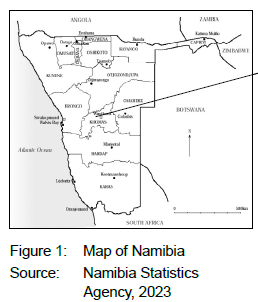
This research was conducted in Windhoek, the capital city of Namibia, situated in the south-western region of Africa. Namibia shares borders with Angola to the north, Botswana to the east, and South Africa to the south (see Figure 1). Established in 1890 by the Orlam/Afrikaner group, Windhoek has evolved into a dynamic urban centre with an estimated population of approximately 400,000 residents, making it the most populous city in the country (CoW, 2024). As the political and administrative hub, Windhoek accommodates Namibia's executive, legislative, and judicial branches of government (CoW, 2024).
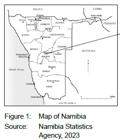
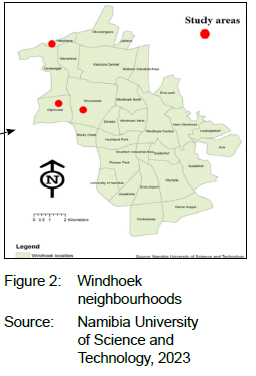
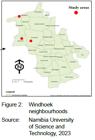
Windhoek is classified as a medium-sized city with socio-spatial segregation: high-income neighbourhoods are predominantly located to the east of the Central Business District (CBD), whereas low- and ultra-low-income areas are concentrated towards the west (CoW, 2020). Figure 1 illustrates Namibia's 14 regions, while Figure 2 highlights the three study neighbourhoods within Windhoek, selected for their representative economic and socio-spatial characteristics: Khomasdal (middle-income), Otjomuise (low-income), and Havana (ultra-low-income informal settlement). Affluent suburbs were deliberately excluded from the study, based on the premise that their residents, due to their higher socio-economic standing, are generally better positioned to engage with municipal authorities regarding local concerns.
4. METHODOLOGY
4.1 Research design
For this study, a mixed-methods approach for the data collection was used. A mixed method is defined as a process that involves data collection, analysis and interpretation using both quantitative and qualitative approaches (Leedy & Ormrod, 2019). The quantitative analysis used the questionnaire as a research instrument for collection of data from the residents (respondents) in the three neighbourhoods and descriptive statistics was used for reporting the results. For the qualitative approach, a semi-structured interview was used to gain insights from 20 planners/officials. The study also employed thematic analysis to group survey responses in two central themes: participation barriers in the planning process and participatory improvement in the planning process (Cresswell & Poth, 2018: 45). The integration of both data types aimed to ensure that key perspectives from residents (questionnaire respondents) and professional stakeholders (interviewees) were comprehensively captured and synthesised. This mixed-methods approach strengthened the validity of the findings and provided a more nuanced foundation through the triangulation of data for the development of the participatory planning framework (Kothari & Garg, 2019).
4.2 Population and sample
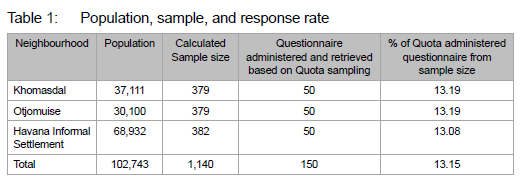
This study focused on three neighbourhoods: Khomasdal (37,111 residents), Otjomuise (30,100 residents), and Havana Informal Settlement (68,932 residents) (NSA, 2023). Due to the impracticality of surveying their entire populations, a non-random probability sampling approach was used, specifically structured quota sampling and purposive sampling. Structured quota sampling ensured representation from each neighbourhood, capturing the distinct characteristics and views of residents (Mulisa, 2022: 81). Purposive sampling selected 50 residents from each neighbourhood, totalling 150 respondents, with the criterion that participants had lived in their neighbourhoods for at least one year. This was crucial for ensuring informed responses. As Kothari and Garg (2019: 55) note, purposive sampling allows researchers to select participants who can provide valuable information, and Cresswell and Poth (2018: 157) emphasise its importance in selecting knowledgeable participants.
Table 1 shows the total population of each neighbourhood, the calculated sample size based on Krejcie and Morgan's (1970) guidelines, and the number of questionnaires administered through quota sampling. Despite the total population of 102,743, the sample size of 150 respondents is statistically valid for reliable findings, as recommended by Krejcie and Morgan (1970). The quota sampling approach ensured that the sample was representative of the population, allowing for generalisable results from a smaller yet methodologically sound sample size.
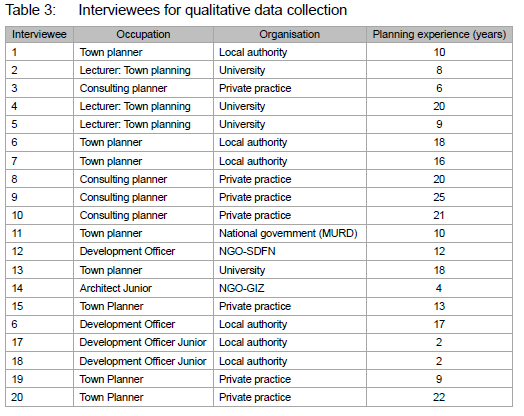
For the qualitative data, the study interviewed 20 urban planners (see Table 3), drawn from institutions that actively engage with residents in the planning and development of their neighbourhoods. This included six urban planners/community development officers from CoW, seven from private practice and three academics from the Namibia University of Science and Technology (NUST). There were also three respondents from non-governmental organisations such as GIZ and the Shack Dwellers Federation of Namibia. Moreover, one urban planner who works in the Ministry of Urban and Rural Development and one from University of Namibia (UNAM) were also interviewed. All the planners/officials, who were interviewed, had adequate planning experience either in the private or public sectors, or in academia with an average urban planning experience of 11 years in the sector.
4.3 Data collection
For quantitative data collection, questionnaires were distributed to 150 respondents in the neighbourhoods of Khomasdal, Otjomuise, and Havana Informal Settlement from the 18 April to 19 July 2024. The questionnaire was divided into five sections, namely: the demographic data of participants; approaches to neighbourhood planning; the extent of urban residents' inclusion in neighbourhood planning; the option for residents' inclusion in planning, and suggestions on the key elements of the planning framework. The questionnaire had both closed-ended and open-ended questions in all sections. Although scholars such as Kothari and Garg (2019: 99) believe it to be difficult to analyse open-ended questions, for this study, open-ended questions were necessary as they were used to further probe respondents and provide a better understanding of the matters of interest in the research.
For the qualitative data collection, a semi-structured interview was conducted with 20 planners/officials. An interview guide was developed and used to aid the collection of data from the planners. The interview guide had key questions such as: How would you rate the effectiveness of the participatory planning process undertaken by the CoW? What are the methods of public participation that are mostly used in participatory planning? How satisfied are you with involvement of residents in the planning process within their neigbourhoods? What are some of the structures used by CoW to engage with residents at neigbourhood level? These questions were critical as they aimed to explore the engagement process between urban planners and residents.
4.4 Data analysis and interpretation
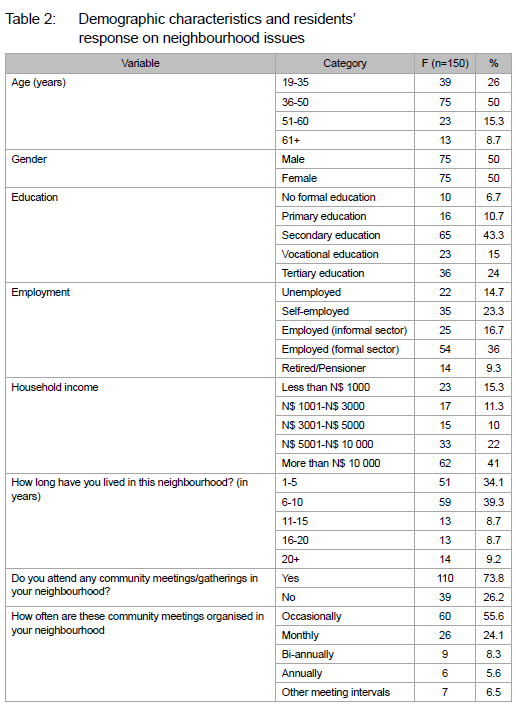
For quantitative data analysis, the completed questionnaires were analysed, using the Statistical Package for Social Sciences (SPSS) software, which was preceded by data cleaning and sorting processes (Field, 2018). This was followed by a frequency analysis on demographic variables such as age, gender, education and employment of respondents to produce descriptive statistics (i.e. frequencies [F] and percentages [%]) on the demographic characteristics and residents' perceptions on neighbourhood issues.
For the qualitative data analysis process, the interviews were recorded, then transcribed and analysed using the thematic analysis approach based on frequency of occurrence (Cresswell & Poth, 2018: 45). Each interview lasted for approximately 30 minutes with the planner/official. The recording and transcription of the interviews was necessary to provide a deeper and comprehensive quality analysis on key matters such as: the planners' views on participation of communities in the planning process; barriers that hinder effective participation; and optimal approaches for better inclusion in the planning process. Some of the themes that were frequent and emerged from the analysis were the minimum involvement of residents, lack of knowledge on planning and technical 'planning' language as a barrier within the process. These themes pointed to the disjuncture between planning and the community. Moreover, for the qualitative data, reliability and validity were ensured through the rich and direct/verbatim quotes that were captured from planners and residents. These were presented in tables, thus providing clear, reliable, and grounded results for the study. This approach has been supported by existing scholarly work. For instance, in their analysis on reliability and validity of qualitative data, Noble and Smith (2024: 2) have listed the inclusion of rich and direct quotes from participants as one of the strategies for provide reliable and valid results in qualitative data.
5. RESULTS
5.1 Demographic characteristics of the residents/participants
Table 2 presents the socio-demographic characteristics of 150 residents across the three neighbourhoods: Khomasdal, Otjomuise and Havana Informal Settlement who completed the study's questionnaire. The age distribution shows that 50% (75) of participants were in the 36-50 age group, followed by 26% (39) in the 19-35 age group. The least represented group was those aged 61 and above, accounting for 8.7% of participants. Gender representation was balanced, with 50% of participants identifying as male and 50% as female. Regarding education, 43% of participants had completed secondary education, while 24% had attained tertiary education. Employment status revealed that 36% of participants were employed in the formal sector, and 41% reported earning more than N$ 10,000. In terms of residency duration, 39.3% of participants had lived in their neighbourhoods for 6-10 years, followed by 34.1% who had resided there for 1-5 years. A small proportion (9.2%) had lived in their neighbourhoods for over 20 years. The vast majority (73.8%) indicated that they attend community meetings/ gatherings in their neighbourhoods of which most meetings are organised either on an ad-hoc basis (55.6%) or monthly (24.1%).
These results highlight the study's robustness, as it successfully gathered data from a diverse group of participants, primarily adults who had lived in their respective neighbourhoods for a significant period. This demographic diversity is essential for ensuring the validity and reliability of the study's findings.
Table 3 presents the profile of 20 planners/officials interviewed as part of the study who were requested to provide views on their satisfaction with the participation of residents in the planning processes. This includes those that work in the local authority (CoW), private practice and academia.
5.2 Consultation or participatory process of CoW
5.2.1 Residents' views and level of satisfaction with the CoW consultation process
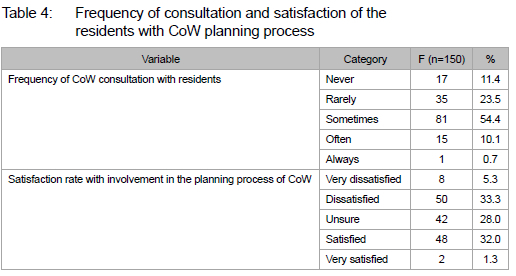
Table 4 shows the results from the study to understand the frequency of the various consultation/engagement initiatives that the CoW employs and satisfaction of the residents with CoW planning process when consulting with the community. Roughly 11.4% (17) of the participants indicated that they were 'never' consulted by the city during the planning process within their neighbourhoods. Meanwhile, 23.5% (35) of the participants reported that they are 'rarely' consulted during the planning process of the CoW. A bigger segment of the residents, i.e. 54.4% (81), pointed out that they are 'sometimes/somehow' consulted by the city during the planning process. Less than 10% (15) of the participants indicated that they are often/always consulted during the planning process within their neighbourhoods.
The study attempted to understand the satisfaction rate of residents with the consultative/participatory planning process in their neighbourhoods. Table 4 shows that 5.3% (8) of the residents are very dissatisfled with the level of their involvement in the participatory planning process within their neighbourhoods. A further 33.3% (50) of the residents noted that they are dissatisfied with their involvement in the planning process. Approximately 28% (42) of the residents indicated that they are unsure/undecided on the level of their involvement in the planning process, while 32% (48) of the residents indicated that they are satisfied with their involvement in the planning process.
It is evident from this empirical data that there is a need for the CoW to revisit its consultation and public participation process. This would serve to improve the process in relation to the depth and breadth of its engagement, as it could ensure greater participation from the community. Thus, to further examine the participation of residents in the planning and development process, the next section analyses the responses that were received from urban planners concerning the same issues raised by residents.
5.2.2 Planners' views on the participation of residents in Windhoek's planning process
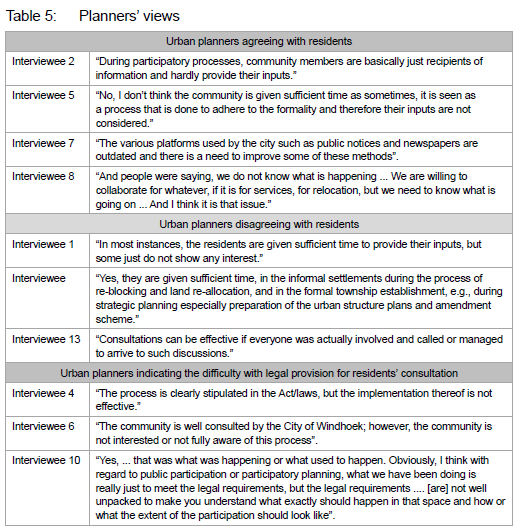
The responses recorded in Table 5 show diversity from the interviewees ranging from those who agreed with the residents; those who disagreed with residents' views, and those who argued that the challenge could be in the consultation/participation process as outlined by the various pieces of legislation such as the Urban and Regional Planning Act. Over a third of the urban planners/ officials agreed with residents that the consultation or participatory process of CoW is limited in its engagement and thus can only be viewed as procedural. However, a segment of urban planners disagreed with the views of the residents, and rather indicated that the challenge was with the communities, as at times they do not show up at these consultative meetings/gatherings. More interestingly, some urban planners argued that the challenge could be more with the consultative/ participatory planning process based on its legal/formal requirements, as prescribed in the Urban and Regional Planning Act of 2018.
The preceding sections presented the perspectives of both residents and planners on participatory planning within the CoW. An analysis of planners' views reveals signs of tokenism, limited awareness, and various barriers to meaningful participation. Arnstein (2019: 24) defines tokenism as a process where citizens are given the opportunity to voice their opinions, but without any guarantee that their input will influence decision-making. This concept aligns with the sentiments expressed by both planners and residents, as shown in Table 5. Several barriers were identified that hinder residents' participation, including a lack of awareness, limited understanding of planning processes, and poor scheduling of engagement activities. For example, some residents are unable to attend, due to work obligations (Mamokhere & Meyer, 2022: 19). The study found that planners often assume that simply holding meetings equates to meaningful public participation. Although the Urban and Regional Planning Act 5 of 2018 identifies public meetings and workshops as key participation platforms, relying mainly on these methods may unintentionally limit planners' understanding of their true impact and overlook whether all community voices are being heard.
5.3 Approaches for optimal involvement in the planning process
5.3.1 Residents' suggestions for the engagement process during participatory planning
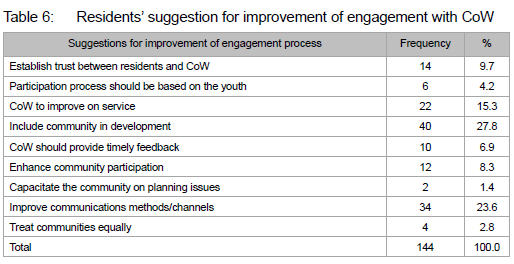
During the questionnaire survey, all 150 respondents were asked to provide suggestions on how the CoW could enhance engagement with its residents (Table 6). A total of 144 (96%) residents offered their suggestions on how to enhance the consultation process between themselves and the CoW. These suggestions were then grouped into nine broader categories. Thus, roughly 27.8% of the residents strongly indicated that there is a need to include the community in the development process. The residents made this observation, as they felt that they are only recipients of what the planners or officials (CoW) decide for them and thus their input in the process is minimal. The second segment of the comments, which comprised 23.6% of the residents, revealed a need for the city to improve its communication methods and channels as part of the consultation process.
This was followed by the third segment of 15.3% of the residents who indicated an urgent need for the city to improve its provision of basic services such as water and electricity in the informal settlements. Moreover, 9.7% of the residents indicated a need to establish trust between residents and the CoW to ensure that both parties benefit from mutual engagements. In addition, 4.2% of the residents felt that the youth were excluded from consultations during the participatory planning processes of the CoW. This was followed by the segment of the 2.8% residents who suggested that communities/neighbourhoods must be treated equally when providing services, and in the planning and development in their areas. Finally, 1.4% of the respondents indicated that there was a need to capacitate the community on planning issues.
5.3.2 Planners' perceptions on improving the CoW planning process
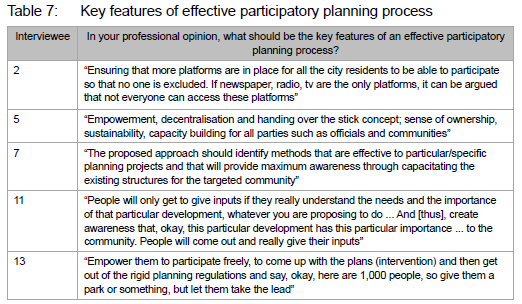
The study further probed the urban planners' views on how best to enhance residents' participation in the current planning process. Their responses to this question are presented in Table 7.
A thorough analysis of the data from the study indicates that both residents and urban planners recognise the need for adequate participatory planning processes. This is very clear as the residents placed great emphasis on the improvement of communication channels and the importance of consulting/including residents in the planning of their areas. These comments were supported by some planners who noted that the city should provide more platforms for residents to participate in the planning process, focus on empowerment and capacity building, and identify effective methods, while at the same time creating awareness of the importance of residents' participation in the planning process.
6. DISCUSSION
Existing studies in many post-apartheid cities have explored the inherited planning system that falls short of addressing most of the contemporary issues. For example, Watson (2009) and Horn et al. (2018) argued that cities have continued to exclude the masses in the planning and decision-making process. The UN-Habitat report on cities (2022) cautiously warned against planning systems that are neither sustainable nor resilient, especially in cities of the Global South. Thus, in the case of CoW, this study argues that there is a genuine need for planning authorities to renew their commitment to urban dwellers by adopting and promoting a proposed framework of planning approaches that are participatory in the making of neighbourhoods.
This observation was presented in the empirical data collected as part of this study. It is important that a segment of professionals believe that the problem is not only with the planning system, but also with the residents themselves. This observation was made against the backdrop of data indicating that the input emanating from the residents is minimal and there is a need to empower and capacitate them on important planning matters. Moreover, the existing planning system in post-apartheid cities such as Windhoek is complex, as professionals, processes, and institutions at times use past rigid and fragmented instruments that do not respond to the planning realities and needs of residents.
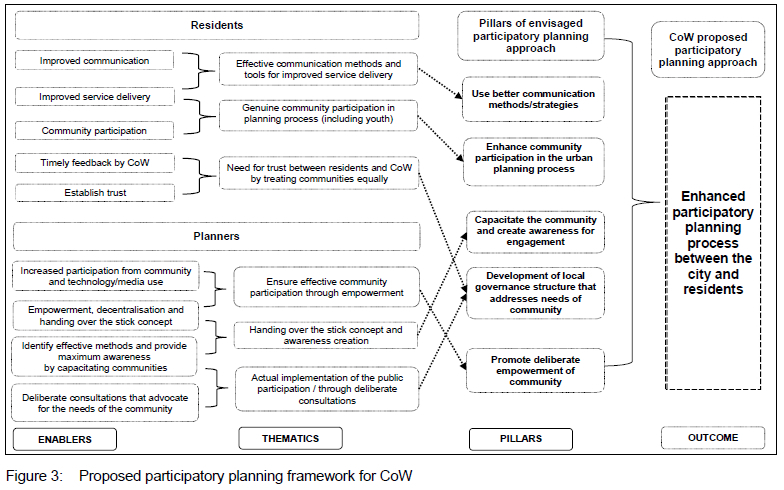
Based on the empirical data gathered from residents and urban planners, the research developed a participatory planning framework that optimally includes residents in the planning process of the city. The structure of the framework consists of enablers, thematics, pillars and the outcome. Figure 3 illustrates the proposed framework.
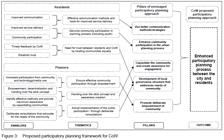
The enablers are the verbatim inputs/ comments provided by the residents and the urban planners/officials who were surveyed and interviewed. These verbatim 'inputs' from both the residents and the planners are viewed as the foundation of this framework, as they provided their views based on lived experiences of residents and practical experiences of planners while they engage in the planning process. In validation of the above assertion, Yankson (2023) surveyed the residents' perceptions on street naming and observed that the vast majority of the residents indicated a strong interest for their views to be included in such urban planning processes. Thus, extant literature and empirical studies clearly indicate the need for a participatory planning framework that is conceptualised through residents' inputs and their local knowledge.
The thematics are the summarised version of the verbatim 'comments', and they are crucial building blocks to the pillars of the framework. They provide condensed results of comments and could be understood to be the key themes that emanate from the empirical data. These thematics relate to key issues that are of paramount interest to the residents during their engagement with the CoW as part of the planning process.
The five pillars developed based on the study were to support a participatory planning process that emphasises the involvement of residents. In other words, these pillars are projects/activities that the CoW ought to undertake or implement if they want to ensure that there is an improvement in the participation of residents as part of the planning process. The synopsis of this framework is based on the empowerment and inclusion of residents as advocated for by previous studies. For instance, Liu et al. (2018: 3) argue that the empowerment and involvement of residents as part of urban regeneration planning are vital components.
The outcome of the approach is an enhanced participatory planning framework that rests on its five pillars. This framework is critical as it seeks to empower residents through an improved engagement with their officials. In their studies, Ouma (2023: 475) noted that it is important to capacitate communities, as this improves their well-being. Through these pillars, the framework should provide better communication methods that ultimately enhance participation and capacitate the residents, by developing local governance structures to address the needs of the community. Sulemana and Ngah (2012: 25) posit that what sets participatory planning apart from all other forms of engagement is that it is premised on the intentional engagement of citizens in the planning and development of their localities. Hence, the framework (Figure 3) is vital as it seeks to fill the gap that exists within the participatory planning process of CoW.
7. CONCLUSION
The main aim of this article was to contribute new insights toward a more effective participatory planning approach that the CoW can adopt in its neighbourhood-level planning processes. Specifically, the study highlights the critical need to bridge the disconnect between formal planning mechanisms and informal, community-driven participation practices. While the research focused on three Windhoek neighbourhoods - representing middle-, low-, and ultra-low-income areas - its findings may not be fully generalisable across the entire city. However, the study offers a valuable starting point for understanding how participatory planning can be more inclusive and responsive, particularly in contexts marked by socio-economic diversity. Despite its scope limitations, this study addressed a critical issue, namely participatory planning in a post-apartheid city of the Global South. Both the literature and empirical findings revealed that, although residents are generally eager to participate in the planning of their neighbourhoods, several barriers inhibit meaningful involvement. These challenges range from residents' limited awareness of available participatory platforms to the methods and approaches used by planners to engage communities. To address these shortcomings, the study proposes a participatory planning framework aimed at bridging the divide between planning professionals and local residents. The framework encourages an inclusive approach that integrates community perspectives with the technical expertise of planners, ensuring more effective and representative urban planning processes within the CoW. From a broader policy perspective, the framework offers insights that may be relevant to other Global South contexts such as South Africa and Zimbabwe, as they design or reform their participatory planning systems, particularly at the urban level. Some lessons learned from Windhoek's experience are that municipalities should invest in awareness campaigns to inform communities of participation opportunities. Planning professionals must adopt inclusive consultation approaches tailored to diverse communities. While the successful implementation of the framework may face obstacles such as limited technical capacity and weak political will, it nonetheless presents an innovative model. If adopted and integrated effectively within existing planning systems, it holds the potential to significantly enhance public participation and promote more inclusive urban governance.
REFERENCES
2. LITERATURE REVIEW
-
ARNSTEIN, S.R. 2019. A ladder of citizen participation. Journal of the American Planning Association, 85(1), pp. 24-34. https://doi.org/10.1080/01944363.2018.1559388
» https://doi.org/10.1080/01944363.2018.1559388 -
BILJOHN, M. & LUES, L. 2020. Citizen participation, social innovation, and the governance of local government service delivery: Findings from South Africa. International Journal of Public Administration, 43(3), pp. 229-241. https://doi.org/10.1080/01900692.2019.1628052
» https://doi.org/10.1080/01900692.2019.1628052 -
BUSSU, S., BUA, A., DEAN, R. & SMITH, G. 2022. Introduction: Embedding participatory governance. Critical Policy Studies, 16(2), pp. 133-145. https://doi.org/10.1080/19460171.2022.2053179
» https://doi.org/10.1080/19460171.2022.2053179 - CHARMAN, A., TONKIN, C., DENOON-STEVENS, S. & DEMEESTERE, R. 2017. Post-apartheid spatial inequality: Obstacles of land use management on township micro-enterpise formalisation. s.l.: Sustainable Livelihood Foundation.
-
CHITEKWE-BITI, B. 2018. Co-producing Windhoek: The contribution of the Shack Dwellers Federation of Namibia. Environment and Urbanisation, 30(2), pp. 387-406. https://doi.org/10.1177/0956247818785784
» https://doi.org/10.1177/0956247818785784 - CoW (CITY OF WINDHOEK). 2020. Windhoek urban structure plan. Windhoek: CoW.
-
CoW (CITY OF WINDHOEK). 2024. History and heritage. [Online]. Available at: <https://www.windhoekcc.org.na/history-and-heritage/> [Accessed: 12 February 2024].
» https://www.windhoekcc.org.na/history-and-heritage/ - CRESSWELL, J. & POTH, C. 2018. Qualitative inquiry and research design: Choosing among five approaches. 4th edition. London: SAGE Publications.
-
DELGADO, G. 2021. Situating modernities: The socio-spatial co-production in Namibia. In: Mohan, A.K. (Ed.). Theorising urban development from the Global South. Cham, Switzerland: Palgrave Macmillan, pp. 197-218. https://doi.org/10.1007/978-3-030-82475-4_9
» https://doi.org/10.1007/978-3-030-82475-4_9 -
DENOON-STEVENS, S., ANDRES, L., NEL, V. & JONES, P. 2022. Unpacking planners' views of the success and failure of planning in post-apartheid South Africa. Cities, 130, article 103867. https://doi.org/10.1016/j.cities.2022.103867
» https://doi.org/10.1016/j.cities.2022.103867 -
ERIKSSON, E., FREDRIKSSON, A. & SYSSNER, J. 2022. Opening the black box of participatory planning: A study of how planners handle citizens input. European Planning Studies, 30(6), pp. 994-1012. https://doi.org/10.1080/09654313.2021.1895974
» https://doi.org/10.1080/09654313.2021.1895974 - FIELD, A. 2018. Discovering statistics using IBM SPSS statistics. 5th edition. London: SAGE.
-
GUMBO, T., PRETORIUS, O. & INGWANI, E. 2022. Mixed housing development, inclusivity, and urban sustainability nexus in the cities of the global south: A systematic bibliometric review. Journal of Inclusive Cities and Built Environment, 2(1), pp. 81-85. https://doi.org/10.54030/2788-64X/2022/cp1v2a16
» https://doi.org/10.54030/2788-64X/2022/cp1v2a16 -
HALL, P. & WARD, C. 2014. Sociable cities: The 21st re-invention of the garden city. 2nd edition. London: Taylors & Francis Group. https://doi.org/10.4324/9781315758367
» https://doi.org/10.4324/9781315758367 -
HORN, P., MITLIN, D., BENNETT, J., CHITEKWE-BITI, B. & MAKAU, J. 2018. Towards citywide participatory planning: Emerging community-led practices in three African cities. Manchester: GDI Working Paper, The University of Manchester. https://doi.org/10.2139/ssrn.3225770
» https://doi.org/10.2139/ssrn.3225770 -
HUQ, P.A. 2014. The limits of citizen participation in the urban local governance process in Bangladesh. International Journal of Public Administration, 37, pp. 424-435. https://doi.org/10.1080/01900692.2013.858356
» https://doi.org/10.1080/01900692.2013.858356 -
ISHII, R. 2017. Community participation in local governance: An empirical analysis of urbanized local governments in the Philippines and Uganda. International Journal of Public Administration, 40(11), pp. 907-917. https://doi.org/10.1080/01900692.2016.1242610
» https://doi.org/10.1080/01900692.2016.1242610 -
KAMUZHANJE, J. 2021. Urbanisation, inclusive cities and the plight of the people with disability. In: Magidimisha-Chipungu, H. & Chipungu, L. (Eds). Urban inclusivity in Southern Africa. Cham, Switzerland: Springer, pp. 98-112. https://doi.org/10.1007/978-3-030-81511-0_7
» https://doi.org/10.1007/978-3-030-81511-0_7 -
KOHIMA, J., CHIGBU, U.E., MAZAMBANI, M.L. & MABAKENG, M.R. 2023. (Neo-)segregation, (neo-) racism, and one-city two-system planning in Windhoek, Namibia: What can a new national urban policy do? Land Use Policy, pp. 1-14. https://doi.org/10.1016/j.landusepol.2022.106480
» https://doi.org/10.1016/j.landusepol.2022.106480 - KOTHARI, C.R. & GARG, G. 2019. Research methodology: Methods and techniques. 4th edition. New Dehli: New Age International.
-
KREJCIE, R.V. & MORGAN, D.W. 1970. Determining sample size for research activities. Educational and Psychological measurements, pp. 607-610. https://doi.org/10.1177/001316447003000308
» https://doi.org/10.1177/001316447003000308 - LEEDY, P.D. & ORMROD, J. E. 2019. Practical research: Planning and design. 12th edition. Boston: Pearson.
-
LEMON, A. 2021. The aparthied city. In: Lemon, A. (Ed.). South African urban change: Three decades after apartheid homes still apart. Cham, Switzerland: Springer, pp. 1-16. https://doi.org/10.1007/978-3-030-73073-4_1
» https://doi.org/10.1007/978-3-030-73073-4_1 -
LIU, B,. WANG, X., XIA, N. & NI, W. 2018. Critical success factors for the management of public participation in urban renewal projects: Perspectives from governments and the public in China. Journal of Urban Planning and Development. 144(3), pp. 1-9. https//doi:10.1061/(ASCE) UP. 1943-5444.0000467
» https//doi:10.1061/(ASCE) UP. 1943-5444.0000467 -
MAFAME, T. & HORN, A. 2025. Place-making for inclusive public spaces in South African townships: A community-led approach. African Geograhical Review, pp. 1-17. https://doi.org/10.1080/19376812.2024.2446237
» https://doi.org/10.1080/19376812.2024.2446237 -
MAHARAJ, B. 2023. Structural violence and the subversion of participatory planning: The struggle for Warwick market in Durban, South Africa. City: Analaysis of Urban Change, Theory, Action, 27(3-4), pp. 501-519. https://doi.org/10.1080/13604813.2023.2223884
» https://doi.org/10.1080/13604813.2023.2223884 -
MAMOKHERE, J. & MEYER, D.F. 2022. Comprehending stakeholders' involvement in the Integrated Development Planning process as a tool for improved community participation. EUREKA: Social and Humanities, pp. 18-32. https://doi.org/10.21303/2504-5571.2022.002426
» https://doi.org/10.21303/2504-5571.2022.002426 -
MILTIN, D. 2021. Citizen participation in planning: From the neighbourhood to the city. Environment and Urbanisation, 33(2), pp. 295-309. https://doi.org/10.1177/09562478211035608
» https://doi.org/10.1177/09562478211035608 -
MULISA, F. 2022. Sampling techniques involving human subjects: Applications, pitfalls, and suggestions for further studies. international Journal of Academic Research in Education, 8(1), pp. 75-84. https://doi.org/10.17985/ijare.1225214
» https://doi.org/10.17985/ijare.1225214 -
NAMIBIA STATISTICS AGENCY 2023. [Online]. Available at: <https://census.nsanamibia.com/khomas-region/> [23 February 2024].
» https://census.nsanamibia.com/khomas-region/ - NAMIBIA UNIVERSITY OF SCIENCE AND TECHNOLOGY. 2023. Windhoek neighbourhoods' map. Windhoek: NUST.
- NEL, V. 2019. Planning in complex spaces: An orderly and predictable world. In: Marais, L. & Nel, V. (Eds). Space and planning in secondary cities: Reflections from South Africa. Bloemfontein: Sun Media Bloemfontein (Pty) Ltd., pp. 25-40.
-
NOBLE, H. & SMITH, J. 2024. Ensuring validity and reliability in qualitative research. Evidence-Based Nursing, pp. 1-2. https://doi.org/10.1136/ebnurs-2024-104232
» https://doi.org/10.1136/ebnurs-2024-104232 -
OUMA, S. 2023. Participation as 'city-making': a critical assessment of participatory planning in the Mukuru Special Planning Area in Nairobi, Kenya. Environment & Urbanization, 35(2), pp. 470-489. https://doi.org/10.1177/09562478231175031
» https://doi.org/10.1177/09562478231175031 -
SAIME, G. & WATSON, V. 2022. Co-production and the issue of urban up-scaling and the governance change in the Global South: The case of Uganda. Planning Theory, 21(3), pp. 269-290. https://doi.org/10.1177/14730952221076601
» https://doi.org/10.1177/14730952221076601 - SULEMANA, M. & NGAH, I. 2012. Participatory planning: Ending the controversies. European Journal of Social Sciences, 28(1), pp. 24-34.
-
SWAPAN, M. 2016. Participatory urban governance in Bangladesh. A study of the gap between the promise and the realities. Environment and Urbanisation, 7(2), pp. 196-213. https://doi.org/10.1177/0975425316652548
» https://doi.org/10.1177/0975425316652548 -
TODES, A. & ROBINSON, J. 2020. Re-directing developers: New models of rental housing development to reshape the post-apartheid city. Economy and Space, 52(2), pp. 297-317. https://doi.org/10.1177/0308518X19871069
» https://doi.org/10.1177/0308518X19871069 -
TOTAFORTI, S. 2020. Urban planning in post-apartheid South African cities: The case of Johannesburg. Open Journal of Political Science, 10, pp. 507-520. https://doi.org/10.4236/ojps.2020.103031
» https://doi.org/10.4236/ojps.2020.103031 -
TSORIYO, W. 2024. Place attachment and participation in community-driven development in Gauteng province, South Africa. Town and Regional Planning Journal, 84, pp. 1-14. https://doi.org/10.38140/trp.v84i.7954
» https://doi.org/10.38140/trp.v84i.7954 - UN HABITAT. 2022. World Cities Report: Envisaging the future. Nairobi: UN Habitat.
-
VAIDYA, H. & CHATTERJI, T. 2020. SDG 11 Sustainable and commuties: SDG 11 and the new urban: Global sustainability frameworks and local action. In: I. Franco, T. Chatterji, E. Derbyshire & J. Tracey (eds). Actioning the global agenda for local impact: Towards sustainability, science, policy, education, and practice. Singapore: Springer, pp. 174-185. https://doi.org/10.1007/978-981-32-9927-6_12
» https://doi.org/10.1007/978-981-32-9927-6_12 -
VERNET, N. & COSTE, A. 2017. Garden cities of the 21st century: A sustainable path to suburban reform. Urban Planning, 2(4), pp. 181-196. https://doi.org/10.17645/up.v2i4.1104
» https://doi.org/10.17645/up.v2i4.1104 -
WATSON, V. 2009. The planned city sweeps the poor away: Urban planning and the 21st century urbanisation. Progress in Planning, 72, pp. 151-193. https://doi.org/10.1016/j.progress.2009.06.002
» https://doi.org/10.1016/j.progress.2009.06.002 -
WECK, S., MADANIPOUR, A. & SCHMITT, P. 2022. Place-based development and spatial justice. European Planning Studies, 30(5), pp. 791-806. https://doi.org/10.1080/09654313.2021.1928038
» https://doi.org/10.1080/09654313.2021.1928038 -
YANKSON, E. 2023. Street naming and political identity in the postcolonial African city: A social sustainability framework. Journal of Urban Affairs, 45(3), pp. 685-709. https://doi.org/10.1080/07352166.2023.2166839
» https://doi.org/10.1080/07352166.2023.2166839 -
ZHOU, X., LIN, X., MONSTADT, J., HOOIMEIJER, P., WANG, S. & LIU, Z. 2024. Examining collaborative planning processes and outcomes in urban regeneration: A deliberative turn in China? https://doi.org/10.1177/00420980241259985
» https://doi.org/10.1177/00420980241259985
Peer reviewed and revised: April 2025
Published: June 2025