The ambiguity of business support interventions for home-based enterprises that are re-shaping residential urban spaces in Durban, South Africa
Abstract
Positive developmental consequences for home-based enterprises (HBEs) are diminished in South African townships, due to insufficient alignment of business support interventions (BSI). There is limited urban planning knowledge on how HBEs in townships operate within residential zones and how spatial and regulatory challenges affect their development. The integration of supporting informal businesses presents a challenge since the informal economy does not have detailed spatial information. This article aims to address gaps in urban planning knowledge regarding how HBEs operate in residential zones, particularly in areas known for historical land-use conflicts. A case study approach with mixed methods (surveys and interviews) is used to investigate local initiatives for economic development in a ward area, using quantitative and qualitative data to better understand the interdisciplinary linkages of urban development in the South Durban Basin of eThekwini Municipality. Findings show that there are gaps in the way in which HBEs understand planning, policy, and regulations and this needs to be considered in reducing the lack of business support interventions for local economic development.
local economic development; urban planning; home-based enterprises; business support; informality
Abstract
Positiewe ontwikkelingsgevolge vir tuisgebaseerde ondernemings (HBOs) word verminder in Suid-Afrikaanse 'townships' weens onvoldoende belyning van besig-heidsondersteuningsinisiatiewe (BSI). Beperkte stadsbeplanningskennis bestaan oor hoe HBOs in 'townships' funksioneer binne residensiële sones en hoe ruimtelike en regulatoriese uitdagings hul ontwikkeling beïnvloed. Die integrasie van ondersteuning aan informele besighede bied 'n uitdaging aangesien die informele ekonomie nie gedetailleerde ruimtelike inligting het nie. Die doel van hierdie artikel is om leemtes in stede-like beplanningskennis aan te spreek oor hoe HBOs in residensiële sones funksioneer, veral in gebiede wat bekend is vir historiese grondgebruikkonflikte. 'n Gevallestudie-benadering met gemengde metodes (opnames en onderhoude) is gebruik om plaas-like inisiatiewe vir ekonomiese ontwikkeling in 'n wyksgebied te ondersoek deur gebruik te maak van kwantitatiewe en kwalitatiewe data om die interdissiplinêre verbande van stedelike ontwikkeling in die Suid-Durban-kom van eThek-wini Munisipaliteit beter te verstaan. Bevindinge toon dat daar leemtes is in die wyse waarop HBOs beplanning, beleid en regulasies verstaan en dit moet in ag geneem word om die gebrek aan besigheidsondersteuningsintervensies vir plaaslike ekonomiese ontwikkeling te verminder.
1. INTRODUCTION
Cities are reshaped and reclaimed by people living and working in an area because of both formal and informal changes (Ballard, 2012; Bayat, 1997; Wachsmuth & Brenner, 2014). There are distinctive challenges for cities that are directly related to the spatial-economic disparities in the urban environment (De Soto, 2000; Harvey, 2008). In urban areas, the economic vitality of communities is intertwined with the spatial organisation and regulatory frameworks established through urban planning. This article focuses on 'invisible' informal work in Ward 68, eThekwini Municipality (Durban), South Africa, to reflect on the impact of business-support interventions. Residents' understanding of planning permissions and the varying levels of enforcement of planning regulations result in unplanned development, which has an impact on the design, social processes, and regulations of spaces in the city (Charman, Tonkin Denoon-Stevens & Demeestere, 2017; Roy, 2005).
Home-based enterprises (HBEs) in townships are constantly evolving and thereby have regulatory compliance challenges. Businesses based at home in township residential zones are offered support through business support interventions (BSI). BSI include training and financial incentives. Support of this nature influences how the residential property is modified and used. There are discrepancies in the alignment of spatial and economic development goals in Durban, since the distribution of HBEs in residential zones presents a unique challenge. The impact of HBEs in these zones is not well understood. There is a lack of representation of the diversity of informal enterprises because research and visibility of informal street traders have been more prevalent compared to HBEs (Charman et al., 2015). Hence, urban planning has a gap in knowledge of HBEs in residential zones to appropriately support the sector. Developing an understanding of the interaction between urban planning, economic development, and BSI is crucial for effectively addressing the spatial and regulatory complexities faced by HBEs in township residential zones.
This article aims to address gaps in urban planning knowledge regarding HBEs in residential zones and their spatial and regulatory complexities that influence their development. This insight is significant because the data can inform both economic and spatial urban development. For example, knowledge on local HBEs' economic challenges and interventions may highlight their implications for urban planning, specifically in terms of the support extended to HBEs.
2.1 Economics of informal development
The relationship between capitalism and urbanism shapes experiences of justice and injustice in the city
(De Soto, 2000; Harvey, 2008).
Harvey (2008) emphasises the 'right to the city' as an alternative to the dominance rights of property owners in urban spaces under capitalism. Options to transform the economy, which take informality into account, are thus influenced by competing claims to space, development agendas, and the flexibility of labour rights.
Informal sector enterprise (the business) and informal sector employment (the people) are the informal economy (Swaminathan, 1991). A high prevalence of informality characterises developing countries, where informality is defined as lacking registration of firms, or lacking security in terms of employment contracts (ILO, 2014). Another view of the informal economy focuses on the declining relationship between work and state protections and less on forms of compliance and regulation. The example of Women in Informal Employment: Globalizing and Organizing (WIEGO) (2017: online) describes the informal economy as "the diversified set of economic activities, enterprises, jobs, and workers that are not regulated or protected by the state. The concept originally applied to self-employment in small, unregistered enterprises. It has been expanded to include wage employment in unprotected jobs". In this scenario, the informal economy includes private firms who are "allowed" to hire short-term and minimally paid labour (McFarlane, 2012: 91). Skinner (2019: 434) further highlights that the dynamics within the informal sector and between corporates and the informal sector "often have an exploitative dimension that warrants government protection measures". "Informal work is now the norm in many developing country cities They too should have a claim within the right to the city" (Brown & Kristiansen, 2009: 8). Hence, the approach to informality also determines who has the right to the city.
Williams (2015) identifies three policy approaches to informality in the United Kingdom: the government takes no action; moves informal to formal businesses, and eradicates informality. Nevertheless, any approach to economic development impacts on policymaking, use of spaces, and the urban form for informal businesses. Informal businesses include those that are not survivalist in nature, and that can be recognised as strategies for people who cannot find formal work. The framing of informal economic development as job-creating township economies requires caution because there are transdisciplinary issues such as social challenges that influence informal businesses (Dawson, 2021).
McFarlane (2012: 105) argues that "framing informality and formality as practices means dispensing with both the idea that informality belongs to the poor and formality to the better off, and the associated idea that informality and formality necessarily belong to different kinds of urban spaces". Therefore, livelihoods are not only associated with the destitute of society, since there are diverse networks of actors who establish different practices in businesses. The increasing way in which informal processes override formal ones means that expansion is being driven without regulatory frameworks. According to Roy (2005: 149), "in many parts of the world, the site of new informality is the rural/ urban interface. Indeed, it can be argued that metropolitan expansion is being driven by informal urbanization [including] the incorporations of small towns and rural peripheries in a dispersed metropolitan region." The social contracts in place between informal businesses and their clients, which determine trade on a smaller scale, enable the growth of economic informality (De Soto, 2000).
A key concept of informality is urbanisation (Roy, 2005). Planning as a mode of regulating spaces is obsolete, as the production of space in cities changes due to informal development that defies strategic urban planning processes. Colonial policies and laws with 'formal planning systems' for development in cities should no longer be enforced (Cobbinah, 2023). In cities that have unequal distribution of wealth and growing inequalities, there is an "urbanization of injustice" (Soja, 2010). A spatial justice lens and inclusive approaches to economic development enable a reimagining of how geographic space contributes to shaping economic development (Smith, 2005; Babere, 2015).
2.2 The South African context
There are ongoing concerns about the lack of economic growth potential among informal businesses and support for the informal sector in South Africa (Laing, Van Stel & Storey, 2021). The increase in informal work directly relates to the need to generate income and to sustain livelihoods when formal jobs are not available (Charman et al., 2017; Kamete, 2018). Unemployment in South Africa (32.1%) highlights the need for government support (StatsSA, 2023). In 2014, the Department of Trade and Industry established the Department of Small Business Development (DSBD) to drive support initiatives (PPT, 2016; Maloka, 2015) that assist informal businesses and SMMEs with their economic growth potential (South Africa, 1995; Development Policy Research Unit, 2006). In addition, the National Development Plan (NDP) of South Africa (SA) formed the foundation for policy and programmes to address economic growth and the development of SMMEs which are presented as opportunities to address racial and class inequalities (South Africa, 2012).
Therefore, there is hope that support to SMMEs, including informal enterprises as part of local economic development, would be a strategy to address some social injustices in the country. Opportunities to enable local economic development provided the local state with a metaphorical key to enable the 'right to the city' for more people. The SA landscape was founded on apartheid planning, which enforced regulations for segregation, uneven development, and socio-spatial prejudice that had an impact on all spheres of policy and practice. According to Skinner (2019: 417), "[t]he system purposely stripped black South Africans of access to the inputs needed to produce economic value and powerfully repressed entrepreneurship". This apartheid spatial structuring of the urban environment and subsequent spatial processes presented stubborn challenges to the SA city's plans for transformation towards integrated and equitable development.
Overall, the nature of the perception of the informal sector and the approach to urban management in South Africa can be described as a contradictory mix of the following:
• Dismissed: The informal economy is not considered part of the urban environment. Regulations and approaches to development view informal practices as disorder to be eradicated from cities (Kamete, 2018; Cobbinah, 2023).
• Transformed: The informal economy is accepted as a socio-economic challenge, which is transitioning. The informal becomes formal through policy and regulation of informal activities (Kamete, 2018; Harrison, Todes & Watson, 2008).
• Allowed: The informal economy is inherently a part of the economy. It has a place in the urban fabric with its own structures, policy, and regulatory framework to support this form of local economic development (Cobbinah, 2023; Kamete, 2018; eThekwini Municipality, 2016).
The approach to informal business development in SA largely focused on formalisation. This response aimed to address the challenges faced by unregulated informal sectors with high potential to exploit labour and/or other resources (McFarlane, 2012; Skinner, 2019). However, government's approach to mainstreaming informality by integration was described as pernicious, because transforming businesses excludes informality (Kamete, 2018). Policy shifts towards sustainable development took place in the business environment, for example, the 1991 Businesses Act allowed for informal economic activity, mainly by removing barriers to street-trading (Lund & Skinner, 2005). Human settlement development in eThekwini embraced sustainable development plans, which aimed for a better quality of life. Strategic planning was operationalised at local levels through the process of creating an Integrated Development Plan (IDP). Laws such as the 2000 Municipal Systems Act (MSA) were set up to ensure that integrated plans started appearing on municipal agendas nationally (South Africa, 2002). In accordance with the MSA (South Africa, 2002), IDPs included economic nodes in the Spatial Development Framework (SDF). Economic plans for the city of Durban are, therefore, situated in a spatial framework, and were based on legal requirements and on establishing interventions for spatially just impact. The integration of supporting informal businesses presents a challenge, since the informal economy does not have detailed spatial information. However, sustainable development plans include services that provide for accessibility to employment, childcare, and adequate transport for communities. Thereby informality must be recognised for flexible approaches to development planning, to build a more just society.
The discourse of space should be included in the arguments for economic development toward spatial justice. According to Harvey (2008: 37), the right to the city does not rely on capital claims to the city, but it means "greater democratic control over the production and utilization of the surplus. Since the urban process is a major channel of surplus use, establishing democratic management over its urban deployment constitutes the right to the city." In current practice, surplus-oriented thinking, that is, the paradigm of surplus used to the detriment of inhabitants and human rights, is an ongoing matter of contestation (Turok & Borel-Saladin, 2013). This study recognises a gap in knowledge of informal entrepreneurship in these segregated residential spaces of Durban, in line with the studies by Charman et al. (2015; 2017). More research and interventions for informality in different spaces showed that it was an inherent part of the urban economy that required a policy re-think.
2.2.1 Defining SA's informal workspace
Wariawa (2014) defines home-based work in two broad categories, namely 'self-employed home-based workers' and 'sub-contracted home-based workers'. The former are essentially entrepreneurs who use their homes and other resources to develop a business, while the latter are workers employed by someone outside their homes, although these persons work from their residential space. Types of work include home industry; home occupation; house shop, and house tavern (Charman et al., 2017: 8). Again, HBEs emphasise the urban poor and the type of work is synonymous with informality, with a focus only on survivalist enterprises (South Africa, 2017; eThekwini Municipality, 2016: 7).
Statisticians define the informal sector as enterprise-based, where small businesses are unregistered. Informal employment is separately defined with worker-based arrangements, where the workplace offers limited or no social protection for workers (lEJ, 2018). The informal sector includes enterprises, with fewer than five employees, who do not deduct income tax and who are household businesses not registered for tax (lEJ, 2018). To deliver sustainable outcomes for supporting informality, there is recognition in the literature that the people who work in this sector have limited wage employment opportunities in the formal economy (Kamete, 2018). These categorisations of informality distort a more wholistic approach to understanding the economy. It is critical to investigate how various informal business activities re-shape urban spaces.
There are different ways of understanding informal businesses and their use of space. A basic profile of an informal business, as defined by the Department of Small Business Development (DSBD) (2017) includes the following: enterprises that lack registrations (no CIPC, SARS, AT compliance, and/or tax clearance certificate, etc.), using personal accounts for banking, thus do not produce financial statements of the business, and lack business skills, finance, tools of trade, etc. to grow the business. HBEs, which communicate using the internet or via word-of-mouth, would not necessarily be directly visible to people in an area. Hence, 'visible' businesses can be described as those with signage and street presence and the 'invisible businesses are those that have an internet presence or networks but cannot be recognised at street level.
Examples of how HBEs are understood in practice were usually linked to the business sector or to the employees in the business. The way in which informal businesses operate impacts on their surroundings, regardless of the form they take. 'Geography matters' because there are policy implications for land use when informal businesses are supported by BSI (Babere 2015; Mabin, 2005). Considering types of work occurring in residential zones, the diverse business sectors present spatial and economic challenges internally and often also affect their external surroundings. Appropriate policy approaches can be enabled by evaluating BSI and how that impacts on the businesses and the environment.
2.2.2 Business Support Interventions
Business Support Interventions (BSI) is an all-encompassing term to describe the various forms of support available to businesses. BSI can be described as a non-specific set of activities that aims to improve and/or promote the growth of SMME sectors (Dayaram, 2021). This term refers to both financial and non-financial interventions for conceptualising economic development strategies for both formal and informal sectors.
SA encourages support interventions toward economic growth, business growth, and the employment of more people. In this way, BSI inform how the services and knowledge about growing businesses are transmitted to local people in different areas. One of the main state programmes is the National Informal Business Upliftment Strategy (NIBUS) that relies on local municipalities and implementing organisations to uplift informal business (DSBD, 2014; 2020). According to Skinner (2019: 427), "NIBUS presents a significant step forward. This is the first time in South Africa's history that there is a national government strategy on the informal sector in and of itself, rather than as a component of a broader category, whether SMMEs or the second economy". The five pillars of the NIBUS strategy are legal and regulatory frameworks; financial and non-financial enterprise development; inter-governmental relations to develop co-ordinated response to programmes and implementations; diverse and symbiotic partnerships to support such upliftment, and good information management to build knowledge about the informal sector and to track initiatives (DSBD, 2020). These pillars of state intervention and actions strongly advocate support to informal businesses (DSDB, 2020; eThekwini Municipality, 2016).
There is ambiguity of the impact from formal interventions for supporting informal businesses like HBEs, on both land-use changes and local economic benefits. It is clear that local government in Durban ensured that the spatial orientation of BSI spread across the city of Durban, ensuring a spatial focus across the South, West, and Northern parts of the Municipality. In the case of private sector BSI and local networks, the distribution of services is focused on respective supply chains for SMMEs. It is unclear how the private sector supports or disrupts informal work. Informal enterprises also fit into criteria used by the state to describe SMMEs in terms of the size of a business. The size of a business could be measured by the number of employees and/or by the annual turnover of a business (South Africa 2019; PPT, 2016; SEDA, 2011). Due to the limitations of available data on income of informal businesses, they have often been categorised according to their number of employees. The definition of businesses according to size are micro enterprises as employing 5 or less people; very small enterprises employing between 5 and 20 people; small enterprises employing between 20 and 49 people, and medium enterprises employing between 50 and 250 people.
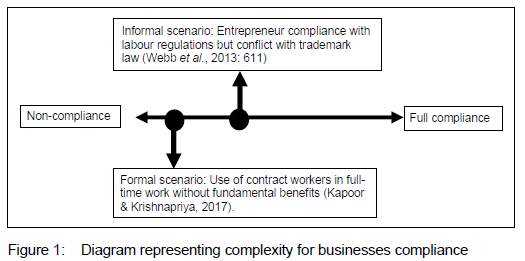
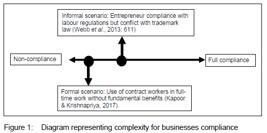
Descriptions of the informal economy and of informal businesses show that there were informal administrative practices such as lack of business compliance, irregular business operations, and informal working conditions. Across the definitions, there was a continuum between compliance and non-compliance that defined levels of formality (see Figure 1).
The practices for assisting informal work are largely imagined through transitioning the informal to formal. This drive to better inform policy and practice for their support includes national strategies such as the National Informal Business Upliftment Strategy (NIBUS), Informal and Micro Enterprise Development Programme (IMEDP) (DSDB 2020; 2017) and, at a local level, Durban's Informal Economy Policy (2001).
The perception of HBEs in SA townships as informal activities, whether accurate or not, shapes how business activities are perceived by the local government. Informal businesses became part of the spatial dynamics of the neighbourhood as more peoples' livelihood strategies relied on HBEs. Land use and spatial distribution of informal businesses and their changes over time directly impact on the urban environment. Urban planning and management are governed by land-use management schemes that are rapidly becoming redundant, due to growing informal businesses in residential areas. The perceived limitations or opportunities for SMMEs' growth in the local spatial economy and the well-known lack of information about growing informal businesses are ongoing challenges to agencies who attempt to deliver support (Berger & Udell, 1998). It is important to understand the rapid growth of informal businesses for considering the investments going toward supporting them.
There are many inconsistencies in the approaches to informality in SA. Calls for the change in approach to policy and practice on informality toward alternative ways to measure only economic gains need to be supported. BSI as part of an inclusive approach can assist small businesses across the continuum of informality and formality in different areas.
3. STUDY AREA
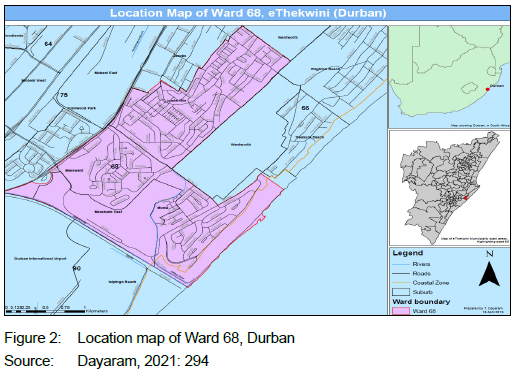
The study area is located on the east coast of South Africa (see Figure 2), in the province of KwaZulu-Natal, and in the eThekwini Metropolitan Municipality (Durban). Ward 68 describes a politically constructed boundary for local level area management. The boundary encompasses 6.1km2 and includes three suburbs, namely Merewent, Merebank East, and Austerville. The South Durban Basin (SDB) is an example of how apartheid planning created socially unjust spaces and environmental racism. The population groups living in Ward 68 typically had no option but to work and live in environmentally unsafe conditions. The suburbs in the ward area can be defined as townships,1 areas designated for the Black2 population under the 1950s Group Areas Act. In addition, the planning and design of the SDB perpetuated the injustices of land use because of the limitations of the built typology, restricted land-use system, and regulatory frameworks. The spatial elements of Ward 68 for BSI need to be considered, in order to optimise the services, facilities, and amenities that may enable more inclusive and socially just spaces.
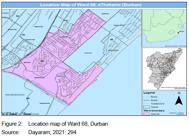
Spatial exclusion is evident in the design of the suburbs and perpetuated by ongoing conflict such as the development of logistics for a new port (SDCEA, 2016). Considering Bayat's (1997) concept of quiet encroachment, the understanding is that the uses of a localised space, including context-specific injustices in an area, offer a different representation of space. When the ward area is viewed in isolation from its surroundings, the study area appears to be a residential suburb. However, the area has a complex mix of land uses, including residential units adjacent to large-scale industry.
Merebank East directly borders the city's proposed back of port development. The suburbs are all next to an oil refinery, and the suburbs are also adjacent to other industrial zones. Austerville borders the Jacobs industrial zone, and the Mondi Paper Mill neighbours Merewent and Merebank East (see Figure 2). Numerous HBEs were observed in this area. The study area is influenced by political and geographic boundaries that determine urban management practices for the area. The case study includes both the space of the study area and the spatial processes of HBEs.
4. METHODOLOGY
4.1 Research design
Understanding the way in which HBEs operate and perceive support interventions can allow for more appropriate interventions to support local economic development. Similarly, for constructing suitable interventions, there must be better understanding of the implications for interventions for HBEs development. This study employs a mixed methods approach, primarily using a survey (quantitative) and key informant interviews (qualitative) to investigate HBEs and the interventions they have experienced (Cohen & Crabtree, 2006). The reason for collecting both quantitative and qualitative data is to elaborate on specific findings from the breakdown of the interviews, and to cross-check this data against the questionnaire data set such as similarities in BSI support, and BSI challenges that have implications for township development (Creswell & Plano-Clark, 2018: 27).
4.2 Population, sample, and response rate
According to the 2011 census, the population of Ward 68 is 39,355 within an area of 6.1km2, consisting of 9,959 households. Survey participants were purposefully sampled using a non-probability snowball sampling technique, as this study did not aim to provide a comprehensive sample of all home-based enterprises in the area (Kumar, 2011). A survey of 100 businesses uncovered a diversity of informal businesses in the area. This method targeted both 'visible' businesses, identified by signage, and 'invisible' businesses, found through online presence or word-of-mouth referrals.
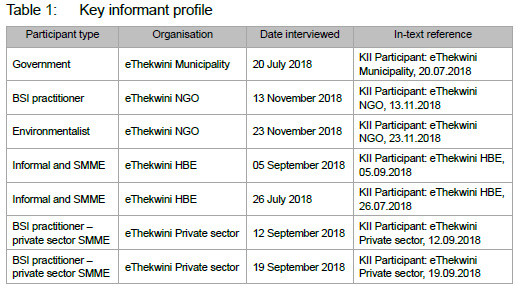
Thereafter, purposive sampling followed to include different types of BSI practitioners and HBEs for the key informant interviews. Judgement and purposive sampling were based on an information-oriented selection of participants (Kumar, 2011). The enterprises that met the selection criteria included entrepreneurs who were between the ages of 15-64 years (working age population), having experience with BSI, planned to expand their businesses, and had regulatory challenges) were key informants. Seven key informants provided insight into the challenges and opportunities that BSI present (see Table 1).
In total, 100 surveys were completed using a questionnaire, and seven key informant interviews were completed. These were guided by semi-structured questions.
4.3
Data collectionDuring April 2018, fieldworkers used a structured questionnaire to survey HBEs, using either cellular phones or printed forms to collect responses from 100 HBEs in Ward 68. The survey questionnaire consisted of 54 questions predominantly closed-ended with some open-ended questions. It was designed to be completed online to ensure legibility and streamline data collection. Fieldworkers facilitated data collection in batches of fifteen surveys each, conducting in-person meetings for submission and review of the data schedules. Surveys were reviewed for completeness, signed consent, and then saved to Google Drive.
The online survey form was created using Google Forms and included three sections. The first section contained questions on the characteristics of the respondents and their businesses, including ownership, age, size, sector, job creation, income, and reasons for starting the business. Section two on BSI support for HBEs and Section three on BSI challenges for HBEs included three statements each with tick-box options. Participants were required to select the option most appropriate to their business. Closed-ended questions were favoured to reduce respondent bias (Harlacher, 2016: 9-10). The open-ended interviews with BSI officials and enterprises were done between September and November 2018. The interview schedule for BSI officials included 13 questions and the interview schedule for enterprises included 14 questions, of which this article examines the responses to 12 questions regarding regulations, BSI support, and BSI challenges that have implications for township development.
4.4
Data analysis and interpretationData collected from the surveys and interviews was manually processed using MS Excel. For the surveys, frequencies of options selected for closed questions were calculated and indicated as percentages to describe the respondents' profile and HBE characteristics, and to explore the BSI support and challenges that HBEs experienced. For the interviews, content analysis facilitated the identification of themes and patterns pertaining to the HBEs and the BSI in the study area (Kumar, 2011). Responses were thematically clustered in terms of characteristics of HBEs, BSI support, and implications for urban planning when support is extended to HBEs.
4.5 Limitations to the study
It is hypothesised that citizens are both formally and informally making valuable contributions to the economy at a local level and that they have no formal support interventions. The study examined the perceived benefits and challenges of BSI experienced by HBEs. However, since many of the HBEs did not know about business support available, the findings focused more on the benefits of having HBEs and the challenges that those businesses experience. The case-specific findings cannot be extrapolated to the entire region as the focus on Ward 68 in the city limits the understanding of regional impacts of informal businesses in a residential zone.
5. RESULTS AND DISCUSSION
This section represents the results and findings from the research on HBEs in Ward 68 for a better understanding of this sector and the support for informal economic activity.
5.1 HBE characteristics
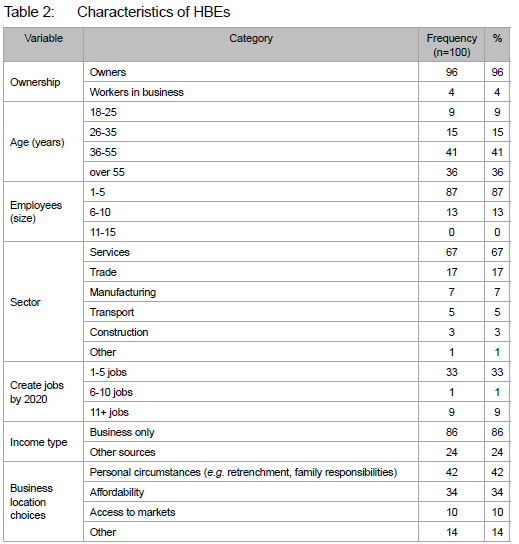
In SA, approaches for support have problematised informality to deliver support that transitions informal enterprise into more formal practices. If an enterprise employs between one and five employees, they can be classified as SMMEs.3 In this study, 87% of informal businesses can be described as micro enterprises. A total of 96 business owners were surveyed. Out of the four who were not owners, one entrepreneur's spouse and one entrepreneur's parent responded on their behalf. It was assumed that the remaining two survey participants worked at the enterprise where one was a relative, as they worked from home. The other was not, as the participant did not work from the interview site (see Table 2). The transformation approach influences how the actors are engaging toward HBEs' development in the neighbourhood.
The sample of participants surveyed in Ward 68 contained mainly service-oriented businesses (67), followed by trading (17) and manufacturing enterprises (7). Diverse business sectors in the study area also included construction, transport, and those that identified as 'other'. Business activities included hair salons, plumbing, beauty products, Spaza/tuck shops, specialised retail (e.g. selling spices), caterers, taverns, repair services, car repairs/panel beaters, medical services, clothing alterations, professional services (medical, IT, accounting, construction, and engineering), care centres, and transport/taxi services. These goods and services often change the frontage of homes and increase pedestrian and vehicle traffic.
These businesses are multi-faceted. In addition to the information in Table 2, there are examples whereby business owners described having additional sources of income not directly related to their core business models, e.g. by offering make-up and nail beauty treatments in a hair salon (surveys 8 and 14) or by providing nutrition consulting from a home-based gym (survey 5). There were also additional products that did not necessarily relate to the core business but provided additional funds for the businesses that were run from home. An example of this is a crèche owner who sold beading and mosaics (survey 1).
Thirty-three HBEs aimed to create between one and five new jobs, while nine businesses aimed to create more than ten jobs in Ward 68 by 2020. Seventeen businesses did not specify their job creation goals. Nevertheless, this data indicated that there were growth goals in HBEs.4 It also showed that, while the businesses may be mostly informal at that stage, there was potential for some of the businesses to expand with possibilities for formalising. While it was not assumed that these businesses would grow in their current location, it showed the potential for commercialisation nodes between suburbs and connecting regions to transform the city. The HBEs' operations and growth impact on how the neighbourhood develops over time. Therefore, the frameworks for supporting them must take into account the levels of compliance and how to accommodate for development in these spaces.
The approach to transforming or allowing informal businesses requires criteria to assess their suitability for different areas as well as the operational requirements in space (McFarlane, 2012; Skinner, 2019). When considering business location choices, cost and accessibility, access to markets, and life circumstances (usually due to family responsibilities) were distinct locational factors for the entrepreneurs. One significant reason for choosing to work from home is that entrepreneurs find themselves in situations where sudden changes such as retrenchment or the need to attend to family needs require flexibility and convenience, that working from home can accommodate (42%). Another driving factor for operating a business from home is the aim to reduce start-up costs and the need for affordable workspace (34%). By utilising their residential space, entrepreneurs can create a workspace that meets their operational requirements without significant financial burden. These life circumstances that drive people to work from home alter the use of space in a neighbourhood. The business community would require sectoral and collective understanding to be able to support economic development.
Influencing factors for starting HBEs were varied and not all participants were sure that home-based enterprises offered them what they needed. For example: 'I was just starting off my business and my vision was not developed at the time. I would also like to sell outside factories. Working from home can become a distraction' (survey 6). HBEs rely on their businesses for their livelihoods and use their premises to maximise their potential to do business on a site that is affordable, given their circumstances. Of the total number of businesses surveyed, 76 have no other sources of income. Given that 28 of these entrepreneurs were over the age of 55 years, it is assumed that the business owners, who were not close to retirement age, were using their available resources to develop their businesses in which they were potentially invested till retirement or unless better economic opportunities become available (see Table 2). However, not all types of HBE alter their premises to accommodate for business activities. The right to be able to use available resources and space to provide goods and services at a neighbourhood level is important especially in contexts where there is a need to generate income, provide goods or services to the local community, and sustain livelihoods (Charman et al., 2017).
5.2 BSI support for HBEs
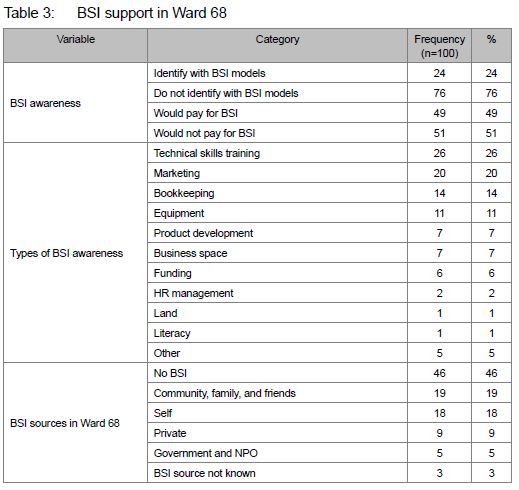
BSI is defined by a wide range of support activities from different service providers. It includes the different ways in which businesses collaborate to support each other (i.e. business networks). The participants provided a range of responses to the benefits of BSI, despite them not being strongly accessed across the sample; 76% surveyed did not know about support; 46% had no form of BSI support, and 51% would not pay for BSI (see Table 3). Participants were most aware of technical skills training (25%) and marketing (20%) in terms of the type of BSI support. The survey showed that 19% identified community, family, and friends as invaluable in support for HBEs. Those who did not know about BSI were interested to find out more about how to access services, while those who received support actively sought ways to grow and invest in their businesses.
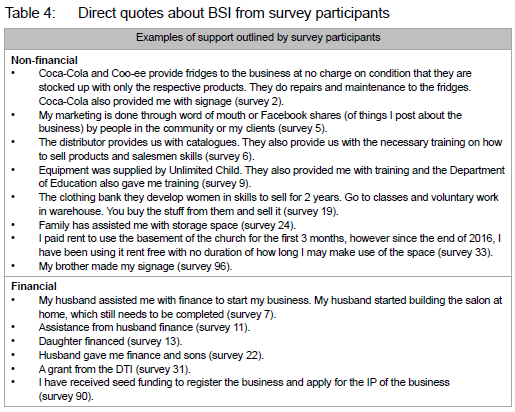
In Table 4, the direct quotes from participants represent the financial or non-financial benefits of BSI. The study found that there was a mix of both financial and non-financial business support to the 24 surveyed participants who confirmed that they received business support. In cases of programmatic support from government-funded programmes, the HBEs often received a combination of support. In addition to the BSI identified by surveyed participants, some responses indicated that the use of private consultants for activities such as bookkeeping, self-funding/obtaining private investment, and improving education was important for business owners in establishing and growing their HBEs.
Both surveyed and interviewed participants mentioned that registration with the eThekwini Municipal business support database enabled them to benefit from monitoring, evaluation, and BSI services. For example, the relevant authorities that monitor health and safety conduct inspections on businesses (KII5: eThekwini HBE, 26.07.2018). In another example, a crèche was able to access clinic and social development support because of being part of a business network that was registered with the city (KII: eThekwini HBE, 05.09.2018). Participants strongly distinguished between empowerment and dependency in terms of support models for BSI. Businesses appreciated the capital and resource inputs that some types of BSI delivered. However, they were not impressed by shortterm dependency models (KII: eThekwini HBE, 26.07.2018). Models of dependency were created by support interventions which assisted businesses in ways that made them reliant on the BSI for access to work, equipment, and/or additional skilled labour. The preferred BSI models provide practical and financial stimulus, enabling the business owner to learn and grow without reliance on the supporter (KII: eThekwini HBE, 26.07.2018). Businesses identified that having officials approve their business provided additional credibility to their HBEs and helped them improve, either via mentorship or by identifying and providing additional BSI.
Other benefits of BSI were that HBEs could learn from more experienced and skilled professionals. An example of this is that business mentors help entrepreneurs develop better habits and improve skills, levels of service, and/or business growth. With further strategic implementation, there is potential for BSI to have increased positive impacts for HBEs.
5.3
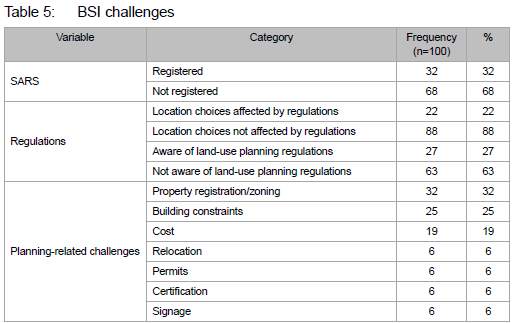
The challenges for BSI and HBEsThere are several challenges for businesses in residential zones (see Table 5), including the physical space and built form. These challenges are related to regulations, zoning, permits, and building constraints that have spatial impact and implications for urban planning. For example, nearly 63% of the participants were unaware of any land-use planning regulations and 88% of the participants felt that their business location was not affected by regulations, making the push towards formalisation and regulatory compliance more challenging. Planning-related challenges experienced by participants included property registration (32%), building constraints (25%), costs (19%), permits, certification, relocation, and signage.
Government-led BSI do not include compliance with all regulations but with those that are department specific. HBEs can evade compliance because they are invisible to authorities if they do not register, for example 68% were not registered with SARS and remained 'unseen'.
More strategic interventions are required for HBEs to enable appropriate growth and development in the spaces where they operate.
5.4
Implications of supporting HBEs for urban planningData showed that business networks in Ward 68 were often effective in addressing common issues with relevant authorities. Mobilising around challenges is an approach that can transform spaces for informal business sectors. The exploitative dimensions mentioned in Skinner (2019) can be addressed with BSI to include government protections. In an interview with a member of the business network for ECD centres, the Wentworth Creche Forum was mentioned, which is an example showing operative challenges of home-based crèches (KII: eThekwini HBE, 05.09.2018) and how the municipality was involved in supporting them.
The Wentworth Crèche Forum mobilised HBEs that faced similar challenges in land-use zoning, business registrations, equipment, and skills development. They decided to formalise a network to communicate with eThekwini Municipality (Durban). The HBE ECD centres could not meet some of the requirements typically assigned to operating an ECD centre, which included spatial elements of access points, separation of property, and land-use rezoning. Over a five-year period, the network advocated for a special consent for their properties from the municipality and were successful in getting this approved (KII: eThekwini HBE, 26.07.2018). The special consent from the municipality had to be renewed every two years and it only applied to those businesses that are part of the network and not to all ECD centres. Frameworks and strategic plans in Durban are shifting to sustainable development, but the development needs of townships must balance economic activities within residential zones via mechanisms such as integrated development planning (eThekwini Municipality, 2016).
The spatial and economic policy aims to address injustice and transformation of space with collaborative interventions (Charman et al., 2017). BSI has the potential to be applied as a tool for collaborative approaches towards economic development. The current zoning tends to maintain the status quo of the township as purely residential; this may perpetuate exclusion and segregation in space at local level. As with the ECD centres, the vast majority of businesses surveyed with different levels of formal and informal practices made efforts to follow the correct procedures in establishing and operating their enterprises. In this area, there is no overarching BSI or development strategy for different HBE sectors and HBEs are vulnerable to independent complaints. The increasing land-use changes can increase injustice, by setting exclusionary or misaligned precedents for supporting economic development at a local level.
Registration and/or licensing with appropriate regulatory bodies indicated that HBEs were making efforts to understand and comply with regulations. While some were more administratively competent, others were focused on their technical skills. They thus struggled with administrative processes. According to a participant, "they say that we must be fully registered, which is a battle because we have been trying for so many years to get registered. We have been up-and-down to social development and the files get lost or the files are ... [pause] ... so it's just we [sic] been fighting" (KII: eThekwini HBE, 26.07.2018). The disdain for bureaucracy presented itself in different ways across the interviews with key informants. There was frustration associated with paperwork requirements across the spectrum of businesses. While compliance itself was not rejected, the methods and time required to follow the processes involved were onerous and the relevance of the administration was questioned by HBE and BSI practitioners. Some of the obstacles to compliance were requests for building plans (for fences and additional structures to property), re-zoning, low finances, and expectations of the expenses associated with compliance, uncertainty of being able to continue to work from home, and time pressure of entrepreneurs who do not factor in additional time to compile applications/registrations that are not directly part of their business operations. The lack of knowledge about regulations and requirements for business to operate was apparent in the survey responses. A participant stated: "Not sure of what regulations I am not complying with, but I would be interested to know what I need to comply with. We would like the property to remain residential instead of rezoning it. This is my house as well" (survey 67). A significant finding of this study is that the support for compliance could be better conceptualised for HBEs.
Durban established inclusive and flexible plans to address the issues of informality. This offers an alternative approach to working with informal workers in the form of transforming business from informal to formal (eThekwini Municipality, 2001). This process is contentious in the context of residential areas because of the red tape, perceived expenses, and lack of buy-in from all stakeholders. Collaborative networks can apply pressure on local government and shift the dynamics to find inclusive ways of doing business in areas not zoned for the activities. This means that spaces are 'changed' as a result, and that a similar protocol could be developed to apply to those affected by similar challenges. However, it is noted that the ECD network was not strategically placed and had limited influence at the time of the application for special consent. The concerns for spatial impact that resulted from a range of business actions, support, and city planning need more attention. The invisibility of HBEs remains a challenge for delivering BSI.
Practitioners challenged when it came to finding businesses to support. One of the participants working in an NGO who provided BSI confirmed that "for now we have not yet identified businesses that are operating at the backyard at home of which that one is informal, we haven't gone to that level" (KII: eThekwini NGO, 13.11.2018). Visibility and access to businesses are important for planning and implementing BSI because the needs of different businesses vary. BSI can provide linkages for planning and economic development to support sustainable livelihoods that are resulting from HBEs (PPT, 2016; Bohme & Thiele, 2012). Working with the Informal Economy Support Programme (IESP), a business support programme in 2016 revealed that businesses were identified by visible markers such as signage. Therefore, a lack of visible appearance to indicate a business may result in exclusion. However, the lack of signage also shows that businesses are communicating with clients differently. Other means of communication such as online tools used by HBEs should be explored.
One local network that supported businesses was the 'MBK ADVERTS and NOTICES' WhatsApp group, which was created on 15 February 2019. The group had six administrators and 246 participants in 2020; this group became too large and a second group of 256 participants was created on 20 January 2020. Further evidence that not all HBEs necessarily rely on visibility in physical space could be found in the following explanation of one BSI practitioner: "if you are a business that relies on visibility of your premises then residential [area] is a problem - either you are going to struggle or you are going to annoy all your neighbours by putting up big signs . if you run your business that doesn't have a lot of that sort of thing and you do not have a lot of people coming to see you, then you can run any business from home" (KII: eThekwini Private sector, 12.09.2018). Online and word-of-mouth advertising were frequently used, with technology that used less data, such as WhatsApp. The use of online communication is strategic for enterprises and provides an increasing audience for HBE networking and marketing.
BSI needed to be more inclusive of HBEs in residential zones and more aware of the role it inherently holds in obtaining information that can contribute to the development needs of local HBE spaces. Workspaces are changing. HBEs are redefining suburban nodes. Re-shaping of space is rapidly occurring, due to 'invisible' businesses with implications for urban planning and management.
6. CONCLUSION
Urban planning plays a crucial role in shaping economic development, particularly concerning the perceived encroachment of businesses on residential areas. Support for such development should be contingent upon the potential for enhanced service provision within the community. In areas such as Ward 68, which is characterised by historical conflicts in land use, initiatives must prioritise optimising services, facilities, and amenities to foster more inclusive and socially just spaces. Reducing poverty through local economic development was expounded in policy. However, the implementation and integration of HBEs requires more urban planning knowledge within the city's spatial precincts.
The data showed creativity and receptiveness for BSI from HBEs, with a strong distinction and preference for empowerment over dependency support models. The application of business support intersects different disciplines. Some enterprises effectively mobilised to support viable opportunities, but as in the case of home-based crèches, the impact was limited to those who were aware of/or could participate in the forum at that time. Informal businesses are expected to transform by transitioning to formality, but residential spaces are formed and shaped by informal HBEs, not the other way around. In residential zones, informal businesses have an impact on the access to suburban spaces as well as influence the social processes of the community and individuals in the area.
Addressing inefficiencies between government-led economic and urban development is important, especially when considering the conflicting goals of supporting informal businesses and addressing spatial challenges in residential zones. The inefficiencies primarily revolve around conflicting priorities and challenges in integrating informal businesses into formal urban planning frameworks. These inefficiencies have presented as zoning, regulatory, and spatial challenges for HBEs. Urban development often relies on zoning regulations that do not strategically accommodate informal businesses, leading to regulatory barriers for informal businesses. Informal businesses, particularly HBEs, face challenges with basic infrastructure and services such as utilities, transportation, and market linkages. BSI have linkages into economic development that offer support for the growth and sustainability of informal businesses. However, informal businesses operating within residential zones encounter unique legal and regulatory constraints related to land use, taxation, licensing, and permits that require specialised support. Economic development goals aimed at supporting these businesses contradict urban development policies that prioritise formalisation and compliance with regulatory frameworks.
Spatial constraints such as limited physical space and congestion within residential zones can further exacerbate the challenges faced by HBEs. Urban development interventions, solely focused on spatial planning, may overlook the unique needs and dynamics of HBEs, leading to inefficiencies in resource allocation. Developing local mixed methods case studies can enhance understanding of HBEs for town planning, as well as facilitating more responsive BSI tailored to informal businesses in residential areas. Overall, the contradiction arises from the tension between fostering economic development and maintaining the rights of different users in urban development zones. Supporting informal businesses within residential zones requires an approach that addresses the specific challenges HBEs face, while maximising on the opportunities to adapt to change, in order to balance the broader goals for development in Durban.
REFERENCES
2. LITERATURE REVIEW
-
BABERE, N.J. 2015. Social production of space: 'Lived Space' of informal livelihood operators; the case of Dar es Salaam city, Tanzania. Current Urban Studies, 3, pp. 286-299. https://doi.org/10.4236/cus.2015.34024
» https://doi.org/10.4236/cus.2015.34024 -
BALLARD, R. 2012. Geographies of development: Without the poor progress in human geography. Human Geography, 36(5), pp. 563-572. https://doi.org/10.1177/0309132511431933
» https://doi.org/10.1177/0309132511431933 -
BAYAT, A. 1997. Un-civil society: The politics of the 'informal people'. Third World Quarterly, 18(1), pp. 53-72. https://doi.org/10.1080/01436599715055
» https://doi.org/10.1080/01436599715055 -
BERGER, A. & UDELL, G. 1998. The economics of small business finance: The roles of private equity and debt markets in the financial growth cycle. Journal of Banking & Finance, 22(6-8), pp. 613-673. https://doi.org/10.1016/S0378-4266(98)00038-7
» https://doi.org/10.1016/S0378-4266(98)00038-7 -
BOHME, M. & THIELE, R. 2012. Informal-formal linkages and informal enterprise performance in urban West Africa. Washington, DC: World Bank. https://doi.org/10.1596/26787
» https://doi.org/10.1596/26787 - BROWN, A. & KRISTIANSEN, A. 2009. Urban oplicies and the right to the city: Rights, responsibilities, and citizenship. Paris: UNESCO-UN-HABITAT.
-
CHARMAN, A., PETERSEN, L., PIPER, L., LIEDMAN, R. & LEGG, T. 2015. Small area census approach to measure the township informal economy in South Africa. Journal of Mixed Methods Research, 11(1), pp. 36-58. https://doi.org/10.1177/1558689815572024
» https://doi.org/10.1177/1558689815572024 - CHARMAN, A., TONKIN, C., DENOON-STEVENS, S. & DEMEESTERE, R. 2017. Post-apartheid spatial inequality: Obstacles of land use management on township micro-enterprise formalisation. A Report by the Sustainable Livelihoods Foundation.
-
COBBINAH, P.B. 2023. The oddity of desiring informality. Dialogues in Human Geography, pp. 1-5. https://doi.org/10.1177/20438206231191737
» https://doi.org/10.1177/20438206231191737 -
COHEN, D. & CRABTREE, B. 2006. Qualitative research guidelines project. Princeton, NJ: Robert Wood Johnson Foundation. [Online]. Available at: http://www.qualres.org/HomeTria-3692.html [Accessed: 7 May 2017].
» http://www.qualres.org/HomeTria-3692.html - CRESWELL, J. & PLANO-CLARK, V. 2018. Designing and conducting mixed methods research. 3rd edition. Thousand Oaks, CA: Sage Publications.
-
DAWSON, H.J. 2021. Making plans through people: The social embeddedness of informal entrepreneurship in urban South Africa. Social Dynamics, (47)3, pp. 389-402. https://doi.org/10.1080/02533952.2021.1909949
» https://doi.org/10.1080/02533952.2021.1909949 - DAYARAM, T. 2021. The role of business support interventions in promoting spatial justice: A case study of informal economic development in a residential zone, eThekwini (Ward 68). Unpublished PHD dissertation, Durban University of Technology.
- DE SOTO, H. 2000. The mystery of capital: Why capitalism triumphs in the West and fails everywhere else. New York: Basic Books.
-
DEVELOPMENT POLICY RESEARCH UNIT. 2006. Impact of municipal regulations on SMMEs. Working Paper 06/107. [Online]. Available at: http://ssrn.com/abstract=967624 [Accessed: 18 November 2017].
» http://ssrn.com/abstract=967624 -
DSBD (SOUTH AFRICA, DEPARTMENT OF SMALL BUSINESS DEVELOPMENT). 2017. National Informal Business Upliftment Strategy. [Online]. Available at: http://www.dsbd.gov.za/?page_id=1224 [Accessed: 18 November 2017].
» http://www.dsbd.gov.za/?page_id=1224 -
DSBD (SOUTH AFRICA, DEPARTMENT OF SMALL BUSINESS DEVELOPMENT). 2019. Annual review: Small business and cooperatives in South Africa. [Online]. Available at: http://www.dsbd.gov.za/?wpdmpro=2016-annual-review-of-small-businesses-and-cooperatives-south-africa [Accessed: 1 May 2020].
» http://www.dsbd.gov.za/?wpdmpro=2016-annual-review-of-small-businesses-and-cooperatives-south-africa -
DSBD (SOUTH AFRICA, DEPARTMENT OF SMALL BUSINESS DEVELOPMENT). 2020. National Informal Business Upliftment Strategy (NIBUS). [Online]. Available at: http://www.dsbd.gov.za/?page_id=1224 [Accessed: 17 October 2020].
» http://www.dsbd.gov.za/?page_id=1224 -
ETHEKWINI MUNICIPALITY 2001. Durban's informal economy policy. eThekwini Unicity Municipality. [Online]. Available at: http://www.durban.gov.za/City_Services/BST_MU/Documents/Informal_Economy_Policy.pdf [Accessed: 22 April 2021].
» http://www.durban.gov.za/City_Services/BST_MU/Documents/Informal_Economy_Policy.pdf -
ETHEKWINI MUNICIPALITY 2016. Embracing micro business in the informal economy, eThekwini EDGE (Economic Development and Growth in eThekwini), Durban. [Online]. Available at: http://www.durban.gov.za/Resource_Centre/edge/Documents/Edge%2017th%20Edition%20Microbusiness%20in%20the%20Informal%20Economy.pdf [Accessed: 22 April 2021].
» http://www.durban.gov.za/Resource_Centre/edge/Documents/Edge%2017th%20Edition%20Microbusiness%20in%20the%20Informal%20Economy.pdf - HARLACHER, J. 2016. An educator's guide to questionnaire development (REL 2016-108). Washington, DC: U.S. Department of Education.
-
HARRISON, P., TODES, A. & WATSON, V. 2008. Planning and transformation: Learning from the post-apartheid experience. London: Routledge. https://doi.org/10.4324/9780203007983
» https://doi.org/10.4324/9780203007983 -
HARVEY, D. 2008. The right to the city. New Left Review, 53. [Online]. Available at: <https://newleftreview.org/issues/ii53/articles/david-harvey-the-right-to-the-city> [Accessed: 22 April 2021].
» https://newleftreview.org/issues/ii53/articles/david-harvey-the-right-to-the-city -
IEJ (INSTITUTE FOR ECONOMIC JUSTICE). 2018. Informal economy / sector. [Online]. Available at: https://www.iej.org.za/stream-3-policy-brief-1-informal-economy-sector/ [Accessed: 22 April 2021].
» https://www.iej.org.za/stream-3-policy-brief-1-informal-economy-sector/ -
ILO (INTERNATIONAL LABOR OFFICE). 2014. Transitioning from the informal to the formal economy. International. Labour Conference, 103rd Session, Geneva. [Online]. Available at: http://www.ilo.org/wcmsp5/groups/public/---ed_norm/---relconf/documents/meetingdocument/wcms_218128.pdf [Accessed: 22 April 2021].
» http://www.ilo.org/wcmsp5/groups/public/---ed_norm/---relconf/documents/meetingdocument/wcms_218128.pdf -
KAMETE, A.Y. 2018. Pernicious assimilation: Reframing the integration of the urban informal economy in Southern Africa. Urban Geography, 39(2), pp. 167-189. https://doi.org/10.1080/02723638.2017.1298219
» https://doi.org/10.1080/02723638.2017.1298219 - KAPOOR, R. & KRISHNAPRIYA, P.P. 2017. Informality in the formal sector: Evidence from Indian manufacturing. F-35316-INC-1. International Growth Center.
- KUMAR, R. 2011. Research methodology: A step-by-step guide for beginners. 3rd edition. London: Sage publications.
-
LAING, E., VAN STEL, A. & STOREY, D.J. 2021. Formal and informal entrepreneurship: A cross-country policy perspective. Small Business Economics, 59, pp. 807-826. https://doi.org/10.1007/s11187-021-00548-8
» https://doi.org/10.1007/s11187-021-00548-8 -
LUND, F. & SKINNER, C. 2005. Creating a positive business environment for the informal economy: Reflections from South Africa. The International Donor Conference, 'Reforming the Business Environment', 27 November 2004, Cairo, (26)4, pp. 431-456. https://doi.org/10.3828/idpr.26.4.5
» https://doi.org/10.3828/idpr.26.4.5 -
MABIN, A. 2005. Suburbanisation, segregation, and government of territorial transformations. Transformation: Critical Perspectives on Southern Africa, 57, pp. 41-63. https://doi.org/10.1353/trn.2005.0030
» https://doi.org/10.1353/trn.2005.0030 - MALOKA, C.M. 2015. SMMES support programmes for robust local economic development in South Africa. In: SAAPAM 4th Annual Conference Proceedings, Limpopo Chapter 2015, University of Limpopo, South Africa, pp. 344-355.
-
MCFARLANE, C. 2012. Rethinking informality: Politics, crisis, and the city. Planning Theory & Practice, (13)1, pp. 89-108. https://doi.org/10.1080/14649357.2012.649951
» https://doi.org/10.1080/14649357.2012.649951 - PPT (PROJECT PREPARATION TRUST). 2016. lESP Pilot Phase Self-Evaluation Report. Durban: Project Preparation Trust.
-
ROY, A. 2005. Urban informality: Toward epistemology of planning. Journal of the American Planning Association, 71(2), pp. 147-158. https://doi.org/10.1080/01944360508976689
» https://doi.org/10.1080/01944360508976689 - SDCEA (SOUTH DURBAN COMMUNITY ENVIRONMENTAL ALLIANCE). 2016. Mapping perceptions of the Clairwood Business Community. Ford Foundation.
-
SEDA (SMALL ENTERPRISE DEVELOPMENT AGENCY). 2011. Service offerings. [Online]. Available at: http://www.seda.org.za/ServicesOfferings/Training/Pages/Home.aspx [Accessed: 18 November 2017].
» http://www.seda.org.za/ServicesOfferings/Training/Pages/Home.aspx -
SKINNER, C. 2019. Informal-sector policy and legislation in South Africa: Repression, omission and ambiguity. [Online]. Available at: https://www.researchgate.net/publication/333668377_Informal-sector_policy_and_legislation_in_South_Africa_Repression_omission_and_ambiguity [Accessed: 22 April 2021].
» https://www.researchgate.net/publication/333668377_Informal-sector_policy_and_legislation_in_South_Africa_Repression_omission_and_ambiguity -
SMITH, D.M. 2005. On the (im) possibility of social justice in South Africa. Transformation, 58, pp. 45-65. https://doi.org/10.1353/trn.2005.0041
» https://doi.org/10.1353/trn.2005.0041 -
SOJA, E. 2010. Seeking spatial justice. Minnesota: University of Minnesota Press. https://doi.org/10.5749/minnesota/9780816666676.001.0001
» https://doi.org/10.5749/minnesota/9780816666676.001.0001 - SOUTH AFRICA. 2002. Municipal Systems Act, Act 32 of 2000. Pretoria: Government Printer.
- SOUTH AFRICA, DEPARTMENT OF TRADE AND INDUSTRY 1995. The White Paper on National Strategy for the Development and Promotion of Small Business in South Africa, WPA 16317: 20 March 1995. Pretoria: Government Printer.
- SOUTH AFRICA, NATIONAL PLANNING COMMISSION (NPC). 2012. National Development Plan 2030: Our future - Make it work. Pretoria: Government Printer.
- SOUTH AFRICA, NATIONAL TREASURY 2014. Guidance note for the Built Environment Performance Plan 2015/16-2017/18. Pretoria: Government Printer.
-
STATSSA (STATISTICS SOUTH AFRICA). 2024. Economy. [Online]. Available at: https://www.statssa.gov.za/?page_id=737&id=1 [Accessed: 26 November 2023]
» https://www.statssa.gov.za/?page_id=737&id=1 - SWAMINATHAN, M. 1991. Understanding the 'informal sector': A survey. World Institute for Development Economics Research. Wider Working Papers. Cambridge, MA: Centre for International Studies, pp.1-38.
-
TUROK, I. & BOREL-SALADIN, J. 2013. The spatial economy. Background Research Report for the Integrated Urban Development Framework. HSRC. [Online]. Available at: https://www.cogta.gov.za/cgta_2016/wp-content/uploads/2016/05/TUROK-SPATIAL-ECONOMY-DRAFT-FINAL.pdf [Accessed: 22 April 2021].
» https://www.cogta.gov.za/cgta_2016/wp-content/uploads/2016/05/TUROK-SPATIAL-ECONOMY-DRAFT-FINAL.pdf -
WACHSMUTH, D. & BRENNER, N. 2014. Introduction to Henri Lefebvre's 'Dissolving city, planetary metamorphosis'. Environment and Planning D: Society and Space, 32, pp. 199-202. https://doi.org/10.1068/d3202int
» https://doi.org/10.1068/d3202int - WARIAWA, A. 2014. Investigating the 'regulation' of economic activities in Mohlakeng Extension 7. BSc Hons project (Urban and Regional Planning), School of Architecture and Planning, University of the Witwatersrand.
-
WEIGO (WOMEN IN INFORMAL EMPLOYMENT, GLOBALISING AND ORGANISING). 2017. Home-based workers. [Online]. Available at: http://www.wiego.org/informal-economy/occupational-groups/home-based-workers [Accessed 3 February 2019].
» http://www.wiego.org/informal-economy/occupational-groups/home-based-workers -
WILLIAMS, C. 2015. Tackling entrepreneurship in the informal sector: An overview of the policy options, approaches and measures. Journal of Developmental Entrepreneurship, (20)1, pp. 1-21. https://doi.org/10.1142/S1084946715500065
» https://doi.org/10.1142/S1084946715500065
Peer reviewed and revised: July 2024
Published: December 2024
1 A 'township' as referred corresponds to the following definition of the SLF; "Commonly refers to low-income urban suburbs with little or no formal economic developments. Specifically, the term refers to residential areas that during apartheid were reserved for non-whites (Africans, Coloureds and Indians) who lived near or worked In areas that were designated "white only'. Townships are usually situated on the margins of urban settlements" (Charman et al., 2017: 7). This statement infers the official categories of race during apartheid, namely 'White', 'Coloured', 'Indian', and 'Black'.
2 Lund and Skinner (2005) acknowledge that the non-White groups were commonly referred to as Black but stated that the distinction had to be made as the apartheid government had differently imposed legislation on and resource allocation to four groups. The study found that residents chose to self-identify into those four groups and to "use terminology such as 'our people' in describing a race-based sense of space". Therefore, the racial distinctions were still relevant to the research.
3 Considering the lack of data available on informal enterprise income, the study defines the size of an SMME according to the number of employees (DSBD, 2019; PPT, 2016; SEDA, 2011).
4 The COVID-19 pandemic has changed our world. These spatial impacts affect economics, the natural environment, and social processes in the urban environment. In an article from WEIGO, Women in informal employment: globalising and organising, Harvey (2020) reflects on the perspective of informal work and on exclusionary planning. The event is not unprecedented; the disruptions to human habitats range from global pandemics to enforced legislation for segregation which have lingering impacts in different spaces. COVID-19 impacts on all spheres of our habitat, from how we will re-use space to how we design new space and processes. The effects of the pandemic on job creation are beyond the scope of this study.
5 Key informant interview (KII)