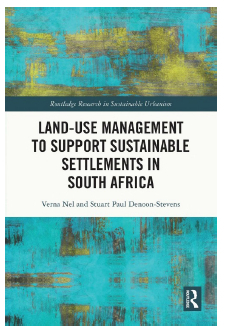
Land-use management to support sustainable settlements in South Africa
Martin Lewis
Town Planner, Pretoria, South Africa. Email: https://orcid.org/0000-0003-3460-0525
Authors: Verna Nel and Stuart Paul Denoon-Stevens
Publisher: Routledge, London
ISBN: 978-0-367-63910-5
Date: 2024
In a conference paper delivered in 2006 at the Planning Africa Conference, I explored what an appropriate land-use management system could look like. It was argued that "the process of identifying the characteristic of an appropriate system should not be a once-off exercise, but rather an ongoing process where the role players should interact and relook/re-evaluate the existing process and procedures" (Lewis, 2006: 868). The book Land-use management to support sustainable settlements in South Africa is set to provide a theoretical and practical foundation needed to change the practice of land-use management in Southern Africa. The argument for change is the premise of changing values, technological developments, progression in medical science, changes in the standard of living, and globalisation. The authors highlight, inter alia, the increased emphasis on sustainability and climate change.
The book addresses Ave main areas, namely a discussion of the evolution of land-use management; planning theory and its applicability to the Global South; the question as to why the current system is inadequate for the South African context; the principles and options for a land-use management system to support sustainable and equitable settlements, and a southern approach to sustainable land-use management.
In the chapter "Evolution of landmanagement", the authors move from the early rules and generative codes and regulations based on zoning codes, towards providing an overview of the evolution of land-use management in South Africa. It starts with restrictive covenants during the early beginnings, through the first planning laws, the different Ordinances, the Development Facilitation Act, 1995 (DFA), the green paper, the white paper, the bills, and the Spatial Planning and Land Use Management Act, 2013 (SPLUMA). Students starting off their studies in Urban and Regional Planning and related disciplines will And this chapter valuable in understanding the progression of land-use management. They will then be able to identify that within the South African context.
It is then appropriate that the authors discuss planning theory and its applicability to the Global South. It is evident from this chapter that not all concepts from the North can be directly translated into Southern situations. The authors indicate that southern scholars have highlighted that "the Northern theories, when applied to the Global South, are often anachronistic and inappropriate for the contexts of the South" (Nel & Denoon-Stevens, 2024: 37).
With the fall of apartheid and the rise of democracy in South Africa, there is still spatial fragmentation. In Chapter 4, the authors set out to answer why the current system is inadequate for the South African context. Reasons for the system's inadequacy relate to problems such as the inequality and exclusions created through colonial systems, and traditional areas under the administration of traditional leadership. It is also indicated that land-use management regulations have not been designed for indigenous cultural practices. The existence of informality and the substantial reliance on income through the informal economy and systems have typically not been taken into account in the development of land-use management systems. South Africa is plagued with an unemployment rate of 32.1%, as reported in the fourth quarter of 2023 (StatsSA, 2023). With many people thus being reliant on the informal economy, the "exclusion" of informality in a system highlights and magnifies the inadequacy of such a system. Some further causes for our current state of affairs identified by the authors relate to power, politics, and corruption; conflicting and competing rationalities; customary land tenure and contested leadership, as well as capacity, bureaucracy, and the aspirations' mismatch.
Chapter 5 discusses the principles and options for a land-use management system to support equitable and sustainable settlements. Through the DFA (South Africa, 1995) and then SPLUMA (South Africa, 2013), land-development principles were set to guide the achievement of sustainable and equitable settlements. The authors highlight some principles that informed the proposals towards more equitable and sustainable settlements. These include acknowledging and working with change, changing lifestyles, changing technologies, and changing circumstances. Another relates to the fact that land-use regulations can change. If a regulation is no longer fit for purpose, it should be changed or replaced. SPLUMA typically resulted in the requirement for existing land-use management systems to change. Others include regenerative sustainability, social justice and inclusion, economic development and livelihoods. The importance of context was also highlighted. A one-size-fits-all system approach may not be suitable in all instances.
The authors also explored a number of other systems and tools that can be used in the development of a land-use management system that can accommodate the diversity of settlements in Southern Africa.
In the final chapter, the authors present suggestions for a Southern approach to sustainable land-use management. It is suggested that different zones could fall within different forms of land-use management, but the processes should be comparable. There could also be an exploration of different processes, some more simplified, based typically on the complexity of the change or the potential impact. There is also the possibility of simplifying the system, thus streamlining the application and development options. This could have time and cost-saving implications.
What makes this book unique is the focus on the Global South and a southern approach to sustainable land-use management. It provides a critical evaluation of an existing system and presents an alternative land-use management system for South African municipalities, offering valuable insights for policymakers, planners, and practitioners seeking to promote sustainable settlements and equitable land-use management in South Africa and Southern Africa.
REFERENCES
- Lewis, M.P. 2006. An appropriate land-use management system for present-day South Africa - How roles could change. In: Cullinan, M., Madell, C. & Watson, V. (Eds). Proceedings of the Planning Africa 2006 Conference, pp. 866-889.
-
Nel, V. & Denoon-Stevens, S.P. 2024. Land-use management to support sustainable settlements in South Africa. London: Routledge. https://doi.org/10.4324/9781003121312
» https://doi.org/10.4324/9781003121312 -
South Africa. 1995. Development Facilitation Act, 1995. Act 67 of 1995. Government Gazette. https://www.gov.za/sites/default/flles/gcis_document/201409/act67of1995.pdf [Accessed 8 April 2024].
» https://www.gov.za/sites/default/flles/gcis_document/201409/act67of1995.pdf -
South Africa. 2013. Spatial Planning and Land-Use Management Act, 2013. Act 16 of 2013. Government Gazette. https://www.gov.za/sites/default/flles/gcis_document/201409/367305-8act16of20.pdf [Accessed 8 April 2024].
» https://www.gov.za/sites/default/flles/gcis_document/201409/367305-8act16of20.pdf -
StatsSA. 2023. Key findings: P0211 - Quarterly Labour Force Survey (QLFS), 4th Quarter 2023. https://www.statssa.gov.za/7page_id=1856&PPN=P0211&SCH=73574 [Accessed 8 April 2024].
» https://www.statssa.gov.za/7page_id=1856&PPN=P0211&SCH=73574