Turning land into property: Caste, speculation, and social inequality in India's peri-urban areas
Abstract
Speculative urbanism has become a defining feature of contemporary city-making in India, yet the role of local actors in shaping speculative landscapes remains underexplored. This article examines the transformation of land into property in Delhi's peri-urban frontier, with a focus on Noida Extension. Drawing on 65 semi-structured interviews and field observations, it examines how dominant caste landowners leverage political ties, financial capital, and social networks to convert agrarian land into rental housing and speculative ventures. Territorial practices such as informal development, partnerships with builders, and symbolic constructions illustrate how speculation is simultaneously a material, social, and political process that produces new hierarchies while reproducing older ones. For marginalised groups, particularly Dalits, these transformations result in exclusion from emergent property regimes and limited access to urban accumulation. By situating grassroots speculation within wider state-capital assemblages, the article argues that peri-urban transformation is not only about dispossession but also about differentiated accumulation. In doing so, it contributes to the existing literature on speculative urbanism and territorialisation, by highlighting how peri-urban development in India is a process of property-making that reshapes social inequality and reconfigures caste politics.
Speculative urbanism; caste; land speculation; exclusion; peri-urban; territorialisation
Abstract
Spekulatiewe verstedeliking het 'n bepalende kenmerk van kontemporêre stadvorming in Indië geword, maar die rol van plaaslike akteurs in die vorming van spekulatiewe landskappe bly onderontgin. Hierdie artikel ondersoek die transformasie van grond na eiendom in Delhi se peri-stedelike grensgebied, met 'n fokus op Noida-uitbreiding. Deur gebruik te maak van 65 semi-gestruktureerde onderhoude en veldwaarnemings, ondersoek dit hoe dominante kaste-grondeienaars politieke bande, finansiële kapitaal en sosiale netwerke benut om landbougrond in huurbehuising en spekulatiewe ondernemings te omskep. Territoriale praktyke soos informele ontwikkeling, vennootskappe met bouers en simboliese konstruksies illustreer hoe spekulasie gelyktydig 'n materiële, sosiale en politieke proses is wat nuwe hiërargieë skep terwyl ouer hiërargieë herproduseer word. Vir gemarginaliseerde groepe, veral Dalits, lei hierdie transformasies tot uitsluiting van opkomende eiendomsregimes en beperkte toegang tot stedelike akkumulasie. Deur grondvlakspekulasie binne wyer staatskapitaal-samestellings te plaas, voer die artikel aan dat peri-stedelike transformasie nie net oor onteiening gaan nie, maar ook oor gedifferensieerde akkumulasie. Deur dit te doen, dra dit by tot die bestaande literatuur oor spekulatiewe verstedeliking en territorialisering deur uit te lig hoe peri-stedelike ontwikkeling in Indië 'n proses van eiendomsmaking is wat sosiale ongelykheid hervorm en kastepolitiek herkonfigureer.
Abstract
Ho aha ka boikaketsi e se e le letsoao le ka sehloohong la nts'etsopele ea litoropo India, empa karolo ea batho ba moo ho bopa libaka tse ncha e ntse e sa hlalosoa ka botlalo. Sengoloa sena se hlahloba phetoho ea mobu ho ba matlo libakeng tse ka thoko ho Delhi, ka ho shebana le katoloso ea Noida. Ka ho sebelisa lipuisano tse 65 tse hlophisitsoeng le ho shebella ka kotloloho, se hlahloba kamoo beng ba mobu ba tsoang lichabeng tse phahameng ba sebelisang likamano tsa lipolotiki, chelete le marang-rang a sechaba ho fetola mobu oa temo hore e be matlo a hirisoang le merero ea boikaketsi. Mekhoa ea ho laola mobu, joalo ka nts'etsopele e seng molaong, likamano le baahi ba hahang le mehaho ea matsoao, e bontsa hore boikaketsi ke ts'ebetso ea lintho tse bonahalang, ea sechaba le ea lipolotiki e bõpang maemo a macha ha e ntse e tsosolosa a khale. Bakeng sa lihlopha tse hlekefetsoang, haholo-holo Dalits, liphetoho tsena li baka ho tlosoa tsamaisong e ncha ea matlo le ho fokotsa monyetla oa ho bokella leruo la litoropo. Ka ho beha boikaketsi ba mobu ka hare ho tsamaiso ea mmuso le chelete, sengoloa se re phetoho ea libaka tse ka thoko ha e bue feela ka ho amohuoa mobu, empa hape ka pokello e fapaneng ea leruo. Ka tsela ena, se kenya letsoho ho lingoliloeng tse teng ka boikaketsi ba litoropo le ho laola libaka ka ho bontsa kamoo nts'etsopele ea libaka tse ka thoko India e leng ts'ebetso ea ho fetola mobu hore e be matlo e fetolang phapang ea sechaba le lipolotiki tsa lichaba.
1. INTRODUCTION
Since the 1990s, economic liberalisation and market-oriented reforms have profoundly reshaped rural and peri-urban geographies in India. The expansion of cities into agrarian peripheries has produced new frontiers of speculative urbanism, marked by escalating land values and the conversion of farmland into real estate (Gururani, 2023; Jonnalagadda & Cowan, 2024; Shatkin, 2016). Land has thus become central to urban accumulation strategies, with land rent emerging as a dominant mechanism for value extraction in peri-urban India. Across the National Capital Region (NCR) and beyond, this transformation is most visible in spaces where once-agrarian communities are now integrated into circuits of urban growth driven by state planning and private capital.
State authorities, particularly development agencies such as the Noida and Greater Noida Industrial Development Authorities, have facilitated these transitions through policies aimed at land acquisition, conversion, and commodification. Drawing on powers of eminent domain, the state frequently collaborates with private developers to create 'land banks' for infrastructure, housing, and speculative investment (Goldman, 2021; Kennedy & Sood, 2016; Levien, 2011). Scholars note that such state-capital alliances have generated new governance rationalities that reconfigure landownership and alter the political economy of peri-urban spaces (Goldman & Narayan, 2021; Shatkin, 2016).
While this literature underscores the significance of state-capital nexuses, it raises a crucial question: What is the role of local actors?
Existing research on speculative and frontier urbanism has illuminated how state and corporate actors drive dispossession and transformation (Archer, 1973; Arif et al., 2023; Upadhya, 2023).
However, it often casts local residents either as passive victims of displacement or as heroic resisters. This binary framing obscures the complex and uneven ways in which villagers and other local actors engage with urban transitions. Herein lies the research gap: the lived, differentiated strategies of peri-urban villagers remain insufficiently examined. As Banks, Lombard and Mitlin (2020), Gautam (2021; 2025), and Sasu et al. (2024) demonstrate, access to land-based opportunities is deeply stratified - mediated by caste, class, gender, and political connections. In India, where land remains a critical resource tied to caste status and kinship networks, these inequalities are particularly pronounced.
Recent studies (Balakrishnan, 2019; Gururani, 2023; Upadhya, 2023; Gidwani & Reddy, 2011) reveal that caste continues to shape access to land, speculative partnerships, and governance institutions in the urbanising countryside. Yet villagers' speculative practices have rarely been studied as constitutive of peri-urban transformation in their own right. What remains underexplored is how grassroots speculation unfolds within villages and reshapes intra-community hierarchies, even as it links to wider state-capital assemblages.
The agency of rural actors in land speculation warrants closer scrutiny, particularly in how dominant caste groups transition into roles as developers, landlords, or brokers, while others are excluded from these circuits. In this light, the phenomenon of village-led urbanisation, where villagers act as informal developers or rentiers, becomes significant. This shift from viewing villagers as mere respondents to development, to recognising them as active, though unequal, agents provides a conceptual axis for this study. Scholars such as Abramson (2016), Cowan (2018), and Gururani (2024) emphasise the importance of these local dynamics in shaping urban expansion in India. Roy's (2009) call to 'recalibrate the geographies of authoritative knowledge' is especially relevant. Understanding India's peri-urban transformation requires attending to how villagers actively negotiate urban futures, not merely as recipients of development but as agents of its production.
Building on this critical turn in Global South urbanism, this article deepens the analysis through an empirical study of Noida Extension villages in the Delhi NCR. Specifically, it investigates how land speculation by villagers is shaped by internal social hierarchies and power structures. Dominant caste landowners increasingly partner with builders, construct rental housing, and enter speculative markets, whereas landless groups and non-dominant castes are frequently excluded from these gains. These exclusions are not only material but also territorial and symbolic, reflecting control over land, planning, and political patronage. Drawing on earlier work on land grabbing and village-level urban transformations (Gautam, 2025), this study argues that urbanisation in peri-urban India is a class- and caste-making process. It enables some villagers to convert agrarian assets into urban capital, while others remain confined to precarious labour markets and declining livelihood options. By foregrounding the territorial strategies, informal partnerships, and exclusions that shape speculative land practices, the article highlights how intra-village inequalities are being remade and often intensified through everyday engagements with urban expansion.
This study contributes to efforts to provincialise urban theory, by grounding it in India's complex social realities and examining the political economy of land in contemporary urban transitions. The introduction situates this analysis, by tracing the shift from large-scale peri-urban processes to the everyday geographies of caste, speculation, and inequality.
To further situate this study within broader Global South urban debates, this article also explicitly engages emerging conceptual vocabularies of extended, displaced, injected, and organic urbanisation. These frameworks - developed by scholars such as Schmid & Topalović, (2023), Brenner and Katsikis (2020), and Gururani (2020; 2024) - highlight how peri-urban transformation unfolds through multi-scalar, relational, and territorially uneven processes. Integrating these concepts clarifies how India's peri-urban expansion resonates with wider planetary patterns of urbanisation, while retaining local specificities shaped by caste, kinship, agrarian histories, and state-capital configurations.
Finally, the article draws on agent-based and collaborative theories, including assemblage urbanism (Durose et al., 2022), co-production (Mitlin & Bartlett, 2018), and relational agency (Cleaver & Whaley, 2018), to foreground how peri-urban transitions are co-constructed by villagers, bureaucrats, developers, and brokers. This positions villagers not merely within structures of dispossession but as differentiated actors embedded in networks of negotiation, territorialisation, and speculative aspiration.
2.1 Conceptual framework: Urbanisation vocabularies and theoretical integration
Contemporary scholarship on planetary urbanisation moves beyond city-centric models to capture diverse and relational processes shaping urban futures. Four conceptual vocabularies - extended, displaced, injected, and organic urbanisation - provide critical lenses for understanding these dynamics. Extended urbanisation highlights how urbanisation unfolds across agrarian, ecological, and infrastructural landscapes, challenging bounded notions of the urban (Schmid & Topalović, 2023; Woiwode et al. 2024; Chakrabarti & Mishra, 2025). Displaced urbanisation foregrounds the role of forced migration and development-induced displacement in restructuring urban peripheries and governance regimes (Wat & Morris, 2024). Injected urbanisation refers to remittance-driven transformations and circular labour migration that stimulate urban growth in rural regions without local agglomeration (van Duijne, Nijman & Choithani 2023). Finally, organic urbanisation emphasises integrated, adaptive urban-rural development rooted in ecological and cultural continuity (Lin, 2025).
To operationalise these concepts, this study engages agent-based modelling (ABM) and collaborative theories. ABM offers a computational approach to simulate interactions among heterogeneous actors - villagers, developers, and bureaucrats - whose decisions collectively shape peri-urban landscapes (Crooks et al., 2021; Guo & Liu, 2024). By modelling adaptive behaviours and spatial decision-making, ABM captures emergent patterns of land speculation, informal development, and governance fragmentation. This is particularly relevant for peri-urban India, where urbanisation is not linear but negotiated through micro-level strategies and contingent alliances.
Complementarily, collaborative theories, including co-production and assemblage urbanism, foreground the relational and negotiated character of urbanisation. Co-production emphasises participatory governance and the joint shaping of urban futures by state and non-state actors (Lee, Feiertag & Unger, 2024), while assemblage approaches conceptualise urbanisation as a dynamic constellation of practices, infrastructures, and institutions (Durose et al., 2022). These frameworks illuminate how peri-urban transitions are co-constructed through informal partnerships, territorial strategies, and distributed agency rather than top-down planning alone.
Integrating these perspectives enables a multi-scalar analysis. The vocabularies situate peri-urbanisation within planetary processes, while ABM and collaborative theories provide tools to examine localised agency and emergent complexity. Together, they advance an understanding of urbanisation as both structural and contingent, produced through global flows and grounded in everyday negotiations.
To situate this argument, four bodies of scholarship are particularly relevant, namely peripherisation and the agrarian-urban interface, land speculation in the periphery, territorialisation from above and below, and exclusion and differentiated urban citizenship.
2.2 Peripherisation and the agrarian-urban interface
Urban scholars in the postcolonial context have long argued that conventional theories of urbanisation, anchored in Western experiences, fail to explain the complexities of cities in the Global South (Robinson & Roy, 2016). Roy (2016) stresses that, in postcolonial cities, the 'urban question' is inseparable from the 'agrarian question', as the expansion of urban territories is deeply entwined with rural land systems, caste hierarchies, and agrarian livelihoods. Building on this, Gururani (2020) conceptualises 'agrarian urbanism' to denote hybrid spaces where agrarian social relations and landholding practices continue to shape urbanisation. This lens is particularly relevant to the 'urbanising frontiers' of India such as those in Delhi NCR, where state-led and speculative urbanisation strategies intersect with existing rural landscapes (Gururani & Dasgupta, 2018). Empirical studies illustrate how village territories are gradually absorbed into the metropolitan economy, often through ambiguous planning practices (Dubey, 2018; Gautam, 2025). The result is a fractured urban form, where informal self-built housing proliferates and municipal services lag behind. Caldeira's (2017) concept of 'peripheral urbanisation' further provides a critical framework to understand this growth. Unlike formal, state-sanctioned development, peripheral urbanisation unfolds through long-term, resident-driven processes of 'autoconstruction'. These dynamics are evident in villages around Greater Noida, where dominant caste landowners and local developers incrementally convert agricultural land into housing colonies, often without formal approval or infrastructure provisioning (Gautam, 2025).
2.3
Land speculation and the financialisaton of the peripheryPeri-urban areas in India are increasingly shaped by speculative land markets. Goldman (2021) characterises this as a turn toward 'speculative urbanism', where land speculation becomes the central mode of governance and statecraft. In India, this is evident in policies such as land pooling and corridor-based urban planning (e.g., DMIC and Smart Cities), which facilitate large-scale conversion of farmland into real estate assets. Lund (2019) and Smith (1996) describe such processes as unfolding within a 'frontier logic', where legal ambiguities, planning lapses, and informal practices create new territories for capital accumulation. In Delhi NCR, this has played out in places such as Yamuna Expressway, Noida Extension, and Ghaziabad, where local and corporate speculative actors collude to transform land into rent-generating property. Empirical studies from India corroborate these patterns. Gautam (2025) and Kennedy(2019)show how dominant-caste landowners convert their agrarian holdings into commercial and residential properties, often partnering with private developers. Levien's (2015) notion of 'land-broker state', where the state actively mediates land transactions between farmers and capitalists, blurs public-private boundaries. Such state-mediated speculation marginalises landless and smallholder groups, who rarely benefit from increased land values. This speculative urbanism reinforces caste capital (Bandyopadhyay & Barua, 2016; Deshpande, 2013), where upper-caste landowning groups use their historical advantage to monopolise the benefits of land commodification. The shift from agriculture to real estate thus becomes a class- and caste-making process in peri-urban India.
2.4
Territorialisation from above and belowTerritorialisation refers to the process whereby control over space is asserted, maintained, and contested. As Sack (1986) as well as Vandergeest and Peluso (1995) argue, territorialisation involves both inclusion and exclusion, often through the imposition of spatial boundaries and control over land use. While the state is often a principal territorialising agent, scholars such as Peluso and Lund (2011) as well as Rasmussen and Lund (2018) have shown that non-state actors such as caste groups, panchayats, and informal developers also territorialise space. In the Indian peri-urban context, territorialisation manifests through both formal zoning plans and informal practices such as boundary walls, entry gates, and kin-based control of housing clusters. Empirical studies from Noida Extension (Gautam, 2025) and Hyderabad (Sundaresan, 2017) show how dominant caste networks play a key role in negotiating with developers and local bureaucrats to retain control over formerly rural land, now fragmented into residential enclaves and commercial plots. The territorial logic of caste is critical, in this instance. As Gururani (2019) points out, the caste-land relationship in peri-urban India is undergoing transformation but remains central to how territory is demarcated and defended. For instance, in Bisrakh and other Noida Extension villages, dominant castes assert their spatial dominance through real estate ventures, community associations, and informal policing, thereby consolidating their urban citizenship, while others remain marginalised.
2.5 Exclusion and uneven urban citizenship
Exclusion is central to understanding peri-urban transformation, where processes of exclusion seem to be inherent in urban development. Peluso and Ribot (2020) emphasise that exclusion is not merely about the absence of legal rights but also about the absence of 'powers' or capabilities to benefit from land and its associated resources. In Delhi NCR, landless Dalits, OBCs, and migrant tenants are frequently excluded from land-based benefits, despite residing in urbanising villages for decades (Gautam,
2021). Empirical work by Gidwani and Reddy (2011), Reddy, Goli, and Rammohan (2021), and Upadhyaya and Rathod (2021) demonstrates how caste continues to shape access to land, livelihoods, and housing. In many urbanising villages, even when land is monetised, the benefits are distributed unequally, leading to the reproduction of historical hierarchies. For example, in the process of redevelopment or regularisation, landowners receive compensation or legal recognition, while tenants and informal settlers are evicted or criminalised (Cowan, 2018; Dubey, 2018). This resonates with the critique offered by Banks et al. (2020), who caution against binary views of urban poor as either passive victims or heroic resisters. Instead, peri-urban populations are internally differentiated by caste, class, gender, and migration status, affecting their strategies of negotiation, resistance, and adaptation to urban change.
This research frames peri-urban urbanisation as a class- and caste-making process shaped by land speculation, territorialisation, and unequal access to resources. It challenges the view of villagers as a uniform group under top-down policies, revealing varied positions - some integrated into landlord networks, others excluded. Moving beyond simple binaries of dispossession and resistance, it offers a nuanced perspective rooted in local hierarchies, historical landholding, and speculative ambitions. Conceptualised as 'speculative territorialisation', the study shows how land speculation in peri-urban India creates new markets, reshapes rural-urban intersections, and reinforces historical inequalities.
3. STUDY AREA
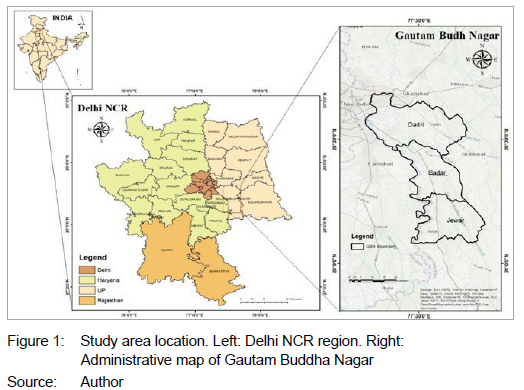
Noida Extension (Greater Noida West), located in Gautam Buddha Nagar district of Uttar Pradesh (Figure 1) within the NCR, is one of India's fastest transforming peri-urban frontiers, where agrarian villages are being absorbed into Delhi's metropolitan economy. Since the early 2000s, state-led planning and regulatory shifts - notably the Special Economic Zones Act, 2005 and the expansion of the Noida and Greater Noida Industrial Development Authorities under the Uttar Pradesh Industrial Area Development Act, 1976 - have enabled large-scale land assembly and the conversion of farmland into residential, rental, and commercial developments (Government of India, 2005; Government of Uttar Pradesh, 1976; NCRPB, 2013; Shatkin, 2017).
This transformation reflects NCR's expressway-led growth and wider dynamics of extended urbanisation, where state agencies provide infrastructure, while developers and local elites turn agrarian land into financialised property (Kundu, 2011; Brenner & Schmid, 2014; Goldman, 2021; Searle, 2016; Gururani, 2013). Noida Extension captures three key processes central to NCR urbanisation.
First, it exemplifies speculative urbanism, where state-capital alliances and local actors co-produce urban space, by translating farmland into real estate assets (Goldman, 2021; Searle, 2016; Shatkin, 2017; NCRPB, 2013). Secondly, it exposes caste-differentiated incorporation into property markets: dominant agrarian castes leverage landownership and political brokerage to accumulate urban wealth, while non-dominant castes and Dalits - often tenants or wage labourers - remain largely excluded from secure housing (Levien, 2018; Jodhka, 2014; Thorat & Newman, 2010; Sud, 2020). Thirdly, it shows multi-scalar territorialisation, where formal planning overlays plot-level subdivisions, informal layouts, and symbolic assertions of authority by villagers, echoing 'occupancy urbanism' and 'informality-as-planning' (Benjamin, 2008; Roy, 2009; Gururani, 2013).
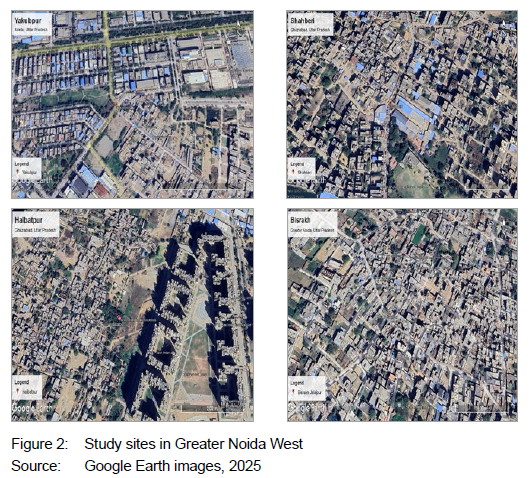
Four villages - Bisrakh, Sahberi, Yakubpur, and Haibatpur (Figure 2) - illustrate these dynamics. In Bisrakh, dominant castes consolidate power through informal real estate ventures (Gururani, 2013; Searle, 2016). Sahberi's 2011 building collapse exposed governance failures and speculative construction.
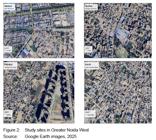
Yakubpur's small-plot layouts reveal caste-based disparities in access to capital, while Haibatpur's rapid land conversion and rental housing reshape livelihoods and gendered property relations.
Together, these sites show how fields become plotted layouts, colonies, and high-rise clusters - how land acts simultaneously as livelihood, asset, and symbol of authority - and how peri-urban growth produces new hierarchies, while reproducing old ones (Gautam, 2025; Shatkin, 2017; Levien, 2018). Studying Noida Extension thus clarifies NCR-wide processes of state-enabled land assembly, real estate-led growth, and contested governance, linking national reforms and regional planning to uneven urbanisation across India's metropolitan peripheries (Kundu, 2011; NCRPB, 2013; Ghertner, 2015; Sud, 2020).
4. METHOLODGY
4.1
Research designThis study examines how grassroots speculation unfolds in peri-urban India, focusing on the rapidly transforming landscape of Noida Extension. A qualitative case study approach was used to capture the complex, context-specific processes of land transformation and the social meanings attached to property-making (Yin, 2018; Flyvbjerg, 2011). Data were collected through semi-structured interviews, field observations, and document review, enabling close engagement with villagers, local brokers, and officials. The qualitative design allowed exploration of lived experiences, negotiations, and exclusions that quantitative methods cannot capture, foregrounding how speculation is embedded in social hierarchies of caste, class, and gender (Bourdieu, 2005; Levien, 2018). Analysis followed a thematic approach, using iterative coding to identify recurring patterns of speculation, exclusion, and territorial strategies. This interpretive framework linked everyday practices to broader processes of state-led planning and market expansion, revealing how peri-urban land is simultaneously an economic asset, a social resource, and a political instrument.
4.2
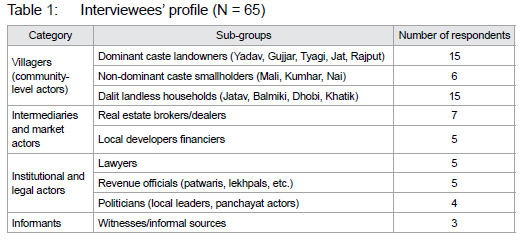
Population, sample, and response rateA total of 65 semi-structured interviews were conducted between 2022 and 2025, purposively designed to reflect the heterogeneity of actors implicated in land speculation and peri-urban transformation. To ensure the representation across the study area, 36 interviews out of the 65 interviews were conducted primarily with the village's communities. Respondents included dominant caste landowners (15), particularly Yadavs, Gujjars, Tyagis, and Jats, who sold land or collaborated with builders; non-dominant caste (6) and Dalit households, including landless labourers (15), who often experienced exclusion from speculative benefits, property rights, and access to urban opportunities. In addition, brokers (7), small-scale developers (5), lawyers (5), revenue officials (5), current and former politicians (4), and informal sources (3) were interviewed to provide institutional and market perspectives (see Table 1).
Purposive sampling was selected as it enables researchers to capture diverse perspectives relevant to the research questions rather than aiming for statistical representativeness (Palinkas et al., 2015). Sampling was done in three steps, namely identifying the key actor groups involved in the land transformation process listed in Table 1; selecting respondent from each group, and continuing interviews until thematic saturation was reached for each actor category.
Saturation guided the sample size: after 65 interviews, no substantially new themes emerged. Stratifying the interviews across caste, class, and institutional roles helped ensure that dominant voices were balanced with the often-overlooked experiences of marginalised groups (Crenshaw, 1991; Still, 2019).
4.3 Data collection
Two complementary methods were employed: semi-structured interviews and field-based observations. The Key Informant interviews were carried out through in-person, semi-structured interviews during repeated field visits (2022-2025). The interviews followed a flexible guide covering topics such as the negotiation of land sales, the role of caste and kinship networks, aspirations linked to speculative landholding, and experiences of exclusion in governance and urban development. Semi-structured interviewing was chosen because it provides a balance between comparability across cases and flexibility to capture respondents' own framing of issues (Kvale & Brinkmann, 2015). The interview guide comprised approximately 12-15 open-ended questions, supported by follow-up probes to allow respondents to expand on their experiences. The questions were designed to elicit narratives concerning land sales and negotiations, speculative practices, caste and kinship networks, aspirations, and perceptions of exclusion from urban development. While the guide provided a common framework across interviews, flexibility was maintained to adjust sequencing and wording, depending on the respondent's role (e.g., landowner, broker, or politician) and willingness to elaborate. This open-ended format allowed participants to frame issues in their own terms, generating nuanced and context-specific insights that would not have been possible through closed-ended questioning.
In addition to interviews, field-based observations were carried out across four villages (see Figure 2) over multiple visits between 2022 and 2025. These observations focused on both material and social dimensions of change: the conversion of agricultural fields into plotted layouts, the rise of gated colonies and high-rise towers, the erection of boundary walls and entry gates, and the role of symbolic markers in consolidating dominant caste authority. Observations also extended to village meetings and everyday interactions, with detailed field notes documenting patterns of inclusion and exclusion, decision-making processes, and negotiations between actors. Such immersion and sustained engagement enabled the research to cross-reference narratives with material transformations, thereby strengthening the validity of findings (Emerson, Fretz, & Shaw, 2011).
4.4 Data analysis and interpretation
The analysis combined thematic coding of interviews with interpretive analysis of field notes, employing an inductive strategy informed by grounded theory traditions (Charmaz, 2014). Transcribed interviews were coded to identify recurrent themes such as speculation, exclusion, kinship, territorialisation, and governance. Observational data were analysed to interpret how these themes manifested in the material environment and spatial practices. Triangulation between interviews and observations ensured that the study did not rely solely on discursive accounts but also situated these within the evolving built environment (Denzin, 2017).
The study employed a systematic mapping methodology to spatially ground its analysis of territorialisation and speculative practices. Field photographs (2022-2025), historical images, and base maps were integrated to document land-use transformations within villages and their peripheries. Archival images from local residents were triangulated with interview narratives and geospatial annotations to ensure interpretive rigour. Key features such as newly demarcated plots, vanished village ponds, boundary extensions by dominant landlords, and fenced enclosures were identified, mapped, and verified through on-site observations. These procedures revealed patterns of boundary expansion, gated colony development, and caste-based clustering, illustrating the materialisation of exclusionary practices. Synthesising interviews, field notes, and spatial analyses, the study conceptualises 'speculative territorialisation' as both discursive and material-spatial, reflecting how aspirations, anxieties, and social hierarchies are inscribed onto landscapes through mechanisms such as caste clustering, gated enclaves, and farmland erasure, thus underscoring uneven distributions of benefits and burdens in peri-urban development (Levien, 2021; Benjamin, 2008).
4.5 Limitations of the study
Despite its contributions, the study has several limitations. First, the focus on four villages in Noida Extension limits the generalisability of the findings to other peri-urban contexts in India, although the case is analytically valuable, given the region's role as a speculative frontier. Secondly, while purposive sampling captured diversity, the perspectives of women may have been underrepresented, due to difficulties in accessing them, which limits understanding of gendered experiences and roles in land transactions and speculative practices. Thirdly, although triangulation between interviews and observations strengthens validity, the study relies primarily on qualitative data, which may benefit from complementing with longitudinal quantitative tracking in future research. Finally, researcher positionality, especially in navigating caste hierarchies during fieldwork, inevitably shaped interactions and access, a factor acknowledged as part of the interpretive framework (England, 1994).
4.6 Anonymity and ethical considerations
All participants were assured confidentiality at the time of interviews. To protect their privacy, the names of individuals, as well as sensitive identifiers such as specific land plot details, kinship markers, and professional affiliations have been anonymised throughout the paper. Pseudonyms are used where necessary to illustrate narratives, and any information that could lead to the identification of respondents has been altered or withheld in line with standard ethical research practices (Kvale & Brinkmann, 2015)
5. FINDINGS AND DISCUSSION
The findings reveal that peri-urban transformation in Noida Extension Villages (NEV) is largely driven by villagers themselves; yet this process unfolds in highly unequal ways. The analysis is structured around four interrelated themes, reflecting the interplay of land, caste, capital, and power in shaping the emerging urban landscape.
5.1
Demographic profile of intervieweesTable 1 shows how the 65 respondents were spread across different social and institutional groups. The respondent profile illustrates a deliberate stratification to capture multiple perspectives on peri-urban speculation. Dominant caste landowners (15) and intermediaries such as brokers (7) and developers (5) hold significant influence over land transactions, reinforcing their privileged position. Conversely, non-dominant caste smallholders (6) and Dalit landless households (15) represent marginalised actors with limited bargaining power. Institutional figures such as lawyers (5), revenue officials (5), and politicians (4) mediate disputes and formalise processes, while informants (3) provide peripheral insights. This categorisation ensured inclusion of grassroots voices alongside market and state actors, enabling a multi-layered understanding of how territorialisation links everyday negotiations with institutional mechanisms, ultimately revealing uneven benefits and burdens in peri-urban development (Levien, 2021; Benjamin, 2008).
5.2
Land acquisition and early transformationsA walk around poNEV reveals a deeply uneven and stratified landscape marked by plots of uneven sizes and varied constructions,
ranging from multi-storey rental apartments to modest one- or two-storey houses, shaped by entrenched caste-based landholding hierarchies. This spatial configuration reflects the material embodiment of the village's homestead culture, histories, and the entrenched social and economic hierarchies of landholding castes. Such uneven landscapes can also be understood through the lens of 'extended' and 'organic' urbanisation, where dominant castes gradually expand urban forms outward, while non-dominant residents engage in incremental, low-capital adaptations (Schmid & Topalović, 2023; Lin, 2025). The characteristics of the apartments built on these plots provide insight into the differential levels of household wealth, often shaped by caste-based landownership. Wealthier landowning castes (e.g., Yadav, Jats, Gujjars, Tyagis), historically dominant in the region, typically own larger and more lucrative plots, enabling them to construct five- to six-storey concrete apartments with terraces and balconies, used for rental income. One landowner from Bishrak village explains:
"Our plot was large, so we decided to build a six-storey building. The rentals from each floor now provide a steady income that farming never could" (Vinod Bhati, Bishrak, interview, 2023).
In contrast, smaller plots (often held by historically non-landed castes and Dalit groups) only afford to host modest one- or two-storey houses, reflecting their constrained economic positions. They often find themselves excluded from the new landownership entirely and exclusion from emerging property markets. These patterns exemplify 'left-behind' spaces within peri-urban growth, where marginalised groups are spatially and economically excluded from speculative gains despite proximity to urban expansion (MacKinnon, Béal & Leibert, 2024). A Dalit smallholder from Bisrakh notes:
"We cannot afford to build more than a small house, as most Dalits here did not own land and therefore received no compensation like the larger landholders. Even if we had the money, we lack the connections to get approvals or purchase additional plots" (Banti, Dalit smallholder, interview, 2023).
This illustrates how post-agrarian property regimes continue to shape urban landscapes. Faxon and Lund (2025) note that, in post-agrarian contexts, new land values and hybrid livelihoods emerge from agrarian and pastoral legacies. In NEV, these livelihoods often involve rental housing businesses on ancestral plots, diversifying into other ventures. Rapid urban expansion has transformed villages into informal rental hubs, providing critical housing for migrant workers and low-income groups amid severe shortages. One local developer explains:
"People need affordable places to stay. Our apartments fill that gap, but only those with land, power connections can enter this market" (Sushil Kumar, interview, 2024).
Building a house here requires not only money, but also social and political connections. Although these villages were once outside formal building laws, they now fall under urban governance, increasing the need for official approvals. Previously, relaxed rural regulations allowed informal housing to thrive. Currently, the ability to develop rental housing depends on economic capital - often tied to caste hierarchies - and access to influential networks. Non-landed castes are disadvantaged, lacking both resources and connections, while authorities increasingly profit from the rental housing boom. Another respondent notes:
"Even if I had money, the authorities would not approve anything unless someone influential vouches for me. This is why we remain excluded."
Dominant landed castes, leveraging financial resources and political influence, have captured most of the benefits from urban transformation. Although land acquisition under the NCR Development Plan began in the late 1980s, significant socio-economic changes in Noida Extension emerged only in the 2000s (Keelor, 2012). Landowners, who received substantial compensation largely.
abandoned farming, shifting to roles such as developers, brokers, and investors. Many converted ancestral properties into rental businesses for steady income. As Ramesh Singh, a former farmer turned property dealer, explains
"After getting compensation, we realized farming wouldn't give us the same returns. The real money was in building and renting out properties."
Urban transformation has made non-farm employment a key factor shaping the trajectories of landowning communities in this region. Those who shifted to capital-intensive occupations such as property dealing, development, or construction, were better positioned to upgrade ancestral homes and compete in emerging land markets. Leveraging caste influence and political connections, they often converted illegal land into legal urban property. This reflects broader evidence that rapid land commodification tends to widen class and caste inequalities (Upadhya & Rathod, 2021). As land becomes a financial asset, caste hierarchies persist, enabling higher-caste landowners to build and rent large apartment blocks, reinforcing socio-economic segregation, even amid rural urbanisation.
5.3 Power brokers, capital, and new developments
Beyond individual capabilities, access to social and political power has become a key factor in gaining economic advantage in the rapidly changing peri-urban landscape. Agent-based perspectives (Guo & Liu, 2024) reveal how individual strategies such as building foundations or leasing plots aggregate to shape emergent land markets, while collaborative frameworks (Cleaver & Whaley, 2018) show how informal partnerships between villagers and builders co-produce urban space. As one Dalit villager explains,
"Here, power and connection matter more than money. If you are close to the Pradhan (local village leader) or belong to his baradari (caste), then you will get land deals and builder contacts. Without that, nothing moves."
Such dynamics resonate with findings from peri-urban Bangalore, where Gidwani and Reddy (2011) and Upadhya and Rathod (2021) note that local 'Reddy' elites secured the bulk of gains from speculative land rushes, while Dalit and lower-caste groups remained marginalised. Holding political office not only brings direct financial benefits, but also opens up privileged access to influential networks, making it easier to engage in rent-seeking and land speculation. Another resident remarks:
"Builders don't come to us directly. They go to the Pradhan's house, sit there, and from there the deal starts."
Strategically located amidst high-rises, NEV has drawn sustained interest from private builders who view it as a profitable entry point into urban transition. According to Amit, a local builder
"Everyone knows rent is the future here. If you have money, you make a building. If not, you remain dependent on others."
Builders are increasingly playing an active role in shaping the informal housing market in this area. Recently, many local investors have begun constructing new apartment buildings to capitalise on rising housing demand and maximise rental profits. In this ongoing process of spatial transformation, the local village leader (Pradhan), along with his caste kin and allies, has assumed a central role in brokering land deals with outside developers and investors - transactions they could not manage on their own. This illustrates 'injected' urbanisation, where external capital accelerates transformations in pre-existing rural territories (van Duijne et al., 2023). One elected representative bluntly states:
"Outside developers cannot enter this market area without us. We decide whose land is sold and at what rate."
External actors provide substantial financial or informal incentives to politically connected individuals for access to village land. These alliances enable local elites to amass wealth and strengthen their influence in the urban development economy. Similar patterns occur elsewhere in India, where peri-urban elites in Bangalore and Gurgaon leverage patronage for disproportionate land gains (Cowan, 2018; Upadhya & Rathod, 2021). Increasingly, builders and villagers collaborate through joint housing development ventures rather than limiting transactions to vacant land. Such collaborative arrangements demonstrate how agent-based and networked strategies shape uneven access to economic opportunities, reinforcing existing hierarchies (Guo & Liu, 2024). One respondent explains:
"As housing demand has reached its peak, making it unaffordable even for the middle-class to buy new apartments, and with construction costs rising dramatically over the years, these villages are increasingly seen as better alternatives."
As a result, the area has experienced a significant increase in the construction of rental housing units, making it highly desirable for rental accommodation. Responding to this demand, individuals with substantial capital have developed hundreds and, in some instances, thousands of rental units. One villager proudly notes:
"I have built more than 200 rooms in different plots. Every month, the rent gives us steady income." (Rajbir, a dominant caste landlord from Sahberi village, Interview, 2024 march)
Those lacking capital to develop rental properties often opt for petty leases or partnerships with builders or investors. High construction costs drive collaborations where villagers provide land titles and investors supply funds. A Tyagi resident remarks:
"This is [a] good thing, we don't have to spend our own money. The builder makes the floors; we keep one for living and two for rent. Everyone benefits."
These arrangements, common among dominant caste groups, involve formal contracts dividing property rights: developers typically gain two to three floors for rental income, while villagers keep the rest for residence and additional rentals. One resident, Ramesh, states:
"the advantages are evident -villagers don't have to invest their own money, yet they gain better housing and a steady source of income from renting out the extra units."
Dalits and other non-dominant communities in these villages rarely access such arrangements. Limited landownership excludes them from partnering with developers and benefiting from land-based ventures or rental housing, which dominant caste groups commonly enjoy. While some find work in local industries, their lack of land titles and small plot sizes restrict capital accumulation during land acquisition and prevent rental construction. One developer openly admits:
"Many of them own patta land -small plots given to Dalits by the government - which are legally complicated and too small for construction. That's why we avoid such partnerships."
Another developer adds:
"If we work with them, the dominant castes will not allow construction - not only in this village but in others too."
Consequently, property development and rental income remain concentrated among landed castes, reinforcing socio-economic inequality. Access to external collaborations often depends on social and political capital, enabling privileged villagers to secure referrals through leaders and enter joint building agreements.
A new class of local builders and developers - often relatives or clients of village leaders - now shapes NEV. Predominantly from dominant caste groups, they leverage caste-based networks across Delhi NCR. One such builder, from the upper Rajput caste, explains:
"Earlier, I used to do farming on my 50 Bigha of land. But now, together with my brothers, we have started working as developers and investors, developing these colonies and earning rental income from our village's properties."
Many have moved to affluent areas, yet retain control over their native villages' transformation. With privileged access to information and strong ties to external developers and investors, they act as intermediaries, channelling opportunities to their own communities and allies. A local resident explains:
"For instance, a recently completed apartment built in 2022 was the result of collaboration between a local developer and a relative of the village leader."
These networks, reinforced by political power and familial connections, secure capital, loans, and approvals for those with the "right" ties, amplifying existing land-based advantages. Linked to the village head through property ventures, the developer, who shares caste ties, financed housing on the leader's relative's land, illustrating how caste and political networks shape access to capital and reinforce land-based privilege.
Villagers with limited resources often assert landownership by laying foundations without completing construction - a symbolic act signalling future intent to build. One villager explains:
"We've laid the foundations for two plots - it cost us around R30 lakhs. It shows others (local developers) that we plan to build here eventually, even if we can't right now."
Others repurpose plots by leasing them to small industries, scyards, or rickshaw stands, a practice that emerged after NEV's agricultural land was acquired in the early 2000s. One Dalit respondent explains:
"We did not get the money as government compensation. Big landlords do, but we don't have money to build. Local builders don't invest in our small plots. What can we do with the land? At least by giving it to a workshop or rickshaw stand, we get some monthly income."
These anticipatory strategies help preserve claims and potential land value but remain largely accessible to dominant caste groups with social and economic capital, unlike non-landed Dalit communities who lack both resources and political leverage.
5.4 Land speculation and uneven returns
Rapid development in Noida Extension and rising housing demand have transformed land from a means of production into a speculative asset for income and capital accumulation. These practices can be conceptualised as 'displaced' urbanisation: urban functions and capital accumulation are relocated from agricultural to residential land, while marginal groups remain excluded from these benefits (Wat & Morris, 2024). One Gujjar landowner explains:
"Farming was never this profitable. A single room today gives more than what five bighas of wheat used to yield. Land is no longer for farming - it is for making money every month" (Interview, NEV villager, July 2023).
Anticipating this shift, landed groups began constructing rental units on their plots as early as the 2000s, leveraging both land and capital to appropriate rent. A Tyagi resident recalls:
"We started building rooms in 2004 itself. At that time, nobody believed rent would be a business. But we knew land would turn into gold one day" (Interview, Bishrak, August 2023).
Dominant caste groups leveraged their social position to acquire plots from Dalits and other non-landed communities at undervalued rates, anticipating land commodification and rising property values. A Balmiki respondent emphasises the asymmetry of such transactions:
"People from big castes bought our land for very little. We had no choice - either sell cheap or get nothing. Now they are making buildings, and we are left only as tenants" (Interview, NEV villager, July 2023).
Landed communities anticipated rising property values, by maximising built-up space - adding floors, extending plot boundaries, and encroaching on public land. These practices narrowed village roads into congested alleys and turned property into a bargaining chip, enabling wealth accumulation and a shift away from agriculture. The capture of common spaces by dominant castes reinforced spatial and economic inequalities, mirroring patterns observed in Gurgaon's villages (Cowan, 2018). The persistence of left-behind spaces shows how peri-urbanisation generates both material and symbolic exclusions, echoing Global South comparative studies (Brenner & Katsikis, 2020).
In recent years, villagers have shifted from renting rooms to migrant workers toward selling plots and redeveloped apartments, driven by rising property demand and escalating prices in nearby formal housing societies. A Jat villager explains:
"Earlier we gave rooms on rent to migrants, but now we sell floors. A single floor can fetch 40 to 80 lakhs. With that money, we buy land in other villages or plots where the government will give more compensation later" (Interview, NEV, August 2023).
Research shows that a single floor in a multi-storey apartment built on an 80 homestead plot can sell for ?30-50 lakhs (USD 36,000-60,000), providing significant capital often reinvested in real estate or agricultural and non-agricultural land, anticipating future appreciation or state acquisition at higher compensation rates (Keelor, 2012; Gautam, 2025).
Because the sale of apartments in villages is not formally regulated under planning laws, it is common for the original owner's name to remain on the title deed, even after the property is sold. Typically, registration is done in the buyer's name through informal agreements. A local property dealer explains:
"In villages, nobody asks for full property transfer. The buyer takes possession, and the seller's name stays on paper. Everyone knows these houses won't be demolished because they are inside the village boundary" (Interview, property dealer, July 2023).
Villages carry both social and political significance, making such arrangements mutually beneficial, despite legal ambiguities. Balakrishnan (2019) argues that agrarian-urban land transformations are underpinned by caste networks, producing recombinant urbanisation - new capitalist values layered atop older social orders - resulting in highly unequal outcomes (Rasmussen & Lund, 2018).
With the rise of unauthorised colonies and local developers, the state government has tightened oversight of land-based illegal transactions (Gautam, 2025). In NEV, a construction boom has drawn stricter monitoring, despite the absence of formal municipal regulations. Officials now conduct daily patrols and pressure villagers to seek permits, often as a means to extract bribes. In the early 2000s, lax enforcement allowed widespread violations, including height-limit breaches and encroachment on public land, which narrowed roads and caused congestion. At present, authorities strictly prohibit expansion beyond legal boundaries, with violators facing police action and prolonged court cases.
Rather than halting construction, stricter regulatory controls have increased the value of political influence, deepening divides between those with access to power and those without. Ribot and Peluso (2003:170) note that
"privileged access to individuals or institutions with the authority to make and implement laws can strongly influence who benefits from the resource in question."
In NEV, this dynamic was repeatedly echoed in interviews, where villagers emphasised that connections to influential actors often determined outcomes. A Gujjar villager remarks:
"Money is not enough now. Without the right connections in the Authority, nothing gets approved" (Interview, NEV villager, July 2023).
Previously, any villager with sufficient capital could undertake construction. Those with greater resources simply built larger or more elaborate structures. However, under stricter regulatory oversight, financial means alone is no longer sufficient. Villagers now require official permissions to proceed, and securing these approvals often depends on personal ties with authorities - what locals commonly describe as political contacts, bhaichara (brotherhood), and social networks.
Conversely, respondents from marginalised groups reported experiencing deliberate exclusion. A Balmiki household head explains:
"When we start construction, someone from the big castes calls the police or Authority. They stop our work even if it is legal. But when their people build on the road, no one says anything" (Interview, Balmiki resident, June 2023).
Interviews show that personal connections often accelerate approvals for dominant communities, while non-landed groups face major barriers in engaging developers or securing permissions. Dominant castes frequently obstruct marginalised households, even halting legal construction through official intervention.
Although land-based accumulation appears accessible, property speculation remains deeply unequal. Benefits hinge on historical privilege, financial resources, market access, and political influence - factors that reinforce each other. Political ties grant privileged access to capital and insider networks, enabling those with land and wealth to exploit opportunities. Consequently, land markets have become a key driver of social and economic differentiation within the community (Gautam, 2021; 2024; 2025).
5.5 Territorial and exclusionary claims
Exclusion in these villages operates through multiple, interconnected dynamics, most notably through practices of territorialisation, encroachment, coercion, and forceful appropriation. Collaborative and agent-based theories clarify how these actions are not only individual but also coordinated within caste networks, producing emergent patterns of spatial control that marginalise non-dominant residents (Guo & Liu, 2024; Mohindroo, 2025).
Territorialisation refers to asserting control over space, by establishing and enforcing boundaries (Peluso, 2005; Sack, 1986). This process is inherently exclusionary, granting access to some groups, while denying it to others. As noted earlier, caste continues to shape unequal access to land and housing benefits, especially in rapidly urbanising villages. This section examines two primary mechanisms whereby certain groups - particularly Dalits and non-dominant castes - are excluded from emerging land markets. First, the absence of formal land rights combined with entrenched hierarchies limits marginalised groups from asserting land. Secondly, dominant villagers engage in competitive territorialisation to prevent others from gaining access to land. These practices deepen intra-community divisions and fuel localised property conflicts. Such dynamics can be understood through 'organic' and 'extended' frameworks of urbanisation, highlighting the incremental and spatially uneven unfolding of peri-urban growth (Schmid & Topalović, 2023; Lin, 2025).
Prior to the wave of urban expansion, the village landscape remained largely undivided, with many plots either abandoned or uncultivated. However, as urbanisation accelerated and agricultural livelihoods declined, land began to rise in value, and rental housing became more profitable. This led to a sharp increase in territorial behaviour, with physical markers such as walls, fences, gates, wooden planks, stones, and barbed wire being deployed to demarcate plots for anticipated construction.
These acts of boundary-making frequently became flashpoints for conflict, particularly over encroachments. For example, one household extended its construction into a road area to enlarge its plot. This act of encroachment did not spark protest; instead, it normalised the practice, encouraging others to follow suit. Soon, roadways and common land were steadily occupied, generating tensions between neighbours. In another instance, a family expanded its building into a shared alleyway, only to face intervention from local authorities after formal complaints were lodged.
While many households engaged in territorialisation, the consequences of these actions varied significantly based on social position. Those with connections to local politicians, the police, and administrative authorities had far greater room for manoeuvre. The case of Satish illustrates this dynamic. Satish, a Dalit, began constructing a rental house on a plot adjacent to a large property owned by Kapil, a member of the dominant caste. Satish's design included eaves (chajja), a common feature across the area, but this was not tolerated by Kapil and his caste group. Satish faced constant harassment and even physical assault, being slapped by Kapil for his construction.
Tensions over encroachment were further exacerbated by the perception that local leadership - often drawn from dominant caste groups - was biased in resolving such disputes. Non-dominant groups, including Dalits, felt that these leaders favoured their own caste and community, which further discouraged them from asserting property claims. In addition, the high cost of construction meant that wealthier villagers had more resources to assert and expand their territorial claims.
Field evidence reveals that property-related conflicts often involve dominant, landed communities creating obstacles for non-landed groups in an effort to force them to sell their holdings. These disputes are exacerbated by the social hierarchies that continue to marginalise certain caste groups. One such case is that of Mr Daya, a Dalit resident of the NEV, who owned a small parcel of land in a mixed but segregated neighbourhood. The area included both Dalit households and Tyagisan upper-caste landowners. The vast majority of Dalits, including Mr Daya, received their land through government-allotted pattas under land redistribution schemes, but these plots were situated along the main road, while the Tyagi landholdings were located behind them. Despite this arrangement, Tyagi families resented the presence of Dalits and frequently instigated conflicts to pressure them into selling their land at marginal rates.
In Mr Daya's case, his corner plot, adjacent to a developing residential area, became a target. Devender, a well-off Tyagi from an agricultural background, repeatedly broke Mr. Daya's boundary wall, claiming he needed access for his tractor. Even though this was a clear encroachment on Mr Daya's land, Devender showed no remorse. Instead, he and his associates harassed Mr Daya, insisting that he reduce the size of his plot to accommodate Devender's tractor. After enduring years of such harassment and lacking support from local authorities or social networks, Mr Daya was forced to sell his plot to Devender at a significantly undervalued price. Devender later constructed a five-storey apartment building on the land, earning substantial rental income. This case exemplifies how caste-based coercion continues to displace marginalised groups, despite their formal ownership of land.
This pattern is not an isolated incident but rather reflects broader dynamics in which caste-based coercion and exclusionary practices continue to marginalise non-dominant groups, particularly Dalits. As land prices soared in the 2010s, wealthier, more influential villagers increasingly resorted to intimidation tactics to pressure marginalised residents into selling their land.
The absence of formal recognition of Dalit land rights exacerbates this divide. While landowning, native-born villagers benefit from preferential access to land and local resources, Dalits and other marginalised groups are often excluded from rural welfare provisions, regardless of how long they have lived in the village. Since rural land is collectively owned, control over land-related decisions remains in the hands of the landed villagers, leaving non-landed groups with limited opportunities to assert their rights or protect their property.
6. CONCLUSION
This study examined how peri-urban transformation in Noida Extension is shaped not only by state-capital alliances, but also by villagers' own speculative practices. Based on interviews and field observations, the analysis shows that grassroots speculation is uneven and exclusionary. Dominant caste landowners convert agrarian assets into property through rental housing, builder partnerships, and political brokerage, while Dalits and landless groups remain largely excluded. The result is a highly uneven urban frontier where social hierarchies are both reconfigured and reproduced.
Moving beyond dominant narratives that frame peri-urbanisation as a contest between state-led extraction and local resistance, this study situates analysis at the neighbourhood scale to reveal the everyday social dynamics that drive land speculation. The commodification of land has intensified territorial competition, as villagers assert claims and stake speculative investments through boundaries, foundations, and symbolic constructions. Incorporation into the land economy is shaped by caste, capital, and political networks, reinforcing rather than dismantling historical inequalities.
To conceptualise these processes, the study advances the idea of 'speculative territorialisation', highlighting how land-making is simultaneously economic, territorial, and political. Grassroots actors engage in informal construction, developer alliances, and exclusionary practices that reflect embedded hierarchies of caste and power.
These findings have important implications for planning and policy. First, peri-urban land markets are socially embedded, not neutral, and planning frameworks must account for caste and power dynamics to prevent elite capture. Secondly, inclusive urban development policies must directly address intra-village inequalities to avoid reproducing disparities. Thirdly, widespread informal construction and unregulated layouts point to gaps in land-use regulation; flexible, context-sensitive planning, including community land trusts, participatory land-use frameworks, and oversight of builder-villager partnerships, can help protect marginalised households and ensure more equitable outcomes.
For urban theory, the study demonstrates that speculative urbanism in the Global South cannot be fully understood without attending to villagers' differentiated strategies. By foregrounding caste, grassroots speculation, and everyday territorial practices, the analysis provincialises dominant accounts of urban frontiers and offers insights relevant to peri-urban transformations beyond India, including Africa, Asia, and Latin America.
Peri-urban transformation in Noida Extension is driven by uneven, socially embedded speculation, where land simultaneously serves as economic asset, social resource, and instrument of authority. Conceptualised as 'speculative territorialisation', this process highlights how new markets and opportunities coexist with persistent hierarchies, producing urban frontiers that are deeply unequal, yet actively contested.
REFERENCES
2. LITERATURE REVIEW
-
ABRAMSON, D.B. 2016. Peri-urbanization and the politics of development-as-city-building in China. Cities, 53, pp. 156-162. https://doi.org/10.1016/j.cities.2015.11.002
» https://doi.org/10.1016/j.cities.2015.11.002 -
ARCHER, R.W. 1973. Land speculation and scattered development: Failures in the urban-fringe land market. Urban Studies, 10(3), pp. 367-372. https://doi.org/10.1080/00420987320080491
» https://doi.org/10.1080/00420987320080491 -
ARIF, M., SENGUPTA, S., MOHINUDDIN, S. & GUPTA, K. 2023. Dynamics of land use and land cover change in peri-urban area of Burdwan City, India: A remote sensing and GIS-based approach. GeoJournal, 88(4), pp. 4189-4213. https://doi.org/10.1007/s10708-023-10860-3
» https://doi.org/10.1007/s10708-023-10860-3 -
BALAKRISHNAN, S. 2019. Shareholder cities: Land transformations along urban corridors in India. Philadelphia, PA: University of Pennsylvania Press. https://doi.org/10.9783/9780812296303-007
» https://doi.org/10.9783/9780812296303-007 -
BANDYOPADHYAY, A. & BARUA, N.M. 2016. Factors determining capital structure and corporate performance in India: Studying the business cycle effects. The Quarterly Review of Economics and Finance*, 61, pp. 160-172. https://doi.org/10.1016/j.qref.2016.01.004
» https://doi.org/10.1016/j.qref.2016.01.004 -
BANKS, N., LOMBARD, M. & MITLIN, D. 2020. Urban informality as a site of critical analysis. The Journal of Development Studies, 56(2), pp. 223-238. https://doi.org/10.1080/00220388.2019.1577384
» https://doi.org/10.1080/00220388.2019.1577384 -
BENJAMIN, S. 2008. Occupancy urbanism: Radicalizing politics and economy beyond policy and programs. International Journal of Urban and Regional Research, 32(3), pp. 719-729. https://doi.org/10.1111/j.1468-2427.2008.00809.x
» https://doi.org/10.1111/j.1468-2427.2008.00809.x -
BOURDIEU, P. 2005. The social structures of the economy. Cambridge: Polity Press. https://doi.org/10.1111/j.1467-9663.2006.352_4.x
» https://doi.org/10.1111/j.1467-9663.2006.352_4.x -
BRENNER, N. & KATSIKIS, N. 2020. Operational landscapes: Hinterlands of the Capitalocene. Architectural Design, 90(1), pp. 22-31. https://doi.org/10.1002/ad.2521
» https://doi.org/10.1002/ad.2521 -
BRENNER, N. & SCHMID, C. 2014. The 'urban age' in question. International Journal of Urban and Regional Research, 38(3), pp. 731-755. https://doi.org/10.1111/1468-2427.12115
» https://doi.org/10.1111/1468-2427.12115 -
CALDEIRA, T.P. 2017. Peripheral urbanization: Autoconstruction, transversal logics, and politics in cities of the Global South. Environment and Planning D: Society and Space, 35(1), pp. 3-20. https://doi.org/10.1177/0263775816658479
» https://doi.org/10.1177/0263775816658479 -
CHAKRABARTI, A. & MISHRA, M. 2025. The dynamic urban and peri-urban spaces in India and the political economy lens. In: Political economy of emerging urban and peri-urban spaces in India. A roadmap towards environmental and social sustainability. Singapore: Springer, pp. 1-23. https://doi.org/10.1007/978-981-97-8872-9_1
» https://doi.org/10.1007/978-981-97-8872-9_1 - CHARMAZ, K. 2014. Constructing grounded theory. 2nd edition. London: Sage.
-
CLEAVER, F. & WHALEY, L. 2018. Understanding process, power, and meaning in adaptive governance: A critical institutional reading. Ecology and Society, 23(2). https://www.jstor.org/stable/26799116. https://doi.org/10.5751/ES-10212-230249
» https://www.jstor.org/stable/26799116. https://doi.org/10.5751/ES-10212-230249 -
COWAN, T. 2018. The urban village, agrarian transformation, and rentier capitalism in Gurgaon, India. Antipode, 50(5), pp. 1244-1266. https://doi.org/10.1111/anti.12406
» https://doi.org/10.1111/anti.12406 -
CRENSHAW, K. 1991. Mapping the margins: Intersectionality, identity olitics, and violence against women of color. Stanford Law Review, 43(6), pp. 1241-1299. https://doi.org/10.2307/1229039
» https://doi.org/10.2307/1229039 -
CROOKS, A., HEPPENSTALL, A., MALLESON, N. & MANLEY, E. 2021. Agent-based modeling and the city: A gallery of applications. In: Urban Informatics. Singapore: Springer, pp. 885-910. https://doi.org/10.1007/978-981-15-8983-6_46
» https://doi.org/10.1007/978-981-15-8983-6_46 -
DENZIN, N.K. 2017. The research act: A theoretical introduction to sociological methods. London: Routledge. https://doi.org/10.4324/9781315134543
» https://doi.org/10.4324/9781315134543 - DESHPANDE, S. 2013. Caste and castelessness: Towards a biography of the 'general category'. Economic and Political Weekly, 48(15), pp. 32-39.
- DUBEY, S. 2018. Urban transformations in Khora Village, NCR. Economic and Political Weekly, 53(12), pp. 77-83.
-
Durose, C., Van Ostaijen, M., Van Hulst, M., Escobar, O. & Agger, A. 2022. Working the urban assemblage: A transnational study of transforming practices. Urban Studies, 59(10), pp. 2129-2146. https://doi.org/10.1177/00420980211031431
» https://doi.org/10.1177/00420980211031431 -
EMERSON, R.M., FRETZ, R.I. & SHAW, L.L. 2011. Writing ethnographic fieldnotes. 2nd edition. Chicago: University of Chicago Press. https://doi.org/10.7208/chicago/9780226206868.001.0001
» https://doi.org/10.7208/chicago/9780226206868.001.0001 -
ENGLAND, K.V. 1994. Getting personal: Reflexivity, positionality, and feminist research. The Professional Geographer, 46(1), pp. 80-89. https://doi.org/10.1111/j.0033-0124.1994.00080.x
» https://doi.org/10.1111/j.0033-0124.1994.00080.x -
FAXON, H.O. & LUND, C. 2025. Editorial: Post-agrarian questions. Antipode. https://doi.org/10.1111/anti.70016
» https://doi.org/10.1111/anti.70016 - FLYVBJERG, B. 2011. Case study. In: Denzin, N.K. & Lincoln, Y.S. (Eds.). The Sage handbook of qualitative research. Thousand Oaks, CA: Sage, pp. 301-316.
-
GAUTAM, A.K. 2021. Dynamics of caste and landlessness: A missing perspective in urban development. Economic and Political Weekly, 56(10). epw.in [Accessed 1 October 2025].
» epw.in -
GAUTAM, A.K. 2025. Local developers, fragmented development and perils of governance. Economic and Political Weekly, 60(8). epw.in [Accessed 1 October 2025]. https://doi.org/10.71279/epw.v60i8.42981
» epw.in -
GHERTNER, D.A. 2015. Rule by aesthetics: World-class city making in Delhi. Oxford: Oxford University Press. https://doi.org/10.1093/acprof:oso/9780199385560.001.0001
» https://doi.org/10.1093/acprof:oso/9780199385560.001.0001 -
GIDWANI, V. & REDDY, R.N. 2011. The afterlives of 'waste': Notes from India for a minor history of capitalist surplus. Antipode, 43(5), pp. 1625-1658. https://doi.org/10.1111/j.1467-8330.2011.00902.x
» https://doi.org/10.1111/j.1467-8330.2011.00902.x -
GOLDMAN, M. & NARAYAN, D. 2021. Through the optics of finance: Speculative urbanism and the transformation of markets. International Journal of Urban and Regional Research, 45(2), pp. 209-231. DOI: https://doi.org/10.1111/1468-2427.12967
» https://doi.org/10.1111/1468-2427.12967 -
GOLDMAN, M. 2021. Speculative urbanism and the urban-financial conjuncture: Interrogating the afterlives of the financial crisis. Environment and Planning A: Economy and Space, 53(2), pp. 359-366. https://doi.org/10.1177/0308518X211016003
» https://doi.org/10.1177/0308518X211016003 -
GOVERNMENT OF INDIA. 2005. The Special Economic Zones Act, 2005. New Delhi: Government of India. sezindia.gov.in [Accessed 2 October 2025].
» sezindia.gov.in -
GOVERNMENT OF UTTAR PRADESH. 1976. Uttar Pradesh Industrial Area Development Act, 1976. Lucknow: Government of Uttar Pradesh. ndiacode.nic.in [Accessed 2 October 2025].
» ndiacode.nic.in -
GUO, Z. & LIU, X. 2024. How artificial intelligence cooperates with agent-based modeling for urban studies: A systematic review. Transactions in GIS, 28(3), pp. 654-674. https://doi.org/10.1111/tgis.13152
» https://doi.org/10.1111/tgis.13152 -
GURURANI, S. 2013. Flexible planning: The making of India's 'Millennium City', Gurgaon. Economic and Political Weekly, 48(24). https://doi.org/10.5790/hongkong/9789888139767.003.0005
» https://doi.org/10.5790/hongkong/9789888139767.003.0005 -
GURURANI, S. 2019. Property-work, work of property: Figuring land and caste in an urbanizing frontier. City, 28(1-2), pp. 64-83. https://doi.org/10.1080/13604813.2024.2322785
» https://doi.org/10.1080/13604813.2024.2322785 -
GURURANI, S. 2020. Cities in a world of villages: Agrarian urbanism and the making of India's urbanizing frontiers. Urban Geography, 41(7), pp. 971-989. https://doi.org/10.1080/02723638.2019.1670569
» https://doi.org/10.1080/02723638.2019.1670569 -
GURURANI, S. 2023. 'Coexisting heterogeneity': Agrarian-urban entanglements in India's urbanizing frontiers. In: Shatkin, G. & Robinson, J. (Eds). The Routledge handbook of comparative global urban studies. London: Routledge. https://doi.org/10.4324/9780429287961
» https://doi.org/10.4324/9780429287961 -
GURURANI, S. 2024. Property-work, work of property: Figuring land and caste in an urbanizing frontier. City, 28(1-2), pp. 64-83. https://doi.org/10.1080/13604813.2024.2322785
» https://doi.org/10.1080/13604813.2024.2322785 - GURURANI, S. & DASGUPTA, R. 2018. Frontier Urbanism: Urbanisation Beyond Cities in South Asia. Economic and Political Weekly, 53(12), pp. 41-45
-
JODHKA, S.S. 2014. Caste in contemporary India. London: Routledge. https://doi.org/10.4324/9780203701577
» https://doi.org/10.4324/9780203701577 -
JONNALAGADDA, I. & COWAN, T. 2024. City drafting: Property-making and bureaucratic urbanism in South Asia. City, 28(1-2), pp. 7-23. https://doi.org/10.1080/13604813.2024.2321024
» https://doi.org/10.1080/13604813.2024.2321024 - KEELOR, V. 2012. Noida Extension to now be called Greater Noida (West). Times of India, 15 September. [Accessed 1 October 2025].
-
KENNEDY, L. 2019. The politics of land acquisition in Haryana: Managing dominant caste interests in the name of development. Journal of Contemporary Asia, 49(4), pp. 571-589. https://doi.org/10.1080/00472336.2019.1651885
» https://doi.org/10.1080/00472336.2019.1651885 - KENNEDY, L. & SOOD, A. 2016. Greenfield development as 'tabula rasa': Rescaling, speculation and governance on India's urban frontier. Economic and Political Weekly, 51(17), pp. 41-49.
-
KUNDU, A. 2011. Trends and processes of urbanisation in India. UNFPA/IIED. iied.org [Accessed 1 October 2025].
» iied.org - KVALE, S. & BRINKMANN, S. 2015. Interviews: Learning the craft of qualitative research interviewing. 3rd edition. London: Sage.
-
LEE, D., FEIERTAG, P. & UNGER, L. 2024. Co-production in the urban setting: Fostering definitional and conceptual clarity through comparative research. Urban Planning, 9(1), pp. 1-6. https://doi.org/10.17645/up.8262
» https://doi.org/10.17645/up.8262 -
LEVIEN, M. 2011. Special economic zones and accumulation by dispossession in India. Journal of Agrarian Change, 11(4), pp. 454-483. https://doi.org/10.1111/j.1471-0366.2011.00329.x
» https://doi.org/10.1111/j.1471-0366.2011.00329.x - LEVIEN, M. 2015. From primitive accumulation to regimes of dispossession: Six theses on India's land question. Economic and Political Weekly, 50(22), pp. 146-157.
-
LEVIEN, M. 2018. Dispossession without development: Land grabs in neoliberal India. Oxford: Oxford University Press. https://doi.org/10.1093/oso/9780190859152.001.0001
» https://doi.org/10.1093/oso/9780190859152.001.0001 -
LEVIEN, M. 2021. Agrarian questions of dispossession: From national development to speculative urbanization. Journal of Agrarian Change, 21(1), pp. 3-26. https://doi.org/10.1111/joac.12382
» https://doi.org/10.1111/joac.12382 -
LIN, M. 2025. Development mechanism of organic integration of new urbanization and rural revitalization. Advances in Economics, Management and Political Sciences, 160, 19780. https://doi.org/10.54254/2754-1169/2025.19780
» https://doi.org/10.54254/2754-1169/2025.19780 -
LUND, C. 2019. Land in the political economy of accumulation and enclosure. Journal of Peasant Studies, 46(1), pp. 1-20. https://doi.org/10.1080/03066150.2018.1534101
» https://doi.org/10.1080/03066150.2018.1534101 -
MACKINNON, D., BÉAL, V. & LEIBERT, T. 2024. Rethinking 'left-behind' places in a context of rising spatial inequalities and political discontent. Regional Studies, 58(6), pp. 1161-1166. https://doi.org/10.1080/00343404.2023.2291581
» https://doi.org/10.1080/00343404.2023.2291581 - MITLIN, D. & BARTLETT, S. 2018. Co-production in cities: Providing services, empowering communities, changing relationships. [Accessed 1 October 2025].
-
MOHINDROO, R. 2025. Caste and urban housing in Mumbai. International Journal of Social Science and Economic Research, 10(10), pp. 334-349. https://doi.org/10.46609/IJSSER.2025.v10i10.049
» https://doi.org/10.46609/IJSSER.2025.v10i10.049 -
NCRPB (NATIONAL CAPITAL REGION PLANNING BOARD). 2013. Regional Plan 2021 for the National Capital Region. rgplan.com [Accessed 1 October 2025].
» rgplan.com -
PALINKAS, L.A., HORWITZ, S.M., GREEN, C.A., WISDOM, J.P., DUAN, N. & HOAGWOOD, K. 2015. Purposeful sampling for qualitative data collection and analysis in mixed method implementation research. Administration and Policy in Mental Health, 42(5), pp. 533-544. https://doi.org/10.1007/s10488-013-0528-y
» https://doi.org/10.1007/s10488-013-0528-y -
PELUSO, N.L. 2005. Seeing property in land use: Local territorialization in forest zones. Society & Natural Resources, 18(1), pp. 33-49. https://doi.org/10.1080/08941920590881880
» https://doi.org/10.1080/08941920590881880 -
PELUSO, N.L. & LUND, C. 2011. New frontiers of land control: Introduction. Journal of Peasant Studies, 38(4), pp. 667-681. https://doi.org/10.1080/03066150.2011.607692
» https://doi.org/10.1080/03066150.2011.607692 -
PELUSO, N.L. & RIBOT, J. 2020. Postscript: A theory of access revisited. Society & Natural Resources, 33(2), pp. 300-306. https://doi.org/10.1080/08941920.2019.1709929
» https://doi.org/10.1080/08941920.2019.1709929 -
RASMUSSEN, M.B. & LUND, C. 2018. Reconfiguring frontier spaces: The territorialization of resource control. World Development, 101, pp. 388-399. https://doi.org/10.1016/j.worlddev.2017.01.018
» https://doi.org/10.1016/j.worlddev.2017.01.018 -
REDDY, S.P., GOLI, S. & RAMMOHAN, A. 2021. The interaction of household agricultural landholding and caste on food security in rural Uttar Pradesh, India. Food Security, 13(1), pp. 1-20. https://doi.org/10.1007/s12571-020-01109-9
» https://doi.org/10.1007/s12571-020-01109-9 -
RIBOT, J.C. & PELUSO, N.L. 2003. A theory of access. Rural Sociology, 68(2), pp. 153181. https://doi.org/10.1111/j.1549-0831.2003.tb00133.x
» https://doi.org/10.1111/j.1549-0831.2003.tb00133.x -
ROBINSON, J. & ROY, A. 2016. Debate on global urbanisms and the nature of urban theory. International Journal of Urban and Regional Research, 40(1), pp. 181-186. https://doi.org/10.1111/1468-2427.12272
» https://doi.org/10.1111/1468-2427.12272 -
ROY, A. 2009. Why India cannot plan its cities: Informality, insurgence and the idiom of urbanization. Planning Theory, 8(1), pp. 76-87. https://doi.org/10.1177/1473095208099299
» https://doi.org/10.1177/1473095208099299 -
ROY, A. 2016. What is urban about critical urban theory? Urban Geography, 37(6), pp. 810-823. https://doi.org/10.1080/02723638.2015.1105485
» https://doi.org/10.1080/02723638.2015.1105485 -
SACK, R.D. 1986. Human territoriality: Its theory and history. Cambridge: Cambridge University Press. https://doi.org/10.1017/CBO9780511623286
» https://doi.org/10.1017/CBO9780511623286 -
SASU, A., JAVED, A., IMRAN, M. & SQUIRES, G. 2024. Land banking, land price and Ghana's informal land markets: A relational complexity approach. Land Use Policy, 141, article 107133. https://doi.org/10.1016/j.landusepol.2024.107133
» https://doi.org/10.1016/j.landusepol.2024.107133 -
SCHMID, C. & TOPALOVIC, M. 2023. Extended urbanisation: Tracing planetary struggles. Basel: Birkhäuser. https://doi.org/10.1515/9783035623031
» https://doi.org/10.1515/9783035623031 -
SEARLE, L.G. 2016. Landscapes of accumulation: Real estate and the neoliberal imagination in contemporary India. Chicago: University of Chicago Press. https://doi.org/10.7208/chicago/9780226385235.001.0001
» https://doi.org/10.7208/chicago/9780226385235.001.0001 -
SHATKIN, G. 2016. The real estate turn in policy and planning: Land monetization and the political economy of peri-urbanization in Asia. Cities, 53, pp. 141-149. https://doi.org/10.1016/j.cities.2015.11.015
» https://doi.org/10.1016/j.cities.2015.11.015 -
SHATKIN, G. 2017. Cities for profit: The real estate turn in Asia's urban politics. Ithaca, NY: Cornell University Press. https://doi.org/10.7591/9781501709715-fm
» https://doi.org/10.7591/9781501709715-fm -
SMITH, N. 1996. The new urban frontier: Gentrification and the revanchist city. London: Routledge. https://doi.org/10.1007/978-1-349-24439-3_5
» https://doi.org/10.1007/978-1-349-24439-3_5 -
STILL, C. 2019. Dalit women: Honour and patriarchy in South India. London: Routledge. https://doi.org/10.4324/9781315101132
» https://doi.org/10.4324/9781315101132 - SUD, N. 2020. The making of land and the making of India. Oxford: Oxford University Press.
-
SUNDARESAN, J. 2017. Urban planning in the informal city: Land use planning in Hyderabad. Journal of Planning Education and Research, 37(4), pp. 413-423. https://doi.org/10.1177/0739456X16664789
» https://doi.org/10.1177/0739456X16664789 - THORAT, S. & NEWMAN, K.S. (Eds). 2010. Blocked by caste: Economic discrimination in modern India. Oxford: Oxford University Press.
-
UPADHYA, C. & RATHOD, S. 2021. Caste at the city's edge: Land struggles in peri-urban Bengaluru. South Asia Multidisciplinary Academic Journal, 26, article 2. https://doi.org/10.4000/samaj.7134
» https://doi.org/10.4000/samaj.7134 -
UPADHYA, C. 2023. Agrarian urbanism and vernacular capital in India. Journal of South Asian Development, 18(3), pp. 457-462. https://doi.org/10.1177/09731741231209124
» https://doi.org/10.1177/09731741231209124 -
UPADHYA, C. & RATHOD, S. 2021. Caste at the city's edge: Land struggles in peri-urban Bengaluru. South Asia Multidisciplinary Academic Journal, 26 article 7134. https://doi.org/10.4000/samaj.7134
» https://doi.org/10.4000/samaj.7134 -
VANDERGEEST, P. & PELUSO, N. 1995. Territorialization and State Power in Thailand. Theory and Society, 24(3), pp. 385-426. https://doi.org/10.1007/BF00993371
» https://doi.org/10.1007/BF00993371 -
VAN DUIJNE, R.J., NIJMAN, J. & CHOITHANI, C. 2023. Injected urbanism? Exploring India's urbanizing periphery. Economic Geography, 99(2), pp. 161-190. https://doi.org/10.1080/00130095.2022.2133696
» https://doi.org/10.1080/00130095.2022.2133696 -
WAT, P. & MORRIS, A. 2024. Putting urban displacement in its place. City, 28(1), pp. 1-18. https://doi.org/10.1080/13604813.2024.2315883
» https://doi.org/10.1080/13604813.2024.2315883 -
WOIWODE, C. et al. 2024. Identifying entry points for adaptive governance in peri-urban Chennai (India): A multi-dimensional, multi-level, and multi-scalar approach. Frontiers in Sustainable Cities, 6, Article 1368240. https://doi.org/10.3389/frsc.2024.1368240
» https://doi.org/10.3389/frsc.2024.1368240 - YIN, R.K. 2018. Case study research and applications: Design and methods. 6th edition London: Sage.
Peer reviewed and revised: October 2025
Published: December 2025