Barriers to the implementation of Ghana's spatial planning agenda: An assessment of the Sekondi Takoradi Urban Network (STUN)
Abstract
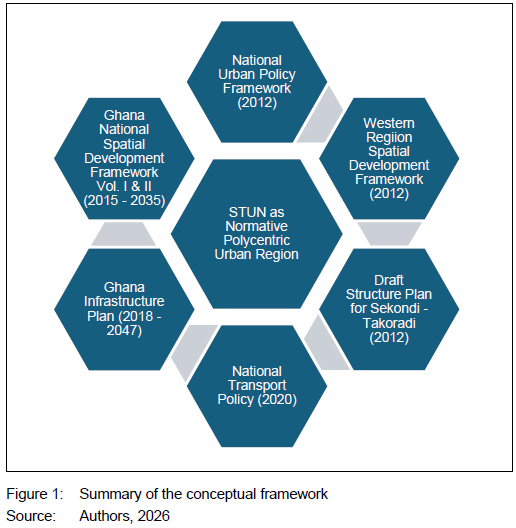
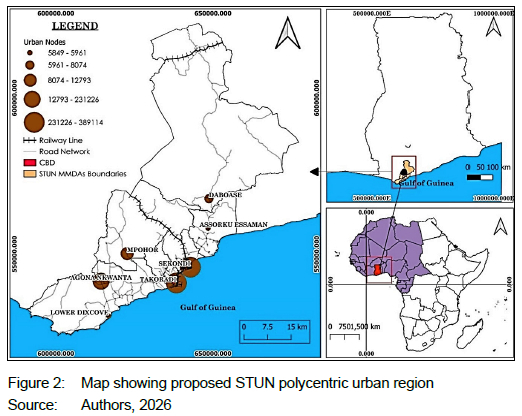
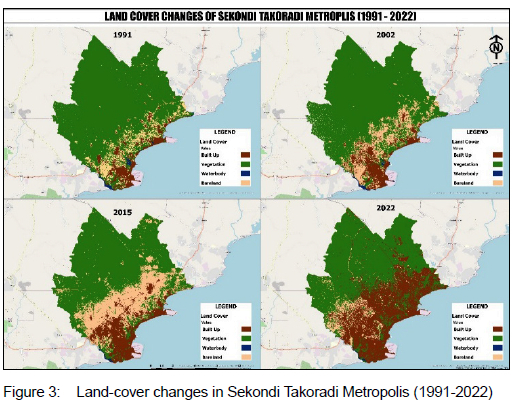
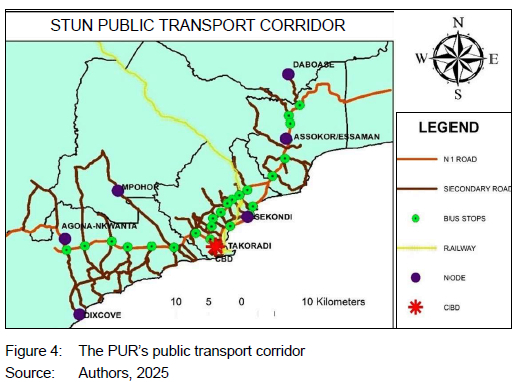
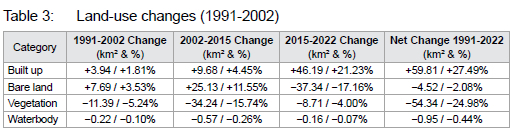
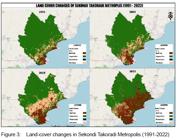
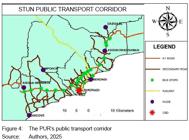
This article investigates the extent to which the policy vision of polycentric urban development, articulated in Ghana's National Spatial Development Framework (NSDF), has been realised in practice within the Sekondi-Takoradi Urban Network (STUN). Employing a qualitative research design, the study integrates GIS-based land-use analysis with structured interviews to evaluate the implementation of Ghana's polycentric development strategy and to identify barriers to STUN's functional transformation. Spatial analysis of land-use change is complemented by thematic analysis of interview data, organised around two analytical dimensions: spatial coordination and transport integration. The findings highlight four interrelated themes shaping the assessment of STUN: its conceptualisation as a normative polycentric urban region; the translation of this vision into a functional polycentric system; the role of urban governance in advancing polycentricity; and the relationship between spatial planning, transport systems, and polycentric development. Despite policy commitments to balanced regional growth, STUN remains predominantly monocentric in practice. Weak spatial-transport integration, limited inclusion of informal mobility providers, and poor inter-institutional coordination undermine the framework's implementation. The article contributes to debates on urban planning in the Global South by demonstrating that policy designation alone is insufficient to achieve functional polycentricity. It argues for strengthening regional planning institutions, improving transport-land-use integration, and formally incorporating informal mobility systems to advance polycentric development beyond symbolic policy intentions.
polycentric urban development; spatial planning; transit-oriented development; urban governance; Ghana; Sekondi-Takoradi; national spatial development framework (NSDF)
 Thumbnail
 Thumbnail
 Thumbnail
 Thumbnail