Rethinking rural development research: Gaps, frameworks, and emerging directions (2010-2025)
Abstract
Rural human-settlement planning faces persistent theoretical and methodological challenges that weaken policy design and implementation. Despite extensive scholarship, the field remains fragmented by inconsistent definitions of 'rural', limited theoretical integration, and methodological heterogeneity, all of which constrain comparative analysis and evidence-based decision-making. This review of literature (2010-2025), based on a qualitative desktop approach and thematic analysis, identifies four critical gaps. First, definitional ambiguity produces widely divergent rural population estimates, complicating programme targeting and evaluation. Secondly, theoretical fragmentation prevents the development of integrated frameworks that address social, economic, and environmental priorities collectively. Thirdly, methodological practice is dominated by single-case studies, limiting cross-context learning and the transferability of findings. Fourthly, environmental and governance dimensions are unevenly incorporated into sustainability research, reducing its relevance for resilience building and institutional reform. These shortcomings have practical consequences, namely unclear classifications risk excluding intended beneficiaries, siloed theory undermines coordination, and narrow methods weaken the evidence base for scaling interventions. Advancing the field requires context-sensitive rural classifications, integrated socio-ecological-governance frameworks, and methodological innovation - particularly comparative, longitudinal, and mixed-methods designs - to enable systematic learning across diverse rural settings and respond effectively to pressures such as climate change, urbanisation, and technological transformation.
Rural development; human settlement planning; sustainability; governance; spatial heterogeneity; place-based development; interdisciplinary research
Abstract
Beplanning van landelike nedersettings staar steeds teoretiese en metodologiese uitdagings in die gesig wat beleidsontwerp en implementering verswak. Ten spyte van uitgebreide navorsing bly die veld gefragmenteer deur inkonsekwente definisies van 'landelik', beperkte teoretiese integrasie en metodologiese heterogeniteit, wat vergelykende analise en bewysgeba-seerde besluitneming belemmer. Hierdie literatuuroorsig (2010-2025), gebaseer op 'n kwalitatiewe lessenaarbenadering, identifiseer vier kritieke gapings. Eerstens lei definisionele dubbelsinnigheid tot uiteenlopende skatting van landelike bevolkings, wat programteikening en evaluering bemoeilik. Tweedens verhinder teoretiese fragmentasie die ontwikkeling van geïntegreerde raamwerke wat sosiale, ekonomiese en omgewingsprio-riteite kollektief aanspreek. Derdens word metodologiese praktyk oorheers deur enkelgevalstudies, wat kruis-konteksleer en oordraagbaarheid van bevindings beperk. Vierdens word omgewings- en bestuursdimensies ongelyk geïntegreer in volhoubaarheidsnavorsing, wat die relevansie vir veerkragtigheid en institusionele hervorming verminder. Hierdie tekortkominge het praktiese gevolge, naamlik onduidelike klassifikasies kan begunstigdes uitsluit, gesiloïeerde teorie ondermyn koördinering, en beperkte metodes verswak die bewysbasis vir grootskaalse intervensies. Om die veld te bevorder, is konteks-sensitiewe landelike klassifikasies, geïntegreerde sosio-ekologiese-bestuursraamwerke en metodologiese innovasie - veral vergelykende, longitudinale en gemengde-metodeontwerpe - nodig om sistematiese leer oor uiteenlopende landelike kontekste te ondersteun en doeltreffend te reageer op druk soos klimaatsverandering, verste-deliking en tegnologiese transformasie.
Abstract
Moralo oa matlo a mahaeng o ntse o tobana le liphephetso tse kholo tsa thuto le mekhoa tse sitisang ho rala le ho kenya ts'ebetsong maano ka katleho. Leha ho na le liphuputso tse ngata, lefapha lena le ntse le arohane ka lebaka la litlhaloso tse sa lumellaneng tsa 'mahaeng,' ho haella ha kopanyo ea thuto le ho fapana ha mekhoa, ho leng thata ho etsa tlhahlobo e bapisoang le liqeto tse ipapisitseng le bopaki. Tlhahlobo ena ea lingoliloeng (2010-2025), e ipapisitse le liphuputso tsa desktop, e supa likheo tse 'ne tsa bohlokoa. Ea pele, ho se hlake ha litlhaloso ho baka lipalo tse fapaneng tsa baahi ba mahaeng, ho thatafatsa ho lebisa mananeo le ho a lekola. Ea bobeli, ho arohana ha thuto ho sitisa ho thehoa ha meralo e kopaneng e sebetsanang ka kopanelo le litaba tsa sechaba, moruo le tikoloho. Ea boraro, mekhoa e sebelisoang e busoa ke lithuto tsa nyeoe e le 'ngoe, ho fokotsa ho ithuta maemong a fapaneng le ho fetisetsa liphetho. Ea bone, likarolo tsa tikoloho le taolo ha li kopanngoa ka ho lekana liphuputsong tsa botsitso, ho fokotsa bohlokoa ba tsona ho mamello le phetoho ea mekhatlo. Likheo tsena li baka litlamorao tse tobileng: ho hlophisa hampe ho ka siea ba lokelang ho rua molemo, thuto e arohaneng e sitisa tsebelisano, 'me mekhoa e lekanyelitsoeng e fokotsa bopaki bakeng sa mehato e meholo. Ho ntsetsa pele lefapha lena, ho hlokahala litlhaloso tse hlophisitsoeng empa tse hlokolosi ka maemo, meralo e kopaneng ea taolo ea sechaba-tikoloho, le boqapi ba mekhoa - haholo-holo meralo e bapisoang, ea nako e telele le e kopanyang mekhoa e fapaneng - e le ho thusa ho ithuta ka mokhoa o hlophisitsoeng maemong a mahaeng a fapaneng le ho arabela ka katleho liphetoho tsa maemo a leholimo, ho fallela metseng le phetoho ea theknoloji.
1. INTRODUCTION
Rural human-settlement planning and development have steadily risen on the global agenda; yet rural transformation remains an unsettled and evolving field. Researchers and practitioners still wrestle with basic questions about how rural places change and how that change might be steered. Early work focused narrowly on agricultural growth; more recent studies have widened the analytical lens to encompass social, economic, environmental, and governance dimensions of rural change (Rikhotso & Gumbo, 2025; Chen et al., 2025). Even so, the literature is often fragmented and still shaped by urban-centred assumptions, a bias that undermines policies which do not engage with the lived realities of rural spaces (Bruckmeier, 2011; Stapel & DeYoung, 2011; Asad et al., 2021; Maniram, 2023). Contemporary rural areas are being reshaped by rapid urbanisation, climate change, technological shifts, and complex governance dynamics (Pan et al., 2025; Geng et al., 2024), pressures that compound persistent problems of poverty, infrastructural deficit, and environmental degradation across regions where most of the world's rural population lives. Current estimates place that population at roughly 3.4 billion, with nearly 90% in Africa and Asia (Mpongwana & Cishe, 2024; Bhanudas, 2025). As Fuller (2022:1030) and Crumb et al. (2023: 125) note, many existing theories struggle to capture this diversity and complexity.
A central obstacle is definitional ambiguity: What exactly counts as 'rural'? Competing classification systems, based variously on density, distance to urban centres, economic function or administrative rules, can label the same place as rural or urban, obscuring intra-rural variation and complicating policy targeting (Farrigan et al., 2024: 2; Cromartie & Ratcliffe, 2025; Childs, Boyas & Blackburn, 2022: 17; Bennett et al., 2019). This problem is amplified by the urban provenance of many conceptual tools (for example, collaborative governance), which often require substantial reinterpretation to fit the institutional and social realities of remote communities (Douglas, 2018; O'Caoimh, Douglas & Navarro, 2019). The consequences are practical: participatory initiatives can founder when they ignore entrenched power relations (Matera, 2020: 4), and climate adaptation efforts frequently underperform when socio-economic and institutional dynamics are sidelined (Atkinson & Atkinson, 2023; Dyanty et al., 2025). Fragmented theory, fuzzy definitions, methodological limits, and weak integration of sustainability and governance concerns continue to constrain the capacity of rural research to inform effective policy. This article responds to those deficiencies by pursuing three interlinked objectives, namely to systematically document the theoretical, definitional, methodological, and sustainability gaps that constrain rural development scholarship; to analyse how these gaps produce policy failures and limit evidence-based decision-making, and to identify emerging opportunities and methodological innovations that can strengthen the field's theoretical and empirical foundations. The modest and practical aim is to provide a clearer analytical base that enables researchers and policymakers to design more holistic, context-sensitive strategies for shaping inclusive and resilient rural futures.
2.1 Theoretical perspectives on rural development
Rural development theory has evolved through several major ideas, each shaping how policies are designed. Modernisation theory argues that rural areas should follow an urban-style path of industrialisation and technology to achieve growth (Evwierhurhoma, 2024). While this approach focuses on economic progress, critics mention that it ignores social and environmental costs and assumes one universal path for all places, which does not fit diverse realities (Luintel, 2014; Ukwandu, 2017; Mohammed & Ibrahim, 2023). Rooted in Eurocentric thinking, modernisation often misreads Global South contexts by treating Western industrialisation as the norm, overlooking local histories and indigenous knowledge (Ukwandu, 2017). It also fails to account for colonial legacies such as land dispossession, economic restructuring, and institutional distortions that still shape rural policy and inequality (Tricontinental, 2025). Early thinkers such as Rostow even saw underdevelopment as natural and unchanging, rather than the result of historical exploitation. This led to policies that kept poorer regions dependent on instead of supporting development suited to local needs (Tricontinental, 2025).
Dependency theory emerged as a response, showing that rural poverty often stems from unequal relationships with cities and global markets (Evwierhurhoma, 2024: 9). It explains how wealth and resources flow away from rural areas toward urban centres and powerful global actors. However, critics argue that this view sometimes underestimates rural communities' ability to adapt, resist or find creative ways to cope with outside pressures.
Recent studies have revived this debate. Wung, Tameko and Wirajing (2025) analysed 54 African countries (1990-2021) and found that reliance on external drivers such as foreign investment and debt was linked to weaker economic transformation. They conclude that "the more African countries rely on the external world for change, the less they realise this change" (Wung et al., 2025: 1). Similarly, Naseemullah (2023) shows how structural adjustment, privatisation, and deregulation have reproduced extractive systems and weakened rural state capacity. Together with Rodney's (1972) classic work, these studies suggest that external domination persists, now through financial instruments and policy conditions rather than direct colonial rule. This raises hard questions for policymakers about what real structural change would require both locally and globally.
From these critiques, a reformist or 'alternative development' approach has emerged. It promotes gradual, people-centred change, participatory planning, NGO-led projects, and community empowerment as alternatives to top-down industrial models (Badal, 2018). Its strength lies in focusing on well-being rather than Gross Domestic Product (GDP) growth. But reformism has limits. Without deeper redistribution, participatory programmes can improve short-term outcomes, while leaving landownership, fiscal control, and political power unchanged. Critics warn that these initiatives can unintentionally hide the need for structural reforms such as land redistribution, fiscal decentralisation, and anti-corruption measures (Badal, 2018).
Neoliberalism offers a contrasting logic. It favours market liberalisation, privatisation, and entrepreneurship, reducing the state's direct role and encouraging private investment (Ostry, Loungani & Furceri, 2016). Supporters cite efficiency gains and rapid growth in some instances. Yet even the International Monetary Fund (IMF) admits mixed results. Unregulated capital flows and harsh austerity often fail to deliver sustained growth and instead increase inequality (Ostry et al., 2016). In rural areas, these policies can hit hard - agricultural liberalisation and land-market reforms often benefit big agribusiness, while small farmers face price swings, weaker safety nets, and risk of losing land (Clements, 2015). Market-first strategies may deepen poverty unless paired with regulation and social protection.
There are counterarguments. Reformist approaches are praised for promoting social justice and local knowledge (Badal, 2018). Many scholars argue that markets need not be rejected entirely; instead, policy can combine market tools with redistribution and strong public institutions - for example, through targeted procurement or pro-poor value chains (Clements, 2015). Recent literature suggests a nuanced view of neoliberalism, viewing it as a mix of institutional arrangements whose effects depend on context and policy design (Rutar, 2023). This encourages pragmatic combinations of market mechanisms, redistribution, and state support. Taken together, reformist and neoliberal paradigms reveal enduring trade-offs - equity versus efficiency, local empowerment versus structural transformation. Neither is sufficient alone; both offer partial tools that must be adapted and sometimes resisted to build fair and resilient rural futures (Ostry et al., 2016; Clements, 2015; Badal, 2018; Rutar, 2023).
The sustainable development theory tries to reconcile these tensions, by linking economic growth with social equity and environmental care (Mihai & Iatu, 2020). While influential in principle, applying it in rural areas is uneven. Indicators that reflect rural priorities are scarce (Sawantbhonsale, Mandloi & Singh, 2024); most of the data are urban or national-scale and ignore local ecological knowledge. Many rural communities lack resources to adopt green practices, and sudden livelihood changes can cause social harm. Studies warn that well-meaning sustainability programmes can backfire. Pal, Lean and Villanthenkodath (2025) show that conservation subsidies, if imposed without considering local livelihoods, can restrict land access and harm food security. Their research suggests that sustainability works best when locally driven and embedded in participatory governance, while top-down donor schemes often marginalise communities and reduce economic options. Effective sustainability planning must be co-developed with communities and backed by long-term institutional and financial support.
Human development approaches shift focus from GDP to education, health, and empowerment (Evwierhurhoma, 2024). These ideas are vital for well-being, but critics note that capability-based strategies can ignore structural barriers such as land tenure, patriarchal norms, and elite control (Afifi et al., 2022). Robeyns (2011) warns that without structural reform, this approach risks individualising poverty instead of addressing systemic causes. Thus, capability strategies must be paired with political-economic reforms such as land redistribution, anti-corruption, and gender-transformative policies.
Participatory and community-based frameworks also stress local knowledge and involvement (Ndlovu & Msimanga, 2023). While they support ownership and context-specific solutions, they often operate within structural limits imposed by markets, tenure systems, and institutional imbalances (Evwierhurhoma, 2024). Participation can be symbolic. Mokoena and Molepo (2024) found that, although the vast majority of the respondents believe that participation improves accountability, officials often treat community input as advisory, not binding. As the Centre for Gender Equality (CGE, 2025) notes, tenure insecurity and elite capture cannot be solved by participation alone; structural redistribution is needed for real empowerment.
These theories each highlight important aspects of rural change, but none captures its full complexity. The fragmentation in rural development theory reflects a deeper tension between approaches that stress structural constraints and those that emphasise agency and participation. Effective rural development must consider recognising the weight of structural forces, while valuing rural communities' capacity to adapt, innovate, and resist under unequal conditions.
2.2 Definitional and classification challenges
A persistent difficulty in rural planning is that there is no shared agreement on what 'rural' means. The definition shifts depending on the country, the institution, or even the department within the same government (Childs et al., 2022; Hart, Larson & Lishner, 2005). For instance, in the United States, one federal agency may classify a locality as rural, while another labels the same place as urban (Cromartie & Ratcliffe, 2025; Farrigan et al., 2024). Simple cutoffs, such as the Organisation for Economic Co-operation and Development (OECD) guideline of fewer than 150 people per square kilometre, are straightforward to apply, but they are often blunt instruments (Oostindie & Bock, 2023). A community of a few hundred people near a major city may retain rural characteristics in terms of livelihood, , and land use, yet still be statistically categorised as urban.
In response, researchers have experimented with relational and continuum-based approaches. Clustering methods group areas that share similar social, spatial, or economic traits (Stjernberg et al., 2023; OECD, 2025), while composite indices such as Waldorf and Kim's Index of Relative Rurality combine factors such as population size, remoteness, and land-use patterns to position places along a sliding rural-urban scale. These approaches offer more distinction, but they can be difficult for policymakers to interpret and apply (Weiss et al., 2025; USDA, 2025). Moreover, they carry value judgments about what features are considered most important. Changing the weight of factors such as distance to a city, density, or economic orientation can produce entirely different classifications, even when using the same dataset (OECD, 2025). What appears 'scientific' often masks underlying assumptions about what rurality should look like.
A further complication is the Modifiable Areal Unit Problem (MAUP). Rural characteristics vary across space. Shifting the boundaries of observation can materially change the conclusion. This occurs both across different scales (the scale effect) and within the same scale based on how boundaries are drawn (the zoning effect). Jahan et al. (2025), for example, demonstrate how lung cancer data in Queensland yielded different patterns, depending on the level of spatial aggregation used. These variations did not reflect real epidemiological differences, but rather the influence of arbitrary boundary choices.
This has real planning consequences. When large administrative areas are used, internal diversity is hidden, one 'rural district' may contain a busy village centre and sparsely populated agricultural land (Manley, 2021). As a result, funding streams, development programmes, and rural support policies can exclude communities not because of their lived rural conditions, but due to how boundaries are drawn (Bennett et al., 2019; Childs et al., 2022). To avoid such distortions, rural planning requires definitions that are flexible enough to recognise diversity yet standardised enough to guide consistent policy. Continuous measures that incorporate economic function, mobility patterns, and urban linkages may provide a more grounded way of recognising rural contexts without oversimplifying or erasing them.
2.3 Methodological and spatial heterogeneity constraints
A major challenge in rural research is the choice of methods. Researchers often struggle to balance qualitative approaches, which provide rich, place-based detail, with quantitative approaches, which aim for broader generalisations (Pilcher & Cortazzi, 2023). Many studies rely on case studies or small-area surveys. These give deep insights into local realities but cannot easily be applied to other regions (Mtisi, 2022; Evwierhurhoma, 2024). On the other hand, large-scale quantitative studies use national data sets and standard indicators, but these can oversimplify rural diversity and overlook how life is actually lived in these communities (Pilcher & Cortazzi, 2023). Mixed-methods designs, combining statistics with interviews or ethnography, could solve this problem, but they are still rare in rural research.
Another difficulty is spatial heterogeneity - the fact that rural areas vary widely even within the same region. For example, one area might include commercial farms, smallholdings, isolated homesteads, and dense village clusters, each with different social and economic dynamics (Pan et al., 2025; Cruz et al., 2024). This diversity makes it hard to create models or indicators that work everywhere (Wang et al., 2025; Wang & Zhang, 2023). The Modifiable Areal Unit Problem (MAUP) adds to this complexity. Research results can change depending on whether data is grouped by region, district, or village. For instance, a broadband project might appear to be successful at district level but still leave remote households without service. Similar issues occur in health research. Gonçalves et al. (2018) describe how a rural health survey in Pelotas, Brazil, faced scattered homes, poor transport, and irregular settlement patterns, forcing the team to adapt urban sampling methods, by reducing household clusters per tract. This shows that many standard research procedures are designed for urban settings and need adjustment for rural contexts.
Because of these gaps, rural research often either over-generalises or stays too narrowly focused. Without better tools such as indicators that reflect rural well-being, it is hard to compare regions or evaluate programmes (Dymitrow & Stenseke, 2016; OECD, 2024; Grant, Longhurst & Thier, 2024). Data collection also suffers from a digital divide. Limited internet and GIS access make advanced methods such as remote sensing or mobile surveys difficult in remote villages (Yu et al., 2024; Amaliah et al., 2025). Still, these technologies offer promising solutions to data shortages, as will be discussed later.
2.4 Gaps in sustainability and environmental integration
Although sustainability is now a common buzzword in development, rural research has not fully integrated ecological and social dimensions into its core frameworks (Sawantbhonsale et al., 2024; Mihai & latu, 2020). Many studies still prioritise shortterm economic indicators such as income and production, while treating ecosystem health and community rights as secondary concerns. On the ground, governments in rural areas often lack the budgets and institutional capacity to pursue green practices, and long-standing customs or livelihood priorities can make rapid change difficult to sustain (Sawantbhonsale et al., 2024; Mihai & latu, 2020).
Empirical work shows the consequences of this gap clearly. Irungu et al. (2023), for example, examined China's rural revitalisation programme and found that attempts to fold the Sustainable Development Goals (SDGs) into local planning, via a quadruple-helix model of university, state, industry, and community cooperation, risked remaining symbolic without fresh methodological thinking. Similarly, Pal et al. (2025) show that pursuing environmental protection in isolation such as an overreliance on conservation subsidies can inadvertently harm food security by restricting land access or narrowing productive choices. Their cross-country comparison suggests that durable sustainability gains are more likely when local innovation is paired with integrated, participatory governance; by contrast, top-down donor programmes often alienate residents and remove livelihood options without offering realistic alternatives.
Climate change brings these tensions into sharp relief. Rural populations are often first to feel the impacts and least able to adapt. Studies from across the Global South report how poverty, weak infrastructure, and fragile local institutions compound climate vulnerability (Atkinson & Atkinson, 2023). Work on South African smallholders (Dyanty et al., 2025) reinforces that social networks and institutional support are crucial determinants of resilience. Yet standard vulnerability frameworks tend to overlook things that matter locally, including traditional ecological knowledge, gendered labour patterns, or customary coping practices. Dube's (2023) study in Zimbabwe illustrates this well. Indigenous forecasting and seed-sharing systems were largely ignored by formal adaptation plans, not because they lack value, but because dominant policy and scientific framings often marginalise non-Western knowledges. When incorporation does occur, it is sometimes superficial. Knowledge is stripped of context and cultural meaning rather than treated as a legitimate partner in adaptation design.
Monitoring and evaluation also lag behind. Many projects track generic indicators that miss what communities themselves view as success. The Food and Agriculture Organization (FAO)'s SCALA programme (FAO, 2025), for instance, ran into difficulties scaling promising land-use practices because pilot sites enjoyed governance and investment conditions that did not hold elsewhere. That gap between pilot and scale is common. Donor seed funding can launch initiatives, but long-term financing and locally appropriate financing mechanisms are usually lacking (Habiyaremye, Kruss & Booysens, 2019; UN, 2025).
These findings point to a simple but stubborn lesson. Technically sound interventions are not enough. For sustainability to take root in rural places requires attention to power, financing, local priorities, indigenous knowledge systems, and patience to rebuild institutions and capacities rather than imposing quick fixes.
2.5 Governance and institutional research gaps
Rural governance is not simply urban governance applied in a different setting; the context is fundamentally different, and this matters for both research and practice. Traditional governance models often assume a dense network of agencies, short distances, and strong administrative capacity - conditions that are rarely present in remote rural areas (Douglas, 2018). Recent studies that adapt collaborative governance frameworks to rural contexts highlight familiar challenges such as geographic isolation, limited local skills and finances, and a much greater diversity of local interests than many models anticipate (Saputra & Havlíček, 2024). In short, standard institutional prescriptions often fail, because they overlook the basic logistical and capacity constraints of rural settings.
Decentralisation illustrates this problem well. On paper, transferring responsibilities to local governments should make governance more responsive. In practice, local institutions often lack the staff, technical expertise, or budgets to carry out these responsibilities effectively (Dick-Sagoe, 2020). Fragmentation across departments and weak coordination between sectors make matters worse, resulting in inconsistent or even contradictory support (Department of Agriculture, Land Reform and Rural Development, 2013; Department of Rural and Community Development, 2021; Ngumbela, 2023). The Bushbuckridge study during South Africa's COVID-19 lockdown shows the human cost of this fragmentation. Households received uneven assistance from different state actors, weakening resilience during a crisis (Rusere et al., 2025).
Beyond formal capacity issues, local power structures and cultural norms shape governance in ways that standard models often ignore. Donor rhetoric about 'community participation' can mask who actually holds authority on the ground (Matera, 2020). Customary leaders, local elites, and informal networks frequently control access to resources and influence decision-making, meaning that participation risks being symbolic unless these actors are recognised and engaged. Many formal planning frameworks also struggle to accommodate customary institutions, village elders, chiefs, and traditional land regimes, even though these systems play central roles in resolving disputes and allocating resources (Tshitangoni & Francis, 2018).
The result is a literature and practice that lean heavily on neat urban analogies - models that look good on paper but fail in rural reality. Moving forward requires theory and empirical work that treat rural governance on its own terms. Research and policy must centre rural actors, smallholder associations, customary authorities, and local NGOs within mainstream governance debates, rather than treating them as peripheral addons. Only by aligning institutional design with the realities of distance, capacity, and power can governance deliver the responsiveness and resilience rural communities need.
2.6 Contextual and geographical representation gaps
There is a significant imbalance in rural development research. Most of the studies still focus on Europe and North America, while regions such as Africa, Asia, and Latin America - home to the majority of the world's rural population - remain underrepresented (Majumdar & Baikady, 2024; UN, 2021). This gap matters, because rural experiences differ widely across contexts, challenging the idea that one-size-fits-all models can work everywhere.
Recent studies illustrate these differences. For example, Wang et al. (2025) show that rural development in Gansu Province, China, is driven more by local resource constraints than by external investment. Similarly, Jia, Liu and Li (2025) find that rapid urbanisation in Guangdong has led to clustered rural settlements and a shift from 'reduction' to 'integration', demonstrating a pattern differently from the more stable rural-urban relations noted in many high-income countries.
Comparative research reinforces this point. Raj et al. (2022) show that, while USA adaptation strategies are well resourced, Indian villages must navigate caste hierarchies, patriarchal norms, and other social constraints often ignored by mainstream policy models. Majumdar and Baikady (2024) as well as Atkinson & Atkinson (2023) reach similar conclusions. Policies that succeed in Europe often fail where land tenure is insecure, climate risk is high, and institutional capacity is limited.
This geographic bias is not merely academic; it has real-world consequences. When theory and policy rely mainly on northern experience, they risk overlooking structural, cultural, and institutional realities that shape rural life in the Global South. For example, Rusere et al. (2025) note that infrastructure deficits, common across rural Africa, are rarely central in Western analyses. Likewise, indigenous knowledge, customary governance, and gendered labour relations are often overlooked (Majumdar & Baikady, 2024). Without a broader evidence base, global frameworks can become incomplete or even counterproductive when applied in unfamiliar settings.
The preceding review reveals a set of interlinked gaps that constrain both scholarship and policy in rural development. Despite decades of research, definitional ambiguity persists, producing inconsistent classifications and misaligned interventions (Hart et al., 2005; Bennett et al., 2019; Farrigan et al., 2024). Theoretical fragmentation remains pronounced: dominant paradigms such as modernisation, dependency, reformist, neoliberal, and sustainability offer partial insights but seldom integrate socio-economic, ecological, and governance dimensions into a coherent framework (Bruckmeier, 2011; Arora-Jonsson & McAreavey, 2023; Mihai & latu, 2020). Methodological limitations compound these issues, with an over-reliance on single-case studies, weak adoption of mixed-methods and spatially sensitive designs, as well as inadequate incorporation of participatory approaches (Pilcher & Cortazzi, 2023; Mtisi, 2022; Gonçalves et al., 2018). Governance dynamics that transcend geographic boundaries such as the influence of religious movements (e.g., Zion Christian Church) and traditional authority systems (chieftaincies) are rarely examined, despite their significant role in shaping rural development processes and resource allocation (Matera, 2020; Tshitangoni & Francis, 2018). Finally, the literature exhibits a strong Global North bias, leaving the lived realities of rural communities in Africa, Asia, and Latin America underrepresented (Majumdar & Baikady, 2024; Raj et al., 2022; Rusere et al., 2025). These gaps collectively undermine the capacity of rural development research to generate transferable knowledge and actionable policy. Addressing them requires conceptual synthesis, methodological pluralism, and inclusive research agendas that foreground local agency, while engaging structural constraints and culturally embedded governance systems (Perz et al., 2022; Kant & Anjali, 2021).
This study responds to these deficiencies, by critically synthesising fragmented theoretical traditions, interrogating definitional inconsistencies, and highlighting methodological innovations that can reconcile depth with comparability. It also foregrounds governance dynamics, including customary and religious authority structures, that shape rural development beyond formal state boundaries (Douglas, 2018; Saputra & Havlíček, 2024). By doing so, the study aims to provide a clearer analytical foundation for designing context-sensitive, integrated strategies that advance equitable and sustainable rural futures (Newman, 2023; Wang et al., 2025).
3. METHODOLOGY
This study employs a qualitative desktop-research design, relying exclusively on secondary sources to examine and synthesise literature on rural development. Desktop research involves systematically reviewing and interpreting existing publications rather than collecting new field data (Scarlet, 2024). As Snyder (2019) notes, this approach is practical and cost-efficient. It demands analytical rigour and strong access to scholarly material rather than the logistical demands of fieldwork, making it well suited to tracing conceptual and methodological debates across disciplines. The review focused on literature published between 2010 and 2025, a period marked by heightened attention to sustainability, governance, and the social dimensions of rural change. Sources included peer-reviewed journal articles, government reports, publications by non-governmental and international organisations, as well as selected grey literature such as policy briefs and technical documents, which capture practice-based insights often absent from academic outlets (Cheong et al., 2023). A structured and transparent process guided the review, from the identification of search terms and databases to the screening of documents for relevance and quality. The material was then synthesised into thematic domains: rural development theory, research methodologies, classification systems (with emphasis on rural-urban distinctions), sustainability frameworks, and governance models. This thematic approach made it possible to trace recurring debates, conceptual tensions, and areas of convergence across the field, producing a coherent and contextually grounded account of how rural development is theorised, researched, and operationalised in both scholarship and policy practice.
3.1
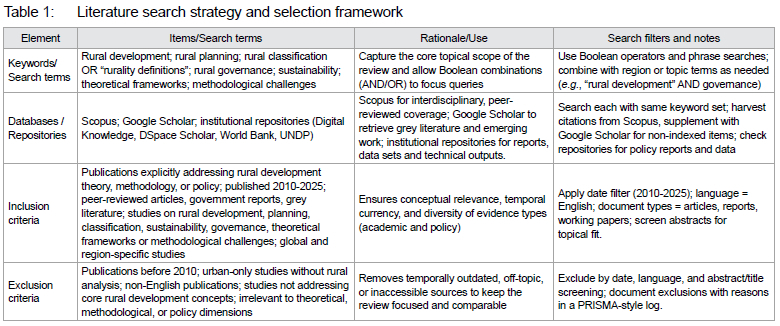
Literature search strategyAn iterative search strategy guided the review, using multiple electronic databases and online repositories (see Table 1). Rather than following a single linear protocol, the search developed through successive cycles of searching, screening, and refinement. Newly identified texts informed adjustments to search terms, selection criteria, and the overall scope - an exploratory process well suited to complex, interdisciplinary fields (Booth, Sutton & Papaioannou, 2016; Peters et al., 2015; Kosztyán, Csizmadia & Katona, 2021; Mak & Thomas, 2022).
Repeated database searches, multiple rounds of title/abstract and full-text screening, and continuous adjustments to keywords ensured broad coverage. To maintain transparency, the study recorded search strings, dates, and inclusion/ exclusion decisions, keeping an audit trail of methodological adjustments as familiarity with the field increased (Peters et al., 2015; Gottlieb et al., 2021). This adaptive approach is particularly appropriate for rural development, where concepts are fluid, terminology varies across disciplines, and methods differ widely (Heath, Levay & Tuvey, 2021; Chigbu, Atiku & Du Plessis, 2023).
3.2
Data analysisThe collected literature was analysed using thematic analysis, following established procedures, namely familiarisation with the material, generation of descriptive codes, grouping codes into higher-order categories, and refinement of themes before final synthesis (Braun & Clarke, 2019; Guest, MacQueen & Namey, 2012). This aligns with recent guidance on literature-based thematic synthesis, emphasising iterative reading, reflexive coding, and transparent documentation (Peters et al., 2020; Nowell et al., 2017).
Coding focused on recurring ideas such as, for example, definitions of 'rural', sustainability frameworks, or governance challenges. Particular attention was paid to contradictions or omissions, which signalled conceptual or methodological gaps. Themes such as classification issues, interdisciplinary divides, and measurement challenges emerged across the texts. The aim was not to test a hypothesis but to identify where the literature is fragmented or underdeveloped.
The analysis combined descriptive indicators with interpretive depth. Frequency counts were used to show how often topics appeared, while richer interpretations drew on close reading and cross-study comparison (Guest et al., 2012; Braun & Clarke, 2019). This balance made it possible to assess both the prevalence of key issues and their significance for theory and policy (Peters et al., 2020; Pilcher & Cortazzi, 2023).
Contradictions were treated as meaningful data rather than errors (Chinh et al., 2019; Zade et al., 2018). Following qualitative best practice, inconsistencies were retained to understand their disciplinary, geographic or contextual roots (Krippendorff, 2019). For example, differing definitions of 'rural' were coded as thematic findings, reflecting how geography, disciplinary focus, and policy aims shape conceptual variation (Chinh et al., 2019). Likewise, tensions between agency- and structure-focused theories were preserved to reflect valid scholarly debate (Zade et al., 2020; Ahmed et al., 2025).
Throughout, the emphasis was on critical assessment, highlighting what is established, what remains unclear, and where significant debate persists. By synthesising these observations, the analysis identifies the dominant theoretical and methodological gaps in contemporary rural development research.
4. FINDINGS AND THEMATIC ANALYSIS
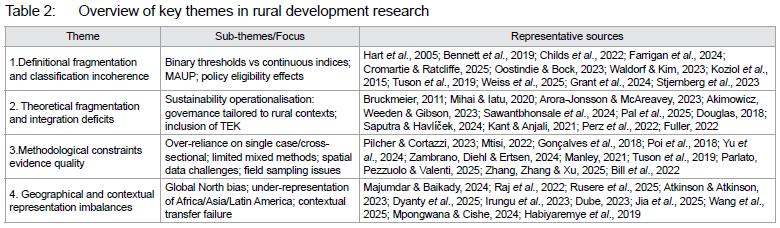
Table 2 summarises four major themes identified in the literature review, namely definitional fragmentation, theoretical gaps, methodological constraints, and geographic imbalances. Each theme includes subtopics and representative sources, providing a quick reference to the main challenges and areas for future research.
4.1 Theme 1 - Definitional fragmentation and classification incoherence
A dominant and recurring finding is that inconsistent definitions of 'rural' produce profound empirical and policy problems. Multiple authors document that national and sectoral definitions differ systematically, producing inconsistent population counts, mis-targeting of programmes, and difficulties for comparative research (Hart et al., 2005; Bennett et al., 2019; Childs et al., 2022). Recent technical reports and syntheses confirm that this remains unresolved: USA federal definitions, for example, can produce substantially different rural population estimates (Farrigan et al., 2024; Cromartie & Ratcliffe, 2025), while OECD and European Union (EU) typologies generate alternate rural shares in crosscountry comparisons (Oostindie & Bock, 2023; OECD, 2024).
Two sub-patterns are notable. First, binary thresholds (e.g., fixed population density cut-offs) remain widespread, because they are administratively simple, yet they mask functional relations and peri-urban gradations (Wandl & Magoni, 2016; Koziol et al., 2015; Manley, 2021). Secondly, continuous or composite measures, including indices of relative rurality and clustering approaches, are proposed and validated across studies, but uptake is limited in policy practice (Waldorf & Kim, 2023; Stjernberg et al., 2023; Weiss et al., 2025). Several empirical studies highlight the modifiable areal unit problem (MAUP) as a technical source of contradictory results when differing spatial units are used (Tuson et al., 2019; Koziol et al., 2015).
Policy implications of definitional incoherence are evident in the literature. Programmatic eligibility and funding allocations are sometimes determined by administrative boundaries rather than functional need, excluding vulnerable populations (Bennett et al., 2019; Childs et al., 2022; Grant et al., 2024). The literature, therefore, converges on two pragmatic prescriptions, namely adopt continuous, multidimensional measures of rurality for research and flexible policy thresholds for programmes and routinely report sensitivity analyses, using alternative definitions to show how classification choices affect results (Waldorf & Kim, 2023; Goetz & Han, 2015; Grant et al., 2024).
4.2 Theme 2 - Theoretical fragmentation and integration deficits
The second theme relates to theory. While rural development draws on varied traditions, the reviewed literature shows that these approaches are rarely brought together in a coherent analytical framework. The vast majority of studies examined worked within single theoretical or sectoral boundaries rather than integrating economic, social, ecological, and governance dimensions. This fragmentation limited the ability of these studies to capture the multi-layered character of rural transformation.
Three gaps were especially evident in the review. First, sustainability was often discussed more as a goal than as an integrated analytical practice. Only a small number of studies operationalised environmental, social, and economic considerations together (Sawantbhonsale et al., 2024; Pal et al., 2025). Secondly, governance frameworks were frequently transferred from urban contexts without adjustment, leading to assumptions of institutional density or administrative capacity that were not present in rural areas (Douglas,
2018; Saputra & Havlíček, 2024). Thirdly, intersectional and indigenous knowledge systems, including Traditional Ecological Knowledge (TEK), were mentioned but seldom substantively incorporated, even in settings where these knowledge systems are central to land and resource management (Kant & Anjali, 2021; Dube, 2023).
These patterns were reflected in the outcomes reported. Studies that relied on narrow theoretical framings often described stalled implementation, weak community buy-in, or policy misalignment. By contrast, the strongest studies used interdisciplinary, mixed-methods approaches and worked with local actors in knowledge co-production. Such studies were better able to explain change processes and to propose feasible, context-responsive interventions (Newman, 2023; Wang et al., 2025). This suggests that more integrated theoretical and methodological approaches are not only conceptually necessary but also empirically linked to stronger rural development outcomes.
4.3 Theme 3 - Methodological constraints and evidence quality
Methodological weaknesses recur across the corpus and limit the field's capacity to deliver robust, transferable knowledge. Three interrelated methodological patterns appear repeatedly, namely an over-reliance on singlecase or cross-sectional designs that constrain causal inference; limited use of mixed-methods and participatory techniques that would triangulate and validate findings, and uneven adoption of advanced spatial and remote-sensing tools that are required to capture rural heterogeneity (Pilcher & Cortazzi, 2023; Mtisi, 2022; Gonçalves et al., 2018).
Quantitatively, the reviewed literature shows that comparative and longitudinal designs are relatively rare in rural scholarship (Pilcher & Cortazzi, 2023; Wang, 2025), while mixed-methods approaches remain under-utilised, despite clear demonstrations of their value for unpacking mechanisms (Pilcher & Cortazzi, 2023; Perz et al., 2022). Spatially, many studies rely on administratively convenient units that do not reflect functional settlement systems, a pattern that obscures intra-region variability and produces misleading programme evaluations (Manley, 2021; Tuson et al., 2019; Parlató et al., 2025; Zhang et al., 2025). Practical field challenges (dispersed populations, poor roads, sampling difficulty) are also well documented (Gonçalves et al., 2018), as are ethical and epistemic issues in applying urban sampling frames to rural contexts (Zambrano et al., 2024).
The literature points to a set of methodological remedies such as standardise and report sampling strategies and sensitivity to spatial aggregation (Manley, 2021; Koziol et al., 2015); mainstream mixed-methods and participatory GIS to combine local knowledge with spatial analytics (Poi, et al., 2018; Parlató et al., 2025), and invest in longitudinal panel studies and comparative multi-site designs to permit causal and transferability claims (Wang, 2025; Perz et al., 2022). Where technological constraints exist, hybrid approaches (low-cost remote sensing plus community monitoring) are proposed as pragmatic workarounds (Bill et al., 2022; Yu et al., 2024).
4.4 Theme 4 - Geographical and contextual representation imbalances
Research disproportionately focuses on Europe and North America, leaving the Global South - home to the vast majority of rural populations - under-represented (Majumdar & Baikady, 2024; OECD, 2020; Mpongwana & Cishe, 2024). This bias leads to two issues, namely theories and policies over-fit to well-resourced contexts, and insufficient theorisation of context-specific variables such as customary governance, indigenous knowledge, informal markets, and gendered labour regimes (Raj et al., 2022; Dube, 2023; Atkinson & Atkinson, 2023).
Case studies show that transplanted 'best practice' policies often fail, due to unexamined assumptions (Rusere et al., 2025; Raj et al., 2022; Irungu et al., 2023). Conversely, comparative studies sampling across Global North-South divides reveal how institutional capacities and cultural norms alter outcomes (Wang et al., 2025; Jia et al., 2025). The consensus: expand funding and publication for under-represented regions, prioritise multi-site comparative research, and embed context-sensitivity in theory development (Majumdar & Baikady, 2024; Newman, 2023; Habiyaremye et al., 2019).
Rural development research faces four linked challenges, namely unclear definitions, fragmented theories, narrow methods, and limited representation of Global South contexts, highlighting the need for integrated frameworks and inclusive approaches.
5. DISCUSSION
5.1 Definitional fragmentation and its policy consequences
Unclear definitions of 'rural' create serious problems for research and policy. When rural areas are not consistently identified, studies become hard to compare and policies risk missing the people they aim to help. For example, in the USA, two communities just a few miles apart might be classified differently - one rural, one urban -based on arbitrary boundaries. This 'definitional chaos' undermines policy validity and resource allocation. Different classification systems can produce rural population estimates ranging from 10% to 28% of a nation's total population, making comparisons unreliable (Lichter & Brown, 2011; Childs et al., 2022; Hart et al., 2005; Bennett et al., 2019; Zhu, Ying & Xiang, 2025). The issue is especially problematic in peri-urban areas, which blur the line between rural and urban but are poorly captured by current systems (Wandl & Magoni, 2016).
Studies show that binary cut-offs and administrative boundaries often misclassify these areas, leading to inaccurate population counts and programme eligibility errors. These inconsistencies have two major consequences, namely research loses coherence, because data sets do not match across studies, and policies risk excluding vulnerable groups. The solution is clear: move away from rigid labels and adopt multidimensional, continuous measures of rurality, supported by sensitivity testing to ensure robust results (Farrigan et al., 2024).
5.2
Theoretical fragmentation and the limits of sectoral policyRural planning often suffers from fragmented theories that keep policies compartmentalised. Without integrated models, sectoral approaches such as treating agriculture, health, and infrastructure separately miss opportunities for synergy (European Commission, 2021; Bruckmeier, 2011). For example, Wang (2025) found that in Guizhou, China, addressing land reform, leadership development, and collective action in isolation overlooked the benefits of integrated resource governance. In short, viewing issues separately leads to policy gaps and wasted opportunities (Arora-Jonsson & McAreavey, 2023).
The literature shows persistent disciplinary silos and limited adoption of frameworks that capture multilevel and multidimensional dynamics (Theme 2). This fragmentation results in policies that fail to link governance, ecological, and socioeconomic factors, often producing partial or even counterproductive outcomes. The solution is clear: theoretical integration through interdisciplinary models and mixed-methods research must become a priority if rural development is to generate practical, evidence-based solutions for complex challenges (Bruckmeier, 2011; Wang, 2025).
5.3
Methodological constraints and evidence qualityWeak research methods reduce the reliability of evidence in rural development studies. Many studies rely on single-case or short-term designs, making it hard to draw broader conclusions. Reviews show that, without mixed methods and indicators tailored to rural contexts, it is difficult to evaluate programmes or apply lessons elsewhere (Pilcher & Cortazzi, 2023). This creates real risks. For example, a rural electrification project might seem successful in one area but fail in another because important factors such as maintenance capacity were not measured.
The analysis also found common patterns such as heavy dependence on single-site studies, few comparative or long-term designs, and inconsistent reporting of sampling and spatial boundaries. These weaknesses limit causal insights and make findings hard to transfer. Field challenges such as scattered populations and poor infrastructure often push researchers toward convenient sampling, which further reduces accuracy. To improve evidence quality, three steps are needed: use mixed-methods, multi-site, and longitudinal designs to strengthen comparisons and causal claims; report how spatial boundaries affect results and apply sensitivity checks, and combine low-cost remote sensing with community-based monitoring where technology access is limited.
5.4 Geographical and contextual representation imbalances
A major finding of this review is that most of the research on rural development focuses on Europe and North America. This creates a skewed evidence base that often fails when applied to regions in the Global South (Majumdar & Baikady, 2024). Rural areas in Africa, Asia, and Latin America face very different realities such as weaker institutions, insecure land tenure, and higher climate risks. Policies designed for well-resourced contexts often do not work.
Examples from recent studies confirm this. During South Africa's COVID-19 lockdown, overlapping government responses led to inconsistent household support, exposing weak delivery systems (Rusere et al., 2025). In India, adaptation strategies that succeed in rural America clash with local social norms such as caste and gender roles (Raj et al., 2022). In China, rural development patterns differ sharply from European models, driven by local resource constraints and rapid urbanisation (Wang et al., 2025; Jia et al., 2025). These cases show that governance capacity, cultural norms, and environmental conditions strongly influence outcomes.
The implication is clear. Theories and policies must be tested across diverse contexts, not inferred from narrow case studies. Comparative, multi-site research is essential to identify which strategies work broadly and which depend on local conditions. Funding bodies and journals should prioritise studies from underrepresented regions and encourage North-South comparisons. Only by broadening the evidence base can rural development research produce guidance that is truly relevant worldwide.
5.5 Structural and systemic challenges
Structural and systemic gaps act as broad, underlying barriers rather than isolated problems. Issues such as unclear roles among national, regional, and local actors, limited funding for integrated programmes, and fragmented monitoring systems influence research priorities, data availability, and the feasibility of interdisciplinary work. These constraints increase definitional ambiguity, limit methodological innovation, skew geographic coverage, and make it harder to turn evidence into policy. As a result, technical fixes (e.g., creating a new index) rarely succeed without accompanying institutional reforms.
Many of these gaps stem from deeper structural issues. Research and funding often favour urban problems and models, creating an urban-centric bias (Maniram, 2023; Asad et al., 2021). Rural areas, far from academic hubs and political influence, rarely shape research agendas. Funding calls typically focus on sector-specific outcomes (e.g., crop yields, child health) rather than overall rural well-being, encouraging narrow studies and discouraging interdisciplinary planning. Academic incentives also favour 'safe' publications in specialised journals, leaving riskier but socially important rural topics underexplored and perpetuating a cycle of limited data and weak theory (Newman, 2023).
Community-level capacity constraints aggravate these challenges. A persistent digital divide (Yu et al., 2024) and rural 'brain drain' reduce local planning expertise and make participatory methods harder to implement. Addressing these issues requires multilevel reforms: universities should establish rural research centres, donors should create targeted innovation funds, and journals should actively prioritise interdisciplinary rural work. Realigning incentives is essential to attract diverse, collaborative research.
5.6 Sustainability, climate vulnerability, and the limits of existing empirical frames
Deficits in sustainability and climate resilience are not minor shortcomings - they are central constraints that intensify the problems identified in this review. When definitions, theories, and methods are fragmented, ignoring environmental and social dynamics creates systematic blind spots in evidence and policy. For example, measures of 'rurality' that overlook ecological gradients and climate hazards often undercount or misclassify populations most at risk from resource depletion, seasonal shocks, and long-term climate trends (Wang et al., 2025; Raj et al., 2022). Case studies show how agrarian transitions, migration, and changing livelihoods compound environmental vulnerability where monitoring is weak (Rusere et al., 2025; Raj et al., 2022).
Theoretical silos often separate socio-economic and environmental analysis, producing policies that address either livelihoods or ecosystems, but rarely both (Bennett et al., 2019; Atkinson & Atkinson, 2023). Methodologically, the lack of longitudinal environmental indicators and weak local monitoring capacity limit the ability to detect slow-onset stresses and adjust policy in time.
Participatory monitoring can help but remains underused (Perz et al., 2022; Rusere et al., 2025). Structural barriers - such as the absence of institutional mandates and routine funding for integrated socio-ecological monitoring - further hinder translating research into adaptation policy and practice (Atkinson & Atkinson, 2023; Bennett et al., 2019). Closing these sustainability gaps requires: (a) socio-ecological frameworks that link people, places, and ecosystems; (b) improved temporal coverage through longitudinal environmental indicators and community monitoring; and (c) institutional reforms that embed environmental metrics into routine monitoring, budgeting, and program eligibility decisions (Raj et al., 2022; Wang et al., 2025; Perz et al., 2022).
6. IMPLICATIONS FOR RURAL DEVELOPMENT THEORY AND RESEARCH PRACTICE
This review confirms that current rural development theory remains constrained by definitional fragmentation, disciplinary silos, and insufficient engagement with socio-ecological and governance complexity. Rural development requires theories that transcend disciplinary silos and account for spatial, social, ecological, and governance complexity (Bruckmeier, 2011; Arora-Jonsson & McAreavey, 2023).
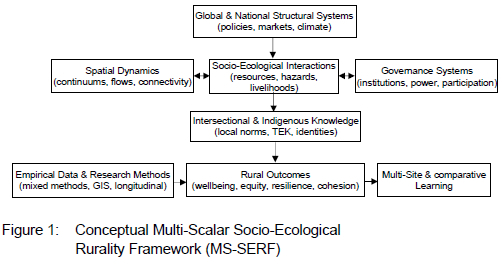
Conceptually, the field would benefit from a multi-scalar, cross-dimensional framework (see Figure 1) that replaces binary urban-rural categories with continuous measures of rurality, emphasises socio-ecological governance, and incorporates intersectional perspectives, including indigenous and local knowledge systems. Such a framework should explicitly address power relations, structural inequalities, and cultural specificities shaping diverse rural realities (Kant & Anjali, 2021; Perz et al., 2022; Dube, 2023). The proposed Multi-Scalar Socio-Ecological Rurality Framework (MS-SERF) provides a more realistic basis for analysing peri-urban dynamics, mobility, and spatial inequality. This framework is designed to guide theory-building, empirical research and policy formulation by offering: (1) a non-binary conceptualisation of rurality; (2) a socio-ecologically integrated understanding of rural change; (3) an explicit focus on power, governance and knowledge diversity; and (4) a structure for linking local processes to broader structural forces.
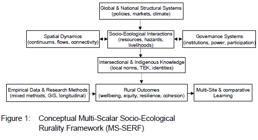
The MS-SERF framework provides a foundation for rethinking how rurality is theorised and measured while addressing long-standing limitations in the literature.
Methodologically, future research should prioritise mixed-methods longitudinal designs, stronger spatial analytics to address the modifiable areal unit problem, and genuinely participatory approaches that respect local agency while addressing structural drivers. Comparative multi-site and cross-regional studies are also needed to distinguish context-specific mechanisms from general patterns, improving external validity and policy relevance (Pilcher & Cortazzi, 2023; Wang, 2025; Perz et al., 2022).
Achieving these shifts requires coordinated action by researchers, funders, and policymakers to support innovative, inclusive research programs. Only sustained institutional commitment can enable theory and practice to respond effectively to the complexity and urgency of contemporary rural challenges (Newman, 2023; Atkinson & Atkinson, 2023).
7. EMERGING OPPORTUNITIES AND PROMISING DIRECTIONS
The implications outlined in Section 6 highlight significant theoretical, conceptual, and methodological shifts needed to strengthen rural development scholarship. Building on these implications, this section identifies concrete opportunities and emerging directions in research, policy, and practice that can operationalise these shifts. Rather than revisiting the conceptual contributions already articulated, the discussion here focuses on practical, forward-oriented avenues that show how integrated, multi-scalar, and participatory approaches can be implemented on the ground.
7.1 Technological and Analytical Advances
Rapid technological change is expanding what is empirically possible in rural research and planning. Advances in geographic information systems (GIS), remote sensing and large-scale data analytics enable researchers to capture rural heterogeneity with a level of granularity previously unattainable (Zhang et al., 2025). High-resolution spatial data allow for systematic monitoring of settlement change, land degradation, and peri-urban dynamics. For instance, a GIS/GPS planning database in Papua New Guinea improved transparency and supported more accurate targeting of rural infrastructure investments (Poi et al., 2018), while routine satellite imagery enables continuous tracking of village expansion and land-use change (Parlato et al., 2025). Longitudinal spatial studies such as those conducted in Guangdong Province, China (Jia, Liu & Li, 2025) illustrate how rural settlements reorganise under urban pressure, revealing phenomena such as village "hollowing" and supporting differentiated policy responses.
Digital tools are also reshaping participatory practice. Mobile surveys, SMS-based feedback systems and online engagement platforms allow residents to communicate needs and monitor projects in near real time, reducing information asymmetries and, in documented cases, nudging officials toward greater responsiveness (Bill et al., 2022; Yu et al., 2024). These tools can democratise evidence production, but their effectiveness depends on digital literacy, network access, cultural fit, local trust - including trust in traditional authority systems - and robust data governance structures.
7.2 System-Oriented and Integrated Policy Innovations
New policy initiatives demonstrate an increasing willingness to link sectoral domains traditionally treated in isolation. Early 'smart village' models and integrated rural development programmes reflect attempts to align agriculture, education, infrastructure and governance within more holistic, place-based strategies (OECD, 2020; Akimowicz, Weeden & Gibson, 2023). Resilience and adaptive capacity frameworks also offer practical tools for integrating environmental and social dimensions and preparing for climate, market and demographic shocks (Geng et al., 2024; Akimowicz, Weeden & Gibson, 2023).
Yet these initiatives underscore a critical lesson: system-oriented planning succeeds only when matched by investments in social capital, local institutional capacity and participatory decision-making. Evidence from participatory rural programmes shows that durable gains depend on locally grounded implementation and long-term support, rather than the mere adoption of integrated frameworks (Kitano, 2024).
Translating integrated approaches into practice therefore requires institutional strengthening, capacity building, and the incorporation of monitoring systems that can track cross-sectoral interactions.
7.3 Methodological Innovations and Future Research Directions
Realising the potential of the opportunities above requires methodological change aligned with the implications outlined in Section 5.8. Mixed-methods research should become routine rather than exceptional. Integrating quantitative analytics with grounded qualitative inquiry yields multi-layered insights into rural dynamics that single-method approaches cannot achieve. Spatial modelling, network analysis and interaction models have proven valuable tools for unpacking rural-urban linkages, mobility and service access patterns (Goetz & Han, 2015).
Participatory methodologies further strengthen analytical depth and practical relevance. Community-based and co-produced research approaches - such as Participatory Action Research - elevate local agency and incorporate Traditional Ecological Knowledge (Kant & Anjali, 2021). Examples from the Amazon show how co-designed environmental monitoring systems simultaneously enhanced conservation outcomes and strengthened governance institutions (Perz et al., 2022). Community-driven monitoring of water quality, rangeland use, and land-use change can improve both equity and policy responsiveness.
Extending inquiry across time and space is equally essential. Longitudinal research captures institutional evolution, shifting practices and the durability of intervention effects (Wang, 2025). Comparative, cross-regional studies help distinguish generalisable mechanisms from context-specific dynamics - an important task given pronounced cultural and institutional variation across rural settings (Raj et al., 2022).
Finally, action research - co-designing, implementing, and refining interventions iteratively -offers a promising but underused bridge between theory and practice. Though still under-represented in leading journals, it provides actionable, context-sensitive evidence capable of informing immediate policy decisions and supporting community priorities.
8. CONCLUSION
The review demonstrates that rural development scholarship currently finds itself at a decisive inflection point. This review has synthesised evidence that rural development scholarship is hindered less by isolated methodological faults than by a set of interlocking, structural limitations: inconsistent measures of rurality, fragmented theoretical traditions, constrained empirical strategies, and a geographic bias in research attention. These limitations undermine the capacity of academic work to produce reliable, generalisable guidance for policy and practice in diverse rural contexts.
Rather than adding further descriptive detail, progress requires three targeted shifts. First, measurement and classification must move from crude binaries to flexible, multidimensional systems that disclose sensitivity to scale and functional linkages. Second, theory building should prioritise integrative, socio-ecological frameworks that explicitly connect governance, livelihood, and environmental processes and that are tested through interdisciplinary teams. Third, methodological portfolios must be diversified: coordinated comparative and longitudinal studies, mixed method designs that combine spatial analytics with participatory inquiry, and pragmatic hybrid data strategies (community monitoring plus remote sensing) are needed to strengthen causal inference and transferability.
These technical changes will not succeed in isolation. Institutional incentives, funding, journal priorities and university structures, must be aligned to reward long-term, collaborative, place-sensitive research and to support scholarship in under-represented regions. If scholars, funders and practitioners adopt these reforms, the field can produce more robust, contextually grounded evidence to inform equitable and resilient rural policy. The task is urgent but feasible: thoughtful redesign of how we define, theorise and study rural places will materially improve the prospects for sustainable rural futures.
REFERENCES
2. LITERATURE REVIEW
-
AFIFI, R., PARKER, E. DINO, G., HALL, D. & ULIN, B. 2022. Reimagining Rural: Shifting Paradigms About Health and Well-Being in the Rural United States. Annual review of public health, 43, pp. 135-154. https://doi.org/10.1146/annurev-publhealth-052020-123413
» https://doi.org/10.1146/annurev-publhealth-052020-123413 -
AHMED, S., MOHAMMED, R., NASHWAN, A., IBRAHIM, R. & ABDALLA, Q. et al. 2025. Using thematic analysis in qualitative research. Journal of Medicine Surgery and Public Health, 6. https://doi.org/10.2139/ssrn.5222482
» https://doi.org/10.2139/ssrn.5222482 -
AKIMOWICZ, M., WEEDEN, S. & GIBSON, R. 2023. Building bridges across the plurality of rural development research. Annals of Regional Science, 22, pp. 1-8. https://doi.org/10.1007/s00168-023-01224-3
» https://doi.org/10.1007/s00168-023-01224-3 -
ALAOUI, K., RADOINE, H. & NAHIDUZZAMAN, K. 2024. Rural planning evaluation and sustainable development potential in rural communes of Rehamna province (Morocco). Journal of Urban Management, 13(4), pp. 624-638. https://doi.org/10.1016/j.jum.2024.07.002
» https://doi.org/10.1016/j.jum.2024.07.002 -
AMALIAH Y., HUSNI A., ANSAR M. & CHOWDHURY, K. 2025.The research landscape of rural sustainable livelihood: a scientometric analysis. Frontiers in Sustainable Food Systems, 6, article 1548378. https://doi.org/10.3389/frsus.2025.1548378
» https://doi.org/10.3389/frsus.2025.1548378 -
ARORA-JONSSON, S. & MCAREAVEY, R. 2023. From crisis to sustainability: The politics of knowledge production on rural Europe. Sociologia Ruralis, 63(3), pp. 771-792. https://doi.org/10.1111/soru.12446
» https://doi.org/10.1111/soru.12446 -
ASAD, F., NUR, F., MORRIS, J. & BOBIAK, J. 2021. Report: Defining Rural. Spatial Determinants of Health Lab, Carleton University: Ottawa, ON. https://doi.org/10.22215/sdhlab/2021.3
» https://doi.org/10.22215/sdhlab/2021.3 -
ATKINSON, C. & ATKINSON, A. 2023. Impacts of Climate Change on Rural Communities: Vulnerability and Adaptation in the Global South. Encyclopedia, 3(2), pp. 721-729. https://doi.org/10.3390/encyclopedia3020052
» https://doi.org/10.3390/encyclopedia3020052 -
BADAL, B. 2018.Alternative rural development: Social justice, equity, self-reliance, and Third Worldism. Research Nepal Journal of Development Studies, 1(1), pp. 1-17. https://doi.org/10.3126/rnjds.v1i1.21269
» https://doi.org/10.3126/rnjds.v1i1.21269 -
BENNETT, J., BORDERS, F., HOLMES, M., KOZHIMANNIL, B. & ZILLER, E. 2019. What Is Rural? Challenges And Implications Of Definitions That Inadequately Encompass Rural People And Places. Health Affairs, 38(12), pp. 19851992. https://doi.org/10.1377/hlthaff.2019.00910
» https://doi.org/10.1377/hlthaff.2019.00910 -
BHANUDAS, D. 2025. Rural Development: Challenges & Solutions. International Journal of Advance and Applied Research, 6(29), 89-93. https://doi.org/10.5281/zenodo.15568919
» https://doi.org/10.5281/zenodo.15568919 -
BILL, R., BLANKENBACH, J., BREUNIG, M. & HAUNERT, J. 2022. Geospatial Information Research: State of the Art, Case Studies and Future Perspectives. PFG, 90, pp. 349-389. https://doi.org/10.1007/s41064-022-00217-9
» https://doi.org/10.1007/s41064-022-00217-9 - BOOTH, A., SUTTON, A. & PAPAIOANNOU, D. 2016. Systematic approaches to a successful literature review. 2nd edition. London: SAGE.
-
BRAUN, V. & CLARKE, V. 2019. Reflecting on reflexive thematic analysis. Qualitative Research in Sport, Exercise and Health, 11(4), pp. 589-597. https://doi.org/10.1080/2159676X.2019.1628806
» https://doi.org/10.1080/2159676X.2019.1628806 -
BRUCKMEIER, K. 2011. Towards Interdisciplinary Rural Research -Theorizing Nature-Society Relations. Natures Sciences Sociétés, 19(1), pp. 3-13. https://doi.org/10.1051/nss/2011111
» https://doi.org/10.1051/nss/2011111 -
CGE (CENTRE FOR GENDER EQUALITY). 2025. Exploring barriers to women's access to communal land in southern Africa. Policy Brief. cge.org [Accessed 10 November 2025].
» cge.org -
CHEN, Y., ZHU, L., DU, J. & HONG, W. 2025. Evaluation of rural comprehensive development level and obstacle factors in various countries around the world. PLoS One, 20(4), article 0317282. https://doi.org/10.1371/journal.pone.0317282
» https://doi.org/10.1371/journal.pone.0317282 -
CHEONG, H., LYONS, A., HOUGHTON, R. & MAJUMDAR, A. 2023. Secondary qualitative research methodology using online data within the context of social sciences. International Journal of Qualitative Methods, 22, pp. 1-19. https://doi.org/10.1177/16094069231180160
» https://doi.org/10.1177/16094069231180160 -
CHIGBU, U., ATIKU, S. & DU PLESSIS, C. 2023. The science of literature reviews: searching, identifying, selecting, and synthesising. Publications, 11(1), article 2. https://doi.org/10.3390/publications11010002
» https://doi.org/10.3390/publications11010002 -
CHILDS, E., BOYAS, J. & BLACKBURN, J. 2022. Off the beaten path: A scoping review of how 'rural' is defined by the U.S. government for rural health promotion. Health Promotion Perspectives, 12(1), pp. 10-21. https://doi.org/10.34172/hpp.2022.02
» https://doi.org/10.34172/hpp.2022.02 -
CHINH, B., ZADE, H., GANJI, A. & ARAGON, C. 2019. Ways of qualitative coding: A case study of four strategies for resolving disagreements. In: Extended Abstracts of the 2019 CHI Conference on Human Factors in Computing Systems (CHI EA '19), 4-9 May, Glasgow, UK. ACM. https://doi.org/10.1145/3290607.3312879
» https://doi.org/10.1145/3290607.3312879 -
CLEMENTS, E. 2015. Addressing rural poverty and food insecurity through local food purchasing and school lunch programs: PAA Africa, PRONAE and the creation of institutional markets in Mozambique. Revista NERA (Special Issue 26), pp. 28-50. https://doi.org/10.47946/rnera.v0i26.3570
» https://doi.org/10.47946/rnera.v0i26.3570 -
CROMARTIE, J. & RATCLIFFE, M. 2025. Rural Definitions and Measurement. Federal Committee on Statistical Methodology. ntl.bts.gov [Accessed 15 June 2025].
» ntl.bts.gov -
CRUMB, L., CHAMBERS, C., AZANO, A., HANDS, A., CUTHRELL, K. & AVENT, M. 2023. Rural cultural wealth: dismantling deficit ideologies of rurality. Journal of Multicultural Education. 17(2), 125-138. https://doi.org/10.1108/JME-06-2022-0076
» https://doi.org/10.1108/JME-06-2022-0076 -
CRUZ, J., LUKE, D., CEBALLOS, R., RAMANADHAN, S. & EMMONS, K. 2024. Reconceptualizing rurality: Exploring community capital to identify distinct rural classes in the United States. SSM Population Health, 22(9), article 101729. https://doi.org/10.1016/j.ssmph.2024.101729
» https://doi.org/10.1016/j.ssmph.2024.101729 - DEPARTMENT OF AGRICULTURE, LAND REFORM AND RURAL DEVELOPMENT SOUTH AFRICA. 2013. Rural Development Framework Policy. Government of South Africa. Rural Development Framework Policy [Accessed 15 June 2025].
-
DEPARTMENT OF RURALAND COMMUNITY DEVELOPMENT. 2021. Our rural future: Rural development policy 2021-2025. Government of Ireland. gov.ie [Accessed 15 June 2025].
» gov.ie -
DICK-SAGOE, C.2020. Decentralization for improving the provision of public services in developing countries: A critical review. Cogent Economics & Finance, 8(1), article 1804036, https://doi.org/10.1080/23322039.2020.1804036
» https://doi.org/10.1080/23322039.2020.1804036 -
DOUGLAS, D. 2018. Governance in Rural Contexts: Toward the Formulation of a Conceptual Framework. EchoGéo, 43. https://doi.org/10.4000/echogeo.15265
» https://doi.org/10.4000/echogeo.15265 -
DUBE, N. 2023. Adaptation and resilience in rural Zimbabwe. GeoJournal, 88, pp. 5331-5352. https://doi.org/10.1007/s10708-023-10918-2
» https://doi.org/10.1007/s10708-023-10918-2 -
DYANTY, T., AGHOLOR, I.A., NKAMBULE, T.B., NKUNA, A.A. & NKOSI, M., et al. 2025. SocioEconomic Determinants of Climate Change Adaptation Strategies Among Smallholder Farmers in Mbombela: A Binary Logistic Regression Analysis. Climate, 13(5), article 90. https://doi.org/10.3390/cli13050090
» https://doi.org/10.3390/cli13050090 -
DYMITROW, M. & STENSEKE, M.2016. Rural-Urban Blurring and the Subjectivity Within. Rural Landscapes: Society, Environment, History, 3(1), article 4. https://doi.org/10.16993/rl.1.
» https://doi.org/10.16993/rl.1 - EUROPEAN COMMISSION. 2021. A long-term Vision for the EU's Rural Areas - Towards stronger, connected, resilient and prosperous rural areas by 2040. European Commission. Europa. eu [Accessed 21 June 2025].
-
EVWIERHURHOMA, F.E.2024. Rural development challenges and management theories. Nigerian Agricultural Policy Research Journal, 11(1), pp. 8-14. https://doi.org/10.22004/ag.econ.343426
» https://doi.org/10.22004/ag.econ.343426 -
FAO (FOOD AND AGRICULTURE ORGANIZATION). 2025. Engaging the private sector in climate action: Lessons learned from the implementation of the SCALA programme. UNDP Climate Promise. climatepromise.undp.org [Accessed 17 June 2025].
» climatepromise.undp.org -
FARRIGAN, T., GENETIN, B., SANDERS, A., PENDER, J. & THOMAS, K., et al. 2024. Rural America at a glance (Report No. EIB-282). U.S. Department of Agriculture, Economic Research Service. https://doi.org/10.32747/2024.8722498.ers
» https://doi.org/10.32747/2024.8722498.ers -
FULLER, A. 2022. Researching Rural Development: Selected Reflections. World, 3(4), pp. 1028-1031. https://doi.org/10.3390/world3040058
» https://doi.org/10.3390/world3040058 -
GEBREMESKEL, A., UDENIGWE, O., ETOWA, J. & YAYA, S. 2023. Unpacking the challenges of fragmentation in community-based maternal newborn and child health and health system in rural Ethiopia: A qualitative study. PLoS ONE, 18(9), article 0291696. https://doi.org/10.1371/journal.pone.0291696
» https://doi.org/10.1371/journal.pone.0291696 -
GENG, Y., YANG, X., ZHANG, N., LI, J. & YAN, Y. 2024. Sustainable rural development: differentiated paths to achieve rural revitalization with case of Western China. Scientific Reports, 14(1), article 31507. https://doi.org/10.1038/s41598-024-83339-x.
» https://doi.org/10.1038/s41598-024-83339-x -
GOETZ, S. & HAN, Y. 2015. Evaluation of rural area classifications using statistical modelling. Penn State University, Department of Agricultural Economics, Sociology, and Education (AESE), NERCRD/NARDeP. Prepared for the Workshop on Rationalizing Rural Area Classifications, National Academy of Sciences and USDA Economic Research Service. nationalacademic.org [Accessed 17 June 2025].
» nationalacademic.org -
GONÇALVES, H., TOMASI, E., TOVO-RODRIGUES, L., BIELEMANN, R. & MACHADO, A., et al. 2018. Population-based study in a rural area: Methodology and challenges. Revista de Saúde Pública, 52(1). https://doi.org/10.11606/S1518-8787.2018052000270
» https://doi.org/10.11606/S1518-8787.2018052000270 -
GOTTLIEB, M., HAAS, M., DANIEL, M. & CHAN, T. 2021.The scoping review: a flexible, inclusive, and iterative approach to knowledge synthesis. AEM Education and Training, 5, article 10609. https://doi.org/10.1002/aet2.10609
» https://doi.org/10.1002/aet2.10609 -
GRANT, P.D., LONGHURST, J.M. & THIER, M. 2024. Rural definition triangulation: Improving the credibility and transferability of rural education research in the United States. Journal of Research in Rural Education, 40(1). https://doi.org/10.3102/2016985
» https://doi.org/10.3102/2016985 -
GUEST, G., MACQUEEN, K. & NAMEY, E. 2012. Applied thematic analysis. Thousand Oaks, CA: SAGE. https://doi.org/10.4135/9781483384436
» https://doi.org/10.4135/9781483384436 -
HABIYAREMYE, A., KRUSS, G. & BOOYENS, I. 2019. Innovation for inclusive rural transformation: The role of the state. Innovation and Development, 10(2), pp. 155-168. https://doi.org/10.1080/2157930X.2019.1596368
» https://doi.org/10.1080/2157930X.2019.1596368 -
HART, G., LARSON, H. & LISHNER, M. 2005. Rural Definitions for Health Policy and Research. American Journal of Public Health, 95(7), pp. 1149-1155. https://doi.org/10.2105/AJPH.2004.042432
» https://doi.org/10.2105/AJPH.2004.042432 -
HEATH, A., LEVAY, P. & TUVEY, D. 2021. Literature searching methods or guidance and their application to public health topics: a narrative review. Health Information & Libraries Journal, 39(1), pp.6-21. https://doi.org/10.1111/hir.12414
» https://doi.org/10.1111/hir.12414 -
IRUNGU, R., LIU, Z., LIU, X. & WANJIRU, A. 2023. Role of networks of rural innovation in advancing the Sustainable Development Goals: A quadruple helix case study. Sustainability, 15(17), article 13221. https://doi.org/10.3390/su151713221
» https://doi.org/10.3390/su151713221 -
JAHAN, F., HAQUE, S., HOGG, J., PRICE, A. & HASSAN, C., et al. 2025. Assessing the influence of the modifiable areal unit problem on Bayesian disease mapping in Queensland, Australia. PLoS ONE. 20(1): e0313079. https://doi.org/10.1371/journal.pone.0313079
» https://doi.org/10.1371/journal.pone.0313079 -
JIA, L., LIU, Z. & LI, Y. 2025. Spatiotemporal dynamics of rural settlement evolution in Guangdong Province, China. Scientific Reports, 15, article 18244. https://doi.org/10.1038/s41598-025-03228-9
» https://doi.org/10.1038/s41598-025-03228-9 -
KANT, N. & ANJALI, K. 2021. Traditional Ecological Knowledge (TEK): A Strategic Resource for Tribal Communities. In: LEAL FILHO, W. et al., (Eds). Peace, Justice and Strong Institutions. Encyclopedia of the UN Sustainable Development Goals. Springer, Cham, pp. 915-928. https://doi.org/10.1007/978-3-319-95960-3_130
» https://doi.org/10.1007/978-3-319-95960-3_130 -
KITANO, S. 2024. Examining social capital in rural collective action: Its measurement, heterogeneity, and policy impact, ZBW. Kiel, Hamburg: Leibniz Information Centre for Economics. econstor.eu [Accessed 15 June 2025].
» econstor.eu -
KOSZTYÁN, Z., CSIZMADIA, T. & KATONA, A. 2021. SIMILAR-systematic iterative multilayer literature review method. Journal of Informetrics, 15, article 101111. https://doi.org.10.1016/j.joi.2020.101111.
» https://doi.org.10.1016/j.joi.2020.101111 - KOZIOL, N., ARTHUR, A., HAWLEY, L., BOVAIRD, J., et al. 2015. Identifying, analysing, and communicating rural: A quantitative perspective. Journal of Research in Rural Education, 30(4), pp. 1-14.
-
KRIPPENDORFF, K. 2019. Content analysis: An introduction to its methodology. 4th edition. Thousand Oaks, CA: SAGE Publications, Inc. https://doi.org/10.4135/9781071878781.n13
» https://doi.org/10.4135/9781071878781.n13 -
LICHTER, D. & BROWN, D. 2011. Rural America in an urban society: Changing spatial and social boundaries. Annual Review of Sociology, 37, pp. 565-592. https://doi.org/10.1146/annurev-soc-081309-150208
» https://doi.org/10.1146/annurev-soc-081309-150208 -
LUINTEL, Y. 2014. Modernity and Gender: A Critique of Modernization Theory. Himalayan Journal of Sociology and Anthropology, 6, pp. 221-235. https://doi.org/10.3126/hjsa.v6i0.10732
» https://doi.org/10.3126/hjsa.v6i0.10732 - MAJUMDAR, K. & BAIKADY, R. 2024. Rural Development Policy in the Global South. Bristol University Press/Routledge.
-
MAK, S. & THOMAS, A. 2022. Steps for conducting a scoping review. Journal of Graduate Medical Education, 14(5), pp. 565-567. http://doi.org.10.4300/JGME-D-22-00621.1.
» http://doi.org.10.4300/JGME-D-22-00621.1 -
MANIRAM, R. 2023. Recounting the learning challenges experienced by students from rural areas in South Africa in the context of a pandemic. African Journal of Inter/ Multidisciplinary Studies, 5(1), pp. 1-12. https://doi.org/10.51415/ajims.v5i1.1298
» https://doi.org/10.51415/ajims.v5i1.1298 -
MANLEY, D. 2021. Scale, Aggregation, and the Modifiable Areal Unit Problem. Handbook of Regional Science. https://doi.org/10.1007/978-3-662-60723-7_69
» https://doi.org/10.1007/978-3-662-60723-7_69 -
MATERA, S. 2020. The role of power dynamics for community engagement: A case study in Myanmar. Thesis, Lund University, Division of Risk Management and Societal Safety. lup.se [Accessed 23 June 2025].
» lup.se -
MIHAI, F. & IATU, C. 2020. Sustainable Rural Development under Agenda 2030. In: Bastante-Ceca, M. (Ed.). Sustainability Assessment at the 21st century. London: IntechOpen Limited, pp. 9-18. https://doi.org/10.5772/intechopen.90161
» https://doi.org/10.5772/intechopen.90161 -
MOHAMMED, S.A. & IBRAHIM, M. 2023. Critique of the Modernization Theory's Conceptions of Underdevelopment: A Theoretical Approach. Nnamdi Azikiwe Journal of Political Science, 8(2), pp. 113-129. najops.org.ng [Accessed 17 June 2025].
» najops.org.ng -
MOKOENA, N. & MOLEPO, J. 2024. Participation in local economic development: Insights from Benoni, South Africa. Journal of Local Government and Leadership, 14(2), pp. 234-256. https://doi.org/10.4102/jolgri.v5i0.162
» https://doi.org/10.4102/jolgri.v5i0.162 -
MPONGWANA, Z. & CISHE, N. 2024. Evidence of factors hindering establishment of viable rural development action in Eastern Cape municipalities. African Journal of Governance and Development, 13(1), pp. 34-50. https://doi.org/10.36369/2616-9045/2024/v13i1a3
» https://doi.org/10.36369/2616-9045/2024/v13i1a3 -
MTISI, S. 2022. The qualitative case study research strategy as applied on a rural enterprise development doctoral research project. International Journal of Qualitative Methods, 21, pp. 1-13. https://doi.org/10.1177/16094069221145849
» https://doi.org/10.1177/16094069221145849 -
NASEEMULLAH, A. 2023. The political economy of national development: A research agenda after neoliberal reform? World Development, 168, article 106269. https://doi.org/10.1016/j.worlddev.2023.106269
» https://doi.org/10.1016/j.worlddev.2023.106269 -
NDLOVU, T. & MSIMANGA, M. 2023. Community-based participatory planning contribution to social capital for enhanced disaster resilience in rural Matobo, Zimbabwe, Jàmbá: Journal of Disaster Risk Studies, 5(1), article 1409. https://doi.org/10.4102/jamba.v15i1.1409
» https://doi.org/10.4102/jamba.v15i1.1409 -
NEWMAN, J. 2023. Promoting Interdisciplinary Research Collaboration: A Systematic Review, a Critical Literature Review, and a Pathway Forward, Social Epistemology, 38(2), pp. 135-151. https://doi.org/10.1080/02691728.2023.2172694
» https://doi.org/10.1080/02691728.2023.2172694 -
NGUMBELA, X. 2023. Challenges and tensions faced by rural based municipalizes in delivering basic services in South Africa. Global science Research Journals, 5(1). https://doi.org/10.15651/JPAPR.23.1.011
» https://doi.org/10.15651/JPAPR.23.1.011 -
NOWELL, L., NORRIS, J., WHITE, D. & MOULES, N. 2017. Thematic analysis: Striving to meet trustworthiness criteria. International Journal of Qualitative Methods, 16, pp.1-13. https://doi.org/10.1177/1609406917733847
» https://doi.org/10.1177/1609406917733847 -
O'CAOIMH, B., DOUGLAS, D. & NAVARRO, F. 2019. Governance in rural contexts: Concepts and challenges. Webinar. Rural Policy Learning Commons (RPLC). brandonu.ca [Accessed 20 June 2025].
» brandonu.ca -
OECD. 2020. Rural well-being: Geography of opportunities, OECD Rural Studies, OECD Publishing, Paris. https://doi.org/10.1787/d25cef80-en.
» https://doi.org/10.1787/d25cef80-en - OECD. 2024. Measuring well-being in rural areas - Bridging gaps in data and perception. [Webinar]. The Rural Principles Series [Accessed 15 June 2025].
-
OECD. 2025. Regional, rural and urban development. oecd.org [Accessed 21 June 2025].
» oecd.org -
OOSTINDIE, H. & BOCK, B. 2023. Multi-spatial understandings of rural diversity and policy notions framework: Synthesis report. GRANULAR Project Deliverable 2.1. Wageningen University & Mediterranean Agronomic Institute of Montpellier. ruralgranular.eu [Accessed 17 June 2025].
» ruralgranular.eu - OSTRY, J., LOUNGANI, P. & FURCERI, D. 2016. Neoliberalism: Oversold? Finance & Development, 53(2), pp. 38-41. [Online] Available at: International Monetary Fund [Accessed 9 November 2025].
-
PAL, S., LEAN, H. & VILLANTHENKODATH, M. 2025. Achieving sustainable food security: integrating environmental and governance issues. Journal of Environmental Studies and Sciences. E-version. https://doi.org/10.1007/s13412-025-01036-1
» https://doi.org/10.1007/s13412-025-01036-1 -
PAN, Y., PIRAS, F., WANG, Z., LAI, M., AGNOLETTI, M. & SANTORO, A. 2025. A methodological framework for identifying traditional rural landscapes based on environmental, cultural, and socio-economic indicators - the case study of China. Scientific Reports, 15(1), article18650. https://doi.org/10.1038/s41598-025-04133-x
» https://doi.org/10.1038/s41598-025-04133-x -
PARLATO, M.C.M., PEZZUOLO, A. & VALENTI, F. (Eds). 2025. Rural landscape management and conservation: Advances in GIS and remote sensing applications [Special issue]. Envlronments.MDPI. https://www.mdpi.com/journal/environments/special_issues/ROU01G1409
» https://www.mdpi.com/journal/environments/special_issues/ROU01G1409 -
PERZ, S., ARTEAGA, M., BAUDOIN FARAH, A., BROWN, I. & MENDOZA, E., et al. 2022. Participatory Action Research for Conservation and Development: Experiences from the Amazon. Sustainability, 14(1), article 233. https://doi.org/10.3390/su14010233
» https://doi.org/10.3390/su14010233 -
PETERS, M., GODFREY, C., MCINERNEY, P., PARKER, D. & SOARES, C. 2015.Guidance for conducting systematic scoping reviews. International Journal of Evidence-Based Healthcare, 13(3), pp. 141-146. https://doi.org/10.1097/XEB.0000000000000050
» https://doi.org/10.1097/XEB.0000000000000050 -
PETERS, M., MARNIE, C., TRICCO, A.C., POLLOCK, D. & MUNN, Z., et al. 2020. Updated methodological guidance for the conduct of scoping reviews. JBI Evidence Synthesis, 18(10), pp. 2119-2126. https://doi.org/10.11124/JBIES-20-00167
» https://doi.org/10.11124/JBIES-20-00167 -
PILCHER, N. & CORTAZZI, M. 2023. 'Qualitative' and 'quantitative' methods and approaches across subject fields: Implications for research values, assumptions, and practices. Quality & Quantity, 58, pp. 2357-2387. https://doi.org/10.1007/s11135-023-01734-4
» https://doi.org/10.1007/s11135-023-01734-4 -
POI, N., SEKAC, T., JANA, S.K. & PAL, D. 2018. Rural Development Planning -A Case Study in Developing Geospatial Data Infrastructure with the help of GIS, Remote Sensing and GPS. American Journal of Rural Development, 6(3), pp. 59-70. https://doi.org/10.12691/ajrd-6-3-1
» https://doi.org/10.12691/ajrd-6-3-1 -
RAJ, S., ROODBAR, S., BRINKLEY, C. & WOLFE, D. 2022. Food Security and Climate Change: Differences in Impacts and Adaptation Strategies for Rural Communities in the Global South and North. Frontiers in Sustainable Food Systems, 5, article 691191. https://doi.org/10.3389/fsufs.2021.691191
» https://doi.org/10.3389/fsufs.2021.691191 -
RIKHOTSO, S. & GUMBO, T. 2025. Investigating the Barriers to Successful Rural Development Projects: Bibliometric Analysis of Trends and Insights from South Africa (2014-2024). CORP 2025 Conference Proceedings. pp. 645-651. https://doi.org/10.48494/REALCORP2025.3005
» https://doi.org/10.48494/REALCORP2025.3005 -
ROBEYNS, I. 2011. The capability approach. In Stanford Encyclopedia of Philosophy. plato.stanford.edu [Accessed 10 November 2025].
» plato.stanford.edu - RODNEY, W. 1972. How Europe underdeveloped Africa. London: Bogle-L'Ouverture Publications.
-
RUSERE, F., HUNTER, L., COLLINSON, M. & TWINE, W. 2025. Resilience and coping strategies in rural South Africa during the COVID-19 lockdown: A study of livelihoods, food security, and socioeconomic determinants. Human Ecology, 53, pp. 213-225. https://doi.org/10.1007/s10745-025-00603-y
» https://doi.org/10.1007/s10745-025-00603-y -
RUTAR, T. 2023. What is neoliberalism really? A global analysis of its real-world consequences for development, inequality, and democracy. Social Science Information, 62(3), pp. 295-322. https://doi.org/10.1177/0539018423120295
» https://doi.org/10.1177/0539018423120295 -
SAPUTRA, R. & HAVLÍCEK, T. 2024. Strengthening rural governance for rural development through collaborative strategy: The application of soft system methodology and textual network analysis. Systemic Practice and Action Research, 37, pp. 1175-1193. https://doi.org/10.1007/s11213-024-09696-w
» https://doi.org/10.1007/s11213-024-09696-w -
SAWANTBHONSALE, A., MANDLOI, S. & SINGH, S. 2024. Challenges in implementing sustainable practices in rural regions. International Journal of Creative Research Thoughts, 12(9), pp. e419-426. ijcrt.org [Accessed 10 November 2025].
» ijcrt.org -
SCARLET, J. 2024. Sustainable Investment Strategies for Rural Development. International Journal of Developing Country Studies, 6(3), pp. 1-14. https://doi.org/10.47941/ijdcs.2172
» https://doi.org/10.47941/ijdcs.2172 -
SNYDER, H. 2019. Literature review as a research methodology: An overview and guidelines. Journal of Business Research, 104, pp. 333-339. https://doi.org/10.1016/j.jbusres.2019.07.039
» https://doi.org/10.1016/j.jbusres.2019.07.039 -
STAPEL, C. & DEYOUNG, A. 2011. Toward a Transdisciplinary Rural Education Research Agenda. Rural Educator, 32(3), pp. 29-37. https://doi.org/10.35608/ruraled.v32i3.427
» https://doi.org/10.35608/ruraled.v32i3.427 -
STJERNBERG, M., NORLÉN, G., VASILEVSKAYA, A., TAPIA, C. & BERCHOUX, T. 2023. Scoping report on European rural typologies. GRANULAR Project Deliverable 4.6. https://doi.org/10.5281/zenodo.13767183
» https://doi.org/10.5281/zenodo.13767183 -
TRICONTINENTAL (INSTITUTE FOR SOCIAL RESEARCH). 2025. Towards a new development theory for the Global South. Tricontinental Analysis, pp. 1-32. tricontinental.org [Accessed 10 November 2025].
» tricontinental.org -
TSHITANGONI, M. & FRANCIS, J. 2018. Relevance of Traditional Leadership in Rural Community Development amidst Democratic Institutions in Southern Africa: A Critical Review. Stud Tribes Tribals, 15(2), pp. 70-83. https://doi.org//10.1080/0972639X.2017.1383557
» https://doi.org//10.1080/0972639X.2017.1383557 -
TUSON, M., YAP, M., KOK, M., TURLACH, B., MURRAY, K. & WHYATT, D. 2019. Incorporating geography into a new generalized theoretical and statistical framework addressing the modifiable areal unit problem. International Journal of Health Geographies, 18, article 6. https://doi.org/10.1186/s12942-019-0170-3
» https://doi.org/10.1186/s12942-019-0170-3 - UKWANDU, D. 2017. The modernisation theory of development and the challenges of development in Sub-Saharan Africa: A decolonial application. Administratio Publica, 25(4), pp. 99-121.
-
UNDP. 2025. INFF scales up operation - key vehicle for implementing the Sevilla Platform for Action. Statement by Marcos Neto at the 4th Financing for Development Conference. United Nations Development Programme. undp.org [Accessed 17 June 2025].
» undp.org -
UNITED NATIONS. 2021. World Social Report 2021: Reconsidering Rural Development. New York. [Online] Available at: desapublications.un.org [Accessed 15 June 2025].
» desapublications.un.org -
UN (UNITED NATIONS). 2025. Confronting the debt crisis: 11 actions to unlock sustainable financing. New York, NY: United Nations. un.org [Accessed 15 June 2025].
» un.org -
USDA (U.S. DEPARTMENT OF AGRICULTURE, ECONOMIC RESEARCH SERVICE). 2025. Rural classifications - Data for rural analysis. usda.org [Accessed 21 June 2025].
» usda.org -
WALDORF, B. & KIM, A. 2023. Defining and measuring rurality in the US: From typologies to continuous indices. Commissioned paper presented at the Workshop on Rationalizing Rural Area Classifications, Washington, DC. nationalacademies.org [Accessed 15 June 2025].
» nationalacademies.org -
WANDL, A. & MAGONI, M. 2016. Sustainable planning of peri-urban areas: Introduction to the special issue. Planning Practice & Research, 32(1), pp. 1-3. https://doi.org/10.1080/02697459.2017.1264191
» https://doi.org/10.1080/02697459.2017.1264191 -
WANG, J. 2025. Exploring determinants and development paths of rural economy from sustainable common-pool resource governance perspective. Economics of Governance, 26(3), pp. 271-311. https://doi.org/10.1007/s10101-025-00330-6
» https://doi.org/10.1007/s10101-025-00330-6 -
WANG, J., CAO, Z., CHEN, T. & HU, C. 2025. The impact of policy quantification on rural spatial development in suburbs: A case study of Dalian's main urban area. Land, 14(1), article 153. https://doi.org/10.3390/land14010153
» https://doi.org/10.3390/land14010153 -
WANG, X. & ZHANG, X. 2023. A regional comparative study on the mismatch between population urbanization and land urbanization in China. Plos one, 18(6), article 0287366. https://doi.org/10.1371/journal.pone.0287366
» https://doi.org/10.1371/journal.pone.0287366 -
WANG, X., GENG, M. & TANG, X. 2025.Unbalanced rural development in underdeveloped areas: rurality and human settlements. Frontiers in Sustainable Food Systems, 8, article 1518683. https://doi.org/10.3389/fsufs.2024.1518683
» https://doi.org/10.3389/fsufs.2024.1518683 -
WEISS, A., WELCH, J., MANUEL, L., PLEASANT, M. & SHENG, M. 2025. Rural health disparities and differences in definitions of rurality (Final Report). NORC (University of Chicago), prepared for ASPE, U.S. Department of Health and Human Services. aspe.hhs.gov [Accessed 16 June 2025].
» aspe.hhs.gov -
WUNG E., TAMEKO J. & WIRAJING, M. 2025. The curse of dependency: Examining structural change in African economies. Forum for Economic and Financial Studies, 3(1) article 2269. https://doi.org/10.59400/fefs2269
» https://doi.org/10.59400/fefs2269 -
YU, Y., APPIAH, D., ZULU, B. & ADU-POKU, K. 2024. Integrating Rural Development, Education, and Management: Challenges and Strategies. Sustainability, 16(15), article 6474. https://doi.org/10.3390/su16156474
» https://doi.org/10.3390/su16156474 -
ZADE, H., DROUHARD, M., CHINH, B., GAN, L. & ARAGON, C. 2018. Conceptualizing disagreement in qualitative coding. In Extended Abstracts of the 2018 CHI Conference on Human Factors in Computing Systems. Association for Computing Machinery, pp. 1-8. http://dx.doi.org/10.1145/3173574.3173733
» http://dx.doi.org/10.1145/3173574.3173733 -
ZAMBRANO, J., DIEHL, J. & ERTSEN, W. 2024. Sowing Q methodology in the rural global South: a review of challenges and good practices. Cogent Social Sciences, 10(1), article 2359018. https://doi.org/10.1080/23311886.2024.2359018
» https://doi.org/10.1080/23311886.2024.2359018 -
ZHANG, F., ZHANG, Q. & XU, M. 2025. Remote Sensing Insights into Urban-Rural Imbalance and Sustainable Development: A Case Study in Guangdong, China. Sustainability, 17(5), article 2247. https://doi.org/10.3390/su17052247
» https://doi.org/10.3390/su17052247 -
ZHU, F., YING, B. & XIANG, C. 2025. Advancements in rural resilience research over the past two decades and its significance for sustainable development. Discover Sustainability, 6, article 145. https://doi.org/10.1007/s43621-025-00901-x
» https://doi.org/10.1007/s43621-025-00901-x
Peer reviewed and revised: November 2025
Published: December 2025