Planning for non-motorised transport: Provision of footpaths as public spaces in Kisii town, Kenya Wilfred Ochieng Omollo
Abstract
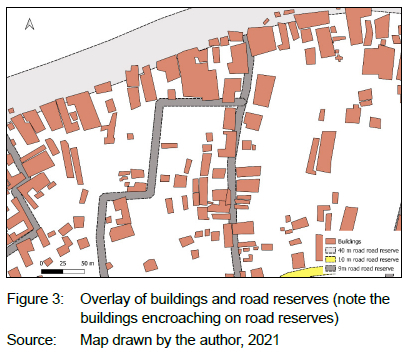
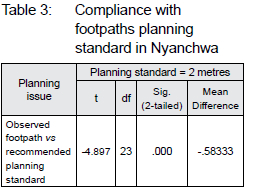
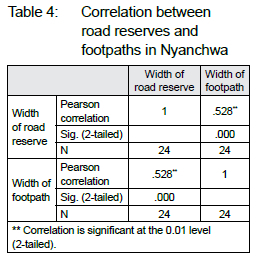
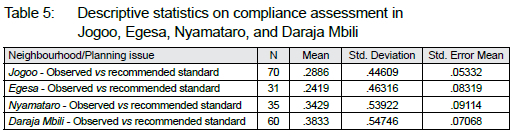
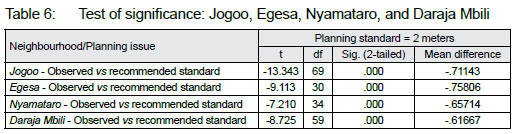
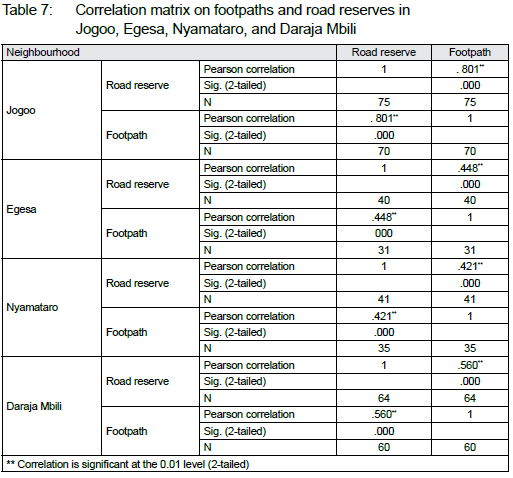
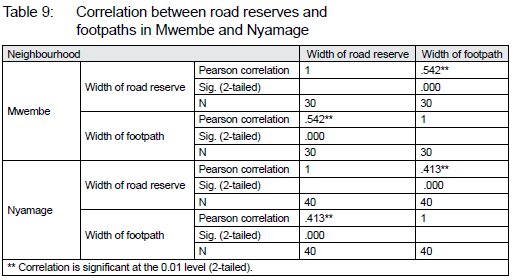
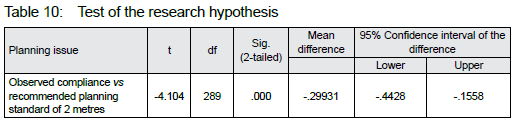
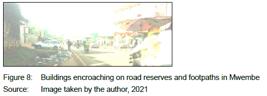
Walking in urban areas is regarded as healthy, cheap, and pollution free. It is influenced by variables such as the availability of safe footpaths, rights-of-way, condition of roads, patterns of land use, and safety. However, unsatisfactory provision of footpaths continues to attract global attention because of their centrality to sustainable urban mobility and safety. This article used a correlational research design to investigate if the residential building developments in the seven neighbourhoods of Kisii town, Kenya, comply with the planning standard that regulates pedestrian footpaths. It was guided by the public interest theory of regulation that justifies spatial planning through development control. A structured observation checklist, satellite image and photography were used to collect primary data. The analysis relied on a one-sample t-test, GIS, and Pearson's bivariate correlation. Research findings showed that most of the residential developments failed to observe the two metres planning standard. Compliance generally declined by a mean of 0.3 metres, thus negating the development control principles of access and safety in the use of footpaths as public spaces. The problem was exacerbated by developments that intruded on road reserves, thus reducing the widths of footpaths, the inability of the County Government of Kisii to effectively undertake development control, and the failure to prioritise the provision of footpaths when awarding tenders for the construction and maintenance of roads. As a case study, this article enlightens the academic community, policymakers, and practitioners in the construction industry on how compliance with the standards used in regulating footpaths may be evaluated through a triangulation of statistical and spatial approaches, a gap that hitherto existed in the town-planning literature.
Non-motorised transport; footpaths; public space planning; road reserves; Kisii town; Kenya
 Thumbnail
 Thumbnail
 Thumbnail
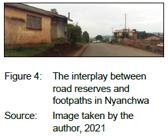 Thumbnail
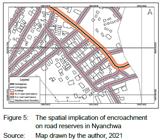 Thumbnail
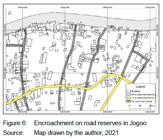 Thumbnail
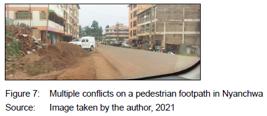 Thumbnail
 Thumbnail