A living conditions index for main and backyard shacks and backyard rooms in Gauteng's metropolitan municipalities: 2001 to 2011
Abstract
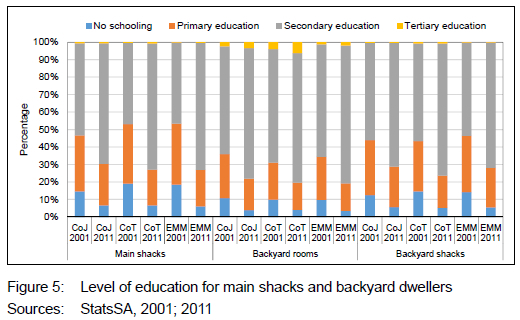
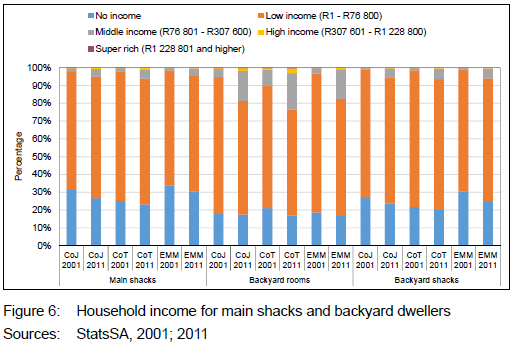
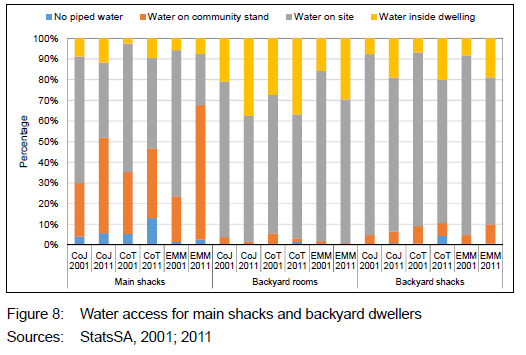
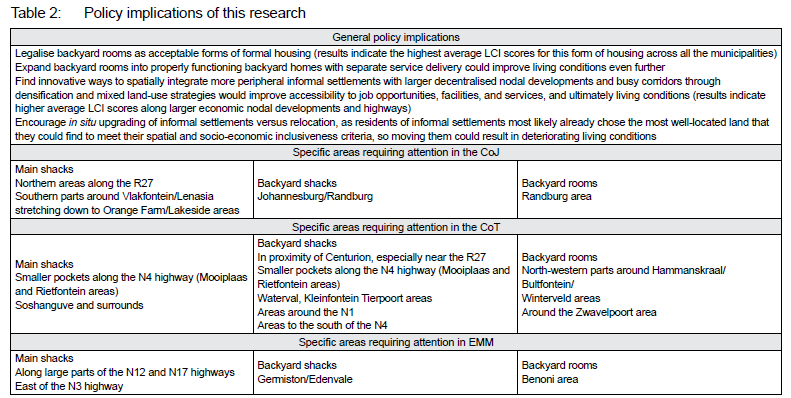
Physical housing conditions and neighbourhood characteristics influence people's living conditions. This article aims to determine changes in the living conditions of people residing in main and backyard shacks, and backyard rooms in the City of Johannesburg, City of Tshwane, and Ekurhuleni from 2001 to 2011. The methods involved computing percentages to determine profile characteristics, calculating an average living conditions index (LCI) score per main place for 2001 and 2011, and mapping the average LCI scores through thematic and hot spot analyses. Results show that young, Black, single men mostly reside in these dwellings. People are better educated and have higher incomes in backyard rooms, compared to main shacks; service delivery shows similar patterns. People in all the dwelling types and municipalities generally experience poor to average LCI scores, and none higher than 60%. Backyard rooms do, however, generally produce higher LCI scores than main shacks. Important policy implications are highlighted.
Living conditions index (LCI); main shacks; backyard shacks; backyard rooms; City of Johannesburg (CoJ); City of Tshwane (CoT); Ekurhuleni (EMM)
 Thumbnail
 Thumbnail
 Thumbnail
 Thumbnail
 Thumbnail
 Thumbnail
 Thumbnail
 Thumbnail
 Thumbnail
 Thumbnail
 Thumbnail