Uncovering missing environmental narratives in the planning of Nusantara, Indonesia
Abstract
Urban planning in postcolonial contexts is increasingly shaped by environmental rhetoric that promises sustainability, resilience, and progress. However, beneath these promises lie discursive practices that overlook ecological considerations and marginalise indigenous and rural knowledge. This study examines the environmental ideology and its construction and legitimation in the planning discourse on Indonesia's new capital, Nusantara. While existing research has examined the design and planning of Nusantara, few studies have interrogated the discursive strategies used by the government to legitimise development. Using critical discourse analysis and ecolinguistics, the research examines government documents, media articles, and indigenous testimonies to trace how language operates as a tool of power, as well as narrative structures that erase ecological concerns, marginalise indigenous knowledge, and promote technocratic urban ideals to justify the capital relocation. The findings show that sustainability discourse in Nusantara's planning is performative and contradictory, simultaneously invoking ecological concern, while enabling extractive practices and epistemic erasure. These findings suggest that the planning of Indonesia's new capital (Nusantara) tends to sideline rural areas, rural ways of knowing land, forest, development, and local communities. Furthermore, the discourse also reveals epistemic and ecological exclusions embedded in state-led development. Conceptually, this research contributes to debates on urban-rural planning dynamics in the Global South, by bringing southern urbanism into dialogue with critical discourse analysis and showing how language is used to legitimise exclusion in development projects. It challenges planners and policymakers to recognise the political work of language and the need for epistemic justice in shaping urban futures. Beyond the discipline, the study speaks to broader debates on environmental governance, indigenous rights, and the ethics of development. It calls for planning practices that are not only ecologically sound, but also culturally and epistemologically inclusive, where sustainability begins with listening, not erasure.
Critical discourse analysis; environmental governance; environmental ideologies; discursive power; indigenous knowledge; indigenous and rural ecologies; Indonesia's capital city; postcolonial urbanism; sustainability narratives; urban planning discourse
Abstract
Stedelike beplanning in postkoloniale kontekste gebruik dikwels omgewingsre-toriek wat volhoubaarheid en vooruitgang belowe. Tog verberg hierdie beloftes praktyke wat ekologiese realiteite ignoreer en inheemse kennis marginaliseer. Hierdie studie ontleed hoe omgewing-sideologie gekonstrueer en gelegitimeer word in die diskoers rondom Indonesië se nuwe hoofstad, Nusantara. Terwyl ontwerpaspekte reeds bestudeer is, het min navorsing die taalstrategieë ondersoek wat die regering gebruik om ontwikkeling te regverdig. Deur kritiese diskoersanalise en ekolinguistiek ondersoek die studie amptelike dokumente, media en inheemse getuienisse om te wys hoe taal as mag funksioneer - ekologiese kwessies uitvee, landelike kennis verdring en tegnokratiese ideale bevorder. Bevindings toon dat volhoubaarheidsdiskoers performatief en teenstrydig is. Dit dui op ekologiese sorg terwyl dit ontginningspraktyke en epistemiese uitwissing moontlik maak. Die beplanningsproses marginaliseer landelike gemeenskappe en bevat uitsluitings in staatsgeleide ontwikkeling. Konseptueel dra hierdie werk by tot debatte oor stedelik-landelike dinamika in die Globale Suide en beklemtoon hoe diskoers uitsluiting legitimeer. Dit doen 'n beroep op beplanning wat ekologies gesond én kultureel inklusief is - waar volhoubaarheid begin met luister, nie uitwissing nie.
Abstract
Merero ea toropo maemong a kamora bokolone hangata e sebelisa puo e buang ka tikoloho e ts'episang botsitso le tsoelo-pele. Leha ho le joalo, litsepiso tsena li pata mekhoa e sa hlokomeleng maemo a tikoloho le ho nyenyefatsa tsebo ea matsoalloa. Thuto ena e hlahloba kamoo maikutlo a tikoloho a hahiloeng le ho tiisoa ka puo e sebelisoang puisanong mabapi le motse-moholo o mocha oa Indonesia, Nusantara. Ha likarolo tsa moralo li se li ithutiloe, lipatlisiso tse fokolang li shebile maano a puo a sebelisoang ke mmuso ho lokafat-sa nts'etsopele. Ka ho sebelisa tlhahlobo ea puo e tebileng le ekolinguistics, thuto ena e hlahloba litokomane tsa semmuso, mecha ea litaba le lipolelo tsa matsoal-loa ho bontsa kamoo puo e sebetsang e le matla - e hlakola mathata a tikoloho, e sutumetsa tsebo ea mahaeng, 'me e khothalletsa mehopolo ea bo-ramahlale. Liphuputso li bontsa hore puo ea botsitso e sebetsa e le pontso empa e na le lik-hohlano: e bontsa tlhokomelo ea tikoloho ha e ntse e lumella mekhoa ea ho hula lisebelisoa le ho timetsa tsebo. Ts'ebetso ea moralo e nyenyefatsa sechaba sa mahaeng 'me e kenyelletsa ho tlo-hela batho mererong e tsamaisoang ke mmuso. Ka mohopolo, mosebetsi ona o kenya letsoho lipuisanong ka likamano tsa toropo le mahaeng ho Global South 'me o totobatsa kamoo puo e tiisang ho tloheloa ha batho. E khothalletsa moralo o sireletsang tikoloho le o kenyelletsang setso - moo botsitso bo qalang ka ho mamela, eseng ka ho timetsa.
1. INTRODUCTION
In 2019, the Indonesian government announced plans to relocate its capital from Jakarta to East Kalimantan, citing Jakarta's increasing vulnerability to flooding, water scarcity, traffic congestion, and seismic risks. The relocation is framed as a strategic move to promote balanced national development and environmental resilience (Hackbarth & De Vries, 2021). Despite Jakarta's vulnerable condition, the Indonesian government proposes capital city relocation for even development and to avoid natural disasters such as earthquakes and volcanic eruptions (Syaban & Appiah-Opoku, 2023; Yahya, 2018). East Kalimantan is subsequently positioned as the ideal site for relocation. To inform about this relocation, the Indonesian government frequently shares information regarding new capital city development on their official website Indonesian Capital City (IKN), ikn.go.id, and other mainstream media such as Antara news, Kompas, and Tempo.
At the same time, the relocation is not taking place in an empty space. East Kalimantan is a densely storied rural landscape, inhabited by Paser, Dayak, Kutai and Berau communities whose livelihoods, spiritual practices, and ecological knowledge are deeply tied to forests, rivers, and customary land. Framing Nusantara, primarily through legality, resilience, and 'forest city' branding, risks obscuring how these rural ecologies are being reclassified as national assets, investment zones, or 'green backdrops' to a new capital. This article situates the capital-relocation discourse within the tension between a state-led narrative of environmental modernisation and the marginalisation of rural ecologies and indigenous ways of relating to land.
Beyond the technical and environmental justifications, the government has actively shaped public perception of the new capital through strategic discourse, by presenting Nusantara as a 'forest city', a 'green city', and a 'smart city' (Coffey, 2016). The government discourses discuss the new capital development plan, progress, and investment, while introducing a new capital city, 'Nusantara', as a forest city. This frame of Nusantara as a forest city brings consequences of dominant narratives that sound sustainability-friendly with mentioning words such as green, smart, and progressive. The government discourses repeatedly state green with several collocations such as economy in 'green economy', architecture in 'green architecture', and space in 'green space'. Not only green, but the discourses also mention Nusantara as a smart city with a commitment to using renewable energy. As construction of Nusantara accelerates and public narratives become institutionalised, it is increasingly urgent to interrogate how environmental language is being used to legitimise development. This moment represents a discursive turning point, where rhetorical framings may have lasting ecological and social consequences, particularly for rural and indigenous communities whose voices remain marginalised.
Furthermore, in their discourses, they repeatedly frame the new capital city as 'smart city', 'green city', and 'forest city' (Rahayu et al., 2025). Through metaphors and word choices, the government represents Nusantara as a solution for Jakarta's problems. However, the framing of green and forest city is rarely explained in actual actions taken by the government, which is likely a rhetorical tagline (Rahayu et al., 2025). These narratives reflect a technocentric environmental ideology that prioritises infrastructure, innovation, and national symbolism, often at the expense of ecological integrity and indigenous knowledge systems (Lammi 2024). Developing Nusantara without a grounded understanding of its ecological condition's risks exacerbating environmental degradation, even when framed as a smart city. This disparity makes it possible for important aspects to be erased or marginalised. Such framing reveals how governmental discourse strategically obscures ecological and cultural complexities. To critically examine these discursive strategies, this study draws on Critical Discourse Analysis (CDA) to explore how language legitimises development and obscures ecological and cultural complexity. However, given the environmental stakes of Nusantara's planning discourse, this research adopts Ecological Discourse Analysis (EDA) as a methodological extension. EDA builds on CDA's foundations, by systematically analysing how language constructs ecological meaning. In this study, EDA is operationalised through coding of eco-beneficial, eco-destructive, and eco-ambivalent framings, using transitivity analysis, metaphor identification, and evaluative language mapping. NVivo was used to ensure consistency and transparency in coding across textual and interview data. This dual framing enables a nuanced interrogation of both power and ecological consequence in the discourse on Indonesia's capital relocation. This study thus asks: How do environmental ideologies embedded in Indonesia's new capital city planning discourses legitimise development while erasing rural ecologies and indigenous perspectives?
While existing studies have examined the design and spatial planning of Nusantara, few have critically analysed the discursive strategies used to legitimise its development, especially the environmental ideologies that obscure rural ecologies and indigenous knowledge systems. Research on urban planning in capital cities has been done in the past decade (Abubakar & Doan, 2017; Bolleter & Cameron, 2021; Ghalib, El-Khorazaty & Serag, 2021). The research criticises how new cities are developed dominantly in Asia and Africa. When talking about developing new cities, the vast majority of countries look up to those big cities in developed countries such as London, Washington DC, and New York. However, each country has its uniqueness, not all city planning is suitable for all countries, so copying one city to place in another country is not a wise decision. To address this gap, this study draws on southern urbanism and CDA to examine how planning narratives construct legitimacy, while erasing alternative ecological imaginaries. Therefore, southern urbanism offers a critical alternative to northern-centric planning paradigms, emphasising the importance of indigenous knowledge, ecological sensitivity, and cultural specificity. While many new cities in Asia and Africa emulate Western urban models, southern urbanism argues for context-driven planning that reflects the lived realities of communities in the Global South.
2.1 Environmental ideologies in planning discourse
Environmental ideology, broadly defined as a belief system about the human-nature relationship (Novikau, 2016), has been widely used to analyse environmental attitudes and planning decisions. According to O'Riordan (1977), environmental ideology is distinguished into two ideologies: ecocentrism and technocentrism. Ecocentrism revolves around the belief that nature is not only essential to human livelihood but is also the fundamental medium through which people understand their own personalities, social functions, and the patterns of human relationships. This belief tends to consider natural 'rights and morality' and places human beings as the ones who should protect nature and use it responsibly. Technocentrism is characterised by professional and managerial elitism, scientific rationality, and optimism. This viewpoint tends to be more practical and efficient, viewing nature as a resource and believing that human beings can use nature as a resource for a more comfortable life (O'Riordan, 1976: 4). These ideological positions have shaped urban planning discourses globally, often legitimising development through sustainability rhetoric (Hajer, 1995; Swyngedouw, 2007).
Those ideological positions are often reflected in the discourses on planning, such as the discussions surrounding Nusantara, Indonesia's new capital. The recurrent use of phrases such as 'green city', 'forest city', and 'eco-smart capital' in much of the environmental dialogue on IKN exhibits traits of greenwashing, that is, when symbolic rhetoric replaces genuine ecological commitment. Becker-Olsen and Potucek (2013) define greenwashing as the deliberate employment of environmental terminology to encourage an illusion of sustainability, while obscuring ecological damage. The term 'greenwashing' is frequently used to denounce misleading practices that assert positive environmental outcomes without any authentic effect. Corporate greenwashing refers to the propagation of misleading, insufficient (Furlow, 2010), or deceptive (Siano et al., 2017) environmental information concerning a company, product, or service, or the concealment of negative environmental effects within communications regarding a company's environmental performance (Delmas & Burbano, 2011; Lyon & Maxwell, 2011; Marquis & Toffel, 2011; Roger & Buil, 2014; Yu et al., 2020).
In urban planning, these ideological positions are not abstract labels but shape how particular territories are imagined and governed. Technocentric approaches often materialise as large-scale infrastructure projects, smart-city agendas, and growth-pole strategies in which nature is valued primarily as a resource or as an aesthetic 'green space' that supports urban competitiveness. Ecocentric approaches, by contrast, foreground ecological limits, interdependence, and the rights of non-human entities, and they tend to value rural landscapes as sites of livelihood, culture, and biodiversity rather than reservoirs of land for national projects. In the case of Nusantara, we show how technocentric environmental framings in planning discourse recast East Kalimantan's rural ecologies from lived territories of Paser and Dayak communities into a technocratic resource base for a 'green and smart' capital city.
2.2 Ecolinguistics and the power of language
Ecolinguistics is a multidisciplinary study that studies the complex connection between language, ecology, and the environment. It acknowledges that language serves not merely as a method of communication, but also as a potent instrument that influences our views, beliefs, and actions toward the environment (Fill & Muhlhausler, 2001). Ecolinguistics examines how language reflects and influences human relationships with the environment, encompassing individual perspectives, cultural behaviours, social policies, and global environmental movements (Fill & Muhlhausler, 2001). Ecolinguistics extends beyond studying language in isolation to examine its broader sociocultural and ecological contexts. The study examines how language influences human-environment relationships, cultural depictions of nature, and environmental advocacy campaigns (Stibbe, 2014). Ecolinguistics study integrates knowledge from anthropology, sociology, psychology, and ecology to comprehensively explore how language influences environmental discussions and human connection with the natural world (Fill & Muhlhausler, 2001).
Ecolinguistics provides a theoretical framework for analysing how language shapes IKN and its development through government and mass media discourses.
Applying ecolinguistics concepts to analyse IKN-related discourses can expose the inherent environmental ideology embedded in linguistic structures, exposing the narratives related to environmental issues. This method enables a detailed understanding of the ideological aspects of IKN discourses and their impact on people's perspectives.
2.3 Postcolonial planning and southern urbanism
Critical research on the Global South has evolved over decades. Southern urbanism has emerged as a crucial framework for understanding urban development in the Global South, challenging Eurocentric models and emphasising context-speciflc planning rooted in local histories, cultures, and knowledge systems (Robinson, 2006; Roy, 2009; Watson, 2016). The phrase 'Global South' is contested and used variously to denote geography, epistemological critique, or alternative urban dynamics (Follman et al., 2023). Southern urbanism is not merely a counter-narrative to dominant paradigms, but a distinct epistemological approach that foregrounds realities, cultural heritage, and informal practices of cities in the Global South (Lin, 2025). These urban spaces are shaped by colonial legacies, hybrid planning models, migrant building practices, and emergent forms such as informal settlements and gated communities. Such complexity demands a rethinking of agency, engagement, funding, and dominant policy frameworks. Southern urbanism requires methodologies that bridge past and present ontologies to address global urban challenges at the local, everyday scale. Although southern urbanism offers a relevant framework for cities across Asia and Africa, Indonesia's capital relocation appears to disregard its principles, favouring technocratic and symbolic approaches that often conflict with indigenous ecologies. While Roy (2009) and Watson (2016) offer foundational critiques of postcolonial planning, recent work on South-east Asian urbanism (e.g., Padawangi, 2025) highlights the hybrid and contested nature of planning in Indonesia. These studies highlight the importance of situating southern urbanism within Indonesia's distinct sociopolitical and ecological context.
2.4
Marginalisation of rural and indigenous peoples' narrativesGlobal critiques of development have long highlighted the marginalisation of rural and indigenous communities, particularly in the context of large-scale planning and modernisation projects. Scholars such as Kelly and Lu (2021), Pankaj (2007), and Peluso (1995) have shown how development discourse often frames rural landscapes as underutilised or backward, legitimising their transformation through state-led interventions. In these narratives, indigenous ecologies and knowledge systems are frequently excluded or reduced to symbolic references, while technocratic visions of progress overwrite the lived realities of rural communities. Existing studies on Indonesia's capital relocation have primarily focused on land use, spatial planning, and policy implementation, with limited attention to the discursive mechanisms whereby rural and indigenous erasure is enacted (Astuti & McGregor 2017).
2.5
Growth pole theory and capital relocationGrowth pole theory, introduced by Perroux (1950), posits that economic development is not uniform across space but concentrated around dynamic centres - 'poles' - that stimulate growth in surrounding regions. In planning discourse, new capital cities are often framed as strategic growth poles intended to redistribute development, reduce regional disparities, and catalyse infrastructure investment (Ghalib et al., 2021; Hackbarth & De Vries, 2021). Indonesia's relocation of its capital to East Kalimantan reflects this logic. The government positions Nusantara as a catalyst for balanced national development, aiming to shift economic activity away from Java and stimulate growth in underdeveloped regions. However, critics argue that such projects often reproduce spatial inequalities and ecological disruption under the guise of progress (Kelly & Lu, 2021). While growth pole theory provides a rationale for capital relocation, its implementation must be critically examined, especially when technocratic planning overlooks indigenous ecologies and entrenches epistemic exclusion.
3. STUDY AREA
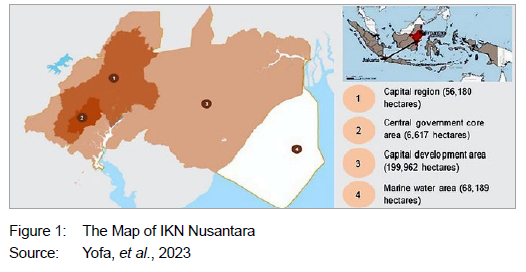
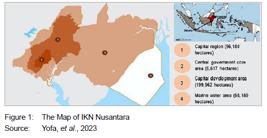
The study focuses on East Kalimantan, the designated site for Indonesia's new capital city, Nusantara. Located in Penajam Paser Utara Region, Nusantara has a total land and water area of approximately 324,332 ha (Yofa et al., 2023). The water area is 68,188 ha and the land area is 256,142 ha, which consists of two areas, namely the Nusantara Capital City Area (KIKN) and the Nusantara Capital City Development Area (KP-IKN) (Blueprint IKN) (Yofa et al., 2023). This region is home to diverse indigenous communities, including the Paser and Dayak peoples, whose ecological knowledge and cultural practices are deeply intertwined with the forested landscape (Yofa et al., 2023). The relocation project has significant implications for land use, environmental integrity, and indigenous sovereignty, making East Kalimantan a critical site for examining the discursive construction of development and environmental ideology.
4. METHODS
4.1 Research design
This study employed a qualitative research design because the research problem needs to be explored by investigating documents related to Nusantara and indigenous people's voices, in order to examine how sustainability and environmental narratives are constructed in the planning of Indonesia's new capital, Nusantara (Creswell & Poth, 2023). The study combined documentary analysis with semi-structured interviews. Discourse-analytic perspectives (discussed in the Literature Review) informed the interpretation of the flndings, but the methodological process was grounded in qualitative thematic and systematic coding (Alejandro, 2024). This study draws on a diverse corpus of texts, including government planning documents, media coverage, civil society reports, and interviews with indigenous community members. The textual data were selected to reflect the discursive landscape surrounding the relocation of Indonesia's capital city, with attention to both dominant and marginalised voices.
4.2
Population, sampling and response rateThe study incorporates interviews with ten indigenous participants, selected through purposive sampling (Ahmad & Wilkins, 2024). Participants were drawn from the Paser and Dayak ethnic groups, irrespective of sub-ethnic affiliation. Eligibility required individuals to be members of indigenous communities, either in leadership or custodial roles (e.g., tribal leaders, village heads, cultural custodians) or in positions of active community engagement (e.g., youth representatives). To identify participants, researchers liaised with local government offices, which provided contact details of eligible individuals, including members of AMAN (the Indigenous Peoples' Alliance of the Archipelago). All participants were lifelong residents of their respective communities.
While the study sought to capture intra-group diversity through the inclusion of different roles, it acknowledges the limitation of not representing the full spectrum of indigenous perspectives in Kalimantan. The inclusion of these lived experiences enriches the analysis, by complementing textual data with grounded, community-based perspectives.
4.3
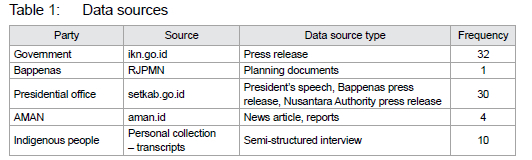
Data collection and corpus constructionThis study draws on both documentary sources and interviews to examine the discursive construction of Nusantara's development (see Table 1). Documentary sources were collected in two stages. First, the researchers conducted a systematic search of official government websites (ikn. go.id, setkab.go.id, and Bappenas pages) for the period 29 April 2019 to 31 May 2024, using the keywords 'IKN', 'Nusantara', 'ibu kota negara', and 'relokasi ibu kota'. This search produced an initial pool of documents, including press releases, speeches, planning documents, and background notes. Secondly, the researchers searched the website of the Indigenous Peoples' Alliance of the Archipelago (AMAN; aman. id) for the same period, using the keywords 'IKN', 'Nusantara', and 'Kalimantan Timur', which yielded additional news articles, statements, and reports relevant to the capital-relocation debate.
From this initial pool, the researchers applied the following inclusion criteria: the text is at least 300 words long; it contains at least one substantive discussion of the capital relocation (beyond a passing mention), and it includes explicit or implicit references to environmental issues, land use, rural communities, or indigenous peoples. They excluded duplicate publications, purely technical procurement notices, and items that dealt exclusively with national macro-politics or unrelated policy domains. Applying these criteria resulted in the final corpus summarised in Table 1: 32 press releases from ikn.go.id; 1 planning chapter from the RJPMN; 30 speeches and press releases from the Presidential Office and Bappenas, and 4 AMAN reports and news items.
It is important to note that texts were not selected on the basis of whether they were 'supportive' or 'critical' of the government's position. All documents that met the length and thematic criteria were included, regardless of stance. The aim was not to demonstrate a predetermined view of rural marginalisation, but to reconstruct the spectrum of publicly available discourses that frame the Nusantara project.
For each document, basic metadata was recorded, including source, date, authoring institution, and approximate word count. Government texts in the corpus range from short press releases of roughly 350 words to longer planning chapters exceeding 3,000 words. Where they refer to the repeated use of key terms such as 'green' or 'forest' city, this is based on within-document frequencies relative to text length rather than isolated occurrences. In addition to these written materials, several publicly available transcripts of presidential speeches and ministerial press briefings about Nusantara were reviewed to contextualise dominant framings; only those meeting the inclusion criteria were coded and incorporated into the corpus.
Semi-structured interviews were conducted with ten indigenous participants near the new capital, each lasting one to two hours, audio-recorded, and transcribed. Transcripts were returned to participants for review to ensure accuracy and clarify ambiguities. The interviews addressed six key questions exploring indigenous perceptions of Nusantara's development, including hopes, concerns, and experiences. These perspectives, often underrepresented in public discourse, highlight the imbalance between dominant government narratives and local voices. The interviews form part of a broader research programme on indigenous communities' experiences of IKN (Rahayu et al., 2025). In this article, however, the researchers analyse the interview data only in relation to environmental narratives, rural ecologies, and epistemic (dis)inclusion.
4.4 Data analysis and interpretation
All collected data were managed and analysed using NVivo 14, a widely used qualitative data analysis software that facilitates the organisation, coding, and interpretation of rich, subjective textual data (Moncada, 2025). The corpora were coded and categorised according to linguistic strategies, including transitivity, metaphor, and evaluative language, enabling systematic comparison between eco-beneflcial, eco-destructive, and eco-ambivalent framings.
The analysis followed the three-phase approach proposed by Miles and Huberman (1994): data reduction, data display, and conclusion/verification. During data reduction, word frequency queries in NVivo identified dominant lexical patterns, revealing thematic tendencies and discursive priorities of each actor. Coding according to linguistic strategies allowed the identification of recurrent ecological and ideological framings. Coded data were then organised into thematic matrices and visualised using NVivo's coding stripes and matrix queries. These visualisations facilitated cross-source comparisons and highlighted discursive asymmetries such as the prevalence of technocratic language in government texts versus the ecological and cultural emphases in indigenous narratives. In the final phase, discursive patterns were interpreted in relation to environmental ideology and southern urbanism. Four key themes emerged and were verified through iterative coding, note-taking, and triangulation across data sources in Table 1: technocentric environmental framing, metaphorical legitimation, ecological ambivalence, and epistemological tension. Contradictions, silences, and metaphorical framings were critically examined to draw conclusions about how environmental ideologies are constructed, contested, and legitimised in the discourse on Nusantara.
4.5 Limitation
While the study includes a broad range of sources, it acknowledges limitations in representativeness, in particular the underrepresentation of indigenous voices in public discourse. Media bias, access to indigenous texts, and the interpretive nature of linguistic analysis may also affect the findings. These limitations are addressed in the Discussion section. This article analyses discourses rather than built outcomes, excluding evaluations of environmental promises or infrastructure performance. It examines how official and counter-discourses construct environmental ideologies and rural ecologies through language. The focus is on symbolic and epistemic dimensions of planning, not implementation audits.
5. FINDINGS
5.1
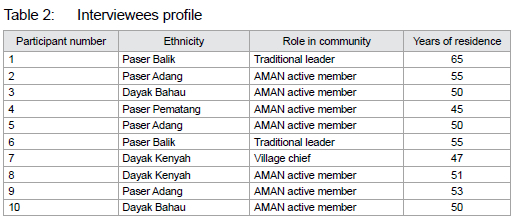
Interviewees profileTo complete the documentary analysis, the researchers provided a counterbalance from indigenous people's interviews. Table 2 summarises the interviewees' profiles which were chosen through purposive sampling (Ahmad & Wilkins, 2024).
Ten interviewees participated in the study, representing Paser Balik, Paser Adang, Paser Pematang, Dayak Bahau, and Dayak Kenyah communities. Their roles included traditional leaders, a village chief, and active members of AMAN, the indigenous peoples' organisation. With 45-65 years of residence in their respective communities, the participants brought extensive lived experience and cultural knowledge, ensuring the validity of their contributions to the study.
5.2
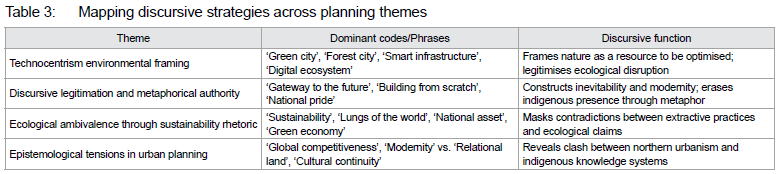
Thematic findings from critical discourse analysisA critical discourse analysis of planning documents and interview data on Nusantara revealed four interwoven themes, namely technocentric environmental framing, metaphorical legitimation, ecological ambivalence, and epistemological tension. These themes highlight how language operates as a mechanism of power, constructing legitimacy, masking ecological contradictions, and marginalising indigenous knowledge systems. Table 3 synthesises the dominant codes and their discursive functions, showing how specific phrases and rhetorical strategies frame nature as a resource, invoke metaphors of inevitability and progress, deploy sustainability rhetoric to conceal contradictions, and position global modernity against indigenous epistemologies. Together, the themes demonstrate how planning discourse not only legitimises urban development, but also reproduces exclusionary epistemic assumptions, revealing the deep entanglement of language, ideology, and urban transformation in Nusantara. Each theme reflects a distinct yet interconnected dimension of the planning discourse, demonstrating how language operates as a site of power and ideological influence.
5.2.1 Technocentrism environmental framing
The first theme reveals how environmental discourse is shaped by a technocentric logic that frames nature as a resource to be managed, optimised, and instrumentalised. Phrases such as 'green city' and 'smart infrastructure' do not simply describe ecological aspirations; they encode a developmental ideology that privileges control, efficiency, and extractive progress. The environmental discourse on Indonesia's new capital is saturated with promises of sustainability, resilience, and ecological harmony. Yet beneath this surface lies a technocentric logic that privileges infrastructure, control, and progress over ecological integrity. This theme examines how environmental ideologies are constructed through the interplay of technocentrism, ecocentrism, sustainability rhetoric, and symbolic ecology. The analysis reveals how nature is often invoked decoratively with terms such as 'forest city' or 'green development', while substantive ecological commitments remain vague or absent. These framings serve to legitimise the capital relocation, while masking its ecological contradictions.
Technocentrism is a paradigm which believes that human beings can use nature as a resource to support their lives. It deals with professional and managerial elitism, scientific rationality and optimism. The Indonesian government reflects its technocentric ideology throughout the discourses, using recurring phrases such as 'smart city', 'green city', and 'forest city', as in the following quotation:
"If the new State Capital were to be built in Kalimantan, then it must be developed with urban forest and green city plans in mind. We care very much about its environment and therefore, we must design the new city to accompany the area's natural aspects" (IKN, 15 July 2019).
From the quotation above, the Indonesian government prioritises IKN development to enhance economic advancement. The use of 'green city' and 'forest city' becomes sustainable rhetoric in which government justifies the guilt of developing IKN in a place with abundant biodiversity with its possible impact to destroy the environment. These phrases operate as discursive shields, deflecting critique by invoking ecological imagery, while masking extractive practices. Their repetition constructs a symbolic ecology that legitimises environmental disruption under the guise of sustainability. The phrases are used to anticipate the counterarguments from environmentalists who question the government's decision to relocate and develop the new capital city in Kalimantan Island. Besides, the government consistently uses lexical words that assume that Kalimantan Island and its environments are part of a national commodity:
"Kalimantan is known as a national energy source and the lungs of the world^to maintain the function of the island as the world's lungs (Heart of Borneo) by preserving the area's environmental and preserving the area's environmental and ecological assets..." (RJPMN, III.39).
Kalimantan Island where Nusantara is built is viewed as a national energy source. The use of the word 'source' presupposes that it is right to exploit the island, to use it to the maximum, which is the key of technocentric ideology, that is, using natural resources maximally to support human life. Technocentrism does not view nature as part of human beings as the other things living on earth, living side by side with human beings. Rather, it views nature as resources to fulfil human needs and take advantage thereof.
This theme reveals how environmental discourse is co-opted by technocratic ideology, where nature is framed as a resource to be optimised rather than a relational entity to be respected. The use of terms such as 'green city' and 'forest city' functions as rhetorical camouflage, legitimising ecological disruption under the guise of sustainability. The framing reflects a deep-rooted belief in managerial control and infrastructural progress, sidelining ecocentric values and indigenous ecological wisdom.
5.2.2 Discursive legitimation and metaphorical authority
Building on the technocratic framing, the second theme examines how metaphor and evaluative language are deployed to construct legitimacy and erase contestation. Terms such as 'gateway to the future' and 'building from scratch' function as rhetorical devices that naturalise displacement and position the state as a visionary force, while obscuring the historical and ecological realities of the land.
Language plays a pivotal role in legitimising the relocation of Indonesia's capital, constructing it as both a national selection and a visionary urban future. This theme examines the discursive strategies that underpin such legitimation, focusing on the use of metaphors, appeals to authority, and evaluative language. Metaphors such as 'gateway to the future' or 'forest city' imbue the project with symbolic power, while evaluative descriptors frame rural areas as backward and urban relocation as modern. The rhetorical devices do more than describe; they persuade, obscure, and normalise a developmental logic that marginalises dissent and complexity.
The Indonesian government legitimised its decision to relocate the capital city by means of metaphors such as 'building a new capital from scratch', where the Indonesian government compares the area where Nusantara is about to develop to an empty sheet of paper. In fact, it is not empty land; indigenous people live there, along with their cultural sites and forests. The phrase 'building a new capital city from scratch' is used to legitimise their decision, which many environmentalists already oppose, considering that Kalimantan Island is home to thousands of endemic species, some of which are not found anywhere else in the world.
To counter this argument, the Indonesian government often claims that it is building the city from scratch, which is an unproductive forest. It is thus trying to create a capital city with a forest that it calls a 'forest city'. However, when looking at the development of IKN, which impacted the environment where such a vast forest is cut down, contributing to raising the temperature and taking the indigenous people's home, land, and their forest, their legitimate statement about making a green city or forest city is just rhetoric. While metaphor and evaluative language construct legitimacy, they also obscure the ecological contradictions embedded in planning discourse - a tension explored further in the next theme.
Language becomes a tool of power. Metaphors such as 'building from scratch' and 'gateway to the future' obscure the presence of indigenous communities and ecological heritage. These rhetorical devices do not merely describe; they authorise, normalise, and erase. The government's strategic use of metaphor and evaluative language constructs a narrative of inevitability and modernity, while silencing dissent and masking the violence of displacement.
5.2.3 Ecological ambivalence through sustainability rhetoric
The third theme exposes the ambivalence embedded in the state's sustainability rhetoric. While phrases such as 'lungs of the world' and 'national asset' evoke ecological concern, they coexist with policies that promote extractive industries and infrastructural expansion. This contradiction reveals a performative ecocentrism that masks deeper technocratic commitments. Despite its ecological branding, the discourse on Nusantara reveals a deep ambivalence towards environmental integrity. This theme interrogates the ecological consequences of planning language, highlighting moments of eco-beneflcial recognition alongside vague or contradictory sustainability claims. The presence of eco-ambivalent discourses suggests a tension between rhetorical inclusion and actual ecological commitment. While indigenous ecological wisdom is occasionally acknowledged, it is rarely integrated into planning paradigms, raising questions about epistemic justice and the sincerity of environmental concern.
The way in which the Indonesian government uses 'green phrases' such as 'green economy', 'green space', 'green architecture', and 'green city' indicates an eco-beneficial viewpoint to ensure that the new capital city will be based on ecological awareness and sustainability. However, the rest of the discourse in the same article or different articles shows the opposite. The government aims to ensure that the city is an eco-friendly one, but it suggests down-streaming, which could lead to nickel mining. The government suggests that the city will be a green city or a smart city with a zero-carbon footprint, which leads to the decision to use electric vehicles. The massive use of electric cars indeed supports a zero-carbon footprint, but it leads to another issue: nickel mining, which is harmful to the environment if the exploitation is not controlled.
"According to the President, the IKN development is carried out with the concept of a nature-based future smart city with 70 percent green area and will prioritize renewable energy as energy source, including in transportation."
"Around 80 percent of the transportation here is public transportation with autonomous vehicles, without crews and driver. We value pedestrians and cyclists there. Ten-minute city, the distance to everywhere is within 10 minutes," President Jokowi added (Setkab, 18 October 2022).
If these claims are more than rhetorical flourishes, they reveal a contradiction: the government's stated commitment to ecocentrism is undermined by its continued support for extractive industries such as nickel mining. Even if their perspective to develop Nusantara is ecocentrism by making nursery seed places to ensure the life of all species, on the other hand, they still allow mining and logging, which exploit Indonesia, especially Kalimantan Island. This is also reflected in how the Indonesian government refers to Kalimantan as a 'national source', 'national assets' and 'lungs of the world'. These three metaphors posit Kalimantan Island and its environment as a mere commodity for humankind or for the Indonesian government's needs.
This theme exposes the contradictions embedded in the state's sustainability discourse. While green phrases suggest ecological awareness, they coexist with policies that promote extractive industries such as nickel mining. This ambivalence reflects a performative commitment to ecocentrism, undermined by technocentric practices. The framing of Kalimantan as a 'national asset' or 'lungs of the world' commodifies nature, revealing a tension between rhetorical inclusion and ecological integrity.
5.2.4 Epistemological tensions in urban planning
The final theme exposes the epistemological tensions at the heart of Nusantara's planning discourse. Globalised urban ideals - centred on competitiveness, modernity, and exclusivity - clash with indigenous relational knowledge and cultural continuity. The exclusion of local voices is not incidental; it reflects a deeper epistemic hierarchy that privileges northern-centric paradigms over situated ecological wisdom.
At the heart of Nusantara's planning discourse lies a clash of epistemologies: one rooted in northern-centric urban ideals and another grounded in lived realities of southern urbanism. This theme critically examines how planning models imported from the Global North - emphasising order, efficiency, and technological mastery - are privileged over contextual, relational, and indigenous approaches to urban development. Codes such as northern-centric planning, contextual planning, and indigenous knowledge reveal the epistemological hierarchies embedded in the capital design. The analysis foregrounds how southern urbanist principles are marginalised, despite their relevance to Indonesia's ecological and cultural landscape. The fact that the Indonesian government prefers northern-urbanism is obvious from how it made Nusantara with no more than 2,000 inhabitants a centralised place, while also making Nusantara exclusive and separated from the surrounding with advanced technology adaptation where no city will have the similar technology. This will make discrepancy between Nusantara and other countries. Furthermore, the Indonesian government also agrees with Global North countries to participate in developing Nusantara and by mentioning cities in the Global North as the purpose of Nusantara development. The tendency to follow northern urbanism is evident from the following excerpt:
"Jakarta will remain the center of finance, business, and trade just like New York, while the capital city will be the center of government like Washington DC. Jakarta will continue its role as an economic hub, and it will be a competitor to Singapore," said Minister Bambang (IKN, 20 August 2019).
It is evident from the excerpt that Indonesia follows northern urbanism as its goal. It is reflected in different articles that refer to various cities in the Global North. In addition, the Indonesian government portrays Nusantara as a 'smart city' with only 2,000 inhabitants, highlighting its exclusivity. In fact, the city is surrounded by indigenous people who have lived there. It also creates a gap between people 'who live in Nusantara' and the outside, reflecting exclusivity, untouchability, and separation. The argument is not that the Indonesian government directly copies the spatial plans of Washington DC or New York, but that official comparisons to these cities indicate an aspirational alignment with northern urban models. These references function as symbolic orientations positioning Nusantara within a repertoire of 'world-class' capitals, rather than serving as evidence of wholesale institutional transfer.
Interviewees repeatedly described feeling excluded from formal planning processes for Nusantara. AMAN representatives reported that they had not been invited as recognised indigenous organisations. Several traditional leaders stated that consultations focused on compensation rather than on co-designing the project. Although full access to membership lists and internal procedures of the planning committees was unavailable, these testimonies indicate a perceived exclusion of indigenous voices from decision-making. In the analysis, 'exclusion' is treated not as a verified institutional fact about every planning forum, but as a recurring experiential and discursive theme in how indigenous communities understand the project. This interpretation is reinforced by statements from indigenous leaders in Pemaluan, Sepaku:
"Then the affected houses were compensated by paying for the damages, but there should have been a solution sought for those affected, not just by paying and then letting it go. Because most of those affected are indigenous people. A suitable land and area should have been found flrst and through discussions, not just by paying and then giving a short period for them to vacate their homes. As a result, the victims had to rent houses at high prices per month, which can reach 700 thousand rupiah." (Interviewee 1).
According to the participant's statement, the indigenous people living in the Nusantara development area are being persuaded to relocate. However, this creates a new problem in that those lands are passed down from one generation to the next. Relocating them not only makes them lose their ancestral land, but it also separates them from their roots. For example, the Balik people (the participant's tribe), as the indigenous people in the area of Nusantara, are decreasing in number. They naturally work on the farm. It is a different farm from that on Java Island. It is a traditional farm rooted in Kalimantan indigenous people's ancestors. Their bond with the forest is clearly strong. They view the forest not only as a place to earn a living, but also as a place where they obtain ingredients for rituals, crafts, and herbs. Therefore, even though the government repeatedly states that it would build Nusantara from scratch, this is not the actual case. It is not an empty land or like their metaphor 'from scratch'. Those places abound in indigenous knowledge and heritage that cannot and never will be changed.
On the other hand, the indigenous people hope that, if Nusantara is built, it can be built based on indigenous knowledge - not relocating people from their ancestral land, not cutting down the trees, and endangering the biodiversity that lives there. Indigenous people need to go to the forest not only to earn money, but also to continue the knowledge transfer, for that knowledge will exist until the next generation, as stated by some participants as follows:
"The Paser and Dayak communities are very closely connected to the forest. So, when the forest disappears, many things will be lost, such as culture, medicine, social relationships, and knowledge. This is the reason why we strive to preserve the remaining patches of forest...there is a lot of food in the forest that can be used to survive when staple food is scarce. Also, 90% of the medicine used by the Paser community is obtained from the forest. For example, in rituals, the materials and tools are sourced from there. If the forest disappears, then the rituals will be disrupted. This can create difficulties in teaching future generations if the forest no longer exists."
At the heart of Nusantara's development lies a clash of world views: northern-centric urbanism versus indigenous relational knowledge. The planning discourse privileges exclusivity, technological mastery, and global competitiveness, while marginalising the lived realities of local communities. The exclusion of indigenous voices from planning processes is not incidental - it reflects epistemic injustice. This theme calls for a reimagining of urban futures rooted in cultural continuity, ecological respect, and participatory justice.
6. DISCUSSION
The findings of this study reveal a complex interplay between environmental ideology, discursive power, and epistemological exclusion in the planning discourse on Indonesia's new capital, Nusantara. Across government documents, media narratives, and indigenous testimonies, language emerges not as a neutral tool but as a mechanism for legitimising development, obscuring ecological contradictions, and marginalising rural and indigenous knowledge (Mosurska et al., 2023). In O'Riordan's terms, this pattern reflects a technocentric environmental ideology in which growth-oriented, state-led development is discursively prioritised over ecological limits and local ways of knowing. Read through the lens of southern urbanism, these dynamics also illustrate how postcolonial planning projects reproduce northern-centric ideals, while enacting forms of epistemic injustice, whereby indigenous and rural knowledges are rendered secondary to technocratic expertise.
The technocentric environmental framing reflects a deep-rooted belief in managerial control and infrastructural mastery. Phrases such as 'green city' and 'forest city' function as forms of symbolic ecology in the ecolinguistic sense: rhetorical devices that mask extractive practices under the guise of sustainability. This aligns with global critiques of greenwashing in urban planning, where ecological language is deployed to soothe public concern, while enabling environmental disruption (Swyngedouw, 2007; Hajer, 1995). In the case of Nusantara, the repeated invocation of 'green' and 'smart' legitimises the transformation of Kalimantan's biodiverse landscape into a technocratic urban hub, sidelining ecocentric values and indigenous ecological wisdom.
Discursive legitimation is further reinforced by what Amossy (2022) calls 'metaphorical authority'. Phrases such as 'gateway to the future' and 'building from scratch' construct a narrative of inevitability and modernity, erasing the presence of indigenous communities and ecological heritage. These metaphors do not merely describe; they authorise and normalise displacement. The framing of Kalimantan as an 'empty sheet' or 'national asset' also reproduces a colonial logic of terra nullius, where land is imagined as vacant and available for development, regardless of its cultural and ecological significance. Viewed through southern urbanism, such metaphors position Nusantara within a repertoire of aspirational 'world-class' projects, while rendering rural ecologies and indigenous claims to place discursively expendable.
The sustainability rhetoric embedded in planning discourse reveals a troubling ambivalence (Newig, Voβ & Monstadt 2007). While the government promotes ostensibly eco-beneficial initiatives such as renewable energy and green infrastructure, these are contradicted by policies that support nickel mining, deforestation, and infrastructural expansion. This tension between rhetorical inclusion and ecological degradation exemplifies ecological ambivalence and reinforces critiques of greenwashing, where environmental language is mobilised without corresponding material restraint. In this sense, Nusantara's planning discourse performs a thin, technocentric version of ecocentrism: ecological concerns are invoked symbolically to legitimise the project, while the underlying development model remains extractive and anthropocentric.
Most critically, the findings expose epistemological tensions at the heart of Nusantara's planning, between northern-centric urban ideals and southern urbanist principles. The project privileges exclusivity, technological sophistication, and global competitiveness - drawing inspiration from cities such as Washington DC and Singapore -while marginalising the relational knowledge systems of indigenous communities. The recurring exclusion of indigenous voices from planning processes is not simply a procedural oversight; it exemplifies epistemic injustice in urban-rural planning, where certain ways of knowing and relating to land are rendered less credible or inconvenient. This dynamic echoes broader critiques of postcolonial planning, where imported models overwrite local histories and ecological embeddedness (Roy, 2009; Watson, 2016).
The testimonies of Paser and Dayak communities offer a powerful counter-narrative, rooted in cultural continuity, ecological stewardship, and intergenerational knowledge. Their voices challenge the dominant, technocentric planning paradigm and point toward alternative relational ecologies, in which land is understood through obligation, reciprocity, and care rather than solely through investment and infrastructure. In terms of southern urbanism, these counter-narratives demonstrate that critical perspectives from the Global South are not only theoretical critiques of northern-centric models but lived, situated practices of imagining and inhabiting urban-rural futures. They underscore that questions of epistemic justice and participatory justice are central to planning. Development must be grounded in the lived realities and knowledge systems of those most affected by it, rather than imposed upon them.
7. CONCLUSION
This study offers a timely intervention into how environmental ideologies are shaped, circulated, and contested within the planning of Indonesia's new capital. At its core, it reveals that language is not merely descriptive; it is constitutive. The words used to frame development projects do not simply reflect reality; they actively construct it, often at the expense of ecological integrity and cultural continuity.
More broadly, the findings challenge dominant paradigms of urban planning that treat sustainability as a technical fix rather than a relational ethic. In doing so, the study contributes to a growing body of scholarship that critiques the performative use of 'green' rhetoric in state-led development and calls for a deeper reckoning with the epistemologies that underpin planning decisions. It invites planners, policymakers, and scholars to ask: Whose knowledge counts?
Whose futures are being imagined and whose are being erased?
Specifically, this research contributes to debates on urban-rural planning dynamics and southern urbanism, by foregrounding the discursive mechanisms whereby rural and indigenous knowledge is rendered invisible. It brings discourse analysis into dialogue with southern urbanism, showing how planning in postcolonial contexts often reproduces northern-centric ideals, while silencing local ecological wisdom. By centring indigenous testimonies and exposing the contradictions within official narratives, the study offers a methodological and ethical blueprint for more inclusive, grounded, and fair planning practices.
Beyond academia, these insights matter for anyone invested in the future of cities, the health of ecosystems, and the dignity of communities. As governments worldwide pursue ambitious urban transformations, this article reminds the readers that progress must not come at the cost of erasure. True sustainability begins not with infrastructure, but with listening, with recognising that the land is already storied, already inhabited, already wise.
REFERENCES
2. LITERATURE REVIEW
-
ABUBAKAR, I.R. & DOAN, P.L. 2017. Building new capital cities in Africa: Lessons for new satellite towns in developing countries. African Studies, 76(4), pp. 546-565. https://doi.org/10.1080/00020184.2017.1376850
» https://doi.org/10.1080/00020184.2017.1376850 -
AHMAD, M. & WILKINS, S. 2024. Purposive sampling in qualitative research: A framework for the entire journey. Quality & Quantity, 59(6), pp. 1461-1479. https://doi.org/10.1007/s11135-024-02022-5
» https://doi.org/10.1007/s11135-024-02022-5 -
ALEJANDRO, A. 2024. Multi-method qualitative text and discourse analysis: A methodological framework. Journal of Qualitative Research Methods, 15(3), pp. 123-145. https://doi.org/10.1177/10778004231184421
» https://doi.org/10.1177/10778004231184421 -
AMOSSY, R. 2022. Constructing political legitimacy and authority in discourse. Argumentation et Analyse du Discours, (28), pp. 1-19. https://doi.org/10.4000/aad.6398
» https://doi.org/10.4000/aad.6398 -
ASTUTI, R. & MCGREGOR, A. 2017. Indigenous land claims or green grabs? Inclusions and exclusions within forest carbon politics in Indonesia. The Journal of Peasant Studies, 44(2), pp. 445-466. https://doi.org/10.1080/03066150.2016.1197908
» https://doi.org/10.1080/03066150.2016.1197908 -
BECKER-OLSEN, K. & POTUCEK, S. 2013. Greenwashing. In: Idowu, S. et al. (Eds.). Encyclopedia of corporate social responsibility. Springer, pp. 1318-1323. https://doi.org/10.1007/978-3-642-28036-8_104
» https://doi.org/10.1007/978-3-642-28036-8_104 -
BOLLETER, J. & CAMERON, R. 2021. A critical landscape and urban design analysis of Egypt's new administrative capital city. Journal of Landscape Architecture, 16(1), pp. 8-19. https://doi.org/10.1080/18626033.2021.1948183
» https://doi.org/10.1080/18626033.2021.1948183 -
COFFEY, B. 2016. Unpacking the politics of natural capital and economic metaphors in environmental policy discourse. Environmental Politics, 25(2), pp. 203-222. https://doi.org/10.1080/09644016.2015.1090370
» https://doi.org/10.1080/09644016.2015.1090370 - CRESWELL, J.W. & POTH, C.N. 2023. Qualitative inquiry and research design: Choosing among five approaches. 5th edtion. Thousand Oaks, CA: SAGE Publications.
-
DELMAS, M.A. & BURBANO, V.C. 2011. The drivers of greenwashing. California Management Review, 54(1), pp. 64-87. https://doi.org/10.1525/cmr.2011.54.1.64
» https://doi.org/10.1525/cmr.2011.54.1.64 - FILL, A. & MÜHLHÄUSLER, P. (Eds). 2001. The ecolinguistics reader: Language, ecology and environment. London & New York: Continuum.
-
FOLLMANN, A., KENNEDY, L., PFEFFER, K. & WU, F. 2023. Peri-urban transformation in the Global South: A comparative socio-spatial analytics approach. Regional Studies, 57(3), pp. 447-461. https://doi.org/10.1080/00343404.2022.2095365
» https://doi.org/10.1080/00343404.2022.2095365 - FURLOW, N. 2010. Greenwashing in the new millennium. Journal of Applied Business and Economics, 10(6), pp. 22-25.
-
GHALIB, H., EL-KHORAZATY, M.T. & SERAG, Y. 2021. New capital cities as tools of development and nation-building: Review of Astana and Egypt's new administrative capital city. Ain Shams Engineering Journal, pp. 3405-3409. https://doi.org/10.1016/j.asej.2020.11.014
» https://doi.org/10.1016/j.asej.2020.11.014 -
HACKBARTH, T.X. & DE VRIES, W.T. 2021. An evaluation of massive land interventions for the relocation of capital cities. Urban Science, 5(1), article 25. https://doi.org/10.3390/urbansci5010025
» https://doi.org/10.3390/urbansci5010025 - HAJER, M.A. 1995.Thepolitics of environmental discourse: Ecological modernization and the policy process. Oxford: Clarendon Press.
-
KELLY, A.S. & LU, X. 2021. Locating discourses and narratives for intervention. In: Bruns, D. & Swaffield, S. Critical landscape planning during the Beit and Road Initiative. Singapore: Springer, pp. 57-84. https://doi.org/10.1007/978-981-16-4067-4_4
» https://doi.org/10.1007/978-981-16-4067-4_4 - LAMMI, D. 2024. Focal issues of sustainable development presented by the World Economic Forum 2024.
-
LIN, F.C.H. 2025. The ephemerality and micro-historicity of the postcolonial-urban: A critical case study of Asia's urban mobility. Journal of Asian Architecture and Building Engineering, pp. 1-16. https://doi.org/10.1080/13467581.2025.2526199
» https://doi.org/10.1080/13467581.2025.2526199 -
LYON, T.P. & MAXWELL, J.W. 2011. Greenwash: Corporate environmental disclosure under threat of audit. Journal of Economics & Management Strategy, 20(1), pp. 3-41. https://doi.org/10.1111/j.1530-9134.2010.00282.x
» https://doi.org/10.1111/j.1530-9134.2010.00282.x -
MARQUIS, C. & TOFFEL, M.W. 2016. Scrutiny, norms, and selective disclosure: A global study of greenwashing. Organization Science, 27(2), pp. 483-504. https://doi.org/10.1287/orsc.2015.1039
» https://doi.org/10.1287/orsc.2015.1039 - MILES, M.B. & HUBERMAN, A.M. 1994. Quaiitative data anaiysis: An expanded sourcebook. 2nd edition. Thousand Oaks, CA: Sage Publications.
-
MONCADA, M. 2025. Should we use NVivo or Excel for qualitative data analysis? Bulletin of Sociological Methodology, 165-166(1-2), pp. 186-211. https://doi.org/10.1177/07591063251317084
» https://doi.org/10.1177/07591063251317084 -
MOSURSKA, A., CLARK-GINSBERG, A., SALLU, S. & FORD, J.D. 2023. Disasters and indigenous peoples: A critical discourse analysis of the expert news media. Environment and Planning E: Nature and Space, 6(1), pp. 178-201. https://doi.org/10.1177/25148486221096371
» https://doi.org/10.1177/25148486221096371 -
NEWIG, J., VOβ, J.P. & MONSTADT, J. 2007. Governance for sustainable development in the face of ambivalence, uncertainty and distributed power: An introduction. Journal of Environmental Policy & Planning, 9(3-4), pp. 185-192. https://doi.org/10.1080/15239080701622832
» https://doi.org/10.1080/15239080701622832 - NOVIKAU, A. 2016. The evolution of the concept of environmental discourses: Is environmental ideologies a useful concept? Western Political Science Association 2016 Annual Meeting Paper, March.
-
O'RIORDAN, T. 1977. Environmental ideologies. Environment and Planning A, 9(1), pp. 3-14. https://doi.org/10.1068/a090003
» https://doi.org/10.1068/a090003 -
PADAWANGI, R. 2025. City and the temptation to overlook: Critical reflections from Indonesia on urban development and methods of counter-overlooking in the field. Urbanisation, 10(1), pp. 11-28. https://doi.org/10.1177/24557471251331695
» https://doi.org/10.1177/24557471251331695 -
PANKAJ, A.K. 2007. State-led development of developing societies. Journal of Asian and African Studies, 42(3--4), pp. 321-327. https://doi.org/10.1177/0021909607077485
» https://doi.org/10.1177/0021909607077485 -
PELUSO, N.L. 1995. Whose woods are these? Counter-mapping forest territories in Kalimantan, Indonesia. Antipode, 27(4), pp. 383-406. https://doi.org/10.1111/j.1467-8330.1995.tb00286.x
» https://doi.org/10.1111/j.1467-8330.1995.tb00286.x -
PERROUX, F. 1950. Growth poles. Economic space: Theory and applications. Quarterly Journal of Economics, 64(1), pp. 89-104. https://doi.org/10.2307/1881960
» https://doi.org/10.2307/1881960 -
RAHAYU, F., HASYIM, M., ARIFIN, M., LUKMAN, L. & ZAMRUDDIN, M., et al. 2025. Framing the future: An ecolinguistic analysis of government and media discourses on Indonesia's new capital (IKN). International Journal of Environmental Sciences, 11(4), article 2025. https://doi.org/10.64252/dyhdqc84
» https://doi.org/10.64252/dyhdqc84 -
RAHAYU, F., VALIANTIEN, N., ALAMSYAH, A., ARIANI, S. & LINA, E. 2025. The guardian of East Borneo: Indigenous women in gender equality, local culture, and language preservation in the surrounded area of Indonesia's new capital city. Forest and Society, 9(2), pp. 546-559. https://doi.org/10.24259/fs.v9i2.42710
» https://doi.org/10.24259/fs.v9i2.42710 -
ROBINSON, J. 2006. Inventions and interventions: Transforming cities - An introduction. Urban Studies, 43(2), pp. 251-258. https://doi.org/10.1080/00420980500495812
» https://doi.org/10.1080/00420980500495812 - ROGER, O. & BUIL, P. 2014. Manual de comunicación ambiental: del greenwashing a la sostenibilidad. EUNSA: Ediciones Universidad de Navarra.
-
ROY, A. 2009. The 21st-century metropolis: New geographies of theory. Regional Studies, 43(6), pp. 819-830. https://doi.org/10.1080/00343400701809665
» https://doi.org/10.1080/00343400701809665 -
SIANO, A., VOLLERO, A., CONTE, F. & AMABILE, S. 2017. More than words: Expanding the taxonomy of greenwashing after the Volkswagen scandal. Journal of Business Research, 71, pp. 27-37. https://doi.org/10.1016/j.jbusres.2016.11.002
» https://doi.org/10.1016/j.jbusres.2016.11.002 -
STIBBE, A. 2014. An ecolinguistic approach to critical discourse studies. Critical Discourse Studies, 11(1), pp. 117-128. https://doi.org/10.1080/17405904.2013.845789
» https://doi.org/10.1080/17405904.2013.845789 - SWYNGEDOUW, E. 2007. The post-political city. In: BAVO (Ed.). Urban politics now. Rotterdam: NAI Publishers, pp. 58-76.
-
SYABAN, A.S.N. & APPIAH-OPOKU, S. 2023. Building Indonesia's new capital city: An in-depth analysis of prospects and challenges from current capital city of Jakarta to Kalimantan. Urban, Planning and Transport Research, 11(1), article 2276415. https://doi.org/10.1080/21650020.2023.2276415
» https://doi.org/10.1080/21650020.2023.2276415 -
WATSON, V. 2016. Locating planning in the New Urban Agenda of the urban sustainable development goal. Planning Theory, 15(4), pp. 435-448. https://doi.org/10.1177/1473095216660786
» https://doi.org/10.1177/1473095216660786 -
YAHYA, M. 2018. Pemindahan ibu kota negara maju dan sejahtera. Jurnal Studi Agama dan Masyarakat, 14(1), pp. 21-30. https://doi.org/10.23971/jsam.v14i1.779
» https://doi.org/10.23971/jsam.v14i1.779 -
YOFA, R., IRAWAN, A., RAFANI, I. & SUDARYANTO, T. 2023. The development of Indonesian New State Capital (IKN) and its implications for the agricultural sector. FFTC Agricuitural Policy Platform (FFTC-AP). fftc.org.tw [Accessed: 1 October 2025].
» fftc.org.tw -
YU, E.P., LUU, B.V. & CHEN, C.H. 2020. Greenwashing in environmental, social and governance disclosures. Research in International Business and Finance, 52, 101192. https://doi.org/10.1016/j.ribaf.2020.101192
» https://doi.org/10.1016/j.ribaf.2020.101192
Peer reviewed and revised: November 2025
Published: December 2025