The extent to which South Africa's legal and policy frameworks empower traditional leadership to contribute to achieving SDG 11
Abstract
Sustainable Development Goal 11 (SDG 11) focuses on making cities and human settlements inclusive, safe, resilient, and sustainable. Although the goal primarily addresses urban development, its principles also extend to rural areas, but the extent to which South Africa's legal and policy frameworks empower traditional authorities to contribute to the development of their communities, particularly towards achieving SDG11, remains insufficiently explored. This study investigates how South Africa's national legislative frameworks on traditional leadership have been applied to support the advancement of SDG 11. It examines the legal provisions within the 1996 Constitution of the Republic of South Africa, and relevant legislation to determine whether these frameworks provide a strong legal basis for promoting SDG 11 through the empowerment of traditional leadership. This study employs a desktop research methodology involving a comprehensive review of relevant laws, policies, and case law. Secondary data were gathered from case studies, journal articles, books, case laws, and credible internet sources. The findings suggest that the traditional authority system is deeply embedded within the South African Constitution, as well as legislative and policy frameworks, and has been effectively leveraged to advance SDG 11. Key insights emphasise the constitutional and legal recognition of traditional authorities and highlight the enforcement of traditional leadership roles and functions through various legal cases, and SDG 11-aligned programmes in South Africa. The areas where the role and functions of traditional leadership intersect with SDG 11 and rural development include security and safety, community participation, land management and sustainable settlements, cultural heritage and community identity, disaster management, and environmental stewardship. The empowerment of traditional leadership in South Africa has significant implications for achieving SDG 11 and rural development. These implications include enhanced local governance and service delivery, increased accountability and transparency, balanced rural-urban linkages, promotion of environmental stewardship, and the fostering of inclusive development. It also strengthens rural resilience, preserves cultural heritage, promotes sustainable resource management, and improves community engagement. However, challenges related to power dynamics, equity, and the need for policy integration and cohesion must be addressed to ensure that traditional leadership empowerment contributes effectively to sustainable development in South Africa.
traditional leadership; sustainable development goals; legal and policy frameworks; policy; constitution; legislation; rural development; empowerment
Abstract
Doelwit 11 vir Volhoubare Ontwikkeling (SDG 11) fokus daarop om stede en menslike nedersettings inklusief, veilig, veerkragtig en volhoubaar te maak. Alhoewel dit hoofsaaklik stedelike ontwikkeling aanspreek, strek die beginsels ook na landelike gebiede. Die mate waarin Suid-Afrika se regs- en be-leidsraamwerke tradisionele owerhede bemagtig om by te dra tot SDG 11, is egter onvoldoende ondersoek. Hierdie studie ondersoek hoe Suid-Afrika se nasionale wetgewende raamwerke oor tradisionele leierskap toegepas is om SDG 11 te bevorder. Dit kyk na die 1996 Grondwet en relevante wetgewing om te bepaal of hierdie raamwerke 'n sterk regs-grondslag het vir die bevordering van SDG 11 deur tradisionele leierskap. Die studie gebruik 'n rekenaarnavorsingsmetodolo-gie met 'n oorsig van relevante wette, beleide en regspraak. Sekondêre data is versamel uit gevallestudies, joernaalar-tikels, boeke, regspraak en betroubare in-ternetbronne. Die bevindinge dui aan dat die tradisionele gesagstelsel diep binne die Grondwet en wetgewende raamwerke ingebed is en effektief SDG 11 bevorder. Sleutelinsigte beklemtoon die grondwet-like en wetlike erkenning van tradisionele owerhede en die afdwinging van leierska-prolle deur regsake en SDG 11-belynde programme. Die rol van tradisionele leier-skap in SDG 11 en landelike ontwikkeling sluit sekuriteit, gemeenskapsdeelname, grondbestuur, volhoubare nederset-tings, kulturele erfenis, rampbestuur en omgewingsrentmeesterskap in. Be-magtiging van tradisionele leierskap het beduidende implikasies vir SDG 11 en landelike ontwikkeling, soos verbeterde plaaslike bestuur, verhoogde deursigtigheid, gebalanseerde landelik-stedelike skakels, omge-wingsrentmeesterskap en inklusiewe ontwikkeling. Dit versterk landelike veerkragtigheid, bewaar kulturele erfenis, bevorder volhoubare hulpbronbestuur en verbeter gemeenskapsbetrokkenheid. Uitdagings rakende magsdinamika, billikheid en beleidsintegrasie moet egter aangespreek word om effektiewe bydrae tot volhoubare ontwikkeling te verseker.
1. INTRODUCTION
Currently, over half of the global population resides in cities, and by 2030, it is anticipated that 6 out of 10 people will live in urban areas (Indicators, SDG, 2020: 5). By 2050, this figure is expected to increase to 6.5 billion people, accounting for two-thirds of the world's population (Indicators, SDG, 2020: 5). The rapid urban expansion, particularly in developing nations, combined with rising rural-to-urban migration, poses substantial challenges that could impede planned growth and development (Indicators, SDG, 2020: 5). As of 2018, Northern America is the most urbanised region, with 82% of its population living in urban areas, followed by Latin America and the Caribbean at 81%, Europe at 74%, and Oceania at 68%. In Asia, the urbanisation rate is approaching 50% (UNDESA, 2018). By contrast, Africa remains largely rural, with only 43% of its population residing in urban areas (UNDESA, 2018).
Recognising the transformative power of urbanisation and the importance of cities, a dedicated urban sustainable development goal was created (Indicators, SDG, 2020: 5). In September 2015, the United Nations Sustainable Development Summit adopted the "2030 Agenda for Sustainable Development", a framework designed to guide global development from 2015 to 2030 (Indicators, SDG, 2020: 5). This agenda includes SDG 11 that seeks to make cities inclusive, safe, resilient, and sustainable. SDG 11 expands on the Millennium Development Goals' (MDGs) emphasis on basic services and slum reduction, by addressing a wider array of urban development issues (Indicators, SDG, 2020: 5). It is strongly interconnected with other SDGs and serves as a foundation for them, recognising urbanisation and city growth as key drivers of development (Indicators, SDG, 2020: 5).
Statistics South Africa (Stats SA) (2016-2021) reports a significant rise in migration from mainly rural provinces, leading to a 15% decrease in rural populations over the past 20 years (DALRRD, 2023: 1). Over the past decade, the rural population has declined from 37% in 2012 to 32.5% or 19.48 million people. By 2021, Gauteng, the most urbanised province, gained more than 1 million new residents, while the Eastern Cape and Limpopo saw the highest levels of outmigration, with nearly 1 million people leaving these areas between 2016 and 2021 (DALRRD, 2023: 1). Despite the surge in rural-to-urban migration in South Africa, a significant portion of the population still resides in rural areas, where traditional leadership1 plays a crucial role. Approximately 14 million people reside in regions overseen by traditional leaders.2 These areas often experience severe poverty and underdevelopment, with limited access to economic opportunities, inadequate infrastructure, and a shortage of basic services (South Africa, 2003b: 31). Moreover, South Africa's local government structure is primarily defined by Chapter 7 of the Constitution and Chapter 1 of the Municipal Structures Act. These documents categorise municipalities into three main types: Category A metropolitan municipalities, Category B local municipalities, and Category C district municipalities. Within the National Treasury's Municipal Infrastructure Investment Framework (MIIF), Category B local municipalities are further divided into four subcategories: B1 (secondary cities), B2 (large towns), B3 (small towns), and B4 (predominantly rural areas) (GGA, 2024: 5).3 This classification is based on factors such as population size, density, economic specialisation, financial capacity, and historical context, including whether the area was governed by the homeland system during apartheid (GGA, 2024: 5). For instance, the designation of some municipalities as B4 (mostly rural areas) often reflects their status as regions with severe poverty, underdevelopment, limited economic opportunities, inadequate infrastructure, and lack of access to basic services (GGA, 2024: 5).
In South Africa, where a significant portion of the population lives in rural areas governed by traditional authorities, these authorities play a critical role in their communities. As such, the country recognises and embeds the functions and roles of traditional authorities in the legal and policy frameworks. The Constitution of the Republic of South Africa, 1996 (South Africa, 1996), along with legislation such as the Traditional Leadership and Governance Framework Act (TLGFA), 41 of 2003 (South Africa, 2003a), the Local Government: Municipal Structures Act, 117 of 1998 (South Africa, 1998a); the Municipal Systems Act, 32 of 2000 (South Africa, 2000), the Spatial Planning and Land Use Management Act (SPLUMA), 16 of 2013 (South Africa, 2013) empower traditional leadership. In addition to legislation, policies such as the White Paper on Local Government (WPLG), (South Africa,1998b) and the White Paper on Traditional Leadership and Governance (WPTLG), (South Africa, 2003b) stipulate the role and functions of traditional leadership in the democratic dispensation.
Rautenbach, Fombad and Steytler (2019: 200) argue that recognising traditional leaders in South Africa enhances democracy, by incorporating diverse voices into local governance. By contrast, Rautenbach and Ferreira (2023: 16) highlight a contradiction in recognising traditional leadership within the constitutional framework. They point out that modern constitutional principles emphasise the rule of law, the separation of powers, and the limitation of state authority through a bill of rights, whereas traditional leadership focuses on the authority of the leader, guided by adaptable norms based on cultural customs.
SDG 11 is a global initiative aimed at creating inclusive, safe, resilient, and sustainable cities and human settlements. While it is primarily associated with urban development, its principles are also relevant to rural areas, especially where traditional governance plays a vital role in community life. However, the effectiveness of South Africa's legal and policy frameworks in enabling traditional authorities to contribute to community development and achieve SDG 11 remains unclear. This raises the need for research to assess how these frameworks support the involvement of traditional authorities in achieving SDG 11. Therefore, this study seeks to explore the role of traditional authorities within South Africa's constitutional, legislative, and policy frameworks regarding SDG 11, with the aim to enhance understanding of their integration into the country's sustainable development agenda.
2. METHODS AND REVIEW APPROACH
The review provides a comprehensive analysis of the role of traditional leadership in achieving SDG 11 in South Africa, particularly in rural areas governed by traditional authorities. South Africa was selected for this study because of the ongoing discussions on the role of traditional leadership institutions within its democratic framework. Some scholars, including Rautenbach and Ferreira (2023: 16), suggest that incorporating traditional leadership may undermine democratic principles. By contrast, other scholars such as Rautenbach et al. (2019: 200) believe that involving traditional leadership enhances democracy. The research employs a doctrinal methodology, analysing legal resources such as statutes, case law, regulations, and legal commentaries to address legal questions and develop theories (Sepaha, 2023). This traditional approach, often conducted in law libraries, focuses on locating authoritative decisions, legislation, and secondary sources (Singhal & Malik, 2014). The research also examines relevant case studies on traditional leadership initiatives that align with SDG 11.
This study employs qualitative research methods, primarily using desktop research and secondary data analysis. The review focuses on national and local government legislation, policy documents, and case law sourced from South African government repositories. Additional resources include materials related to SDG 11, along with relevant journal articles and books. The research took place between 10 June and 30 October 2024. The review incorporates literature from the past decade, and earlier works, to provide a comprehensive perspective on the empowerment of traditional leadership in South Africa. The analysis centre on South African laws, policies, and case law. Given the research focus, purposive sampling (non-probability method) was employed to select legislative frameworks, policies, principles, and case law that best support the research objectives (Etikan, Musa & Alkassim, 2016: 3).
The article begins with a review of key issues such as the targets and indicators of SDG 11. It also discusses South Africa's progress in advancing SDG 11. This is followed by a brief discussion on the evolving roles of traditional leadership, with a particular focus on traditional leadership in Africa. The discussion then transitions to case studies of traditional leadership in SDG 11-aligned programmes. The role of traditional leadership is examined within the framework of South African law and policy, spanning pre-colonial, colonial, apartheid, and post-apartheid eras. The discussion highlights how traditional leadership has evolved in the context of South Africa's legislative and policy frameworks. The 1996 Constitution, relevant legislation, and case laws are investigated to explore how the constitutional, legislative, and policy frameworks recognise and enforce traditional leadership through legal provisions and case law, in South Africa. The discussion highlights relevant legal provisions concerning the roles and functions of traditional authorities and their intersection with SDG 11 targets, along with their implications for sustainable development outcomes. The review concludes that traditional authorities are well-positioned to contribute to the achievement of SDG 11.
3. KEY CONCEPTS
3.1 SDG-11 targets and proposed indicators
This section examines the specific targets and indicators under SDG 11, offering a detailed overview of their aims and the methods used to track progress. Target 11.1 of SDG 11, titled "Safe and Affordable Housing", aims to ensure that, by 2030, everyone has access to adequate, safe, and affordable housing, along with basic services, and to upgrade slums (Indicators, SDG, 2020: 24-26). The indicator for this target, 11.1.1, measures the 'proportion of the urban population living in slums, informal settlements, or inadequate housing'. This indicator reflects the percentage of people living in substandard housing conditions, including slums and informal settlements (Indicators, SDG, 2020: 24-26). The primary objective is to decrease this proportion, highlighting the importance of developing improved housing policies, affordable housing options, and enhanced infrastructure to address the needs of the urban poor (Indicators, SDG, 2020: 24-26).
Target 11.2, titled "Accessible and Sustainable Transport Systems", aims to ensure that, by 2030, everyone has access to safe, affordable, accessible, and sustainable transportation. This includes improving road safety and expanding public transport, with particular attention to the needs of vulnerable groups such as women, children, persons with disabilities, and the elderly (Indicators, SDG, 2020: 24-26).
The corresponding indicator 11.2.1 measures the 'proportion of the population with convenient access to public transport, disaggregated by sex, age, and disability status'. This indicator assesses how easily people can access public transportation, considering factors such as distance and travel time (Indicators, SDG, 2020: 24-26). The primary focus is on improving the accessibility and reliability of public transport systems that are crucial for reducing urban congestion and fostering sustainable urban mobility (Indicators, SDG, 2020: 24-26).
SDG 11 introduces Target 11.3, titled "Inclusive and Sustainable Urbanisation", to promote inclusive and sustainable urbanisation and enhance the capacity for participatory, integrated, and sustainable planning and management of human settlements in all countries by 2030. The target is monitored through two indicators, namely 11.3.1 and 11.3.2. Indicator 11.3.1 is the 'Ratio of land consumption rate to population growth rate'. This indicator evaluates the efficiency of land use in urban areas, by comparing the rate of land consumption with population growth (Indicators, SDG, 2020: 24-26). A lower ratio signifies more efficient land use, highlighting sustainable urban planning practices that emphasise the preservation of natural resources and green spaces (Indicators, SDG, 2020: 24-26). Indicator 11.3.2 measures the 'Proportion of cities with a direct participation structure of civil society in urban planning and management that operates regularly and democratically'. This indicator assesses the level of civic engagement in urban planning processes (Indicators, SDG, 2020: 24-26). Cities that actively involve civil society in decision-making are more likely to create inclusive and sustainable urban policies, underscoring the significance of participatory governance in effective urban management (Indicators, SDG, 2020: 24-26).
Target 11.4, titled "Protect the World's Cultural and Natural Heritage", aims to enhance efforts to protect and safeguard cultural and natural heritage globally. The associated indicator 11.4.1 measures the 'Total expenditure (public and private) per capita spent on the preservation, protection, and conservation of all cultural and natural heritage'. This indicator tracks the financial investments made by both the public and private sectors in preserving cultural and natural heritage (Indicators, SDG, 2020: 24-26).
Increased spending in this area signifies a strong commitment to safeguarding heritage sites that are vital for maintaining cultural diversity and promoting sustainable tourism (Indicators, SDG, 2020: 24-26).
Target 11.5, titled "Reduce Disaster Risk and Build Resilience", aims to significantly lower the number of deaths, people affected, and direct economic losses relative to global gross domestic product (GDP) caused by disasters, including water-related disasters, by 2030, with a special focus on protecting the poor and vulnerable populations (Indicators, SDG, 2020: 24-26).
The target is monitored through two indicators, namely 11.5.1: Number of deaths, missing persons, and directly affected persons attributed to disasters per 100,000 population, and 11.5.2: Direct economic loss in relation to global GDP, damage to critical infrastructure, and number of disruptions to basic services attributed to disasters. These indicators measure the human and economic impact of disasters, focusing on reducing vulnerability and enhancing resilience in urban areas (Indicators, SDG, 2020: 24-26). The primary goal is to minimise loss of life and economic damage, by implementing effective disaster risk-reduction strategies (Indicators, SDG, 2020: 24-26).
Target 11.6, titled "Reduce Environmental Impact of Cities", seeks to minimise the per capita environmental impact of cities by 2030, with particular emphasis on improving air quality and managing municipal and other waste (Indicators, SDG, 2020: 24-26). This target is tracked through two indicators, namely 11.6.1: Proportion of urban solid waste regularly collected and with adequate final discharge out of total urban solid waste generated, by cities, and 11.6.2: Annual mean levels of fine particulate matter (e.g., and ) in cities (population-weighted). These indicators focus on urban waste management and air quality improvement, both of which are crucial for reducing cities' environmental footprints (Indicators, SDG, 2020: 24-26). Effective waste management systems and air quality control measures are essential for promoting public health and ensuring sustainable urban living conditions (Indicators, SDG, 2020: 24-26).
Target 11.7, titled "Provide Access to Safe and Inclusive Green and Public Spaces", aims to ensure that, by 2030, everyone, especially women, children, older persons, and persons with disabilities, has access to safe, inclusive, and accessible green and public spaces (Indicators, SDG, 2020: 24-26). This target is monitored through two indicators, namely: 11.7.1: Average share of the built-up area of cities that is open space for public use for all, by sex, age, and persons with disabilities, and 11.7.2: Proportion of persons victimised by physical or sexual harassment, by sex, age, disability status, and place of occurrence, in the previous 12 months. These indicators assess both the availability and safety of public spaces, highlighting the need for inclusive urban design that accommodates all segments of the population (Indicators, SDG, 2020: 24-26).
Access to green and public spaces improves the quality of life in urban areas and fosters social cohesion (Indicators, SDG, 2020: 24-26).
Target 11.a, titled: "Strong National and Regional Development Planning", aims to support positive economic, social, and environmental linkages between urban, peri-urban, and rural areas, by enhancing national and regional development planning. The corresponding indicator is 11.a.1: Proportion of population living in cities that implement urban and regional development plans integrating population projections and resource needs, by city size. This indicator evaluates the extent to which cities implement comprehensive urban and regional development plans (Indicators, SDG, 2020: 24-26). Effective planning that integrates demographic trends and resource management is vital for promoting balanced development and reducing regional inequalities (Indicators, SDG, 2020: 24-26).
Target 11.b, titled: "Implement Policies for Inclusion, Resource Efficiency, and Disaster Risk Reduction", seeks to substantially increase, by 2030, the number of cities and human settlements adopting and implementing integrated policies and plans that promote inclusion, resource efficiency, climate change mitigation and adaptation, as well as resilience to disasters (Indicators, SDG, 2020: 24-26).
This target also aligns with the Sendai Framework for Disaster Risk Reduction 2015-2030. The indicators for this target are 11.b.1: Number of countries that adopt and implement national disaster risk reduction strategies in line with the Sendai Framework for Disaster Risk Reduction 2015-2030, and 11.b.2: Proportion of local governments that adopt and implement local disaster risk reduction strategies in line with national disaster risk reduction strategies. These indicators track the adoption and implementation of disaster risk reduction strategies at both national and local levels (Indicators, SDG, 2020: 24-26). The focus is on enhancing resilience to climate-related and other disasters through integrated policies and planning (Indicators, SDG, 2020: 24-26).
Target 11.c, titled "Support Least Developed Countries in Building Sustainable and Resilient Buildings", aims to assist the least developed countries in constructing sustainable and resilient buildings, by providing financial and technical assistance, with an emphasis on using local materials (Indicators, SDG, 2020: 24-26). The associated indicator is 11.c.1: Proportion of financial support to the least developed countries that is allocated to the construction and retrofitting of sustainable, resilient, and resource-efficient buildings utilising local materials. This indicator tracks the financial aid directed toward the construction and retrofitting of buildings in least-developed countries, focusing on the adoption of sustainable building practices and the use of local materials (Indicators, SDG, 2020: 2426). The goal is to enhance resilience and reduce the environmental impact in these vulnerable regions, promoting sustainable development (Indicators, SDG, 2020: 24-26).
SDG 11 is crucial to the sustainable development agenda, highlighting the significant role that cities and human settlements play in achieving economic, social, and environmental objectives. The targets and indicators outlined in SDG 11 provide a framework for transforming urban areas into sustainable, inclusive, and resilient spaces. Achieving these objectives requires coordinated actions across all levels of governance, strong policy frameworks, and active engagement from all stakeholders, including civil society and the private sector.
The next section discusses the progress of SDG 11 in South Africa.
3.2 SDG 11 progresses in South Africa
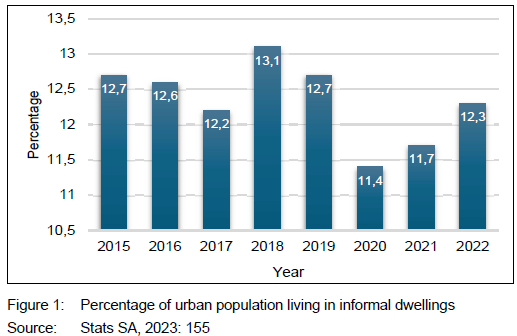
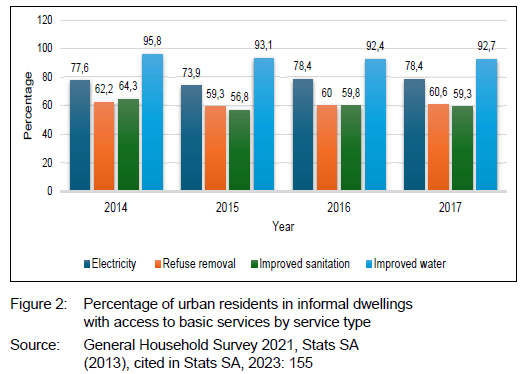
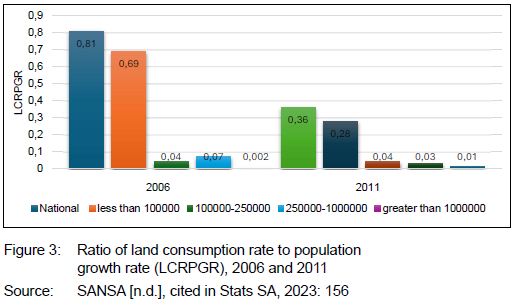
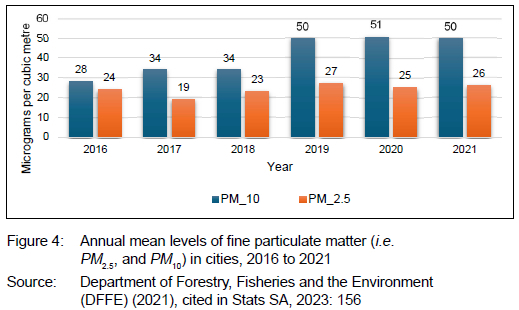
This section evaluates South Africa's progress towards achieving SDG 11, focusing on sustainable urban development and living conditions in urban areas, based on the 2023 Sustainable Development Goals Country Report. Key themes include the percentage of the urban population living in informal dwellings, access to basic services, the land consumption rate relative to population growth (LCRPGR) for 2006 and 2011, air quality indicators from 2016 to 2021, and the role of traditional leadership in dispute resolution. It is noted that not all SDG 11 targets are reported on, due to data limitations, particularly for targets 11.2, 11.4, 11.7, and 11.c (Stats SA, 2023: 154-155).
Data from Figure 1 highlights fluctuations in the percentage of the urban population living in informal dwellings from 2018 to 2022. In 2018, 13.1% of urban residents lived in informal settlements, signalling a critical need for intervention. This figure decreased to 11.4% in 2020, possibly due to effective housing policies, but increased to 12.3% by 2022, indicating persistent challenges in addressing informal housing. It also points to ongoing issues linked to rapid urbanisation.
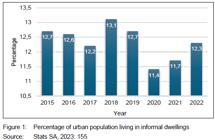
These trends relate to Target 11.1, which aims for adequate, safe, and affordable housing by 2030. The data also aligns with Target 11.3, emphasising the need for inclusive urbanisation, and touches on Target 11.5, highlighting the importance of disaster risk management in informal settlements. Overall, the findings underscore the need for improved urban planning and sustained policy efforts to address the complexities of informal housing.
Figure 2 displays data on the percentage of the population with access to four essential services, namely electricity, refuse removal, improved sanitation, and improved water, between 2014 and 2017. Access to electricity increased slightly from 77.6% in 2014 to 78.4% in 2017, indicating progress but suggesting the need for further interventions. By contrast, access to refuse removal services declined from 62.2% in 2014 to 59.3% in 2017, reflecting challenges in waste management, possibly due to population growth. Improved sanitation access also declined from 64.3% in 2014 to 56.8% in 2015, recovering slightly to 59.3% in 2017, raising public health concerns. Access to improved water remained high, peaking at 95.8% in 2015, although it slightly declined to 92.7% by 2017, indicating the need for ongoing maintenance amid challenges such as population growth and climate change.
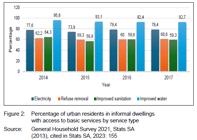
Overall, while electricity and water access have stabilised or improved, refuse removal and sanitation services have significantly declined. The upward trend in electricity access aligns with Target 11.1 on basic services, while the decline in refuse removal and sanitation highlights challenges related to Targets 11.1 and 11.6, which focus on equitable access and environmental impact, respectively. These mixed results emphasise the need for targeted policies to support sustainable urban development.
Figure 3 illustrates the land-use efficiency measure for various urban areas, aligning with Target 11.3, which aims to promote inclusive and sustainable urbanisation and integrated planning. The data indicates that most of the urban categories are moving away from an optimal efficiency level ofone, suggesting increased land-use inefficiency.
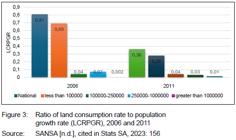
Urban areas with populations under 100,000 and over 250,000 are particularly affected, facing significant declines in land-use efficiency, which raises concerns about urbain sprawl and inefficient infrastructure. Conversely, mid-sized cities (100,000 to 250,000) are managing land use more effectively, likely due to improved planning and resource allocation, supporting Target 11.3's emphasis on balanced development.
The declining land-use efficienay trend poses risks such as urban sprawl, strain on public services, and environmental degradation, impacting on Target 11.6 , which seeks to mitigate cities' environmental impact Overall, these trends highlight the urgent need for comprehensive urban planining strategies to optimise land use and promote sustainable development in the context or South Africa's accelerating urbanisation.
Figure 4 illustrates fluctuations in annual mean levels of particulate matter of both PM10 and PM2.5, which are crucial indicators related Target 11.6, aimed at reducing the adverse environmental impact of cities, particularly air quality. levels of PM10 (particulate matter with a diameter of 10 micrometres or less) showed a troubling upward trend, rising from 28 micrograms per cubic meter in 2016 to 51 micrograms per cubic meter in 2020 and 2021, exceeding the national ambient air quality standard (NAAQS) limit of 40 micrograms. This deterioration in air quality raises serious public health concerns, especially respiratory and cardiovascular risks.
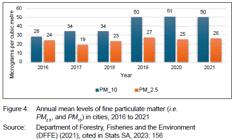
By contrast, PM25 levels (finer particulate matter) showed only a slight increase, from 24 micrograms per cubic meter in 2016 to 26 micrograms in 2021, suggesting a less alarming trend but still a cause for concern under Target 11.6. The sharp rise in PM10 levels calls for immediate strategies to mitigate pollution, including stricter emissions regulations and improved industrial practices, aligning with Target 11.6's focus on improving air quality.
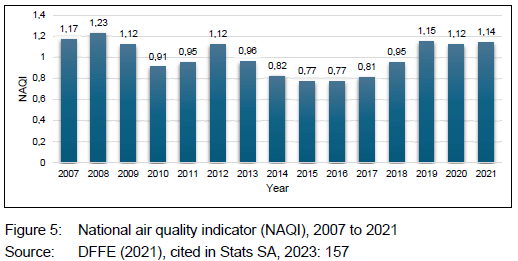
Figure 5 illustrates South Africa's air quality trends from 2010 to 2018, focusing on PM10 and sulphur dioxide (SO2) concentrations. During this period, except for 2012, air-quality levels remained below the NAAQS, aligning with Target 11.6, which aims to reduce the environmental impact of cities, particularly air quality. The adherence to these standards indicates success in air-quality management through regulatory frameworks, pollution control measures, and public aiwareness, supporting Target 11.6's objective to improve air quality. Stricter emissions regulations, cleaner technologies, and reduced vehicular emissions likely contributed to this positive trend.
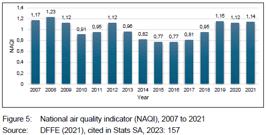
However, periods before 2010 and after 2018 show concentrations exceeding the NAAQS, posing public health risks, as high PM10 and SO2 levels are harmful to respiratory health and the environment. This dieterioration highlights challenges linked to industrial activities and urbanisation, requiring sustained efforts and comprehensive air-quality management strategies to address air pollution and protect public health, in line with Target 11.6.
Indicator 11.a.1 assesses the implementation of national urban policies and negional development plans in South Africa, focusing on population dlynamics, territorial development, and local fiscal capacity. The National Development Plan (NDP) and the Integrated Development Plan (IDP) (Stats SA, 2023: 157) support Target 11.a, which aims to enhance urban and regional planning. By 2015, South Africa had adopted 13 disaster risk reduction (DRR) strategies (Stats SA, 2023: 157-158), reflecting efforts towards Target 11.b, which advocates for integrated DRR policies. However, the limited number of DRR strategies compared to the number of municipalities indicates ongoing vulnerability to disaster risks.
The variation in deaths from natural disasters - ranging from 290 in 2013 to 437 in 2016 - (Stats SA, 2023: 159) shows the need for improved disaster preparedness aligned with Target 11.5, which seeks to reduce disaster-related deaths and economic losses. Although deaths decreased to 288 by 2018, challenges remain, highlighting the need for better disaster management strategies. Concerning SDG 11 and specifically Target 11.3, data from 2018 and 2021 indicates that 3.9% and 5.6% of the population, respectively, sought dispute resolution through traditional authorities (Stats SA, 2023: 219), showcasing the role of traditional governance in promoting social cohesion and participatory urban planning.
The preceding discussion reveals that South Africa has made limited progress in achieving SDG 11, with only a few indicators reflecting any improvement.
3.3 The role of traditional leadership and SDG 11
Historically, the vast majority of countries have experienced hierarchical leadership or absolute monarchy. The demand for representative government, facilitated by rural peasants and urban factory workers seeking better wages, working conditions, and gender equality, led to the rise of modern democracy globally (South Africa, 2003b: 10). Prior to colonisation, African governance was primarily influenced by traditional leadership systems, where traditional leaders and institutions addressed various community issues (South Africa, 2003b: 10).
Traditional authorities in Africa wielded both political and administrative power, overseeing services such as land administration, road construction, latrine building, dispute resolution, and well provision, funded by community levies, donations, royalties, and tributes (Amoateng, 2007: 22). The colonisation of African states by European powers resulted in varied approaches to traditional institutions; some were deemed uncivilised and subjected to assimilation, while others were incorporated into colonial administration but with reduced status and influence (South Africa, 2003b: 10).
The emergence of the nation-state during colonial and post-colonial periods led to the takeover of basic service provision by elected local governments, resulting in traditional authorities losing their independent resource base and ability to directly serve their communities (Amoateng, 2007: 22). However, the inability of state structures to address socio-economic needs, coupled with the persistence of traditional institutions, has sparked renewed interest in indigenous knowledge and governance (Amoateng, 2007: 22).
Amoateng (2017: 1) observes an increased interest in traditional institutions, due to decentralisation trends in developing countries, particularly in Asia and Africa, with rural communities preferring these systems and urban populations favouring modern governance. The Dula Omar Institute (DOI) [n.d.]: 3) highlights that the hierarchical nature of traditional leadership in Africa, comprising kings, chiefs, headsmen, and village leaders, establishes traditional authorities as the main governance structure in many rural areas, particularly in matters such as land allocation and management,4dispute resolution,5 environmental preservation, and the promotion and preservation of culture and heritage.6
Due to these responsibilities, traditional leaders often engage more frequently with citizens in rural areas than in modern state institutions (DOI, [n.d.]: 1). Traditional leaders also contribute to development and promote peace, particularly in rural areas. These factors necessitate their recognition and integration within government frameworks (DOI, [n.d.]). In addition to their traditional roles, traditional leaders complement the government's initiatives, by engaging the community in the implementation of development projects, raising awareness about health issues such as human immunodeficiency virus/acquired immunodeficiency syndrome (HIV/AIDS), promoting education,7 encouraging economic activities, fostering respect for the law, and urging community members to participate in the electoral process (Amoateng, 2007: vi).8
Despite facing challenges such as alignment with democratic principles, corruption, autocratic tendencies, and the marginalisation of women, traditional leaders retain significant respect and legitimacy, due to their governance roles, especially where modern state structures are absent. Their ongoing importance suggests the need for decentralisation
laws and policies to incorporate traditional leaders at the local level (DOI, [n.d.]: 3). Amoateng (2007: v) views chieftaincy as a vital, adaptable institution within African communities, making its role a priority for policymakers. Traditional authorities continue to hold significant influence, particularly in areas lacking formal state structures, serving as alternative power sources in many rural communities. This situation has encouraged governments to include these authorities in governance discussions (DOI, [n.d.]). Some African countries that have tried to effect substantial changes to the institutions of chieftaincy rule in the aftermath of the colonial administration include South Africa,9Ghana,10 and Zimbabwe.11
3.3.1 Case studies on traditional leadership in SDG 11-aligned programmes
This section examines specific case studies demonstrating how traditional leadership aligns with the aims and targets of SDG 11, to illustrate their contributions to making cities and human settlements inclusive, safe, resilient, and sustainable.
a. Traditional authorities in the Dagbon Crisis, Ghana
The chieftaincy institution in Ghana plays a crucial role in conflict resolution and sustainable governance, aligning with SDG 11, particularly Target 11.3, which emphasises inclusive and participatory decision-making, and Target 11.7, which aims to foster safe and inclusive communities. A significant example is the resolution of the Dagbon chieftaincy conflict between the Abudu and Andani royal families in the Northern Region. In 2003, the Ghanaian government established the Committee of Eminent Chiefs, chaired by prominent figures such as Asantehene Otumfuo Osei Tutu II, to facilitate a locally driven resolution (Issifu & Bukari, 2022: 230). This initiative employed the eminent chiefs approach (ECA), a hybrid model that integrated indigenous peace-building practices with state support, culminating in the "Roadmap to Peace" in 2006 (Asiedu, 2008: 33). This synthesis of local governance with formal institutional frameworks illustrates how culturally grounded, community-led strategies can enhance resilience and contribute to sustainable development in both urban and rural contexts.
b.
Okyehene's natural resources management in Akyem Abuakwa, GhanaThe Akyem Abuakwa Traditional Area in Ghana, rich in natural resources, faces significant threats from deforestation, pollution, and wildlife exploitation (OEF, 2003: 1). In alignment with SDG 11, particularly Targets 11.4 and 11.6, traditional authorities are actively working to preserve cultural and natural heritage and reduce environmental impacts on communities. The OEF, established in 2000, educates communities on sustainable practices through programmes such as Annual Environment Week and the Community Environment Protection Brigade, which protect forests, water sources, and wildlife (OEF, 2003: 16). Furthering Target 11.3's focus on inclusive, sustainable urbanisation, the FOREST Okyeman programme, funded by the UN, promotes reforestation, sustainable tourism, and alternative livelihoods, aiming to plant 3 million trees and improve the lives of 1.3 million people, with a focus on women and youth (UN, [n.d.]: 4).
c.
Asantehene's land allocation for affordable housing, GhanaAsantehene Otumfuo Osei Tutu II allocated 205 acres in Dedesua, Kumasi, to the State Housing Company Limited for affordable housing (State Housing Company Limited, 2018). Aligned with SDG 11, Target 11.1, this initiative aims to provide safe, affordable housing for low-income families, address Ghana's housing deficit, and create youth employment opportunities to boost economic development in the Ashanti Region. This project demonstrates traditional leadership's vital role in advancing sustainable urban development and improving living conditions for vulnerable communities.
d.
Royal Bafokeng Administration's (RBA) service delivery, South AfricaThe Royal Bafokeng Administration (RBA) in South Africa demonstrates the critical role of traditional leadership in advancing SDG 11. Notably, the RBA partnered with Sun City and the government, each contributing R53 million to a road project (Selepe, 2009: 173), aligning with Target 11.6 on sustainable urban planning. The RBA's 60% water subsidy and installation of water meters (Thornhill & Selepe, 2010: 170) support Targets 11.1 and 11.5, by ensuring affordable access to safe water, reducing health risks, and enhancing disaster resilience. In addition, the RBA's tribal police force and tribal court promote community safety and justice (Thornhill & Selepe, 2010: 171-172), contributing to Targets 11.3, 11.5, and 11.7, by supporting local governance, mitigating conflict, and creating secure public spaces for all residents.
e.
Traditional leadership in coronavirus disease 2019 (COVID-19) programmes, South AfricaDuring COVID-19, traditional leaders in South Africa partnered with local municipalities to curb the spread of the virus, by promoting compliance with restrictions on gatherings, including funerals and cultural practices (Matsiliza, 2024: 6). For instance, the AmaMpondomise Kingdom in the Eastern Cape suspended gatherings and adjusted funeral practices to allow only immediate family members, with full ceremonies postponed. Traditional leaders distributed sanitiser, soap, and masks, with Chiefs such as Mahlangu in Mpumalanga organising clinic sanitisation (DOI, 2020; Matsiliza, 2024: 6; Mutereko, 2022: 181). These efforts supported SDG 11, particularly Target 11.5, by reducing public health risks in rural areas, highlighting the role of localised responses in building resilient communities.
While traditional leaders play a crucial role in achieving SDG 11, there are instances where their actions have hindered progress. In Ghana, issues such as multiple land sales by clans and families cause disputes, with President Akufo-Addo noting the need for land-administration reforms to address unauthorised sales and conflicts (Osei, 2022). Similarly, during the COVID-19 pandemic in South Africa, some traditional leaders sought to classify their services as essential and issued unauthorised permits, leading to local conflicts over authority (DOI, 2020).
4. TRADITIONAL LEADERSHIP IN SOUTH AFRICAN LEGAL AND POLICY FRAMEWORKS
This section discusses the role and functions of traditional leadership in supporting sustainability, inclusivity, and resilience within South Africa's legal and policy frameworks.
4.1 Historical background
In pre-colonial South Africa, traditional leaders held the highest authority as the political and administrative heads of rural communities, managing political, economic, cultural, and religious affairs from 1880 to 1893 (SAHO, [n.d.]). However, the onset of colonialism in the 19th century transformed their roles, assigning them responsibilities such as administering justice, allocating land (held in trust for their communities), maintaining law and order, managing local administrative tasks, and promoting education (SAHO, [n.d.]).
Colonial laws such as the Black Administration Act of 1927 and the Black Authorities Act of 1951 limited the powers of traditional leaders, placing them under greater colonial control (Khunou, 2009: 86). The Governor-General's office was established to oversee these leaders, allowing the appointment or removal of chiefs, even against customary laws. This centralised control diminished their autonomy, reducing them to enforcers of colonial policies. The rise of the National Party in 1948 and the establishment of apartheid further solidified these changes (SAHO, [n.d.]).
The Bantu Authorities Act of 1951 formalised traditional leaders as administrative agents of the apartheid regime, especially in Bantustans created under the Promotion of Bantu Self-Government Act of 1959 (Khunou, 2009: 86-88). In homelands such as Transkei, Bophuthatswana, Venda, and Ciskei, Africans were denied South African citizenship, and were granted limited rights (Dugard, 1980: 22). Traditional authorities in these areas often supported the apartheid government's segregationist policies, further diminishing their original roles (Khunou, 2009: 86).
After the demise of apartheid in 1994, the 1996 Constitution recognised traditional leadership within the framework of a unified and democratic South Africa.
4.2 Empowering traditional leadership under South African legal and policy frameworks
This section explores the role of traditional leadership in the South African constitutional, legal, and policy context.
4.2.1 Constitutional framework
According to Part A of Schedule 4 of the 1996 Constitution of the Republic of South Africa, 'Traditional leadership' and 'Indigenous law and customary law' fall under concurrent national and provincial legislative powers, subject to Chapter 12 of the Constitution. Sections 76 and 44 of the Constitution authorise Parliament to enact laws regarding traditional leadership, with involvement from both the National Assembly and the National Council of Provinces. While Parliament cannot repeal or amend provincial legislation, national laws will take precedence over provincial laws if they meet the conditions specified in Section 146 of the Constitution.
Chapter 12 of the South African Constitution formally recognises the role and existence of traditional leadership within the country's legal framework. Section 211(1) grants official status to traditional leaders, by acknowledging their role under customary law, reflecting their historical and cultural significance. This integration into the constitutional structure underscores the importance of traditional leadership in South Africa's governance. In addition, Section 212(1) allows for national legislation to define the role of traditional leadership at the local level concerning community matters. Section 212(2) further stipulates that national or provincial legislation may establish houses of traditional leaders and a national council of traditional leaders to address issues related to traditional leadership, customary law, and community customs.
4.2.2 Legislative frameworks
a. Traditional Leadership and Governance Framework Act (TLGFA), 41 of 2003
The TLGFA was enacted in 2003 to implement the constitutional recognition of traditional leadership. The Act defines the roles and functions of traditional leaders within South Africa's democratic governance system and establishes traditional councils to operate alongside elected municipal councils, particularly in rural areas. It emphasises traditional leaders' roles in promoting socioeconomic development, preserving cultural heritage, and leading in areas governed by customary law. It is important to note that the TLGFA also imposes principles of democracy, accountability, and gender equality, marking a shift from the traditionally hereditary and male-dominated leadership structures.
Chapter 5 of the TLGFA outlines the responsibilities of traditional leaders. Section 19 states that their duties are based on customary law, community traditions, and relevant legislation. Section 20(1) allows national or provincial governments to assign specific roles to traditional councils or leaders through legislation, covering various areas such as arts and culture, land administration, health, welfare, justice, safety and security, economic development, environmental management, and education.
b.
Local Government: Municipal Structures Act, 117 of 1998Section 81(1) of the Local Government: Municipal Structures Act allows traditional authorities that follow a customary law system within a municipality to participate in the council's proceedings through their leaders. These traditional leaders must be permitted to attend and engage in any council meeting. Section 81(2)(a) of that same Act adds that the members of the Executive Council (MEC) for local government in a province, in line with Schedule 6 and by notice in the Provincial Gazette, must identify the traditional leaders who may participate in municipal council proceedings.
Section 81(3) stipulates that, before a municipal council decides on any matter directly impacting the area of a traditional authority, the council must afford the leader of that authority an opportunity to present his/her views on the matter. In addition, Section 81(4)(b) empowers the MEC for local government, after consulting the provincial House of Traditional Leaders, to prescribe a role for traditional leaders in municipal affairs by notice in the Provincial Gazette.
c.
Municipal Systems Act, 32 of 2000According to Section 17(2)(d) of the Municipal Systems Act, municipalities are required to establish mechanisms, processes, and procedures that enable local communities to participate in municipal affairs. This includes organising consultative sessions with recognised community organisations and, where appropriate, traditional authorities. Section 29(1)(b) of the same Act stipulates that, when a municipality drafts its integrated development plan, including its consideration and adoption of the draft plan, it must, through the appropriate mechanisms, processes, and procedures established under Chapter 4, identify and consult with organs of state, traditional authorities, and other relevant stakeholders. In addition, Section 76(b) of the Municipal Systems Act, 32 of 2000, states that a municipality may provide a municipal service within its area or part of its area through an external mechanism, by entering into a service delivery agreement with a traditional authority.
d. Spatial Planning and Land Use Management Act (SPLUMA), 16 of 2013
Section 12(1) of SPLUMA mandates that the national, provincial, and municipal governments must prepare spatial development frameworks that include and address the integration of previously disadvantaged areas, areas under traditional leadership, rural areas, informal settlements, slums, and land holdings of state-owned enterprises and government agencies into the spatial, economic, social, and environmental objectives of the relevant sphere of government. In addition, Section 23(2) of SPLUMA specifies that by Section 81 of the Local Government: Municipal Structures Act, and the TLGFA, a municipality must ensure the participation of a traditional council when performing its duties under this chapter.
4.2.3 Policy frameworks
a. White Paper on Traditional Leadership and Governance (WPTLG), 2003
Part 3.2 of the WPTLG outlines the government's initiatives to enhance local service delivery, by engaging all sectors of society, with traditional leadership playing a vital role in rural areas. Traditional leaders contribute to community well-being, by promoting socio-economic development, improving services, fostering nation-building, maintaining peace, encouraging social cohesion, and preserving cultural values.
The WPTLG emphasises that traditional leadership, as a custom-based institution, can significantly influence government policies affecting traditional communities. Traditional leaders should advise on customary issues, be consulted on relevant policies, support government initiatives, and form cooperative partnerships to enhance development. Part 3.3 details traditional leadership's roles, functions, and structures across various government levels. It focuses on additional roles in Sections 3.3.3(a), 3.3.3(c), and 3.3.3(d), which are essential for empowering traditional leadership to achieve SDG 11.
Section 3.3.3(a) establishes district houses of traditional leaders to support collaboration with district municipalities. Their responsibilities include advising on rules impacting rural communities, participating in development programmes, and monitoring government initiatives.
Section 3.3.3(b) notes that traditional councils will build cooperative relationships with local municipalities, assist in community engagement in development planning, relay community needs, suggest interventions, and contribute to local policy formulation.
Section 3.3.3(c) allows national and provincial departments to empower traditional councils through legislation. Traditional leaders promote indigenous knowledge in arts and culture, advise on sustainable land use and agriculture, and facilitate access to social services. They also administer traditional justice systems, support local economic initiatives, advocate for environmental stewardship, and disseminate government policies, while ensuring compliance with constitutional laws.
b. White Paper on Local Government (WPLG), 1998
Part 4.1 of the WPLG highlights the role of traditional leadership at the local level, detailing their various responsibilities. Traditional leaders act as heads of the traditional authority, exercising limited legislative, executive, and administrative powers. They preside over customary law courts, maintain law and order, and interact with their communities through platforms such as imbizo12 and lekgotla.13
Traditional leaders assist community members in their interactions with the state, by providing advice on traditional affairs through the Houses and Council of Traditional Leaders. They organise consultations to address community needs, disseminate information, preserve cultural values, and promote unity. As spokespersons and custodians of customs, they play a vital role in safeguarding community welfare. In local development, traditional leaders recommend land allocations, resolve disputes, advocate for development, ensure community participation in decision-making, and advise on trading licenses. Some traditional authorities also have interests in mineral-rich areas, utilising these resources to support community development.
After reviewing the legal and policy frameworks regarding traditional leadership in sections 4.2.1, 4.2.2, and 4.2.3, it is clear that traditional leadership is acknowledged within these frameworks. However, this recognition faces challenges, as the roles and functions of traditional leaders have sometimes been contested in court.
4.2.4 South African case law
This section examines how judicial rulings have upheld or challenged the legal and policy recognition of traditional leadership.
a. Mahikeng Local Municipality v Gwiriri and Others (UM157/2019) [2023] ZANWHC 132 (10 August 2023)
The case involved a dispute between the Mafikeng Local Municipality and Velaphi Gwiriri, representing the community. The Municipality sought an interdict to prevent the respondents from unlawfully using a portion of land within its jurisdiction, which they claimed to use based on traditional rights. The central legal issue concerned the authority of the Municipality versus the rights of traditional leaders and community members regarding land use. The court ruled in favour of the Municipality, granting the interdict and affirming its authority to manage land within its jurisdiction.
The case is significant as it clarifies the roles of local municipalities and traditional authorities in land management, highlighting ongoing tensions in South Africa related to land rights, especially regarding customary law. The decision may influence future land disputes, particularly in contexts where traditional and statutory systems intersect.
b. Lepelle Nkumpi Local Municipality v The Bakgaga Ba Ga-Mphalele Traditional Authority and Others (6753/2018) [2021] ZALMPPHC 42 (5 August 2021)
The case highlights the contentious role of traditional leaders in South Africa regarding land allocation. The Lepelle Nkumpi Local Municipality challenged the Bakgaga traditional authority for issuing permission to occupy (PTO) certificates for municipal land without municipal approval, leading to a legal dispute over the authority of the traditional authority. Accordingly, the Municipality sought to compel the Bakgaga traditional authority to act within its defined obligations under the Constitution and relevant subsidiary legislation and to prevent any future conduct that might contravene its designated role in the land development and reform process.
The Supreme Court of Appeal ruled in favour of the Municipality, affirming that the traditional authority does not have the authority to allocate municipal land or issue PTOs without consent. The ruling shows the importance of municipal governance and the need for traditional authorities to operate within established legal frameworks. This decision reinforces municipal authority over land management and emphasises the need for cooperation between traditional leaders and municipal officials to prevent disputes.
5. DISCUSSION
Recalling in section 3.1, SDG 11 aims to "Make cities and human settlements inclusive, safe, resilient, and sustainable". The discussion in section 4.2 outlined the functions and role of traditional leadership within South Africa's legal and policy frameworks. This section examines the intersection of traditional governance and SDG 11, exploring the implications of empowering traditional authorities in South Africa to achieve this goal. The focus is on how traditional systems can contribute to or hinder sustainable development in rural settings, particularly in terms of making human settlements inclusive, safe, resilient, and sustainable.
5.1 Intersection of SDG 11 targets and functions of traditional leadership
5.1.1
Security and safetyThe overarching goal of SDG 11 that aims to make cities and human settlements inclusive, safe, resilient, and sustainable, aligns with Section 3.3.3(c) of the WPTLG. This section entrusts traditional leadership with responsibilities related to justice, security, and home affairs, enabling traditional leaders to administer traditional justice systems, enhance safety and security within their communities, and promote peace in rural areas. The alignment of these responsibilities with the objectives of SDG 11 highlights the vital role traditional leaders can play in promoting inclusive and resilient communities, particularly in rural settings.
5.1.2
Community participationWithin the framework of SDG 11 that seeks inclusive and sustainable urbanisation, Target 11.3 emphasises the importance of enhancing public participation in urban development processes. This target is particularly relevant to traditional leadership in South Africa, aligning with legal and policy frameworks that integrate traditional authorities into municipal governance. A key mechanism for this integration is found in Section 81(1) of the Local Government: Municipal Structures Act that allows traditional leaders, who operate under customary law, to participate in municipal council activities. This ensures their involvement in local governance and decision-making processes that impact on their communities.
Section 81(3) of the Act requires municipal councils to provide traditional leaders with the opportunity to express their views before making decisions that affect their areas. This provision highlights the importance of consulting traditional leaders and incorporating their perspectives into municipal decisions. Section 81(4)(b) further reinforces this involvement, by authorising the MEC for local government, in consultation with the provincial house of traditional leaders, to define the roles of traditional leaders in municipal affairs through notices published in the Provincial Gazette, thereby formalising their participation in municipal governance.
Moreover, Section 17(2) (d) of the Municipal Systems Act mandates municipalities to establish mechanisms that facilitate community participation in municipal affairs. This includes organising consultative sessions with community organisations and, where appropriate, traditional authorities, ensuring that diverse community voices are included in municipal planning and decision-making.
The WPTLG further endorses the role of traditional leaders, by advocating for their involvement in guiding customary matters, consulting on policies that affect rural and traditional communities, and supporting government initiatives. It highlights the need for traditional leaders to develop cooperative partnerships with the government, in order to promote development and improve service delivery, aligning with the broader objectives of SDG 11.
5.1.3 Land management and sustainable settlements
SDG 11, particularly through Target 11.1, focuses on providing safe and affordable housing, while Target 11.2 aims to establish accessible and sustainable transport systems, and Target 11.a promotes robust national and regional development planning. In addition, Target 11.3 seeks to promote inclusive and sustainable urbanisation. These objectives intersect with the responsibilities of traditional leadership in rural areas, where traditional leaders often oversee communal lands and are instrumental in decisions related to land use, housing, and infrastructure development.
According to Section 3.3.3(c) of the WPTLG, traditional leaders are actively involved in land administration, advising the government on sustainable land practices, supporting agricultural development, and preventing animal cruelty. Furthermore, Section 20(1) of the TLGFA empowers national or provincial governments to assign specific responsibilities to traditional councils, particularly in areas such as land administration, agriculture, and economic development.
In addition, Section 23(2) of SPLUMA requires municipalities to involve traditional councils in developing spatial frameworks. These frameworks must integrate disadvantaged areas, regions under traditional leadership, rural communities, informal settlements, slums, and land managed by state-owned enterprises and government agencies into the broader spatial, economic, social, and environmental goals of the government. Traditional leaders also contribute significantly to local development, by recommending land allocations, resolving disputes, and advocating for development, as outlined in the WPTLG. This role is further supported by Section 29(1)(b) of the Municipal Systems Act that requires municipalities to consult traditional authorities and other stakeholders when drafting and considering their integrated development plans.
5.1.4
Cultural heritage and community identitySDG 11, particularly Target 11.4, focuses on safeguarding and promoting cultural and natural heritage, a goal that closely aligns with the role of traditional leaders in South Africa. The TLGFA highlights the significance of traditional leaders in advancing socio-economic development, preserving cultural heritage, and providing leadership in areas governed by customary law. This responsibility is further emphasised in Section 3.3.3(c) of the WPTLG that tasks traditional leaders with promoting indigenous knowledge systems, music, oral history, commemorative events, and the preservation of cultural heritage.
Traditional leaders continue to fulfil their customary roles based on community laws and practices, while ensuring compliance with the Constitution and relevant legislation, as outlined in Section 3.3.3(c) of the WPTLG. In addition, the WPLG recognises the role of traditional leadership in cultural heritage protection, particularly in Part 4.1 that highlights their involvement in organising consultations to preserve cultural values and acting as custodians of customs. Section 20(1) of the TLGFA also empowers national or provincial governments to assign specific responsibilities to traditional councils, including in areas such as arts and culture, registration of births, deaths, and customary marriages, as well as tourism and natural resource management.
5.1.5
Disaster managementSDG Target 11.5 focuses on reducing disaster risk and strengthening resilience against natural and human-made hazards, emphasising the importance of effective measures to protect communities and mitigate disaster impacts. Target 11.b promotes the implementation of inclusive policies that enhance resource efficiency and support disaster risk reduction efforts. These targets are closely connected to the roles and functions of traditional leadership in South Africa that are vital to local governance and community well-being. In South Africa, traditional leaders are key in managing and safeguarding local resources, supporting disaster preparedness, and promoting community resilience. Section 20(1) of the TLGFA allows national or provincial governments to assign specific duties to traditional councils or leaders. This includes responsibilities related to disaster management, where traditional leaders can help coordinate response efforts and enhance local resilience strategies. They also manage natural resources, overseeing and protecting communal lands and resources sustainably. In addition, traditional leaders are critical in disseminating government policies and ensuring that communities are informed about relevant regulations. They contribute to education efforts, enhancing community knowledge and preparedness for disaster risk reduction and sustainable resource management. By aligning with SDG Targets 11.5 and 11.b, the roles of traditional leaders support the implementation of policies that promote inclusion, efficiency, and resilience within local communities, highlighting their significant contributions to achieving these global development goals.
5.1.6 Environmental management
SDG Target 11.6 aims to reduce the environmental impact of cities, while Target 11.7 focuses on providing access to safe and inclusive green and public spaces. These targets align closely with the responsibilities of traditional leaders as outlined in South Africa's legal and policy frameworks for advancing SDG 11. For instance, Section 20(1) of the TLGFA allows national or provincial governments to assign specific roles to traditional councils or leaders through legislation or other means. These roles can encompass various areas, including environmental management, tourism, and natural resource management. Section 3.3.3(c) of the WPTLG empowers traditional leaders to advise the government on sustainable land use, agricultural development, and efforts to prevent animal cruelty. In addition, traditional leaders play a crucial role in environmental management, by promoting environmental stewardship, advocating for the sustainable use of cultural and natural resources, and supporting traditional practices in water resource management.
5.2 Implications of empowering traditional leadership for SDG 11 and rural development
5.2.1
Enhances local governance and service deliveryTraditional authorities possess deep knowledge of local customs and community needs, enabling them to provide culturally relevant and responsive governance in rural areas. Empowering these leaders helps align development strategies with local values, fostering inclusivity and enhancing the effectiveness of initiatives by ensuring that they meet the community's context. This cultural alignment is essential for promoting sustainable development, while respecting traditional practices and addressing modern needs. Moreover, traditional authorities can significantly boost local participation in decision-making, leading to more community-driven, successful, and sustainable development projects. Their involvement in formal governance structures also enhances the delivery of essential services and facilitates conflict resolution and peacekeeping, which are vital for building resilient and secure communities, aligning with the goals of SDG 11.
5.2.2
Increases accountability and transparencyTo empower traditional authorities effectively, it is crucial to implement clear mechanisms for accountability and transparency. This involves setting up oversight bodies, conducting regular audits, and creating avenues for community feedback to prevent corruption and ensure that leaders serve the community's best interests. Transparent decision-making and open communication with the community are key to building trust and inclusivity, aligning traditional governance with SDG 11's objective of fostering accountable and resilient institutions. By adopting these practices, traditional authorities make a valuable contribution to local governance and sustainable development.
5.2.3
Balancing rural-urban linkagesEmpowered traditional authorities help connect rural and urban areas, by fostering balanced development that addresses the underlying reasons for urban migration. Their thorough understanding of local needs enables them to improve rural infrastructure, services, and economic opportunities, making rural living more viable and reducing the push to migrate to cities. Furthermore, their participation in urban planning ensures that the needs of rural migrants are considered, promoting inclusive and culturally sensitive urban environments. Incorporating traditional perspectives into both rural and urban development aligns with SDG 11's goals of sustainable urbanisation and balanced regional growth.
5.2.4
Environmental stewardshipEmpowered traditional authorities are ideally positioned to promote environmental stewardship, by harnessing their cultural influence and local ecological knowledge to advocate for sustainable practices. As guardians of traditions that emphasise harmony with nature, they combine these practices with contemporary environmental strategies to support sustainable land use, biodiversity conservation, and community-based efforts. Acting as intermediaries between governments and communities, traditional leaders ensure that environmental policies are comprehended, embraced, and effectively executed. Their involvement encourages community-driven initiatives to address environmental challenges, tailoring solutions to local needs, and enhancing both resource sustainability and community resilience. This approach not only supports SDG 11, but also fosters inclusive, participatory, and culturally relevant environmental governance.
5.2.5
Promotes inclusive developmentTraditional authorities play a crucial role in rural communities by representing local values and customs. Empowering them enables development strategies to be aligned with these cultural traditions, making initiatives more inclusive and relevant. Their deep understanding of local practices helps integrate modern development with traditional ways of life, promoting community ownership and engagement. By mobilising community participation, they ensure that various needs are addressed in the planning and execution of sustainable projects. Their facilitation of inclusive dialogue enhances the relevance, effectiveness, and fairness of development efforts, thereby strengthening community cohesion and resilience.
5.2.6
Strengthens rural resilienceTraditional authorities, as guardians of communal lands, are vital in maintaining the livelihoods and cultural practices of rural communities. Empowering them improves land-use sustainability, by combining traditional knowledge with modern environmental objectives, ensuring that land management addresses both community needs and environmental conservation. This approach enhances rural resilience against issues such as soil erosion, deforestation, and climate change, supporting SDG 11. In addition, traditional authorities are adept at mediating land disputes, using their deep understanding of local customs to resolve conflicts fairly. Their role in disaster preparedness also safeguards rural settlements, promoting resilience and sustainability in line with broader development goals.
5.2.7
Promotes cultural heritageEmpowered traditional leadership is imperative for preserving cultural heritage amidst rapid change and urbanisation, by incorporating cultural elements into development strategies. Their strong ties to traditions enable them to steer development in a manner that respects and integrates traditional values, rituals, and historical sites, boosting community pride and continuity. By championing the protection of cultural sites and practices in urban areas, traditional leaders ensure that development honours and celebrates community identity. This approach promotes a sense of belonging and ownership, supporting sustainable and culturally sensitive urbanisation that harmonises heritage with modern growth.
5.2.8
Ensures sustainable resource managementTraditional leaders offer invaluable perspectives on sustainable land use and resource management, due to their deep understanding of local customs and environmental stewardship. Their long-standing knowledge encompasses sustainable agricultural practices, water conservation, and biodiversity preservation that can inform environmentally sound and culturally appropriate methods. By incorporating this traditional ecological knowledge into development projects, traditional leaders ensure that practices align with local conditions and community needs, leading to effective resource management. In addition, their role in fostering sustainable rural development facilitates a reduction in rural-to-urban migration, supporting balanced growth and preserving both environmental and community well-being.
5.2.9
Improves community engagementEmpowering traditional leaders enhances community involvement in development initiatives, resulting in more sustainable and locally driven outcomes. Their strong ties to residents and deep knowledge of community needs enable them to effectively engage people and ensure that projects are suited to local circumstances. As intermediaries between the community and external development partners, traditional leaders represent local interests and negotiate on behalf of the community, ensuring that projects align with local values and priorities. This fosters greater community ownership and commitment, enhancing the success and sustainability of development efforts, while promoting a more inclusive and equitable model of governance.
5.2.10
Challenges of power dynamics and equityEmpowering traditional authorities can present challenges, particularly when their roles overlap with those of elected local governments, leading to governance inefficiencies and conflicts, due to unclear responsibilities, as highlighted in section 4.2.4 of the study. This overlap can result in competing interests and vague jurisdictional boundaries that can impede coordinated efforts and reduce the effectiveness of urban planning and resource management, ultimately slowing progress toward SDG 11. More so, if not carefully managed, the empowerment of traditional authorities could reinforce existing social hierarchies and inequities, particularly affecting marginalised groups. Without mechanisms to ensure fair representation and equitable distribution, traditional systems may perpetuate existing disadvantages and prioritise immediate benefits over long-term sustainability. To mitigate these challenges, empowerment strategies should incorporate strong checks and balances, promote transparency, and ensure inclusive engagement to support fair and sustainable development outcomes.
5.2.11
Policy integration and cohesionTo effectively contribute to SDG 11, traditional authorities must be strategically aligned with national and local policy frameworks, ensuring that their actions support broader development objectives and regulatory standards. Integrating traditional leadership into established policy structures helps harmonise traditional practices with modern governance, enhancing efforts to create inclusive, safe, and resilient human settlements. Empowering traditional authorities involves investing in their capacity to handle contemporary governance challenges, by providing training and resources in strategic planning, resource management, and conflict resolution. This investment equips them to align their activities with sustainable development goals, fostering a more integrated and responsive approach to development and contributing to the achievement of SDG 11.
6. CONCLUSION
This article examined the role and functions of traditional authorities within South Africa's legal and policy frameworks, especially to achieving SDG 11. It highlighted the crucial role of traditional authorities in promoting SDG 11 that aims to make cities and human settlements inclusive, safe, resilient, and sustainable. Traditional leaders have historically been central to governance and community life in South Africa, exerting significant influence over justice, land, and social order through hereditary customs. With the advent of democracy in 1994, the 1996 Constitution acknowledged traditional leadership within a democratic framework, presenting both challenges and opportunities for redefining their roles in a unified South Africa.
The article outlined key legal and policy frameworks that recognise the roles of traditional authorities, including the 1996 Constitution of the Republic of South Africa, the TLGFA, the Local Government: Municipal Structures Act, the Municipal Systems Act, and the SPLUMA. In addition, the WPTLG and the WPLG further highlight these roles. The study also showed that traditional leadership in South Africa extends beyond policy and legislation to practical implementation in the courts and SDG 11-aligned programmes.
The analysis of South Africa's legal and policy frameworks showed that traditional authorities are well-positioned to contribute to achieving SDG 11. These frameworks enable traditional leaders to enhance sustainable development through improved local governance, community participation, and effective resource management. Key areas of intersection include community security, participation, land management, cultural heritage, and disaster management.
Empowering traditional authorities within the constitutional and policy contexts can significantly impact on rural development and achieve SDG 11, by promoting local governance, accountability, transparency, balanced rural-urban linkages, and environmental stewardship. However, challenges such as power dynamics, equity issues, and the need for policy coherence must be addressed for traditional leadership to effectively support sustainable development. While South African legislation has made progress in empowering traditional authorities, successful integration with modern governance structures is crucial for balanced development. A transformative approach focusing on community involvement, legal compliance, policy coherence, and sustainable development is necessary to respect and integrate the rights and perspectives of indigenous communities.
In sub-Saharan Africa, the integration of traditional leadership into national legal frameworks varies widely. Some countries have made progress in recognising traditional leaders, while others experience conflicts between traditional and statutory roles, leading to legal disputes. Future research could explore how various countries address these challenges, providing case studies and best practices to enhance the integration of traditional leadership in achieving SDG 11.
ACKNOWLEDGEMENT
The author wishes to express his gratitude to the National Research Foundation of South Africa (NRF) (Grant number 115581) for the financial support towards this research.
REFERENCES
-
AGBEVADE, A., GRAHAM, E. & VAN, R.E. 2021. The national peace council and democratic consolidation: An assessment. International Journal of Political Science and Governance, 3(2), pp. 90-100. https://doi.org/10.33545/26646021.2021.v3.i2b.114
» https://doi.org/10.33545/26646021.2021.v3.i2b.114 -
AMOATENG, A.Y. 2007. Harnessing traditional governance in Southern Africa. (Commissioned by the Economic Commission for Africa, Southern Africa Office, November). [Online]. Available at: http://hdl.handle.net/20.500.11910/5579 [Accessed: 24 August 2024].
» http://hdl.handle.net/20.500.11910/5579 - ASIEDU, E.O. 2008. Examining the state's capacity in the management of the Dagbon crisis in Ghana: Is there a role for ECOWAS? ALC Research Report No. 1. African Leadership Centre, Kings College, London.
-
DALRRD (DEPARTMENT OF AGRICULTURE, LAND REFORM AND RURAL DEVELOPMENT). 2023. Integrated-Rural-Development-Sector-Strategy-2023. [Online]. Available at: <http://www.daff.gov.za/images/Quick%20Links/integrated-rural-development-sector-strategy-2023.pdf> [Accessed: 18 January 2024].
» http://www.daff.gov.za/images/Quick%20Links/integrated-rural-development-sector-strategy-2023.pdf -
DOI (DULA OMAR INSTITUTE). [n.d.]. The role of traditional authorities in local governance [Online]. Available at: <https://dullahomarinstitute.org.za/siteworkspace/doi-factsheets-9.pdf> [Accessed: 19 October 2024).
» https://dullahomarinstitute.org.za/siteworkspace/doi-factsheets-9.pdf -
DOI (DULA OMAR INSTITUTE). 2020. The role of traditional leaders in combating COVID-19 in rural areas [Online]. Available at: <https://dullahomarinstitute.org.za/multilevel-govt/local-government-bulletin/archives/vol-15-issue-3-september-2020/the-role-of-traditional-leaders-in-combating-covid-19-in-rural-areas> [Accessed: 19 October 2024].
» https://dullahomarinstitute.org.za/multilevel-govt/local-government-bulletin/archives/vol-15-issue-3-september-2020/the-role-of-traditional-leaders-in-combating-covid-19-in-rural-areas - DUGARD, J. 1980. South Africa's independent homelands: An exercise in denationalisation. Denver Journal of International Law & Policy, 10, pp. 11-36.
-
ETIKAN, I., MUSA, S.A. & ALKASSIM, R.S. 2016. Comparison of convenience sampling and purposive sampling. American Journal of Theoretical and Applied Statistics, 5(1), pp. 1-4. https://doi.org/10.11648/j.ajtas.20160501.11
» https://doi.org/10.11648/j.ajtas.20160501.11 -
GGA (GOOD GOVERNANCE OF AFRICA). 2024. Governance Performance Index - South Africa 2024. [Online]. Available at: <https://digitalmallblobstorage.blob.core.windows.net/wp-content/2024/03/Enhanced-GPI-2024.pdf> [Accessed: 20 August 2024].
» https://digitalmallblobstorage.blob.core.windows.net/wp-content/2024/03/Enhanced-GPI-2024.pdf - GHANA. 1992. Constitution of the Republic of Ghana. Accra, Ghana: Ghana Publishing Corporation.
-
INDICATORS, SDG. 2020. Sustainable development goals. UN. [Online]. Available at: <https://unstats.un.org/sdgs/metadata> [Accessed: 20 August 2024].
» https://unstats.un.org/sdgs/metadata -
ISSIFU, A.K. & BUKARI, K.N. 2022. (Re)thinking homegrown peace mechanisms for the resolution of conflicts in Northern Ghana. Conflict, Security and Development, 22(2), pp. 221-242. https://doi.org/10.1080/14678802.2022.2059934
» https://doi.org/10.1080/14678802.2022.2059934 -
KHUNOU, S.F. 2009. Traditional leadership and independent Bantustan's of South Africa: Some milestones of transformative constitutionalism beyond apartheid Potchefstroom Electronic Law Journal, 12(4), pp. 81-122. https://doi.org/10.4314/pelj.v12i4.50050
» https://doi.org/10.4314/pelj.v12i4.50050 - LEPELLE NKUMPI LOCAL MUNICIPALITY V THE BAKGAGA BA GA-MPHALELE TRADITIONAL AUTHORITY AND OTHERS (6753/2018) [2021] ZALMPPHC 42 (5 August 2021).
-
MABELEBELE, J. 2006. Ideological objectives underpinning imbizo as a model of communication and governance. Communicare: Journal for Communication Sciences in Southern Africa, 25(2), pp. 103-125. https://doi.org/10.36615/jcsa.v25i2.1749
» https://doi.org/10.36615/jcsa.v25i2.1749 - MAHIKENG LOCAL MUNICIPALITY V GWIRIRI AND OTHERS (UM157/2019) [2023] ZANWHC 132 [10 August 2023].
-
MATSILIZA, N.S. 2024. The strategic role of traditional leadership in promoting good governance. Africa's Public Service Delivery and Performance Review, 12(1), article 825. https://doi.org/10.4102/apsdprv12i1.825
» https://doi.org/10.4102/apsdprv12i1.825 - MUTEREKO, S. 2022. Working in the shadows: The role of traditional leaders in the management of COVID-19. In: The COVID-19 pandemic in South Africa: A review of selected local governance and policy responses. Democracy Development Programme (DDP), pp. 166-188.
-
OEF (OKYEMAN ENVIRONMENT FOUNDATION). 2003. Community-based Integrated Natural Resources Management Project in Okyeman. [Online]. Available at: <https://documents1.worldbank.org/curated/ar/264501468749072539/pdf/298700Okyeman1GEF0Project0Brief.pdf> [Accessed: 19 October 2024].
» https://documents1.worldbank.org/curated/ar/264501468749072539/pdf/298700Okyeman1GEF0Project0Brief.pdf -
ONURA, W. 2023. Engaging traditional leaders to advance environmental protection [Online]. Available at: <https://www.tmg-thinktank.com/blog/engaging-traditional-leaders-to-advance-environmental-protection> [Accessed: 19 October 2024].
» https://www.tmg-thinktank.com/blog/engaging-traditional-leaders-to-advance-environmental-protection -
OSEI, L. 2022. City New Room. Stop wrongful, multiple sale of lands -Akufo-Addo to chiefs and landowners. [Online]. Available at: <https://citinewsroom.com/2022/12/stop-wrongful-multiple-sale-of-lands-akufo-addo-to-chiefs-and-land-owners/> [Accessed: 20 October 2024].
» https://citinewsroom.com/2022/12/stop-wrongful-multiple-sale-of-lands-akufo-addo-to-chiefs-and-land-owners/ -
PARLIAMENT OF THE REPUBLIC OF SOUTH AFRICA. [n.d.]. Glossary [Online]. Available at: <https://www.parliament.gov.za/glossary> [Accessed: 10 August 2024].
» https://www.parliament.gov.za/glossary -
RAUTENBACH, C. & FERREIRA, G. 2023. Traditional authorities and state functions in South Africa: A complex relationship of private participation? Potchefstroom Electronic Law Journal, 26(1), pp. 1-38. https://doi.org/10.17159/1727-3781/2023/v26i0a16229
» https://doi.org/10.17159/1727-3781/2023/v26i0a16229 - RAUTENBACH, C., FOMBAD, C. & STEYTLER, N. 2019. Mapping traditional leadership and authority in post-apartheid South Africa: Decentralisation and constitutionalism in traditional governance. In: Fombad, C. (Ed.). Constitutional adjudication in Africa. London, UK: Oxford University Press, pp. 483-519.
-
RAY, D.I. & REDDY, P.S. 2003. Grassroots governance? Chiefs in Africa and the Afro-Caribbean. Calgary: University of Calgary Press. https://doi.org/10.1515/9781552383575
» https://doi.org/10.1515/9781552383575 -
SAHO (SOUTH AFRICAN HISTORY ONLINE). [n.d.]. The role of traditional leaders during apartheid. [Online]. Available at: <https://www.sahistory.org.za/article/role-traditional-leaders-during-apartheid> [Accessed: 20 October 2024].
» https://www.sahistory.org.za/article/role-traditional-leaders-during-apartheid - SELEPE, M.M. 2009. The role of traditional leaders in the promotion of municipal service delivery in South Africa. Unpublished PhD dissertation, University of Pretoria, Pretoria, South Africa.
-
SEPAHA, P. 2023. Doctrinal and non-doctrinal research. Law Colloquy, 3 November 2023. [Online]. Available at: <https://lawcolloquy.com/publications/blog/doctrinal-and-non-doctrinal-research-/269> [Accessed: 18 January 2024].
» https://lawcolloquy.com/publications/blog/doctrinal-and-non-doctrinal-research-/269 - SINGHAL, A.K. & MALIK, I. 2014. Doctrinal and socio-legal methods of research: Merits and demerits. Educational Research Journal, 2(7), pp. 252-256.
- SOUTH AFRICA. 1996. Constitution of the Republic of South Africa, Act 108 of 1996. Pretoria: Government Printer.
- SOUTH AFRICA. 1998a. Local Government: Municipal Structures Act, Act 117 of 1998. Pretoria: Government Printer.
- SOUTH AFRICA. 1998b. White Paper on Local Government (WPLG). Pretoria: Government Printer.
- SOUTH AFRICA. 2000. Municipal Systems Act, Act 32 of 2000. Pretoria: Government Printer.
- SOUTH AFRICA. 2003a. Traditional Leadership and Governance Framework Act, Act 41 of 2003 (TLGFA). Pretoria: Government Printer.
- SOUTH AFRICA. 2003b. White Paper on Traditional Leadership and Governance (WPTLG). Pretoria: Government Printer.
- SOUTH AFRICA. 2013. Spatial Planning and Land Use Management Act, Act 16 of 2013 (SPLUMA). Pretoria: Government Printer.
-
STATE HOUSING COMPANY LIMITED. 2018. Otumfuo gives 200 acre land to State Housing Company Ltd. [Online]. Available at: <https://statehousing.gov.gh/2018/08/01/otumfuo-gives-200-acre-land-to-state-housing-company-ltd/> [Accessed: 19 October 2024].
» https://statehousing.gov.gh/2018/08/01/otumfuo-gives-200-acre-land-to-state-housing-company-ltd/ -
STATS SA (STATISTICS SOUTH AFRICA). 2023. Sustainable development goals: Country Report 2023. [Online]. Available at: <https://www.statssa.gov.za/MDG/SDG_Country_report.pdf> [Accessed: 19 October 2024].
» https://www.statssa.gov.za/MDG/SDG_Country_report.pdf - THORNHILL, C. & SELEPE, M.M. 2010. The role of the Royal Bafokeng Administration in the promotion of municipal service delivery. Journal of Public Administration, 45(si-1), pp. 162-174.
- TUTU II, O.O. 2004. Traditional systems of governance and the modern state. In: Keynote address presented at the Fourth African Development Forum, 11-15 October, Addis Ababa.
-
UMHLABUYALINGANA LOCAL MUNICIPALITY [n.d.]. [Online]. Available at: <https://umhlabuyalingana.gov.za/> [Accessed: 30 October 2024].
» https://umhlabuyalingana.gov.za/ -
UN (UNITED NATIONS). [n.d.]. From vision to action: UN partners Okyeman Environmental Foundation to save the environment, create jobs and protect lives. [Online]. Available at: <https://ghana.un.org/sites/default/files/2021-09/Full%20Story_Visit%20to%20Okyenhene%20Palace.pdf> [Accessed: 19 October 2024].
» https://ghana.un.org/sites/default/files/2021-09/Full%20Story_Visit%20to%20Okyenhene%20Palace.pdf -
UNDESA (UNITED NATIONS DEPARTMENT OF ECONOMIC AND SOCIAL AFFAIRS). 2018. 68% of the world population projected to live in urban areas by 2050, says UN. [Online]. Available at: <https://www.un.org/development/desa/en/news/population/2018-revision-of-world-urbanization-prospects.html> [Accessed: 20 October 2024].
» https://www.un.org/development/desa/en/news/population/2018-revision-of-world-urbanization-prospects.html -
WHITE, R., TURPIE, J. & LETLEY, G.L. 2017. Greening Africa's cities: Enhancing the relationship between urbanisation, environmental assets, and ecosystem services. Washington, DC: World Bank. https://doi.org/10.1596/26730
» https://doi.org/10.1596/26730 - ZIMBABWE GOVERNMENT. 2013. Constitution of the Republic of Zimbabwe. Harare: Government Printers.
Peer reviewed and revised: October 2024
Published: December 2024
1 The term denotes the customary institutions, structures, or systems of governance that are acknowledged, used, or implemented by traditional communities (South African Government, WPLG, 2003).
2 The term refers to 'chiefs' of different ranks (WPLG, 2003).
3 The Umhlabuyalingana Municipality, located in north-eastern KwaZulu-Natal, covers 3,621km and has a population of approximately 191,660. It is 99% rural, with 60% of the land under traditional authority (Umhlabuyalingana Local Municipality, [n.d.]).
4 In the eThekwini Municipality of KwaZulu-Natal province, South Africa, roughly 36% of the land is managed by the eThekwini Municipal Authority, while 37% falls within traditional authority areas overseen by the Ingonyama Trust Board, which operates under the national administration of the Minister for Rural Development and Land Reform (White, Turpie & Letley, 2017: 15).
5 In Ghana, disputes are typically first brought before the Regional House of Chiefs and, if necessary, escalated to the National House of Chiefs, where both informal and formal discussions, including committee work, help resolve many traditional ethnic issues (Ray & Reddy, 2003: 25).
6 In Kenya, the Maasai community near Loita Forest has historically coexisted with wildlife and neighbouring communities, managing their natural resources sustainably. Oloiboni Mokombo Senteu ole Simel, a third-generation leader in Narok County, highlighted this legacy of conservation. With community support and legal advocacy, he successfully contested the Kenyan government's plan to gazette the sacred Loita Forest, citing concerns over its impact on the Maasai's ancestral ties and cultural practices (Onura, 2023).
7 In Ghana, Asantehene Otumfuo Osei Tutu established the Otumfuo Education Fund to assist talented underprivileged children and created a Health Committee to address issues such as HIV/AIDS, infant mortality, and waterborne diseases in collaboration with regional health teams (Tutu II, 2004: 5). In 1999, the World Bank initiated the "Promoting Partnership with Traditional Authorities Project" with a $4.5 million grant aimed at enhancing Asanteman's management capacity, rehabilitating schools, building sanitation facilities, promoting health education, and preserving cultural traditions (Tutu II, 2004: 5).
8 Since 2012, the National Peace Council (NPC) in Ghana has hosted the "Peace Pact", a high-level meeting where presidential candidates pledge to uphold peace during elections. The inaugural meeting, organised with the Institute for Democratic Governance (IDEG) and Asantehene Otumfuo Osei Tutu II, occurred in Kumasi on 27 November 2012, and is referred to as the "Kumasi Declaration" (Agbevade, Graham & Van, 2021: 96).
9 Section 211(1) of the South African Constitution (1996) affirms the recognition of the institution, status, and role of traditional leadership in line with customary law while being subject to the provisions of the Constitution.
10 Article 270(1) of the Constitution of Ghana (1992) guarantees the institution of chieftaincy, along with its traditional councils, as established by customary law and customs (Ghana, 1992).
11 Section 280(1) of the Constitution of Zimbabwe (2013) acknowledges the institution, status, and role of traditional leaders within the framework of customary law.
12 A Zulu term for a traditional community meeting convened by the chief to address important local issues (Mabelebele, 2006: 103).
13 A Setswana term that refers to a council of elders or advisors to the king. Nowadays, it is often used to describe a meeting of decisionmakers or influential individuals (Parliament of the Republic of South Africa, [n.d).].