Securing indigenous land rights through community engagement in South African mining communities: Lessons from international and national legislative and policy frameworks
Abstract
The mining sector in South Africa has long been a cornerstone of the nation's economy, but its expansion has often marginalised indigenous communities and their land rights. This study explores how global normative standards on community engagement have been applied to protect indigenous land rights in South African mining communities. It examines the legal provisions of the Constitution of the Republic of South Africa, 1996, along with relevant legislation and policies to assess their effectiveness in safeguarding these rights through community consultation. Key policies and frameworks include international principles such as Free, Prior, Informed Consent (FPIC), Social Licence to Operate (SLO), and the United Nations Declaration on the Rights of Indigenous Peoples (UNDRIP). The research relies on desktop analysis of laws, policies, and case law, supplemented by secondary sources such as journal articles, books, and online resources. Findings reveal that community engagement is embedded within South African legal and policy frameworks and aligns with international norms. The Constitution and extractive industry legislation recognise and protect indigenous land rights, a principle further supported by South African case law. This recognition is crucial for enforcing legal protections for indigenous communities through engagement processes, highlighting the role of community consultation in land rights protection. The study also examines the impacts of these legal protections on town planning and indigenous land rights. It identifies key benefits such as community empowerment, enhanced legal safeguards, stronger community participation, and compliance with international standards. Additionally, it discusses the role of community engagement in promoting sustainable development, conflict resolution, and cultural preservation. In the context of town planning, the findings suggest a shift towards more inclusive and transformative approaches that prioritise legal compliance, policy alignment, and the active involvement of indigenous communities in development decisions.
indigenous land rights; community engagement; customary law; South African constitution; legislation; sustainable development
Abstract
Die mynbousektor in Suid-Afrika is 'n hoeksteen van die land se ekonomie, maar het dikwels inheemse gemeen-skappe benadeel, wie se grondregte histories gemarginaliseer is. Hierdie studie ondersoek die toepassing van internasionale normatiewe standaarde oor gemeenskapsbetrokkenheid om inheemse grondregte in Suid-Afrikaanse myngemeenskappe te beskerm, met spesifieke fokus op die Grondwet van 1996, sowel as relevante wetgewing en beleide. Dit sluit internasionale beginsels en beste praktyke in soos Free, Prior, Informed Consent (FPIC), Social License to Operate (SLO), en die Verenigde Nasies se Verklaring oor die Regte van Inheemse Volke (ONDRIP). Metodologies is die studie gebaseer op rekenaarnavorsing en 'n oorsig van wet-gewing, beleide, en wetsverslae, sowel as sekondêre data uit joernaalartikels en boeke. Die bevindinge toon dat ge-meenskapsbetrokkenheid nie net in die Suid-Afrikaanse Grondwet en ontgin-ningswette verseker word nie, maar ook in lyn is met internasionale beginsels en toegepas is in die beskerming van inheemse grondregte, soos blyk uit Suid-Afrikaanse regspraak. Sleutelbevindinge beklemtoon die erkenning van gebruik-like grondregte in grondwetlike, wetlike, beleids- en internasionale kontekste, en die afdwinging van wetlike beskerming vir inheemse grondregtehouers deur ge-meenskapsbetrokkenheid, soos geskat uit regspraak. Hierdie erkenning en afdwinging het 'n beduidende impak op stadsbeplanning en die beskerming van inheemse grondregte. Impakte sluit in gemeenskapsbemagtiging, verbeterde wetlike beskerming, versterkte gemeen-skapsbetrokkenheid, voldoening aan internasionale standaarde, volhoubare ontwikkeling, sosiale en ekonomiese voordele, konflikoplossing en kulturele bewaring. In stadsbeplanning behels die impakte die aanvaarding van 'n transformerende benadering wat verbeterde gemeenskapsbetrokkenheid, wetlike nakoming, beleidsbelyning en 'n verbintenis tot volhoubare en inklusiewe ontwikkeling insluit.
1. INTRODUCTION
Indigenous peoples comprise approximately 6.2 per cent of the global population, totalling roughly 7.7 billion individuals (ILO, 2019: 13), and manage approximately 25 per cent of the world's land area (Garnett et al., 2018: 3). More than half of future green energy and mining projects globally are located on or near indigenous land (Teevan & Campbell, 2024). Indigenous communities' resource-rich territories have often become conflict zones, both literally and figuratively (Teevan & Campbell, 2024). The historical challenges associated with mineral extraction, from the United States of America's Gold Rush to Africa's diamond mines, have generated vast wealth for governments and private companies; yet it has seldom improved the lives and livelihoods of indigenous peoples (Teevan & Campbell, 2024). As a result, indigenous peoples make up roughly 19 per cent of the global population living in extreme poverty, and their life expectancy is, on average, up to 20 years shorter than that of non-indigenous populations (World Bank Group, 2023). The World Bank Group (2023) further notes that indigenous peoples often face challenges due to the lack of formal recognition for their lands, territories, and resources, even though much of their land is held under customary ownership. In support, Development Alternative Inc. (DAI, [n.d.]) contends that, despite customary land tenure being the primary institutional framework for ensuring secure land rights, customary tenure frequently receives limited or weak recognition in statutory law.
The World Bank Group (2023) posits that, over the past 30 years, indigenous people's rights have gained growing recognition through the adoption of various international instruments. The UNDRIP recognises indigenous peoples' rights to their lands, territories, and resources, including rights to those lands, territories, and resources traditionally held by indigenous peoples but now controlled by others as a matter of fact and law (Gargett, 2013: v). The UNDRIP provides broad recognition of the rights of indigenous peoples to land, territories, and natural resources (Gargett, 2013: v).
Despite the exertion of extensive efforts to recognise and safeguard indigenous rights through national laws and international frameworks such as the UNDRIP and the ILO Indigenous and Tribal Peoples Convention, 1989 (No. 169), conflicts over extractive and industrial projects continue to arise, accompanied by their detrimental social and environmental effects (Scheidel et al., 2023: 1). The World Bank Group (2023) highlights that, despite the official recognition of indigenous lands and territories, there are frequently inadequate safeguards in place to protect their boundaries or manage the use and exploitation of their natural resources. Even in countries where customary land tenure is acknowledged and protected, these land rights are often threatened (UNDP & UNE, 2018: 14). The fragility of customary land rights is evident when companies recognise the economic potential of mining in an area and pursue legal rights to exploit these resources (UNDP & UNE, 2018: 14). Bainton (2020: 1) highlights that the relationship between mining and indigenous people has always been intricate. This complexity arises from the opposing relationships that miners and indigenous people have with the land and resources targeted for extraction. This situation often results in dispossessing indigenous people of their lands (UNDP & UNE, 2018: 14). Scheidel et al. (2023: 5) estimate that, on average, 40 per cent of indigenous lands are lost, due to mining activities.
The situation in South Africa is comparable. The country has established clear legislative and policy measures to protect indigenous land rights through community engagement and consultation. The Constitution of the Republic of South Africa, 1996, along with legislation such as the Mineral and Petroleum Resources Development Act (MPRDA), 28 of 2002; the Expropriation Act (EA), 73 of 1975; the Prevention of Illegal Eviction from and Unlawful Occupation of Land Act (PIEUOLA), 19 of 1998; the Interim Protection of Informal Land Rights Act (IPILRA), 31 of 1996; the Traditional Leadership and Governance Framework Act (TLGFA), 41 of 2003; the Municipal Systems Act (MSA), 32 of 2000, and the Spatial Planning and Land Use Management Act (SPLUMA), 16 of 2013 provide a robust legal framework for safeguarding these rights.
In addition to legislation, policies such as the White Paper on a Minerals and Mining Policy for South Africa (MMPSA) of 1998; Broad-Based Socio-Economic Empowerment Charter for the Mining and Minerals Industry (BBSEECMNI) of 2018, the Mineral and Petroleum Resources Development Act: Mine Community Resettlement Guidelines (MCRG) of 2019, the Guidelines for the Rehabilitation of Mined Land (GRML), the Draft Reviewed Housing and Living Conditions Standard for the Mineral Industry (DRHLCSMI) of 2019, and the Revised Social and Labour Plan Guidelines (RSLPG) further reinforce the protection of indigenous land rights in South Africa through community engagement and consultation.
However, mining companies frequently fail to implement these provisions effectively, resulting in community protests. A prominent example is the proposed Xolobeni Titanium Mining Project, where the AmaDiba community denied Transworld Energy and Mineral Resources (TEM) access to their land for mining, due to insufficient consultation and the absence of prior informed consent (Baleni and Others v Minister of Mineral Resources and Others (2018) ZAGPPHC 829).
Seldom has research examined how community consultation and engagement have been successfully explored and applied to safeguard indigenous land rights in mining communities to draw lessons for the future. This article aims to fill this knowledge gap by examining how South Africa has assimilated and applied international and national laws, policies, and principles on community engagement to protect indigenous land rights in mining communities. Specifically, the study explores the protection of customary land rights through three key themes: international laws and principles, South African legislative and policy frameworks, as well as case law. This study sheds light on how legal proceedings have shaped the understanding and implementation of community engagement to safeguard the land rights of indigenous host communities.
2. METHODS AND REVIEW APPROACH
The review offers an in-depth overview of the protection of indigenous land rights through community engagement in South Africa. This study investigates the role of community engagement and consultation in safeguarding customary land rights in South African mining communities. To accomplish this objective, the review employs a doctrinal research methodology that involves the analysis of existing legal resources such as statutes, case law and regulations, as well as the related legal commentaries. This method is used to examine, interpret, and synthesise these sources to answer legal questions or develop legal theories (Sepaha, 2023). Doctrinal research is a traditional approach typically conducted in a law library and focusing on locating authoritative decisions, relevant legislation, and other secondary sources (Singhal & Malik, 2014: 252). The review primarily relied on desktop and library-based research, using secondary sources for information. These sources include databases such as Google Scholar, Taylor and Francis, Wiley Online Library, Science Direct, and ResearchGate. The search used keywords such as 'indigenous land rights', 'community engagement', 'customary law', 'constitution', and 'legislation'. The primary phase of the research took place from 16 January to 25 May 2024, with further data collection from 20 June to 10 August 2024. The review examined both recent literature (published over the past 10 years since 2014) and older literature to provide a comprehensive view of current perspectives on protecting indigenous land rights and ensuring sustainable mining practices in South Africa. The sources include international laws and principles and South African laws, policies, and case law on the subject.
The article begins with a review of key issues such as community engagement in the mining industry and indigenous land rights. Secondly, the protection of indigenous land rights under international laws and principles provides an in-depth overview of international laws, policies, and principles that protect customary land rights worldwide. Thirdly, relevant legislation, national policies, and strategic plans are reviewed to explore how the constitutional, legislative, and policy frameworks protect customary land rights in South Africa. In the discussion, a significant focus is placed on the principle of community engagement, assessing its integration in these frameworks as a fundamental element. The discussion also highlights the implication of protecting indigenous land rights in South Africa for the town planning industry. It is concluded that the South African legal system guarantees indigenous land rights through meaningful community consultation and engagement.
3. KEY ISSUES
To clearly understand how the concept of 'community engagement' has been applied to protect indigenous land rights in mining communities, it is essential to examine the relevant provisions in international laws and principles, and national laws and policies.
3.1 Community engagement and the mining industry
Community engagement is commonly defined as the process whereby a project proponent establishes and sustains positive relationships with local communities that may be impacted by the project throughout its duration (Herbertson et al., 2009: 3). It entails a comprehensive, inclusive, and ongoing relationship between a company and its stakeholders, including community members (Hub & Acuity, 2019). The community engagement process aims to effectively inform affected communities and garner their support for a particular project (Penn State College of Agriculture Sciences, [n.d.). In the mining context, community engagement can be broadly understood as a company's interactions with the residents of the area where the mining project is located to foster mutual understanding, trust, and support between the company and the community (Holley & Mitcham, 2016: 25).
Lack of community engagement may lead to mining communities resenting mine development in their community, despite the potential for their deriving significant benefit from the development. In essence, failing to consult or engaging in insufficient consultation with the communities most impacted by mining is detrimental to all parties involved (Zembe & Barnes, 2023: 58). Ortega Girones, Pugachevsky and Walser (2009: 4) posit that successful mining sector development depends on the integrity of the access to, the maintenance of, and the transfer of rights to mineral resources.
Many mining projects continue to be postponed, interrupted, or even shut down, due to inadequate community engagement. Research indicates that stakeholder-related risks are a significant non-technical factor contributing to delays in mining projects (Wang et al., 2016: 2). Community engagement is the most effective approach to tackle community-related risks, in order to attain sustainable outcomes (Wang et al., 2016: 2). The resulting benefits from a well-planned community engagement may include a reduction in the time taken to obtain approvals and negotiate agreements, easy access to new resources, improvements in the corporate risk profile, and possibly the ability to secure access to capital on more favourable terms (Sohn, Herz & La Vina, 2007: 14). Franks et al.'s (2014:7528) study on the financial impact of conflicts at various stages of the project cycle found that the costs primarily stemmed from lost productivity, due to delays. For major world-class mining projects with capital expenditures between US$3 and US$5 billion, community conflict led to an estimated US$20 million per week in delayed production, measured in net present value terms. This estimate was supported by an independent analysis of publicly available financial data from a Latin American mine, where a nine-month construction delay in 2010 added US$750 million to the project's costs, equating to roughly US$20 million per week (Franks et al., 2014: 7528). For instance, during the development of the Malampaya natural gas project in the Philippines, an approximated value of US$6 million was spent to ensure a meaningful community engagement to avoid anticipated delays that might have cost the company an estimated value of US$50-72 million (Sohn et al., 2007: 25). By contrast, the Yanacocha gold mine in Peru incurred an estimated cost of US$1.69 billion in project delays, due to community opposition to the proposed mining expansion (Sohn et al., 2007: 43).
Meaningful community engagement also serves as a valuable risk-management tool. Potential harm to a host mining community stemming from industrial activities can provoke protests potentially leading to project delays or government interventions altering mining licences or permits (Herbertson et al., 2009: 1). For instance, in January 2005, in Peru, the Machiguenga community objected to the public hearing of the environmental impact assessment on Block 56 of the Camisea Il/Peru LNG liquefied natural gas project (Herbertson et al., 2009: 8). This offset the project by four months and delayed a loan facility disbursement from the Inter-American Development Bank to the project for 18 months (Herbertson et al., 2009: 8). In such scenarios, community engagement becomes a crucial tool for project proponents to identify and address risks and resolve emerging issues effectively (Herbertson et al., 2009: 32). By engaging the community openly and transparently, trust and respect can be earned to address community opposition and expectations and eventually limit the level of risk, including construction, operational, financial, and political risks associated with mining operations (Sohn et al., 2007: 13-15). In a related development, construction activities at the Conga project were suspended on 30 November 2011, at the request of Peru's central government, due to escalating protests in Cajamarca, led by anti-mining activists and the regional president (Newmont Mining Corporation, 2012: 21).
Community engagement has the potential to bolster a mining company's reputation. Several notable projects have illustrated the negative consequences of inadequate community engagement and the insufficient involvement of communities in human rights risk management that can affect a company's reputation. For example, in 2006, there was opposition to the proposed Phulbari Coal Project in Bangladesh (Herbertson et al., 2009: 35). Protesters raised concerns that the project could displace over 120,000 people and restrict access to drinking and irrigation water for an additional 220,000 people. Ultimately, in March 2008, the Asian Development Bank withdrew from its three-year participation in the project, due to its high-risk level (Herbertson et al., 2009: 35). A well-crafted engagement plan that fosters open, informative, transparent, and inclusive discussions, addressing community apprehensions, is thus central to both community acceptance of mining projects and investors' participation. Companies with well-planned community engagement models are also more likely to receive government approvals for access to resources (Herbertson et al., 2009: 35).
3.2 Indigenous land rights
The World Bank Group (2023) describes indigenous peoples as culturally distinct communities and societies. These groups have deep ancestral ties to the lands and natural resources on which they depend and which are essential to their identities, cultures, livelihoods, and both their physical and spiritual well-being (World Bank Group, 2023). The World Bank Group (2023)
further notes that indigenous peoples often face challenges, due to the lack of formal recognition for their lands, territories, and resources, even though much of their land is held under customary ownership. In support, Development Alternative Inc. (DAI, [n.d.] contends that, despite customary land tenure being the primary institutional framework for ensuring secure land rights, customary tenure frequently receives limited or weak recognition in statutory law.
As noted by Arko-Adjei and Akrofl (2019: 1), customary land tenure is mainly defined by its largely unwritten nature, rooted in local practices and norms. It is adaptable, negotiable, and specific to certain locations, with its principles arising from rights established through the initial clearing of land or conquest. Generally, these systems are overseen by traditional rulers or councils of elders (Arko-Adjei & Akrofl, 2019: 1). According to Yeboah and Kakraba-Ampeh (2016: 1), customary lands encompass all territories owned by tribes, families, and occasionally individuals. These lands are collectively owned and trusted by chiefs, elders or designated traditional leaders on behalf of the community or landowning group. Customary tenure systems are based on societal customs and historical practices rather than on formal legal frameworks. They display several common principles of land governance. A fundamental aspect of these systems is that an individual's or family's right to own land and other natural resources is rooted in their genuine membership in the social or political community, such as ethnic group, clan, or family, that collectively holds the land in trust (DAI, [n.d.]). However, this collective ownership approach often clashes with the demands of the modern global market that constantly seeks resources and land (Miller, 2021). Customary land tenure systems are constantly evolving, due to various interconnected factors, including cultural interactions, socio-economic changes, and political dynamics (Arko-Adjei & Akrofl, 2019: 1). Approximately 90 per cent of sub-Saharan Africa's land area is governed by customary tenure (DAI, [n.d.]).
Customary law is regarded as a crucial element of the regulatory framework for mining, particularly concerning land tenure systems (UNDP & UNE, 2018: 51). In developing countries and regions primarily inhabited by indigenous peoples, land tenure is commonly governed by customary laws (UNDP & UNE, 2018: 1). In contrast to statutory land tenure systems that are formalised in written laws, customary land tenure systems are guided by unwritten laws and practices embraced by local communities and rooted in their sociocultural traditions and historical bonds (UNDP & UNE, 2018: 51). These customary laws govern aspects such as ownership, utilisation, administration, and transfer of land (UNDP & UNE, 2018: 51). In essence, customary law comprises regulations governing personal status, community assets, and local institutions across much of Africa (Ndulo, 2017: 148).
Prior to colonisation, indigenous laws that did not differentiate between land and mineral rights governed the vast majority of African territories, including South Africa (Ollennu, 1962). To indigenous communities, land holds significant political, social, cultural, and spiritual value, beyond mere economic or market worth (Quan, Tan & Toulmin, 2004:121-122). In this customary context, mineral resources were viewed as a natural extension of the benefits derived from the land (Ollennu, 1962). Nevertheless, the post-colonial era witnessed a departure from such customary legal practices in many developing nations (Quan et al., 2004: 16).
This transition involves mineralised lands shifting from full ownership to restricted access, typically in the form of user or surface rights for communities (Debrah, Mtegha & Cawood, 2018: 96). In many jurisdictions communities lack legal ownership rights over mineral resources1 (Debrah, Mtegha & Cawood, 2018: 96). However, they are often granted limited land access upon the discovery of minerals (Debrah et al., 2018: 96). In many African countries, even though the legal interpretation of the severance of minerals may be clearly defined (World Bank, 1992), the customary interpretation of land still considers the ownership of mineral resources to be part of customary land rights (Debrah et al., 2018: 96). This dual (customary and legal) interpretation of the ownership of land concerning non-mineralised land and mineralised lands has often fuelled tensions over who has the claim to the use of the land, the rights to minerals, compensation, and even access to other forms of benefits (Debrah et al., 2018: 95).
3.3 Indigenous land right protection under international laws and principles
3.3.1 UNDRIP (61/295)/ILO Indigenous and Tribal Peoples Convention, 1989 (No. 169)
Indigenous peoples have the right to the lands, territories, and resources they have traditionally owned, occupied, used or acquired (UNDRIP, Article 26(1)). In support, article 26(2) of UNDRIP posits that indigenous peoples are entitled to own, use, develop, and control these lands, territories, and resources based on traditional ownership, occupation or use, and through other means. States must legally recognise and protect these lands, territories, and resources, respecting the customs, traditions, and land tenure systems of the indigenous peoples concerned (UNDRIP, Article 26(3)). Hence, indigenous peoples cannot be forcibly displaced from their lands or territories. Any relocation requires their free, prior, and informed consent, along with fair and just compensation and, where feasible, the option to return (UNDRIP, Article 10). Indigenous peoples have the right to participate in decision-making on matters affecting their rights through representatives chosen by themselves according to their own procedures. They also have the right to maintain and develop their indigenous decision-making institutions (UNDRIP, Article 18).
States must establish effective mechanisms, including restitution, developed in collaboration with indigenous peoples, to address instances where a cultural, intellectual, religious, and spiritual property has been taken without their free, prior, and informed consent or in violation of their laws, traditions, and customs (UNDRIP, Article 11(2)). Indigenous peoples are entitled to redress, including restitution or, when this is not possible, just, fair, and equitable compensation for lands, territories and resources they have traditionally owned or used that have been confiscated, taken, occupied, used or damaged without their free, prior, and informed consent (UNDRIP, Article 28(1)). They also possess the right to conserve and protect the environment and the productive capacity of their lands, territories, and resources. States must, therefore, establish and implement assistance programmes for indigenous peoples to ensure such conservation and protection without discrimination (UNDRIP, Article 29(1)). In addition, states must consult and cooperate in good faith with indigenous peoples through their representative institutions, in order to obtain their free, prior, and informed consent before adopting and implementing legislative or administrative measures that may affect them (UNDRIP, Article 19).
States must take effective measures to prevent the storage or disposal of hazardous materials on the lands or territories of indigenous peoples without their free, prior, and informed consent (UNDRIP, Article 29(2)). Furthermore, indigenous peoples have the right to determine and develop priorities and strategies for developing or using their lands, territories, and other resources (UNDRIP, Article 32(1)). States shall also engage in genuine consultation and cooperation with indigenous peoples through their representative institutions, in order to obtain their free and informed consent before approving any project affecting their lands, territories, and other resources, especially concerning the development, utilisation or exploitation of mineral, water or other resources (UNDRIP, Article 32(2)).
The requirement to consult indigenous peoples whenever legislative or administrative measures that may directly affect them are planned is considered the "cornerstone of Convention No. 169", forming the basis for all its provisions (Committee of Experts on the Application of Conventions and Recommendations [CEACR], Convention No. 169, general observation, 2010). Article 6(1a) of the ILO Indigenous and Tribal Peoples Convention, 1989 (No. 169) mandates that governments consult with the affected peoples through appropriate procedures and their representative institutions when such measures are being considered. Furthermore, Article 6(2) specifies that these consultations must be conducted in good faith and in a manner suited to the circumstances, to achieve agreement or consent on the proposed measures.
3.3.2 Free, prior, and informed consent (FPIC)
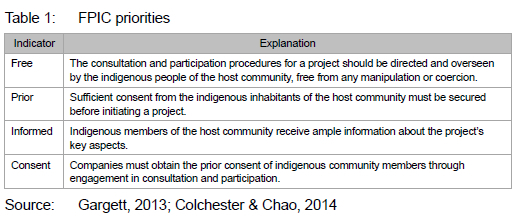
FPIC is designed to ensure that indigenous communities are consulted and involved before the start of any project on their ancestral lands or the use of resources in their territory (Colchester & Chao, 2014: 9). It provides indigenous peoples with the right to self-determination and self-governance in both national and local government discussions regarding developments that affect their livelihoods and resources (Colchester & Chao, 2014: 9). Table 1 details the core components of FPIC and illustrates how each component contributes to effective community engagement.
3.3.3 Social licence to operate (SLO)
Sustainable mining projects depend not only on regular geological evaluations, but also on economic, technical, financial, and legal factors. Within this framework, prospective mining operations must secure broad support and approval from the host mining community to maintain their SLO (Dalupan, 2015: 6). The Australian Minerals Industry Framework for Sustainable Development defines the concept as an unwritten social contract. Unless a company earns that licence and maintains it based on good performance on the ground, and community trust, there will undoubtedly be negative implications. Communities may seek to block project developments; employees may choose to work for a company that is a better corporate citizen, and projects may be subject to ongoing legal challenges, even after regulatory permits have been obtained, potentially halting project development (Dalupan, 2015: 6).
Given the definition, even after a company secures government approval, it still requires "social acceptance" to carry out its operations in the host community. Hence, when going into consultation, the question should not be how to get "social acceptance right", but rather how to get "regional development right" (Dyer, 2023:48). Although a company gains legal authorisation to start or expand operations from a government department (de Zeeuw & Kuschminder, 2016: 10-12), SLO signifies the social acceptance obtained from stakeholders and interest groups impacted by industrial activities (Gehman, Lefsrud & Fast, 2017: 309).
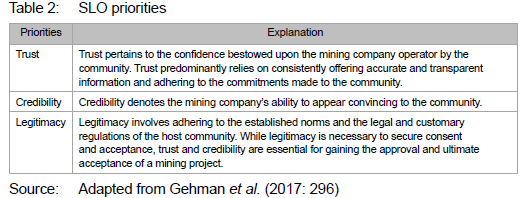
The SLO depends on the community's perception of an organisation's credibility, reliability, and acceptance of its operations, rather than being established through formal agreements, approvals or licences (Gehman et al., 2017:296). Achieving SLO involves building relationships and establishing trust and respect between organisations and their stakeholders, especially the host community that is often facilitated through community engagement (Dalupan, 2015: 4). SLO is achieved when a company secures and maintains widespread acceptance and approval from local and/or national stakeholders, including community members, traditional leaders, and sometimes NGOs for its projects or operations (Dalupan, 2015: 4). Gehman et al. (2017: 296) emphasise that the essential components for a company to attain SLO successfully include trust, credibility, and legitimacy, all of which must be established with stakeholders.
Table 2 explains the priorities associated with obtaining and maintaining a SLO, particularly emphasising the role of community engagement and the relationship with host communities.
Practical examples demonstrate how effective community engagement transcends the concept of a social licence, evolving into a legal licence through concrete actions such as its incorporation into international legislation, policy, and principles. These highlight the significance of community engagement as a protective measure for indigenous land rights in mining areas. In essence, the preceding paragraphs illustrated the concept of community engagement across the practical, policy, and legislative dimensions.
In dualist states, international law instruments entered into by the state do not automatically become part of the state's legal sources and become applicable only after being domesticated through domestic statutes and legislative processes (Mutubwa, 2019: 28-29). The next section discusses how these principles of community engagement have been integrated into the South African legal system to protect indigenous land rights.
3.4 Customary land rights protection in South Africa
3.4.1 Constitutional and legislative frameworks
While mineral rights were not separated from the land in South Africa, they remained an integral part thereof and belonged to the landowner (Van der Vyver, 2012: 127). Nonetheless, landowners' ownership of the minerals was later abolished, as section 3(1) of the MPRDA, 28 of 2002, now proclaims: "Mineral and petroleum resources are the common heritage of all the people of South Africa and the State is the custodian thereof." Under the MPRDA, 28 of 2002, minerals embedded in customary lands are ceded from land rights and entrusted to the hands of the state on behalf of the people. This right allows the state, as a custodian of mineral resources, to grant mining permits without the prior consent of the host community.2Section 1.3.6.1 of the White Paper on MMPSA of 1998 restates the position that the South African government does not support the existing dual system of state and private ownership of mineral rights. The section outlines the government's long-term goal: to ensure that all mineral rights are vested in the State, thus benefitting the entire population of South Africa. It also clarifies that state-owned mineral rights will not be transferred or sold. In pursuit of the objective outlined in section 1.3.6.1, section 1.3.6.2 of the White Paper provides a transitional arrangement for developing a new system for granting access to mineral rights. Under this new system, the right to prospect and mine for all minerals will vest in the State.
However, the Constitution calls for the need to recognise and observe the land rights of communities, the restitution of rights dispossessed under the historically imbalanced legislative regime, and the promotion of communal land tenure rights (Smith, Nindi & Bechaus, 2011:2). Section 25(6) of the Constitution provides that a person or community, whose tenure of land is legally insecure because of past racially discriminatory laws or practices, is entitled, as determined by an Act of Parliament, to receive either legally secure tenure or an equivalent form of redress. This provision ensures that individuals or groups who have been disadvantaged by historical injustices in land allocation and ownership are granted a remedy. In addition, section 7 of the Constitution obliges the state to "respect, protect, promote, and fulfil" the rights enshrined in the Bill of Rights, including the right to security of tenure for individuals whose tenure has been rendered insecure, due to past racially discriminatory laws or practices.
In support, section 3 of the EA, 73 of 1975, permits the expropriation of land. It is still subject to compensation for the attainment of the objects of a given Act. Relatedly, the PIEUOLA, 19 of 1998, prohibits illegal evictions from land and provides recourse for affected parties.
The legal system of South Africa duly recognises customary law as a legitimate source of law in terms of the Constitution, and it follows that any dispossession of communal land should require community consent under customary law (Smith et al., 2011: 2). However, the constitutional recognition of customary rights does not exist in a vacuum. Section 39(3) of the South African Constitution stipulates that the provisions of customary law must conform to the principles in the Bill of Rights. Moreover, section 211(3) of the South African Constitution states that customary law can be applied by the courts only when that law is applicable, and subject to the Constitution and any legislation that explicitly deals with it.
The IPILRA, 31 of 1996, addresses the security of tenure for informal land rights. According to section 2(3) of IPILRA, 31 of 1996, any individual who loses an informal land right, due to dispossession, must receive adequate compensation. The TLGFA, 41 of 2003, establishes a comprehensive framework for the recognition and formalisation of traditional communities, and for defining the roles and responsibilities of traditional leaders. This legislation is crucial for integrating traditional governance structures in the broader legal and administrative systems. The TLGFA, 41 of 2003, sets out a clear process for recognising traditional communities. According to section 2(1) of the TLGFA, 41 of 2003, a community can be officially recognised as a traditional community if it adheres to a system of traditional leadership based on its cultural customs and practices and follows a system of customary law. This recognition ensures that traditional communities receive formal acknowledgement and protection under the law, allowing them to maintain their cultural heritage and governance practices.
The TLGFA, 41 of 2003, mandates that traditional councils play an active role in the municipal planning process. Specifically, section 4(1) of the TLGFA, 41 of 2003, emphasises that traditional councils are involved in facilitating their community's participation in the development or amendment of the municipality's integrated development plan. This involvement ensures that the needs and perspectives of traditional communities are considered in municipal planning and decision-making processes, promoting inclusive and culturally sensitive development.
The MPRDA, 28 of 2002, reads with regulations and guidelines on consultation and provides for an extensive consultation process with landowners, lawful occupiers, as well as interested and affected parties (IAPs), before a prospecting right, mining right or mining permit is granted (MCRG, 2019). The MPRDA, 28 of 2002, encourages applicants to inform and engage landowners, legitimate occupants, as well as interested and impacted parties regarding any proposed development. The outcomes of these consultations are to be submitted as part of the application process (MCRG, 2019). The consultation process entails meaningful engagement with landowners, lawful occupiers, as well as IAPs regarding the impacts the proposed project will have on their rights to use and their enjoyment of the land. It should also address matters relating to resettlement. In the context of this article, one of the most relevant provisions of the MPRDA, 28 of 2002, is section 5(4), which stipulates that "no person may prospect for or remove, mine, conduct technical co-operation operations, reconnaissance operations, explore for and produce any mineral or petroleum or commence with any work incidental thereto on any area without-(c) notifying and consulting with the landowner or lawful occupier of the land in question."
While the MPRDA, 28 of 2002, grants the community only a consultative right under section 5(4), the IPILRA of 1996 affords the community a consensual right in situations where IPILRA, 31 of 1996, applies and in cases of customary land tenure.
The MSA, 32 of 2000, is among the laws mandating public participation and regulating land tenure. The Act aims to provide communities with adequate legal protection regarding their land and ensure recourse in cases of arbitrary land deprivation (MCRG, 2019). Section 16(1) of the MSA, 32 of 2000, requires municipalities to cultivate a governance culture that combines formal representative government with participatory governance. To do this, municipalities must establish conditions that promote active community involvement in municipal affairs, including building the capacity of both the local community and municipal staff to support such participation. Section 17(1) clarifies that community involvement in municipal matters should be facilitated through a political structure established under the MSA, 32 of 2000. Section 17(2) also mandates that municipalities create mechanisms, processes, and procedures to support community participation. This includes organising consultative meetings with locally recognised community organisations and, where relevant, traditional authorities, and ensuring that the community is kept informed.
Section 18(1) of the MSA, 32 of 2000, further obliges municipalities to inform their communities about the available mechanisms, processes, and procedures for encouraging and supporting participation. This communication must address areas where participation is expected, the rights and responsibilities of community members, and details regarding municipal governance, management, and development. In addition, section 22(1) authorises the Minister to issue regulations or guidelines that enhance community participation in municipal governance. Section 28(2) requires municipalities to engage the local community through the established mechanisms, processes, and procedures outlined in Chapter 4 before adopting any new processes. Section 29(1) further requires that the process for drafting a municipality's integrated development plan, including its review and adoption, must include community involvement. This includes consulting the community about its development needs and priorities and involving other stakeholders, including traditional authorities, in the planning process.
Section 42 of the MSA, 32 of 2000, mandates that municipalities engage the local community in developing, implementing, and reviewing the municipality's performance management system through mechanisms, processes, and procedures established under Chapter 4. The community must have a role in setting key performance indicators and targets for the municipality. Section 55(1) of the MSA, 32 of 2000, stipulates that the municipal manager, as the head of administration, is responsible and accountable, under the policy guidance of the municipal council, for establishing an efficient, effective, and accountable administration. This administration must carry out the municipality's integrated development plan as per Chapter 5, operate according to the performance management system detailed in Chapter 6, and be responsive to the community's needs for participation in municipal affairs. The municipal manager is also responsible for facilitating community involvement in these matters.
Section 80(2) of the MSA, 32 of 2000, indicates that, before a municipality enters into a service delivery agreement for a basic municipal service, it must create a mechanism and programme for community consultation and information dissemination about the agreement. The details of the agreement must be communicated to the local community via the media. Section 85(2) of MSA, 32 of 2000, adds that, prior to creating an internal municipal service district, the municipality must consult the local community on aspects such as the proposed district boundaries, the nature of the municipal service to be provided, the financing method, and the service-provision mechanism. The municipality must also obtain the consent of the majority of community members in the proposed service district, who will be required to contribute to the service provision.
The SPLUMA, 16 of 2013, is one of the laws that mandate public participation and regulate land tenure. It provides communities with robust legal protection over their land and ensures recourse in cases of arbitrary land deprivation (MCRG, 2019). According to section 7 of SPLUMA, 16 of 2013, the principle of good administration mandates that the preparation and amendment of spatial plans, policies, land-use schemes and development application procedures include transparent public participation processes. These allow all parties to provide input on matters affecting them and apply to spatial planning, land development, and land-use management. Section 12(1) requires national and provincial governments and all municipalities to prepare spatial development frameworks that consider and, where necessary, incorporate significant public engagement outcomes. This includes direct participation through public meetings, exhibitions, debates, media discourses, and other forums that facilitate such involvement.
Section 15 of SPLUMA, 16 of 2013, stipulates that a municipality may amend its land-use scheme after public consultation if the amendment is in the public interest, advances or benefits a disadvantaged community, or further supports the municipality's vision and development goals. Regarding land-use scheme amendments and rezoning, section 28(1) allows a municipality to amend its land-use scheme by rezoning land as necessary to achieve the development goals and objectives of the municipal spatial development framework. However, section 28(2) requires a public participation process to ensure that affected parties can make representations, object to, or appeal the decision.
Section 24(1) of SPLUMA, 16 of 2013, mandates that a municipality must, after public consultation, adopt and approve a single land-use scheme for its entire area within five years from the commencement of SPLUMA, 16 of 2013. Section 26(5) allows for amendments to the land-use scheme after public consultation if such amendments serve the public interest, advance or benefit a disadvantaged community, or further the municipality's development goals.
Section 52(6) requires the Minister to prescribe criteria for implementing certain powers or functions under SPLUMA, 16 of 2013, including the types, scale, and nature of land-development applications affecting the national interest, and measures to guide Municipal Planning Tribunals, municipalities, and parties involved in land-development applications.
Section 54(1) of SPLUMA, 16 of 2013, allows the Minister, after public consultation, to make regulations consistent with SPLUMA, 16 of 2013, prescribing matters related to national norms and standards, policies and directives on spatial development planning, land-use management, and land development.
3.4.2 Policy frameworks
As part of the transitional arrangement outlined in section 1.3.6.2 of the White Paper on MMPSA of 1998 in pursuit of the objective in section 1.3.6.1, the government will develop detailed legislative proposals for a new system of access to all mineral rights. These proposals will include provisions for the payment of prospecting fees or royalties by the holders of prospecting or mining licences to the registered holders of mineral rights. The State will determine these fees or royalties after consulting with the registered holders of the mineral rights, using fees and royalties payable to the State as a guideline. In addition, the proposals will include provisions for the payment of surface rentals by the holders of prospecting or mining licences to the registered landowners, with the rental amounts determined by the State after consultation with the landowners.
In the context of government policy, section 4.4 of the White Paper on MMPSA of 1998 requires the government to proactively ensure fair and effective consultation with all IAPs, facilitating public involvement in decision-making. It mandates adherence to the audi alteram partem principle (hearing both sides) in all decision-making processes that must also allow for appeals. Access to information must align with constitutional standards. In addition, mining companies are obliged to adhere to local development goals, spatial planning, and IDP in the municipalities where they operate. They are also encouraged to foster social engagement by considering the needs of local communities in their operations.
Section 6.3 of the White Paper on MMPSA of 1998 also emphasises the importance of stakeholder consultation. It notes that, for the mineral industry to effectively contribute to economic growth and foreign exchange earnings, strong cooperation between the government, labour, and the industry is essential. This cooperation can be achieved only if policy formulation, management, and regulation occur in a transparent manner and with close consultation with industry stakeholders. Section 6.1.4 of the White Paper underscores that, during the establishment of mining operations, the mining company must engage with the affected community, while considering local economic development needs and IDPs.
The preamble of the BBSEECMNI of 2018 emphasises that colonial rule and apartheid policies systematically prevented the vast majority of South Africans from owning production resources and participating fully in the mainstream economy. The sector's ongoing endorsement and implementation of discriminatory policies have exacerbated significant inequalities, particularly in the mining industry itself. The review of the BBSEECMNI of 2018 recognises that transformation and competitiveness are interdependent. Consequently, the updated BBSEECMNI of 2018 seeks to resolve ambiguities and provide regulatory clarity, by introducing new definitions, terms, and targets that align with other legislation. This alignment aims to ensure the meaningful participation of historically disadvantaged persons, in line with the objectives of the MPRDA, 28 of 2002. The BBSEECMNI of 2018 defines 'effective ownership' as the meaningful participation of historically disadvantaged persons. It acknowledges these individuals, including host communities, as vital partners in achieving substantial economic participation.
Section 2.1 of the BBSEECMNI of 2018 mandates that, in order to advance meaningful economic participation, integrate historically disadvantaged persons into the mainstream economy, and ensure effective ownership of the country's mineral resources, mining rights holders must provide equity equivalent benefits to host communities. This requires consulting with relevant municipalities, host communities, traditional authorities, and other affected stakeholders to determine the community's development needs.
Section 2.5, titled "Community Development", asserts that mining communities are integral to mining development, requiring a balance between mining operations and the socio-economic needs of these communities. Mining rights holders must significantly contribute to mine community development, focusing on the impact and scale in mine communities and adhering to the principles of the social licence to operate. Section 2.5.1 further mandates that mining rights holders must, in consultation with relevant municipalities, mine communities, traditional authorities, and affected stakeholders, identify developmental priorities for these communities. These priorities must be incorporated into the prescribed and approved social and labour plan of the mining rights holder. Section 2.1.4.1.7 requires that an approved host community development programme be published in at least two languages commonly used in the host community.
A notable policy document that upholds indigenous land rights through community engagement is the MCRG of 2019 that provides guidelines to be applied by an applicant or a holder of a prospecting right, mining right or mining permit when an application such as a prospecting right, mining right or mining permit will affect the resettlement of landowners, lawful occupiers, holders of informal and communal land rights, mine communities, and host communities. The most relevant sections in the remit of this study are as follows:
5.1 The following fundamental principles shall be considered: (a) Meaningful consultation: an applicant or a holder of a prospecting right, mining right or mining permit must consult meaningfully with landowners, lawful occupiers, interested and affected parties, holders of informal and communal land rights, mine communities and host communities.
7.1 An applicant or a holder of a prospecting right, mining right or a mining permit shall: 7.1.1 Provide for the opportunity for landowners, lawful occupiers, interested and affected parties, holders of informal and communal land rights, mine communities, and host communities to comment and obtain clear, accurate and understandable information about all the impact of the proposed mining activity or implications of a decision on resettlement.
The GRML acknowledges that rehabilitation objectives should currently align with national and regional IDPs that may not always reflect local community wishes. However, these objectives must align with the Environmental Management Plan (EMP) and Closure Plan commitments, ensuring sustainable post-mining land use. Consensus on these commitments must be achieved through a public participation process before mining permission is granted. Further, planning must be conducted as an iterative process, beginning with initial outlines based on the mine's assessment of likely impacts and proposed mitigation measures. These initial outlines must be reviewed in light of feedback from IAPs, potentially requiring multiple modifications to the original plan. lAPs are identified through the public participation process that is central to the legal authorisation process. The concerns of these parties and authorities, as identified in the public participation process, must be considered by the mine planner in collaboration with a rehabilitation specialist. Section 1.2 of the GRML addresses the legal authorisation process for obtaining a mining right or permit that is the formal method whereby the mine proponent secures acceptance of the mining activity plan from the IAPs and the government. The authorisation process should incorporate the concerns of the IAPs and authorities identified through the public participation process as part of the scoping process.
Section 2.1 of the DRHLCSMI, 2019 emphasises the development of socially, physically, and economically integrated housing in mine communities. It stipulates that, following consultation with relevant stakeholders, a rights holder must acquire land in close proximity to the mine operations and plan the housing needs to support a compact, integrated, and mixed land-use environment.
The RSLPG aims to support applicants for mining and production rights in drafting the necessary social and labour plans as specified in the MPRDA, 28 of 2002. As per section 42(1) of the MPRDA, 28 of 2002, the submission of a social and labour plan (SLP) is a compulsory requirement for securing mining or production rights. The SLP requires applicants to develop and implement a range of initiatives, including a human resources development programme (HRDP), a mine community development plan (MCDP), a housing and living conditions plan (HLCP), an employment equity plan (EEP), and strategies to safeguard jobs and manage downscaling or closure.
Section 2 of the RSLPG underscores that the EEP is designed to promote diversity and ensure the participation of historically disadvantaged South Africans (HDSA) in all decision-making roles and key occupational categories in the mining sector. It mandates that each mining company must achieve at least 40 per cent HDSA demographic representation.
Section 3 of the RSLPG outlines that the main goal of mine community development is to significantly contribute to community growth, both in scale and impact, in accordance with the principles of maintaining a social licence to operate. The mine or production operation must engage in consultation and cooperation in the creation and review of the IDPs of the mine communities. Furthermore, the operation must coordinate with other economic development frameworks, such as the Provincial Growth and Development Strategy (PGDS), the National Spatial Development Strategy (NSDS), National priorities, and other relevant frameworks. The mine or production operation is required to develop a plan through consultation with the relevant communities and authorities that is aligned with the IDPs of the mine community.
Even though the policies discussed provide important frameworks for upholding indigenous rights, it is worth noting that policy documents are not legislation or subordinate legislation. This means that they cannot create legally binding obligations on mining rights holders. This was exemplified in the case of Minerals Council of South Africa v Minister of Mineral Resources and Energy and Others (20341/19) [2021] ZAGPPHC 623; [2021] 4 All SA 836 (GP); 2022 (1) SA 535 (GP) (21 September 2021) that centred on the legal status and enforceability of the 2018 Mining Charter, also known as Mining Charter III. On 21 September 2021, a full bench of the Gauteng Division of the High Court delivered a unanimous judgment. They declared that the Charter's provisions, including sanctions for non-compliance and various procurement and empowerment targets, were not legally enforceable.
3.4.3 South African case law
3.4.3.1
Bengwenyama Minerals (Pty) Ltd and Others v Genorah Resources (Pty) Ltd and Others (CCT 39/10) [2010] ZACC 26; 2011 (4) SA 113 (CC); 2011 (3) BCLR 229 (CC) (30 November 2010)The Constitutional Court of South Africa addressed crucial issues concerning the rights of indigenous communities in the context of mining activities. This landmark case highlighted the importance of community engagement in upholding indigenous land rights. The court ruled that proper consultation and meaningful participation of the local community are mandatory before granting mining rights, emphasising that such engagement is not only a statutory requirement, but also a constitutional imperative. This decision underscored the role of community engagement as a protective measure for indigenous land rights in the South African mining sector, ensuring that the interests and concerns of indigenous peoples are adequately considered in mining operations.
3.4.3.2
Maledu and Others v Itereleng Bakgatla Mineral Resources (Pty) Limited and Another (CCT265/17) [2018] ZACC 41; 2019 (1) BCLR 53 (CC); 2019 (2) SA 1 (CC) (25 October 2018)The Constitutional Court of South Africa reaffirmed the necessity of community engagement in the context of mining rights and indigenous land rights. The court ruled in favour of the Maledu community, emphasising that their consent and meaningful consultation were required before any mining activities could proceed on their land. This case highlighted the critical role of community engagement in protecting the rights and interests of indigenous communities, ensuring that they have a say in decisions that affect their land and livelihoods. The judgment reinforced the principle that mining companies must engage with local communities transparently and respectfully, recognising their rights and adhering to constitutional and legislative requirements.
3.4.3.3
Baleni and Others v Minister of Mineral Resources and Others (73768/2016) [2018] ZAGPPHC 829; [2019]1 All SA 358 (GP); 2019 (2) SA 453 (GP) (22 November 2018)
The High Court of Gauteng delivered a landmark judgment that reinforced the necessity of community consent and engagement in mining operations. The case involved the Xolobeni community that challenged the granting of mining rights on its ancestral land without its consent. The court ruled that the community's informal land rights, protected under the IPILRA of 1996, required its full and informed consent before any mining activities could commence. This decision emphasised that mere consultation was insufficient; active consent from the affected community was mandatory. The judgment highlighted the crucial role of community engagement in protecting Indigenous land rights, ensuring that its autonomy and connection to its land are respected and upheld in the face of mining interests. The case set a significant precedent for the protection of indigenous communities against the involuntary dispossession of their land by mining companies.
3.4.3.4
Sustaining the Wild Coast NPC and Others v Minister of Mineral Resources and Energy and Others (3491/2021) [2022] ZAECMKHC 55; 2022 (6) SA 589 (ECMk) (1 September 2022)The Eastern Cape High Court examined the legality of granting mining rights along South Africa's Wild Coast without adequate community consultation and environmental consideration. The case was brought forward by a community organisation and other stakeholders who argued that the mining activities threatened the environmental integrity and the rights of the local communities.
The court ruled in favour of the applicants, emphasising the necessity for thorough and meaningful engagement with the affected communities. The judgment underscored that any mining activities must comply with both environmental laws and community consultation requirements, aligning with the principles of sustainable development. The ruling reiterated that the voices of local communities must be heard and considered in the decision-making process, ensuring that their rights and interests are protected against potentially harmful mining operations. Furthermore, the case reinforced the critical role of community engagement in safeguarding environmental and indigenous rights, highlighting that the approval of mining projects must involve transparent and inclusive processes that respect the rights of local communities and the ecological balance of the area.
4. DISCUSSION AND SIGNIFICANCE OF THE MAIN FINDINGS
This review demonstrates that South Africa has taken significant steps to address the insecurity of indigenous land rights, by embedding these rights in its constitutional, legislative, and policy frameworks, in alignment with international laws and principles. As mentioned earlier, indigenous land rights are recognised at the international level through various articles of the UNDRIP (Articles 10; 11(2); 18; 19; 26(1); 26(2); 26(3); 28(1); 29(1); 29(2); 32(1); 32(2)) and the ILO's Indigenous and Tribal Peoples Convention, 169 of 1989 (Articles 6(1a) and 6(2)), along with principles such as FPIC and SLO.
Domestically, the 1996 Constitution of South Africa, specifically sections 25(6) and 7, acknowledges the right to tenure security. Sections 39(3) and 211(3) further recognise customary law, provided it aligns with the Constitution. Several key legislative provisions protect indigenous land rights through community engagement. For instance, section 3 of the EA, 73 of 1975, permits the expropriation of land, subject to compensation, for achieving the objectives of a given act. The PIEUOLA, 19 of 1998, prohibits illegal evictions and provides recourse for affected parties.
Informal land rights are protected under section 2(3) of the IPILRA, 31 of 1996, and sections 2(1) and 4(1) of the Traditional Leadership and Governance Framework Act (TLGFA), 41 of 2003, through community involvement. In addition, section 5(4) of the MPRDA, 28 of 2002, and section 5(4) of the IPILRA protect indigenous land rights through community engagement. Moreover, various sections of the MSA, 32 of 2000, - including sections 16(1), 17(1), 17(2), 18(1), 22(1), 28(2), 29(1), 42, 55(1), 80(2), and 85(2) - ensure indigenous land rights through community consultation. Likewise, sections 7, 12(1), 15, 28(1), 28(2), 24(1), 26(5), 52(6), and 54(1) of the SPLUMA, 16 of 2013, safeguard indigenous land rights through community engagement. The protection of indigenous land rights through community engagement is further reinforced by South African policies, including the White Paper on MMPSA of 1998, the BBSEECMNI of 2018, the MCRG of 2019, the GRML, the DRHLCSMI of 2019, and the RSLPG. These policies collectively strengthen the framework for safeguarding indigenous land rights through active community engagement and consultation.
The protection of indigenous land rights in South Africa goes beyond policy and legislative frameworks; it also involves the enforcement of these rights that often face resistance. This is evident in several notable legal cases, in section 3.4.3, which underscore the ongoing legal battles to uphold and enforce indigenous land rights in the face of challenges.
The findings have implications for indigenous land rights, as South African legislative and policy frameworks provide for the following:
• Empowerment and autonomy: Indigenous landholders in South Africa receive formal recognition and legal validation of their customary land rights, enabling them to exercise greater control over their land and resources. This recognition ensures that their traditional practices and governance systems are respected and integrated into the broader legal framework.
• Strengthened legal protections: Customary land rights are formally recognised within constitutional and legal frameworks, ensuring that these rights are not only acknowledged, but also actively protected by law. This legal support empowers indigenous communities to assert their rights more confidently against external pressures, particularly from mining companies. In addition, it provides a legal recourse in cases where their rights are threatened or violated.
• Enhanced community engagement: In the context of the South African legislative frameworks and case laws discussed, the enforcement of indigenous land rights requires meaningful community engagement. It suffices to say that indigenous landholders must actively participate in decision-making processes that affect their land. The implication is that any development must involve comprehensive consultation with the community to ensure that its views and concerns are heard and addressed appropriately. Such engagement fosters a more inclusive approach to land management and development, ensuring that indigenous perspectives and needs are integrated into project planning and execution.
• Compliance with international standards: Protecting indigenous land rights through community engagement, as demonstrated in the legislation and case law, aligns South Africa with international human rights standards and obligations such as those outlined in the UNDRIP. This compliance enhances South Africa's reputation and commitment to upholding indigenous rights globally.
• Equitable development outcomes: The recognition and enforcement of customary land rights through community engagement can lead to a more equitable development outcome. In the process of meaningful community engagement, indigenous communities, particularly those in mining regions, can negotiate for fair compensation, improved resettlement conditions, and enhanced socio-economic prospects. This approach helps mitigate the negative impacts of mining such as displacement, ensuring that development benefits are distributed more equitably among all stakeholders. In addition, equitable development contributes to social stability and supports long-term economic sustainability.
• Conflict prevention and resolution: Through meaningful consultation, this can help prevent conflicts between mining companies and indigenous communities. By ensuring that communities are involved in planning and decision-making processes, potential disputes can be addressed proactively. Moreover, having legal frameworks in place provides a structured basis for resolving conflicts should they arise, ensuring that indigenous land rights are respected and upheld.
• Empowerment and self-determination: This allows indigenous communities to exercise greater control over their land and resources, enabling them to make decisions that are in tandem with their cultural values and long-term interests. This empowerment fosters a sense of ownership and responsibility that is crucial for the sustainable management of natural resources and the preservation of cultural heritage.
• Policy and legislative reforms: This includes updating the existing laws and policies to better protect indigenous land rights and developing new ones that support sustainable and inclusive development practices. Legislative reforms should aim to close any gaps that may be exploited to undermine indigenous land rights, ensuring comprehensive protection across all levels of governance.
• Sustainable land use: Indigenous communities often possess traditional knowledge and practices that contribute to sustainable land management. Recognising these rights helps preserve such practices and promotes environmental sustainability. Sustainable land use practices not only protect the environment, but also enhance the resilience of indigenous communities to climate change and other environmental challenges.
The findings have implications for the town planning industry, as recognition of indigenous land rights means that the industry should provide for the following:
• Enhanced community participation: The constitutional and legislative frameworks that guarantee indigenous land rights necessitate the inclusion of indigenous land rights holders in town planning processes in South Africa. This involves conducting consultations, seeking input, and incorporating the views and rights of indigenous communities into planning decisions. Ensuring their perspectives are respected and integrated into development plans is essential for both ethical and legal compliance.
• Legal compliance and protection: With indigenous land rights recognised under South African constitutional and legislative frameworks, it is incumbent on planning authorities in South Africa to incorporate those rights into the planning process. This includes conducting thorough due diligence to identify any customary land claims and ensuring that development plans do not infringe upon these rights. Legal safeguards must be in place to prevent the displacement or unfair treatment of indigenous populations. Such compliance would ensure that the rights of indigenous communities are upheld and that any development projects proceed within the bounds of the law.
• Policy revisions and implementation: Policy adjustments are required to align town planning practices with the recognition of customary land rights in South Africa. This involves revising current policies to better reflect the constitutional and legal acknowledgement of these rights and developing new policies that promote community engagement and safeguard indigenous land interests. These policies should aim to support the active involvement of indigenous communities in the planning process, ensuring that their land rights are recognised and respected.
• Sustainable and inclusive development: Town planning should adopt a more inclusive approach that considers the social, cultural, and economic impacts on indigenous communities. Sustainable development principles should guide planning to ensure that the benefits of development are shared equitably and do not infringe on indigenous land rights, promoting fairness and equity.
• Conflict-resolution mechanisms: Given the potential for conflicts arising from land use and development, effective mechanisms must be established to resolve disputes involving customary land rights. Town planning authorities should collaborate closely with legal entities to provide mediation and conflict-resolution services that are accessible to indigenous communities. These mechanisms should be designed to address conflicts promptly and fairly, ensuring that disputes are resolved in a manner that respects the rights and interests of indigenous populations.
• Monitoring and enforcement: The continuous monitoring and enforcement of legal protections for customary land rights are essential. Town planning authorities should establish mechanisms to track compliance with the legal requirements and ensure that any violations are promptly addressed. Regular audits, community feedback systems, and transparent reporting practices could help maintain accountability and protect indigenous land rights effectively.
5. CONCLUSION
Historically, indigenous communities have experienced land dispossession, environmental degradation, and socio-economic disparities, due to mining activities. Consequently, through its legislative and policy instruments, South Africa acknowledges these historical injustices and commits to a future where indigenous groups actively participate in decision-making and benefit from the wealth generated by mining operations on their ancestral lands. The article emphasises that the South African legal and policy frameworks on community engagement, including the 1996 Constitution, the MPRDA of 2002, the IPILRA of 1996, and the MCRG of 2019, recognise indigenous land rights. These frameworks align with international principles, particularly FPIC, SLO, UNDRIP, and the ILO conventions that are essential for upholding indigenous rights. The interaction between international and national legislation and policies on community engagement to protect indigenous land rights represents a shift towards broader inclusivity. Furthermore, the article reveals that, in South Africa, protecting indigenous land rights through community engagement extends beyond policy and legislative frameworks to include practical action such as implementation in courts of law.
The protection of indigenous land rights through community engagement in constitutional, legal, policy, and international contexts has a profound impact on indigenous landholders in South Africa. These implications include empowerment and autonomy, strengthened legal protection, enhanced community engagement, compliance with international standards, the promotion of equitable development outcomes, conflict prevention, the empowerment of indigenous communities, necessary policy reforms, and the encouragement of sustainable land use. Collectively, these impacts foster a more just and inclusive approach to land rights and development, ensuring that the voices and rights of indigenous populations are respected and integrated into the broader development agenda.
South African legislation and policies are often considered to be on a par with global standards, as reflected in the Constitution, 1996, and key legislation such as the MPRDA, 28 of 2002; the EA, 73 of 1975; the PIEUOLA, 19 of 1998; the IPILRA, 31 of 1996; the TLGFA, 41 of 2003; the MSA, 32 of 2000, and the SPLUMA, 16 of 2013. These laws provide a robust legal framework for safeguarding indigenous land rights. Complementing this legislation are policies such as the White Paper on MMPSA of 1998, the BBSEECMNI of 2018, the MCRG of 2019, the GRML, the DRHLCSMI of 2019, and the RSLPG that further strengthen the protection of these rights through community engagement and consultation. While the many instances of case law discussed in this study highlight this protection, the implementation and "follow-through" often fall short.
Protecting customary land rights through community engagement requires a transformative approach to town planning, one that prioritises increased community involvement, strict legal compliance, policy coherence, as well as a strong focus on sustainable and inclusive development. This approach is essential to ensuring that planning processes not only respect, but also integrate the rights, customs, and perspectives of indigenous communities. Doing so would promote more equitable and just outcomes, ensuring that all stakeholders - especially those traditionally marginalised - are actively involved in decisions that affect their lands and livelihoods. This transformative approach is particularly relevant in regions in the Global South where indigenous land tenure systems are prevalent. In these areas, the historical and cultural significance of land is deeply intertwined with community identity and survival. However, these communities often face challenges in securing their land rights, due to pressures from development, urbanisation, and external interests.
For instance, customary land tenure systems are widespread in sub-Saharan Africa, and the integration of these systems into national legal frameworks varies significantly across countries. While some nations have made strides in recognising and formalising customary land rights, others still grapple with conflicts between customary practices and statutory laws. This tension can lead to situations where development projects such as mining or infrastructure projects encroach on indigenous land without adequate consultation or compensation.
Future studies could provide valuable insights, by exploring how different countries, especially in sub-Saharan Africa, have navigated these challenges. By examining case studies and best practice guidelines, researchers could assess how effectively these countries have integrated customary land rights into local legislation and town planning processes. Such studies could also identify gaps in the current approaches and suggest ways to strengthen the protection of indigenous land rights through community engagement.
Moreover, such studies could explore the role of international frameworks and principles such as the UNDRIP and the principle of FPIC and SLO in shaping national policies and practices. By understanding how these global standards are applied or adapted in different contexts, policymakers and planners could develop more effective strategies for protecting indigenous land rights and ensuring that development processes are both inclusive and equitable.
In conclusion, safeguarding customary land rights through community engagement is not simply a matter of legal reform; it is about transforming the entire approach to planning and development. By prioritising the voices and rights of indigenous communities, countries can create more just and sustainable outcomes, ultimately contributing to the broader goals of social justice and economic development in the Global South.
COMPETING INTERESTSThe authors have declared that no competing interest exists.
CREDIT STATEMENTBoth authors contributed equally to the development and writing of this article.
ACKNOWLEDGEMENT
The authors wish to express their gratitude to the National Research Foundation of South Africa (NRF) (Grant number 115581), for the financial support towards this research.
REFERENCES
-
ARKO-ADJEI, A. & AKROFI, E.O. 2019. Customary land tenure security: Tools and approaches in sub-Saharan Africa (a synthesis report). [Online]. Available at: https://unhabitat.org/sites/default/files/2021/09/customary-land-tenure-security-tools-and-approaches-in-sub-saharan-africa.pdf [Accessed: 18 January 2024].
» https://unhabitat.org/sites/default/files/2021/09/customary-land-tenure-security-tools-and-approaches-in-sub-saharan-africa.pdf -
BAINTON, N. 2020. Mining and indigenous peoples. In: Oxford research encyclopedia of anthropology. Oxford, UK: Oxford University Press, p. 35. https://doi.org/10.1093/acrefore/9780190854584.013.121
» https://doi.org/10.1093/acrefore/9780190854584.013.121 - BALENI AND OTHERS V MINISTER OF MINERAL RESOURCES AND OTHERS (73768/2016) [2018] ZAGPPHC 829; [2019] 1 All SA 358 (GP); 2019 (2) SA 453 (GP) (22 November 2018).
- BENGWENYAMA MINERALS (PTY) LTD AND OTHERS V GENORAH RESOURCES (PTY) LTD AND OTHERS (CCT 39/10) [2010] ZACC 26; 2011 (4) SA 113 (CC); 2011 (3) BCLR 229 (CC) (30 November 2010).
-
CENTRE FOR ENVIRONMENTAL RIGHTS. RSLPG (Revised Social and Labour Plan Guidelines). [Online]. Available at: https://cer.org.za/wp-content/uploads/2013/03/SLP-guidelines-2010.pdf [Accessed: 12 August 2024].
» https://cer.org.za/wp-content/uploads/2013/03/SLP-guidelines-2010.pdf -
CHAMBER OF MINES OF SOUTH AFRICA & COALTECH RESEARCH ASSOCIATION. 2007. GRML (Guidelines for the Rehabilitation of Mined Land). [Online]. Available at: https://coaltech.co.za/wp-content/uploads/2019/10/Task-12.1-Guideline-for-the-Rehabilitation-of-Mined-Land-2007.pdf [Accessed: 16 August 2024].
» https://coaltech.co.za/wp-content/uploads/2019/10/Task-12.1-Guideline-for-the-Rehabilitation-of-Mined-Land-2007.pdf - COLCHESTER, M. & CHAO, S. 2014. Respecting free, prior, and informed consent: Practical guidance for governments, companies, NGOs, indigenous peoples and local communities in relation to land acquisition. Food and Agriculture Organization of the United Nations.
-
DAI (DEVELOPMENT ALTERNATIVE INC.). [n.d.]. In sub-Saharan Africa, it's time to recognize customary land rights. [Online]. Available at: https://oecdcogito.blog/2024/08/09/indigenous-peoples-in-mining-regions-from-compensation-to-collaboration/ [Accessed: 15 October 2024].
» https://oecdcogito.blog/2024/08/09/indigenous-peoples-in-mining-regions-from-compensation-to-collaboration/ -
DALUPAN, C.G. 2015. Community agreements and mining: A new frontier for social impact investments. RTC Impact Fund and One Earth Future. https://doi.org/10.18289/OEF.2015.004
» https://doi.org/10.18289/OEF.2015.004 -
DEBRAH, A.A., MTEGHA, H. & CAWOOD, F. 2018. Social licence to operate and the granting of mineral rights in sub-Saharan Africa: Exploring tensions between communities, governments, and multi-national mining companies. Resources Policy, 56, pp. 95-103. https://doi.org/10.1016/j.resourpol.2018.02.008
» https://doi.org/10.1016/j.resourpol.2018.02.008 -
DE ZEEUW, J. & KUSCHMINDER, J. 2016. When oil, gas or mining arrives in your area: Practical guide for communities, civil society and local government on the social aspects of oil, gas and mining. Building flourishing communities, Cordaid. [Online]. Available at: https://landinvestments.org/resource/when-oil-gas-or-mining-arrives-your-area-practical-guide-communities-civil-society-and [Accessed: 15 July 2024].
» https://landinvestments.org/resource/when-oil-gas-or-mining-arrives-your-area-practical-guide-communities-civil-society-and -
DYER, A., AUSTRALIAN ENERGY INFRASTRUCTURE COMMISSIONER. 2023. Community engagement review report, on behalf of the Department of Climate Change, Energy, the Environment and Water, Canberra, 2 February 2024, CC BY 4.0. [Online]. Available at: https://www.dcceew.gov.au/sites/default/flles/documents/75979.pdf [Accessed: 18 January 2024].
» https://www.dcceew.gov.au/sites/default/flles/documents/75979.pdf -
FRANKS, D.M., DAVIS, R., BEBBINGTON, A.J., ALI, S.H., KEMP, D. & SCURRAH, M. 2014. Conflict translates environmental and social risk into business costs. Proceedings of the National Academy of Sciences, 111(21), pp. 7576-7581. https://doi.org/10.1073/pnas.1405135111
» https://doi.org/10.1073/pnas.1405135111 - GARGETT, A. 2013. The United Nations Declaration on the Rights of Indigenous Peoples: A manual for national human rights institutions. Asia Pacific Forum of National Human Rights Institutions.
-
GARNETT, S.T., BURGESS, N.D., FA, J.E., FERNÁNDEZ-LLAMAZARES, Á., MOLNÁR, Z., ROBINSON, C.J., WATSON, J.E., ZANDER, K.K., AUSTIN, B., BRONDIZIO, E.S. & COLLIER, N.F. 2018. A spatial overview of the global importance of indigenous lands for conservation. Nature Sustainability, 1(7), pp. 369-374. https://doi.org/10.1038/s41893-018-0100-6
» https://doi.org/10.1038/s41893-018-0100-6 -
GEHMAN, J., LEFSRUD, L.M. & FAST, S. 2017. Social license to operate: Legitimacy by another name? Canadian Public Administration, 60(2), pp. 293-317. https://doi.org/10.1111/capa.12218
» https://doi.org/10.1111/capa.12218 - GHANA GOVERNMENT. Constitution of the Republic of Ghana, 1992.
-
HERBERTSON, K., BALLESTEROS, A.R., GOODLAND, R. & MUNILLA, I. 2009. Breaking ground: Engaging communities in extractive and infrastructure projects. Washington DC: World Resources Institute. https://doi.org/10.1037/e587702011-001
» https://doi.org/10.1037/e587702011-001 -
HOLLEY, E.A. & MITCHAM, C. 2016. The Pebble Mine Dialogue: A case study in public engagement and the social license to operate. Resources Policy, 47, pp. 18-27. https://doi.org/10.1016/j.resourpol.2015.11.002
» https://doi.org/10.1016/j.resourpol.2015.11.002 -
HUB, G.I. & ACUITY, A. 2019. Inclusive infrastructure and social equity: Practical guidance for increasing the positive social outcomes of large infrastructure projects. [Online]. Available at: https://inclusiveinfra.gihub.org/. [Accessed: 19 August 2024].
» https://inclusiveinfra.gihub.org/ - ILO (INTERNATIONAL LABOUR ORGANIZATION). CEACR (Committee of Experts on the Application of Conventions and Recommendations) No. 169, General Observation, 2010.
-
ILO (INTERNATIONAL LABOUR ORGANIZATION). 2019. Implementing the ILO Indigenous and Tribal Peoples Convention No. 169: Towards an inclusive, sustainable and just future. [Online]. Available at: <https://www.ilo.org/sites/default/flles/wcmsp5/groups/public/@dgreports/@dcomm/@publ/documents/publication/wcms_735607.pdf> [Accessed: 18 January 2024].
» https://www.ilo.org/sites/default/flles/wcmsp5/groups/public/@dgreports/@dcomm/@publ/documents/publication/wcms_735607.pdf - MALEDU AND OTHERS V ITERELENG BAKGATLA MINERAL RESOURCES (PTY) LIMITED AND ANOTHER (CCT265/17) [2018] ZACC 41; 2019 (1) BCLR 53 (CC); 2019 (2) SA 1 (CC) (25 October 2018).
-
MILLER, S. 2021. Maori land in Aotearoa New Zealand: Changing landscapes of customary and freehold land. [Online]. Available at: <https://storymaps.arcgis.com/stories/227400ed45b74364b558ae6ce044af7e> [Accessed: 18 January 2024].
» https://storymaps.arcgis.com/stories/227400ed45b74364b558ae6ce044af7e - MINERALS COUNCIL OF SOUTH AFRICA V MINISTER OF MINERAL RESOURCES AND ENERGY AND OTHERS (20341/19) [2021] ZAGPPHC 623; [2021] 4 All SA 836 (GP); 2022 (1) SA 535 (GP) [21 September 2021].
- MUTUBWA, W. 2019. Monism or dualism: The dilemma in the application of international agreements under the South African Constitution. Journal of Conflict Management and Sustainable Development, 3(1), pp. 27-37.
-
NDULO, M.B. 2017. Legal pluralism, customary law and women's rights. Southern African Public Law, 32(1), pp. 1-21. https://doi.org/10.25159/2522-6800/3576
» https://doi.org/10.25159/2522-6800/3576 -
NEWMONT MINING CORPORATION. 2012. Annual Report. [Online]. Available at: https://s24.q4cdn.com/382246808/files/doc_financials/annual/2012-Annual-Report_v001_e75k8c.pdf [Accessed: 16 October 2024].
» https://s24.q4cdn.com/382246808/files/doc_financials/annual/2012-Annual-Report_v001_e75k8c.pdf - NIGERIA FEDERAL GOVERNMENT Constitution of the Republic of the Federal Republic of Nigeria, 1999.
- OLLENNU, N.A. 1962. Principles of customary land law in Ghana. Cambridge: Cambridge University Press.
- ORTEGA GIRONES, E., PUGACHEVSKY, A. & WALSER, G. 2009. Mineral rights cadastre: Promoting transparent access to mineral resources. Bretton Woods, NH: World Bank Group.
-
PENN STATE COLLEGE OF AGRICULTURE SCIENCES. [n.d.]. What is community engagement? [Online]. Available at: https://aese.psu.edu/research/centers/cecd/engagement-toolbox/engagement/what-is-community-engagement [Accessed: 2 September 2024].
» https://aese.psu.edu/research/centers/cecd/engagement-toolbox/engagement/what-is-community-engagement - QUAN, J., TAN, S. & TOULMIN, C. 2004. Land in Africa: Market asset or secure livelihood? London: Church House.
-
SCHEIDEL, A., FERNÁNDEZ-LLAMAZARES, Á., BARA, A.H., DEL BENE, D., DAVID-CHAVEZ, D.M. et al. 2023. Global impacts of extractive and industrial development projects on indigenous peoples' lifeways, lands, and rights. Science Advances, 9(23). https://doi.org/10.1126/sciadv.ade9557
» https://doi.org/10.1126/sciadv.ade9557 -
SEPAHA, P. 2023. Doctrinal and non-doctrinal research. Law Colloquy, 3 November 2023. [Online]. Available at: https://lawcolloquy.com/publications/blog/doctrinal-and-non-doctrinal-research-/269 [Accessed: 18 January 2024].
» https://lawcolloquy.com/publications/blog/doctrinal-and-non-doctrinal-research-/269 - SINGHAL, A.K. & MALIK, I. 2014. Doctrinal and socio-legal methods of research: Merits and demerits. Educational Research Journal, 2(7), pp. 252-256.
- SMITH, H., NINDI, S. & BECHAUS, G. 2011. Complex commons under threat of mining: The process for and content of community consent. Paper submitted for presentation to the 2011 IASC-FES Conference, Sustaining Commons, Sustaining our Future: Governance of the Commons, 10 January 2011, Hyderabad, India.
- SOHN, J., HERZ, S. & LA VINA, A. 2007. Development without conflict. Washington, DC: World Resources Institute.
- SOUTH AFRICA. 1975. EA (Expropriation Act), 63 of 1975. Pretoria: Government Printer.
- SOUTH AFRICA. 1996a. Constitution of the Republic of South Africa, Act 108 of 1996. Pretoria: Government Printer.
- SOUTH AFRICA. 1996b. IPILRA (Interim Protection of Informal Land Rights Act), 31 of 1996. Pretoria: Government Printer.
- SOUTH AFRICA. 1998a. PIEUOLA (Prevention of Illegal Eviction from and Unlawful Occupation of Land Act), 19 of 1998. Pretoria: Government Printer.
- SOUTH AFRICA. 1998b. MNPSA (White paper: A minerals and mining policy for South Africa). Pretoria: Government Printer.
- SOUTH AFRICA. 2000. MSA (Municipal Systems Act), 32 of 2000. Pretoria: Government Printer.
- SOUTH AFRICA. 2002. MPRDA (Mineral and Petroleum Resources Development Act), 28 of 2002. Pretoria: Government Printer.
- SOUTH AFRICA. 2003a. SPLUMA (Spatial Planning and Land Use Management Act), 16 of 2013. Pretoria: Government Printer.
- SOUTH AFRICA. 2003b. TLGFA (Traditional Leadership and Governance Framework Act), 41 of 2003. Pretoria: Government Printer.
- SOUTH AFRICA. 2018. BBSEECMNI (Broad-Based Socio-Economic Empowerment Charter for The Mining and Minerals Industry), Government Gazette, 41934, 27 September, Regulation no. 1002.
- SOUTH AFRICA. 2019a. DRHLCSSMI (Draft Reviewed Housing and Living Conditions Standard for the Mineral Industry), Government Gazette, 42326, 20 March, Regulation no. 449.
- SOUTH AFRICA. 2019b. MCRG (Mineral and Petroleum Resources Development Act: Mine Community Resettlement Guidelines), Government Gazette, 42884, 4 December, Regulation no. 1566.
- SUSTAINING THE WILD COAST NPC AND OTHERS V MINISTER OF MINERAL RESOURCES AND ENERGY AND OTHERS (3491/2021) [2022] ZAECMKHC 55; 2022 (6) SA 589 (ECMk) (1 September 2022).
-
TEEVAN, S. & CAMPBELL, J. 2024. Indigenous peoples in mining regions: From compensation to collaboration? [Online]. Available at: https://oecdcogito.blog/2024/08/09/indigenous-peoples-in-mining-regions-from-compensation-to-collaboration/ [Accessed: 16 October 2024].
» https://oecdcogito.blog/2024/08/09/indigenous-peoples-in-mining-regions-from-compensation-to-collaboration/ -
UNDRIP (UNITED NATIONS DECLARATION ON THE RIGHTS OF INDIGENOUS PEOPLES). [Online]. Available at: https://www.un.org/development/desa/indigenouspeoples/wp-content/uploads/sites/19/2018/11/UNDRIP_E_web.pdf [Accessed: 16 October 2024].
» https://www.un.org/development/desa/indigenouspeoples/wp-content/uploads/sites/19/2018/11/UNDRIP_E_web.pdf - UNDP & UNE (UNITED NATIONS DEVELOPMENT PROGRAMME & UNITED NATIONS ENVIRONMENT). 2018. Managing mining for sustainable development: A sourcebook. Bangkok: United Nations Development Programme.
- VAN DER VYVER, J.D. 2012. Nationalisation of mineral rights in South Africa. De Jure Law Journal, 45(1), pp. 125-142.
-
WANG, L., AWUAH-OFFEI, K., QUE, S. & YANG, W. 2016. Eliciting drivers of community perceptions of mining projects through effective community engagement. Sustainability, 8(7), article 658. https://doi.org/10.3390/su8070658
» https://doi.org/10.3390/su8070658 - WORLD BANK. 1992. Strategy for African mining. In: Africa Technical papers department series, technical paper 181. Mining Unit, Industry and Energy Division. Washington, DC: World Bank.
-
WORLD BANK GROUP. 2023. Indigenous Peoples. [Online]. Available at: https://www.worldbank.org/en/topic/indigenouspeoples#:~:text=Indigenous%20Peoples%20are%20distinct%20social,which%20they%20have%20been%20displaced [Accessed: 13 October 2024].
» https://www.worldbank.org/en/topic/indigenouspeoples#:~:text=Indigenous%20Peoples%20are%20distinct%20social,which%20they%20have%20been%20displaced - YEBOAH, E. & KAKRABA-AMPEH, M. 2016. Land investments, accountability and the law: Lessons from Ghana. London: International Institute for Environment and Development (IIED).
-
ZEMBE, S.M. & BARNES, N. 2023. Exploring community engagement challenges in the mining sector of South Africa. Indonesian Journal of Community Engagement, 9(1), pp. 53-59. https://doi.org/10.22146/jpkm.72217
» https://doi.org/10.22146/jpkm.72217
Peer reviewed and revised: October 2024
Published: December 2024
1 For instance, article 257 of the 1992 Constitution of the Republic of Ghana states that all minerals in their natural state, whether in or under land, rivers, streams, water courses, the exclusive economic zone, or the continental shelf, are the property of the Republic of Ghana and are vested in the President on behalf of and in trust for the people of Ghana. Section 44(3) of the Constitution of the Federal Republic of Nigeria, 1999 states that all mineral resources in their natural state, whether in or under land, rivers, streams, water courses, the exclusive economic zone, or the continental shelf, are the property of the Federal Republic of Nigeria and are vested in the President on behalf of and in trust for the people of Nigeria.
2 According to section 3(2)a of the MPRDA of 2002, the state as a custodian of the nation's mineral and petroleum resources may grant, issue, refuse, control, administer, and manage any reconnaissance permission, prospecting right, permission to remove, mining right, mining permit, retention permit, technical co-operation permit, reconnaissance permit, exploration right, and production right.