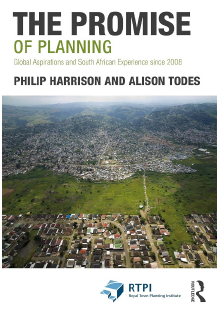
The promise of planning: Global aspirations and South African experience since 2008
Richard Ballard
Principal Researcher, Gauteng City-Region Observatory, Johannesburg, South Africa. Email: https://orcid.org/0000-0001-6244-6946
Authors: Philip Harrison and Alison Todes
Publisher: Routledge, New York
ISBN: 978-0-367-61165-1
Date: 2025
Philip Harrison and Alison Todes' 2025 book The promise of planning is a follow-up to their 2008 book Planning and transformation. As the authors note, the mood of these two books is quite different. Their 2008 book reflects the cautious hope that planning was being reshaped from an instrument of segregation into a tool of transformation. In contrast, the Promise of planning adopts a more 'sombre' tone, reflecting the frustrations of those in the field.
The book covers an expansive range of topics across 14 chapters: international and domestic contexts, South African planning at various scales, the role of organised civil society, the national space economy, spatial transformation, social transformation, environmental challenges, the COVID-19 pandemic, the planning profession, as well as planning education and research. It draws from a wide-ranging review of existing research and from 68 interviews with planners and academics.
A key contribution of the book is a review of the many initiatives that have been put in place since 2008. Internationally, this includes the 2015 Sustainable Development Goals, the 2016 New Urban Agenda, and the 2016 Paris Agreement. In South Africa, major initiatives include the Cities Support Programme of National Treasury established in 2011, the 2012 National Development Plan, the 2012 National Infrastructure Plan (revised in 2022), the 2013 National Planning Commission Spatial Planning and Land Use Management Act, the 2014 Infrastructure Development Act, the 2016 Integrated Urban Development Framework, the District Development Model announced in 2019, and the 2022 National Spatial Development Framework. At the municipal scale, innovative policies were introduced on transit-oriented development and inclusionary housing.
As a result of these initiatives, much has been achieved. In particular, the system of town-planning schemes, which had been in place since 1925, was replaced in 2013 by legislation developed for the purpose of urban transformation. This legislation also confirmed municipal government as being responsible for planning approval, removing ambiguities that had also given authority to provincial governments.
Notwithstanding these and other important advances, spatial justice remains elusive. Inequality remains high and is strongly spatialised. Some forms of urban growth (both densification and sprawl) have been of a kind that planners would not have chosen. Economic growth has been flat, throttling the possibility of upward mobility for large sections of the population. There have been worsening infrastructure breakdowns, resulting in the periodic or perennial non-delivery of essential services such as electricity and water. When droughts, floods, pandemics, and fires arise, disaster preparedness has been inadequate. Well-being is corroded by crime. The authors refer to the literatures on the polycrisis to capture the way in which society is struggling on multiple fronts.
These difficulties can be explained "largely in the context of planning rather than in planning itself" (p. 234). Economic turbulence originating outside South Africa has cost millions of jobs within the country.
This has been compounded by the severe impact of corruption on state capacity within South Africa. Harrison and Todes explore sociopolitical interpretations of 'state capture': the nature of the democratic settlement, processes of elite formation, factionalism among emerging elites, and the continuous renegotiation of the state. This affects planning in general and direct terms, with urban services and projects being a key site of potential patronage. Many planners have been asked to ignore or bend the rules.
Beyond corruption, government capacity has been affected by a host of other factors. Planning is fragmented among competing departments, each of which is attempting to position itself as the coordinating centre. The state's strategic priorities remain unresolved, such as whether to focus on peripheral development, support urban centres or how it might attempt both without undermining one another. Meanwhile human settlements policies have contradicted commitments in other policies for compact urban development. Planning processes still struggle to accommodate informality. Big infrastructure projects have been prioritised over smaller local projects. Politicians remain distracted by silver bullet solutions.
Although local government is meant to be strong and empowered, the need to comply with ever-proliferating national legislation removes the initiative from municipal officials. New policies meant to address the deficiencies of older policies have amplified the layers of bureaucratic requirements. There are high vacancy and turnover rates among officials. New hires are thrown in the deep end with hardly any support or mentorship. Some planners say that their training was too theoretical and did not give them enough practical capacities. Officials must manage the imposition of political decisions that sometimes bypass planning processes and ditch predecessors' projects.
State capacity is further constrained by the way in which it relates to civil society and the citizenry. Whereas social movements in places such as Brazil are closely involved in planning processes, the scope for active and engaged citizens to shape the conduct of government in South Africa has been limited. Civil society organisations have used legal approaches to attempt to influence or set limits on the state but are by and large outside of the operational aspects of planning. The state keeps civil society at arm's length and has at times violently repressed dissent. Participatory processes have become tick-box exercises or have been used by relatively privileged groups to assert their interests.
When the gulf between the promises made by an authority and its ability to deliver on them becomes too wide, it loses legitimacy. The authors argue that the planning is confronting a crisis of this kind. They contend that the solution is not more grand promises, which are unlikely to impress a jaded public, but sober pragmatism in which planners strive for incremental improvements and pathways through difficulties.
This is a rich and engaging volume that will be of great value to those in the field of planning and to urbanists more generally. The book also contains an important personal dimension in that the preface offers a wonderful tribute to Vanessa Watson, who was a co-author of the 2008 book and participated in the initial work on this book project before her passing in 2021.
Book review by Richard Ballard, January 2025