A critical Lefebvrian perspective on planning in relation to informal settlements in South Africa
Abstract
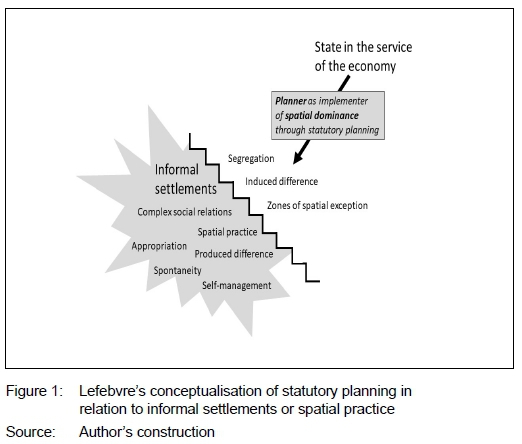
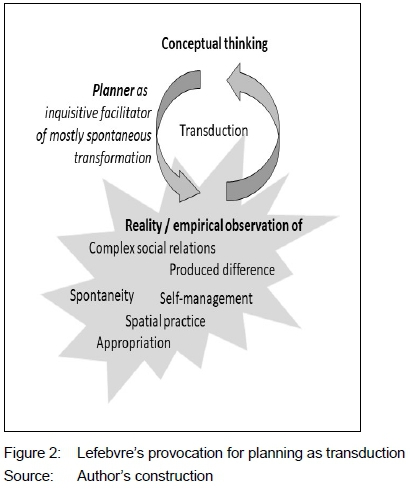
Informal settlements intersect with spatial planning when they are placed on a trajectory towards permanent upgrading. In South Africa, the law requires this intersection to be as non-disruptive as possible. However, this is difficult to secure, as the Slovo Park informal settlement case in Johannesburg exemplifies. This article demonstrates the conceptual relevance of Henri Lefebvre's writing on the right to the city and his closely associated theory on differential space for the informal settlement and planning question. The article notes that the planning theory discourse has engaged with what occurs outside of statutory planning. This skirts Lefebvre's radical critique of statutory planning and its direct implication for spontaneous urban spatial practice. Lefebvre's critique of planning is open-ended, providing pointers towards an alternative, namely transduction. The article shows the relevance of this for the transformation of planning and urban space in South Africa.
Henri Lefebvre; informal settlements; in situ upgrading; planning; planning theory; right to the city; Slovo Park; in situ opgradering
 Thumbnail
 Thumbnail