Spatial development, power dynamics and social tensions: Insights from Dwesa-Cwebe, Wild Coast Region, South Africa
Abstract
Spatial development remains a priority in South Africa and is central to the Spatial Planning and Land Use Management Act (SPLUMA), the Spatial Development Framework (SDF), and broader National Development Plans (NDPs). However, there has been limited focus in literature on the need to address power imbalances in development processes, which not only hinder progress, but also encourage social tensions. This is evident in Dwesa-Cwebe on the Wild Coast, South Africa, which, due to the legacies of apartheid policies, remains marginalised and subjected to external control over development. Without a consensus on the inherent power imbalances and the resulting social conflicts in this community, implementing SPLUMA, SDFs, and NDPs will remain challenging, as has been the case since the advent of democracy in South Africa. This study explores the interaction of power dynamics and their impact on spatial development in Dwesa-Cwebe. Employing a qualitative research design, data were collected from 101 participants through focus group discussions (FGDs) and interviews with government representatives, ward councillors, traditional authorities, and community members. The research revealed significant power imbalances in the implementation of spatial development initiatives, with the government dominating the process while marginalising input from other stakeholders. These imbalances were found to be a key driver of social tensions and delays in the execution of SPLUMA, SDFs, NDPs, and other regional development policies. The study recommends interdisciplinary, gender-inclusive policies that incorporate monitoring and feedback mechanisms to ensure continuous improvement.
spatial development; regional planning; power imbalances; social tensions; SPLUMA; Dwesa-Cwebe; Wild Coast; South Africa
Abstract
Ruimtelike ontwikkeling bly 'n prioriteit in Suid-Afrika en is sentraal tot die Wet op Ruimtelike Beplanning en Grondgebruikbestuur (SPLUMA), Ruimtelike Ontwikkelingsraamwerk (ROR) en breër Nasionale Ontwikkelingsplanne (NOP's). Daar is egter beperkte fokus in literatuur op die behoefte om magswanbalanse in ontwikkelingsprosesse aan te spreek, wat nie net vordering belemmer nie, maar ook sosiale spanning aanmoedig. Dit is duidelik in Dwesa-Cwebe aan die Wildekus, Suid-Afrika, wat weens die nalatenskap van apartheidsbeleide gemarginaliseer bly en aan eksterne beheer oor ontwikkeling onderwerp word. Sonder 'n konsensus oor die inherente magswanbalanse en die gevolglike sosiale konflikte in hierdie ge-meenskap, sal die implementering van SPLUMA, SDF's en NOP's uitdagend bly, soos die geval was sedert die koms van demokrasie in Suid-Afrika. Hierdie studie ondersoek die interaksie van kr-agdinamika en hul impak op ruimtelike ontwikkeling in Dwesa-Cwebe. Deur 'n kwalitatiewe navorsingsontwerp te gebruik, is data van 101 deelnemers ingesamel deur fokusgroepbesprekings (FGD's) en onderhoude met regerings-verteenwoordigers, wyksraadslede, tradisionele owerhede en gemeenska-pslede. Die navorsing het beduidende magswanbalanse in die implementering van ruimtelike ontwikkelingsinisiatiewe aan die lig gebring, met die regering wat die proses oorheers terwyl insette van ander belanghebbendes gemargin-aliseer word. Daar is gevind dat hierdie wanbalanse 'n sleutelaandrywer is van sosiale spanning en vertragings in die uitvoering van SPLUMA, SDF's, NOP's en ander streeksontwikkelingsbeleide. Die studie beveel interdissiplinêre, geslag-inklusiewe beleide aan wat monitering en terugvoermeganismes insluit om deurlopende verbetering te verseker.
1. INTRODUCTION
Spatial development remains a key focus of the South African government's agenda, as reflected in key policy frameworks such as SPLUMA, SDF, and NDPs (Subban & Theron, 2016; Harrison & Todes, 2024). For these plans to be implemented successfully, it is essential to investigate various influencing factors, including the politics of development (Masenya & Kgobe, 2023) and the role of legislative processes (Butcher, 2023), as these factors significantly impact on developmental outcomes. Despite this, there remains a notable gap in the literature regarding the effects of power imbalances among stakeholders involved in spatial development. Such imbalances, especially in land-use contexts, have been linked to increased social tensions, which, in turn, slow down development processes (Govindjee, 2021). This challenge is particularly pronounced in rural, yet economically significant, communities that have been historically marginalised by the apartheid regime (Poswa, 2023).
The Wild Coast region has attracted attention for its strategic location and considerable developmental potential within South Africa's Eastern Cape (Xaba, 2023; Shackleton & Hebinck, 2018; Mambiravana & Umejesi, 2023; Cheteni & Umejesi, 2023). Renowned for its rich natural resources (Ntshona et al., 2010), agricultural productivity (Shackleton & Hebinck, 2018), and vibrant agritourism industry (Cheteni & Umejesi, 2023), the region holds promising prospects. However, this potential is complicated by a complex land-tenure system, where contested notions of indigeneity and belonging lead to tensions between the state and local communities, driven by differing epistemic perspectives (Nyamahono, 2024). The state, tasked with implementing development policies such as SPLUMA, SDF, and NDPs, often finds itself in conflict with local communities, who view themselves as the rightful stewards of the land.
The Dwesa-Cwebe community, the focus of this study, faces additional challenges, due to its proximity to the Dwesa-Cwebe Nature Reserve, which includes marine and coastal protected areas established in the mid-1970s under the Transkei Nature Conservation Act. The formation of the reserve resulted in the displacement of the local community (Funda, 2013; Ntshona et al., 2010), turning them into what Dowie (2011) describes as 'conservation refugees'. With the advent of democracy in South Africa, the Dwesa-Cwebe community sought to reclaim their lands (Funda, 2013). This effort led to the 2001 Settlement Agreement, which partially restored landownership to the community but did not grant full rights of occupancy (Ntshona et al., 2010; Nyamahono, 2024). Currently, the land remains under the administration of the Department of Forestry, Fisheries, and the Environment (DFFE) and is managed by the Eastern Cape Parks and Tourism Agency (ECPTA), undermining the authority of traditional leaders whose influence over land management has been gradually diminished (Nyamahono, 2023; Kepe, 2018; Ntshona et al., 2010).
Owing to these power imbalances, the Dwesa-Cwebe community has garnered national media attention for territorial disputes rooted in the complex land-tenure systems established during the apartheid era (Tsawu, 2022; Matose, Tsawu & Malandu, 2024). These disparities have also intensified social tensions within the region, as local communities attribute these conflicts to the lingering effects of apartheid-era land-reform policies (Denoon-Stevens et al., 2022; Muller, 2020). Despite the acknowledged importance of these issues, existing literature has not adequately examined the evolving dynamics of power in the context of contemporary spatial development or their impact on the effective implementation of frameworks such as SPLUMA, SDF, and NDPs. This study seeks to fill this gap, by critically investigating the intersections of power dynamics and social tensions within Dwesa-Cwebe's spatial development context.
Understanding these dynamics is critical, as suggested by Masenya and Kgobe (2023) and Butcher (2023), because resolving social tensions caused by power disparities is a crucial step toward achieving successful developmental outcomes. By critically examining the power dynamics between the government, traditional authorities, and local stakeholders, this research sheds light on the disparities and tensions that arise and seeks to propose solutions to address them. Ultimately, the study aims to provide insights into how stakeholders can navigate their differences and work together within the context of spatial development. Ultimately, the research aims to inform policy decisions on how to reduce power imbalances and tensions, thereby facilitating the more effective implementation of key policies such as SPLUMA, SDF, and NDPs.
2.1 Spatial development and power dynamics - A global context
In this study, spatial development follows Lami et al. (2024) who define it as the strategic organisation and planning of physical spaces, including land and natural resources, to optimise social, economic, and environmental outcomes. Emphasis is placed on infrastructure development across various dimensions within the community under study. Power dynamics, by contrast, refers to the ways in which individuals and groups exert influence over decision-making processes within spatial development agendas. As highlighted by Bebbington et al. (2018), power dynamics play a critical role in determining who has the authority to make prioritised decisions and under what conditions they are made.
As the world progresses towards achieving the Sustainable Development Goals (SDGs), the prescripts of SDG 11 play a pivotal role if they are well implemented to support equitable development in urban, peri-urban, and rural communities (Lami et al.., 2024). Lami et al. (2024) emphasise that the developmental processes outlined in SDG 11 should consider various regional dynamics, including environmental, social, cultural, and economic factors, as well as the associated risks. Literature, however, highlights the prevalence of power dynamics and social tensions that impact on developmental outcomes, a trend observed across many nations.
Bebbington et al. (2018) conducted a study on spatial development, focusing on infrastructural development and resource extraction and their interaction with community rights in the Amazonia, Indonesia, and Mesoamerica in Latin America. This study critically analysed the roles of various stakeholders, including local communities, the state, and institutional actors, in promoting spatial development. The study found that, while these stakeholders had a common goal of creating an inclusive framework for spatial development, conflicting opinions often arose, due to differing perspectives. The conflicts were dominant in regions rich in natural resources, where stakeholders scrambled for control and ownership of these areas (Bebbington et al., 2018).
Similarly, Li (2020) conducted research in China to examine the implementation of spatial development policies aimed at regional development. The research focused on the interplay between state-led urbanisation policies and the interests of rural communities. Li (2020) found that these policies tend to favour economic development, often at the expense of the sociocultural well-being of local communities and environmental conservation. A major takeaway from Li's (2020) research is the lack of a unifying factor that drives stakeholders to inclusively and equitably participate in spatial development processes. The study highlights the need to develop spatial development policies that balances competing interests among various stakeholders, while advancing regional development.
The power dynamics highlighted, in this instance, have similarly been shown to generate social tensions, often manifesting as conflicts over control and influence in spatial development and land use within the African context. Boone's (2014) work provides an in-depth examination of property ownership, land rights, and tenure systems, exploring how these intersect with political factors across sub-Saharan Africa. Boone (2014) shows the diversity of land-tenure systems, focusing particularly on the differences between state-owned and traditionally owned land, along with their distinct spatial development processes. While the state promotes economic development through urbanisation and spatial policies, local communities, led by traditional authorities, prioritise sustainable development at a localised level. As a result, Boone (2014) identifies common power struggles among the state, traditional authorities, and local elites, who frequently hold disproportionate access to resources.
Sietchiping and Omwamba (2020) studied land-dispute resolutions in the context of contemporary spatial development plans in Africa. Their study examined how state-led land acquisition influences the spatial development processes. Focusing on the New Urban Agenda from the 2016 Habitat III, the study highlights how urbanisation efforts are transforming rural areas into urban spaces and the resulting consequences. While the New Urban Agenda emphasises the importance of urbanisation and development (United Nations, 2017), Sietchiping and Omwamba (2020) found that poorly planned processes can lead to significant social tensions. They found that state-led land acquisitions prioritise industrial development and disregard traditional land tenures and the rights of local communities, resulting in social conflicts. To address these issues, Geyer Jr. (2023) recommended the creation of an inclusive spatial development policy aimed at eliminating inequalities.
2.2 Spatial development and power dynamics - A South African context
In South Africa, researchers have highlighted the prevalence of misunderstandings between various parties involved in spatial planning. Harris and Oranje (2024) conducted a study on the perceptions of settlement planning practitioners in South Africa post-1994, with a specific focus on the Western Cape. Their study found existing power differences between the state and traditional authorities, with the state holding substantial power over landownership and, therefore, the power to adjust the tenure (Fleck & Hanssen, 2024). Harris and Oranje (2024) also noted that, despite existing legislative frameworks to govern settlement planning and development, there is a notable lack of capacity-building among practitioners. This deficiency hinders their ability to effectively navigate the complex politics, land issues, and power dynamics which are all remnants of the apartheid regime. These findings are relevant to the current study, as they emphasise the necessity of using an integrated and participatory approach to mitigate social tensions arising from differing power dynamics.
Nyamahono (2023) supports this view, finding that local communities are more likely to embrace participatory processes when they are included, due to the sense of ownership bestowed upon them as decision-making parties. In the context of local participation and spatial development, Tsoriyo (2024) examined the influence of participants' attachment to place on community-driven projects in Gauteng, South Africa. Tsoriyo (2024) found that people's attachment to a place has a direct impact on the success of community-development initiatives. The study highlighted the importance of incorporating cultural and emotional ties within spatial development planning models, as this fosters community support. These insights from Tsoriyo's (2024) study are relevant to the Dwesa-Cwebe community, as they suggest that understanding and integrating stakeholders' power dynamics and cultural differences can enhance the effectiveness of spatial development.
It is also crucial to recognise that, while inclusive frameworks can facilitate spatial development processes, the role of traditional authorities must be carefully considered. The state often exercises its authority to readjust land-tenure systems through eminent domain powers (Fleck & Hanssen, 2024). However, as Ingwani (2021) observed, traditional authorities often resist state-led development initiatives, especially in cases such as the Wild Coast, where rural land is increasingly being converted for urban use. This resistance is reflected in administrative conflicts between traditional authorities and municipalities, which hold responsibility for implementing institutional development.
Todes et al. (2010) and Harrison, Todes and Watson (2008) also identified the negative implications of state-led urbanisation in rural areas. These dominant social tensions were often associated with the displacement of local communities, disruption of traditional land-use practices (Todes et al., 2010), and the marginalisation of the general populace through top-down policies (Harrison et al., 2008). Xaba (2023) views these forms of marginalisation as externally imposed and result from the roles of local agencies acting on behalf of external parties. Xaba (2023) notes that the resistance of local communities to top-down development approaches is justified, since it stems from a desire for self-determination and culturally sensitive and locally induced development. This perspective is crucial for this study, as it provides a framework for analysing how externally driven spatial development projects can succeed or fail based on their alignment with local priorities and governance structures.
In the context of the Wild Coast, South Africa, Du Plessis (2023) examined the dynamics of legislative frameworks governing traditional authorities in land use. The study identified significant legal ambiguities, tensions, and conflicts among various stakeholders, particularly between traditional authorities and state institutions. These disparities stem from differing roles and powers, which have led to governance challenges and delays in spatial development projects. Mambiravana and Umejesi (2023) also conducted a study in the same region focusing on how stakeholders perceive risks associated with the construction of the N2 Toll Road. The research revealed a divide in perceptions, where institutional stakeholders viewed the road construction as beneficial, while local communities and environmental conservation groups viewed it as a significant threat to their socio-environmental well-being.
The literature reviewed thus far demonstrates how different forms of spatial development such as industrialisation, urbanisation, road construction, environmental conservation, and land planning serve as important case studies for examining how development can exacerbate power imbalances and social tensions among stakeholders. These studies are particularly relevant to the current research, as the potential for spatial development in the Wild Coast region is intricately linked with its complex historical, socio-environmental, and cultural context, all of which impact on policy implementation. Moreover, these studies offer crucial insights that serve as a benchmark for positioning the Dwesa-Cwebe scenario within the broader legal and regulatory framework of spatial development.
2.3 Critical theory in planning
This study employs critical theory in planning, a foundational theory introduced by Forester (1980) and rooted in critical theory, to examine the spatial development challenges and power dynamics among stakeholders involved in urban planning. Forester (1980) argues that differences in perceptions and beliefs about spatial development often lead to friction characterised by social inequalities and a dominant narrative shaped by those in power. Through the concept of communicative action, Forester (1980) emphasises the use of dialogue to empower marginalised stakeholders who frequently face hidden biases in development processes.
A significant application of critical theory in planning, as proposed by Mäntysalo (2002), examines the influence of institutional authority such as the state and its guiding ideology in the planning process. Mäntysalo (2002) highlights the need to identify who benefits or loses through planning and under what circumstances. Sager (2009) expands this view, arguing that critical theory in planning addresses multiple dimensions, including 'focus on power dynamics', 'critiques of traditional planning methods', 'emphasis on public participation', and 'advocacy for social justice'. In this study, the focus on power dynamics is particularly relevant, as it explores how unequal distributions of power in spatial development affect the region's development policies.
Critical theory in planning also advocates for critically assessing planning paradigms, not merely accepting them, to ensure that they address socio-political inequalities. This perspective is supported by Mambiravana, Nyamahono and Budzi (2024), who observed that some infrastructural policies, while progressive in theory, may harm the sociocultural livelihoods of beneflciary communities, particularly in the broader Wild Coast region, where this study is conducted. By applying critical theory in planning, this research allows stakeholders (researchers, town planners, and others) to understand the diverse power dynamics influencing social tensions in spatial development. This approach creates opportunities to empower marginalised communities and support sustainable pathways toward social justice.
3. STUDY AREA
3.1 Dwesa-Cwebe - A historical context
The research was conducted in the Dwesa-Cwebe community, situated adjacent to the Dwesa-Cwebe Nature Reserve in the Wild Coast, Eastern Cape, South Africa. The nature reserve, initially established in the 1890s and officially declared a protected area in 1975, covers approximately 13,500 acres of terrestrial land and about 48,000 acres of marine space (ECSECC, 2022). Its creation led to the forced relocation of residents, who were moved from areas designated for environmental conservation to settlements intended for human habitation (Funda, 2013; Ntshona et al., 2010; Kepe, 2008). These settlements were positioned approximately 5km inland and roughly 18km along the Indian Ocean (ECSECC, 2022) and were referred to as native homelands. Currently, the Dwesa-Cwebe community, once part of these native homelands, consists of seven villages surrounding the nature reserve.
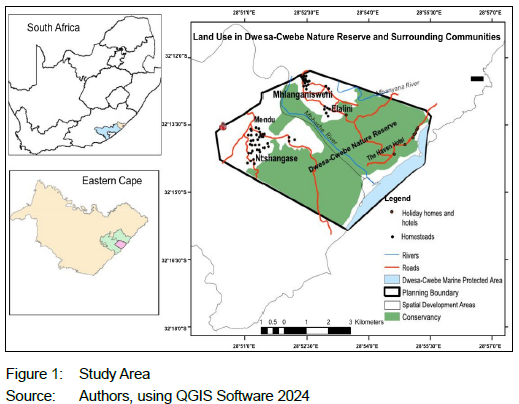
The study focused on four villages - Mhlanganisweni, eLalini, Mendu, and Ntshangase - situated in Wards 20 and 21, within the boundaries marked by the coordinates: NorthEast Corner (E 28° 52', S 32° 16' 12"), South-East Corner (E 28° 52', S 32° 12' 36"), South-West Corner (E 28° 49' 30", S 32° 12' 36"), and North-West Corner (E 28° 49' 30", S 32° 16' 12"), as illustrated in Figure 1. These villages were chosen for their strategic proximity to the Dwesa-Cwebe Nature Reserve, which has become a key tourism destination, and their location along the Mbhashe River, a site of substantial sociocultural and economic importance to the Dwesa-Cwebe community (Nyamahono, 2024). The villages' proximity to the nature reserve is relevant to this study, as it is here that interactions between local communities and the government, represented by DFFE and ECPTA, take place. This proximity highlights the ongoing power dynamics surrounding land use, where the government's developmental and land-use initiatives, under policies such as SPLUMA, the SDF, and the NDPs, often face resistance from local communities (Masenya & Kgobe, 2023).
3.2 Social, economic, and environmental profile of Dwesa-Cwebe
The Dwesa-Cwebe community faces significant challenges related to mal-development, with high unemployment levels largely attributed to its remote location - 230km from East London and approximately 100km from Mthatha, both key economic cities. This contributes to the area's underdevelopment, which is reflected in a human development index (HDI) of 0.506, significantly below the national average of 0.705 (ECSECC, 2022). The HDI is a metric used to evaluate the overall development levels of regions, by quantitatively analysing healthcare provision, education, and standard of living. An index value close to 1 indicates high development levels, whereas a value near 0 suggests lower development levels (ECSECC, 2022). Despite
these obstacles, Dwesa-Cwebe holds considerable potential for development, as indicated by ongoing spatial development initiatives, including the construction of the N2 Toll Road, as well as opportunities in tourism, agriculture, natural resource management, and the region's uranium-rich dunes (Mambiravana & Umejesi, 2023; Rogerson & Rogerson, 2020; Cheteni & Umejesi, 2023; Ntshona et al., 2010; De Villiers & Kepe, 2023).
This positions Dwesa-Cwebe as a promising peri-urban area, contingent on the successful implementation of government-led initiatives under SPLUMA, aimed at transforming the region into a self-sustaining community as part of the NDPs (ECSECC, 2022). However, these plans often trigger tensions, due to clashing power dynamics between the government and local communities. For instance, while tourism could significantly boost Dwesa-Cwebe's transformation into a peri-urban area by 2030 (ECSECC, 2022), its development and revenue management remain largely under the control of the DFFE and ECPTA. This leaves local communities with minimal control over their socioeconomic and environmental assets.
Regarding infrastructure, Dwesa-Cwebe suffers from uneven development, which exacerbates existing tensions. Although many households, schools, community centres, and clinics have access to electricity, running water remains scarce (Nyamahono, 2023). Only tourism-related facilities such as chalets, hotels, and Airbnbs, benefit from consistent water and electricity supplies, much of which are solar-powered to comply with DFFE's low-density tourism regulations. Moreover, the region's underdeveloped road network and limited telecommunication infrastructure pose significant barriers to progress, hindering stakeholder efforts and delaying the implementation of spatial development initiatives.
3.3 Dwesa-Cwebe spatial development plans
Dwesa-Cwebe, along with the broader Wild Coast region, has its growth and spatial development anchored in the legislative framework of South Africa's NDPs (Poswa, 2023). The NDPs serve as the overarching blueprint for the country's development initiatives, including land use and development, which are regulated through the SPLUMA (Harrison & Todes, 2024). SPLUMA requires district and local municipalities to develop SDFs that outline the developmental objectives and goals for a set period (Kwangware, 2022; Ngumbela, 2023). The Mbhashe Local Municipality, which includes the Dwesa-Cwebe community, has established its SDF to guide the transformation of the area into, ultimately, a self-sustaining peri-urban ecotourism hub (Ngqwala & Ballard, 2020).
In essence, the SDF for Dwesa-Cwebe is focused on promoting sustainable economic development that balances the needs of local communities with environmental conservation (De Villiers & Kepe, 2023; Tsawu, 2022). The vision is to establish local service centres, business districts, and employment-generating initiatives, all aligned with the SDF's goals, while addressing long-standing land-use conflicts in the region. As part of the plan to transform the area into a peri-urban space, De Villiers and Kepe (2023) mention that the SDF emphasises strengthening property rights, improving infrastructure such as roads and telecommunications, and promoting local ecotourism projects to enhance community livelihoods. Tsawu (2022) propounds that the framework also stresses equitable access to economic resources to boost local incomes and create business opportunities.
Ongoing initiatives in the Dwesa-Cwebe community and the wider Wild Coast include the creation of ecotourism resorts, the expansion of existing tourism infrastructure managed by the ECPTA, the development of commercial centres, and the construction of the N2 Toll Road, which connects the Eastern Cape with KwaZulu-Natal (Mambiravana & Umejesi, 2023; Rogerson & Rogerson, 2020; Cheteni & Umejesi, 2023). However, these projects have produced mixed sociocultural and economic impacts on the Dwesa-Cwebe community. On the one hand, Cheteni & Umejesi (2023) suggest that the development projects will significantly enhance the region's development, given its rich natural resources and high potential for ecotourism and agritourism. On the other hand, De Villiers and Kepe (2023) point out that the SDFs have intensified tensions, particularly in cases where local communities feel marginalised in the decision-making and development processes.
4. METHODS AND MATERIALS
4.1 Research design
This study used a qualitative research design to explore the intricate interaction of power dynamics and social tensions in the context of spatial development in Dwesa-Cwebe. Qualitative research design allows for FGDs, in-depth interviews (Remler & Van Ryzin, 2021) and thematic data analysis (Braun & Clarke, 2012). In this study, interviews facilitated intensive engagement with key respondents, helping uncover their perceptions, motivations, and the power relations that influence spatial development in Dwesa-Cwebe. The qualitative data was grouped into three themes (disparities, inclusion and exclusion, social cohesion) that explained the key power dynamics and social tensions shaping spatial development in Dwesa-Cwebe. These results were used to provide recommendations for regional development policy.
4.2 Population and sampling
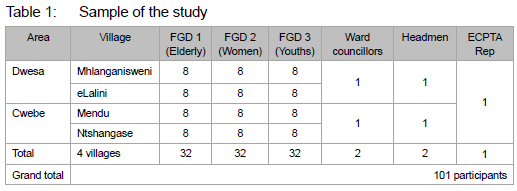
The population for this study included members of the Dwesa-Cwebe community, the ECPTA representative (ECPTA Rep), ward councillors, and headmen. According to ECSECC (2022), Wards 20 and 21, where the study took place, have a population of approximately 10,000 individuals, all Black or African origin. These residents are distributed across roughly 1,000 households within the seven villages. Traditional authorities consisted of headmen, with one headman representing each village. For this study, four headmen represented the four villages involved. In addition, two ward councillors - one from Cwebe and one from Dwesa - were responsible for overseeing the political administration of the community and advocating for local interests in spatial planning and development efforts. To have an appropriate and representative sample, non-probability sampling, specifically the convenience sampling technique, was employed (Remler & Van Ryzin, 2021). These headmen assisted in organising focus groups composed of elders (aged 36+ years), women, and youth (18-35 years) from their respective villages. Prior to the focus groups, participants were briefed on the study's objectives, participant criteria, and the relevance of their involvement. Inclusion criteria required that participants be longterm residents of the Dwesa-Cwebe community, having lived there for at least 10 years to ensure that they had direct experience with ongoing spatial development initiatives. As shown in Table 1, the study's sample consisted of 101 participants.
4.3 Data collection
Data for this study was collected using two primary methods: focus group discussion (FGDs) with community members and in-depth interviews with government representatives, ward councillors, and traditional authorities (Remler & Van Ryzin, 2021). The research instrument for both FGDs and in-depth interviews consisted of 15 open-ended questions designed to explore the various dynamics of power differences and social tensions in the context of spatial development in Dwesa-Cwebe. The questions covered several themes, including stakeholders' roles in spatial development, their levels of power and influence, their perceptions of spatial development, their understanding of inclusion criteria, their familiarity with spatial development legislation, and their views on social tensions and the interactions between different stakeholders in the process.
The use of FGDs was particularly effective in capturing unique perspectives from different community groups, enabling participants to reflect on their roles in spatial development based on their specific capacities. For instance, the youth were given their own FGD to express their views on power dynamics in spatial development as future leaders. The elderly, serving as custodians of community knowledge, provided insights based on their historical and cultural roles. Meanwhile, the women's FGD focused on how power dynamics and spatial development shape and are shaped by gender roles within the community.
4.4 Data analysis and interpretation of findings
The data for this study was predominantly qualitative and analysed using thematic analysis, while demographic information was analysed using descriptive statistics (frequency and percentage). As outlined by Braun and Clarke (2012), thematic analysis is effective for identifying, analysing, and reporting patterns in the data that shape research findings. This method was selected, due to its suitability for the data-collection techniques used in this study, specifically FGDs and in-depth interviews. The analysis followed Braun and Clarke's (2012) suggestions, which involves transcribing the data, cleaning and refining it, extracting relevant information, and organising it into common themes. The themes were chosen based on their frequency on the data collected.
Three main themes emerged from the analysis: (1) Disparities in power and influence over spatial development decisions; (2) Inclusion and exclusion in spatial development processes, and (3) Perceptions of spatial development and social cohesion. The identification of these themes, particularly in the context of land and urban planning, follows Ataman and Tuncer's (2022) assertion that careful analysis of participants' narratives is essential for understanding the phenomenon under investigation. Braun and Clarke (2012) emphasise the importance of using verbatim quotes to clearly illustrate these themes. Accordingly, key participant quotes were included in the study to further elucidate the key power dynamics and social tensions shaping spatial development in Dwesa-Cwebe.
5. RESULTS
5.1 Demographic profile of participants
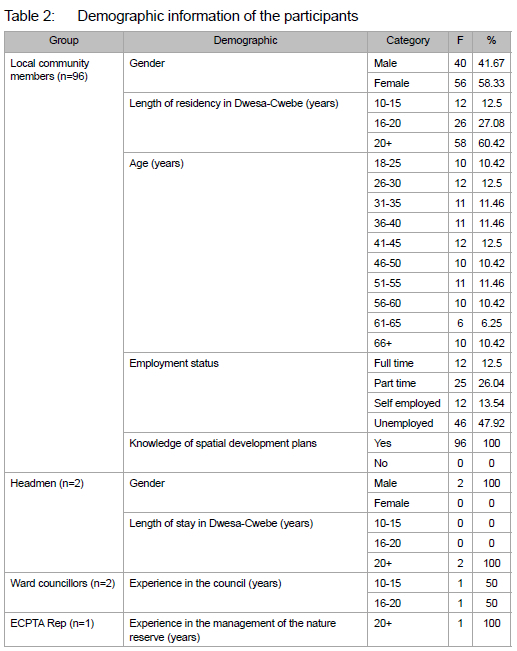
Table 2 shows that most of the participants were female (58%) and that 61% of the participants lived in the Dwesa-Cwebe community for over 20 years. Although the long-term residency suggests that most of the participants have a deep understanding of the community's power dynamics and the social tensions that have arisen over time, the gender imbalance could influence the study's findings from a gendered perspective. It shows how spatial development affects men and women differently, with each gender holding varying levels of power and influence over developmental decisions. Participants were evenly distributed across different age groups, with the majority aged between 26 and 50 years. This even distribution is important, as it captures a wide range of perspectives, ensuring that the study reflects the experiences and views of participants from different generations. Nearly half of the participants (48%) were unemployed. This highlights the economic challenges faced by the local community, which are crucial to understanding the broader context of spatial development.
The headmen, ward councillors, and the ECPTA representative also played an important role, offering insights from individuals with extensive experience in managing local power dynamics and addressing the social tensions that have arisen over time. But the dominance of male ward councillors and headmen points to male leadership in both traditional and political spheres, which could influence the extent of women's inclusion in decisionmaking processes related to spatial development. Collectively, the demographic data on gender, length of residency, knowledge of spatial development, age, employment status, and stakeholder experience provide a comprehensive view of the power dynamics, social tensions, and spatial development processes in Dwesa-Cwebe.
5.2 Disparities in power and influence over spatial development decisions
The theme illustrated the uneven distribution of authority among the study's participants. The research revealed that the source of power and influence, especially for those in institutional positions, stemmed from their official roles within the community. Through primary research, it became clear that stakeholders perceived each other differently, with certain individuals viewing themselves as more powerful and influential than others.
The ECPTA Rep, for instance, asserted his authority over spatial development, particularly in tourism expansion, based on his role as the primary contact for formal tourism. He emphasised his responsibility to ensure development, even if it meant short-term negative impacts on the community, believing that the long-term benefits would justify these sacrifices. The ECPTA representative was quoted as saying:
"My duty is to make sure that this place develops and we can expand all our tourist resorts to the maximum extent possible as long as there are funds available from the government to do so. If it means the road construction is going to benefit the nature reserve and affect a few people in the process, my role is to liaise with them so that they understand that the negative outcomes are only short-lived but the benefits sustain forever" (ECPTA Rep).
Ward councillors, on the other hand, positioned themselves as intermediaries between the local communities and the municipality which oversees spatial development. They distanced themselves from direct authoritative power, instead highlighting their role in facilitating communication and negotiation between the community and government authorities. One of the councillors indicated that:
"What is more satisfying about the position I hold is that I talk to different people on development. I talk to people and take their inquiries to the authorities which is the government. My role is not the type of 'I know it all' but is mostly negotiating in nature" (Ward Councillor).
The headmen expressed concerns over the erosion of their cultural authority and influence, as modern development often bypassed traditional bureaucratic processes. They stressed the importance of involving traditional authorities in decision-making processes, as they are the cultural custodians of the land. One headman mentioned:
"It is unfortunate that the cultural proceedings and sacred practices that were once important are no longer relevant. When important developments are being introduced, we, as traditional authorities, should be informed first and then we can discuss as a community and then give back on how best the plans should be implemented. This is different now and a lot of changes are evident" (Headman).
Another headman noted that more priority is currently being placed on spatial development at the expense of social and cultural well-being, as indicated in the following verbatim:
"Of course, we want development but if it is going to disrespect our societal and cultural values, we do not want it. For it to be called development, it should also lead to the growth of what we believe and culturally respect as a society" (Headman).
The local communities, particularly the elders and women, felt that they had the least power and influence in the ongoing development processes. While they supported development that would bring employment and not disrupt their land-tenure system previously done when Dwesa-Cwebe Nature Reserve was formed, they voiced concerns about being marginalised. This is indicated in the quote below:
"I am one of the few remaining elders in the community and my family is a victim of relocations. I do not wish to see that on anyone. The community wants development but at the least costs ever" (Participant in Elderly FGD).
Women noted their double marginalisation - not only by external authorities, but also within their own community, where their roles were limited to domestic responsibilities. One of the women noted that:
"As women we long for development, but we do not have power and influence over it because there are many people who are supposed to do that. Our duty is to take care of the children and households" (Participant in Women FGD).
Overall, the analysis of stakeholder opinions on power and influence over spatial development decisions in the Dwesa-Cwebe community reveals significant unevenness, with institutional authorities largely shaping the development agenda. ECPTA, ward councillors, and headmen wield varying degrees of influence, with the ECPTA holding the dominant role, particularly in tourism and related infrastructure developments, even when these actions may cause short-term disruptions for long-term gains. Traditional authorities expressed concerns about being undermined, and women indicated minimal involvement in the decision-making process for spatial development. Ward councillors positioned themselves as intermediaries, attempting to bridge the gap between the community and the authorities to ensure more cohesive development efforts.
5.3 Inclusion and exclusion in spatial development processes
This theme captured the extent to which spatial development policies in Dwesa-Cwebe include or structurally exclude certain participants from the process. It explored the power dynamics among stakeholders, particularly how authority figures such as the ECPTA determine who participates in development decisions and who does not. From this study, ECPTA held significant power in deciding who gets involved in the development process, largely because tourism is under their authority. The ECPTA Rep acknowledged that, while the land legally belongs to the local communities, the legislative framework grants the parks authority the power to preside over development and determine the level of community involvement. This is shown in the verbatim below:
"We are glad we were mandated by the government to help the community manage their own land. Since the area carries a significant title of being a protected area, and there are important spatial development agendas taking place, we have the technical expertise to shape this process. As part of the government, we make sure that the decisions are beneficial to the community in many aspects. We also assess different proposals and deliberate them to see which stakeholders bring tangible benefits" (ECPTA Rep).
This top-down approach contrasted with the roles of ward councillors, who viewed themselves as intermediaries tasked with fostering understanding between the community and government-driven development projects. One councillor mentioned:
"We represent the local communities and help them understand that all the parties sent by the government to initiate development in this area is not for the downfall of the community but for its long-term benefits" (Ward Councillor).
However, local community members, including the youth, elderly, and women, expressed significant dissatisfaction with their level of inclusion. The youth, particularly the unemployed, felt excluded from the opportunities that development could bring. The common utterance across most of the youths is indicated below:
"We represent the able-bodied population and we are prepared to work when given the opportunity but the current development processes do not really count us in. Many people are employed in the current developments happening in the region but you hardly see any from our community" (Participant in Youth FGD).
The traditional authorities also raised concerns about the traditional land-tenure systems where they believed that the land should benefit the general populace but was currently not because of the priority placed on different parties over local participants. One headman indicated the following:
"The community which all depends on us have lost their faith in our abilities to lead them and make them realise the gains of holding land. They feel we have failed them but they are not aware that the state has power over everyone. We cannot decide who gets included even after performing a representative role" (Headman).
The elderly, who witnessed previous state-led displacements during the apartheid era, were sceptical about the benefits of current development processes, viewing them as a continuation of past injustices. This is shown in the following verbatim:
"I have come to accept that nothing good comes out of the development processes as long they come from the state. A while ago, it was the state that displaced us to form a protected area, now it is a different state that comes with almost the same agenda" (Participant in Elderly FGD).
This view was also supported by another elder who mentioned that she lived in different places in South Africa and she noticed that gains of development are not easily recognised. The elder indicated that:
"In all the places I have stayed throughout the country, it is very rare to see local people benefiting from any of the developments happening. Usually, external parties get to benefit the most" (Participant in Women FGD).
Furthermore, the women, already marginalised by external authorities, also faced exclusion within the community, due to entrenched patriarchal norms, further limiting their influence over development decisions. This is noted in the following sentiments:
"Women are always the victims of all these processes. Noone consults us about development even though we are here in the village always. It is very strange because this is not 1970s where the roles of women were only to give birth and take care of the children" (Participant in Women FGD).
Overall, the findings reveal that structural inclusion and exclusion persist in the spatial development processes in Dwesa-Cwebe, with the ECPTA maintaining a dominant role in shaping these agendas. This exclusionary approach marginalises significant stakeholders, including local communities - who are the primary landowners - and their traditional authorities, leading to social tensions, as these groups remain perpetually disenfranchised in decisions affecting their land and resources.
5.4 Perceptions of spatial development and social cohesion
This theme explained the research findings regarding how different participants in this study perceived ongoing spatial development and how these perceptions explain the social tensions within the Dwesa-Cwebe community. The study sought to determine whether these spatial development initiatives serve to unite the community or further divide it. The findings revealed a wide array of perceptions, reflecting divergent views on development among the various stakeholders.
The ECPTA Rep viewed spatial development as a catalyst for economic growth, particularly through the expansion of tourism, construction of road networks, and urbanisation. This perspective highlighted the perceived benefits of development, particularly in terms of economic opportunities and infrastructure improvements, as expressed in the following quote:
"The expansion of tourism, the construction of road networks and the urbanisation of the local communities is imminent. Many will witness how all these developments will bring about economic development" (ECPTA Rep).
By contrast, traditional authorities expressed deep concerns that these forms of development posed a significant threat to their social practices, culturally sacred activities, land rights, and traditional leadership structures. They feared that the erosion of cultural values and the potential loss of land could lead to further displacement, a sentiment reflected in the statement:
"As we have noted, our worries are mainly along the erosion of our cultural values, the social and leadership systems and our land. We do not want to lose our land to development of getting to a point where we may be relocated as previously experienced" (Headman).
Local communities also viewed spatial development with scepticism, seeing it as a threat to their sense of belonging. They expressed frustration at being marginalised in decision-making processes, leading to uncertainty about whether the state's plans would benefit them or result in further negative experiences. This sentiment is captured in an elder's reflection:
"We have been divided before as a community and this continues to happen especially that we do not know what the result is in terms of what they call development here. We hope this development is not going to make us move from this community again to other places" (Participant in Elderly FGD).
The unemployed and seasonally employed participants were particularly critical of the development, perceiving it as irrelevant to their lives if they remained without stable employment. The consensus among these groups was that the spatial development initiatives appeared to benefit external parties rather than the local populace. This feeling of exclusion is emphasised in the following quotes:
"I am not employed and I get seasonally employed at times especially when it is peak tourism season when I get a chance to be a tour guide. I do not really see this as development until I get employed on a full-time basis" (Participant in Youths FGD).
"This is development in the eyes of someone who is financially benefiting from it, not the general people. As women, we don't even know what is happening because I never had a chance to reap the benefits" (Participant in Women FGD).
Overall, these findings show the prevalence of differential perceptions and how they relate to social tensions that are imminent in Dwesa-Cwebe community. These contrasting perceptions have also been viewed as the reason for the ongoing disenfranchisement of the community seen through tensions that arise among the general populace, the traditional authorities, and the state.
6. DISCUSSION
6.1 Power and influence over decision making
The findings on the existence of disparities on power and influence of stakeholders over spatial development decisions can be explained by the broader patterns observed in South Africa by various scholars. Harris and Oranje (2024) highlighted the inherent planning inequalities that have persisted post-1994, particularly noting that institutional authorities such as the ECPTA in this study often dominate spatial development decisions. This dominance leaves other stakeholders, including traditional authorities and local communities, with minimal influence, mirroring the marginalisation observed in Dwesa-Cwebe. Similarly, Mambiravana et al. (2024) identified tensions arising from differential roles in development, especially in large infrastructure projects such as road construction. They found that local communities often feel excluded from decision-making processes, with institutional priorities favouring economic growth over the sociocultural well-being of these communities and the environment. This resonates with the experiences of the Dwesa-Cwebe community, where traditional and local voices are overshadowed by institutional agendas. In addition, Shackleton and Hebinck (2018) found that local communities face significant challenges in maintaining their livelihoods under the pressure of external developmental forces. Their study parallels the situation in Dwesa-Cwebe, where the lack of local influence in spatial development decisions has led to adverse social and economic impacts, reinforcing existing inequalities and power imbalance.
The findings can also be interpreted through the lens of critical theory in planning, which exposes underlying power dynamics and social tensions in regional planning processes. Forester (1980) suggests that institutional dominance often characterises spatial development, leading to the marginalisation of other stakeholders, due to implicit biases. This dynamic is evident in this study, as the ECPTA maintains control over spatial development, sidelining the voices of other involved parties. Forester (1980) emphasises the need for policy reforms that prioritise not only theoretical development goals, but also the genuine well-being of local communities.
The disparities in power and the influence that stakeholders, particularly institutional ones, have over spatial development decisions can also be understood within the framework of SPLUMA and the municipal SDF. Under SPLUMA, Mbhashe Local Municipality SDFs are designed to promote inclusive and equitable participation in development, ensuring that all stakeholders are involved (ECSECC, 2022; Poswa, 2023; Ngqwala & Ballard, 2020). A key focus of the government has been to prioritise the inclusion of local and marginalised communities in these processes (Poswa, 2023; Ngqwala & Ballard, 2020). However, the findings from this study indicate that, while the SDF of Mbhashe Local Municipality formally provisions for the participation of all affected stakeholders, this is not fully realised in practice. The ECPTA, for instance, wields a disproportionate amount of influence over spatial development initiatives, particularly those affecting the local community. This practice deviates from the goals of the NDP, which emphasise the importance of balancing development with the protection of social and environmental ecosystems. These findings are consistent with Harris and Oranje (2024), who highlight the persistence of growing inequalities in spatial development in the post-apartheid context.
6.2 Exclusionary approach in development
The findings from this study on the exclusionary approach in spatial development, where the state -through the ECPTA - dominates the process, particularly when pursuing a tourism agenda, align with broader research conducted in South Africa. Cheteni and Umejesi (2023) concluded that institutional authorities, often external participants leading local development initiatives, are prioritised over local stakeholders. This pattern was observed in many agritourism projects across the Wild Coast. Cheteni and Umejesi (2023) found that this top-down approach undermines local communities, who possess significant potential for development through genuine participation but are often marginalised. Similarly, De Villiers and Kepe (2023) observed that the marginalisation of local voices in development decisions, driven by the dominance of external stakeholders with state backing, is a primary source of social tensions in the current development-endowed communities. Their study highlights the need for an inclusionary framework that incorporates local perspectives to address and reduce ongoing inequalities. Xaba's (2023) research further supports these findings, by examining the resistance of local communities to externally initiated, state-assisted, and industry-driven development projects. This resistance is often misunderstood as primitivism, but from the perspective of the affected communities, it is a defence of their rights and traditions against development agendas that prioritise profit over the well-being of local populations.
The findings presented, in this instance, align closely with the critical theory in planning, which critiques the imbalances of power in spatial development processes. Forester (1980) and Sager (2009) suggest that the implementation of spatial development plans can often exacerbate inequalities and encourage social tensions within the communities they are meant to serve. In this study, institutional planning has been shown to marginalise the voices of local communities, particularly through the prioritisation of tourism initiatives over the social and cultural well-being of residents. Sager (2009) advocates for policy reforms that prioritise authentic community participation, aiming to achieve social and political equity among all stakeholders involved.
The exclusionary approaches observed in tourism-related spatial development in Dwesa-Cwebe raise significant concerns about the implementation of the Mbhashe Local Municipality SDF.
According to ECSECC (2022), local communities are intended to benefit from ecotourism initiatives and the establishment of tourism ventures that create employment opportunities and improve livelihoods. However, the findings suggest that ECPTA plays a dominant role, prioritising external interests over local community efforts. This is consistent with Xaba (2023), who found that state institutions across much of the Wild Coast often favour external agents in leading development, rather than supporting genuine grassroots participation. Furthermore, these findings deviate from the provisions of SPLUMA and SDFs, which are designed to ensure that local communities benefit from the natural resources at their disposal (Mambiravana & Umejesi, 2023). This pattern of exclusion aligns with De Villiers and Kepe (2023), who noted that disparities in the implementation of spatial development policies are a primary cause of conflicts in such regions.
6.3 Development perceptions and social tensions
The findings on differing perceptions of spatial development and their impact on social cohesion in the Dwesa-Cwebe community are well-contextualised within the broader scholarship on land-use management, urbanisation, and spatial development. Geyer Jr. (2023) highlights the persistent conflicts among different stakeholders regarding land use, despite the potential for beneficial synergies if these parties can reach a collective understanding. His study found that modern land-use plans are often authoritarian, disregarding customary land practices and the values of local communities, thus creating a significant rift between the state and local populations.
Ingwani (2021) explains the marginalisation of women as they face challenges not only in securing land rights, but also in being excluded from critical decision-making processes. This aligns with the findings of the current study, where women in Dwesa-Cwebe are subject to both customary and institutional spatial development initiatives, often lacking a voice in decisions that directly impact on their lives. Nyamahono (2024) describes this as epistemic injustice, arising from differences in indigeneity and politics of belonging, with women being marginalised, due to perceptions of their indigeneity as less influential in decision-making contexts. To mitigate such social tensions, Nyamahono (2024) recommends an equitable development framework that engages diverse stakeholders toward shared goals.
These findings contrast with the Mbhashe Local Municipality SDF, which emphasises economic development alongside the inclusion and empowerment of vulnerable community members, particularly women (ECSECC, 2022; Poswa, 2023; Ngqwala & Ballard, 2020). Although the SDF promotes women's advancement, insufficient public consultation in Dwesa-Cwebe has intensified social tensions and further marginalised women. Resolving these conflicts necessitates the adoption of inclusive policies, moving away from exclusionary practices to ensure that all community members, especially women, are genuinely involved in development processes.
7. CONCLUSIONS AND RECOMMENDATIONS
This study contributes to understanding how spatial development programmes intersect with stakeholders' power dynamics and influence social cohesion within the Dwesa-Cwebe community. The insights gained are not only applicable to this specific area, but also broadly relevant to the fields of regional planning and urbanisation. The findings highlight the critical impact of regional development policies - SPLUMA, SDFs, town and regional planning policies, and traditional land use policies - and the broader social structures of local communities. The study reveals that the success of these policies is often contingent on the intricate power dynamics and the level of inclusion or exclusion of various stakeholders in the decision-making process. The study found the existence of differing power dynamics and levels of influence towards decision-making and implementation. The research identified that state-led spatial development initiatives focus on economic growth, often at the expense of the social and cultural well-being of the local communities. This approach, which prioritises long-term economic outcomes over immediate social costs, has perpetuated social tensions, particularly in communities historically marginalised since the apartheid era. With respect to regional development policy, this study offers the following three key recommendations:
• Monitoring and feedback of policies - Policies such as SPLUMA and SDFs should undergo regular monitoring to ensure that they remain relevant and effective in addressing local development needs. This monitoring and feedback process must actively involve all local stakeholders, including marginalised groups, to ensure that these policies uphold high standards of equity and inclusivity.
• Implement gender-inclusive policies - Given that the study found women to be consistently marginalised, it is essential that policies be revised to include specific clauses that actively support and enhance the roles of women in development processes. Ensuring that women's voices are respected and included in decision-making will help eliminate gender-based exclusions and promote a more equitable development framework.
• Interdisciplinary corporation policies - since the research found the existence of differing perceptions on what spatial development entails, it is recommended that interdisciplinary teams collaborate to educate multiple stakeholders to have a common understanding. The interdisciplinary corporation policies can encourage longterm social cohesion among stakeholders.
REFERENCES
2. LITERATURE REVIEW
-
ATAMAN, C. & TUNCER, B. 2022. Urban interventions and participation tools in urban design processes: A systematic review and thematic analysis (1995-2021). Sustainable Cities and Society, 76, article 103462. https://doi.org/10.1016/j.scs.2021.103462
» https://doi.org/10.1016/j.scs.2021.103462 -
BEBBINGTON, A.J., HUMPHREYS BEBBINGTON, D., SAULS, L.A. & ROGAN, J. et al. 2018. Resource extraction and infrastructure threaten forest cover and community rights. Proceedings of the National Academy of Sciences, 115(52), pp. 1316413173. https://doi.org/10.1073/pnas.1812505115
» https://doi.org/10.1073/pnas.1812505115 -
BOONE, C. 2014. Property and political order in Africa: Land rights and the structure of politics. Cambridge, UK: Cambridge University Press. https://doi.org/10.1017/CBO9781139629256
» https://doi.org/10.1017/CBO9781139629256 - BRAUN, V. & CLARKE, V. 2012. Thematic analysis. American Psychological Association.
-
BUTCHER, S. 2023. Making land 'developable' for market-driven affordable housing in Gauteng, South Africa. In: Rubin, M., Charlton, S. & Klug, N. (Eds). Housing in African cities: A lens on urban governance. Cham: Springer International Publishing, pp. 65-84. https://doi.org/10.1007/978-3-031-37408-1_4
» https://doi.org/10.1007/978-3-031-37408-1_4 -
CHETENI, P. & UMEJESI, I. 2023. Evaluating the sustainability of agritourism in the wild coast region of South Africa. Cogent Economics & Finance, 11(1), article 2163542. https://doi.org/10.1080/23322039.2022.2163542
» https://doi.org/10.1080/23322039.2022.2163542 -
DENOON-STEVENS, S.P., ANDRES, L., NEL, V. & JONES, P. 2022. Unpacking planners' views of the success and failure of planning in post-apartheid South Africa. Cities, 130, article 103867. https://doi.org/10.1016/j.cities.2022.103867
» https://doi.org/10.1016/j.cities.2022.103867 -
DE VILLIERS, D. & KEPE, T. 2023. Missed opportunities in resolving people-conservation tensions in Dwesa-Cwebe, South Africa. Koedoe, 65(1), pp. 1-5. http://dx.doi.org/10.4102/koedoe.v65i1.1750
» http://dx.doi.org/10.4102/koedoe.v65i1.1750 - DOWIE, M. 2011. Conservation refugees: The hundred-year conflict between global conservation and native peoples. Cambridge, MA: MIT Press.
-
DU PLESSIS, E. 2023. The legal framework governing traditional leaders' role in land use planning in South Africa. Potchefstroom Electronic Law Journal/Potchefstroomse Elektroniese Regsblad, 26(1), pp. 1-28. https://doi.org/10.17159/1727-3781/2023/v26i0a16564
» https://doi.org/10.17159/1727-3781/2023/v26i0a16564 -
ECSECC (Eastern Cape SocioEconomic Consultative Council). 2022. Eastern Cape State of the Province Address. [Online]. Available at: https://www.ecsecc.org/newsitem/eastern-cape-state-of-the-province-address [Accessed: 10 July 2024].
» https://www.ecsecc.org/newsitem/eastern-cape-state-of-the-province-address -
FLECK, R.K. & HANSSEN, F.A. 2024. Courts, legislatures, and evolving property rules: Lessons from eminent domain. Explorations in Economic History, 93, article 101581. https://doi.org/10.1016/j.eeh.2024.101581
» https://doi.org/10.1016/j.eeh.2024.101581 -
FORESTER, J. 1980. Critical theory and planning practice. Journal of the American Planning Association, 46(3), pp. 275-286. https://doi.org/10.1080/01944368008977043
» https://doi.org/10.1080/01944368008977043 - FUNDA, X.N. 2013. Challenges of a post-land settlement process: The Dwesa-Cwebe Nature Reserve in the Eastern Cape, South Africa. Community-based natural resource management in Southern Africa: An introduction. Center for African Studies at the University of Florida, Bloomington, pp. 177-192.
-
GEYER Jr, H.S. 2023. Conflicts and synergies between customary land use management and urban planning in informal settlements. Land Use Policy, 125, article 106459. https://doi.org/10.1016/j.landusepol.2022.106459
» https://doi.org/10.1016/j.landusepol.2022.106459 - GOVINDJEE, U. 2021. Addressing the conflict between property development and the environment when such conflict occurs within the urban edge: Legal considerations. Unpublished PhD dissertation, North-West University, South Africa.
-
HARRIS, M. & ORANJE, M. 2024. Practising planners' perceptions of post-1994 planning law and settlement planning and development processes: A Western Cape case study. Town and Regional Planning, 84, pp. 48-57. https://doi.org/10.38140/trp.v84i.7974
» https://doi.org/10.38140/trp.v84i.7974 -
HARRISON, P. & TODES, A. 2024. The promise of planning: Global aspirations and South African experience since 2008. London, UK: Taylor & Francis. https://doi.org/10.4324/9781003104438
» https://doi.org/10.4324/9781003104438 -
HARRISON, P., TODES, A. & WATSON, V. 2008. Planning and transformation: Learning from the South African experience. London: Routledge. https://doi.org/10.4324/9780203007983
» https://doi.org/10.4324/9780203007983 -
INGWANI, E. 2021. Struggles of women to access and hold land use and other land property rights under the customary tenure system in peri-urban communal areas of Zimbabwe. Land, 10, article 649. https://doi.org/10.3390/land10060649
» https://doi.org/10.3390/land10060649 -
KEPE, T. 2008. Land claims and co-management of protected areas in South Africa: Exploring the challenges. Environmental Management, 41(3), pp. 311-321. https://doi.org/10.1007/s00267-007-9034-x
» https://doi.org/10.1007/s00267-007-9034-x -
KWANGWARE, T. 2022. Local development policy efforts on environmental quality: The case of Amathole District Municipality. Technium Social Sciences Journal, 38, article 833. https://heinonline.org/HOL/P?h=hein.journals/techssj38&i=833; https://doi.org/10.47577/tssj.v38i1.5724
» https://heinonline.org/HOL/P?h=hein.journals/techssj38&i=833 -
LAMI, I.M., ABASTANTE, F., MECCA, B. & TODELLA, E. 2024. Maps and SDG11: A complex but possible relationship. International Journal of Sustainable Development & Planning, 19(4), pp. 1217-1237. https://doi.org/10.18280/ijsdp.190401
» https://doi.org/10.18280/ijsdp.190401 -
LI, T.M., 2020. Land's end: Capitalist relations on an indigenous frontier. Durham, NC: Duke University Press. https://doi.org/10.1515/9780822376460
» https://doi.org/10.1515/9780822376460 -
MAMBIRAVANA, T. & UMEJESI, I. 2023. Infrastructure development and environmental risk perceptions in the Wild Coast, South Africa. Jamba -Journal of Disaster Risk Studies, 15(1), article 1377. [Online]. Available at: https://journals.co.za/doi/epdf/10.4102/jamba.v15i1.1377 [18 August 2024].
» https://journals.co.za/doi/epdf/10.4102/jamba.v15i1.1377 -
MAMBIRAVANA, T., NYAMAHONO, J.D. & BUDZI, J. 2024. Conflicts and competing interests in infrastructure development: A case of N2 Toll Road project, Wild Coast, South Africa. Interdisciplinary Journal of Sociality Studies, 4, pp. 1-17. https://doi.org/10.38140/ijss-2024.vol4.17
» https://doi.org/10.38140/ijss-2024.vol4.17 -
MANTYSALO, R. 2002. Dilemmas in critical planning theory. Town Planning Review, 73(4), pp. 417-436. https://doi.org/10.3828/tpr.73.4.3
» https://doi.org/10.3828/tpr.73.4.3 -
MASENYA, M.J. & KGOBE, F.K.L. 2023. The efficacy of community participation towards land use planning in South African local municipalities. Journal of Public Administration Studies, 8(2), pp. 50-55. https://doi.org/10.21776/ub.jpas.2023.008.02.7
» https://doi.org/10.21776/ub.jpas.2023.008.02.7 -
MATOSE, F., TSAWU, S. & MALANDU, M. 2024. Traditional authority, democracy and protected areas: A quandary for African states. Review of African Political Economy, article 20240020. https://doi.org/10.62191/ROAPE-2024-0020
» https://doi.org/10.62191/ROAPE-2024-0020 -
MULLER, J. 2020. Conflict, empowerment and planning in postapartheid South Africa. In: Boal, F.W. (Ed.). Ethnicity housing. London, UK: Routledge, pp. 43-50. https://doi.org/10.1201/9781003073253-7
» https://doi.org/10.1201/9781003073253-7 -
NGQWALA, N.S. & BALLARD, H.H. 2020. Leadership imperatives for local government service delivery. Administratio Publica, 28(2), pp. 118131. [Online]. Available at: https://hdl.handle.net/10520/ejc-adminpub-v28-n2-a8 [18 August 2024].
» https://hdl.handle.net/10520/ejc-adminpub-v28-n2-a8 -
NGUMBELA, X.G., 2023. Examining the role played by civil society organisations in the Amatole District Municipality in the Eastern Cape Province: Opportunities and constraints. International Journal of Sustainable Society, 15(1), pp. 96-112. https://doi.org/10.1504/IJSSOC.2023.128380
» https://doi.org/10.1504/IJSSOC.2023.128380 -
NTSHONA, Z., KRAAI, M., KEPE, T. & SALIWA, P. 2010. From land rights to environmental entitlements: Community discontent in the 'successful' Dwesa-Cwebe land claim in South Africa. Development Southern Africa, 27(3), pp. 353-361. https://doi.org/10.1080/0376835X.2010.498942
» https://doi.org/10.1080/0376835X.2010.498942 -
NYAMAHONO, J.D. 2023. Participation dynamics in the management of protected areas: The case of Dwesa-Cwebe Nature Reserve and its adjacent communities, Eastern Cape province, South Africa. Unpublished PhD dissertation, University of Fort Hare, South Africa. [Online]. Available at: https://core.ac.uk/download/pdf/588487734.pdf [18 August 2024].
» https://core.ac.uk/download/pdf/588487734.pdf -
NYAMAHONO, J.D. 2024. Epistemic justice in nature reserves management Exploring intersecting indigeneity and politics of belonging in Dwesa, South Africa. Academicus International Scientific Journal, 15(30), pp. 78-97. [Online]. Available at: https://dx.medra.org/10.7336/academicus.2024.30.06 [18 August 2024].
» https://dx.medra.org/10.7336/academicus.2024.30.06 -
POSWA, X.S. 2023. Implementing the Spatial Planning and Land Use Management Act of 2013: An examination of the intersection of the role of traditional leaders and municipalities in spatial planning and land use management. Unpublished PhD dissertation, University of the Western Cape, South Africa. [Online]. Available at: https://etd.uwc.ac.za/handle/11394/10756 [18 August 2024].
» https://etd.uwc.ac.za/handle/11394/10756 - REMLER, D.K. & VAN RYZIN, G.G. 2021. Research methods in practice: Strategies for description and causation. London, UK: Sage Publications.
-
ROGERSON, C.M. & ROGERSON, J.M. 2020. Coastal tourism in South Africa: A geographical perspective. In: Rogerson, J.M. (Ed.). New directions in South African tourism geographies. Cham, Switzerland: Springer, pp. 227-247. https://doi.org/10.1007/978-3-030-29377-2_13
» https://doi.org/10.1007/978-3-030-29377-2_13 -
SAGER, T. 2009. Responsibilities of theorists: The case of communicative planning theory. Progress in Planning, 72(1), pp. 1-51. https://doi.org/10.1016/j.progress.2009.03.002
» https://doi.org/10.1016/j.progress.2009.03.002 -
SHACKLETON, S.E. & HEBINCK, P. 2018. Through the 'thick and thin' of farming on the Wild Coast, South Africa. Journal of Rural Studies, 61, pp. 277-289. https://doi.org/10.1016/j.jrurstud.2018.01.012
» https://doi.org/10.1016/j.jrurstud.2018.01.012 -
SIETCHIPING, R. & OMWAMBA, J. 2020. The future of urban policy in Africa. Localization of SDG 11 and the new urban agenda. In: Nunes Silva, C. (Ed.). Local governance in the new urban agenda. Cambridge, UK: Cambridge University Press, pp. 275-291. https://doi.org/10.1007/978-3-030-47135-4_14
» https://doi.org/10.1007/978-3-030-47135-4_14 -
SUBBAN, M. & THERON, H. 2016. Contextualising the national development plan for enhanced service delivery: Considerations for planning in KwaZulu-Natal. Town and Regional Planning, 68, pp. 43-56. DOI: https://doi.org/10.18820/2415-0495/trp68i1.4
» https://doi.org/10.18820/2415-0495/trp68i1.4 -
TODES, A., KOK, P., WENTZEL, M., VAN ZYL, J. & CROSS, C. 2010. Contemporary South African urbanisation dynamics. Urban Forum, 21, pp. 331-348. https://doi.org/10.1007/s12132-010-9094-5
» https://doi.org/10.1007/s12132-010-9094-5 -
TSAWU, S. 2022. Traditional authorities and co-management of protected areas in South Africa: The case of Dwesa-Cwebe Nature Reserve in the Eastern Cape. Unpublished PhD dissertation, University of Cape Town, South Africa. [Online]. Available at: http://hdl.handle.net/11427/37051 [17 August 2024].
» http://hdl.handle.net/11427/37051 -
TSORIYO, W. 2024. Place attachment and participation in community-driven development in Gauteng Province, South Africa. Town and Regional Planning, 84, pp. 1-14. https://doi.org/10.38140/trp.v84i.7954
» https://doi.org/10.38140/trp.v84i.7954 -
UNITED NATIONS. 2017. New Urban Agenda. [Online]. Available at: https://unhabitat.org/sites/default/flles/2019/05/nua-english.pdf [Accessed: 25 July 2024].
» https://unhabitat.org/sites/default/flles/2019/05/nua-english.pdf -
XABA, M.B. 2023. Resisting development or imposition? Examining the many dynamics around the resistance of externally initiated, state-assisted, and industry-driven "development" projects in the Wild Coast, Eastern Cape, South Africa. Cogent Social Sciences, 9(2), article 2282798. https://doi.org/10.1080/23311886.2023.2282798
» https://doi.org/10.1080/23311886.2023.2282798
Peer reviewed and revised: November 2024
Published: December 2024