A review of some of the criteria used in land-demarcation processes
Abstract
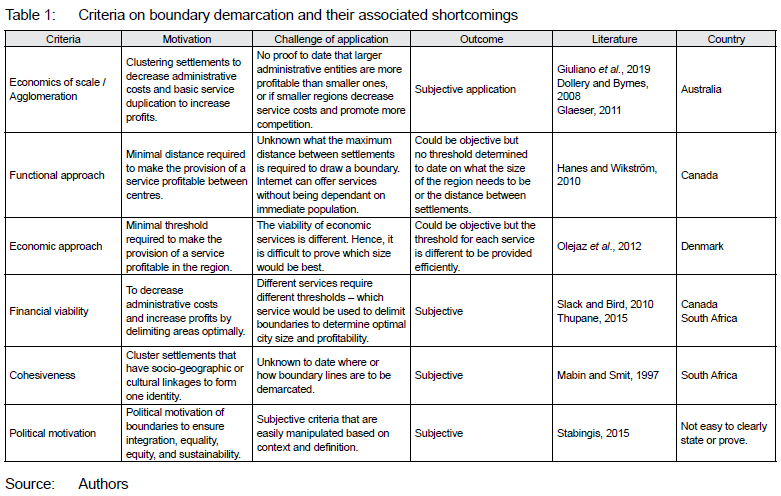
In recent years, settlements have sprawled beyond the urban growth boundaries, due to a number of factors, including mobility, technology, and urban blight. As a result, governments globally have opted to restructure their local administrative boundaries (municipalities) to be more accommodating to the unplanned growth, while setting a clear limit to the extent to which the urban region could grow. Without a clear administrative boundary, urban problems such as civil conflict, administrative duplication, political corruption, lack of service delivery, and environmental degradation become more prevalent. In order to understand the driving forces behind administrative delimitation, this article reviews how local administrative boundaries can be delineated from a theoretical stance. It further unpacks various criteria to contextualise how boundaries could be demarcated and their resultant structure. The article reveals that, from a theoretical stance, the method of demarcating administrative urban boundaries is not apparent, since a variety of factors influence open systems. Consequently, this article provides awareness of the challenges of demarcating local administrative boundaries, with both administrative and policy implications. Administratively, it sheds light on criteria that can influence boundary demarcation. In terms of policy, it demonstrates that the demarcation of boundaries is a huge challenge that requires further research and action.
local administration; demarcation; local boundaries; functional linkages
 Thumbnail