The perspectives of social work supervisees on the quality of supervision in the Giyani region of Limpopo province, South Africa
Abstract
This article reports on a qualitative research study which was intended to explore the perspectives of social work supervisees on the quality of supervision in the Giyani region of Limpopo, South Africa. It was important to determine the quality of supervision rendered because social work supervision is intended to capacitate social workers with knowledge and skills and to support them, yet such supervision is fraught with challenges for decades. Purposive sampling was thus used to select study participants from whom data were collected by means of semi-structured interviews. The study findings revealed that the majority of the participants (10 of the 13) were not offered quality supervision by their supervisors. The participants attributed the poor supervision to the fact that their supervisors were delegated not appointed to supervise. The study thus recommends that all delegated social work supervisors in the Giyani region should be permanently appointed to their supervision positions.
quality supervision; social work; social work supervisee; social work supervisor; supervision
INTRODUCTION
Despite numerous research studies conducted on social work supervision in South Africa, the authors of this study did not come across one that investigated the perspectives of social work supervisees on the quality of supervision that they receive. According to Jasper and Field (2016), quality supervision implies that the social work supervisor should have knowledge and the ability to demonstrate skills that are necessary in addressing the strengths and challenges of the supervisees. The Trafford CYPS Social Work Supervision Policy (2013) adds that quality supervision requires a planned and staged process that should ensure that social work supervisees are clear about what is expected of them in terms of their roles, purpose and their responsibilities, which will lead them to the achievement of positive outcomes. Quality supervision also serves the dual purpose of protecting the welfare of the service users and assisting supervisees to develop and maintain essential skills (Aasheim, 2012). Bourn and Hafford-Letchfield (2011) state that quality supervision should incorporate aspects of learning and support functions as well as affording supervisees the opportunity to provide and receive constructive feedback that can ignite the spirit of learning and improving oneself as well as contributing towards reaching the organisational objectives. Illing (2019) asserts that quality supervision should support and enhance social work supervisees' knowledge and skills to improve the delivery of services. Illing (2019) adds that quality supervision ensures that supervision is provided on a regular basis and informed by addressing the individual needs of the supervisees.
Proceeding from these assumptions, the authors of this study felt that there was a need to investigate the perspectives of social work supervisees on the quality of supervision in the Giyani region of Limpopo province, South Africa. The reasons for conducting the study in Giyani emanated from an observation that social work supervisees in the Department of Social Development in Giyani were always seeking professional advice from other social workers on the cases they were handling instead of asking their immediate supervisors. The researchers felt that this study could generate new ideas on how to improve the quality of supervision in the Department of Social Development and the NGO sectors. The study also makes recommendations on the provision of quality social work supervision that are relevant to the social work profession and policymakers as well as for future research studies. Additional aspects discussed in this article include research methodology and supervision challenges.
SUPERVISION CHALLENGESSocial work supervision is fraught with numerous challenges (Engelbrecht, 2013; Kheswa, 2019) that date back several decades (Engelbrecht, 2018). Research studies between 1970 and 2010 highlight challenges such as lack of social and emotional supervisory support and poor interpersonal interactions, which affected social workers adversely (O'Donoghue & Tsui, 2013). Furthermore, in the mid-1990s Rwomire and Raditlhokwa (1996) identified supervision challenges such as staff shortages, insufficient resources, lack of qualified supervisors and lack of time to offer supervision. As a result, there was an alarming exodus of social workers from the profession in South Africa (Department of Social Development, 2006). The departure of social workers was attributed to high workloads, high staff turnover, low wages and lack of supervision (Naidoo, 2004). In 2005 the study conducted by Mboniswa (2005) pointed to a lack of training for supervisors, high caseloads and a lack of resources as some of the factors contributing towards supervisors' inability to offer quality supervision. Moreover, most of the participants in the study by Mbau (2005) indicated that they did not have supervision contracts, revealing that the supervision arrangement lacked structure. In 2006 the policy entitled Recruitment and Retention Strategy for Social Workers in South Africa also confirmed that supervision of social workers in the country was unstructured and that there was a shortage of quality social work supervisors at the time - which in turn hastened the exodus of social workers from the country (Department of Social Development, 2006). Engelbrecht (2006) added that the brain drain of South African social workers was mainly precipitated by factors such as economic reasons, poor working conditions and personal circumstances. Supporting Engelbrecht's findings, Kasiram (2009) concurred that poor working conditions, unmanageable workloads and low remuneration may have led to the brain drain of social workers in the country, which in turn also led to shortages in the provision of service delivery.
Following the departure of social workers, there was a national drive to recruit learners to join the social work profession. For instance, social work was regarded as a scarce skill in 2003 and entered on the scarce skills list of the Draft Scarce Skills and Policy Framework of 2003 (Department of Social Development, 2006). As an example of the recruitment drive, in 2011 the KwaZulu-Natal Provincial Department of Social Development intensified its recruitment of learners to study toward a degree in social work. The nationwide recruitment drive led to the establishment of the social work bursary by the National Department of Social Development in 2007, which they claimed produced over 8 000 social work graduates from different South African universities within 8 years (Mkhize, 2015).
Timan (2021) is of the view that the turnover of social workers has stopped, but the literature shows that the damage caused by the exodus persists. According to Waters (2013) and Joseph (2017), after 2013 South Africa had a 77% shortage of social workers and required 68 498 social work practitioners, yet only 16 164 social work practitioners were registered at the time. It can also be argued from the literature that this shortage of social workers - including supervisors - has had a negative impact on the provision of quality supervision.
Recent research on supervision shows little to no change in the challenges faced by supervisors. Engelbrecht (2013), Kheswa (2019), Mokoka (2016), Shokane, Makhubele, Shokane and Mabasa (2017), and Wynne (2020) all reveal that social work supervision in South Africa remains fraught with numerous challenges, including unstructured supervision, a lack of training for supervisors and their lack of current theoretical knowledge, the high ratio of supervisees to supervisors, and unmanageable workloads.
More recently, the problems with social work supervision were exacerbated by the COVID-19 pandemic. The pandemic has had a negative impact either directly or indirectly on every member of society, including social work practitioners (Slisco, 2022). Ornellas, Engelbrecht and Atamturk (2020) and Ashcroft, Sur, Greenblatt and Donahue (2022) point out that social workers continue to face the same extreme challenges as before the COVID-19 pandemic, which negatively affects their daily work activities. On the other hand, Dominelli (2020) noted that social workers offered their services to clients while receiving only limited supervision and support from their supervisors during COVID-19 pandemic. Zvomunya (2021) indicated that the pandemic had a negative impact on social workers' internal assessment, fieldwork supervision and the mentorship of social workers. Ashcroft et al. (2022) add that social work practitioners have also experienced increased personal and professional burdens, fatigue, burnout and stress during the COVID-19 pandemic, as well as a heavier workload. It can thus be argued that a social work supervisor who is burdened, fatigued and burned-out won't be able to offer quality supervision to their supervisees.
RESEARCH METHODOLOGYIn this study the researchers employed a qualitative research approach as described by Creswell (2013). According to Leedy and Ormrod (2013), qualitative research entails an approach that seeks to understand complex situations, experiences, views and practices of research participants within a specific context. This enabled the researchers to obtain in-depth information regarding the perspectives of social work supervisees on the quality of supervision they receive in the Giyani region of Limpopo.
Furthermore, exploratory, descriptive and contextual research designs were adopted in this study. An exploratory research design is pertinent where limited information is available on the subject (Bless, Higson-Smith & Sithole, 2013). The exploratory research design was employed in this study because the phenomenon had not been extensively studied in the region. A descriptive research design, on the other hand, seeks to provide a comprehensive picture or account of certain phenomena, settings, experiences and groups (Ruane, 2016). In this study the descriptive research design aided the researchers to developing a detailed description of the viewpoints of social work supervisees regarding the quality of supervision they receive from their supervisors. The researchers endeavoured to provide a comprehensive description of the phenomenon by asking the participants to describe the kind of supervision they received from their supervisors and their descriptions are presented as research findings. A contextual research design was adopted because, according to Creswell (2014), in qualitative research a grasp of the physical and social settings is vital in enabling the researchers to gather the participants' personal information to acquire an in-depth understanding of their historical and cultural worlds. The study was conducted in the participants' natural settings, i.e. in the offices of the social workers, because this enabled the researchers to observe their working environment and see the challenges that they are faced with on daily basis.
In this study the data were collected from 13 social work supervisees, who were selected through a purposive sampling method. According to Bless et al. (2013), purposive sampling relies on the judgement of the researcher regarding the distinctive qualities of the sample to be included in the study. Miles, Huberman and Saldana (2014) support this method of purposive rather than random selection. The inclusion criteria for the study were as follows: social work supervisees were employed by the DSD in the Giyani region; they had to have had at least a minimum of one-year supervision experience as a social worker; they consented to participate in the study; and they had to have a good command of English. It is important to note that the study did not have a predetermined number of participants to be interviewed; instead, the researchers applied the principle of data saturation. According to Faukner and Trotter (2017), data saturation refers to the point at which the researcher realises that no new information is emerging when collecting data from the participants and this redundancy alerts the researcher to stop any further data collection.
The study also adhered to the appropriate ethical principles. According to Weinhardt (2020), there are several ethical issues in social research, but for the purpose of this study, the following ethical issues were considered and adhered to: informed consent, confidentiality, anonymity, privacy, protection from harm, debriefing of participants, beneficence and management of information. Permission to conduct the study on the DSD premises was granted by the Limpopo Provincial Research Ethics Committee. This was done after obtaining ethical approval to conduct the study from the College of Human Sciences Research Ethics Committee in the College of Social Sciences at the University of South Africa, CREC Reference #:2020-CHS-69197067.
Semi-structured interviews were employed to gather data from the participants. According to Doody and Noonan (2013), in semi-structured interviews the researcher follows an interviewing protocol that is relatively structured, but also relies on open-ended questions to allow the researcher to gain in-depth information from the participants. The researchers used semi-structured interviews because they provided the researchers with the opportunity to probe and seek clarification of answers in order to develop a fuller understanding of the phenomenon under study (Grinnel & Unrau, 2011). Finally, the collected data were analysed by means of Creswell's six steps of data analysis (Creswell, 2014). The steps are as follows: organising and preparing data; reading or looking at all data; coding the data; coding process to generate themes; advancing the description of themes; and interpreting the data to present the research findings.
To ensure the validity and reliability of the study, the researchers adhered to the principles of ethical conduct for qualitative research studies that are specifically linked to ensure the high quality of the study, as proposed by Lincoln and Guba (1985). These principles are credibility, transferability, dependability and conformability. Credibility was ensured by the evidence of the researchers' prolonged engagement with the participants (Bhattacherjee, 2012). Transferability was ensured by providing a rich description of how the study was conducted (Bhattacherjee, 2012). In this study as dependability was ensured advised by Bhattacherjee (2012) by providing a comprehensive discussion of how the methodology was employed in the study. According to Krefting (1990), methods of ensuring conformability include coding-recoding, triangulation, and drawing on the expertise of methodological experts. In this study a code-recode process was used to ensure the conformability. Data were sent to an independent coder who coded data and developed themes.
RESEARCH FINDINGS AND DISCUSSION
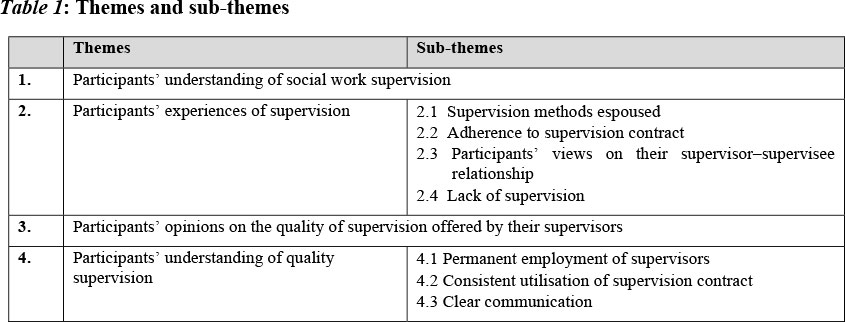
The table below presents the themes and sub-themes that emanated from the collected data.
The key themes that arose from the study data are discussed comprehensively below.
Theme 1: Participants' understanding of social work supervision
The participants provided a range of responses to the question regarding their understanding of social work supervision. Through their narratives the participants indicated that social work supervision entails the provision of support and guidance to supervisees by their supervisors. According to Godden (2012) social work supervision is a process in which an organisation provides supervisory support and guidance to social workers with the intention of enabling supervisors to support their supervisees and building effective professional relationships and developing good practice. The participants also highlighted that when supporting supervisees, supervisors ought to oversee the work of supervisees by holding one-on-one supervision sessions with them. Below are some of their verbatim responses:
In my own understanding I think social work supervision is a process whereby the supervisor provides support and guidance to his or her supervisees in their day-to-day work. It also refers to working hand-in-hand with your supervisor in case maybe you come across some difficulties [then] he or she will be there to offer assistance.
In as far as my understanding goes and expectations, social work supervision entails overseeing the work that the supervisee is expected to do and that will include having one-on-one supervision sessions, trying to understand how supervisees perhaps handle cases, for example, what their challenges are and a supervisee ought to learn from that, which is something very rare.
Based on these comments, social work supervision was understood to entail support, guidance and overseeing the professional duties of the supervisees with the intention of assisting them to handle cases effectively. This suggests that supervision should assist supervisees to deal with challenges and difficulties in their field of work. The participants' narratives confirm the description of supervision by Munson (2002) that supervision is a process of interaction in which the social work supervisor is appointed to assist and provide guidance to the work of the supervisee, particularly in the areas of education, support and administration. The researchers concur with the descriptions of social work supervision provided by the participants, but it seems as though the participants are mostly exposed to administrative supervision and supportive supervision more than educational supervision.
Theme 2: Participants' experiences of supervision
Participants were asked to share their experiences of supervision in terms of supervision sessions and the supervision methods employed by respective supervisors. A handful of participants indicated that they were mostly exposed to individual and group supervision. The participants also shared their experiences in terms of their exposure to the supervision contract and their perceptions of the supervisor-supervisee relationship. This theme was thus divided into four sub-themes, namely supervision methods espoused; adherence to supervision contract; participants' views on their supervisor-supervisee relationship; and lack of supervision. Each of these is discussed below.
Sub-theme 2.1: Supervision methods espoused
The participants reported that they received individual and group supervision. The participants described positive experiences regarding the two supervision methods. Below are some of their comments.
We sometimes have group supervision where we meet as a team and then we discuss issues. When one has got other cases that they feel are personal or they don't need a group, we do one-on-one sessions with the supervisor and I feel she supports us 100%.
My supervisor ensures that the work is done. We do a weekly plan where I plan activities for the week and the supervisor assists me to achieve my goals. She is supportive, she makes sure that whenever I come across the challenges, we sit down and we do individual sessions where we discuss the challenges and how we are going to tackle them.
These excerpts indicate that some participants are exposed to individual and group supervision. It is equally clear from the narratives that the kind of supervision received is mainly informed by what is to be discussed between the supervisor and the supervisee. The quotations also conveyed positive attributes of supervision. It is clear that the supervision sessions assist social work supervisors and supervisees to discuss any challenges that supervisees are facing in their daily work activities. It is also evident that individual supervision is mainly conducted when there are personal or challenging issues to be discussed by the supervisor and the supervisee. The findings are thus consistent with the purpose of individual and group supervision. This is in line with Kadushin and Harkness (2014), who posit that individual supervision affords the social work supervisee the opportunity to make their own decisions and come up with their own solutions when they are confronted with work-related challenges. According to Valentino, LeBlane and Sellers (2016), group supervision is more likely to provide supervisees with opportunities that are unique, thus developing key professional skills, such as peer feedback skills and public speaking skills. It can therefore be deduced from the participants' narratives that both individual and group supervision are beneficial to the supervisees.
Yet the researchers also identified discrepancies in the accounts of the provision of supervision using the identified methods, because according to the participants (i.e. supervisees). supervision is not readily available for them. Below are some verbatim responses from the participants.
We are offered one-on-one supervision [sessions] sometimes not always. Usually when I come across a difficult case, that's when we have supervision session to discuss the case. Therefore, supervision sessions are not done that much, maybe once after a long time, maybe once in three months or six months, depending on the availability of the supervisor at the time. The process is all about the supervisor, she's the one who decides when are we having those supervision sessions.
We have supervision sessions sometimes, not all the times. And then another thing, we are not many in the office, it's only the two of us supervisees under our current supervisor, so we mostly do supervision in a group.
I can say individual supervision happens once in a quarter or maybe after two quarters. She will sit down with all of us, the four of us, try to find out what are the challenges that we are encountering. So, I can say individual supervision, group and peer supervision [sessions] are held maybe once or twice a year.
The above quotations imply that supervision is not formalised in Giyani. It can thus be deduced from the narratives that sometimes individual supervision sessions take place only incidentally when supervisees come across difficult cases that need the attention of the supervisor. Furthermore, there was no consistency in the provision of supervision sessions by the social work supervisors in Giyani, because apparently some supervisors conducted supervision sessions only when they felt like doing so. The study conducted by Bradley, Engelbrecht and Höjer (2010) also revealed that social work supervisees received unstructured supervision and they relied on the informal support of their co-workers when performing their professional duties. Manthosi and Makhubele (2016) also found that supervision in the DSD in Limpopo province is unstructured and social work supervisors often rush the supervision process. Joseph (2017) concurred, finding that there was a lack of regular supervision sessions, with some participants revealing that they received supervision only once per year.
Sub-theme 2.2: Adherence to supervision contract
In this regard, the participants were asked to describe their experiences regarding the supervision contract. There were a range of responses on this matter. Most of the participants reported having had negative experiences regarding the supervision contract, while only a few offered positive remarks. The latter category of participants shared the following comments.
My experience regarding supervision contract is good because it creates an opportunity for me to learn and explore matters relating to the profession. This is because in the contract we stipulate different topics we will focus on during the sessions. For instance, I get an opportunity to research about different policies relating to different issues I am faced with, which include family issues, divorce matters, children matter, and challenges faced by the elderly.
Every year we sign a supervision contract. We usually follow almost all the aspects in the contract. It assists us to keep track of our activities, knowing where to go from now until we finish the whole year. Also, because I believe that the contract is a guideline on how to work, sometimes we divert from it due to other logistics and work schedules and later get back to it.
These findings echo the views of Mokoka (2016) that the supervision contract plays a vital role in social work, because it spells out the conditions for social work supervision. Marc, Makai-Dimeny and Osvat (2014) added that the supervision contract should include the objectives of the supervision and the expected outcomes of the supervision, as well as the frequency of the sessions, the supervision agenda and the place where the supervision will be conducted.
Those who had negative experiences regarding the supervision contract shared the following views.
I think the only time I've seen and have been afforded the opportunity to get involved in the development of my supervision contract was initially when I was employed. For the rest of the time it has been a matter of getting a WhatsApp message being summoned to come and sign.
We usually sign the contract at the beginning of the financial year and that's it. We go back or revisit the contract maybe towards the end of the financial year. As a result, my supervision is never conducted as per the contract that I have signed.
You know what happens with this contract, they just call you and make copies of contract according to the number of their subordinates and then they call you to the office and then you just find everything in black and white and you are expected to sign, that's what happened. This was also the case with my previous supervisors. They will just call you to come and sign and then they forge meetings that never took place, that's what they do.
It is evident from these comments that while most participants acknowledged having signed a supervision contract with their supervisors, they did not receive supervision in accordance with the contract that they signed. It was shocking to find that most of the supervisees were not aware of what was written in their supervision contracts, because they were apparently not afforded an opportunity to read the contents of the contract before signing it and a result they did not know what was expected of them. It was also clear from the participants' comments that the supervision contract was signed only for compliance purposes and that it did not contribute to their professional growth, nor to the supervision process. The Scottish Social Services Council (2016) also found that even when supervision contracts are available to serve as a guide to both the social work supervisor and the supervisee, they may be seen only as a form-filling exercise rather than being perceived as an essential part of the supervision process. The study conducted by Sikhitha (2017) also found that the availability of a supervision contract between the social work supervisor and the supervisee did not motivate supervisors to offer quality supervision to their supervisees. Hence, Manthosi and Makhubele (2016) emphasised the importance of structured supervision and even went so far as to suggest that the DSD in South Africa should come up with plans to ensure that social work supervisors and their supervisees adhere to the supervision contracts. It is thus clear from the narratives that in the Giyani region a supervision contract is also seen as a form-filling exercise because supervision is not provided as per the guidance of the supervision contact and this in turn has implication for the quality of supervision rendered because it means the process is not guided.
The findings of this study show that the availability of a supervision contract does not guarantee the provision of quality supervision by the supervisors. The participants attributed this failure to adhere to the supervision contract to a lack of resources, including human resources.
There are challenges that I have mentioned such as lack of transport and stationery, which becomes a stumbling block for the provision of supervision and service delivery, I think if the department can assist on the issue of transport and stationery, it can help a lot.
I don't think that the contract is being administered correctly. We are just signing those contracts for compliance and one of the causes of that is because supervisors are not appointed in these supervision posts. We have a shortage of supervisors in our area, so because people are not appointed on permanent basis but are delegated, the contract is constructedjust for compliance, it's not adhered to.
The study conducted by Gumbi (2021) also pointed to a lack of resources as one of the factors that negatively affects the implementation of the supervision contract within the DSD. The above findings also corroborate the findings of Maupye (2016) on the perceptions on newly qualified social workers regarding supervision, who also found that lack of resources was amongst the factors impeding with the provision of supervision and implementation of supervision contracts. Therefore, it is deduced in this regard that a lack of resources can impede the implementation of supervision contracts.
Sub-theme 2.3: Participants' views on their supervisor-supervisee relationship
In commenting on their relationship with their supervisor 8 of the 13 participants reported having a good working relationship with their supervisor, as supported by the following narratives.
We have a good relationship with my supervisor, we communicate in all aspects, personal and work-related issues, we don't have any challenges.
My relationship with my supervisor is very harmonious. We communicate on daily basis and whenever I need her she's available. So, I would describe our relationship as good working relationship, professionally also personally there are no grudges or anything that hinders our abilities to execute our duties.
In terms of supervision I will say that the relationship is good, because I am able to discuss cases with her when I don't understand. So, I will say the relationship is good.
However, some participants indicated that they did not have a good professional relationship with their supervisor, as seen from the comments below.
We have no supervisor-supervisee relationship because we don't communicate.
Unfortunately, I have none. I only communicate with my supervisor when she needs the stats, when I need to report, when I must give her a weekly report of what I have done, that's when I communicate with my supervisor. She only came to my office when they were welcoming me here [seven months prior to the interview], she only came to show me the office and that was it. So, I can't say we have a relationship, she's just there to sign my documents.
Personally, the relationship is good but professionally I can say that we lack a good relationship. We don't have a bond. We are far apart; she doesn't even know what I am doing.
I think what is lacking is the involvement [of the supervisor] in what I do, because you will recall I said she is a delegated supervisor. There are times when I would ask for something and my supervisor will tell me she doesn't know why she is troubling herself... you know... helping me because she is not even my official supervisor. So, such experiences limit the nature of relationship that we have.
It is therefore evident that a supervisor-supervisee relationship can either be good or poor. In this study it was found that a poor supervisor-supervisee relationship is characterised by poor communication and that it has negative implications for the supervision process. This corroborates the study by Ladany, Mori and Mehr (2013), who found that a poor supervisor-supervisee relationship could negatively affect the provision of quality supervision. This was found to be the case in Giyani. As noted above, the researchers' reason to conduct the study in the Giyani region emanated from social work supervisees who always sought professional advices from other social worker(s) on the cases they were handling instead of asking their immediate supervisors. Ironically, among the participants who reported that they had a poor supervision relationship with their supervisors, some reported having good personal or collegial relationships. It can thus be deduced from the participants that having good personal relationship with the supervisor sometimes does not necessarily translate into having a good professional relationship with the supervisor.
Sub-theme 2.4: Lack of supervision
The participants reported that they seldom received formal supervision. They articulated their challenges regarding a lack of supervision as follows.
My experience of supervision is not good. This is because we meet with our supervisor maybe once after a month. In most cases we use our phones to call them or to consult instead of them arranging formal sessions so they can ask us about our challenges. We have a lot of challenges in our offices but our supervisors [are not available to provide supervision] ... we have to call them always.
That is a very interesting question because I've never had a one-on-one supervision session with my supervisor. What has happened in the past is that I would be given supervision forms to [fill in] on my own and then sign and then date the supervision sessions and submit to my supervisor.
My experience with supervision has ups and downs because okay normally our supervision contract states that we should have a supervision session once per quarter; that means it is four times a year and indeed we do hold individual supervision sessions once per quarter. However, my challenge with this arrangement is that sometimes as a supervisee you will see that this supervision session is being held to meet the mandate of the employer, not necessarily to serve my interest. Hence, I am saying there are ups and downs.
Judging by these remarks, it appears that social work supervisors in Giyani are not offering formal supervision sessions. The participants indicated that they mostly receive informal supervision only when they called their supervisor to arrange some sort of meeting so that they could discuss their challenges. It is also clear that those social work supervisees who are fortunate enough to receive formal supervision don't receive any professional guidance during such sessions, since the latter are usually geared towards fulfilling the administrative tasks of the employing department. The study conducted by Eagan (2012) revealed that a lack of supervision was one of the main problems for social work practitioners. Manthosi and Makhubele (2016) add that poor service delivery by social work supervisees to their clients is sometimes a result of their receiving poor or inadequate supervision. This study shows that something needs to change if the purpose of supervision is to be achieved. According to Engelbrecht (2013), if the structured supervision of social workers is not improved, supervision will be considered obsolete rather than being recognised for the highly skilled and specialised professional activity that it is. The researcher's view is that the South African Council for Social Service Professions, which regulates the professional conduct of social workers in the country should ensure that all employers of social workers adhere to the supervision framework. The researchers are further of the view that lack of supervision does not only reflect badly on the social work profession, but also on the professional body that regulates the social work profession.
Theme 3: Participants' opinions on the quality of supervision offered by their supervisors
The findings in this regard were antithetical: some participants reported receiving poor supervision, while others claimed that they had received good supervision from their supervisors. However, it is noteworthy that most of the participants (10 of the 13) reported that they were not given quality supervision by their respective supervisors. These participants cited various challenges that they had experienced with their supervisors to illustrate the poor quality of supervision provided.
No, a big no, because we have never engaged on anything as a supervisor and a supervisee. Like I said, the only time we communicate is when I must give her a weekly report of the things I have done. I was doing generic [social work] and suddenly, I must do psychiatric social work. I have never in my life of social work practice had to deal with this kind of social work. Let me put it this way, since I started, I have never called my supervisor for assistance or she has never called to ask how I was doing, how well I was coping. So, there's nothing, she just supervises me when there are documents that need to be signed that's when she supervises me.
No, I don't think so, because firstly my supervisor is working far away from us and she does not assist us with tools of trade. Sometimes you find that we do not have any stationery to use in the office, you find that we are stuck, I think no, is a no.
The quality of supervision is extremely poor, because number one personally I don't have a supervisor. She is someone who has volunteered to assist me sometimes when things get too tough or when I meet serious challenges. Again, my supervisor is delegated to supervise me, so sometimes she absolves herself from the responsibilities and accountabilities of some cases. Her only involvement would be in minor things like perhaps where I would need her signature or the go ahead to do a certain task. It is extremely poor.
In a study by Godden (2012) the social worker participants also expressed their concerns about inadequate supervision, a lack of quality supervision and, in some cases, the total absence of supervision. The study conducted by Maupye (2016) also revealed that although some of the participants were aware of the importance of supervision, they reported a lack of supervision offered by their respective supervisors. Artan et al. (2018) found that in such circumstances participants are likely to perceive supervision as a short-term intervention, because the supervision of social workers does not occur consistently in the social work profession.
Furthermore, as alluded to earlier, only a few participants (3 of 13) in this study indicated that they received high-quality supervision from their supervisors.
I think I am offered quality supervision because whenever I need assistance with issues that I face at work, my supervisor is always there to support and then when she's not there, she will delegate or ask other supervisors to assist on the matter.
I think for a delegated [supervisor] she offers quality supervision, because there are sometimes instances where she goes an extra mile in offering me assistance. If I am struggling with a case, she's able to ensure that at the end of the day we find the solution.
It is clear from the participants' responses that within the DSD in the Giyani region there are some social work supervisors who render quality supervision to their supervisees; these participants indicated that their supervisors offer them assistance and support according to their needs. The study conducted by Joseph (2017) found that quality supervision provided an overwhelming number of significant benefits and all the participants who had received such supervision affirmed that it had assisted them in dealing with their stress levels and enabled them to offer effective interventions to their clients. In the study conducted by Mak (2013) 100% of the supervisees agreed that providing adequate quality supervision directly affects the provision of services to the clients. Clearly, social work supervision is crucial and beneficial for the social work practitioners when it is executed properly (Wynne, 2020).
Theme 4: Participants' understanding of quality supervision
For the researchers to determine the perspectives of supervisees regarding the quality of supervision that they receive in the Giyani region, the participants were asked to provide their general understanding of quality supervision by identifying those aspects that constitute quality supervision. According to Solihull Metropolitan Borough Council (n.d.), quality supervision implies that the supervisor should support social work supervisees to improve the outcomes for the clients they work with and ensure that statutory responsibilities are properly exercised and accountability ensured. The participants in this study provided a variety of responses, which the researchers divided into the main theme and the following three sub-themes: permanent employment of supervisors; consistent utilisation of supervision contract; and clear communication. These sub-themes are discussed below.
Sub-theme 4.1: Permanent employment of supervisors
Some participants referred to the need for the permanent appointment of supervisors in supervision posts. Several participants (10 of the 13) reported that they were supervised by supervisors who were only delegated to supervise. The participants believed that if the supervisor were appointed permanently, they would be able to provide them with quality supervision, because the supervisor would have proven their supervision competence during their job interview.
For me what would constitute quality social work supervision is when a supervisor is formally appointed to the supervision position. This is because in my organisation sometimes supervisors are delegated to assist with supervision, whilst they themselves are appointed as social workers and when delegated they do not give their full attention to the job and sometimes it could be because they may not even have what it takes to do the job; instead they may be just doing the job because they are delegated. So, if they are appointed on permanent basis in the post, for me it would constitute quality social work supervision because they will know what they are doing, they would have contested for that post.
The researchers found noteworthy the perception that the quality of supervision rendered by a delegated supervisor would be compromised for a number of reasons:, firstly, because a delegated supervisor is employed as a social worker with their own caseload and is asked to take on the unpaid task of supervising over and above their own workload; secondly, their credentials (knowledge and practical experience) had not been tested during a formal interview; and thirdly, they are not trained to provide supervision. Our observation is thus that these challenges are a result of the fact that the delegated supervisors in the Giyani region do not feel obliged to offer supervision to their supervisees, because they are not compensated for their services. Sixty-two percent (62%) of participants in the study by Sikhitha (2007) also revealed that their supervisors were not formally appointed to their supervisory positions and that, as a result, these cohorts of delegated supervisors were experienced as not being fully committed to their supervisory duties, which led to the erratic performance in the execution of their supervision function. The study conducted by Goliath (2018) also revealed that 7 of 20 participants rendered supervision without any supervision training. The researchers are thus of the view that delegating social workers to act as supervisors and without adequate supervision training affects the services that supervisees provide to their clients and that this in turn brings the social work profession into disrepute.
The researchers further contend that an appointed supervisor may be more likely to offer quality supervision to supervisees than would a delegated supervisor. The study conducted by Wynne (2020) found that supervision may lead to many supervisees' experience of supervision as more harmful than helpful, because supervisors were often unable to recognise harmful supervision of themselves or in what they impose on supervisees. Our view is that although there are challenges when it comes to the provision of quality supervision, various research publications (Baloyi, 2017; Bhuda, 2019; Engelbrecht, 2010, 2013; Goliath, 2018; Kadushin & Harkness, 2014; Manthosi & Makhubele, 2016; Munson, 2002; Ross & Ncube, 2018; Shokane et al., 2017) have upheld the significance of social work supervision and hailed its value in supporting supervisees emotionally, educationally and administratively; consequently, it also contributes to effective service delivery to the clients. The researchers are of the view that there is a need for supervisors to also be subjected to scrutiny by management to guard against harmful supervision and this scrutiny should also be formalised in the Supervision Framework for Social workers in South Africa.
Sub-theme 4.2: Consistent utilisation of the supervision contract
Some participants (3 of the 13) referred to the establishment of the supervision contract as an essential component of ensuring quality supervision. According to these participants, the social work supervisor should facilitate the development of the supervision contract with the supervisee and must also ensure that supervision is carried out as per the agreement. Some of the participants' views are captured below.
For social work supervision to be quality, I think firstly it must be consistent. For example, if we compile a supervision contract where we agree that every month we will meet to discuss cases, then we should meet as per the agreed upon supervision contract. So, it should be consistent.
I think the supervisor must provide supervision based on the supervision contract and ensure that us as supervisees adhere to the contract.
Similarly, Falender (2014), in his study on clinical supervision in a competency-based era, found that quality supervision should establish a solid supervision alliance by means of the development of the supervision agreement or contract between the supervisor and the supervisee. Illing (2019) also suggests that quality supervision would ensure that the social work supervisor and their supervisees all have the same understanding of the purpose of the supervision to be offered according to the supervision contract. Though the researchers concur that the utilisation of a supervision contract is essential in ensuring the provision of quality supervision, the researchers noted that this practice is not being adhered to by most supervisors in the Giyani region. The researchers are further of the view that if there are no mechanisms in place to monitor adherence to the supervision contract, the contract will just remain a meaningless piece of paper for many supervisees in the Giyani region.
Sub-theme 4.3: Clear communication
The importance of clear lines of communication between supervisors and supervisees was identified as a significant element of quality social work supervision by a handful of participants. According to Sharma and Sharma (2015), clear communication refers to an interpersonal process in which information is shared and understood by all the people who are intended to receive such a message. The distinctive features of quality supervision, as suggested by Marc et al. (2014) and Hirst (2019), include the supervisor's ability to provide a healthy supervisory relationship which is based on trust, transparency and openness, the supervisor's ability to provide guidance to the supervisees, the supervisor's ability to foster a learning environment and provide performance feedback to the supervisees, and the supervisor's ability and skills of communicating availability and interest to the supervisees. The participants in this study also indicated that quality supervision should include good communication between the social work supervisor and their supervisees, because this would enable supervisees to approach their supervisor freely when they encounter challenging cases. The following statements represent some of their views.
In my opinion what would constitute quality supervision will be first of all communication... actually not just communication, great communication between the supervisor and the supervisee. The channels of communication should be open in a way that if a supervisee has a case that he or she is finding it difficult to handle, he or she should openly seek advice and assistance from his or her supervisor and have confidence that the supervisor will be able to help so as to provide quality services to our clients.
Also, what constitutes great supervision is that the supervisor should always be available and communicate with the supervisees and also try to find outfrom the supervisees about anything that they need such as resources and be at the forefront knowing the challenges of the supervisees.
The participants' narratives corroborate the findings in the literature. For example, Ladany et al. (2013) are of the view that a high-quality supervisor makes allowance for an open discussion with the social work supervisee. Mak (2013) adds that a positive communication environment between the social work supervisor and the supervisee can simultaneously ensure supervisees' job satisfaction and better job performance. It is therefore essential for supervisors to be intentional in their engagement with their supervisees because, according to Aasheim (2012), a social work supervisor who is always busy, struggling with their own heavy caseload or unreceptive to supervisees, is unlikely to provide effective supervision. The researchers concur with these findings as they believe that good communication between the supervisor and the supervisee will open up space for discussion, which will subsequently lead to the offering of quality supervision by supervisors to their respective supervisees.
It was interesting to discover that the participants cited aspects of clear communication, permanent employment of supervisors and consistent utilisation of the supervision contract as essential components for quality supervision, because these aspects are already covered in the Supervision Framework for Social Work in South Africa as well as in the Generic Norms and Standards for Social Welfare Services on social work supervision. For instance, amongst other requirements, the Supervision Framework for Social Work in South Africa specifies that supervision functions and sessions should be structured (Department of Social Development, 2012), while the Generic Norms and Standards for Social Welfare Services on supervision specifies that the supervision of social welfare service practitioners and students is an integral and on-going part of professional practice (Department of Social Development, 2013). This suggests that the supervisors in the Giyani are not fully compliant with the provisions of the said policies, which are readily available to them.
CONCLUSIONS AND RECOMMENDATIONS
The researchers conclude that the participants had a clear understanding of what social work supervision is. They recognised that social work supervision entails the provision of support and guidance to supervisees by their supervisors - a point amply corroborated in the social work literature. It has also been found in this study that social work supervision is riddled with challenges, which results in the participant supervisees receiving poor supervision. The participants attributed the poor supervision to the fact that their supervisors are only delegated to the supervision position, not appointed. The implication is that the supervisees never receive formal supervision, support or guidance, because the delegated supervisors must contend with their own workload, over and above their supervision responsibilities. The underutilisation of the supervision contract was also mentioned as a hindrance in this regard, because although supervisors and supervisees do sign the supervision contracts annually, it seems as though the contracts in the DSD Giyani region are merely completed for the sake of compliance. The participants reported that sometimes the contract is not even discussed with them, so they sign it blindly, which means they are often not aware of its contents.
From the findings, this study concludes that quality supervision implies that social work supervisors should always be available to, and actively involved in the work of, their supervisees, offering professional and educational support. This study also concludes that for quality supervision to be achieved, a few conditions need to be met. Firstly, it has been established that a supervision contract is one of the essential components for ensuring quality supervision. This finding shows that supervisees are aware that their supervision relationship should be regulated by means of a supervision contract and they expressed their wish for formal supervision sessions to be conducted in line with their supervision contract. The supervisees also wanted their supervisor to be readily available to them, thereby fulfilling the terms and conditions of the contract. Secondly, a good supervisor-supervisee relationship was regarded as an essential component of quality supervision and would entail clear communication channels between social work supervisors and their supervisees, affording a supervisee the opportunity to discuss any challenges with their supervisor, as and when necessary. Lastly, the participants indicated that supervisors must be permanently appointed to their supervisory position, because then the supervisor would be committed solely to their supervision function.
The researchers accordingly recommend that the DSD and other social work agencies should ensure that the supervision framework is adhered to, because the framework provides guidelines for the way that supervision ought to be carried out. The researchers also recommend that the Supervision Framework for Social Workers in South Africa should be reviewed every five years to ensure that it remains up to date with the new developments in the social work profession. The study also recommends that supervisors in the Giyani region should be appointed not delegated; this is because the poor supervision received by the participants is mostly attributed to the fact that 10 of the 13 participants were supervised by delegated supervisors. Another recommendation is that anonymous reviews of supervisors be completed by employment agencies as a method of making sure that supervisors do render supervision. Future research is also recommended in this regard to investigate the quality of supervision in other DSD regions/districts and provinces. It would also be necessary to develop an intervention tool/model/programme by employing a quantitative approach that would allow for a large sample size of participants, thus enabling generalisation of the research findings.
REFERENCES
- Aasheim, L. 2012. Practical clinical supervision for counsellors: An experiential guide. New York: Springer.
- Artan, A., Ozkan., A. O. & Acikgozi, N. 2018. Evaluation of supervision needs of social workers working in different professional fields. Turkish Journal of Applied Social Work, 1(1): 75-84.
- Ashcroft, R., Sur, D., Greenblatt, A. & Donahue, P. 2022. The impact of Covid-19 pandemic on social workers at the frontline: A survey of Canadian social workers. British Journal of Social Work, 52: 1724-1746.
- Baloyi, T. 2017. Experiences of social work supervisors on supervising inexperienced social workers in the Department of Social Development Malamulele Area Office. Master's thesis. University of Limpopo, South Africa.
-
Bhattacherjee, A. 2012. Social sciences research: Principles, methods, andpractices. 2nd edition. USA: Creative commons attributions-non-commercial-share alike 3.0 [Online] Available: https://digitalcommons.usf.edu/cgi/viewcontent.cgi?article=1002&context=oa_textbooks
» https://digitalcommons.usf.edu/cgi/viewcontent.cgi?article=1002&context=oa_textbooks - Bhuda, G. B. 2019. Supportive supervision: A model for social work supervisors. Doctoral thesis. University of South Africa, Pretoria, South Africa.
- Bless, C., Higson-Smith, G. & Sithole, S. L. 2013. Fundamentals of social research methods: An African perspective. 5th edition. Cape Town: Juta Education.
- Bourn, D. & Hafford-Letchfield, T. 2011. The role of social work professional supervision in conditions of uncertainty. International Journal of Knowledge, Culture and Change Management, 10(9): 41-54.
- Bradley, G., Engelbrecht, L. K. & Höjer, S. 2010. Supervision a force for change? Three Stories Told. International Social Work, 53(6): 773-790.
- Creswell, J. W. 2013. Qualitative inquiry & research design: Choosing among five approaches. 3rd edition. Los Angeles: Sage.
- Creswell, J. W. 2014. Research design: Qualitative, quantitative and mixed methods approaches. 3rd edition. Thousand Oaks, California: Sage.
- Department of Social Development. 2006. Recruitment and Retention Strategy for Social Workers. Pretoria: Government Printers.
- Department of Social Development. 2012. Supervision framework for the social work Profession in South Africa. Pretoria: Department of Social Development
- Department of Social Development. 2013. Generic norms and standards for development of social welfare service. Pretoria: Department of Social Development
- Dominelli, L. 2020. A green social work perspective on social work during the time of Covid-19. International Journal of Social Welfare, 30(1): 7-16.
- Doody, O. & Noonan, M. 2013. Preparing and conducting interviews to collect data. Nurse Researcher, 20(5): 28-32.
- Eagan, V. R. 2012. Social work supervision practice in Australia: Does the rhetoric match the practice? Doctoral thesis. University of Melbourne, Australia.
- Engelbrecht, L. K. 2006. Plumbing the brain drain of South African social workers migrating to the UK: Challenges for social service providers. Social Work/Maatskaplike Werk, 42(2): 101-121.
- Engelbrecht, L. K. 2010. Yesterday, today and tomorrow: Is social work supervision in South Africa keeping up? Social Work/Maatskaplike Werk., 4(3):324342.
- Engelbrecht, L. K. 2013. Social work supervision and frameworks: Playing notes or making music? Social Work/Maatskaplike Werk, 49(4): 456-468.
- Engelbrecht, L. K. 2018. Contemporary practices in social work supervision: Time for new paradigms? European Journal of Social Work, 21(3): 329-332.
- Falender, C. A. 2014. Clinical supervision in a competency-based era. South African Journal of Psychology, 44(1): 6-17.
-
Faukner, S. L. & Trotter, S. P. 2017. International Encyclopedia of Research Methods. [Online] Available: http://www.onlinelibrary.wiley.com [Accessed: 30/09/2020].
» http://www.onlinelibrary.wiley.com - Flick, U. 2018. The Sage handbook of qualitative data collection. Los Angeles: Sage.
-
Godden, J. 2012. BASW/COSW England research on supervision in social work practice with particular reference to supervision practice in multi-disciplinary teams. [Online] Available: https://silo.tips/download/basw-cosw-england-research-on-supervision-in-social-work-with-particular-referen
» https://silo.tips/download/basw-cosw-england-research-on-supervision-in-social-work-with-particular-referen - Goliath, J. 2018. Management functions offrontline social workers supervising social auxiliary workers. Master's thesis. Stellenbosch University, South Africa.
- Grinnel, R. & Unrau, Y. 2011. Social work research and evaluation: Foundations of evidence-based practice. New York: Oxford.
- Gumbi, S. N. 2021. Exploring the experiences of social work practitioners and supervisors on the implementation of social work supervision in the department of social development: A case study of King Cetshwayo District Municipality. Master's thesis. University of KwaZulu-Natal, South Africa.
- Hirst, V. 2019. Burnout in social work: The supervisor's role. Aoteroa New Zealand Social Work, 31(3): 122-126.
- Illing, J. 2019. The Characteristics of Effective Clinical and Peer Supervision in the Workplace: A Rapid Evidence Review. UK: Newcastle University.
- Jasper, C. & Field, P. 2016. An active conversation each week in supervision: Practice educator experiences of the professional capabilities framework and holistic assessment. British Journal of Social Work, 46(6): 1636-1653.
- Joseph, D. 2017. Perceived contributory factors impeding job satisfaction of social workers in Non-Governmental Organisations. Master's thesis. Stellenbosch University, Stellenbosch, South Africa.
- Kadushin, A. & Harkness, D. 2014. Supervision in social work. 5th edition. New York: Columbia University Press.
- Kasiram, M. 2009. The emigration of South African social workers: Using social work education to address gaps in provision. Social Work Education, 28(6): 646-654.
-
Kheswa, J. 2019. Factors and effects of work-related stress and burnout on the well-being of social workers in the Eastern Cape Province, South Africa. SA Journal of Industrial Psychology, 45: a1661. https://doi.org/10.4102/sajip.v45i0.1661.
» https://doi.org/10.4102/sajip.v45i0.1661 -
Krefting, L. 1990. Rigor in qualitative research: The assessment of trustworthiness. [Online] Available: https://www.ajot.aota.org [Accessed: 28/09/2020].
» https://www.ajot.aota.org - Ladany, N., Mori, Y. & Mehr, K. E. 2013. Effective and ineffective supervision. The Counselling Psychologist, 41(1): 28-47.
- Lincoln, Y. S. & Guba, E. G. 1985. Naturalistic inquiry. Newbury Park, CA: Sage.
- Mak, M. A. 2013. Supervision training needs: Perspectives of social work supervisees. Master's thesis. Saint Paul, Minnesota: St. Catherine University.
- Manthosi, F. L. & Makhubele, J. C. 2016. Impact of supervision on social workers' job performance: Implications for service delivery. (SAAPAM). Limpopo Chapter 5th Annual Conference Proceedings. University of Limpopo, Turfloop, South Africa.
- Marc, C., Makai-Dimeny., J. & Osvat, C. 2014. The social work supervisor: Skills, roles, responsibilities. Bulletin of the Transilvania University of Brasov, Series VII: Social Sciences and Law, 7(56): 222-230.
- Maupye, M. V. 2016. Perceptions on newly qualified social workers regarding supervision within the Department of Social Development in the Limpopo Province, South Africa. Master's thesis. University of Witwatersrand, South Africa.
- Mbau, M. F. 2005. The educational function of social work supervision in the Department of Health and Welfare in the Vhembe District of the Limpopo Province. Master's thesis. University of Pretoria, South Africa.
- Mboniswa, M. B. 2005. Perspectives of social workers regarding supervision in the Department of Social Development, Johannesburg. Master's thesis. University of Pretoria, South Africa.
- Miles, M. B., Huberman, A. M. & Saldana, J. 2014. Qualitative data analysis: A methods sourcebook. 3rd edition. USA: Sage.
-
Mkhize, N. 2015. Bursaries for social work students. [Online] Available: https://www.Vukuzenzele.gov.za/bursaries-social-work-students [Accessed: 02/06/2022]
» https://www.Vukuzenzele.gov.za/bursaries-social-work-students - Mokoka, L. 2016. The experiences of social work supervisees in relation to supervision within the Department of Social Development in the Johannesburg Region. Master's thesis. University of South Africa, South Africa.
- Munson, C. E. 2002. Handbook of clinical social work supervision. 3rd ed. New York: The Harworth Social Work Practice Press.
- Nadesan, V. 2020. Social work supervision in a developing country: Experiences of students. The Indian Journal of Social Wok, 81(3): 263-282.
- Naidoo, S. 2004. The social work profession in South Africa. Qua Vadis? Doctoral thesis. University of KwaZulu-Natal, South Africa.
- O'Donoghue, K. & Tsui, M. 2013. Social work supervision research (1970-2010): The way we were and the way ahead. British Journal of Social Work, 1-18.
- Ornellas, A. Engelbrecht, L. & Atamturk, E. 2020. The fourfold neoliberal impact on social work and why this matters in times of the Covid-19 pandemic and beyond. Social Work/Maatskaplike Werk, 3(1): 235-249.
- Ross, E. & Ncube, M. 2018. Student social workers' experiences of supervision. The Indian Journal of social work. 79(1): 31-51.
- Ruane, J. M. 2016. Introducing social research methods: Essentials for getting the edge. United Kingdom: Wiley Blackwell.
- Rwomire, A. & Raditlhokwa, L. 1996. Social work in Africa: Issues and challenges. Journal of Social Development in Africa, 11(2): 5-19.
- Sharma, S. & Sharma, R. 2015. Effective communication. Scholar Research Journal for Interdisciplinary Studies, 3(17): 3151-3156.
-
Scottish Social Services Council. 2016. Supervision learning resource. [Online] Available: https://www.stepintoleardership.info [Accessed: 16/11/2020].
» https://www.stepintoleardership.info - Shokane, F. F., Makhubele, J. C., Shokane, A. C. & Mabasa, M. A. 2017. The Integrated Service Delivery Model. Challenges regarding the implementation of Social Work Supervision Framework in Mopani District Limpopo Province. The 2nd Annual International Conference on Public Administration and Development Alternatives, 26-28 July 2017, Notlo Hotel. Gaborone, Botswana. Turfloop: University of Limpopo.
- Sikhitha, T. M. 2018. Supervision expectations of social workers in Vhembe District of Limpopo Province. Doctoral thesis. University of Limpopo, South Africa.
- Slisco, M. 2022. Social workers experiences during Covid-19. Master's thesis. San Bernardino: California State University, United States.
-
Solihull Metropolitan Borough Council. n.d. Guidance and procedures for social work staff and managers supervision. [Online] Available: https://solihullcs.proceduresonline.com/p_sw_staff_man_supervis.html [Accessed: 17/03/2023].
» https://solihullcs.proceduresonline.com/p_sw_staff_man_supervis.html -
Timan, J. 2021. Mass exodus of social workers ends - But the damage has been done. Leigh Journal News Paper, 23 August 2021. [Online] Available: https://www.leighjournal.co.uk/news/ [Accessed: 14/02/2022].
» https://www.leighjournal.co.uk/news/ -
Trafford CYPS Social Work Supervision Policy. 2013. Trafford Council. [Online] Available: https://www.trafford.gov.uk>docs [Accessed: 17/11/2020].
» https://www.trafford.gov.uk>docs - Valentino, A. C., LeBlane, L. A. & Sellers, T. P. 2016. The benefits of group supervision and the recommended structure for implementation. Behaviour Analysis in Practice, 9(4): 320-328.
-
Waters, M. 2013. SA has a 77% social worker shortage. Politicsweb. [Online] Available: https://www.politicsweb.co.za/politics/sa-has-a-77-social-worker-shortage-mike-waters [Accessed: 05/02/2022].
» https://www.politicsweb.co.za/politics/sa-has-a-77-social-worker-shortage-mike-waters - Weinhardt, M. 2020. Ethical issues in the use of big data for social research. Historical Social Research, 45(3): 342-368.
- Wynne, T. 2020. Potential factors contributing to harmful supervision of social workers. Master's thesis. Stellenbosch University, South Africa.
- Zvomunya, W. 2021. The impact of Covid-19 pandemic on social work education and practice. African Journal of Social Work, 11(4): 189-200.
Article accepted: 04/10/2023
Article published: 14/06/2024
AUTHOR BIOGRAPHY
Tsunduka Maluleke was a Master of Social Work student at the University of South Africa and is currently a Doctorate candidate at the same institution. He is employed as a social worker grade 03 at the Department of Social Development, Limpopo province. His field of specialisation is childcare and protection. The article resulted from his Master's dissertation, conducted from January 2020 to December 2021, and he wrote the initial draft of the article with the assistance of his supervisor.
Gladys Bathabile Bhuda is senior lecturer within the Department of Social work at Unisa. Her research speciality includes social work supervision, social work management as well as social work in health. She supervised the study from January 2020 to December 2021 and assisted with the interpretation of the study's empirical data and the conception of the article.