What motivates mothers to apply a positive parenting approach? A qualitative study
Abstract
Few studies to date have explored the perceptions of parents about positive parenting in general, and none have examined parents' motivation to apply a positive parenting approach. Consequently, the aim of this study was to explore what motivates parents to apply a positive parenting approach. Participants were recruited in South Africa by means of non-probability purposive sampling. Semi-structured interviews were conducted to gain the perspectives of sixteen mothers who identified themselves as positive parents. Participants responded to the following open-ended question: "What motivates you to apply a positive parenting approach?" After a thematic analysis, the following four categories (with themes and subthemes) emerged from the data: It is who I am, It just works, Gaining knowledge through learning and resources, and The importance of social support. The findings of the study may be utilised in interventions to encourage parents to adopt a positive parenting approach and may provide guidance on how to maintain these parenting skills to empower themselves and their children.
authoritative parenting; child-centred; mothers' perspective; motivation; positive parenting
INTRODUCTION
Parenting styles have changed significantly over time, partly influenced by studies that have been dedicated to the negative effects of harsh and inflexible parenting, along with an increase in access to information - largely available via the internet and social media (Silva & Pugh, 2010; Trifan, Stattin & Tilton-Weaver, 2014). The last few decades have seen society shift from a predominantly authoritarian parenting style towards an authoritative parenting style, which is more child-centred in nature and has been proven to have positive effects for both parent and child (Baumrind, 2012). One parenting style (or approach) that has been growing in popularity is positive parenting, which is characterised by warmth, structure, and mutual respect. Using this approach, parents use non-violent, non-shaming discipline to foster problem-solving. The parent guides rather than exerts control over the child, and mistakes are used as learning opportunities. In this approach, both kindness and empathy are used within clearly defined boundaries (Eanes, 2016; Nelsen, Erwin & Duffy, 2015).
Although there has been an increase in research to understand parenting (Farzand, Çerkez & Çavusoglu , 2017), only limited qualitative research has reported the perspective of parents and what motivates them to adopt a particular parenting approach such as positive parenting (Linley, Stephen, Harrington & Wood, 2006). In recent years there has been an influx of books, courses, blog posts and intervention programmes on positive parenting. These are written by parenting educators who advise parents on techniques and practices that enhance the parent-child relationship (Eanes, 2016; Morrill, Hawrilenko & Córdova, 2016; Nelsen et al., 2015). In addition, several studies have reported on positive parenting and the outcomes of interventions aimed at improving poor parenting practices (Breen, Daniels & Tomlinson, 2015). The growing interest in teaching positive parenting techniques in interventions is primarily concerned with families considered at risk and is aimed at improving poor parenting practices (Breen et al., 2015; Morrill et al., 2016).
This study was conceptualised in the positive psychology paradigm (Seligman & Csikszentmihalyi, 2000) and guided theoretically by parent development theory (Mowder, 2006). Mowder's (2006) theory acknowledges the important contribution that an understanding of the thoughts and feelings of the parent in the development of their parenting role could make to existing knowledge. Mowder (2006) sees parental development as a complex combination of the parent's own experiences, needs and life circumstances, in conjunction with the ever-changing needs and development of their child.
In accordance with the vision of the Revised White Paper on Families in South Africa (Republic of South Africa, 2021:189), namely "[t]o promote safe, supportive, nurturing, and resilient families as a core unit of society", the findings of this study may assist social workers in their interventions and their understanding and appreciation of what it means to be a parent, and how parents may view and value their parenting motivation. Furthermore, such focused interventions will enhance family functioning and contribute towards more caring families in South Africa.
Given that little attention has been paid in the literature to the motivations and experiences of parents already putting into practice a positive parenting approach, this study's research question is: What motivates parents to apply a positive parenting approach?
METHOD
This study uses an exploratory qualitative research design. Thematic analysis (Braun & Clarke, 2006) was used to analyse the qualitative data collected using semi-structured interviews.
Participants
Participants from South Africa were recruited by means of non-probability purposive sampling. Only mothers were included in this study, because mothers are still perceived by societal norms to be the primary caretakers (Jungert et al., 2015). Participants needed to be over 18 years of age, and their oldest child no more than 10 years of age. Middle childhood ends at age 11, and the parenting demands differ for children entering adolescence (Keenan, Evans & Crowley, 2016).
Because of the number of individuals who follow positive parenting Facebook groups (Kerner, n.d.), participants who used this social media platform were sought. Permission was obtained from the administrators of various groups. Following this, an advertisement with inclusion criteria was posted in five parenting groups followed by those interested in a positive or gentle parenting approach. To assist parents in self-identifying as positive parents, they needed to answer yes to all the following criteria (Nelsen et al., 2015): 1) Do you try to the best of your ability to parent with warmth, understanding and respect for your child as an individual with their own wants, needs and goals? 2) Do you find that your expectations of your child's behaviour take into consideration what might be considered normal at their stage of development? 3) Do you use non-violent discipline techniques that aim to teach and guide rather than punish? 4) Do you use positive praise and encouragement, trying to point out more of your child's strengths than the areas that they need to improve? 5) Do you focus on finding solutions to problems that will be mutually beneficial to you and the child? Mothers willing to participate in the study and who believed they met the criteria then approached the first author of this article via Facebook inbox or by email to volunteer to participate in the study. These volunteers were then contacted, and interview times and dates were scheduled. For those prospective participants in closer proximity (n = 8), face-to-face interviews were scheduled, and for those located further away (n = 8), Skype interviews were held (Seitz, 2015). Participants were recruited until data saturation occurred, which happened after the 16th interview.
All 16 participants were proficient in English. For 12 participants, English was their first language, for three Afrikaans was their first language (with English as a second language), and one participant was bilingual (English and Afrikaans). The requirement that a participant must be proficient in English excluded many possible participants and limits the generalisability of findings. Participants' ages ranged from 24 to 51 (mean age of 36). All the mothers had completed Grade 12, with 14 of them having higher qualifications, such as certificates, diplomas, or degrees. Fourteen mothers self-identified as middle-income, one as higher-income and one as lower-income. Thirteen of the mothers were married, two were cohabiting, and one was a single mother. Eleven participants resided in the Western Cape province, two in Gauteng province, one in the Northern Cape province, and one in the KwaZulu-Natal province of South Africa. The participants' occupations ranged from home executive (stay-at-home mothers) to consultants, managers, teachers, and women working in health care.
Half of the mothers had a single child, and the others each had two children. The children's ages ranged from five months (those with infants also had an older child) to 9 years (mean age 3 years). Seventeen of the 24 children were younger than 5 years, and the remaining seven were between 6 and 9 years of age. Twelve children were female and twelve were male, and all the children resided with their parents.
Data collection
The data were collected during the second half of 2019 by means of semi-structured interviews in English. Interviews were guided by open-ended and probing follow-up questions. The first statement (Tell me about your parenting) aimed at easing the parents into the interview. The following three questions became more specific and related to the research question: 1) Tell me a bit about why you apply a positive parenting approach? 2) What do you think motivated or motivates you to apply positive parenting? 3) What do you find helpful and supportive about being a positive parent? The interviews lasted for 30 to 60 minutes.
Procedure
Contact was made with the participants following their response to the advertisement. A consent form, explaining the purpose of the study and what it would entail, was sent to the participants in advance, so that they would have time to ask questions or request clarity before the interview. The rights of the participants were stipulated, which included a guarantee of privacy, anonymity, an explanation of the voluntary nature of the study, as well as their right to withdraw from the study without consequences for them.
The face-to-face interviews began by explaining and going through the consent form with the participants, which they then signed. The biographical questionnaire was completed next. For those being interviewed using Skype, the consent document was signed during the interview and, following the interview, was scanned, and then emailed by the participant to the first author. Permission was obtained to audio-record the interviews.
Data analysis
The data were analysed thematically during the first half of2020 by implementing the six steps outlined by Braun and Clarke (2006). The ATLAS.ti (2015) computer software program was utilised to organise, code, and compare the data. After data familiarisation, initial codes were generated, and these codes were then grouped into repeating patterns. From this, codes were combined into overarching ideas, which became themes with subthemes. Each theme was reviewed in relation to the research question, and a write-up of the findings was done - not only a description, but also an interpretation and indications of their relevance (Braun & Clarke, 2006). The data-analysis process took place in close collaboration between the first author and the second author.
Ethics and trustworthiness
This study's research proposal was submitted to Stellenbosch University's Research Ethics Committee and underwent a stringent ethical clearance review (REC-2018-7398). Ethical standards were upheld during the data-collection process. Confidentiality was ensured by storing the data in a password-protected computer and by changing all identifying information (e.g. pseudonyms were used) to ensure participant anonymity.
To confirm the trustworthiness of this study, the criteria established by Guba and Lincoln (1994) were applied. We provided the reader with a rich description of the steps taken to conduct the study, described the findings, indicated how these findings may be of value to the research community, and the conclusions reached reflect the raw data. Our findings and discussion provide a thorough account of how we identified themes from the dataset, and how our findings correspond with those of previous studies.
Limitations
Fourteen of the sixteen participants were middle-income mothers. It would be of interest for future studies to identify a more varied group of positive parents of different educational levels and socio-economic class categories. Furthermore, it would be of interest to find out whether these findings differ in different geographical locations because of different societal norms and child-rearing practices.
FINDINGS
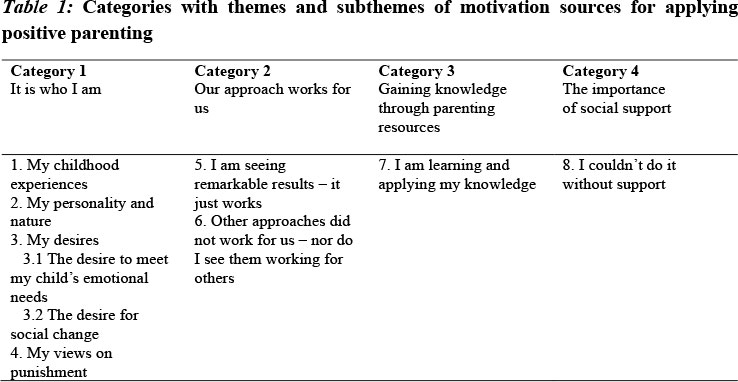
The findings revealed that mothers who apply a positive parenting approach have multiple sources of motivation, which could be divided into four categories, with eight themes and two subthemes (see Table 1).
Category 1: It is who I am
During the interviews, every participant expressed that their experiences, personality, nature, desires, and views, which reflect who they are, played a significant role in their motivation to apply a positive parenting approach. Four themes emerged: My childhood experiences, my personality and nature, my desires, and my views on punitive punishment.
Theme 1: My childhood experiences
Fourteen of the 16 participants discussed the importance of their childhood experiences of their own parents in motivating their present parenting. We report and discuss the influence of both positive and negative childhood experiences on motivating the participants to adopt a positive parenting approach.
Eleven participants talked about negative aspects of their childhood, recalling adverse events and feelings in childhood, which stemmed from the way in which they were parented. For several participants there was a desire not to parent their children in the same way they had been parented. They wanted to foster a more positive experience, to spare their children some of the negative feelings that they had from their own childhood. For some participants, the decision to parent very differently from the way in which their parents had was a conscious one. Two participants used the phrase, "I am going to do the complete opposite of what they [my parents] did". Another participant felt that she had adopted some of her parents' negative qualities and was determined not to allow these qualities to limit her own parenting. Two participants expressed that they felt "screwed up", "damaged" by the way in which their parents had treated them. One participant said:
They damaged me in many ways because of their style of parenting.
When sharing the feelings they experienced from their own childhood based on how they were parented, some of the words participants used were "not good enough", "isolated", "emotionally blackmailed" and "I didn't understand". There were also sentiments of "feeling responsible for their parents' outbursts of anger" and "a fear of punishment". The aspiration not to have the same kind of relationship with their children as they had with their own parents motivated some of the participants to do some things differently. Some of the mothers even commented that they did not wish their children to be like them.
Despite reporting their negative childhood experiences with greater frequency and more emphasis, it is important to note that not all participants experienced their past parenting as negative. For two participants it was a positive experience, one which they wished to recreate with their own children.
I am doing this [using a positive parenting approach] because, my parents, they are amazing, also very gentle.
A third group of participants recalled their experiences as being neither negative nor positive. Some participants had one parent who demonstrated positive qualities and one who demonstrated negative qualities. This provided them with a contrast between their parents, giving them an example of both how they want to be as parents themselves, and how they do not want to be. They reported having a closer relationship with the less punitive parent:
I grew up in a home where my father was quite punitive in his parenting style, and my mother was not, so complete opposites. ... his anger was the only thing you heard, and I do not want my kids to only hear that.
These findings are consistent with the idea posited in the parent development theory (Mowder, 2006), namely that our experience plays an influential role in our parental approach, which is called the intergenerational transmission of parenting (Schofield, Conger & Neppl, 2014). Although the participants in this study used a positive parenting approach, many of them reported experiencing their own parents' parenting as undesirable. The way in which participants more easily recalled their negative versus positive childhood memories may be explained by a phenomenon called the negativity bias - events and interactions that are labelled as negative are recalled better and are perceived to have had a greater influence on individuals than those that are positive (Norris, 2019).
Most participants expressed their desire to parent differently from the way their own parents did. Decisions to parent differently may protect parents from repeating their own past experiences because of two factors. First, the idea proposed by Todorovic and Matejevic (2014) that those who have a strong belief that their own parents' parenting was not correct are more motivated to use a different parenting style. Second, the idea that one is less likely to repeat the parenting mistakes of one's own parents when they (the new parents) place greater importance on the belief that their parenting has a significant effect on their child's development, outcomes, and emotional health.
Theme 2: My personality and nature
All but one of the participants said that their parenting was aligned with their personality and nature. They explained that this approach was their automatic way of behaving, something that came naturally to them. Some of the words they used to describe themselves were positive, gentle, sensitive, laid back, conflict avoidant and calm.
One participant felt that her parenting approach was not guided by anything except her own intuition and instinct. Three participants felt that what they had read and learned about positive parenting (correlating with the theme "My education and learning") supported their instinctive way of doing things.
Fifteen of the 16 participants discussed the use of intuition and instinct in guiding their parenting approach. Participants felt a symbiosis between the knowledge they had gained about positive parenting from things they had read, what they had learned from others, and their own natural way and automatic approach to parenting. Intuition is "what we know without knowing where we learnt it", an "automatic process which happens without conscious awareness" (Betsch & Glöckner, 2010:281). Therefore, it is possible that what participants described as their "gut" and "instinct" could be guided by complex processes coming from many sources and experiences.
Not only did the positive parenting literature resonate with how the participants naturally parented (Farzand et al., 2017; Schofield et al., 2014), but the literature concerning other approaches to parenting also seemed unnatural and not especially useful to them. One participant said the following about positive parenting literature:
I just started doing some more research into it, and just that, when I read up on the positive parenting and attachment style ofparenting, it just made sense.
Theme 3: My desires
A desire is defined as "a strong feeling of wanting to have something or wishing for something to happen" (Collins Dictionary, 2020). In relation to this theme, we report desires that participants expressed and how these desires motivate them in their parenting choices and approach. Participants distinguished between two kinds of desires that they deemed motivational: The desire they had to parent in a way that meets their child's needs (subtheme 1) and their desire for social change (subtheme 2).
Subtheme 1: The desire to meet my child's emotional needs
The mothers identified six needs as integral to having happy, healthy, well-adjusted, and emotionally secure children. These needs are: 1. The child's need for support and encouragement; 2. The need to support the child's individuality; 3. The need for emotional validation; 4. The need to understand discipline; 5. The need to both give and receive respect; and 6. The need to feel loved and happy.
The child's need for support and encouragement: Participants felt that children need to feel both supported and encouraged to flourish. They confirmed this in comments such as:
They just need someone in their corner who is like, you do you, and I am just going to support you through it ... that will give you the confidence and the comfort that you need to continue.
Some of the words used to express what the mothers thought that their children needed were: encouragement, support and to have "someone in their corner". Adler (1956) also believed that children's primary needs were for both belonging (connection between parent and child) and significance (the idea that what you do matters).
The need to support the child's individuality: More than half of the mothers conveyed the desire not to mould their child into something that suited their (the mother's) own ideals or agenda, asserting that children need to be allowed to find their own identity and feel accepted for who they are. A participant mentioned the following:
We are trying to encourage her to be who she is, or how she is, without having to conform to whatever mould people say that you must be.
Three participants all have more than one child. In discussing their children's needs they were mindful that each of their children has unique needs, and they therefore adjust their parenting approach in accordance with the individual child.
Participants in this study may have had a heightened awareness of their child's need for a sense of self and autonomy. This may be due to their own childhood experiences of not feeling able to fully express their individuality with their own parents (see Theme 1 - "My childhood experiences").
The needfor emotional validation: Most mothers were concerned about their child's emotional well-being. Their desire was for their children to know that all their emotions were "okay", and they encouraged them to express their emotions appropriately.
We just wanted to raise our daughter with an actual open mind. She is entitled to her opinions, she is entitled to her emotions, but they must be well thought through.
Emotional validation is an important part of the positive parenting approach and parents are encouraged to empathise with their children's feelings (Eanes, 2016). Participants in this study showed a desire to help their children to express their emotions appropriately.
I read also that we must communicate their feelings for them, and we need to teach them how to use their words. So, um, I use that a lot with them.
The need to understand discipline: Pertaining to discipline, a few participants explained that children needed to understand what was expected of them, and why. For some parents it was important that their children did not just obey them, because 'they said so', but that it is explained to them why certain behaviour may not be acceptable. The sentiment conveyed was that discipline is rooted in understanding rather than obedience allows a child to feel respected and heard, and nurtures cognitive development through understanding.
It makes sense to me that she understands things, rather than just doing what she is told. Um, so that, you know, as she grows up, she understands concepts, and is not following everyone else.
The parents in this study used positive discipline, which opposes punishment of behaviour and rather advocates teaching through encouragement, communication and identifying the need behind the behaviour (Eanes, 2016). Participants did not have the expectation that their children obey simply because 'they said so'; this is indicative that they prefer to follow an authoritative rather than an authoritarian parenting style (Baumrind, 2012). The mothers in the study communicated that they believed that this approach to discipline helped their children to feel emotionally secure (as discussed in the theme "My views on punitive punishment"). One participants embraced the positive discipline technique of a solution-based approach, which is an effective way to teach long-term problem-solving skills (Eanes, 2016; Nelsen et al., 2015).
The need to give and receive respect: The importance of communication and respect were frequently mentioned by 11 of the 16 participants. They said that children have a need to both practise and receive respect.
What you are going to teach them is that you will respond to their needs, which is building up that trust and respect.
For the participants, the way to gain mutual respect was to model and practise it themselves. Through respect they hoped to have a more positive and fruitful relationship with their child. That children need to be treated with both respect and dignity is a key tenet in the positive parenting ethos (Eanes, 2016).
Just because children are little does not mean they do not understand things, nor that they are not entitled to respect.
Two participants both believed that it is this respect that fosters trust between themselves and their children.
What you are going to teach them [the children] is that you will respond to their needs, which is building up that trust and respect, I guess.
Two participants said that, in showing respect to their children, they "get more out of them", which indicates a belief that parental respect has a positive effect on their child as well as their relationship.
The need to feel loved and happy: The mothers wanted their children to know that they were loved and for them to feel happy. They hoped that the positive parenting approach would enhance the bond created between themselves and their child, which would assist in conveying love to their children. Participants thought that, in meeting a child's needs, the child would be happier in general.
... that is with any person. If their needs are met, they are happier too, and can function better. So, it's the same with a child, right?
Four mothers emphasised their desire for their children to experience happiness in their lives. Participants believed that their positive parenting approach, which incorporated support, love and care, would promote happiness in their children.
All of the needs discussed in this subtheme are encompassed by Knost (2013:5), who explains that the consequence of positive parenting is raising a child who has had their needs met so that they can become adults "who have all the coping mechanisms that they need in order to feel safe, secure, and cope with life's stressors".
Subtheme 2: Participants' desire for social change
Eleven of the 16 participants said that a social conscience and a desire for social change were important in motivating them to apply a positive parenting approach. A popular opinion among them was that the world is a "broken" and "dysfunctional place". They expressed seeing a lack of kindness, respect, personal responsibility, and accountability in the world at present. This viewpoint is articulated below:
There is a huge social problem in the world. The world needs a lot more love to heal the disgusting stuff going on.
The participants said that they were raising children not only to fit into society, but also play a small part in transforming it. One participant wanted to instil values in her children that would lead to them engaging in prosocial behaviour.
I want my child to be somebody who sees someone struggling on the side of the road and says, "Can I help you ?" I want her to be a good person.
This is in line with both Seligman and Csikszentmihalyi's (2000) theory of positive psychology and a positive parenting ethos (Kyriazos & Stalikas, 2018), in that that parents believe that children have an innate desire to behave in a prosocial way.
Theme 4: My views on punishment
Eleven of the 16 participants said that they felt motivated to apply a positive parenting approach to discipline due to their views against physical and punitive discipline.
... the idea of smacking a little person is abhorrent and I just cannot do it.
Some participants saw trivial differences between administering a "hiding" or "smack" and child abuse. One participant described corporal punishment as:
... violent, psychologically damaging, and mentally abusing a child.
One of the main tenets of positive parenting is the use of non-physical and non-punitive discipline (Nelsen et al., 2015). Because of this, one inclusion criterion for this study required participants to declare that they did not use physical punishment. Therefore, it is not surprising that the viewpoints expressed by the participants with regard to punishment are in keeping with the principle that positive parenting is a gentle, non-shaming and non-violent parenting approach (Knost, 2013).
Most participants described their discipline style as talking to the child, communicating wrongdoings, guiding, and explaining things to the child. Furthermore, participants expressed that those boundaries and respect were important to them, but that there was also room for "well-thought-out negotiation". In this way, they were using the authoritative parenting principles of discipline, in which the parents have boundaries and limits, but also encourage independent thinking (Baumrind, 2012). Participants talked about disciplining with mutual respect and open communication.
Positive parenting is all about communication, and going on their level, and guiding them, and doing it together, really. That is my aim.
This way of approaching discipline embodies Mowder's (2006) view from the parent development theory framework, in which she expresses the principle that parenting is not something parents do to children, but is part of a reciprocal relationship.
Category 2: Our approach works for us
This category consists of two themes. The first theme pertains to positive results that the participants see from their positive parenting approach, namely, 'I am seeing remarkable results - It just works'. The second theme highlights the following point: 'Other approaches did not work for us - nor do we see them working for others.'
Theme 5:1 am seeing remarkable results - It just works
Thirteen participants reported that they were motivated by the outcomes they were seeing from their parenting approach.
I think I must say it just works.
They found this to be evident in their child's character, qualities, and behaviour. Nine mothers were further motivated by the positive feedback they received from others - friends, family, and teachers. This contributed to their view that this parenting style worked by way of affirmation.
We have everybody always says to us, her teachers and that, "there is a very confident, very empathetic little person " that we are bringing up.
One participant found that even strangers commented on her children's behaviour:
We go out with our children, and we have so many people commenting: "What have you given these children, because they 're so, they are just so content and so relaxed".
Many mothers found that their parenting approach increased the quality of their mother-child relationship. They saw this closeness as another indication that their parenting approach was working. The relationship they have with their children motivated the mothers to continue to apply positive parenting.
She will always be my daughter, but we will be friends for the rest of my life. And that is because of positive parenting.
Participants felt that this was the result of positive parenting virtues such as mutual respect, good communication, emotional support and understanding (Nelsen et al., 2015). One participant felt that the sense of security that she had cultivated contributed to her child's positive behaviour:
At this point we have a good relationship. If I ask her to do something, it gets done ... she is happy to help, and do what she is told, because she has that secure environment.
When asked why they felt it works, participants made statements such as:
It is undeniable to see that she is benefiting hugely from this way ofparenting. I think, because I am seeing the results, and I am seeing my two children really thriving.
Mothers in this study felt that the level of connection they had with their children contributed to their child's positive behaviour, leading to their child being more compliant. This is consistent with the view that authoritative parenting styles, such as positive parenting, are related to an increase in positive child behaviours and compliance, and a decrease in child problem behaviours (Baumrind, 1966; Bornstein & Bornstein 2014).
A few participants also said that they were inspired by others whom they had observed using a positive parenting approach with their own children.
You just need to surround yourself with a tribe that matches your vibe, and it just gives you the confidence to keep going, because it is working for others.
Learning how to parent by observing both their own parents and the success of other parents (Bandura, 2004) may have motivated this study's participants to apply a positive parenting approach.
Theme 6: Other approaches did not work for us - Nor do I see it working for others
Not all the participants started out parenting with a positive parenting approach. Thirteen of the participants described their parenting as evolutionary, changing with their experiences, knowledge, and self-growth:
You are changing all the time, and you cannot beat yourself up about the fact that you have shifted and adjusted, because it must work for you and the child.
Most of the mothers recalled experiences when they had not been positive and peaceful towards their children. One participant recalled how upset she was about sending her child to the 'naughty corner' (a time-out strategy).
I sent him to the naughty corner, and I have a photo of him crying, because it upset him so much, it upset me so much. So that was decided, it was not going to work for us.
Another participant realised that using a punitive approach to punishment was not working for her, nor did it feel congruent with the person that she wanted to be. This caused her to look for alternative ways to discipline.
There were a few smacks on the bum here and there. And then, eventually, I just one night cracked, and I said to my husband, "this is not working, this is really not working" ... this is not the person that I want to be.
Several participants said that they had observed the negative effects that authoritarian parenting approaches have on children. One participant felt this became obvious when she saw children whether their parents had a positive parenting approach.
Just seeing kids where you are like, oh, I can totally see where this behaviour is coming from. They just need an extra cuddle at home.
We often learn from role models who demonstrate a desired behaviour, but we can also learn from observing the negative consequences of those who display undesired behaviour (Bandura, 2004). Through the observation of other parents, mothers in this study found the children of those who used an authoritarian approach to parenting to be impaired, both socially and emotionally (Baumrind, 2012).
Category 3: Gaining knowledge through parenting resources
This category has only one theme, namely, 'I am learning and applying my knowledge' (Theme 7). When asked what motivates them to apply a positive parenting approach, more than half of the participants in this study discussed things they had seen, read, or learned about through various channels of information. For some, this knowledge came prior to their parenting experience. A few participants had some background in child development, either by way of experience or formal education.
Two of the participants described their learning process as "discovering things along the way", "stumbling" upon books, articles and blogs that resonated with how they were as parents and what they wished to be as parents. When participants were asked where they found their information, key resources mentioned were Google, blog posts, books, Pinterest, with the most popular social media platforms being Facebook and Instagram.
Two parents reported being motivated by reading popular parenting books when their children were in infancy and finding that these books were not consistent with their view of how a parent and infant should behave.
So, I read a few books and I read the traditional books. And they were just like, okay, no, not for me. I do not want to do that to my kid.
Not only did participants learn through informational channels, but also from their own experiences, mistakes, and self-reflection. One participant said: Well, it's experience, to be honest. Another participant added that her parenting is evolving every day, that as she gains experience, so her parenting becomes more effective. This aspect has been discussed in the theme, "I am seeing remarkable results - It just works".
An important tenet of positive parenting is an understanding of what to expect developmentally from a child and being able to apply effective strategies to manage challenging behaviour (Eanes, 2016). The literature attests that mothers who have more than average levels of knowledge about child rearing and development are more likely to engage positively with their children (Bornstein, Yu, & Putnick, 2020). This would suggest that the commitment to reading and learning that this study's participants have reported may have contributed to them applying a more positive approach in their parenting.
One source of information that was popular amongst the mothers in this study was social media. They said that they found the advice of others on social media particularly helpful (see Category four, "The importance of social support").
Category 4: The importance of social support
The only theme of this category is "I couldn't do it without support" (Theme 8). Except for two, all the participants spoke about the importance of social support in assisting them with remaining motivated to apply a positive parenting approach. Most participants felt supported, however they also highlighted how lonely and isolating it could be to parent in this way. Four forms of social support emerged from this study, namely partner support, friend support, family support and social media group support. These forms of support are reported and discussed below.
More than half of the mothers found partner support to be fundamental to their execution of the positive parenting approach.
The biggest supporting factor for me has been my husband.
Although some mothers were the driving force behind parenting this way, most mothers described their partner as being as motivated as them. Participants reported that their husbands were actively involved in family life and parenting and shared the responsibilities and workload.
My partner [is supportive]. Yes, he is a whole lot more patient than I am. And sometimes when I have had enough, and I need to just walk away, he is there.
Eight of the mothers found their husbands to be particularly supportive when they needed a break. Many portrayed their husbands as having complementary skills and personalities to their own.
He taught me how to talk and to talk things through in a calm way. He just has a very calm temperament and way of dealing with matters. And like I said, he is a talker.
Partner support is important in reducing the stress of mothers (Eanes, 2016). Parents have a strong influence on one another's approach, with parenting styles often merging over time (Schofield et al., 2014).
The whole idea of being a team is nothing if you are not involved, both of you. It cannot just be the mom, and the dad tags in afterwards ... we decided that we were going to be a team and that is how we were going to parent.
Eight of the participants spoke of friends being a source of support and motivation.
So, friendship has been valuable, and our friends are great in terms of motivating us. I would absolutely say that social support beyond your husband and beyond your family unit is massive.
Whilst two participants said that they had a large group of friends who provided them with social support, four other mothers in this study said they only had a few friends or a single friend to whom they looked for support.
And what I found supportive was one, one single friend that I made that is also a gentle parent. So, we talk to each other whenever things upset us or when one needs advice from the other.
Although less prevalent than partner and friend support, family was a source of social support for some participants, but was not seen as supportive by others.
My Mom has also been a particularly good motivator [for me to parent the way I do]. To be honest, she is very much part of their (the children's) lives.
My own parents do not support us. They let us parent the way that we see fit. So, there is no judgement from them, but there is not a lot of support either.
Those participants who found their family supportive seemed to derive the most support from their mothers. This support takes the form of validation of their parenting style and affirmation that they are doing an excellent job, as well as positive feedback on the grandchild's behaviour.
Both my parents have said that "they can't believe what good parents we are ". My Mom has kind of confided in me that she wishes she had taken more of this kind of line with us kids.
One participant mentioned that their family were neither supportive nor unsupportive. From the comments made, grandparents may initially have been less supportive of the positive parenting approach taken with their grandchildren and, as they witnessed the positive results, they were able to give positive feedback.
... for a little while my dad was like "maybe you should be doing this and maybe you should be doing that". But then he's watched baby grow and seen how polite she is and how advanced she is. And he said to me on more than one occasion, "I wish I knew then what you know now".
Parents are increasingly turning to social media as a source of support (Moon, Mathews, Oden & Carlin, 2019) and education (see Theme 7 "I am learning and applying my knowledge"). Half of the mothers in this current study were able to connect with likeminded individuals and read about the challenges others had experienced in raising their children with a positive parenting approach. Facebook was the predominantly mentioned social media platform. The mothers 'followed' groups (on social media) that made them feel part of a community of like-minded mothers. The ability to connect with others via social media helped participants who felt that they were not surrounded by friends and family who used a positive parenting approach.
I think the most support for this would be from, like a gentle parenting group on Facebook ... you realise, it does work, because there's other stories.
Moon et al. (2019) found that it is especially mothers who are more likely to see social media as a useful source of information about parenting techniques and to use it as a platform to vent, offer and solicit advice, and seek validation.
DISCUSSION
Four main categories of motivation emerged from the data collected for this study. In the first category, participants identified 'who they are' as fundamental to their parenting approach. This included their own childhood experiences, their personality, their nature, their life views, and their desires. According to parent development theory (Mowder, 2006), parents' own experiences guide their approach to parenting. For most participants in this study, their negative experiences of their own parents' parenting motivated them to apply a different and more positive approach with their own children. Beyond their own experience as part of who they are, participants also said that positive parenting felt natural to them because of their own personalities, which they considered to be sensitive and gentle. These are qualities that are best suited to positive parenting, which requires parents to respond to child behaviour with sensitivity and non-violent means of discipline. Participants in this study had an ardent desire to meet the emotional needs of their child, which they saw as important to their child's development. Furthermore, parents desired to affect positive change in the broader society by raising their child with positive parenting values, which were core to their identity as a parent.
Secondly (see Category 2), participants were motivated by the positive results that they saw from their parenting approach. The participants said that their positive parenting approach worked for them. Good behaviour and the demonstration of positive qualities such as empathy, compassion, and kindness, which the mothers in this study reported experiencing and observing in their own children, are consistent with the literature that attests to the positive results that are yielded by a positive parenting approach (Abdullah & Salim, 2020).
Thirdly (see Category 3), participants reported that they were motivated by what they knew and continued to learn about optimal child development. In addition, they believed that their parenting was the most advantageous parenting approach to support their child's development. Parents who are better educated in child development are more likely to parent more positively with their children (Breiner, Ford & Gadsden, 2016). Furthermore, participants were committed to continuously updating their knowledge about the most favourable parenting approach. Lastly (see Category 4), the mothers felt that the social support they receive from partners, friends, family, and social media was pivotal in supporting, inspiring, and helping them to be positive parents.
RECOMMENDATIONS FOR SOCIAL WORKERSTo utilise the findings of this study in interventions, the social worker should be familiar with the following: (1) The Revised White Paper on Families in South Africa (Republic of South Africa, 2021) - a comprehensive document about family needs, circumstances, resources and diversity; (2) authoritative parenting - being able to distinguish between authoritative and authoritarian, and to explain these differences to parents; (3) positive parenting - familiarising themselves with what positive parenting entails and what the benefits are for child development; and (4) interpreting this study's findings to better understand possible underlying motivations that might be present in the parents with whom the social worker is in contact -the more sensitive you are to the needs (and motivations) of the parent, the greater the influence you will have. With this prior knowledge (four categories of motivations) as foundation, the motivations of parents can be explored and developed further, and appropriate and focused parenting interventions can then be implemented.
CONCLUSION
This study provides information on parents' motivations for applying a positive parenting approach. These participants were all proficient in English, had completed at least Grade 12, and most of them identified as being middle-income. The findings of this study address the lack of published knowledge of the motivations of parents who had chosen a positive parenting approach. It serves to define, understand, and examine motivations for positive parenting. These findings may help social workers to better understand and support parents who are already applying a positive parenting approach, or parents who want to change to a more positive parenting approach.
REFERENCES
- Abdullah, S. H. & Salim, R. M. A. 2020. Parenting style and empathy in children: The mediating role of family communication patterns. Humanitas Indonesian Psychological Journal, 17(1): 34-45.
- Adler, A. 1956. Understanding human nature. New York: Greenberg.
-
ATLAS.ti. 2015, September 11. ATLAS.ti Mac-Overview [Video file]. [Online] Available: https://www.youtube.com/watch?v=3f5n4lDAJX4 [Accessed: 17/02/2020].
» https://www.youtube.com/watch?v=3f5n4lDAJX4 - Bandura, A. 2004. Observational learning. In: Byrne, J. H. (ed.). Learning and memory. 2nd ed. New York, NY: John Wiley & Sons Inc.
- Baumrind, D. 1966. Effects of authoritative parental control on child behavior. Child Development, 37(4): 887-907.
-
Baumrind, D. 2012. Differentiating between confrontive and coercive kinds of parental power-assertive disciplinary practices. Human Development, 55(2): 35-51. https://doi.org/10.1159/000337962
» https://doi.org/10.1159/000337962 -
Betsch, T. & Glöckner, A. 2010. Intuition in judgment and decision making: Extensive thinking without effort. Psychological Inquiry, 21(4): 279-294. https://doi.org/10.1080/1047840X.2010.517737
» https://doi.org/10.1080/1047840X.2010.517737 -
Bornstein, L. & Bornstein, M. H. 2014. Parenting styles and child social development. In: Encyclopedia on Early Child Development. 3rd ed. [Online] Available: //www.child-encyclopedia.com/pdf/expert/parenting-skills/according-experts/parenting-styles-and-child-social-development.
» www.child-encyclopedia.com/pdf/expert/parenting-skills/according-experts/parenting-styles-and-child-social-development -
Bornstein, M. H., Yu, J. & Putnick, D. L. 2020. Mothers' parenting knowledge and its sources in five societies: Specificity in and across Argentina, Belgium, Italy, South Korea, and the United States. International Journal of Behavioral Development, 44(2): 135-145. https://doi.org/10.1177/0165025419861440
» https://doi.org/10.1177/0165025419861440 -
Braun, V. & Clarke, V. 2006. Using thematic analysis in psychology. Qualitative Research in Psychology, 3(2): 77-101. https://doi.org/10.1191/1478088706qp063oa
» https://doi.org/10.1191/1478088706qp063oa -
Breen, A., Daniels, K. & Tomlinson, M. 2015. Children's experiences of corporal punishment: A qualitative study in an urban township of South Africa. Child Abuse & Neglect, 48: 131-139. https://doi.org/10.1016/jxhiabu.2015.04.022
» https://doi.org/10.1016/jxhiabu.2015.04.022 -
Breiner, H., Ford, M. & Gadsden, V. L. (Eds.) 2016. Parenting matters: Supporting parents of children ages 0-8 (2nd ed.). Washington, DC: National Academies Press. [Online] Available: https: //www. ncbi.nlm.nih. gov/books/NBK402020/
» https: //www. ncbi.nlm.nih. gov/books/NBK402020/ -
Collins Dictionary. 2020. S.v. 'desire'. [Online] Available: https://www.collinsdictionary.com/dictionary/english/desire [Accessed: 15/03/2019].
» https://www.collinsdictionary.com/dictionary/english/desire - Eanes, R. 2016. Positive parenting - An essential guide. New York: Penguin Random House LLC.
-
Farzand, M., Çerkez, Y. & Çavusoglu, Ç. 2017. Empirical studies on parenting styles: A trend analysis. International Journal of Educational Sciences, 19(2-3): 152-158. https://doi.org/10.1080/09751122.2017.1393959
» https://doi.org/10.1080/09751122.2017.1393959 - Guba, E. G. & Lincoln, Y. S. 1994. Competing paradigms in qualitative research. In: Denzin, N. K. & Lincoln, Y. S. (eds.). Handbook of qualitative research. London, UK: Sage Publications, Inc.
-
Jungert, T., Landry, R., Joussemet, M., Mageau, G., Gingras, I. & Koestner, R. 2015. Autonomous and controlled motivation for parenting: Associations with parent and child outcomes. Journal of Child and Family Studies, 24(7): 1932-1942. https://doi.org/10.1007/s10826-014-9993-5
» https://doi.org/10.1007/s10826-014-9993-5 - Keenan, T., Evans, S. & Crowley, K. 2016. An introduction to child development. 3rd ed. Los Angeles: SAGE Publications Ltd.
-
Kerner, S. M. n.d. Facebook. WhatIs.com. [Online] Available: https://www.techtarget.com/whatis/definition/Facebook [Accessed: 17/02/2020].
» https://www.techtarget.com/whatis/definition/Facebook - Knost, L. R. 2013. The gentle parent: Positive, practical, effective discipline (A Little Hearts Handbook). Florida: Little Hearts Books, LLC.
-
Kyriazos, T. A. & Stalikas, A. 2018. Positive parenting or positive psychology parenting? Towards a conceptual framework of positive psychology parenting. Psychology, 9(7): 1761-1788. https://doi.org/10.4236/psych.2018.97104
» https://doi.org/10.4236/psych.2018.97104 -
Linley, A. P., Stephen, J., Harrington, S. & Wood, A. M. 2006. Positive psychology: Past, present, and (possible) future. The Journal of Positive Psychology, 1(1): 3-16. https://doi.org/10.1080/17439760500372796
» https://doi.org/10.1080/17439760500372796 -
Moon, R. Y., Mathews, A., Oden, R. & Carlin, R. 2019. Mothers' perceptions of the internet and social media as sources of parenting and health information: Qualitative study. Journal of Medical Internet Research, 21(7): e14289. https://doi.org/10.2196/14289
» https://doi.org/10.2196/14289 -
Morrill, M. I., Hawrilenko, M. & Córdova, J. V. 2016. A longitudinal examination of positive parenting following an acceptance-based couple intervention. Journal of Family Psychology, 30(1): 104-113. https://doi.org/10.1037/fam0000162
» https://doi.org/10.1037/fam0000162 - Mowder, B. A. 2006. Parenting infants, toddlers, and young children: Contemporary research in relation to the Parent Development Theory. Journal of Early Childhood and Infant Psychology, 2: 79-99.
- Nelsen, J., Erwin, C. & Duffy, R. 2015. Positive discipline: The first three years. New York: Harmony.
-
Norris, C. J. 2019. The negativity bias, revisited: Evidence from neuroscience measures and an individual differences approach. Social Neuroscience, 16(1): 68-82. https://doi.org/10.1080/17470919.2019.1696225
» https://doi.org/10.1080/17470919.2019.1696225 - Republic of South Africa (RSA). 2021. Department of Social Development. Revised White Paper on Families in South Africa. Notice 540 of 2021. Government Gazette, Vol. 586, No. 44799. (2 July 2021). Pretoria: Government Printers.
-
Schofield, T. J., Conger, R. D. & Neppl, T. K. 2014. Positive parenting, beliefs about parental efficacy, and active coping: Three sources of intergenerational resilience. Journal of Family Psychology, 28(6): 973-978. https://doi.org/10.1037/fam0000024
» https://doi.org/10.1037/fam0000024 -
Seitz, S. 2015. Pixilated partnerships, overcoming obstacles in qualitative interviews via Skype: A research note. Qualitative Research, 16(2): 229-235. https://doi.org/10.1177/1468794115577011
» https://doi.org/10.1177/1468794115577011 -
Seligman, M. & Csikszentmihalyi, M. 2000. Positive psychology: An introduction. American Psychologist, 55(1): 5-14. https://doi.org/10.1037//0003-066X.55.1.5
» https://doi.org/10.1037//0003-066X.55.1.5 -
Silva, J. M. & Pugh, A. J. 2010. Beyond the depleting model of parenting: Narratives of childrearing and change. Sociological Inquiry, 80(4): 605-627. https://doi.org/10.1111/j.1475-682X.2010.00353.x
» https://doi.org/10.1111/j.1475-682X.2010.00353.x -
Todorović, J. & Matejević, M. 2014. Transgenerational transmission of the beliefs of competent parenting. Procedia - Social and Behavioral Sciences, 141: 275-279. https://doi.org/10.1016/j.sbspro.2014.05.048
» https://doi.org/10.1016/j.sbspro.2014.05.048 -
Trifan, T. A., Stattin, H. & Tilton-Weaver, L. 2014. Have authoritarian parenting practices and roles changed in the last 50 years? Journal of Marriage and Family, 76(4): 744-761. https://doi.org/10.1111/jomf.12124
» https://doi.org/10.1111/jomf.12124
Article accepted: 18/12/2023
Article published: 14/06/2024
AUTHOR BIOGRAPHY
Lexi Bradley was a Master's student in Psychology at Stellenbosch University, South Africa. She currently teaches parents and teachers in the practice of Conscious parenting/teaching and respectful discipline. She works under the guidance of the Association for Supportive Counsellors and Holistic Practitioners as a Specialist wellness counsellor. She wrote the initial draft of this article that resulted from her thesis.
Abraham Greeff was a Professor in the Department of Psychology at Stellenbosch University, South Africa. His field of specialisation is family resilience. He supervised the study and currently holds the title of Emeritus Professor at Stellenbosch University.