Xhosa cultural attitudes in relation to adoption
Abstract
Xhosa culture has a strong aversion to breaking familial relationships by placing children in non-parental settings or orphanages, which may lead to limited legal adoption procedures in this cultural context. Their cultural values may also have a significant impact on the adoption process. This study, conducted in Mthatha in South Africa's Eastern Cape province, sought to describe Xhosa cultural attitudes in relation to adoption. The article used a two-pronged sampling approach, combining convenience sampling to easily access respondents and purposeful sampling to deliberately select individuals who met specific criteria relevant to the research objectives, using a cross-sectional descriptive design and a quantitative approach. A closed-ended paper-based questionnaire was used to assess the attitudes of the population to adoption. Descriptive statistics and mean scores were used to analyse the variable distribution and associated demographic characteristics. The article indicated a markedly positive attitude towards adoption among the Xhosa in Mthatha.
adoption; attitude; culture; Xhosa
INTRODUCTION
Adoption is a profoundly human endeavour, involves people of many cultures and origins, and is loaded with emotional intricacies and far-reaching implications for all parties involved (Simon & Farr, 2021). The process of adoption reveals new dimensions in South Africa when viewed through the lens of the Xhosa culture. Featherstone, Gupta and Mills (2018) emphasise the importance of social workers in the adoption process. They are responsible for finding suitable adoptive parents, protecting the child's best interests, and providing ongoing support and counselling to birth parents, adoptive parents and adopted children. They must also traverse the complex web of legal and ethical constraints that regulate adoption. When the fundamental principles of adoption are studied in the context of South Africa's culturally diverse terrain, specifically Xhosa culture, they take on distinct and complicated features. Pieterse and Malan (2023) emphasise the importance of social workers being culturally sensitive to bridge the gap between deeply ingrained cultural norms and the legal framework that controls adoption.
The culture of the Xhosa, South Africa's second largest ethnic group, has a rich history. Their culture is interconnected with ancient customs, beliefs and rituals such as initiation rites, storytelling, beading and singing (Dike, 2023). Various clans and regional variations, such as AmaPondo, AmaMpondo and AmaMfengu, contribute unique behaviours, traditions and dialects to the greater Xhosa culture, enhancing its cultural tapestry (Gumede, 2015; Nkosi, 2021). Individuals of the Xhosa ethnic group are related through ancestry, language and cultural customs, and converse predominantly in isiXhosa (Smith, 2022).
Traditional Xhosa practises have a profound impact on many aspects of their lives, including adoption (Cocks, Alexander, Mogano & Vetter, 2016; Dhlamini, 2021). Thus it is reasonable to assume that deeply ingrained cultural norms exert a significant influence on the adoption process and its outcomes (Buckenberger, 2020). The purpose of the article is to describe Xhosa cultural attitudes to adoption. The authors used quantitative research approaches to achieve this aim. This knowledge can help social workers and legislators design culturally sensitive adoption practises that are consistent with the traditional values and beliefs of the Xhosa culture.
This article will provide insight into the research design, data analysis and primary findings, concluding with recommendations for future research on the challenges of adoption in the Xhosa culture.
CONTEXTUALISATION AND PROBLEM STATEMENTSeveral factors have contributed to the increase in abandoned and orphaned children in South Africa, requiring alternative care, including adoption (Maisiri, van Dyk & Coetzee, 2021). Vulnerable children left without parental care due to various challenging circumstances or parental loss, as highlighted by Vorster (2020), are the focus of adoption practices in the country. These children enter the legal childcare system, necessitating alternative care and a safe, nurturing home environment. Adoption offers a viable solution, providing these children with stability and a permanent home. South Africa's Minister of Social Development, Ms. Lindiwe Zulu (2022), disclosed that over 1,000 children were abandoned by their parents between April 2020 and March 2022. Blackie (2014) underscores various factors contributing to child abandonment, including widespread poverty, unemployment, unexpected pregnancies, HIV/AIDS, high levels of violence, xenophobia, ineligibility for illegal immigrants, alcohol abuse, insufficient clan support, and the misconception that abandonment guarantees a better future. Additionally, Rantao (2022) reported 2.9 million orphans in South Africa, with both the AIDS epidemic and the Covid-19 pandemic significantly contributing to the orphan population (Burkholder, 2019; Mail & Guardian, 2022).
South Africa has a robust legislative and regulatory framework to provide alternative care for children lacking parental support. This framework includes laws such as the Children's Act No. 38 of 2005 (as amended) and the Child Justice Act 75 of 2008 (Republic of South Africa [RSA], 2009), along with policies and regulations such as the General Regulations Regarding Children (RSA, 2010a), Adoption Policy Framework and Strategy (RSA, 2010b), National Norms and Standards for Child Protection (RSA, 2010c), Adoption Policy Implementation (RSA, 2013), the National Child Care and Protection Policy (RSA, 2019), and the Revised White Paper on South African Families (RSA, 2021). These acts and policies align with international and national standards, including the United Nations Convention on the Rights of the Child (UNCRC) (1989) and the African Charter on the Rights and Welfare of the Child (African Union, 1999), grounded in the belief that adoption offers permanence and security. Wrobel and Neil (2012) suggest that long-term fostering, despite past reservations, is increasingly seen as a socially acceptable alternative in many nations. However, the current legislative framework in South Africa favours adoption over fostering or institutionalising children. The Children's Act No. 38 of 2005 (RSA, 2006), as amended, establishes rigorous adoption procedures and children's courts in line with international best practices and sets childcare and protection goals. South Africa was one of just five African countries to sign the Hague Convention on Intercountry Adoptions in 1993. Roby, Rotabi and Bunkers (2013) highlight the country's rapid progress toward having the most effective legislative frameworks for children's welfare on the continent. Despite the strong legal framework of the country, finding enough South African adopters ready to adopt abandoned and orphaned children remains a significant challenge. The adoption of abandoned and orphaned children in South Africa declined dramatically from 2,234 in 2010-2011 to only 799 in 2020-2021 (Child Protection Statistics, 2022). As evidenced by the National Adoption Coalition of South Africa (2018), adoption rates in South Africa pose a significant challenge. Although the country has many abandoned and orphaned children, adoption rates remain shockingly low. This means these children spend more time in the child welfare system, which, according to Sherr, Roberts and Gandhi (2017), could impede their natural growth and development.
The complex relationship between culture and adoption in South Africa, as pointed out by Nachinab, Donkor and Naab (2019), is one of the primary elements that leads to this crisis. When it comes to adoption, different cultures have different degrees of tolerance. This cultural complication is exacerbated by the prevalence of informal care, a practice firmly ingrained in South African society and motivated by cultural values such as ubuntu. Ubuntu, as stressed by Collins-Warfield (2008) and Mokhutso (2022), highlights the view that no child should grow up without a family. This idea often leads to extended clans acting and taking care of orphaned or abandoned children, relying on culturally endorsed moral obligations and communal relationships rather than formal legal processes.
However, Kwatubana and Ebrahim (2020) note that traditional African cultures place a high priority on maintaining clan connections and protecting inheritance rights. When considering the adoption of unrelated children, this cultural emphasis on maintaining patrilineal family relationships can pose difficulties. The tension develops because formal adoption processes can require children to be separated from their cultural and clan roots, contradicting the deeply ingrained belief system in many African traditions (National Adoption Coalition of South Africa, 2018).
In many South African communities, the fundamental principles of childcare are centred on the sacred components of blood, childbirth and the natural world, which are highly valued for their profound symbolic significance. Murovhi, Matshidze, Netshandama and Klu (2018) found that the separation of children from their roots is actively prohibited in these cultural contexts. The participation of individuals in paternal clan rites, an essential rite that requires a deep awareness of one's identity and ancestry, is at the heart of these civilisations. Xhosa culture is notable for its devotion to rites such as 'imbeleko', a ceremonial ceremony that bestows a baby on its ancestors, according to the conventions of the paternal clan. Failure to preserve this tradition, according to Ntanjana and Fezile (2014), is thought to throw a shadow over one's entire lifetime, attracting sadness and the presence of malicious spirits. As a result, attempting to integrate unrelated children into these close-knit clans is not only regarded as inappropriate, but is also laden with significant spiritual implications (Gerrand, 2017).
This setting provides context for kinship care in many South African cultures, where clans readily take on the responsibility of raising relatives' children. Lesetja (2020) and Mabetha, De Wet-Billings and Odimegwu (2021) describe kinship care in South Africa as the tradition where clans assume parenting duties for relatives' children when parents are unable to care for them or have passed away. Masuku and Mlambo (2023) highlight clans as significant social groups within the broader African cultural framework due to their distinct rites and practices. The hierarchical structures of these clans, rooted in a shared belief in common ancestors (Itao & Kaneko, 2022), have been extensively studied by academics like Ten Dam (2021), encompassing various extended families interconnected through lineage. Genealogy and clan affiliation retain high importance in many African societies, with grandparents and other relatives often stepping in to provide care in cases of parental absence or incapacity (Hall, 2022). However, as Jackson (2018) observed, entrenched belief systems may lead to resistance in some black communities toward adopting children who do not share specific clan affiliations or cultural beliefs.
In South Africa, the intricate relationship between culture and adoption vividly illustrates how cultural values, customs, and beliefs guide the care and cultural integration of children into clans. This demonstrates the importance of recognising and respecting these cultural differences in adoption procedures, as they are deeply rooted in South African kinship and communal bonds. Xhosa culture provides a notable example of how cultural perspectives on adoption shape the intricate fabric of South African society. Monye (2017) explains that adoption serves a distinct purpose within Xhosa culture, functioning as a means of lineage preservation through customary law, a role traditionally fulfilled by kin adoption. Mokomane and Rochat (2012) concur, suggesting that alternative care arrangements within clans are increasingly prevalent in South African societies, driven by a complex interplay of socioeconomic factors and deeply ingrained cultural norms. Blackie (2014) and Ratshidi and Boshoff (2019) emphasise the importance of understanding diverse cultural viewpoints on adoption, given the disparity between the country's significant number of abandoned children and relatively low adoption rates.
Xhosa culture stands out as the largest and most prominent among the diverse cultural groups in South Africa's Eastern Cape province, renowned for its rich cultural heritage and historical significance. Child protection statistics (2022) paint a stark picture, ranking this province second highest in the nation for the number of orphaned children, totalling 458,000 who have lost one or both parents. This serves as a poignant reminder of the significant challenges faced by many local families. It's worth noting that collecting reliable adoption statistics in South Africa, particularly in the Eastern Cape province, has proven challenging, with limited available data. Given the region's cultural diversity and richness, a sophisticated and culturally sensitive approach to adoption and child welfare is imperative. The complex landscape of cultural diversity, historical legacy, and evolving care practices accentuate this need.
After a comprehensive literature review, it became evident that there is a significant research gap concerning adoption in the Xhosa culture. The data search, conducted on 21 and 29 January 2020 and 8 February 2020, encompassing databases like Google Scholar, Scopus, Web of Science, JSTOR, Social Sciences Citation Index (SSCI), and ProQuest, utilised keywords such as adoption, adoptive parents, adoptable child, culture, attitude Xhosa, and alternative care. However, it yielded no studies or research articles specifically addressing adoption within Xhosa culture. While some studies such as the African Child Policy Forum (2012), Gerrand (2017), Mokomane et al. (2012) and Ratshidi and Boshoff (2019) examined adoption in broader cultural contexts or specific cultural frameworks, none investigated the unique cultural factors and experiences inherent to the Xhosa culture. This literature gap highlights the critical need for further research in this specific cultural context.
The question this research seeks to answer is the following: What are the Xhosa cultural attitudes to adoption?
The purpose of the research was therefore to investigate and describe Xhosa cultural attitudes to adoption, and to convey the research findings in an academic article.
RESEARCH METHODOLOGYThe article used a quantitative cross-sectional design to investigate and describe the relationship between cultural attitudes and adoption practices among a representative sample of the Xhosa population (Zangirolami-Raimundo, de Oliveira & Leone, 2018). The research used quantitative methods to remain impartial and draw unbiased conclusions (Fouché & Geyer, 2021). The article was mostly descriptive in nature, with the goal of describing Xhosa cultural attitudes to adoption.
The target population, according to Willimack & McCarthy (2019), identifies the elements from which the research findings are to be extrapolated. The people of Mthatha, a metropolis in the Eastern Cape of South Africa, make up the study population. Mthatha has a population of approximately 78,663 people (Worldometer, 2023). The city is home to people from various tribal groups adhering to Xhosa cultural values. This group's exposure to international adoption preferences may result in a stronger willingness to adopt. This receptiveness could stem from familiarity with the process, knowledge of the benefits of adoption, or a cultural ethos that values caring for vulnerable children. As a result, welfare organisations may target the Xhosa population for caregiving services, increasing their exposure to such services. As a result, the focus on this population was justified.
This research employed a two-pronged sampling strategy. A purposeful strategy delimited the population, selecting the Mthatha community in the Eastern Cape province. Dudovskiy (2018) contends that a study's objective is best served by addressing the most pertinent characteristics or common attributes of the population. Justifying this strategy, Mthatha represents Xhosa culture, where many have experienced formal or informal care arrangements influencing attitudes to adoption. Availability sampling, a non-probability strategy, was used, including caregivers or target group members who responded to a general advertisement and were available during the study. Convenient sampling, according to Bachman and Schutt (2014), selects respondents based on accessibility. Initially targeting a minimum sample size of 30, recommended by Creswell (2014) for survey designs, 163 people responded to the advertisement, with 159 meeting inclusion criteria. The larger sample size enhanced statistical power and findings' reliability.
As part of inclusion requirements, respondents had to identify with Xhosa cultural values and primarily reside in Mthatha. Respondents over 18 years old were selected, with no maximum age limits imposed. The Children's Act of 2005 (RSA, 2006), as amended, stipulates that potential adoptive parents must be at least 18 years old. Xaba (2021) notes that while people over 55 years of age are not generally considered adoptive parents, they increasingly serve as primary caregivers for South African children orphaned by the HIV epidemic. The Children's Act (RSA, 2006), as amended, prohibits gender discrimination in adoption; thus, both genders were included in the sample. According to the Children's Act (RSA, 2006), as amended, all relationship statuses single, married, divorced, and others were considered, with no distinction based on marital status. Individuals of all educational levels were welcomed, as the Act does not require education for adoption.
A self-administered paper-based questionnaire designed by Gerrand (1997) was used to collect the data. Respondents selected from prepared alternatives or provided "yes/no" or "true/false" responses to closed-ended questions. Closed-ended questions are commonly used in research for their ease of processing and tendency to produce consistent responses (Babbie, 2014). The questionnaire employed a Likert scale, with respondents indicating their level of agreement with provided statements (Ratshidi, 2016).
An advertisement was placed in Mthatha community centres, notice boards, and lamp posts, inviting individuals who identify with the Xhosa culture and are either already caregivers, willing to take on caregiving responsibilities for another's child, or hold opinions regarding care arrangements such as adoption, to participate freely. An independent social worker employed by the Department of Social Development (DSD) provided a briefing on the study's rationale, objectives, and potential risks and benefits to those agreeing to participate. Respondents signed an informed consent form in the presence of the independent person and a witness before receiving the questionnaire at their residence or in the field worker's office (Bhandari, 2021). The questionnaire was self-administered and paper-based. Another DSD social worker was assigned as the field worker responsible for data collection. The completion of the questionnaires, along with recording the date, time, and location, was facilitated by the field worker and scheduled to occur one week after all informed consent forms had been signed (Guerin, Hayes & McNally, 2018). Respondents who completed the questionnaire at the field worker's office were required to place it in a sealed box situated at the Mthatha DSD office.
Meanwhile, the fieldworker ensured that the questionnaires completed at respondent's homes were deposited in the box upon returning from the respondent's residence.
Data were analysed using IBM SPSS Statistics Version 22, Release 27.0.1.0 (2021), and descriptive statistics and mean score analysis were used to make decisions about variable distribution and percentages of demographic data related to adoption components. The authors developed inferences about the significance of the analysis results based on the findings (Babbie, 2014).
The study falls under the category of "moderately at risk" due to several sensitive questions that might trigger past traumatic experiences, especially for caregivers. While the study itself did not cause direct harm, there was a potential for emotional discomfort. To address this, the authors implemented precautions, including involving social workers to offer free counselling services to vulnerable respondents and providing private counselling options to minimise potential harm (Rubin & Babbie, 2016). Despite these measures, none of the respondents expressed a desire to participate in a debriefing session or took the initiative to do so following their involvement in the research.
The North-West University Health Ethics Research Committee approved the research project with clearance number NWU-00326-21-A1. The appropriate community leaders in Mthatha gave their permission for the study to be conducted in the chosen population. Key ethical criteria, such as written informed consent, confidentiality, autonomy, and the assurance of the safety and well-being of vulnerable respondents, were respected throughout the study. Data will be stored safely for five years before being removed or destroyed, and only authorised users will have access.
Validity in research pertains to the precision and integrity of drawn conclusions (Mohajan, 2017), considering factors like accuracy, consistency, and the measured aspects (Bless, Higson-Smith & Sithole, 2013). Face validity, emphasising respondents' perception of the measurement tool, was the primary focus in this article (Bless et al., 2013; Roestenburg, 2021). The questionnaire's questions were collectively agreed upon by the authors, supervisor, science committee, statistician and ethics committee. Conversely, reliability concerns the consistency of a measure and its replicability (Bless et al., 2013; Nosek & Errington, 2020). Cronbach's Alpha was used by the authors to gauge the questionnaire items' internal consistency. Both authors and a qualified statistician meticulously reviewed the questionnaires. Additionally, three individuals with strong connections to the Xhosa culture in Mthatha participated in a pretest to evaluate the questionnaire's initial validity, reliability and potential flaws. Given its alignment with Xhosa cultural values, no revisions were necessary. Earlier South African studies, such as those by Gerrand (1997), employed a similar metric, illustrating its relevance in regional research contexts.
FINDINGS
The results of the questionnaire were thoroughly examined, with additional references consulted to verify or control quantitative data. Data were collected from a convenience sample of Xhosa individuals in Mthatha, Eastern Cape, South Africa (n = 163), utilising IBM SPSS Statistics Version 22, Release 27.0.1.0 (2021). Mean scores and other descriptive statistics were employed to infer general views on adoption. Gender, age, employment status, educational attainment, and caregiver role were all characteristics analysed using ANOVAs, treating each as a single quantitative measure (Ostertagova & Ostertag, 2013; Ratshidi & Boshoff, 2019).
Descriptive statistics provided an overview of group opinions, while ANOVAs identified potential impacts of demographic factors and caregiver roles on adoption attitudes, presenting a collective perspective per group. Practical significance was determined using ANOVA effect sizes, and any unaddressed variations in opinions were elucidated through accompanying comments (Pallant, 2020; Ratshidi & Boshoff, 2019).
Demographic information
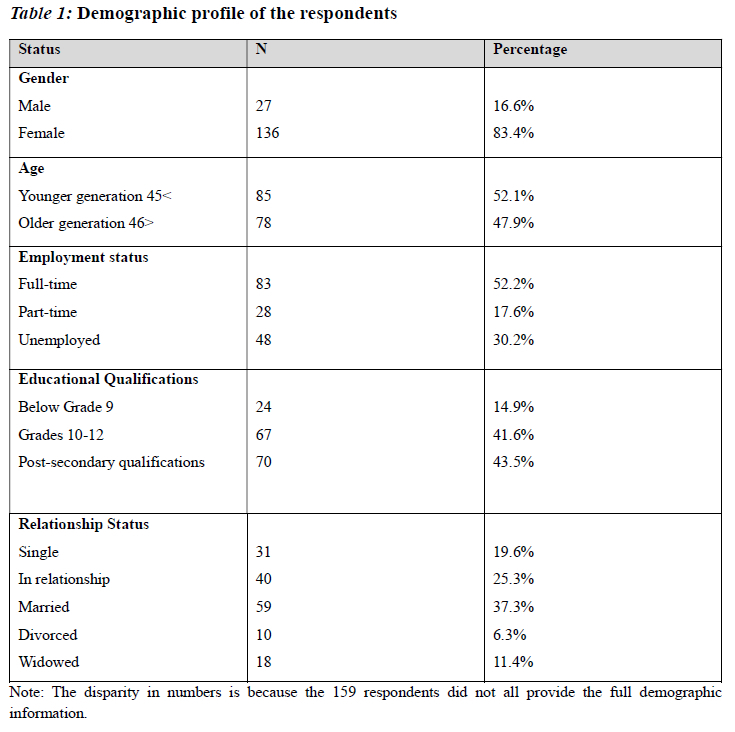
The authors requested demographic information from respondents, including gender, age, employment status, educational background and marital status, to investigate potential associations between demographic factors and adoption attitudes. The study specifically focused on individuals who adhere to Xhosa cultural values.
The majority of those who responded were female (83.4%), and the rest were men (16.6%). The ages ranged from 19 to 69 years, with a mean age of 44.10 (SD=10.93), and the most common age was 48 (n=10). More than half of the respondents were employed full-time (52.2%), while 17.6% were employed part-time and 30.2% were unemployed. Educational qualifications varied, 14.9% completing up to Grade 9, 41.6% completing Grades 10-12 and 43.5% possessing higher qualifications such as training certificates, diplomas, technical diplomas, university undergraduate degrees and postgraduate degrees. The relationship status was reported to be 19.6% single, 25.3% in a relationship, 37.3% married, 6.3% divorced and 11.4% widowed.
Position of the respondents as caregivers
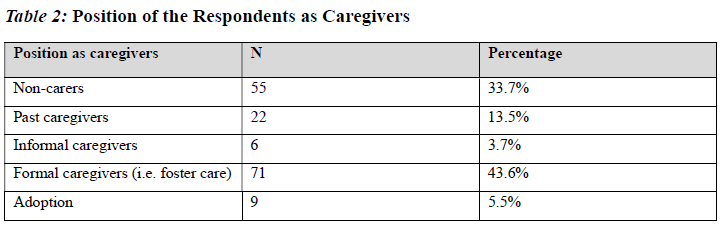
The question about the caregiving positions of the respondents was asked to determine whether they had experience with alternative care and to differentiate between those who participated in the survey only to express their opinion about adoption.
Respondents could select multiple options relevant to them, so while the proportions of respondents for each option are provided, the numbers in the table will not add up to 100%. Regarding caregiving roles, 33.7% of respondents indicated they had never cared for someone else's child and were solely expressing their opinion on adoption. Among those with caregiving experience, 13.5% had previously cared for a child who belonged to someone else but not currently, 3.7% were currently providing informal care for someone else's child (kinship care), and 43.6% were currently caring for someone else's child through formal foster care. The remaining 5.5% of respondents had adopted the child they were currently caring for. According to the data, 33.7% of the respondents expressed an opinion on adoption, while the rest (66.3%) had some exposure to alternative care.
Reliability and descriptive statistics
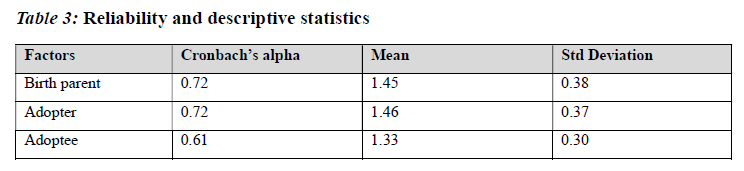
The adoption triad refers to the parents who give up their children for adoption (the birth parent), people who adopt a child (adopter) and the child who has been legally adopted (adoptee). These role players are all vulnerable to the potentially negative attitudes of the public (Gerrand, 1997). The questionnaire had three sections. Table 3 shows the Cronbach Alpha values and descriptive statistics for the three constructs derived from the individual questionnaire sections.
Field (2013) suggests that Cronbach's alpha coefficients of at least 0.50 or above 0.70 show moderate reliability and are preferable for the initial stages of research. The reported Cronbach alpha coefficients for the factors were between 0.61 and 0.72, indicating that the factors were moderately reliable.
Frequencies and descriptive statistics
The authors collected information about the attitudes of the respondents towards the adoption triad to better understand their cultural perspective on adoption. The authors were able to identify the distribution of variables using frequencies and descriptive statistics (Doubell (2014).
The attitudes of the respondents towards the birth parents
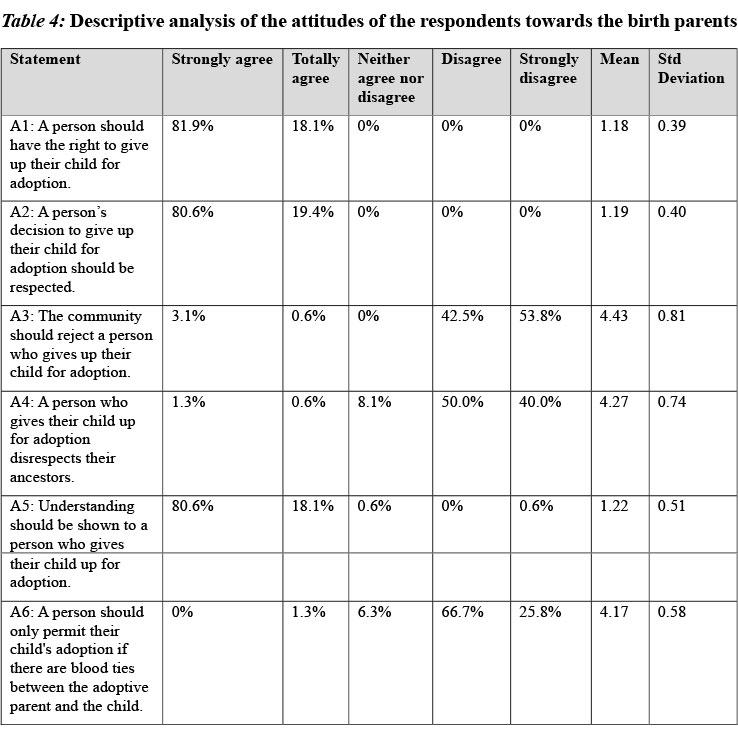
The birth parents are crucial in the adoption process. This section seeks to ascertain the respondents' thoughts about the significance of the birth parents and their participation in the adoption process.
The mean scores for the positively stated items (A1, A2 and A5) ranged from 1.18 to 1.22, showing that the respondents on average agreed with the statements. The negatively worded items (A3, A4 and A6) had mean scores ranging from 4.17 to 4.43. As demonstrated, most of the respondents disagreed with the statements. The findings indicate that the respondents' opinions about the birth parents are largely favourable. Sandelowski (2016) confirms that many adoptive parents understand birth parents' choices but find it difficult to empathise with them because their objectives are different. Individualism and self-reliance can encourage judgemental attitudes toward parents who are perceived as not fulfilling their obligations. Furthermore, poor parenting is stigmatised as being associated with poverty, which worsens preconceived notions about birth parents (Breiner, 2016). It is important to note that the author's study represents only one cultural viewpoint. Yates and de Oliveira (2016) emphasise that different cultural conceptions of adoption and birth parents can influence attitudes, including those people with a Xhosa cultural background participating in this study.
The attitudes of the respondents towards the adopter
Individuals who choose to adopt children make a huge contribution to society by offering an opportunity for children to thrive and have fulfilled lives. The assertions in this section were designed to elicit responses from people who have adopted a child.
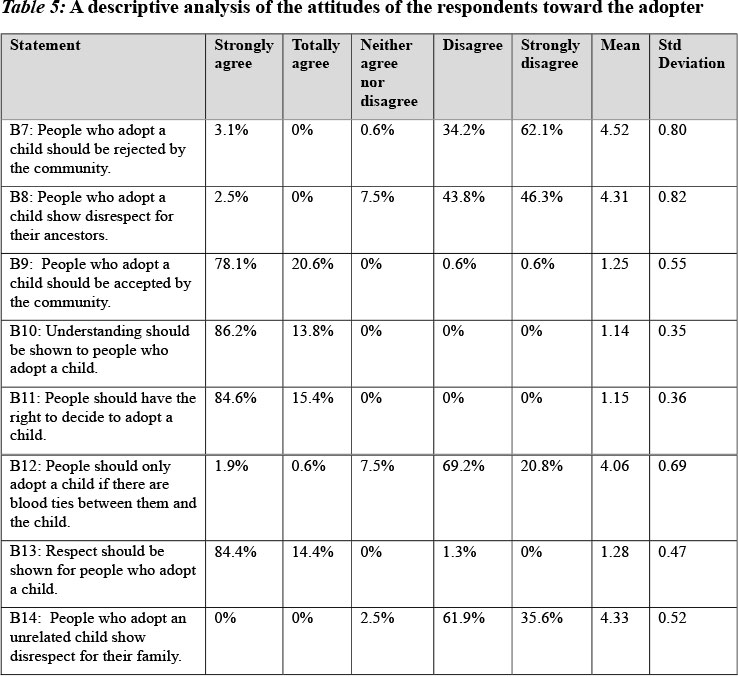
The mean scores for positively stated items (B9, B10, B11 and B13) ranged from 1.14 to 1.25, indicating strong agreement among respondents with these statements, on average. Conversely, negatively worded items (B7, B8, B12 and B14) had mean scores ranging from 4.06 to 4.52, suggesting respondents held differing views from those conveyed in these statements. Overall, respondents held a generally favourable opinion of adopters. Impressions of adoptive parents are likely varied and influenced by a range of social, cultural, and personal factors (Goldberg, 2019). Traditional informal adoption practices, known as customary adoption, may sometimes be preferred over official adoption processes, where someone other than the child's biological parents, such as an aunt, uncle, grandparent, or member of the family's social network, raises the child (Omasker, 2013). Those not adhering to these practices may face scepticism or distrust, as formal adoption may be seen as conflicting with ancestral and cultural beliefs (Rochat et al., 2016). However, adoptive parents are often viewed positively and make significant contributions to their communities.
The attitudes of the respondents towards the adoptee
Adopted children are of the utmost importance in the adoption process and should be treated with compassion, respect and attention throughout the process. The following statements were used to assess the opinions of the respondents about adopted children:
The mean scores for the positively phrased items C15, C16 and C17 ranged from 1.07 to 1.09, suggesting that the respondents on average strongly agreed with the claims made. Negatively phrased items, for example items C18 and C19, mean scores ranged between 4.25 and 4.30. This showed that the respondents disagreed with these claims. As a result, the respondents have a highly positive attitude towards the adoptee. Gerrand (2017) claims that, despite the existence of adopted non-blood relatives, patrilineal black families prefer having a boy child to carry on the lineage. This emphasises the cultural importance of lineage continuation in these families, where the demand for a male successor endures despite different familial arrangements. This emphasises the cultural importance of lineage continuation in these families, where the demand for a male successor endures despite different familial arrangements. Buckenberger (2020) argues that adopting children from unrelated families can hinder their ability to maintain close ties with their birth families and clans. These findings align with Bramlett and Radel's (2016) discovery that respondents could love an adopted child but wouldn't consider adoption themselves. These results highlight the significance of cultural factors in shaping attitudes toward adopted children. In certain cultures, adoption is viewed as a positive and commendable act, with adopted children treated no differently from biological ones.
Comparative analyses
The following section examines whether there was a difference in opinions between the groups based on gender, education, relationship status and caregiver role. These differences were investigated using separate t-tests and ANOVA analyses. A t-test is used when there are two experimental groups, each with a separate set of respondents (Field, 2013). ANOVA tests were used to compare the opinions of various biographical groups (Field, 2013). Furthermore, effect sizes were used to elucidate the respondents' data (Ellis & Steyn, 2003). The effect size is a practical measure of significance. These two authors also emphasise the practical significance of the findings, which is crucial for two reasons: providing population data results and describing the importance of a statistically significant outcome (Ellis & Steyn, 2003).
Gender
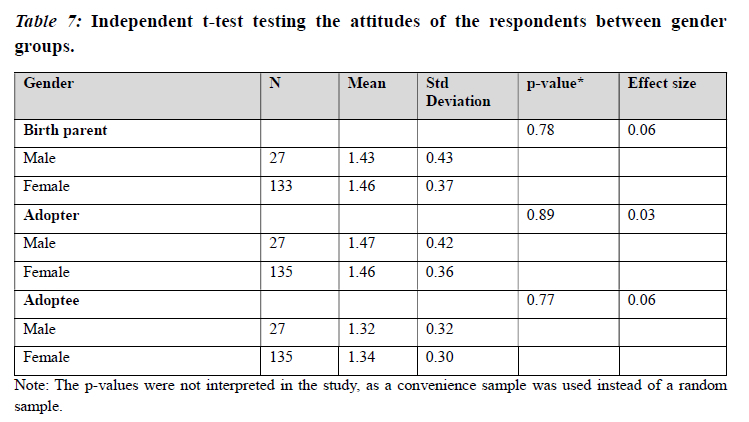
An independent t-test was conducted to examine whether gender has an impact on attitudes toward adoption in Xhosa culture.
Based on the reported effect size (d=0.03-0.06), the difference in attitudes between male and female respondents toward birth parents, adopters, and adoptees was deemed practically insignificant. Both genders strongly agreed or leaned toward agreement, indicating a positive attitude toward adoption. However, it's important to acknowledge that cultural gender norms may influence perceptions of adoption in many South African communities (Wood, 2019). In some cultures, women are expected to bear and care for children, leading to adoption being seen as a sign of infertility or inability to fulfil this role (Nachinab et al., 2019). Consequently, according to Baron (2023), women might view adoption as a last resort or feel ashamed, while men may be more open to adoption to expand their family or offer a better life to a child.
Age
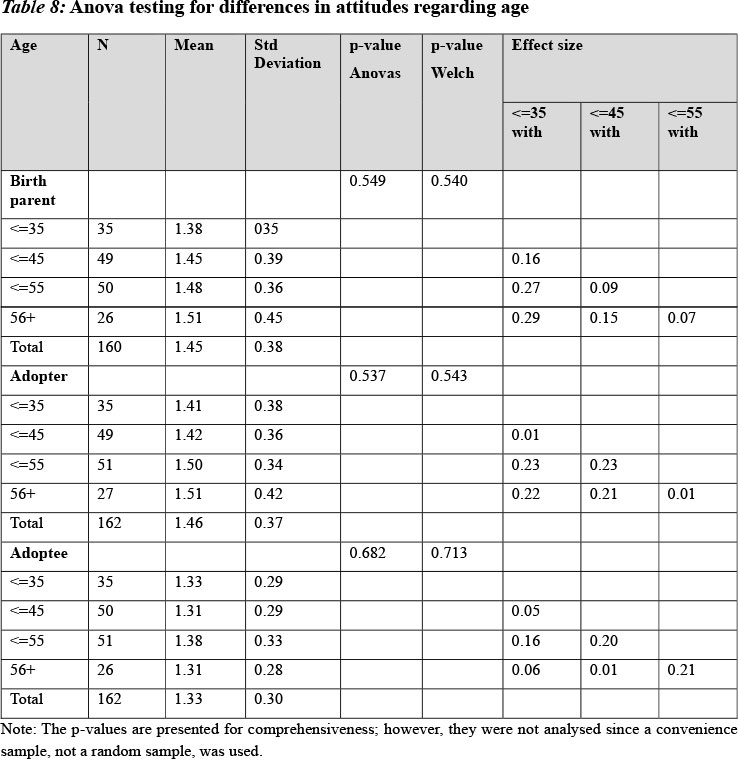
The authors aimed to investigate whether age impacts attitudes toward adoption in the Xhosa culture. ANOVA analyses determined significant differences or variations in adoption attitudes between younger and older individuals in Xhosa culture.
The effect size (d=0.06-0.29) indicated practically no significant differences in opinions across all age groups. Mean scores ranged from 1.31 to 1.51, indicating that regardless of age, respondents held positive attitudes toward the adoption triad, with most strongly agreeing or leaning toward agreement with the questions. However, Simelane-Kalumba (2014) suggested that older generations might harbour more conservative attitudes toward adoption compared to younger generations, who are more exposed to contemporary conceptions. Lu (2021) asserts that younger generations, due to their media exposure, education, and social networks, are more familiar with adoption, leading to increased acceptance and understanding of its benefits. Personal experiences and beliefs can also influence attitudes toward adoption, therefore these results may not represent the views generally held in the wider Xhosa culture.
Educational qualifications
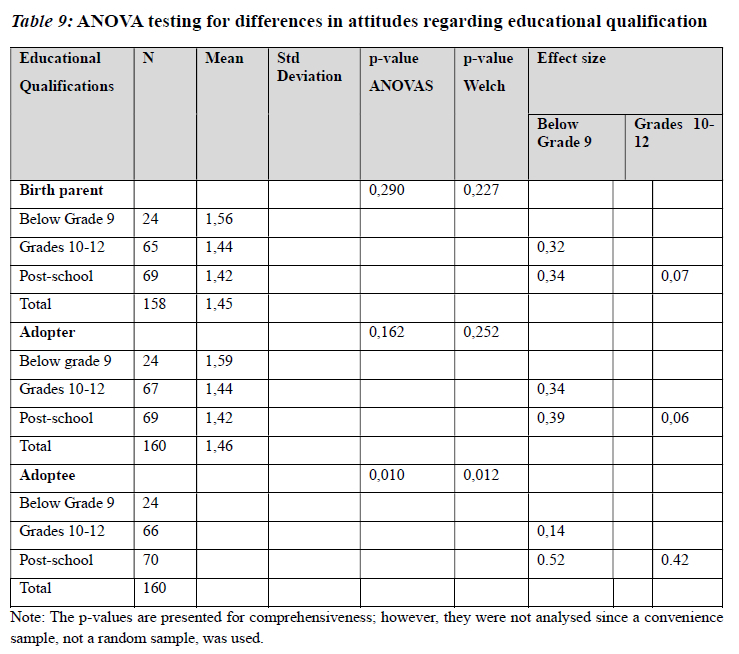
In the study, an ANOVA test was used to investigate attitudes towards adoption among Xhosa people based on their educational background. The purpose of this analysis was to identify potential trends in the way that education influences attitudes towards adoption in Xhosa culture.
The results showed no significant practical variations in attitudes toward birth parents (d = 0.07 - 0.34) and adopters (d = 0.06 - 0.39) across different educational qualification groups. However, there was a slight difference in means between respondents with less than Grade 9 education and those with post-school education regarding attitudes toward the adopted child (d = 0.52). The group with less than Grade 9 education (mean = 1.43, SD = 0.34) strongly agreed or leaned toward agreement, while the post-secondary qualification group (mean = 1.26, SD = 0.27) strongly agreed. This suggests both groups held favourable opinions of the adoptee, albeit slightly less so for those with education levels below Grade 9. Zill (2015) suggests that individuals with higher education levels tend to have more progressive adoption perspectives. Similar findings were noted by Yassini, Shavazi and Shavazi (2012), indicating that those with higher educational backgrounds are more inclined to adopt children than those with lower educational levels. Higher education may provide easier access to adoption-related information, enabling better-informed adoption decisions (Wrobel & Marr, 2020). However, it's important to consider that attitudes toward adoption can be influenced by various factors beyond education alone.
Relationship status
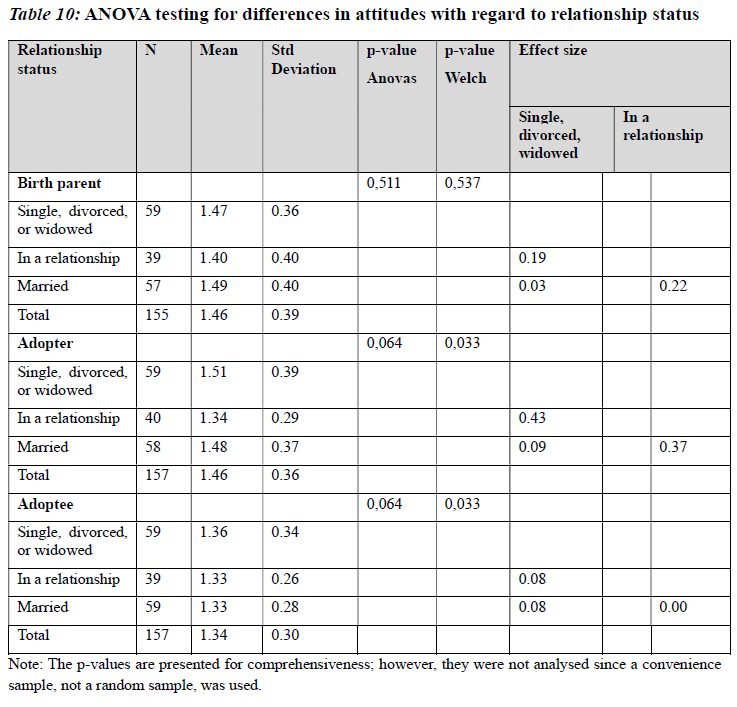
An ANOVA test was performed to reveal the variation in the attitudes of Xhosa people toward adoption and to evaluate its potential significance regarding their relationship status.
The table above presents attitudes toward adoption among different relationship status groups: single, divorced, widowed, in a relationship or married. The study found no significant differences (d = 0.00-0.37) in attitudes toward birth parents, adopters, and adoptees among these groups. Mean scores for all groups (ranging between 1.33-1.51) indicate positive attitudes toward the adoption triad regardless of relationship status. It is a misconception that people in committed relationships view adoption more favourably. Van Laningham, Scheuble and Johnson (2012) affirm that while single people are less likely to consider adoption independently, married or committed couples are more inclined to explore adoption as a means to expand their family. Additionally, contrary to common belief, single people can and do adopt children, offering them a nurturing and supportive home environment. The decision of single adoptive parents is influenced by their personal aspirations, social connections, employment, financial stability, and parenting abilities. It's ultimately about the desire to provide a stable and loving home for a child in need, regardless of marital status. (Mbonambi, 2022). Wissing et al. (2020) suggest that relationship status could vary based on individual beliefs, values, and experiences hence further research is needed to understand the impact of relationship status on adoption views.
Position as caregivers
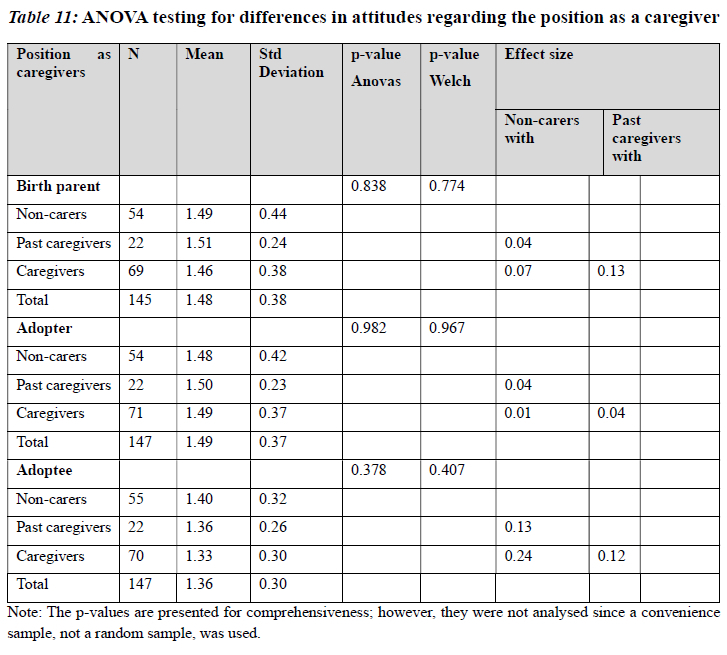
The authors used an ANOVA test to describe how the respondents' position as non-carers, former caregivers, or present caregivers affected their attitudes toward the adoption triad.
This study examined attitudes toward the adoption triad among three groups: non-carers, past caregivers, and caregivers. It found no significant differences between these groups (d = 0.120.24), with mean scores ranging from 1.33 to 1.50, indicating strong agreement or leaning towards agreement with the statements. Despite potential differences in perspectives on adoption procedures, the findings suggest all three groups hold positive attitudes toward the adoption triad. Caregiver status appears to have minimal influence on their attitudes. These results align with earlier studies by Gerrand (2017), Rochat, Mokomane, and Mitchell (2016), and Ratshidi and Boshoff (2019), which also explored South Africans' perceptions of fostering and adoption. Similar underlying concepts may shape opinions on adoption across these groups, explaining the consistent findings across studies.
DISCUSSION
The context, problem statement, research methodology and ethical considerations are covered in the first section of the article. The main objective of this article was to understand Xhosa cultural attitudes to adoption by focusing on three key stakeholders, namely birth parents, adoptive parents and adoptees. To achieve the objective of the study, the respondents were divided into several groups using demographic data. The authors then evaluated the opinions of these groups on the adoption triad: adopters, birth parents and adoptees.
ANOVA, Mann-Whitney and independent t-tests were used to investigate possible connections between demographic factors and attitudes to adoption. Factors such as gender, age, education and marital status were investigated to better understand how they affect attitudes to adoption. Separating respondents into non-caregivers, former caregivers and present caregivers allowed the researchers to better understand how respondents' roles as caregivers affected their attitudes on adoption. The relationship between these characteristics and attitudes toward the adoption triad was examined using the same set of statistical tests.
The study findings revealed that people from the Xhosa culture in Mthatha, South Africa, had a positive attitude towards the adoption triad and that opinions regarding the adoptee, adopter and birth parent had not changed noticeably. Interestingly, the adoption triad was viewed favourably by people in a variety of caregiver roles, including present and former caregivers as well as non-caregivers, with caregiving obligations having no effect on their sentiments. Furthermore, the study revealed that attitudes to adoption were not significantly influenced by demographic characteristics. The study also emphasised how the patterns of adoption in Xhosa culture changed over time, suggesting greater acceptability. Evolving cultural norms imply an increased acceptability of adoption, while shifts in social attitudes suggest a reduction in stigma and a heightened recognition of adoption's advantages within Xhosa communities. Additionally, alterations in cultural practices linked to adoption indicate a growing integration of adoption into traditional Xhosa practices. These findings support broader studies on acceptance of adoption carried out in African communities by academics such as Chanyandura and Rungani (2017), Ratshidi and Boshoff (2019), and Rungani (2017), all of which point to a favourable trend.
Encouraged by these trends, social workers should support inclusive adoption practices by incorporating birth parents, adoptive parents and adoptees into the adoption process through information dissemination and a positive approach to refute stereotypes. Adoptive parents, both past and present, have critical points of view and particular challenges to face that require social workers' support and resources to improve their experience of adopting a child. While these attitudes and challenges may have little influence, social workers should take them into consideration while performing individual evaluations to identify potential needs or difficulties owing to socioeconomic disparities. Social workers must be adaptable and establish specifically designed programmes and services for adoptive families, while strategically advocating adoption as a viable option in this culture. Furthermore, social workers should strategically collaborate with regional authorities, non-governmental organisations and community organisations to promote policy changes and offer resources to speed up the adoption process. Given the noticeable shift in Xhosa cultural views regarding adoption in Mthatha, social workers should consciously participate in ongoing educational and awareness campaigns.
CONCLUSION
The study findings show that people from the Xhosa community in Mthatha have a favourable opinion on adoption. This demonstrates a substantial change in cultural perspective within Xhosa culture, indicating a greater understanding of the value of adoption in creating families and supporting under-privileged or bereft children. This change in perspective could have a favourable impact not only in South Africa but also in nations dealing with orphaned and abandoned children.
Adoption can be used in Xhosa culture to provide children who otherwise would be living in poverty or without a clan with a loving and stable environment. It is possible that the adoption rules in South Africa will change to better assist and facilitate the adoption process, as adoption becomes more accepted and understood in Xhosa culture. This may include the need for additional support and resources for adopting families, as well as taking cultural sensitivity into account at each step of the adoption process.
Cultural sensitivity and education are essential in Xhosa culture for adoption to become increasingly acceptable, since cultural norms and beliefs could influence an individual's decision to adopt. This emphasises the role of social workers in bridging the cultural divide between adoptive families and cultural groups. By providing culturally appropriate counselling, experienced social workers in childcare and family relationships can ensure a respectful adoption procedure.
RECOMMENDATIONSSouth Africa's complex cultural network includes numerous ethnic, linguistic and cultural communities. Exploring the opinions of these groups on adoption is critical to developing a deep understanding of adoption practices and attitudes in the country.
One possible avenue for investigation is a research study on the long-term well-being and outcomes of adopted children in the Xhosa community. This study could investigate the impact of adoption on their social, emotional and psychological development.
It is important that future studies focus on developing training programmes that will give social workers the information and cultural sensitivity necessary to successfully navigate adoption, to increase the effectiveness of adoption procedures.
An in-depth exploration of cultural variations between various ethnic sub-groups of Xhosa culture, particularly their attitudes toward adoption, should be prioritised in research projects.
REFERENCES
- African Union. 1999. African Charter on the Rights and Welfare of the Child. Addis Ababa: African Union.
-
African Child Policy Forum. 2012. Inter-country adoption: An African perspective. Addis Ababa: African Child Policy Forum. [Online] Available: https://www.africanchildforum.org/index.php/en/tlpteam [Accessed: 15/08/2020].
» https://www.africanchildforum.org/index.php/en/tlpteam - Babbie, E. 2014. The basics of social research. 6th ed. Belmont: Cengage Learning.
- Bachman, R. & Schutt, R. K. 2014. The practice of research in criminology and criminal justice. 5th ed. Los Angeles: Sage.
- Baron, T. 2023. The philosophers guide to parenthood: Storks, surrogates and stereotypes. Cambridge: Cambridge University press.
-
Bhandari, P. 2021. Ethical considerations in research: Types & examples. [Online] Available: https://www.scribbr.com/methodology/research-ethics/ [Accessed: 08/09/2023].
» https://www.scribbr.com/methodology/research-ethics/ - Blackie, L. 2014. Adoption in South Africa: A review of the literature. Social Work/Maatskaplike Werk, 50(4): 465-484.
- Bless, C., Higson-Smith, C. & Sithole, S.L. 2013. Fundamentals of social research methods: An African perspective. 5th ed. Cape Town: Juta.
-
Bramlett, M. D. & Radel, L. R. 2016. Factors associated with adoption and adoption intentions of nonparental caregivers. Adoption Quarterly, 20(1): 5-24. https://doi.org/10.1080/10926755.2016.1149534.
» https://doi.org/10.1080/10926755.2016.1149534 - Breiner, H. 2016. Parenting matters. Supporting parents of children aged 0-8. Washington (DC): National Academics Press (US).
-
Buckenberger, G. N. 2020. Cultural factors that influence domestic adoption in South Africa. [Online] Available: https://pillars.taylor.edu/cgi/viewcontent.cgi?article=1004&context=care-conference [Accessed: 24/08/2023].
» https://pillars.taylor.edu/cgi/viewcontent.cgi?article=1004& context=care-conference -
Burkholder, M. 2019. The impact of HIV/AIDS on orphans in a South African context. [Online] Available: https://pillars.taylor.edu/cgi/viewcontent.cgi?article=1002&context=ovc-student [Accessed: 04/10/2021].
» https://pillars.taylor.edu/cgi/viewcontent.cgi?article=1002& context=ovc-student - Chanyandura, R. & Rungani, J. R. 2017. The changing face of adoptions in South African black communities: A case of Johannesburg Child Welfare. Social Work Conference: ASASWEI, Johannesburg, SA. 8-11 October 2017.
-
Child Protection Statistics. 2022. National adoptions. [Online] Available: https://forthevoiceless.co.za/child-protection-statistics/ [Accessed: 20/02/2023].
» https://forthevoiceless.co.za/child-protection-statistics/ -
Cocks, M. C., Alexander, J., Mogano, L. & Vetter, S. 2016. Ways of belonging: Meanings of "nature" among Xhosa-speaking township residents in South Africa. Journal of Ethnobiology, 36(4): 820-841. https://doi.org/10.2993/0278-0771-36A820.
» https://doi.org/10.2993/0278-0771-36A820 - Collins-Warfield, C. 2008. The ubuntu family: An African approach to health in South Africa. Journal of Transcultural Nursing, 19(2): 134-139.
- Creswell, J. W. 2014. Research design: Qualitative, quantitative and mixed methods approaches. 4th ed. Thousand Oaks, CA: Sage.
-
Dhlamini, N. B. 2021. Xhosa people of Zimbabwe: Indigenous South Africans displaced by colonialism. [Online] Available: https://gal-dem.com/xhosa-people-of-zimbabwe-indigenous-south-africans-displaced-by-colonialism/ [Accessed: 21/08/2023].
» https://gal-dem.com/xhosa-people-of-zimbabwe-indigenous-south-africans-displaced-by-colonialism/ -
Dike, F. 2023. Xhosa culture: The clans and customs. [Online] Available: https://www.southafrica.net/za/en/travel/article/xhosa-culture-the-clans-and-customs [Available: 27/08/2023].
» https://www.southafrica.net/za/en/travel/article/xhosa-culture-the-clans-and-customs - Doubell, L. S. 2014. Views of social workers on trans- racial adoptions of abandoned children. Master's thesis. University of Stellenbosch, South Africa.
-
Dudovskiy, J. 2018. Research methodology: Purposive sampling. The ultimate guide to writing a dissertation, in business studies-a step-by-step assistance. [Online] Available: http://www.research-methodology.net [Accessed: 11/09/2021].
» http://www.research-methodology.net - Ellis, S. M. & Steyn, H. S. 2003. Practical significance (effect sizes) versus or in combination with statistical significance (P-values): Research note. Management Dynamics. Journal of the Southern African Institute for Management Scientists, 12(4): 51-53.
-
Featherstone, B. Gupta, A. & Mills, S. 2018. The role of the social worker in adoption -ethics and human rights: An enquiry. [Online] Available: https://www.basw.co.uk/system/files/resources/basw_55505-10_1.pdf [Accessed: 30/08/2023].
» https://www.basw.co.uk/system/files/resources/basw_55505-10_1.pdf - Field, A. 2013. Discovering statistics using IBM SPSS Statistics. 4th ed. California: Sage.
- Fouché, C. B. & Geyer, L. S. 2021. Developing the research proposal. In: Fouché, C.B., Strydom, H. & Roestenburg, W. J. H. (eds.). Research at grass roots: For the social sciences and human service professions. 5th ed. Pretoria: Van Schaik.
- Gerrand, P. A. 1997. An African community's attitude towards modern, western adoption. Master's thesis. Rand Afrikaans University, South Africa.
- Gerrand, P. A. 2017. The legal adoption of unrelated children. Doctoral thesis. University of the Witwatersrand, South Africa.
- Goldberg, A. E. 2019. Open adoption and diverse families. Complex relationships in the digital age. New York: Oxford University Press.
- Guerin, S., Hayes, N. & McNally, S. 2018. Research and evaluation in community, health and social care settings. New York: Routledge.
-
Gumede, P. 2015. Imvelaphi nama siko amaXhosa. [Online] Available: https://www.news24.com/news24/imvelaphi-nama-siko-amaxhosa-20150930 [Accessed: 27/08/2023].
» https://www.news24.com/news24/imvelaphi-nama-siko-amaxhosa-20150930 -
Hall, K. 2022. Statistics on children in South Africa. [Online] Available: http://childrencount.uct.ac.za/indicator.php?domain=1&indicator=4 [Accessed 25/01/2023].
» http://childrencount.uct.ac.za/indicator.php?domain=1& indicator=4 -
Itao, K. & Kaneko, K. 2022. Emergence of kinship structures and descent systems: Multilevel evolutionary simulation and empirical data analysis. Proceedings of the Royal Society, 289(1969): 1-10. https://doi.org/10.1098/rspb.2021.2641.
» https://doi.org/10.1098/rspb.2021.2641 - Jackson, S. J. 2018. Transracial adoption in South Africa: Challenges faced by adoptive parents. Master's thesis. University of Stellenbosch, South Africa.
- Kwatubana, S. P. & Ebrahim, H. B. 2020. Exploring African adoption and foster care practices in South Africa: An indigenous cultural perspective. Journal of Child and Family Studies, 29(2): 447-458.
- Lesetja, M. F. 2020. Kinship foster care: Perceptions and experiences of grandparents regarding fostering their teenage offspring. Master's thesis. University of the Western Cape, South Africa.
- Lu, J. 2021. Exploring the adoption of social media in self-paced physical activity in early childhood education: A case in central China. Educational technology research and development, 70: 321-338.
-
Mabetha, K., De Wet-Billings, N. C. & Odimegwu, C. O. 2021. Healthcare beliefs and practices of kin caregivers in South Africa: Implications for child survival. BMC Health Services Research, 21: 486. https://doi.org/10.1186/s12913-021-06357-9.
» https://doi.org/10.1186/s12913-021-06357-9 -
Mail & Guardian. 2022. The shock of134 500 Covid orphans in South Africa. [Online] Available: https://mg.co.za/special-reports/2022-04-01-the-shock-of-134-500-covid-orphans-in-south-africa/ [Accessed: 02/02/2023].
» https://mg.co.za/special-reports/2022-04-01-the-shock-of-134-500-covid-orphans-in-south-africa/ -
Maisiri, W., van Dyk, L. & Coetzee, R. 2021. Factors that inhibit sustainable adoption of Industry 4.0 in the South African manufacturing industry. Sustainability, 13(3): 1013. https://doi.org/10.3390/su13031013.
» https://doi.org/10.3390/su13031013 -
Masuku, M. M. & Mlambo, V. H. 2023. Tribalism and ethnophobia among black South Africans. Journal of Ethnic and Cultural Studies, 10(1): 125-140. https://dx.doi.org/10.29333/ejecs/1292.
» https://dx.doi.org/10.29333/ejecs/1292 -
Mbonambi, P. 2022. The process of legally adopting a child in South Africa. [Online] Available: https://www.vukuzenzele.gov.za/process-legally-adopting-child-south-africa [Accessed 23/03/2023].
» https://www.vukuzenzele.gov.za/process-legally-adopting-child-south-africa - Mohajan, H. K. 2017. Two criteria for good measurements in research: Validity and reliability. Annals of Spiru Haret University, 17(3): 58-82.
-
Mokhutso, J. 2022. Ubuntu: A countermeasure for challenges of child-rearing. Journal of Theology 103(3): 1-20. https://doi.org/10.46222/pharosjot.1033.
» https://doi.org/10.46222/pharosjot.1033 - Mokomane, Z. & Rochat, T. J. 2012. Adoption in South Africa: Trends and patterns in social work practice. Child & Family Social Work, 17(3): 347-358.
-
Monye, S. 2017. The customary law and adoption: The â€~O e Gapa le Namane’ Custom. Journal of Law, Society and Development, 4(1):1-19. https://doi.org/10.25159/2520-9515/1093.
» https://doi.org/10.25159/2520-9515/1093 - Murovhi, A., Matshidze, P., Netshandama, V. & Klu, E. 2018. Traditional child rearing practices in Vhavenda families South Africa. Journal of Gender, Information and Development in Africa (JGIDA), 7(1): 21-37.
-
Nachinab, G. T., Donkor, E. S. & Naab, F. 2019. Perceived barriers of child adoption: A qualitative study among women with infertility in Northern Ghana. BioMed Research International. [Online] Available: https://www.ncbi.nlm.nih.gov/pmc/articles/PMC6590555/ [Accessed: 10/11/2021].
» https://www.ncbi.nlm.nih.gov/pmc/articles/PMC6590555/ -
National Adoption Coalition of South Africa. 2018. National Adoption Statistics. [Online] Available: https://adoption.org.za/wp-content/uploads/2019/02/NACSA-National-Statistics-2018.pdf [Accessed: 26/07/2021 ].
» https://adoption.org.za/wp-content/uploads/2019/02/NACSA-National-Statistics-2018.pdf -
Nkosi, N. 2021. A list of unique Xhosa clan names, surnames and royal names. [Online] Available: https://buzzsouthafrica.com/a-list-of-unique-xhosa-clan-names-surnames-and-royal-names/ [Accessed: 29/08/2023].
» https://buzzsouthafrica.com/a-list-of-unique-xhosa-clan-names-surnames-and-royal-names/ -
Nosek, B. A. & Errington, T. M. 2020. What is replication? Public Library of Science, 18(3): e3000691. https://doi:10.1371/journal.pbio.3000691.
» https://doi:10.1371/journal.pbio.3000691 - Ntanjana, L. & Fezile, L. 2014. Imbeleko as a traditional practice amongst Xhosa speaking people of South Africa: A cultural and religious perspective. Journal of Social Sciences, 38(2): 163-172.
-
Omasker, K. R. 2013. World congress on family law and children's rights. Sydney Australia. [Online] Available: http://cairns-family-commercial-lawyers.com.au/wp-content/uploads/article-Incorporating-Traditional-Adoption-Practices-into-Australia_s-Family-Law-System-Deanne-Drummond.pdf [Accessed: 11/04/2021].
» http://cairns-family-commercial-lawyers.com.au/wp-content/uploads/article-Incorporating-Traditional-Adoption-Practices-into-Australia_s-Family-Law-System-Deanne-Drummond.pdf - Ostertagova, E. & Ostertag, O. 2013. The adoption process: The influence of the parent's age on adoption decision making. Journal of Social Research & Policy, 4(2): 35-50.
- Pallant, J. 2020. SPSS survival manual: A step by step guide to data analysis using IBM SPSS. 7th ed. London: Routledge.
- Pieterse, K. & Malan, H. 2023. Ethical guidelines for adoption social workers in South Africa: The Delphi process. Master's thesis. North-West University, South Africa.
-
Rantao, M. 2022. The crumbling support for Gauteng's orphans. [Online] Available: https://www.iol.co.za/sundayindependent/news/the-crumbling-support-for-gautengs-orphans-5804b2a4-4e8d-42be-afda-2d4181f37e54 [Accessed: 25/02/2023].
» https://www.iol.co.za/sundayindependent/news/the-crumbling-support-for-gautengs-orphans-5804b2a4-4e8d-42be-afda-2d4181f37e54 - Ratshidi, K. 2016. Cultural specific attitudes of Setswana people towards adoption. Master's thesis. North-West University, South Africa.
- Ratshidi, K. & Boshoff, P. J. 2019. South African families' attitudes towards adopting children: Exploring the impact of demographic variables. Social Work/Maatskaplike Werk, 55(3): 317-333.
- Republic of South Africa (RSA). 2006. Children's Act, 38 of 2005. Government Gazette, Vol. 492, No. 28944. (19 June 2006). Pretoria: Government Printer.
- Republic of South Africa (RSA). 2009. Child Justice Act 75 of2008. Government Gazette, Vol. 527, No. 32225. (11 May 2009). Pretoria: Government Printers.
- Republic of South Africa (RSA). 2010a. Department of Social Development. General regulations regarding children. Government Gazette, Vol. 538, No. 33076. 1 April 2010. Pretoria: Government Printers.
- Republic of South Africa (RSA). 2010b. Department of Social Development. Adoption policy framework and strategy. Pretoria: Government Printers.
- Republic of South Africa (RSA). 2010c. Department of Social Development. National norms and standards for child protection. Cape Town: Government Printers.
-
Republic of South Africa (RSA). 2013. Department of Social Development Policy briefing. Adoption policy implementation. [Online] Available: https://pmg.org.za/committee-meeting/15847/ [Accessed: 10/10/2021].
» https://pmg.org.za/committee-meeting/15847/ - Republic of South Africa (RSA). 2019. Department of Social Development. National Child Care and Protection Policy. Pretoria: Government Printers.
- Republic of South Africa (RSA). 2021. Department of Social Development. Revised White Paper on Families in South Africa. Notice 540 of 2021, Government Gazette, Vol. 586, No. 44799. (2 July 2021). Pretoria: Government Printers.
- Roby, J. L., Rotabi, K. & Bunkers, K. M. 2013. Social justice and intercountry adoptions: The role of the U.S. social work community. Social Work, 58(4): 295-303.
- Rochat, T. J., Mokomane, Z. & Mitchell, J. 2016. Public perceptions, beliefs and experiences of fostering and adoption: A national qualitative study in South Africa. Children & Society, 30(2): 120-131.
- Roestenburg, W. J. H. 2021. Quantitative data collection methods. In: Fouché, C. B., Strydom, H. & Roestenburg, W. J. H. (eds.). Research at grass roots: For the social sciences and human service professions. 5th ed. Pretoria: Van Schaik.
- Rubin, A. & Babbie, E. R. 2016. Essential research methods for social work. 4th ed. Boston: Cengage Learning.
- Rungani, J. 2017. Redefining permanency in children: An investigation on the attitudes and perceptions of social workers on adoption as a long-term placement of children. Social Work Conference: ASASWEI, Johannesburg, SA. 8-11 October 2017.
- Sandelowski, R. 2016. With child in mind. Studies of the personal encounter with infertility. Philadelphia: Pennsylvania Press.
- Sherr, L., Roberts, K. J. & Gandhi, N. 2017. Child violence experiences in institutionalised/orphanage care. Psychology, Health & Medicine, 22(1): 31-57.
- Simelane-Kalumba, P.I. 2014. The use of proverbial names among the Xhosa society: Socio-cultural approach. Doctoral thesis. University of the Western Cape, South Africa.
-
Simon, K. A. & Farr, R. H. 2021. Adoption and racial/cultural socialization in diverse adoptive families: Associations with demographic factors, academic outcomes, and parent-child relationships. Research in Human Development, 18(4): 295-310. https://doi.org/10.1080/15427609.2021.2010492.
» https://doi.org/10.1080/15427609.2021.2010492 -
Smith, S. 2022. Hidden languages of the world: Xhosa language. [Online] Available: https://www.daytranslations.com/blog/hidden-languages-of-the-world-xhosa-language/. [Accessed: 29/08/2023].
» https://www.daytranslations.com/blog/hidden-languages-of-the-world-xhosa-language/ -
SPSS Inc. 2021. IBM SPSS Statistics Version 22, Release 2.0.1.0, Copyright© IBM Corporation and its licensors. [Online] Available: http://www-01.ibm.com/software/analytics/spss/ [Accessed: 31/10/2021].
» http://www-01.ibm.com/software/analytics/spss/ - Ten Dam, C. 2021. Extended families, clans and other kinship groups in present-day societies. [Online] Available: file:///C:/Users/23509066/Downloads/ExtendedFamiliesClansandOtherKinshipGroupsinPrese nt-daySocieties-1.pdf [Accessed: 24/08/2023].
- United Nations (UN). 1989. United Nations Convention on the Rights of the Child. New York: UN Department of Public Information.
- Van Laningham, J. L., Scheuble, L. K. & Johnson, D. R. 2012. Social factors predicting women's consideration of adoption. Michigan Family Review, 16(1): 1-21.
-
Vorster, R. W. 2020. The truth behind SA's shocking child abandonment statistics. [Online] Available: https://www.dailymaverick.co.za/opinionista/2020-10-21-the-truth-behind-sas-shocking-child-abandonment-statistics/ [Accessed: 28/08/2023].
» https://www.dailymaverick.co.za/opinionista/2020-10-21-the-truth-behind-sas-shocking-child-abandonment-statistics/ - Willmack, D. K. & McCarthy, J. S. 2019. Obstacles and opportunities for experiments in establishment surveys supporting official statistics. In: Lavrakas, P. J., Traugott, M. W., Kennedy, C., Holbrook, A. L., de Leeuw, E. D. & West, B. T. (eds.). Experimental methods in survey research: Techniques that combine random sampling with random assignment (pp. 309-326). John Wiley & Sons, Inc.
-
Wissing, M. P., Fadiji, A. W., Schutte, L., Chigeza, S., Schutte, W. D. & Temane, M. 2020. Motivations for relationships as sources of meaning: Ghanaian and South African experiences. Frontiers in Psychology, 11: 1-21. https://doi:10.3389/fpsyg.2020.02019.
» https://doi:10.3389/fpsyg.2020.02019 - Wood, H. J. 2019. Gender inequality: The problem of harmful, patriarchal, traditional and cultural gender practices in the church. HTS Theological Studies, 75(1): 1-8.
-
Worldometer, 2023. South African Population. [Online] Available: https://www.worldometers.info/world-population/south-africa-population/ [Accessed: 05/09/2023].
» https://www.worldometers.info/world-population/south-africa-population/ - Wrobel, G. M. & Marr, E. H. E. 2020. The Routledge handbook of adoption. New York: Routledge.
- Wrobel, G. M. & Neil, E. 2012. Foster care and adoption: A view from South Africa. International Journal of Child, Youth and Family Studies, 3(1): 235-251.
- Xaba, N. 2021. Intergenerational relationships: Experiences of grandmothers in caring for their grandchildren in an urban area in KwaZulu-Natal. Master's thesis. University of KwaZulu Natal, South Africa.
- Yassini, S. M., Shavazi, M. T. & Shavazi, N. T. 2012. Factors associated with adoption acceptance rate from the viewpoint of infertile couples. Iranian Journal of Reproductive Medicine, 10(5): 413-418.
-
Yates, J. F. & de Oliveira, S. 2016. Culture and decision making. Organizational Behaviour and Human Decision Processes. 136: 106-118. https://doi.org/10.10167j.obhdp.2016.05.003.
» https://doi.org/10.10167j.obhdp.2016.05.003 -
Zangirolami-Raimundo, J., de Oliveira, J. & Leone, C. 2018. Research methodology topics: Cross-sectional studies. Revista Brasileira de Crescimento e Desenvolvimento Humano, 28(3):356-360. https://doi:10.7322/jhgd.152198.
» https://doi:10.7322/jhgd.152198 -
Zill, N. 2015. The paradox of adoption. [Online] Available: https://ifstudies.org/blog/the-paradox-of-adoption/ [Accessed: 28/08/2023].
» https://ifstudies.org/blog/the-paradox-of-adoption/ -
Zulu, L. 2022. Shockingly large number of SA children are abandoned. [Online] Available: https://sundayworld.co.za/news/shockingly-large-number-of-sa-children-are-abandoned/ [Accessed: 21/01/2023].
» https://sundayworld.co.za/news/shockingly-large-number-of-sa-children-are-abandoned/
Article accepted: 08/09/2023
Article published: 14/06/2024
AUTHOR BIOGRAPHY
Sibulele Nombebe was a MA (Child Protection) student, affiliated with the research entity COMPRES, within the Faculty of Health Sciences, School of Psychosocial Health, Subject Group Social Work at the North-West University, Potchefstroom Campus, South Africa. She is currently employed by the Department of Social Development in Bloemhof, North-West Province. The article resulted from her master's degree, conducted from January 2020 to December 2022, and she wrote the initial draft of the article.
Pieter John Boshoff is a Senior Lecturer affiliated with the research entity COMPRES, within the Faculty of Health Sciences, School of Psychosocial Health, Subject Group Social Work at the North-West University, Potchefstroom Campus, South Africa. His field of specialisation include trauma intervention, qualitative and quantitative research methodology, and the integration of trauma-informed practices within social work education. He supervised the study from January 2020 to November 2022 and assisted with the writing of the draft article and final editing.