"Ek sal en jy gaan." The interaction between the modal auxiliaries sal en gaan
Abstract
Traditionally sal, wil, moet and kan are regarded as the most common modal auxiliaries in Afrikaans. Recent literature has acknowledged that gaan, a lexical verb denoting 'movement away from a deictic centre', has acquired modal functions resembling those of sal in specific contexts. This article aims to explore the development of the grammatical functions of gaan and the interchangeability of sal and gaan as modal auxiliaries within the scope of grammaticalisation theory. A corpus study is undertaken to identify and analyse the nuances in the modal functions for which these auxiliaries compete when expressing modality in order to establish the extent to which gaan has grammaticalised. Similarly, the degree to which gaan and sal can be used as synonyms is explored in the formal register of the Taalkommissie's newspaper sub-corpus and the informal register of the News Commentary corpus.
Modality; Afrikaans modal auxiliaries; grammaticalisation; corpus-based research; usage-based research
4.1 Overview of the corpus results
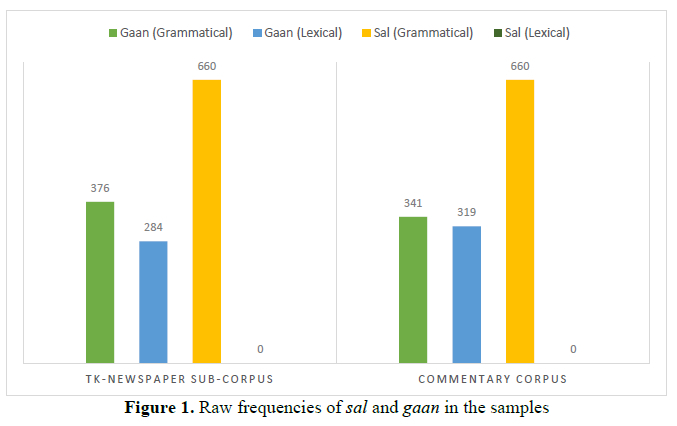
The 660 instances of sal and gaan in both corpora are controlled as follows: i) From the sample (660 hits) of gaan in the TK-corpus and the Commentary corpus respectively, the grammatical uses of gaan are separated from the lexical and inchoative uses of gaan; ii) The sample (660 hits) of gaan will be checked in both corpora, and inaccurate non-grammatical uses of gaan will be eliminated. These results are visually depicted in Figure 1.
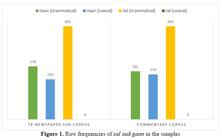
These findings will be discussed in the sections that follow.
The following ratios for lexical gaan versus grammatical gaan were obtained from the samples (660) for both corpora: i) TK-corpus 284:376, ii) Commentary corpus 341:319.
In the TK-corpus sample, 43% of the uses of gaan were lexical instances, compared to 52% lexical instances in the Commentary corpus. However, these results are influenced by the elimination of the inchoative instances of gaan. Since this study is not concerned with the inchoative functions of gaan, these instances were eliminated from the corpus findings. However, the expectation is that gaan will have more instances of grammatical functions than instances of its lexical use, should the inchoative instances be included.
Henceforth only the instances wherein gaan expresses modal meanings are included in the discussion.
The analysis of the corpus data for sal and gaan provided some difficulties. These trials influence the results presented in the following sections and are therefore outlined in this section. Therefore a few general remarks regarding the data analysis are in order: Some instances encountered in both corpora were ambiguous. These instances include i) cases where the modal auxiliary was used to pose a question, ii) cases where figurative language was used, and iii) cases where the intention of the speaker is unclear. These cases are illustrated in (18-23).
(18) Daar gaan dadels van kom.
there go dates of come
Nothing will come of it.
(19) Ek stem dit sal bloedgrond word.
I agree it shall bloodbath (bloodground) become
It will become a bloodbath / tainted ground.
(20) Wie gaan dit keer?
who go it stop
Who's going to stop it?
(21) Hoekom sal jy dan ʼn oornagtassie pak?
why shall you then an overnight bag pack
Why would you then pack an overnight bag?
(22) Ons sal veel beter moet speel.
we shall a lot better must play
We will have to play a lot better.
(23) Ek gaan stem.
I go vote
I will vote. / I am going to vote.
Examples (18) and (19) demonstrate the use of the auxiliary modals in figurative language. Example (18) is an expression which directly translates to 'dates will come of this'. Figurative uses like these are troubling because the modal auxiliary expresses epistemic surety, yet the proposition (that an unspecified situation will result in dates being produced) is impossible, therefore contradicting the meaning expressed by the modal auxiliary. In examples (20) and (21), questions containing the modal auxiliaries are posed. The way in which these questions are phrased makes the meanings expressed by the modal auxiliaries ambiguous. Depending on the interpretation of these questions, gaan and sal can both be understood as future tense markers or modal auxiliaries in these examples. Lastly, sal in example (22) expresses modal meaning, however it is unclear which modal meaning is implied. Cases like these are difficult to classify using the test questions provided in section 2. Similarly, cases containing contextual references to places wherein gaan is the main verb (as is the case in example [23]), simultaneously express the speaker's epistemic commitment as well as the lexical meaning 'going'. In these cases, gaan can be grammatical or lexical depending on the pragmatic context.
These ambiguous cases cannot be undisputedly classified according to the parameters of this study. Therefore, these instances are accounted for in the data tables presented in the following sections. However, they are not included in the interpretation of the data.
4.2 TK-corpus
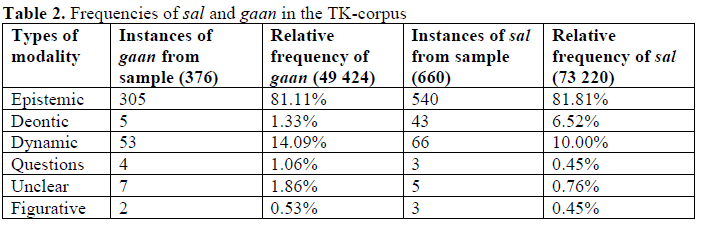
49 424 instances of gaan and 73 220 instance of sal were recorded in the TK-corpus. Sal occurred nearly twice as often as gaan in this corpus. Although noteworthy, this difference is not statistically significant. It is, however, interesting to note that, whilst gaan occurred much less frequently than sal, more than half of the instances of gaan included in the samples were cases wherein gaan functioned as a tense marker or modal auxiliary. Samples of each of these modal auxiliaries were made and the modal functions for sal and gaan are presented in Table 2.
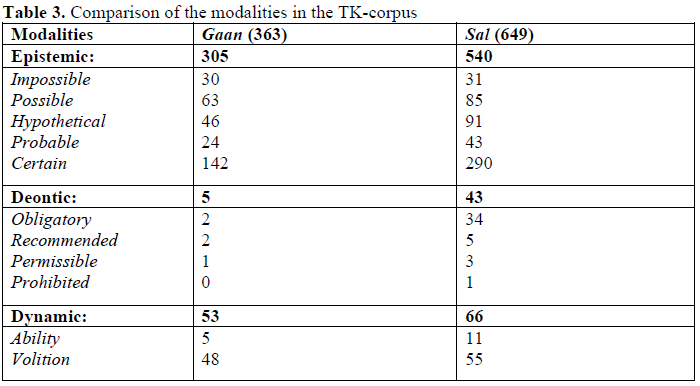
From Table 2, the following conclusions can be drawn. Firstly, epistemic modal uses are the most frequent form of modality in the TK-corpus, since the TK-corpus contains many publications that have been written in the formal register and reviewed by language editors it is possible that this preference for epistemic modality is related to the nature of the texts included in this corpus. Dynamic modality is the second most frequent modality found in the TK-corpus and deontic modality the least frequent modal function. The findings for each sub-class of the modal functions are presented in Table 3.
The epistemic modal functions of sal (81.81%) are slightly more frequent than those of gaan (81.11%) in the TK-corpus. Gaan (14.09%) occurs more frequently in dynamic modal functions than sal (10.00%). For deontic modal functions sal (6.52%) seems to be preferred to gaan (1.33%). The preference for sal in deontic and epistemic modal functions is expected because the TK-corpus contains mostly edited and censored formal written language such as can be found in newspaper articles. Consider examples (24-29).
(24) En dit gaan aaklig wees as die mense dan teruggaan op hul woord.
and it go horrible be if the people then go back on their word
And it will be horrible if the people are going back on their word. (Epistemic)
(25) Hulle mag maar gaan waar hulle wil.
they may but go where they want
They may go wherever they please. (Deontic)
(26) Die jong man gaan volgende jaar ingenieurswese studeer.
the young man go next year engineering study
The young man is going to study engineering next year. (Dynamic)
(27) Die reguleerder sal dus appélleer teen die beslissing.
the regulator shall thus appeal against the blessings
The regulator will appeal the judgement. (Epistemic)
(28) Jy sal nie teruggaan nie.
you shall not go back not
You will not go back. (Deontic)
(29) Ek sal dit wil doen om ʼn verskil in mense se lewens te kan maak.
I shall it will do to a difference in people's lives can make
I will want to do it in order to make a difference in other people's lives. (Dynamic)
It can, therefore, be deduced from these findings that sal occurs more frequently than gaan and expresses the majority of the modal functions in the TK-corpus. Although a distinction can be made between the semantic values of sal and gaan, allowing gaan to be preferred for dynamic modalities and sal for deontic modalities, there is no preference between these two auxiliaries for epistemic modal functions since the difference in relative frequency is very small (0.70%).
This observation is significant because epistemic modality is regarded as the final phase of the general grammaticalisation path for modal auxiliaries (refer to section 2). Both sal and gaan has thus completed the final phase of the grammaticalisation path and are equally grammaticalised in their modal uses. Yet, gaan is more grammatically constrained because it still retains lexical meaning, whereas sal has no lexical meanings and can, therefore, be used in a wider variety of contexts.
4.3 Commentary-corpus
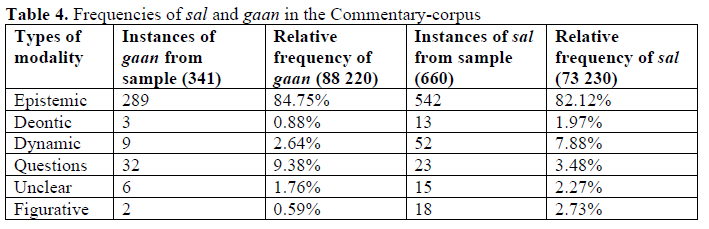
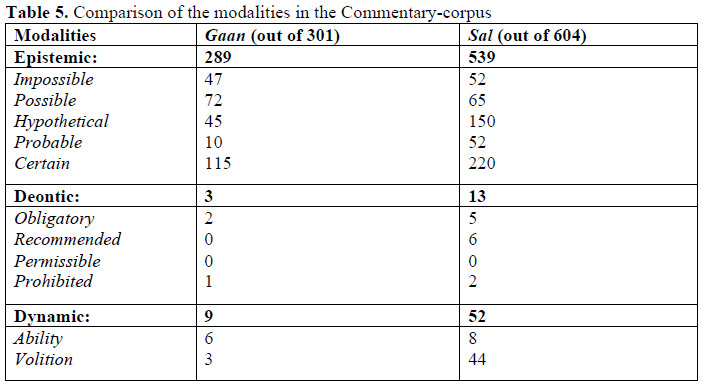
A total of 88 220 instances of gaan and 73 230 instances of sal were identified in the Commentary corpus. It is striking that gaan has occurred considerably more frequently in the informal social Afrikaans that appears in the Commentary Corpus than in the formal Standard Afrikaans of the TK-corpus. This high frequency of use of gaan is all the more striking when one considers that significantly fewer grammatical uses of gaan were found in this sample than in the sample from the TK-corpus (341/660 versus 376/660). These results are summarised in Tables 4 and 5.
Sal is also used less frequently (89.24%) to express epistemic modality than gaan (96.01%) in the Commentary corpus. From this it can be deduced that epistemic modality is the most frequently occurring modal function in informal registers of Afrikaans and that the preferred modal auxiliary verb for epistemic modality in informal Afrikaans registers is gaan. Sal (2.64%) occurs more frequently in dynamic modal functions than gaan (7.88%). These findings contrast with those of the TK-corpus where gaan is more commonly used in dynamic modal functions.
(30) As dit so onaangenaam gaan wees, sal sy nie weer kom nie.
if it this unpleasant go be shall she not again come not
If it is going to be unpleasant, she will not come again. (Epistemic: Informal)
It is interesting that sal seems to be used more commonly in informal registers of Afrikaans to express dynamic modality than gaan is, more so when taking into consideration that gaan is most frequently used to express volition in the TK-corpus. Therefore, sal seems to be the preferred modal auxiliary to express needs and desires in informal registers while gaan seems to be preferred in formal registers.
(31) Ons gaan dit in ons tweede uitgawe van 2007 publiseer.
we go it in our second edition of 2007 publish
We are going to publish it in our second edition of 2007. (Dynamic: TK-korpus)
(32) Ons sal onmiddellik daarmee begin.
we shall immediately with it begin
We will begin immediately. (Dynamic: Commantary corpus)
4.4 Collexeme and distinctive collexeme analysis
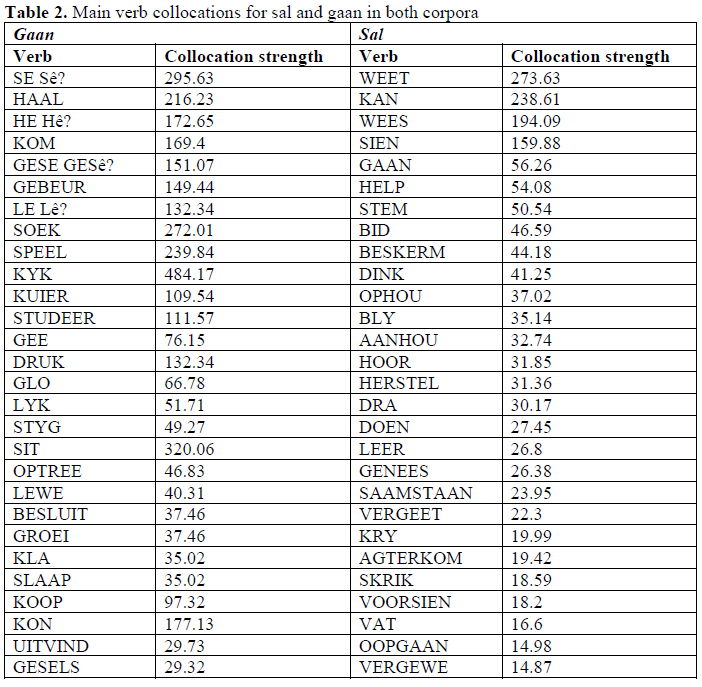
A collexeme analysis is a statistical analysis that measures the degree of the forces of attraction and repulsion between a lemma and a linguistic item that occurs in a particular construction. Collexeme analyses form part of the collostructional methods of language analysis developed by Gries and Stefanowitsch (2016). The purpose of the present collexeme analysis is to determine which verbs most commonly occur with sal and gaan in contexts wherein these auxiliary verbs perform modal functions. Knowledge of the main verbs that tend to collocate with each of these modal auxiliary verbs provides an indication of the syntactic and contextual semantic nuances in Afrikaans that result in one of these modal verbs being preferred over the other.
Gries and Stefanowitsch's (2016) collexeme analysis software was used to perform this calculation. The fifty strongest collocations of sal and gaan are highlighted and interpreted respectively. For this purpose, the results from the two corpora are combined. Only collocation strengths greater than 1.31 are considered significant, because these collocation strengths have a p-value less than 0.05 and are therefore statistically significant.
Certain tendencies for the collocations of sal and gaan can be deduced from an analysis of the top fifty strongest collocations of each modal verb. The following verb groups tended to collocate with gaan: i) main verbs that denote 'movement' as an inherent meaning, ii) verbs of negative experience or actions, iii) choice verbs, iv) verbs that denote moral aversion and v) verbs of creation.
At least half of the fifty strongest collocations with gaan were verbs that contain an inherent meaning that expresses movement. Examples of these verbs include: reis 'to travel', aangee 'to give/pass (sth)', and wegkom 'to get away'. In addition, 7 out of 50 words expressed negative experiences or actions, such as doodskiet 'to kill by shooting', wegkom 'to get away', vang 'to catch', seermaak 'to hurt' and doodgaan 'to die'. Some of these words, such as seermaak 'to hurt' and doodskiet 'to kill by shooting', can also be considered threats. Only three of the top fifty collocations were choice verbs such as besluit 'to decide', kies 'to choose' and uitsoek 'to select'. Likewise, only five of the top verb collocations are verbs of moral aversion, such as rook 'to smoke' and dobbel 'to gamble'. Finally, six of the fifty verb collocations are verbs of creation. These verbs include, among others, skep 'to create', bou 'to build' and skryf 'to write'.
Similar trends can be detected in the fifty strongest collocations of sal. Five verb groups are identified, including negative action verbs and verbs with the prefix er-. Thirteen of the fifty verbs that sal was found to have the strongest collocations with are verbs that can be considered negative actions. These words include afbrand 'to burn down', klap 'to slap', oorspoel 'to flood' and benadeel 'to harm'. In addition, five verbs containing the prefix ver- can be identified. These verbs are verwerp 'to reject', verruil 'to exchange', vermag 'to accomplish', verneem 'to hear' and vervang 'to replace'.
In the collexeme analysis of sal, it is noticeable that this modal verb often strongly coincides with particle verbs, or prepositional verbs like uitloop 'to flow out', terugkyk 'to look back' and aflewer 'to deliver/drop off. This tendency is attributed to the relationship between the modal auxiliary verb and the particle verb, namely that the use of the modal auxiliary verb sal requires the subsequent particle verb to occur in its combined form (Ponelis 1979:235). See examples (33) and (34) for illustration:
(33) Hy sal die boeke aflewer.
he shall the books deliver
He will deliver the books.
(34) Die maatskappy lewer die boeke af.
the company deliver the books off
The company delivers the books.
In example (33) the preposition and verb combine to form a single word unit following the modal auxiliary verb sal. In contrast, the absence of the modal auxiliary verb in example (34) allows for a sentence structure wherein the preposition and the verb occur separately. In cases like these where the preposition and the verb occur separately in the sentence, they are still considered to function as a unit. The modal verb therefore requires the unit form of the prepositional verb. This is confirmed by the absence of the verb form without the preposition in the collocation lists for sal.
The collexeme analysis also indicated strong repulsive forces between some main verbs and sal and gaan, specifically with main verbs with the past tense prefix ge-. Some examples include geslaap 'slept', gebad 'bathed' and gekneus 'bruised'. These results are indicative of the fact that modal verbs capable of functioning as future tense markers cannot occur in constructions denoting the past tense in their future tense forms. It is therefore syntactically marked to state: Ek sal gister gegaan het 'I will have gone yesterday'. In such cases, the past tense form of the modal verb is required, as example (35) illustrates.
(35) Ek sou gister gegaan het.
I would have yesterday gone had
I would have gone yesterday.
In addition to the collexeme analysis, a distinctive collexeme analysis was also performed. A distinctive collexeme analysis is a statistical calculation that forms part of the collostructional methods of analysis and indicates whether a verb is more likely to occur with sal than with gaan, and vice a versa. A distinctive collexeme analysis, unlike a collexeme analysis, does not indicate the words a construction is likely to occur with, but rather with which modal auxiliary a verb is most likely to occur. This analysis was also performed using Gries and Stefanowitsch's (2016) calculators. The thirty strongest collocations for sal and gaan are presented in Table 6.
The results from the distinctive collexeme analysis indicate that verbs denoting stativity or states, like weet 'to know', wees 'to be' and genees 'to heal', prefer to occur with sal as opposed to gaan. This includes words expressing emotions or emotional states, such as skrik 'to have a fright'. Verbs indicative of a transfer, such as kry 'to get', vat 'to take', haal 'to fetch' and dra 'to carry', tend to prefer collocations with sal rather than with gaan. Likewise, mental or cognitive verbs such as dink 'to think', agterkom 'to notice', and vergeet 'to forget' prefer to collocate with sal. Finally, sensory verbs, like sien 'to see' and hoor 'to hear', and abstract verbs, which do not reflect the action that accompanies it in the meaning of the word, such as saamstaan 'to stand together/join forces', help 'to help' and herstel 'to repair', collocate with sal rather than with gaan.
Although these verbs prefer to collocate with sal, the difference in the collocational strength of the main verbs that collocate with sal and gaan respectively is noteworthy. Only four of the words that prefer to collocate with sal have a collocation strength higher than 150. The remaining 26 verbs all have a collocation strength lower than 60. In contrast, 11 main verbs that prefer to collocate with gaan have a collocational strength higher than 150 and only 10 verbs have a collocation strength lower than 50. These results indicate that these verbs have much stronger relational forces of attraction with gaan than with sal, but that they more frequently occur within user-based language with sal.
Sal is thus more commonly used in Afrikaans to express modal meanings, but it is not as strongly connected to the main verb of the sentence as gaan is. This supports what is predicted by grammaticalisation theory. Sal is thus more grammaticalised than gaan because it does not have lexical meaning and can, therefore, be used in a wider variety of contexts than gaan, while the retention of the lexical meaning of gaan ensures that main verbs have stronger collocational strengths with gaan in general.
5. Conclusion
This article explored the interaction and competition between sal and gaan for modal functions within the scope of grammaticalisation theory. The results from the corpus study indicate that the modal uses of sal and gaan are greatly influenced by register. Although gaan occurred less frequently that sal as a marker of modality, it is the preferred modal auxiliary in the informal register included in the Commentary Corpus. It is therefore remarkable that gaan is very rarely used to denote deontic modality in either corpus, especially considering that deontic modality is often used in discussions of rules or laws - themes that are expected to occur often in newspaper articles. It seems that sal is more readily used in these contexts than gaan.
In contrast, sal occurs much more often in both corpora than gaan. This tendency is attributed to the fact that gaan still retains some of its lexical and inchoative uses, while sal exclusively expresses grammatical meaning. Although sal is generally more commonly used in modal functions than gaan, there seems to be a noticeable preference for gaan in the informal register of the Commentary corpus. This finding corresponds with those of Kirsten (2018) and Erasmus (2019).
The collexeme and distinctive collexeme analyses prove that gaan has stronger verb collocations overall, indicating that sal has fewer usage restrictions and is, therefore, more grammaticalised than gaan. The collexeme analyses also indicated that sal often occurs with prepositional verbs, because sal requires the prepositional verb to occur as a single word unit. In contrast gaan does not have the same syntactic requirement.
It was further found that both sal and gaan generally collocate with verbs denoting negative actions or experiences, and moral disapproval. Finally, gaan also collocates strongly with verbs that contain an inherent meaning denoting movement, because these verbs are suggestive of the lexical meaning of gaan, namely 'to go'.
References
- Breed, A. 2012. Die grammatikalisering van aspek in Afrikaans: 'n Semantiese studie van perifrastiese progressiewe konstruksies. Potchefstroom: Noordwes-Universiteit.
- Bybee, J.L. & W. Pagliuca. 1985. Cross-linguistic comparison and the development of grammatical meaning. In J. Fisiak (ed.), Historical semantics, historical word formation. The Hague: Mouton de Gruyter. pp. 59-83. https://doi.org/10.1515/9783110850178.59
- Bybee, J.L., R.D. Perkins & W. Pagliuca. 1994. The evolution of grammar: tense, aspect and modality in the languages of the world. Chicago: University of Chicago.
- Celle, A. 2004. The French future tense and English will as markers of epistemic modality. Languages in Contrast, 5(2): 181-218. https://doi.org/10.1075/lic.5.2.02cel
- Conradie, C.J. 2016. Willens en wetens: Perspektiewe op die Afrikaanse werkwoord wil. Tydskrif vir Geesteswetenskappe, 56(1): 7-24. https://doi.org/10.17159/2224-7912/2016/v56n1a2
- Conradie, C.J. 2018. Modale kettings in Afrikaans. Tydskrif vir Geesteswetenskappe, 58(2): 258-275. https://doi.org/10.17159/2224-7912/2018/v58n2a4
- Conradie, C.J. 2020. Modality. https://taalportaal.org/taalportaal/topic/pid/topic-20170328102748593. [Accessed 11 November 2020]
- De Villiers, M. 1971. Die grammatika van tyd en modaliteit. Kaapstad: Balkema.
- Dik, S.C. 1987. Copula auxiliarization: how and why. In M. Harris et al. (eds.), Historical development of auxiliaries. De Gruyter Mouton. pp. 53-84.
- Erasmus, C.J. 2019. Op soek na 'n omvattende tipologiese beskrywing van modaliteit: die Afrikaanse modale sisteem. Potchefstroom: North-West University.
- Fleischman, S. 1982. The future in thought and language. Diachronic evidence from Romance. Cambridge Studies in Linguistics London.
- Frawley, W. 1992. Linguistic Semantics. New York: Routledge, Taylor & Francis.
- Gries, S.T. & A. Stefanowitsch. 2020. Collostructional analysis. http://www.stgries.info/teaching/groningen/index.html. [Accessed 11 November 2020]
- Gries, S.T. & A. Stefanowitsch. 2004a. Extending collostructional analysis: A corpus-based perspective on 'alternations'. International Journal of Corpus Linguistics, 9(1): 97-129. https://doi.org/10.1075/ijcl.9.1.06gri
- Heine, B. 1993. Auxiliaries: Cognitive forces and grammaticalization. New York: Oxford University Press.
- Hopper, P.J. & E.C. Traugott. 2003. Grammaticalisation. Cambridge: Cambridge University Press.
- Kiefer, F. 1997. Modality and pragmatics. FoliaLinguistica XXXI/3-4: 241-253.
- Kirsten, J. 2018. "Dit gaan nog belangrik word": Veranderinge in grammatikale toekomsverwysing in Afrikaans. Tydskrif vir Geesteswetenskappe, 58(2): 277-292. https://doi.org/10.17159/2224-7912/2018/v58n2a5
- Lehman, C. 2015. Thoughts on grammaticalisation. Berlin: Language Science Press.
- Nuyts, J. 2016. Surveying modality and mood: An introduction. In J. Nuyts & J. Van der Auwera (eds.), The Oxford handbook of modality and mood. Oxford: Oxford University Press. https://doi.org/10.1093/oxfordhb/9780199591435.013.37
- Palmer, F.R. 2001. Mood and modality. Cambridge: Cambridge University Press. https://doi.org/10.1017/CBO9781139167178
- Ponelis, F.A. 1979. Afrikaanse sintaksis. Kaapstad: J.L. van Schaik.
- Salkie, R. 2010. Will: tense or modal or both? English Language and Linguistics, 14(2): 187215. https://doi.org/10.1017/S1360674310000055
- Select Statistic Services. 2019. Population Proportion - Sample Size. https://select-statistics.co.uk/calculators/sample-size-calculator-population-proportion/. [Accessed 30 August 2019]
- Siewierska, A. 1991. Functional grammar. London: Routledge.
- Traugott, E.C. 2011. Modality from a historical perspective. Language and Linguistics Compass, 5(6): 381-396. https://doi.org/10.1111/j.1749-818X.2011.00280.x
- Traugott, E.C. & R.B. Dasher. 2002. Regularity in semantic change. Cambridge: Cambridge University Press. https://doi.org/10.1017/CBO9780511486500
- Van der Auwera, J. & V.A. Plungian. 1998. Linguistic Typology. Berlin: Walter de Gruyter.
- VivA. 2020. Korpusportaal. http://korpus.viva-afrikaans.org/whitelabversoek/explore/corpus. [Accessed 11 November 2020]
- Wärnsby, A. 2006. (De)coding modality. The case of must, may, máste and kan. Lund: Lund University.
2 Directly translated, sal is likened to 'shall'; however, semantically sal correlates with the modal functions of 'will' (as discussed in section 2). For the purpose of analyzing the modal functions of sal, 'will' will be used as a translation throughout this article, because it supports a more thorough understanding of sal as a modal auxiliary than 'shall' does.
3 Some approaches regard all future tense markers as markers of modality (Celle 2004; Salkie 2010).
4 Gries and Stefanowitsch (2004a; 2004b) developed the collostructional analyses as a statistical method of calculating the associations between constructions and the item that precedes or follows it. One of the techniques of a collostructional analysis is a collexeme analysis. Collexeme analyses are used to gain insight into a specific slot in a construction. These analyses are discussed in section 3.4.
5 Corpora were obtained using the Virtual Institute for Afrikaans' (VivA) online corpus portal (VivA 2020).
6 Forthwith referred to as the TK-corpus.
7 Forthwith referred to as the Commentary corpus.