On two developments of (deontic) must in L1 South African English
Abstract
This paper reconsiders the status of what is normally described as deontic must in L1 South African English (SAE), presently understood as a medium-to-weak obligation marker in the grammar (Wasserman & van Rooy 2014). The paper focuses on two uses of the modal where an additional meaning of the speaker's desire and wish (for the addressee) parasites on the modal. These two uses also exhibit distinctive morphosyntactic behaviour. The first part of the paper presents recorded data and gives an informal descriptive account of the modal in the two cases of interest. The second part argues that, in these cases, must has undergone a process of change known as pragmaticalization, language change that leads into the discourse domain (Biberauer 2018; Diewald 2011; Müller & Axel-Tober 2025). Tests from Coppock (2012) and Potts (2005) indicate that new discourse-related meaning has lexicalized into the content of the modal in each case, such that it is distinct from the medium-to-weak obligation marker. The paper finally considers the elements of meaning in these two cases that make must different from canonical deontic must, showing how the components of meaning in its canonical interpretation provide optimal material for the SAE interpretation evidenced in this paper. A new label for SAE must is then proposed for the modal.
South African English; mood and modality; deontic modality; deontic must; language change; pragmaticalization; lexicalization; language contact
1. Introduction
This paper concerns the speaker-centric behaviour that emerges in the two uses of deontic must in L1 South African English (SAE) as illustrated in (1) and (2).1, 2
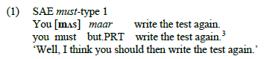
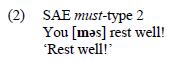
For now I will label SAE must in (1) and (2) must-type 1 and must-type 2, respectively. Must-type 1 and must-type 2, both completely natural for speakers of SAE, are unavailable in more well-studied varieties of English, such as British English (BrE) and American English (AmE). My aim in this paper is twofold: to provide a descriptive account of must in the distinctive must-types 1 and 2 contexts and to show how the meaning components of must in (1) and (2) are divergent from canonical deontic must and weaker counterparts. Canonically, we expect deontic must to encode an obligation meaning (I return to this descriptive point in Section 2). I ultimately show that the modal has undergone processes of pragmaticalization, a subtype of grammaticalization that concerns language change leading into the discourse domain of grammar (Biberauer 2018; Diewald 2011; Müller & Axel-Tober 2025; Traugott 2003). More specifically, the modal is shown to contribute an additional layer of speaker meaning to its proposition in each case. I relate the additional meanings contributed by the modal to non-cancellable implied meanings and evaluate how these meanings may arise: either the modal carries (i) a conventionalized implicature (CI) in the sense of Potts (2005) where pragmatic meaning is encoded on a lexical item or in the grammar, or (ii) presuppositional meaning, that is, meaning at the level of pragmatics which is not encoded structurally (Coppock 2012). I will argue, however, that the speaker centeredness associated with SAE must-types sets them apart from both classic CIs and presuppositions.
The paper is organized as follows: in Section 2, I give a brief background to deontic must in the English modality system and then, more particularly, deontic must within the SAE modality system. In Section 3, data for must-types 1 and 2 are presented in more detail, and their different interpretations and morphosyntactic properties are delineated. Section 4 gives an initial proposal to account for the data surveyed in Section 3 and evaluates whether must in types 1 and 2 contexts contribute presuppositional or CI meaning. From here, I give an initial proposal for the contribution that SAE must makes in types 1 and 2. I propose a new label for must in the two uses in Section 5, where I also consider how the elements of meaning have shifted in the two uses. The conclusion is presented in Section 6.
2. Background
In English, modal concepts of necessity and possibility are expressed analytically via the modal verbs (Huddleston & Pullum 2002: 172-205). A common binary distinction can be made between two main modality types: epistemic and deontic. Epistemic modality refers to modality that expresses a speaker's judgement about a particular state of affairs (SoA) (Huddleston & Pullum 2002: 178).4 In contrast, deontic modality, refers to meanings of obligation or permission (Huddleston & Pullum 2002: 178). In this paper I focus on deontic modality and, more specifically, the deontic use of the necessity modal verb must in SAE.
In Palmer's (2001: 19, 150-152) classic work on the mood and modality system, the deontic use of must is described as an obligation marker that places an action on some controllable agent in the world. In this case, must has a directive meaning because it moves an obligation bearer to action.5 Hence, I refer to this meaning as directive must. It is illustrated in (3):
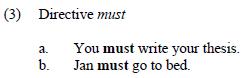
In (3), some individual is directed to action since must has an agentive focus. In (3a), the modal relates to an obligation placed on the addressee who is also the nominal subject in this case. The obligation may also fall on someone outside of the clause as in (3b): here, the obligation bearer may be Jan's babysitter, for example. Crucially, directive must always involves an imposer and obligation bearer who is brought to action. Thus, directives are often viewed as "initiating action" (Palmer 2001: 97). With this in mind, I take three basic components of meaning to be involved in a directive-must claim; this is given in (4):
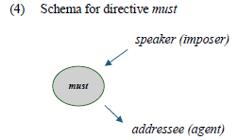
The schema above captures the three main ingredients involved in directive must: (i) a speaker (who is an imposer), (ii) a specific SoA (that is an obligation), and (iii) an addressee (who is an agent). Note here that directive must is available to SAE speakers and, in these cases, behaves as expected. My focus now shifts to uses of deontic must that are by nature strikingly non-directive in SAE. Since my concern is on the two non-directive uses set out in (1) and (2), I will utilize insights from broader descriptions of deontic modality that identify the notion of desire as core to the deontic modal category (Nuyts 2005; van Linden & Verstraete 2011). In this view, deontic modality more broadly refers to an attitude holder's desire towards a particular SoA. This includes deontic meanings that are directive (encoding obligation for a modal like must) as well as non-directive. These descriptions are relevant to the present discussion since it appears that SAE must has capitalized on this general notion of desirability as the deontic core in the two developments that are our primary concern here. In Sections 3 and 4, we will see how this general notion of desire is retained and applied to a mental dimension as opposed to directive must of (3) that is real-world bound (relating to circumstances or facts of the actual world).
It is noteworthy here that deontic must in SAE has generally lost its strong obligation meaning (Wasserman 2014). Presently, the modal has an unmarked status, and its functional domain has hence expanded relative to other World Englishes (Wasserman 2014; Wasserman & van Rooy 2014).6 In well-studied English varieties (e.g., standard AmE and BrE), deontic must is reportedly restricted to a single meaning of strong obligation, that is, directive must as presented in (3) (Biewer 2009; Collins 2009; Leech 2003). One consequence of this monosemy is that the modal has dramatically declined in usage since the 20th century in these varieties, due to a face-threatening quality that stems from must's strong obligation semantics (van Rooy 2021). Such strong obligation is absent in SAE must. In the first edition of the Dictionary of South African English, for example, the entry for deontic must is denotated as the equivalent of shall/should and "unless stressed does not signal obligation in SAE" (Branford 1978: 158). As I will show in Section 3, SAE must does not necessarily signal obligation even under prosodic stress. For now, we simply note that deontic must in SAE is known to be weaker in terms of its obligation semantics compared to other English varieties. Wasserman and van Rooy (2014) argue that SAE must's present status is that of a medium-to-weak obligation marker and present one of the first instances of medium obligation in a letter dated 1892 (ibid.: 45):
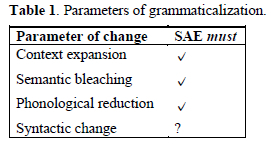
These developments have been linked to language contact with cognate forms in Afrikaans: moet, moes ('must'), and moenie ('must not'), which have corresponding semantic and structural patterns (Shah, Biberauer & Herrman 2024: 76-80; Wasserman & van Rooy 2014: 48). Afrikaans moet has undergone various changes in its own modality system, relative to Dutch moeten from which moet derives. More specifically, moenie has grammaticalized into a negative imperative marker that has triggered widespread use of moet (Biberauer 2020; de Villiers 2025; Wasserman 2016). This has further influenced the trajectory of SAE must such that must is now the more preferred deontic modal amongst the available deontic necessity markers, which include should and the semi-modals have to and ought to (van Rooy 2021). One consequence of the unmarked nature of SAE must is that it is used in a variety of new (syntactic) contexts.7 Context expansion is one of three indicators that a given element has grammaticalized in terms of the parameters of grammaticalization set out by Kouteva, Heine, Hong, Long, Narrog & Rhee (2019). These parameters are presented in Table 1.
Semantic bleaching refers to a process of change, common in grammaticalization processes, whereby the semantic content of an item is lost or diminished (Lehmann 2015). I mentioned earlier that the obligation meaning of SAE must is generally weak because of contact with Afrikaans. In the must-types that we are interested in, no obligation meaning is present. The modal does, however, retain some elements of meaning which we will consider in the following sections. Phonological reduction refers to loss of phonetic content. In Section 3.5, I give a description of the different phonologically reduced forms of the modal that are optionally available to speakers. Syntactic change refers to structural change, or reanalysis-a given element can undergo category change, for example, as happened earlier in the history of English when the class of modals became distinct from the wider class of lexical verbs (Lightfoot 1979; Warner 1995; see also footnote 15). This is an open question for the SAE modal, and it is also left here for future research. Taken together, though, it is clear that SAE must exhibits three of the four parameters of change associated with grammaticalization, a potential precursor for further grammaticalization.
While grammaticalization is not evident in SAE must-as there are no clear signs of syntactic reanalysis-the remainder of the paper will show that pragmaticalization, a related process of language change, has taken place in must in the types 1 and 2 cases, such that the semantic content of the modal is distinct from directive must. That is, must in types 1 and 2 cases is not merely a weaker directive. In particular, a new discourse-related meaning expressing different speaker/hearer-orientated meanings emerges in the two instances of SAE must under consideration here where it is absent in standard cases of deontic must.
3. The empirical facts
In this section, I give an informal approximation of the set of distinctive morphosyntactic properties that separate the two SAE must-types further from directive must discussed in canonical descriptions: namely, additional speaker meaning that parasites on the modal, available phonologically reduced forms, new scopal interpretations with negation, and the must-types' natural disposition to especially combine with perspectival phenomena. The data come from a small corpus of spoken SAE compiled by myself from sociolinguistic interviews, national and regional radio broadcasts, a set of personal recordings from SAE speakers in my community, and from myself, a native speaker of SAE from the Cape.8 I collected the data for the corpus from March 2023 until August 2023. In total, the corpus comprises 145 tokens of SAE must, with 111 must tokens for type 1, 19 tokens for type 2, and 15 tokens for directive or epistemic uses of must.9 The data come from SAE speakers across South Africa.
3.1. Inferred speaker meanings
In this first subsection, I make three claims about a distinctive SAE interpretation attached to must-types 1 and 2 alongside supporting data.
Claim 1: Type 1 is tied to the speaker's mental disposition. Claim 2: Type 2 is tied to the speaker's mental disposition towards the addressee. Claim 3: Must-types 1 and 2 contribute non-propositional content.
The first two claims concern the specific interpretations of type 1 and type 2 (they are different but related); consider that claim 2 is an extension of claim 1. The third claim is about the semantic nature of these interpretations (i.e., whether the content contributed by must in these cases is propositional). I will provide two tests to support these initial claims.
3.1.1. Claim 1: Type 1 is tied to the speaker's mental disposition
My first claim is that, in must-type 1 contexts, the modal signals a speaker bias for the information being expressed in its complement. Thus, the modal contributes an additional layer of meaning about what the speaker views as desirable, adding information about the speaker's internal state or attitude. The meaning is conveyed not via the canonical semantics of must but via an inference attached to the modal (indicated by ⇒). Recall that the modal adds no obligation meaning to its proposition in the types 1 and 2 cases we focus on.
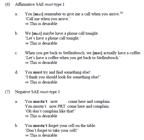
In each case above, there is no expectation that the addressee will or should act thereon (see test in Section 3.1.3). The fact that must-type 1 naturally co-occurs with perspectival elements supports the intuition that in these cases must is tied to a mental disposition of the speaker. See in (6d) that must's complement is a pseudocoordination structure, where try and find something else are not equal conjuncts (compare also try to find something else).11 Likewise, in (7a) come here and complain are not equal conjuncts (this does not literally mean that the addressee should not go to the speaker first and then complain). As various authors have shown (e.g., Biberauer & Vikner 2017: 83), pseudocoordination structures have a particular affinity for perspectival meanings, which is also exemplified in our data. For example, in structures like He just went and did it anyway, an additional perspectival meaning of disbelief or surprise is conveyed.
Notice in addition that must in type 1 contexts may naturally co-occur with discourse and modal particles that further add an identifiable element of speaker perspective towards the proposition (observe in (6b-c) and (7a)). Note that in (7a) now is the SAE particle that emphasizes speaker perspective, which Jeffery & van Rooy (2004) term emphasizer now, not the time adverbial. While these particles are not obligatory for a must-type 1 interpretation, it is noteworthy that these elements very readily combine with SAE must in type 1 structures. The particles combining with affirmative and negative must in these cases normally have an attenuating function as they soften the must claim. In its uncontracted negative form, particles, particularly politeness-related particles like please, intervene between the modal and the negative adverb not.
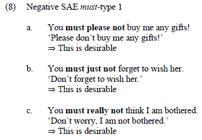
The particles in (8) function like actually and maybe in (6): they are hearer orientated and they soften the must claim. I discuss the nature of the discourse markers that accompany affirmative and negative must in more detail in Section 3.4.
3.1.2. Claim 2: Type 2 is tied to the speaker's mental disposition towards the addressee
My second claim concerns must-type 2. Like type 1, must contributes an additional layer of meaning that is tied to the mental perspective of the speaker, but now, specifically, in relation to the addressee. What results is the expression of a wish for the addressee.
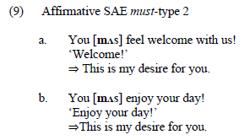
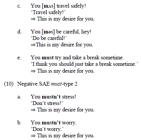
Like must-type 1, type 2 combines with structures that have an affinity with perspectival meanings. For example, must-type 2 naturally combines with a range of psych-predicates (see (9a-b) and (10) in this connection). In these cases, type 2 exhorts the addressee towards actions they cannot completely control. These are natural complements for SAE must since event-actualization is never a strict requirement. Notice here that in contrast to must-type 1, particles are not as frequently co-occurring with type 2.
3.1.3. Supporting claims 1 and 2: Negation of addressee's wishes
Above, I claimed that both must-types 1 and 2 convey inferred meanings about the speaker's mental perspective, with a further specification about the addressee relation in type 2. Since this is a mental perspective tied to a specific individual, we expect that the felicity of must in types 1 and 2 contexts is not real-world bound (unlike normal deontic modals which are evaluated by real-world circumstances). This prediction is naturally borne out in (11).
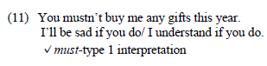
The crucial observation here is that we may naturally follow a must-type 1 claim with a sentence that implies the event in the complement of must may not be actualized by the addressee. Regardless, the must-type 1 interpretation survives unproblematically, being completely felicitous. This is unsurprising if we recall that both types have no agentive focus (which, by contrast, is present in (3)). Hence (11) shows that the addressee's wishes and actions are irrelevant to a must-type 1 claim. Similarly, for must-type 2, the speaker's wish is also completely felicitous even in a context where the wish is unlikely to be realized.

These two observations support the view that must is anchored to someone's mental perspective and not dependent on anything outside this view; that is, its interpretation is not reliant on real-world circumstances or the addressee's wishes/actions.
3.1.4. Claim 3: Types 1 and 2 contribute non-propositional content
My final claim is that must-types 1 and 2 contribute non-propositional information towards their clause. This follows the intuition that must conveys expressive meaning: must merely states the desires of the speaker (towards an addressee); must does not change the meaning of the proposition by its contribution. In other words, the meaning that emerges operates at a discourse level of interpretation.
3.1.5. Supporting claim 3: Interpretative survival under negation
Since propositional content is negated under sentential negation, we expect that if the speaker meaning of must-types 1 and 2 is propositional, it should be negated under sentential negation (Coppock 2012). In our data, however, the speaker's bias/wish is never a part of the negated content: it is simply related to the negative proposition. Consider how the speaker's bias or wish still emerges under sentential negation:
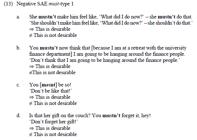
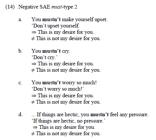
Note here that the observations in (13) and (14) are unrelated to the scope facts of negation (this is discussed in Section 3.2). The fact that the speaker's bias/wish contributed by must is never affected under negation indicates that the contribution of must-type 1 and 2 is not part of the at-issue (or truth-conditional) meaning of the sentence. Rather, the modal appears to be operating at the discourse level of meaning. In (13) the speaker bias relates to the negative proposition encoded by the content of the complement of the modal. Notice further that the speaker also expresses a previously held expectation in relation to the addressee: must presupposes, and responds to, a particular disposition the speaker anticipates the addressee to have. Likewise, in (14) the speaker's wish is simply related to the negative proposition encoded by the content of the complement of the modal. Here, negative must consoles the addressee towards a positive end. This is characteristic of must-type 2 since it is normally positively orientated towards the addressee, unlike the face-threatening nature that is associated with canonical must in other English varieties mentioned earlier (van Rooy 2021). These observations under sentential negation support the intuition that must in types 1 and 2 are expressive in nature and do not contribute toward propositional content since the inferred meanings are never cancelled.
Summarizing, a must-type 1 interpretation relates to the speaker's expressive bias towards the information in the modal's complement. A must-type 2 interpretation relates to the speaker's expressive bias towards the information in the modal's complement for the addressee. We furthermore saw that must-types 1 and 2 naturally interact with perspectival elements and structures, such as instances where they easily combine with pseudocoordination structures, psych-predicates, and non-obligatory speaker/hearer orientated discourse particles. The meaning conveyed in these two cases operates on the discourse dimension of meaning. The following subsections present several distinctive morphosyntactic properties that follow from the must-types.
3.2. Scopal interaction with negation
In the presence of negation, both must-types 1 and 2 have unexpected scopal behaviour. We canonically expect that deontic must always scopes wide with respect to negation (Iatridou & Zeijlstra 2010: 315). This is the scoping pattern captured in standard BrE must as in (15).

In (15), the negation is in the scope of the modality. Directive must in SAE is patterned just like (15). Unexpectedly, however, must-type 1 scopes ambiguously with negation as demonstrated in (16).
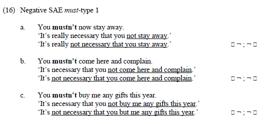
In (16), two possible interpretations are available to SAE speakers: must-type 1 may scope above negation as expected, like (15), but the interpretation where negation scopes narrow, above the modality, is a completely natural option for speakers, too. Impressionistically, it is the preferred scopal interpretation for some speakers, including myself. Must-type 2 diverges further from the canonical expectation since the wide-scope interpretation is in fact excluded:
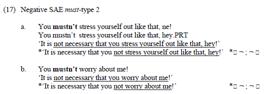

The expected interpretation of (17) is an infelicitous reading since this use of must can only scope narrow in relation to the negation. This scopal pattern is normally the specialized reading for BrE needn't (Van der Auwera 2001: 36-38). These scopal facts are important to the distinctive behaviour of the modal in types 1 and 2 contexts.
3.3. In embedded contexts
Until now, I have suggested that must-types 1 and 2 relate to speaker orientated meanings. SAE must-types, however, are not strictly anchored to the speaker per se. This is obvious as whenever the modal is embedded under an attitude verb (e.g., say) the attitude holder shifts to the matrix subject (no longer the speaker); see (18a) and (19a):
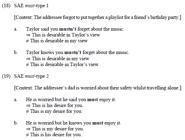
In (18a) and (19a), the respective bias and wish is no longer attached to the speaker but shifts to the individual in the matrix-subject position; that is, the agent of the local speech act. Thus, the orientation of must is shiftable in these embedded contexts. Importantly, the attitude holder appears to not shift under factive verbs; consider the different behaviour under know in (18b) and (19b). This indicates that context alone is not enough for the perspective of must to shift. The shiftable behaviour of SAE must-types will be an important characteristic that sets them apart from similar speaker-centric items that we evaluate in Section 4.2
3.4. Particles
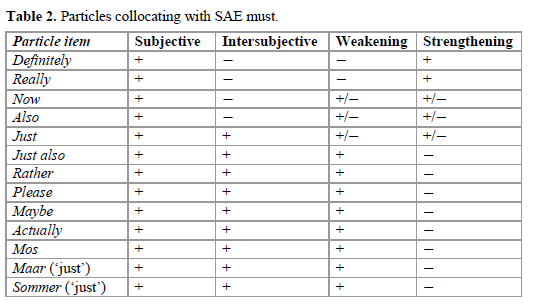
Must-types 1 and 2 naturally combine with a range of non-obligatory discourse and modal particles. Particles collocating with must typically contribute another identifiable element of speaker perspective, making them subjective in nature. Alternatively, particles function intersubjectively (see example (20a)). When particles function intersubjectively, they are deployed to account for both the speaker's and the hearer's needs in an interaction (Van der Wal 2015). Particles also have an attenuating function in terms of strength: they either soften or strengthen the meaning of the modal. Table 2 gives the range of particles that frequently collocate with affirmative and negative SAE must in the two types.
SAE must-types regularly collocate with particles like just or rather that weaken the strength of must:
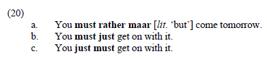
In (20a), the particle maar (literally meaning 'but') is one of the SAE modal particles that have been borrowed from Afrikaans. Here, maar is an example of a particle that has an intersubjective function: maar accounts for the hearer's needs by mitigating the potential forcefulness of the speaker's point of view in (20a). The other Afrikaans-derived SAE modal particles that collocate with must include sommer ('just') and mos (typically likened to 'as you know' or 'after all'). These forms are used productively in the grammar of some but not all SAE speakers. For example, the modal particles are absent in the SAE of KwaZulu-Natal speakers, a variety that has had limited contact with Afrikaans compared to SAE varieties in the Cape and Gauteng.13 In (20b-c), just may precede or follow the position of the modal, which affects whether must is strengthened or weakened. In (20b), just weakens the strength of must, but in (20c), just has a strengthening function when it precedes the modal. This indicates that the position of the discourse particles matters in relation to their function. Table 2 indicates this strengthening or weakening function behaviour with +/−. I connect the observation that must often appears with particles that strengthen or weaken the force of the modal to must having bleached semantic content, discussed in Section 2. In Table 2, now is the same now witnessed earlier that is related to the speaker's perspective. Here, now is semantically close to really; see (21) in this connection (Jeffery & van Rooy 2004). Note again that when the particle precedes the modal it has a strengthening function as opposed to the weakening function when it follows the modal.
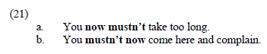
SAE must may also be strengthened by co-occurring with definitely and really. Collocations with particles that strengthen the semantics of the modal are the normal pattern of standard BrE must, which contrasts with SAE must that more regularly combines with particles that weaken the strength of must. Consider again and compare the range of particles that weaken must with those that strengthen SAE must in Table 2. For the purposes of this paper, the key and main observation regarding particles interacting with must-types 1 and 2 is that they do not derive the must-types 1 and 2 interpretations themselves since they are optional. Instead, the particles reinforce the implied meanings attached to the modal in each type.
3.5. Phonological properties
There are several phonological variants for SAE must generally, which are also available for the two must-types. The table below gives the range of must forms available to SAE speakers.
In these cases, must may be optionally reduced via t-deletion and vowel reduction. In standard varieties of BrE, deontic must cannot be phonologically reduced. Thus, the range of variants for SAE must has generally expanded relative to standard BrE must.
3.5.1. Prosodic patterns
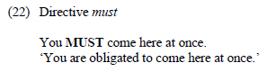
When standard BrE must is prosodically stressed with falling pitch accent, semantic focus is placed on the obligation meaning of must. This is captured in (22):
Interestingly, SAE must-type 1 may be stressed as in (23) without semantic focus on obligation; this is unavailable in standard BrE varieties.
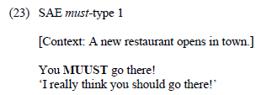
In (23), must is lengthened and an attitudinal meaning is in focus, namely the meaning that always emerges in must-type 1 cases. Although must would not typically be stressed with falling pitch accent as would be the case when BrE must is stressed, the attitudinal meaning would also be in focus if an SAE speaker were to use a falling pitch accent.14 Since this meaning is the same interpretation we get without prosodic stress, I will take this as an indication that the attitudinal meaning does not arise due to the stress placed on the modal.
3.6. Summary
In this section, I presented two must-types with distinctive expressive meanings that are available in SAE. The two types contribute an idiosyncratic layer of meaning that operates outside the proposition, which, crucially, is not present in standard uses of deontic must or weaker directives. These two must-types can also be associated with a distinguishing set of morphosyntactic properties: the must-types naturally combine with perspectival structures; they have divergent scopal behaviour with negation; and they may optionally be phonologically reduced and have unusual prosodic patterns. I furthermore showed that the additional meanings emerging via must contribute non-cancellable content. The question that arises from the description thus far is whether the attitudinal meanings emerging in the two types are a pragmatic effect or whether the meaning is part of the actual content of must in types 1 and 2 contexts; that is, whether there is a special lexical item, distinct from regular deontic must, that encodes these meanings in SAE. I show in Section 4 that, under a pair of tests, the behaviour of the attitudinal meanings in types 1 and 2 contexts suggests the latter.
4. Pragmaticalized content
In Section 3.1.5 it was established that the implied meanings attached to must in types 1 and 2 are not cancellable and operate outside the proposition at the discourse level of meaning. I now examine two possible ways that the modal could convey discourse information: either via context-in this case must carries presuppositional content-or via the encoded content of the item-in this case must has distinct conventionalized content, that is, it carries a CI. Both of these possibilities carry non-cancellable information that is pragmatic in nature. Two tests separate CIs from presuppositions: their behaviour under denials and presuppositional plugs (i.e., attitude verbs like say, believe, or think). The major distinction between the two meanings is that presuppositions, not CIs, remain anchored to the real world and so can be cancelled given sufficient context. These two tests highlight important aspects of must-types 1 and 2 behaviour. Let us consider each test in turn.
4.1. Deniability
CIs cannot survive denials because they are speaker orientated and not evaluated by world events or facts. On the other hand, presuppositions, while also anchored to the speaker, can be cancelled under denials with enough context since they may be evaluated by world events or facts (note that directive must can also be evaluated against real-world facts). This means that the non-cancellable information in presuppositional content is a pragmatic effect. Now consider our data for must in types 1 and 2 in (24) under a set of deniability tests (see Coppock 2012)
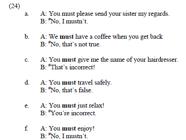
It is pragmatically odd in (24) for the addressee to deny a must-types 1 or 2 claim (i.e., B cannot deny A). Thus, must-types 1 and 2 meanings cannot be targeted by denials like CIs. In our data, however, the meanings may not be cancelled because must seems to relate all the information in its complement to an attitude holder's desire. This is distinct from the behaviour of Potts' (2005) style CIs. To see this, consider (25):
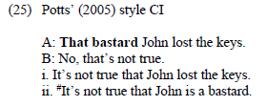
In (25), the CI, that bastard, is not targeted in B's denial. Only the truth of John losing his keys is targeted. In our data, the at-issue meaning of the sentence also becomes unnatural to deny because must relates all at-issue meaning to the speaker's respective desire (i.e., a mental attitude). Thus, must behaves like CIs under denials because the truth of its meaning cannot be evaluated based on world events or facts. At the same time, must-types 1 and 2 behave unlike CIs, because it is only the speaker orientated CI that is not targeted under the denial. In our data, the modal anchors the entire complement to a mental state of an attitude holder, making the entire proposition awkward to deny.
4.2. Presuppositional plugs
Attitude verbs say and believe are examples of presuppositional plugs. CIs and presuppositions behave distinctively in the following way: when presuppositions are embedded under a plug like believe, the presupposition can be cancelled by new information that proves the belief false. In contrast, when CIs are embedded under presuppositional plugs, new information that contradicts the CI is pragmatically odd. See example (26) from Potts (2005: 117).
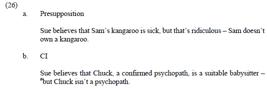
Here, the truth of the respective presupposition and CI are targeted for disqualification. In (26a), Sue presupposes that Sam has a kangaroo. The presupposition is cancelled without any issue when the fact that Sam doesn't have a kangaroo is revealed, disqualifying Sue's belief. The CI in (26b), on the other hand, cannot be cancelled: since CIs are typically anchored to the speaker, the speaker contradicts themself by denying the CI; that is, that Chuck is a confirmed psychopath.
We see under this test then that presuppositions like in (26a) can be evaluated against world facts/knowledge. CIs, like in (26b), however, are tied to the speaker's evaluation or attitude, making it odd for the speaker to counter themself by world facts or knowledge. Our data diverges on each of these points. Consider the oddity when the same test is applied to must-types 1 and 2:
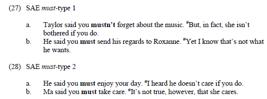
In the preceding section, we saw that must anchors everything in its complement to an attitude holder's mental state (bias or wish). Thus, the meaning attached to the modal cannot be evaluated against world events or facts: like CIs, the modal has to do with a mental attitude, resulting in the oddity of (27) and (28). Therefore, must-types 1 and 2 do not behave as presuppositions. At the same time, however, must does not behave like CIs in types 1 and 2 contexts either. In Section 3.3 we saw how the attitude holder of must shifts when embedded under these verbs, revealing that must is not necessarily speaker orientated. This makes must-types 1 and 2 pragmatically odd for different reasons from CIs. In this case, the truth of must cannot be targeted as it is tied to the mental attitude of someone (not necessarily the speaker). Someone's desire, being entirely subjective, cannot be disqualified.
To summarize, the deniability and presuppositional plug tests show that must-types 1 and 2 are crucially different from presuppositions because they express mental attitudes that cannot be evaluated against the real world. Therefore, must is more like CIs as the meaning behaves as lexicalized content but diverges in significant ways, too: (i) the modal anchors all of its complement to the mental perspective of an attitude holder, and (ii) the orientation of the modal freely shifts under attitude verbs. Altogether, the presented tests cancel out the possibility that must in types 1 and 2 contexts carry presuppositional content and indicate rather that lexicalization of new meaning has taken place in must in these cases.
4.3. Initial proposal
Based on these observations, I propose that the process of change known as pragmaticalization has played a role in producing SAE must in types 1 and 2. Pragmaticalization is change that leads to the encoding of discourse-related meanings (e.g., speaker/hearer-related meanings) in an item (Diewald 2011; Müller & Axel-Tober 2025). This is different from grammaticalization, which concerns language change wherein lexical items become more grammatical/functional, and grammatical items become even more functional (Hopper & Traugott 1993; Lightfoot 1979). Modal verbs have famously undergone this process in the history of English-a pattern that has parallels cross-linguistically (Kouteva et al. 2019; Lightfoot 1979).15
More specifically, I propose that in types 1 and 2 must is a pragmaticalized form of the SAE modal that is anchored to the mental viewpoint of some attitude holder in the discourse. Here, the modal signals that the speaker has an epistemic bias towards the prejacent (P)-all of the information in the content of the modal's complement-of the modal. Let us consider this proposal on the basis of the following examples in which A refers to the attitude holder the modal is related to and B is the addressee:
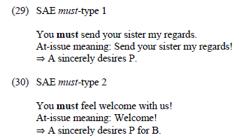
In must-type 1, (29), the modal signals that P is the attitude holder's desired world. In must-type 2, (30), the modal signals that P is the attitude holder's desired world for the addressee. Thus, in (29) and (30), bleached must contributes information about a desired mental world (for an addressee) in view of an attitude holder.
5. Optative must
The meaning emerging in bleached must in each type resembles a meaning normally associated with the optative mood: the expression of a desire, wish, or preference without the use of a lexical item that means desire, wish, or preference (Grosz 2011: 13). Optatives are normally expressed via special syntax or verbal morphology (Palmer 2001). In English, hopes and wishes are typically expressed analytically via lexical verbs like hope and wish, as in (31) (see Huddleston & Pullum 2002: 944).

The speaker's wish in (31) is a standard way of expressing a wish in English; here, the speaker describes their wish via lexical hope. The optative mood in English may also, however, be expressed via special syntactic constructions. I give an example of this in (32) where the same wish is expressed as in (31) but without the lexical verb.

The wish in (32) is expressed via special syntax. In other words, the wish-meaning parasites on special syntax as opposed to the wish being described lexically like in (31). Interestingly, notice in (32) that the modal verb may is used in the optative construction. Portner (1997: 201-203, 2009: 260-262) argues that may in (32) is an optative may and not a modal may (also see Huddleston & Pullum 2002: 96). This is the same may seen in embedded constructions like (33), where may doesn't appear to contribute any modal meaning of its own but appears to rather semantically agree with the desire verb under which it is embedded.

Without going into the details of Portner's (1997) analysis for may in (32) and (33), note simply that may in both examples means something like 'I wish he will come tomorrow'. This is a similar meaning to what we have seen with must in types 1 and 2: a wish for a specific world (for an addressee) is expressed via must. Portner (1997) argues that may in (32) and (33) is a notional mood marker. I propose that this is also true for the cases of SAE must that we have been concerned with throughout this paper: like optative may, must in these cases is a notional mood indicator such that an optative meaning parasites on the modal in types 1 and 2 cases. I therefore propose a new term for must in types 1 and 2: Optative must. For the remainder of this section, I show how the components of meaning of directive must (introduced at the start of this paper), in addition to bleached content, provide optimal material to be used for an optative interpretation of must.
5.1. Ingredients
Recall from Section 2 that there are three main ingredients involved in a directive must claim: a speaker, an obligation, and an addressee. This was schematized previously as (4), now repeated as (34).
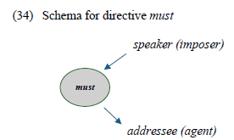
In (34), must is related to an obligation, which is bound to the real world. In (29) and (30), we saw that optative must is a bleached form of the modal-no longer related to notions of obligation-that merely expresses a general meaning of desire (i.e., the deontic core). In types 1 and 2, bleached must is used to express a general notion of desire towards a kind of world or a kind of world in relation to an addressee. In the first case, must relates to a desired world of an attitude holder that is normally the speaker. In (35), I give a basic illustration of the meaning components for this reading.
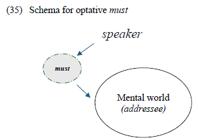
Note that (35) still shows three main ingredients, but the substance of these elements has changed in relation to the bleached form of must. The three ingredients are: (i) the speaker, who is no longer an imposer; (ii) a general notion of desire; and (iii) the speaker's mental world, which the addressee may form a part of (hence, the addressee is in parenthesis). The speaker is enlarged in (35) given the speaker-centric nature of optative must. Unlike directive must, there is no agentive focus in (35). Recall that the tests in Sections 3 and 4 show that optative must holds irrespective of the addressee's action or any real-world circumstances. Instead, the addressee merely forms part of the attitude holder's desired world. Optative must may also convey a wish about a desired world for the addressee. As with (35), there is no agentive focus involved, but now there is a special relation to the addressee as illustrated in (36).
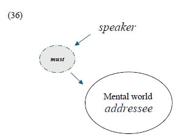
In (35) the speaker is enlarged since the speaker's viewpoint is prominent. In (36) the addressee is also focused (see addressee enlarged and unbracketed given type 2's special focus on the addressee). The three ingredients involved here are (i) a speaker, (ii) a general notion of desire, and (iii) the speaker's mental world for the addressee.
6. Conclusions
In Section 3, I presented a set of divergent morphosyntactic behaviour belonging to two uses of what is presently described as the medium-to-weak obligation marker, deontic must, in SAE. I showed that in addition to conveying additional speaker meaning to its proposition, in these cases must has an affinity with perspectival elements and optional particles, unusual prosodic patterns, a number of phonological variations, and new scopal relations with negation. I argued that in these two uses the bleached modal no longer serves a directive function. Instead, bleached must has undergone processes of pragmaticalization, resulting in a pragmaticalized form of the modal which crucially conveys expressive discourse-related meaning. I termed this use of the modal optative must, arguing that must in these contexts rather functions like a notional optative mood indicator following a similar proposal found for may in Portner (1997). Optative must conveys meaning about the speaker's desire about the world (specifically in relation to the addressee) without any agentive focus. I showed that the pragmaticalized layer of speaker meaning attached to optative must in these cases cannot be cancelled. This is borne out in three tests: namely, the cancellation, deniability, and presuppositional plug tests from Coppock (2012) and Potts (2005). The tests indicated that the speaker meanings expressed via must contribute lexicalized and not presuppositional content. Like CIs, optative must is not evaluated by real-world facts but tied to a mental perspective of an attitude holder. I showed that while distinct, optative must retains a general meaning of desire. It is this general notion that is applied to the mental realm, resulting in an assertion about the speaker's bias or wish for a specific world (for the addressee). The relation between the modal, speaker, and addressee is thus divergent in directive must and optative must. In directive must, an imposer and an agent are involved. By contrast, optative must makes no imposition on an agent (it, in fact, never matters what the real-world circumstances are or whether the addressee acts). Optative must involves the speaker, a general notion of desire, and the speaker's mental world where the addressee is either prominent or not.
References
- Biewer, Carolin. 2009. Modals and semi-modals of obligation and necessity in South Pacific Englishes. Anglistik 20: 41-55. https://doi.org/10.1163/9789042029095_004
- Biberauer, Theresa & Sten Vikner. 2017. Having the edge: A new perspective on pseudo-coordination in Danish and Afrikaans. In Nicholas LaCara, Keir Moulton & Anne-Michelle Tessier (eds). 2017. A schrift to fest Kyle Johnson, 77-90. Amherst: University of Massachusetts.
- Biberauer, Theresa. 2018. Peripheral significance: A phasal perspective on the grammaticalisation of speaker perspective. https://www.york.ac.uk/language/news/events/digs20/#tab-4, talk presented at DiGS 20.
- Biberauer, Theresa. 2020. Learning from commands: Insights from Afrikaans. Paper presented at CRISSP, KU Leuven.
- Coppock, Elizabeth. 2012. Conventional implicatures [Lecture]. Summer Semester 2012, Heinrich Heine University, Düsseldorf, Germany.
- De Vos, Mark. 2005. The syntax of verbal pseudo-coordination in English and Afrikaans. The Hague: LOT. Diewald, Gabriele. 2011. Pragmaticalization (defined) as grammaticalization of discourse functions. Linguistics 49(2): 365-390. https://doi.org/10.1515/ling.2011.011
- Grosz, Patrick Georg. 2011. On the grammar of optative constructions. PhD Dissertation, MIT. https://doi.org/10.1075/la.193
- Hopper, Paul J. & Elizabeth Closs Traugott. 1993. Grammaticalization. Cambridge: Cambridge University Press.
- Huddleston, Rodney & Geoffrey K. Pullum. 2002. The Cambridge grammar of the English language. Cambridge: Cambridge University Press.
- Iatridou, Sabine & Hedde Zeijlstra. 2010. On the scopal interaction of negation and deontic modals. In Maria Aloni, Harald Bastiaanse, Tikitu de Jager & Katrin Schulz (eds). 2010. Logic, Language and Meaning: Proceedings of the 17th Amsterdam Colloquium 6042: 315-324. Berlin: Springer Verlag. https://doi.org/10.1007/978-3-642-14287-1_32
- Kouteva, Tania, Bernd Heine, Bo Hong, Haiping Long, Heiko Narrog & Seongha Rhee. 2019. World lexicon of grammaticalization. Cambridge: Cambridge University Press. https://doi.org/10.1017/9781316479704
- Kratzer, Angelika. 1981. The notional category of modality. In Hans J. Eikmeyer & Hannes Rieser (eds) 1981. Worlds, worlds and contexts: New approaches in world semantics, 38-74. Berlin, Boston: Mouton de Gruyter. https://doi.org/10.1515/9783110842524-004
- Kratzer, Angelika. 2012. Modals and conditionals: New and revised perspectives. Oxford studies in theoretical linguistics. Oxford: Oxford University Press. https://doi.org/10.1093/acprof:oso/9780199234684.001.0001
- Leech, Geoffrey. 2003. Modality on the move: The English modal auxiliaries 1961-1992. In Roberta Facchinetti, Manfred Krug & Frank Palmer (eds). 2003. Modality in contemporary English, 223-240. Berlin: Mouton de Gruyter. https://doi.org/10.1515/9783110895339.223
- Lehmann, Christian. 2015. Thoughts on grammaticalization. Berlin: Language Science Press. https://doi.org/10.26530/oapen_603353
- Lightfoot, David W. 1979. Principles of diachronic syntax. Cambridge: Cambridge University Press.
- Müller, Kalle. & Katrin Axel-Tober. 2025. A syntactic approach to pragmaticalization. Glossa 10(1). doi: https://doi.org/10.16995/glossa.16342
- Nuyts, Jan. 2005. The modal confusion: On terminology and the concepts behind it. In Alex Klinge & Henrik Høeg Müller (eds). 2005. Modality: Studies in form and function, 5-38. London: Equinox. https://doi.org/10.3138/9781845535612-003
- Palmer, Frank R. 2001. Mood and modality. Cambridge: Cambridge University Press. https://doi.org/10.1017/cbo9781139167178
- Portner, Paul. 1997. The semantics of mood, complementation and conversational force. Natural Language Semantics 5: 167-212. https://doi.org/10.1023/a:1008280630142
- Potts, Christopher. 2005. The logic of conventional implicatures. Oxford University Press. https://doi.org/10.1093/acprof:oso/9780199273829.003.0003
- Shah, Sheena, Theresa Biberauer & Erika Herrmann. 2024. Sixth-generation contact German in South Africa: The case of Kroondal German. EL Publishing.
- Traugott, Elizabeth C. 2003. From subjectification to intersubjectification. In Raymond Hickey (ed). 2003. Motives for language change, 124-139. Cambridge: Cambridge University Press. https://doi.org/10.1017/cbo9780511486937.009
- Van der Auwera, Johan. 2001. On the typology of negative modals. In Jack Hoeksema, Hotze Rullmann, Víctor Sánchez-Valencia & Ton van der Wouden (eds). 2001. Perspectives on Negation and Polarity Items, 23-48. Amsterdam; Philadelphia: John Benjamins Publishing Company.
- Van der Wal, Jenneke. 2015. Information structure, (inter)subjectivity and objectification. Journal of Linguistics 51(2): 425-464. https://doi.org/10.1017/s0022226714000541
- Van Linden, An & Jean-Christophe Verstraete. 2011. Revisiting deontic modality and related categories: A conceptual map based on the study of English modal adjectives. Journal of Pragmatics 43(1): 150-163. https://doi.org/10.1016/j.pragma.2010.07.031
- Warner, Anthony. 1995. English auxiliaries: Structure and history. Cambridge studies in linguistics 66. Cambridge: Cambridge University Press.
- Wasserman, Ronel. 2014. Modality on trek: Diachronic changes in written South African English across text and context. PhD Dissertation. North-West University.
- Wasserman, Ronel. 2016. Moet en must: 'n Geval van Afrikaanse invloed op Suid-Afrikaanse Engels. Tydskrif vir Geesteswetenskappe 56(1): 25-44. https://doi.org/10.17159/2224-7912/2016/v56n1a3
2 I am indebted to the audience at the 2024 South African Microlinguistics Conference 12 for their feedback on this paper. Thank you for your very helpful feedback!
3 PRT refers to particle.
4 For instance, in He must have been delayed, the epistemic use of must conveys a speaker judgement concerning a particular SoA.
5 Kratzer (1981, 2012) includes obligation-related deontic must in the larger group of root modality. Broadly, root modality concerns facts that are related to the circumstances or inherent properties of the world or individuals or spatio-temporal locations (Kratzer 2012: 33).
6 SAE must is unmarked since in the paradigm of deontic obligation markers - must, should, have to - must is the default choice amongst speakers.
7 For example, SAE must is frequently and naturally used in questions unlike standard BrE must.
8 I am grateful to Ian Bekker, Kara Schultz, Rajend Mesthrie, and Kate Huddlestone for sharing their data with me. I also thank Theresa Biberauer and the (BrE) audience members at a SyntaxLab talk (Cambridge University), where I presented the SAE must-data, for their BrE judgements and observations on standard BrE divergences from the SAE data.
9 The corpus should not be viewed as an indication of the frequency of these different must uses. My intuition is that must-type 2 is as common as must-type 1 uses in SAE.
10 These data come from spoken recorded data, of which most were transcribed from audio. Transcription of must data included any phonetic reduction (consult Table 1 again for indications of language change). Phonetic rendition is given whenever phonetic reduction is present.
11 Pseudo-coordination structures have the form of regular coordination structures but do not function (syntactically or semantically) as regular coordination structures (cf. de Vos 2005).
12 To annotate the scopal interaction between modality and negation I adopt the formal symbols where ¬ refers to negation and refers to the necessity modal (must).
13 As per consultation with L1 SAE speakers from KwaZulu-Natal.
14 Thank you to Will Bennet for clarifying the distinction between the SAE stress pattern and the canonical stress pattern.
15 The ancestor form for English must, Old English motan, once behaved like a lexical verb before it changed into present day must, which is now part of a syntactically distinct class-the modals, which is itself a subclass of the class of auxiliaries.