Radical homoscapes: The linguistic landscape of a gay sauna in Africa
Abstract
This article examines the linguistic landscape of a homosexual space (homoscape), specifically a gay sauna located in a major city in South Africa - one of the two openly homosexual male bathhouses in Africa. By using the embodied type of an autoethnographic method and couching the observations within the broader scholarship of linguistic landscapes, the author demonstrates that the South African homoscape complies with several characteristics of the homoscapes located in other countries and analysed in scholarship thus far. That is, signage indexes homosexual semiotics and produces a homospace/identity; signage has a restrictive effect on the homosexual landscape/identities; signage is multimodal (visual, auditory, olfactory, gustatory, tactile); English entertains a leading position in the signage; and graffiti is the most transgressive orthographic signage type used. Nevertheless, certain differences between the South African homoscape and the other documented homoscapes can also be observed. The most important of them is the absence of glocalization and any references to local African cultures and indigenous languages and, overall, a barely noticeable extent of multilingualism. The author concludes that the researcher's body can form part of a homoscape and argues for the ethically driven inclusion of researchers in their research as the objects of their study.
linguistic landscapes; homoscapes; gay saunas; homosexuality; (South) Africa
1. Introduction
The first time I entered a gay sauna, I was fifteen years old. I was smuggled in by Mouhcine, my nineteen-year-old lover. We explored all the corners, corridors, and curves of this steamy and sticky underbelly of Paris, as we did with the junctions, joints, and junks of our bodies, equally sweaty and sultry. We experimented with love - in Arabic, with the accompaniment of French, English, German, and Russian along with many more linguistic instruments. We experimented with desire; with sight, smell, and taste; and with rage - our rage.
There was nothing dirty about this. We were two young seafarers who, for a few days, docked in each other's soul and body. Was this love? When you are fifteen, every feeling is love - or hate. You either live an inhibited life or die a splendid death. You do not vegetate in limbo in between; this you will learn in your adulthood. Once tamed and pacified, you will choose a yoke instead of a Molotov cocktail. You will submissively put this yoke onto your shoulders, tie it around your throat, and hope that it unnoticeably strangles you. But at that Parisian time, this future domestication was still hidden from me, remaining far below any of the (un)imaginable horizons. Instead of the yoke, I felt Mouhcine's chest against my back and his tongue on my neck. He was carving words from Scheherazade's tales, inserting them, both carefully and roughly, under my skin, deep into my flesh. He was landscaping my body - physically, mentally, and linguistically; with his Arabic lancet across the Icelandic-Polish terrain of my lips, groin, and buttocks.
Now, several years later, I no longer host the same (amount of) love and hate. Tamed and domesticated, with this agonizing yoke around my neck, I play the game - like everyone else. But I still hold the same rage. And, against the odds, there is a Molotov cocktail in my hand, too: my words. This is how I fight, with a fist of consonants and a knuckle duster of vowels.
The present research emerges from the experiences of an adolescent me: rebellious and defying, nonconformist and radical. For many years, I had kept these experiences buried in the dust of the past. They had become memories; distant, faint, nearly forgotten. There was no place for them in the firm and inflexible edifice of academic respectability and decorum. But I would not be a genuine explorer - I would not be me - if I did not abandon the coziness of educational standards with their false decency and did not experiment. I do so here with my research, with me as a researcher, with my text and its genre, and above all, with my body, the only landscape I have truly known. The temptation has been irresistible; like Mouhcine's hand that had led me across the fog, the obscurity, and the rhythmic reverberations of that Parisian sauna.
This article constitutes such an experiment and examines the linguistic landscape (LL) of counter-heteronormative (LGBTQIA+) spaces associated with (male) homosexuality, specifically, one of their most radical subtypes: male gay saunas.1 (Henceforth, I will refer to these types of spaces as homospaces and to their LLs as homoscapes.) By using the embodied type of an autoethnographic method and by couching the observations within the scholarship of LLs (more generally) and homoscapes (more narrowly), I aim to answer the following two-part research question: Does a homoscape located in a major South African city differ from the homoscapes described in scholarly literature thus far, and, should that be the case, what is the extent of these differences as well as their motivations. To achieve this objective, the paper is organized as follows. First, I familiarize the reader with the critical theoretical issues: conceptual framework, previous research on homoscapes, and methodology (Section 2). Next, I describe the multifold homoscape as experienced by me (Section 3). Subsequently, I evaluate these experiences and answer the research question (Section 4). Finally, I summarize the main findings and ponder the broader significance of my research (Section 5).
2. Theoretical background
In this section, I explain the conceptual framework of my study (2.1), appraise previous research on homoscapes (2.2), and describe my data collection methods (2.3).
2.1 Conceptual framework: Linguistic landscape
The field of LL investigates any displays of linguistic signs made by and for people, whether individuals or groups, and displayed in public spaces (Van Mensel, Vandenbroucke & Blackwood 2016: 423; see also Ben-Rafael, Shohamy, Amara & Trumper-Hecht 2006; Gorter & Cenoz 2024; Landry & Bourhis 1997; Shohamy 2019). The above conceptualization implies that three phenomena are particularly relevant for the analysis of a LL: a sign (placed on a support and bounded to a frame), a space, and the human interaction with them both.
A sign is the most fundamental concept in LL scholarship. Initially, a sign referred to "any piece of written text" (Backhaus 2007: 66), and the modifier linguistic, present in the term linguistic sign[age], was thus comprehended as "orthographic text" only (Cocq, Granstedt, Lindgren & Lindgren 2020: 18; see also Van Mensel et al. 2016: 423). Gradually, this narrow understanding of a sign has expanded to semiotic systems different from phonic-auditory language codified orthographically and included symbols and icons, pictures and colours, figures and outlines, textures and smells, movement and dance, and even food, music, and silence (Cocq et al. 2020: 6, 18; Jaworski 2010; Marten, Van Mensel & Gorter 2012: 4; Pütz & Mundt 2019: 1, 4; Shohamy 2015: 168; 2019: 27; Shohamy & Waksman 2009). Currently, signs draw on all possible "discursive modalities" (Pütz & Mundt 2019: 1; see also Shohamy 2015) - as long as these "communicate meanings" (Pütz & Mundt 2019: 2) - and, in their totality, form a highly complex and heterogeneous yet logical and motivated "semiotic assemblage" (Pennycook 2019: 82).
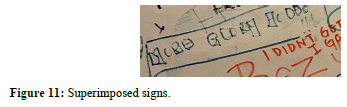
A sign always appears on some support. Supports typically are comprised of traffic signs, street signposts, notice boards, billboards, shops' facades, buildings, tags and labels, menus, and other printed materials, as well as photographs, videos, and material displayed digitally (Landry & Bourhis 1997: 25; Pütz & Mundt 2019). Support may thus be provided by all types of objects, artefacts, and tools, including jars, postcards, sport banners, stamps, and clothing (Blackwood & Tufi 2012; Cocq et al. 2020; Coupland 2010; Gorter & Cenoz 2024; Jaworski 2019; Pütz & Mundt 2019; Shohamy 2019; Siebetcheu 2016; Van Mensel & Darquennes 2012; Van Mensel et al. 2016). In fact, the human body itself can serve as a support for signs such as tattoos (Peck & Stroud 2015). Overall, supports can be more or less permanent (or ephemeral) and more or less dynamic (or static). This last type, signage in motion, has recently attracted the attention of scholars. It includes signs placed on vehicles, signs found on clothing and accessories worn by people, and signs present in video and digital material where texts and visuals "move, merge, change, collapse, blur and dissolve" constantly (Marten et al. 2012: 4). A sign is necessarily confined to "a spatially definable frame" (Backhaus 2007: 66). In LL research, this frame tends to be minimal, or the least granular. This means that signs are usually understood in a fragmentary manner as the smallest units possible (cf. Cocq et al. 2020). Nevertheless, a cluster of signs also may form a sign. In extreme cases (e.g., graffiti), a sign cannot be interpreted separately without its frame (the entire wall) and the other signs with which it clusters (a single graffito being in dialogue with other graffiti).
Space is another central concept in research on LLs. It refers to the area in which the signs (with their supports and frames) are located. LL studies have traditionally focused on physical spaces and thus geographically defined areas: "a […] territory, region, or urban agglomeration" (Landry & Bourhis 1997: 25; see also Ben-Rafael et al. 2006: 14; Marten et al. 2012: 4; Pütz & Mundt 2019: 2). As is the case of signs, spaces may range from smaller to larger units (Marten et al. 2012: 4). Smaller units include places hosting events (e.g., sport facilities), shops and shopping centres, bars and restaurants, healthcare buildings (e.g., hospitals), places of worship (e.g., churches), refugee camps, etc. (Cenoz & Gorter 2006; Shohamy 2019: 31). Larger units are neighbourhoods, cities, and provinces (Shohamy 2019: 30). Of course, the delimitation of a particular space is to some extent arbitrary with its boundaries often being organic, fluid, and fuzzy (Marten et al. 2012: 4; Shohamy 2019: 30). Recently, like the concept of sign, the idea of space became more flexible due to the inclusion of corporeal and virtual reality. That is, the human body is recognized not only as a support but the space on which various signs are located (see the so-called skinscape in Peck & Stroud 2015; Pütz & Mundt 2019: 5). Similarly, the digital medium (e.g., websites, social media, dating and communication apps) is treated as a space hosting signs rather than their support (see digiscapes or cyberscapes in Marten et al. 2012: 4; Pütz & Mundt 2019: 2).
Signs and spaces do not exist in the exclusion of people. In fact, signs and spaces have no meaning without the people who interact with them. On the one hand, signs constitute "environmental print[s]" (Huebner 2006: 31); they are traces left by a person or group of people and communicate the intentions of their author(s) (Pütz & Mundt 2019: 2, 4). Put differently, a LL constitutes "a symbolic representation […] of social, cultural and political values" (ibid.: 4) of those who "initiate […], create [… and] place" signs in a given space (Marten et al. 2012: 1). On the other hand, signs are read by community members or visitors who may be influenced by the signage and respond to it by acting in a certain way (ibid.: 1). This reaction may be linguistic (e.g., adding new signs) and/or extralinguistic. Overall, the analysis of a LL is inseparable from the study of "the authorship, readership, [and] function" of signs (Van Mensel et al. 2016: 427). All of this means that LLs are "constructions" (Jaworski & Thurlow 2010). By being "practiced, conceived and lived" (Pütz & Mundt 2019: 1), they are phenomena developed "discursively" (Pütz & Mundt 2019: 4), "socially", and "relational[ly]" (Cocq et al. 2020: 7).
The fact that a LL may be "changed and affected by human action" (Cocq et al. 2020: 7) and thus "manipulated" (Marten et al. 2012: 1) implies that a LL inherently has a diachronic dimension. A LL is not a static and frozen picture of signs placed in a territory but a dynamic process of landscaping, constantly negotiated, cocreated, and revisited (ibid.). In other words, a LL is not only configurated culturally, politically, economically, socially, and racially, as well as in many other manners (cf. Scollon & Scollon 2003: 2; Van Mensel et al. 2016: 427). The inherent property of this configuration is its constant evolution and "situated[ness] in […] historical [context]" (Pütz & Mundt 2019: 4; see also Blommaert 2016: 2).
The scholarship of LLs is highly diversified in its themes, topics, and perspectives (Gorter 2013; Gorter & Cenoz 2024; Van Mensel et al. 2016). For the present study, the following issues, and their intersection, are the most relevant: LLs and multilingualism, language imbalance, language contestation, and mobility. Multilingualism, or "the capacity of societies, institutions, groups and individuals to engage on a regular basis in space and time with more than one language in everyday life" (Franceschini 2009: 33 in Pütz & Mundt 2019: 3), is a pervasive area in LL research (Gorter 2013: 4). LLs reflect the struggle of different languages over (public) space, visible through their coexistence; that is, through alternation, mixing (e.g., code-switching and translanguaging), and inclusion/exclusion (Gorter & Cenoz 2015; Van Mensel et al. 2016: 430-432). Four primary manners of language coexistence are distinguished in LL scholarship: full-, partial-, and overlapping translations, as well as complementary messages (Reh 2004). Usually, languages that coexist in LLs (or are excluded from them) are not equally potent, some being dominant (majority/statal/official) while others being subjugated (minority/regional/unofficial). LLs constitute an important platform that reveals this linguistic imbalance in terms of the power, status, and overall vitality of the languages involved (Edwards 2010; Gorter 2013: 3; Marten et al. 2012; Pütz & Mundt 2019: 7-8) as dominant languages tend to be more visible than subjugated ones (cf. Marten et al. 2012: 7; Van Mensel et al. 2016: 426). LLs may also protect less powerful languages by creating opportunities for, or even assurance of, their visibility (Van Mensel et al. 2016: 437). Given the above, LL scholarship is almost inherently related to the concept of language contestation; that is, struggles for status and power and the negotiation thereof (Gorter 2013: 3; Marten et al. 2012: 6-7; Pütz & Mundt 2019: 7; Shohamy 2019; Van Mensel et al. 2016). Indeed, a LL constitutes "an empirical barometer" that allows one to "map and interpret" the various linguistic conflicts and disputes (Van Mensel et al. 2016: 424). Lastly, LLs are apparent exponents of mobility: migrations (i.e., populations moving within a country or across countries) and globalization. The "omnipresence of English in LLs worldwide" is the most evident exponent of this latter phenomenon (Van Mensel et al. 2016: 438; see also Blommaert 2010; Gorter 2013: 2).
2.2 Research on homoscapes
As stated in the introduction, the present article concerns a particular type of LL, namely homoscapes, or LLs broadly related to homosexuality (as part of LGBTQIA+). To begin with, the relationship between LLs and sexuality constitutes one of the themes initially overlooked, perhaps even silenced, in LL scholarship (Lucido Santos & Saisuwan 2023: 3; Milani 2014: 202; Milani & Cashman 2024: 2; Motschenbacher 2020; Shohamy 2019: 29, 35). Although some advances in this area have been made (Lucido Santos & Saisuwan 2023: 3), as will be discussed in this section, the study of sexuality in LLs - or LLs of sexuality - still occupies a relatively marginalized position in linguistics (Milani & Cashman 2024).
This marginalization particularly concerns sexualities that transgress the hegemonic and normative status of heterosexuality. A review of the literature shows that the relationship between LL and LGBTQIA+, including male-oriented homosexuality, has only been analysed in the Ni-chōme district in Tokyo, Japan (Baudinette 2017; 2018), the Phatphong 2 district in Bangkok, Thailand (Lucido Santos & Saisuwan 2023), the Wilton Manors suburb in Florida, USA (Motschenbacher 2020), in a few restrooms in Havana, Cuba (Sierra Madero 2012), as well as in some places in Tel-Aviv, Israel (Milani & Levon 2016; Milani, Levon, Gafter & Or 2018), Johannesburg, South Africa (Milani 2014; 2015), Stockholm, Sweden, and in USA, specifically in Washington, DC at American University (Leap 1996) and in Virginia at Dulles Airport (Milani 2014). Others mention certain linguistic aspects of sexual encounters occurring in gay bathhouses and cruising places in USA, Canada, and Australia (Holmes, O'Byrne & Gastaldo 2007; Perez Toledo 2023; Tattelman 1999; Tewksbury 1996, 2002).2 From these few studies, the following generalizations may be extracted (henceforth, I will only use the term homo(sexual) as it directly pertains to my research):
(a) Signage in homoscapes is the manifestation of homosexual semiotics and conversely contributes to the construction of homosexual identities (Lucido Santos & Saisuwan 2023: 2, 11; Motschenbacher 2020). That is, the signage both indexes homosexual culture(s) and produces homospaces (Baudinette 2017: 508; Leap 1996; Motschenbacher 2020: 29). This means that signage contributes to resemantization processes, or "the re-appropriation of the complex rituals, the symbolic processes, [and] the imaginary references [to] mark the geography of a place" (Sierra Madero 2012: 16). All such indexes and markers may range from those that are accessible to and identifiable by the general audience to those that are more cryptic and insider-oriented and thus decipherable only by a specific (homosexual) community (Motschenbacher 2020: 31).
(b) Signs that are openly visible and located on permanent support (e.g., names of establishments, street signs) tend to conform to the rules of political correctness. This type of signage is designed in a way that would not disrupt the heteronormativity of the surroundings and "cause […] annoyance to heteronormative society" (Baudinette 2017: 510). In contrast, signs that populate impermanent supports (e.g., flyers, adverts, printed material) and/or are less visible to a general audience may exploit more transgressive (e.g., pornographic) material. By "challeng[ing] social norms", this latter signage is critical for queering spaces and contributes to the reappropriation of normative areas by counter-normative subjects and thus the above-mentioned resemantization processes (Baudinette 2017: 523 & 510-511; cf. Leap 1996). Overall, by depicting sex, desire, and homoerotic bodies in public and by centring them, signage may be used as a "subversive" strategy and "a form of discursive empowerment" (Motschenbacher 2020: 37 & 42).
(c) Signage constitutes a demarcation strategy. On the one hand, as explained above, it differentiates a homospace from its surroundings and heteronormative areas. On the other hand, it stratifies homosexual landscapes into subtypes and distinguishes the various homosexual cultures (e.g., masculine and effeminate (Baudinette 2017: 506); bottom, top, side, and versatile, as well as twinks, two/unks, bears, otters, etc. (Baudinette 2017: 506, 511, 523; Lucido Santos & Saisuwan 2023: 10; Sierra Madero 2012: 24)).
(d) In fact, more than demarcating, signage has a "restrictive" effect: It "normalizes certain identity categories whilst marginalizing others" (Baudinette 2017: 500; see also Baudinette 2018; Moriyama 2012). To begin with, this signage establishes homosexuality as "the local norm" (Motschenbacher 2020: 1, 2, 37), relegating other sexualities to a peripheral status. Within the spectrum of male homosexualities and homosexual masculinities themselves, it privileges some types and conversely marginalizes others (Motschenbacher 2020: 2, 30). The privileged male homosexual type tends to be hegemonically masculine approximating heteronormativity, as well as middle-class, (sub)urban, and consumption-oriented (Baudinette 2017: 505; Lucido Santos & Saisuwan 2023: 17-18; Motschenbacher 2020: 37, 41). Homosexual desire is also stratified racially, with some races being perceived as more "desirable" than others (Baudinette 2017: 507; cf. Milani 2013). Whiteness is privileged in most contexts; for example, in Japan, Thailand, and the United States (Baudinette 2017; Lucido Santos & Saisuwan 2023; Motschenbacher 2020). In some landscapes, youthfulness and leisureliness are foregrounded (Baudinette 2017: 505; Lucido Santos & Saisuwan 2023). In others, the local normativity centres "non-romantic forms of sexual activity" (Motschenbacher 2020: 37) and promotes "casual attitude[s] toward superficial sexual encounters" (ibid.: 30).
(e) Signage in homoscapes draws on and contributes to the eroticization and sexualization of the male body as well as its commercialization, objectification, and commodification (Lucido Santos & Saisuwan 2023: 17; Motschenbacher 2020; Sierra Madero 2012). Conversely, signage is often apolitical except for gay-right revindications (see, however, Milani and Levon (2016) who relate gay signage to (the critique of) power and politics) and "monotonous in its unquestioned privileging of gay [White] men as a social group" (Motschenbacher 2020: 41). The modality that tends to be more critical and politically engaged is graffiti (Sierra Madero 2012; see point (i)).
(f) All these preferred and/or centred homosexuality types often manifest and epitomize a global gay culture (Baudinette 2017: 523; Lucido Santos & Saisuwan 2023: 18) represented in their economic power, or the pink economy (Sunagawa 2015: 101). This globalized gayness is not truly global but originates in the West from where it has been exported to other parts of the world (Baudinette 2017; Lucido Santos & Saisuwan 2023). Local elements such as culture and identity may, however, transpire and accompany the global/Western ones. This gives rise to the phenomenon of glocalization or "the incorporation of locality [into] global production" (Lucido Santos & Saisuwan 2023: 13).
(g) Signs in homoscapes are "englishiz[ed]" (Lucido Santos & Saisuwan 2023: 9), and English often accompanies local languages, sometimes assuming a leading position (Baudinette 2017: 507, 517; Lucido Santos & Saisuwan 2023). Other regionally dominant languages may also be present, for instance Chinese and Japanese in Thailand (Lucido Santos & Saisuwan 2023: 9). While this may result in a degree of multilingualism in some countries (e.g., Thailand and Japan), English tends to be the only language used in homoscapes in English speaking areas. Consequently, instead of attesting to "multi- or translingual[ism]", these homoscapes are essentially monolingual (Motschenbacher 2020: 27, 41). Apart from language mixing that is visible in some homoscapes, the language style usually employs first- and second-person pronouns, which mark and presuppose belonging to the LGBTQIA+ community (Motschenbacher 2020: 33-34).
(h) Signage present in homospaces is multimodal (Baudinette 2017: 514, 523; Holmes et al. 2007; Milani 2014; Motschenbacher 2020: 29, 37; Sierra Madero 2012; Tewksbury 1996, 2002). Signs are primarily visual and exploit orthographic texts, script types, and fonts; images, photos, and drawings; as well as graffiti and colours (Baudinette 2017: 514, 523; Sierra Madero 2012). A highly pervasive type of sign involves gestures and body movements (Tewksbury 1996, 2002). Nevertheless, signs may also be related to touches, scents, and aromas, as well as the absence of auditory input: silence (Holmes et al. 2007; Sierra Madero 2012: 16, 22; Tattelman 1999; Tewksbury 1996, 2002). Lastly, the physique of the human (male) body itself, whether depicted or real, can constitute a sign (or a sign's support) and indeed plays an essential role in homoscapes (Baudinette 2017: 514; Lucido Santos & Saisuwan 2023; see also Tewksbury 1996, 2002).
(i) Graffiti is the most critical signage type that marks a homospace and indexes homosexual identities in a transgressive manner as it openly defies (hetero-)normativity. On the one hand, graffiti is pervasive in more radical homospaces such as bathrooms, locker rooms, and buildings (or their parts) that are abandoned or less attended to and, therefore, more suitable for cruising. On the other hand, graffiti tends to challenge societal norms and contravene respectability discourses, being overall more vocal and unapologetic about sexual and human rights. It is uncensored, unfiltered, and "unadorned" (e.g., vulgar and sexual(ized)), "performative", "spontaneous", and "ephemeral", as well as "dialogic" and "anonymous" (Sierra Madero 2012: 17-18; see also Leap 1996). In bathrooms, graffiti approximates a publicity style intending to attract, negotiate, and exchange sex via hyperbolic language and exploitation of cultural and sexual "myths", several of which may be offensive, sexist, and even racist (Sierra Madero 2012: 23).
On the whole, scholars agree that sexuality should "be paid serious attention [and] brought onto the map of Linguistic Landscape research" (Milani 2014: 203). Specifically, LL scholarship needs more research that would address the relationship "between semiotic systems and […] queer space[s]" (Baudinette 2017: 524). This necessity stems from the fact that sexuality and its expressions can "enlighten […] the social significance of signage in public space" (Motschenbacher 2020: 26) and thus contribute to the "understanding of the complexity of power relations in multilingual settings, encounters, and lived experiences" (Milani & Cashman 2024: 1). This is especially evident in Africa since, despite important and laudable advances, research on African LLs is itself "underrepresented" within LL scholarship (Pütz & Mundt 2019: 9).3
Responding to this dearth of research on LLs and sexualities, especially the sexualities that transgress heteronormativity and the LLs that are located outside of the global North, the present article offers an analysis of the LL of a radical homospace in Africa - the first study of this type in scholarship. The radical homospace in question is one of the two openly gay saunas found in South Africa and on the African continent generally. To be exact, I will verify whether the generalizations regarding LLs of homospaces proposed in literature and captured in points (a)-(i) are instantiated in the site selected for the present research. This will allow me to ascertain whether this African homoscape differs from the homoscapes described in scholarship thus far and, should this be the case, establish the extent of such differences and their motivations.
2.3 Methods
Following the recent wave of LL studies (Cocq et al. 2020; Pütz & Mundt 2019; Van Mensel et al. 2016), including those dedicated to LLs and homosexuality and thus homoscapes (Baudinette 2017; Sierra Madero 2012), I avoided reducing my research to a purely quantitative approach of "counting signs" (Van Mensel et al. 2016: 440). Rather, I expanded the task of collecting and documenting signs through qualitative ethnographic research, aiming to identify "deeper explanations of people's reasons and rationale" for the presence and types of public-space signage (Pütz & Mundt 2019: 28-29).
Nevertheless, and in further similarity to several LL studies, my research "d[id] not strive for being a proper ethnography characterized by long-term observation and participant observation" (Cocq et al. 2020: 17). In fact, I did not involve other participants in my study at all but instead deployed an autoethnographic mode of ethnography (Ellis 2008; Holman-Jones 2005; cf. Milani 2014). Accordingly, I used my own subjective experiences at the sauna, including my "emotions, sensations, [and] desires" (Andrason 2025a: 73), as the sources of my data (cf. Ellis 2008: 48). Furthermore, inspired by an influential study of homosexual bathhouses - although dedicated to female/lesbian saunas and not concerned with LL per se (Bain & Nash 2006) - I drew on an "embodied" type (ibid.: 99) of autoethnographic research. That is, I made use of my own body "as a tool for data collection [and data generation] in ethnographic fieldwork" (ibid.). This implied three types of autoethnographic "corporal" practices: (a) "preparing [my] bod[y] to attend the bathhouse; (b) positioning [my] bod[y] within the spaces of the bathhouse; and (c) interacting with [my] bod[y] during the event"; in other words, I consciously perceived my body and noticed its responses to the environment (ibid.). In this way, my body became a "visible […] site of knowledge production" (ibid.) and "a necessary element to comprehend the relationship coupling […] the researcher-protagonist and the world" (Andrason 2025a: 72, drawing on Holman-Jones 2005; Ellis 2008). In doing so, I continue the most influential ethnographic studies on gay saunas, whereby an individual researcher visits the research site (Dangerous Bedfellows 1996; Leap 1999). However, contrary to these studies but in agreement with Bain and Nash (2006: 101), I decided to refrain from engaging in deliberate and active sexual practices. Indeed, my focus on autoethnography in this embodied methodology was motivated by my deliberate unwillingness to involve other people in the study, either overtly or covertly (cf. Bain & Nash 2006; Parr 1998). Consequently, I describe my experience, avoiding references to what other attendees of the sauna did during my visits. This, however, does not mean I was not exposed to intimate and erotic(ized) experiences during my fieldwork; such were unavoidable. My experiences certainly emerged from interactions with others. Therefore, the other is inherent to my study too. This paradox is inevitable in autoethnographic research: We are not islands disconnected from other human beings.
When collecting signs, I followed the approach employed in most studies on LLs. I first focused on documenting signs containing "orthographic language" (Cocq et al. 2020: 16). These signs were photographed where phone camera use was allowed. In places where cameras were prohibited, I annotated each sign in my notebook, which I carried with me, reproducing the text with precision and, if relevant, its spatial organization. Other visual signs (e.g., shapes, figures, pictures, colours, videos played on screens, graffiti, gestures) that accompanied or contextualized text were gathered with the same procedure. Additionally, when ethically appropriate, I considered parts of other semiotic codes practiced in the sauna, including olfactory, tactile, and auditory (although, as typical of LL studies, excluding human language understood narrowly, e.g., English, isiXhosa, Afrikaans, etc.). The signage also included the absence of visual and auditory stimuli, or obscurity and silence. These more elusive signs were described in situ. Every 10-15 minutes or after each observation, I would make notes in my notebook. Such an empirical strategy is common in qualitative approaches to LLs, especially when studying non-verbal soundscapes, foodscapes, and other landscape types containing elusive signs (Cocq et al. 2020: 17). In further compliance with the method adopted in most LL studies, I "focus[ed] on the smallest individual sign as a sampling unit" (Marten et al. 2012: 4). Nevertheless, I noted all instances where a sign formed a cluster with other signs, expanding my scope from more atomic to more composite frames. This means that, in agreement with some approaches to LLs (e.g., Cocq et al. 2020: 18), each sign was catalogued separately and tabulated in my database as an individual entry. Yet, its relation to the surroundings was recorded as well. This was particularly important in the case of the graffiti wall, which contains a plethora of signs of diverse complexity and may itself constitute a sign that contrasts with the remaining parts of the room in which it is placed (see Section 3.2.6). Furthermore, apart from individual signs and their relation to other signs, I annotated the support of each sign, its exact location in the sauna, and its function.
3. Evidence
The fieldwork that allowed me to collect the main bulk of data involved four visits to a gay sauna located in a major South African city from January to April 2024. Each time, my visit occurred early in the afternoon and thus several hours before peak hours. This scheduling allowed me to minimize contact with and exposure to other customers. A visit lasted between one and two hours.
3.1 Digital homoscape
Before the first visit, I collected the signs available on the sauna's website and digital material shared via a WhatsApp group I had joined earlier. I will begin my description by analysing this digital part of the sauna's LL.
3.1.1 Website
Before entering the physical premises of the sauna, I familiarized myself with the space through its online platform. The website consists of four separate pages. The first page provides a general introduction to the sauna. It also explains how the sauna works (e.g., its fees and opening hours), how to store one's belongings, and the type of dress code allowed inside. The second page describes the various amenities and services provided (e.g., bar, steam room, lounges, sling, cruising maze, private cubicles and ensuite cabins, showers, sundeck, lockers, and massage). The third page announces events and lists special offers and discounts. The fourth page provides the establishment's contact information. English is the only language used on the website.
From the onset, the register is direct, and the reader is addressed with the second-person pronoun. Indeed, the use of the pronouns you and your is pervasive throughout the text, and the two words appear 80 times in my database (e.g., it's your choice; you must be curious; we've got everything you need; you will be assigned a locker; whatever you are into). This discursive directness is also visible through the use of vocative (e.g., baby!, honey!, man!), conative (e.g., hey), and imperative forms (e.g., take it off, buckle up!, don't even ask!).4 Overall, the writing style is colloquial, which is achieved by specific vocabulary use: attention getters (e.g., hey man!), nouns (e.g., personal crap, shit - both referring to things or personal possessions), modifiers (e.g., creepy, horny), verbs (e.g., wank, bonk), and contractions (sorry 'bout it, we ain't gonna).
The sauna identifies itself as the city's #1 gay cruising destination and a place where the customer can be your gay self. The word gay is used seven times overall. The sauna is also presented as for men only - a space where one can find a whole variety of sexy stuff that gay guys like. No other sexualities, genders, and identities (e.g., homosexual, bisexual, trans(gender), non-binary) are present in the vocabulary used (cf. D'Augelli, Hershberger & Pilkington 2001: 525). It seems that being (to varying extents) homosexual (including bisexual) is equivalent to the label gay (man). Sexual attraction (i.e., desire, including love) and sexual behaviour (i.e., activities, including intercourse and physiological arousal) are thus conflated with sexual identity.
The sexualization of space and bodies is pervasive. The reader is identified as horny and told that in this place, they will find many other men like themselves, all of whom are equally horny and always ready. Rather than taking matters into [their] own hands (i.e., masturbating alone), one should come to the sauna and let guys […] help [one] out with that. Sexual references permeate the website and can be grouped into three main categories:
(a) words referring explicitly to sexual acts: sex (e.g., sexy entertainment facilities; hot & sexy steam room; a whole variety of sexy stuff), fuck (e.g., we've got everything you need for a fucking good time; Frequent Fucker's loyalty program), and other sex-related lexemes such as bonk and bang (e.g., you can bonk each other; as much bang for your butt as you can handle), cum (e.g., epic fun and cum; wear shoes because cum […] is not a cute look), and slut (e.g., full-out slut yourself).
(b) words referring to sex-related amenities and services (e.g., Peeping Tom room, glory holes, sling, porn lounges, cock rings, sex toys, condoms, lube).
(c) implicit or figurative use of words to suggest sexual activities (e.g., we discount stuff so that you can come in and out, and in and out, and in and, hey, you get the idea!; take matters into your own hands; guys [are] waiting to help you out with that; the boys are always ready for a good hoe-down; a stud of stallions ready to be saddled and straddled; wild ride; outdoor fun; epic fun).
The male body, and men themselves, are objectified and depicted as food that can be selected from a list of options and consumed. The following excerpt illustrates this clearly: Come check out the menu! We've got the full spread - some sugar, some spice, but the finest rump is always on the table, so come grab a slice! Whatever your flavour, there's a whole buffet of sexy men ready to savour every delicious inch of you (or vice versa)! A picture accompanying this text depicts the torso and part of the head of a man who is eating ice cream and saying lick me. The website emphasizes the leisurely and festive nature of the sauna. Indeed, one can always expect a good hoedown or a party night, and the word fun features abundantly in the text online (e.g., epic fun, have fun, outdoor fun, the fun starts, no fun with your clothes on). Complying with capitalist logic, the success of such (sexual) celebrations is associated with quantity and correlated with the increased number of participants: more guys = more fun.
The exclusive use of English mentioned above, and the converse omission of local African languages, contributes to the global(ized) outlook of the website. This globalization is also visible through references to the American wild-west culture; in particular, the use of the word cowboy (e.g., we're ready for you, cowboy!) and the depiction of men attending the sauna as a stud of stallions who are ready to be saddled and straddled. An image of a man wearing a cowboy hat and shouting yee-haw! (see next paragraph) makes these wild-west imageries even more evident. Except for the address placing the sauna in South Africa, local references are minimal. The only such element is the mention of the South African power provider Eskom and so-called load-shedding, or rolling power outages, which constitute a typical feature of daily life in South Africa. No references to Indigenous African cultures and epistemologies are made on the website.
Apart from text, the website also contains visual elements such as photos taken in situ (e.g., in the locker room, bar, steam room) and colours of the rainbow pallet, which form part of LGBTQIA+ symbology (see Section 3.1.2). In my opinion, the most impactful of these visuals are comic-style drawings that in four cases accompany orthographic signs. The first of them represents a naked torso, arms, and parts of the legs, with the private parts covered with the text WOW! and splashes of liquid (sweat or sperm). The male body is White, muscular, tanned, and lean. The second drawing depicts the same body parts (torso, arms, and legs) with a similar body type (White, muscular, and lean) wearing white underwear; it is accompanied by comic-style graphics: stars and the text BOOM. The third drawing portrays the torso and parts of the head of a man who is eating ice-cream and saying lick me. This man - again, muscular and lean - is likely a person of colour. The last picture also represents the torso of a Black muscular man covered with splashes of sweat and exclaiming OMFG! (i.e., oh, my fucking god).
The sexualization, objectification, and commercialization of the male body and male homosexuality previously discussed are not surprising given the very purpose of the sauna. One could argue that it is, after all, a privately run male bathhouse, the main objective of which is leisure, sex, and commercial viability rather than politics. To the credit of the establishment, it does announce that it celebrates all body types, and no judgement should be expected: No need to feel shy or intimidated, we've got every body type here, so no judging and a carefree, no judgement zone. Similarly, sexual activities envisioned in the sauna need not be extreme but may range from mild to wild and depend on your choice. In fact, while sex is a common option, it is not mandatory: If you just like to chill and have a drink or two, […], whatever you are into, there's something for you.
3.1.2 WhatsApp
The sauna's WhatsApp group is an informative service. Once accepted, the member is advised that the group is not an interactive platform for [the] patrons to interact with [each other]. This means that the channel is only used to receive news, trends, topics […] related to [the sauna]. As was the case of the website, all the messages are exclusively written in English.
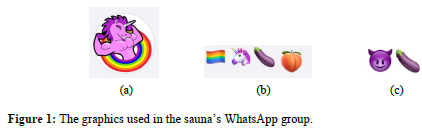
The logo for the WhatsApp group is a caricature of a pink unicorn head atop a lean and muscular torso of a man that is encircled by a rainbow (Figure 1a). The logo is accompanied by four emojis: a rainbow flag, a unicorn head, an eggplant (aubergine), and a peach (Figure 1b). The first emoji is the most common sign of the LGBTQIA+ community, with each colour having a symbolic meaning. The unicorn has become an LGBTQIA+ symbol only recently and stands for fluidity and non-binary (https://unicornyard.com/unicorn-lgbt-meaning). Pink, one of the eight colours on the LGBTQIA+ flag, symbolizes sex. The latter two icons refer to sexual organs, positions, and/or activities. The eggplant stands for a penis and a top/active position or sex preference. The peach stands for the butt and bottom/passive position and preference (See section 3.2.1).
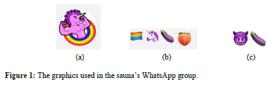
During the three months of data collection, communication and usage of signs was sparse within the WhatsApp group. I was sent two flyers announcing parties: a thematic party Back to the 80's and a celebration of the sauna's anniversary. Both contained short texts: Are you ready to party?!! This Saturday we're taking it back to the 80s. Don't miss out and Come celebrate with us - mark the date) accompanied by icons (Figure 1c). Another announcement concerned the opening hours during the Easter holidays. All such information was in English. Overall, the website and the WhatsApp group prepared me well for the essential part of my fieldwork: visits to the sauna.
3.2 Physical space
The physical elements of the homoscape, which I can describe given my approach, include me, the exterior of the sauna, and the various areas inside it, namely, the reception desk, locker room, cruising zone, and the graffiti wall.
3.2.1 Me: My body, my dress, and my linguistic repertoire
Given the embodied autoethnography I embraced as my methodological frame, I started my research by documenting my body and dress with pictures and written reflections.
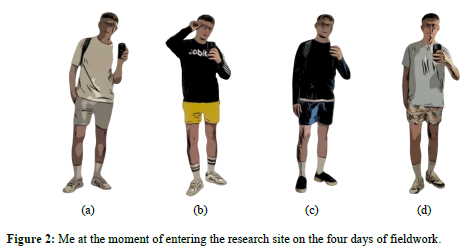
To begin with, I am a White male. I have lived in Africa for the last 15 years, mainly in South Africa but also in Gambia, Ghana, and Maghrib, and I can converse, to varying extents, in more than ten African languages (e.g., Arabic, Kituba, Lingala, Mandinka, Swahili, isiXhosa). I am hyper-multilingual, and my repertoire draws on forty languages, ten of which I speak with native or native-like proficiency. I am homosexual and gravitate towards a cisgender identity. Nevertheless, because of my bottom positioning (see Section 3.2.1) and slightly androgynous traits, - I am slim, perhaps even skinny, with rather delicate features and very sparse body hair - I depart from a hegemonic (hyper)masculinity and to some extent transcend the male gender mechanically assigned to me at birth. The way in which I prepared my body before each visit to the sauna further underlined my departure from hegemonic (hyper)masculinity. Following my regular practice, I shaved body hair from my legs, arms, and armpits. All of this had implications for my presence in the sauna and my interactions with its customers, allowing the other attendees to identify my tribe quite easily.
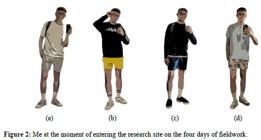
When dressing, I did not experience any angst regarding the garment I would wear (contra Bain & Nash 2006: 101). My preparation involved choosing the clothes I would wear to enter the sauna and those I would wear while inside. As noted by Bain and Nash (ibid.), the clothes one wears may either "collapse" or "reinforce" one's inclusion in the space and relationship with it. Like my physical traits, my clothing (or the lack of some garment items) established my role in the sauna's ecosystem and determined my relationship with it and its customers. Figure 2 presents my outfits when entering the establishment. Each time, I wore shorts, sneakers, white socks, a T-shirt, and, on two occasions, a light jersey, or jumper. These outfits, especially the short, tight, and colourful shorts, underscored my homosexuality (to the outsiders) and my bottomness (to the insiders), as did the 70/80's-style socks, quite entrenched in gay (porn) imagery.
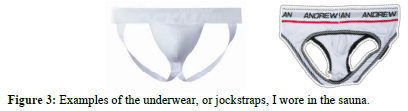
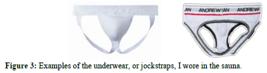
Out of the four dress-code alternatives allowed in the sauna - being naked, wearing underwear or a towel, or, only on Sundays, remaining dressed - I opted for jockstraps, a type of underwear covering the male genitals but revealing the buttocks (Figure 3). Again, I felt comfortable with disclosing, in fact, emphasizing my bottom sexual positioning. This choice was motivated by my commitment to combatting hegemonic masculinities and the so-called bottom shaming (Winder 2023). I wanted to reclaim and revindicate bottoming, which continues to be regarded as a less acceptable type of homosexual activity, not only from a heteronormative perspective but also within the LGBTQIA+ community. The sexual positioning of homosexuals - known by categories such as bottom, top, versatile or side - is "imbued with meanings" (Hoppe 2011: 194). Bottoming, which is a receptive/receiving position, is regarded as "an undesirable position in gay life" (Winder 2023: 780) and associated with "shame" and "disdain", even within the gay community (ibid.: 793). It is considered as such because being penetrated is still viewed as weak(er), more vulnerable and subordinate - and "discursively situated as feminine" (ibid.: 794). Like all penetrated men, bottoms "challenge […] masculinity" (ibid.: 776) because, in popular culture, they epitomize "a masculinity devoid of power" (Pascoe 2005: 329) and thus "effeminacy" (Winder 2023: 779). Therefore, through its hidden misogyny, bottom shaming further idealizes "stereotypically masculine behaviours" in the gay community and reinforces hegemonic (hyper)masculinity within and outside of it (ibid.: 794).
Overall, by preparing my body and clothing, I wanted to position myself as a homosexual subject that fits in with the research site - a member of the community and an insider. This allowed me to become a genuine part of the research - the researcher and the subject being researched simultaneously.
3.2.2 Exterior: the building and surroundings
The sauna is located in a beautiful historical building, well renovated and maintained. It is surrounded by many other small businesses such as coffeehouses, restaurants, bars, and vintage clothing shops. There is a parking lot in front, usually filled with cars. The entire area is trendy, associated with the artistic community, and quite ethnically, racially, and linguistically diverse.
Within this environment, the sauna is virtually unrecognizable as such from the outside. The only elements that overtly inform passersby about the establishment are the flag in the parking lot and the front signboard. Both contain the proper name of the bathhouse and its logo (Figure 1a). Instead of the term sauna or bathhouse, cruising zone is used. Overall, despite the word cruising, the exterior design does not reveal the types of sexual activities that (may) take place inside. On the contrary, the signage conceals the sexual - and especially homosexual - character of the place (cf. Evangelista 2014: 48). This assimilation of the exterior to its environment and the partial invisibilization of erotic homosexuality evoked in me a feeling of semi-clandestineness. While this concealment and secrecy may potentially ensure the privacy, anonymity, and perhaps safety of clients, in my view, they also reflect "the supremacy of the heteronormative discourse of tolerating gay lifestyles as long as they are lived out secretly" (ibid.: 49). This derives from and further contributes to the viewing of gay saunas - and certain types of homosexuality - as "vulgar", repulsive, and deviant (ibid.).
3.2.3 Interior: the reception counter and loyalty card
The sauna's interior is divided into distinct, sometimes strictly separate(d), areas. This compartmentalized spatial organization of the bathhouse predetermines how one may behave, in particular, the degree to which nakedness and sexual desire should be disclosed and performed (see Evangelista 2014: 51). Indeed, the architecture governed - perhaps controlled - the "(re)position" of my body in the sauna and heavily conditioned how I exposed it and experienced it in return (Bain & Nash 2006: 102-103). Each area expected something different from me: how I should dress, act, walk, talk, look, and even breathe, and above all, to whom my body could be presented.
To enter the sauna, I had to ring a bell. When the iron gate was remotely opened, I passed from a bright sunny exterior to a dimmed obscure interior. Near the entrance, there were shelves with a comprehensive display of sex garments, toys, and accessories for purchase. Together with the dimmed lights, this immediately marked the place as homoerotic.
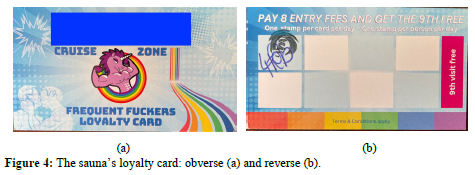
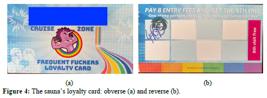
At the reception counter, I received two keys to my locker, an armband with my locker number, and another number used to monitor purchases from the bar. I signed my first name on a visitors' list, annotating the time of my arrival and my locker number. I was also offered a loyalty card, which was the only impermanent sign other than the accessories sold at the sauna and/or garments worn by the attendees, me included. The card is roughly the size of a credit card, with text and colourful graphics printed on both sides (Figure 4). The front contains the name of the sauna (concealed in 4a), its self-identification as a cruising zone, the playful name of the pass (frequent fuckers loyalty card), and the establishment's logo and graphics that include starbursts and a semi-transparent image representing two men kissing. The back stipulates the conditions of use and has spaces for stamps and signatures. Similar to the obverse, the reverse makes use of the rainbow colour symbolism. The text is entirely in English, and no feature (whether linguistic or cultural) relates the card to its local (South) African reality.
3.2.4 Undressing and locker room
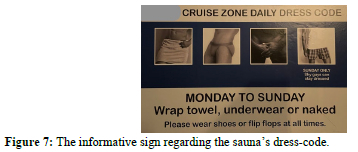
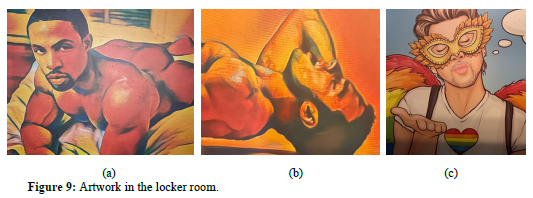
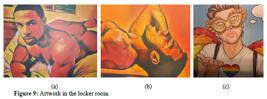
From the reception, I entered a locker room. As I will explain below, the locker room's signage is not particularly homoerotic except for two signs (Figures 7 and 8) and a few pieces of artwork (Figure 9) that are suggestive of sexual activities. This does not, however, mean that this part of the sauna is devoid of homoeroticism. On the contrary, sexual tension is electrifying in the locker room, and finding myself in this space, I immediately felt profoundly erotic(ized). This stemmed from two main reasons. First, locker rooms constitute a pervasive element in homosexual culture; not only locker rooms in gay saunas but also those in more heteronormative spaces (Bain & Nash 2006; Evangelista 2014: 51; Haubrich, Myers, Calzavara, Ryder & Medved 2004: 20). Locker rooms form an inalienable part of homosexual imagery and a shared experience in homosexual(ized) lives. Many artworks (photos, paintings, movies, narratives) that raise homosexual awareness or present homosexual episodes draw on the locker room's references, and one of the most entrenched categories in the gay-porn industry is overtly labelled as locker-room porn (Mercer 2017). Second, the locker room was indeed the place I revealed my body and overtly specified my type of sexual positioning for the first time in my research site. Undressing is a language full of wordless, gaze-driven conversations, glimpses, glances, and gluttonous greedy peaks. The way one undresses matters and forms a ritual. It is relevant what one takes off first and last; what postures one adopts while undressing; and what one does after they have undressed and prepared to enter the inside area, or cruising zone. During my four sauna visits, I undressed in silence. I only occasionally whispered a shy, barely audible hello, after which I immediately turned back. I took my time removing my shorts, socks, and underwear carefully, leaving my T-shirt for last. This slightly concealed disclosure, or partially hidden exposure, felt like a mixture of exhibitionism and voyeurism.
This undressing, together with other spatial and visual elements, makes the locker room an awkward place of transition between the heteronormative exterior and the homosexual interior. In the locker room, one is neither fully out nor in. On the one hand, the locker room is more obscure, subtly suggestive, and erotic than the exterior and reception counter. On the other, it is brighter and less overtly erotic(ized) than the interior cruising zone.
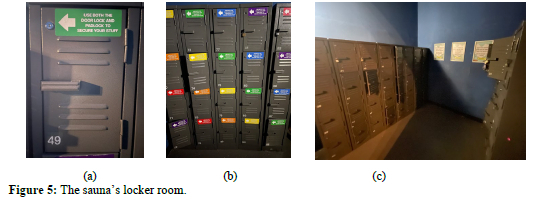
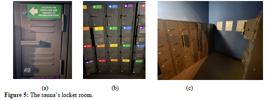
The locker room's architecture consists of two spaces or rooms. Each room contains a row of lockers placed against the wall (Figure 5a-c). Although there are no doors separating these two rooms, each functions as a different space and provides some privacy should the visitors have their lockers in these two distinct areas. To me, this separation amplified the exhibitionistic/voyeuristic character of the locker room, creating the impression of peeping. This experience, which became palpable starting in the locker room, carried throughout the entire sauna (cf. Bain & Nash 2006: 103).
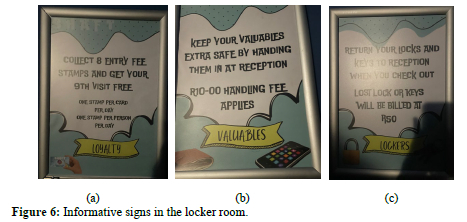
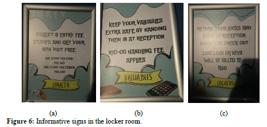
Similar to the digital space, loyalty card, and physical signs found in other parts of the sauna, the signs in the locker room are all in English. The only exception is the graffiti wall (see Section 3.2.6). The English text present in the locker room's signs are of three main types: directive, informative, and prohibitive. Directive signs help the visitor find their way to a particular space or object by directing to it or naming it: for example, lockers 25-36, bar entry, and pull. Informative signs (Figure 6) provide information necessary to navigate the sauna's landscape. For example, they inform customers of special offers related to frequent visits (Figure 6a), explain how to store valuables safely (Figure 6b), and describe the customer's responsibility regarding the keys and lock (Figure 6c). These three signs (i.e., Figures 6a-c) are identically framed and use similarly coloured backgrounds and graphics to form a composition. The messages in these signs use the imperative form, and the visitor is addressed directly by the second-person pronoun you(r). Other signs of this class inform the sauna's attendees that the establishment does not take any responsibility for lost, damaged or stolen cell phones; that if you […] take your phone in, you may ask the barman to look after it while you go cruising or put it in your locker; and provide the details of the Wifi password. Yet other informative signs explain what to do with equipment provided, such as towels and hired flip-flops.
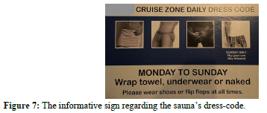
The remaining informative sign concerns the sauna's dress code and contains text and photos of well-sculpted male bodies modelling acceptable options: cover with a towel, wear underwear, or be naked, and on Sundays only, one can stay dressed. The same signage also asks attendees to wear shoes or flip-flops.
The third type of signage is prohibitive. These signs ban smoking in the locker room (no smoking) and forbid taking pictures in the cruising zone (no taking of photos or videos allowed).
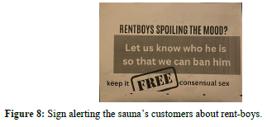
One further orthographic sign notifies customers of the presence of rent boys - a euphemism for young male prostitutes offering sex to other men. The sign requests the sauna's clients to report to the management each case of prostitution they witness to keep the place free. The sex workers are identified as male by the pronouns he and him. The sign is not directed to rent boys themselves - for example, by warning them - but rather to attendees by alerting them.
In addition to signs that include text, whether alone or with pictures and graphics, the locker room contains artwork. There are three such pieces, each marking the space as explicitly homoerotic. Two images are overtly sexual: one represents a naked man (9a), the other depicts the head and shoulders of a man partaking in a sexual activity, most likely masturbating or climaxing (9b). Both men have facial hair, are muscular, and emanate strength. The third picture portrays a man with pouting lips as if sending a kiss (9c). He wears a feathered eye mask, a T-shirt with a heart symbol, and a pair of rainbow-colored wings attached to his back; the name of the sauna is shown in a thought balloon. The silhouette in (9c) is somewhat less hegemonically (hyper)masculine due to the wings and pouting lips. The man in (9a) is Black or Multiracial. The race of the men in (9b) and (9c) is difficult to determine unequivocally, although it seems to be White.
3.2.5 The cruising zone
The homoerotic character felt in the locker room was significantly amplified in the cruising zone. Indeed, almost everything taking place in the cruising area concerned sexual activities and interactions with others. Given my analytical approach, my interactions with others were "disciplined" (Bain & Nash 2006: 104). Although my physical aspect and behaviour allowed me to "blend in" (ibid.) and I appeared to be a usual customer, I avoided contact with others, focusing solely on the LL of the sauna and its impact on my body.
The cruising zone is the main arena of the sauna - its raison d'être. Similar to the spatial organization of the whole establishment and its parts described in Sections 3.2.3 and 3.2.4, the geography of the cruising area is arranged deliberately. Its architecture along with the various components and their layout "encourage […] the physicality of desire", promote an increasing "display [of] one's body", and ultimately "prepare [customers] for the 'main event' […] at the place where they are put under the gaze of other clients" (Evangelista 2014: 52).
Upon entering the cruising zone, one turns right to the first maze of corridors. These connect glory hole boxes to cubicles, dark rooms, and a room with the sling at the end - the "highlight feature" of the sauna's lower floor (cf. Evangelista 2014: 51). All these spaces are envisioned for sexual activities only and form a labyrinthic path of increased sexualization, disclosure, and overall erotic counter-normativity. This path leads from areas with partially dimmed lights to complete obscurity; from spaces bestowed with some privacy and seclusion to those where any act is public and accessible to all; from centring interactions in couples to encouraging group sex; and from locating sexual activities on beds to allowing for sex on furniture purposefully designed for sex. For me, this organization led to losing myself - a trap augmenting my desire and excitement, encouraging me to expose myself, and stimulating me to engage in more imaginative practices. It gradually intensified the feeling of being hunted and viewing myself as prey that is watched, assessed, and chased.
If one turns left at the cruising zone entrance, one enters the bar, the atmosphere of which radically contrasts with the maze on the right. The bar approximates any pub with only a few features, such as pictures and artwork, that render it homoerotic. What really sexualizes the bar space is a TV screen playing porn. Despite this, I certainly felt less comfortable being naked at the bar and could not imagine engaging openly in sexual practices there. To me, the bar functioned as an area where one could rest from the sexual tension dominating the right wing of the floor. Between the bar and the maze leading to the dark room, there is a sitting lounge that invites guests to watch porn movies displayed on a big screen. This seems to be a transition zone between the highly sexualized glory hole boxes, cubicles, dark room, and sling on the one hand, and the minimally sexualized bar area, on the other.
From this lounge, I went upstairs to the second floor. The architecture of the second floor starts with another lounge area, the central element of which is, once again, a screen displaying porn footage. From there, one can go in one of two directions, depending on whether the desired sexual activity should be intimate or public. Heading to the right, one approaches the steam room (i.e., a Turkish-type vapor sauna) and, next, a small maze leading to a dark room. Due to the minimal visibility and small space creating the impression of crowdedness, the dark room ensures anonymity. Immediately behind it is another small cubicle-like area with a mattress and no door. This little space seems to be the most sexually transgressive area upstairs. It encourages group sex and renders any erotic activity entirely public. In contrast, if one proceeds to the left when leaving the second-floor lounge, one enters another maze of cubicles like those on the first floor. These are generally designed to host couples and ensure privacy. At the end of this labyrinth, one arrives at the sundeck. Similar to the bar downstairs, the sundeck is an area with virtually no sexual features. It is bright and sunny with many small plastic fans and pot plants. Here, I was able to relax, sunbathe, and get a break from the sexual tension pulsating inside. The quietness of this space, disturbed only by the sound of the wind, which is a permanent weather phenomenon in this part of the city, radically contrasts with the loud music played inside.
All the orthographic signs found in the cruising zone are written in English. Many of them are directive. They identify the particular type of space or show the way to it: sling, toilets, sundeck, exit, glory holes, cabin, locker room and exit, smoking area, peeping tom, bar. Others guide to specific accessories, such as lube and condoms. Several orthographic signs are prohibitions: no smoking allowed in the lounge area; strictly no smoking in the area; no alcohol past this point; no drinks allowed in the steam room; no shoes in the steam room; no entry; staff only. Sometimes this prohibitive language is less direct: smoking is only allowed at the bar and at the sundeck outside and smoking is only allowed at the bar counter and at the deck. A few signs are alerts: caution - staircase, mind the step, mind your head. An extensive set of signs is merely informative: steam room operating hours 2pm - 12am; sundeck closes daily at 11 pm. Many texts of this type regulate the behaviour of the customers or their interactions (e.g., please keep noise to a minimum; please respect our neighbours; please be courteous hose down the shower floor after douching) and other activities (e.g., please place your used towels in the bin; book your massage enquire at reception or scan this code; if you would like to tip the barman please do so when you check out; please take some free issued condoms). One sign consists of several individual signs (suck, fuck, lick, gay, sex) that form a two-dimensional composition. This complex sign is placed immediately before the dark room on the first floor.
Apart from orthographic signs, signage in the cruising area explores other visual signals and clues. Three types of signs can be distinguished: porn movies and advertisements related to the sauna's activities that are screened on TVs; colours exploited in the architecture of the cruising zone or its accessories (e.g., rainbow flags in the bar and rainbow colours used on the stairs leading to the second floor and on the fans on the sundeck); and artwork (i.e., drawings and pictures placed on the walls). The artwork includes individual art pieces as well as compositions of smaller pieces; it generally portrays men who are (semi-)naked and/or adopting eroticized postures. The men depicted are racially diverse, even in the same drawing. One picture is inspired by the famous photo commemorating American soldiers raising the American flag on the island of Iwo Jima during the Second World War. In the picture, gay men appear to raise an LGBTQIA+ flag. The various signs described in this paragraph tend to feature in the areas with increased visibility: the bar, stairs, sundeck, and the two lounges.
The visual signage of the sauna is not limited to texts and movies/colours/artwork but includes gestural signs made by customers - me in the present research. Walking in the cruising zone felt like a dance. This dance consisted of two types of elements: modification of my movement and manual and facial gestures. Indeed, it was by accelerating, slowing down, and turning (back, left, or right) and by looking at others or avoiding eye contact that I would make evident my disinterest in engaging in sexual activities. Similar gestural clues may, of course, be deployed to express willingness to have sex with others. An additional visual feature that typified the cruising zone - and constitutes part of the semiotic repertoire of gay saunas worldwide - is the lack of visibility and, thus, obscurity. The darker a particular space was the more sexually (in)tense and transgressive its character. The maze, the two dark rooms, and the sling are all characterized by reduced visibility, which is correlated with the radical counter-normative sexual practices that these spaces incite. Conversely, the brighter an area, the less sexually oriented its nature. This same correlation applies to the entire sauna and underlines the layout of the entrance, the reception area, and the locker room (see Sections 3.2.3 and 3.2.4).
Another type of signage involves auditory signals. As explained in the theoretical section and in agreement with methods adopted in other research on LLs, as auditory signs, I considered only those sounds that expanded beyond human language understood narrowly; that is, speech that can be codified with the International Phonetic Alphabet and represented orthographically. These alternative types of auditory signs constitute a permanent element in the sauna's landscape, virtually inseparable from it and the emotions and tensions evoked in customers. They can be grouped into three main categories: the sounds made by humans, sounds coming from loudspeakers and screens, and sounds produced by the sauna's infrastructure. Given the methodology I adopted, I cannot discuss the sounds of the first type as they originated from other people present in the sauna. The only human-made sounds I may report are those I initiated, especially breathing and the noise made with my flip-flops while walking. Both sounds indicated my proximity and excitement to the other customers. The sounds of the second type include music and, very seldom, sounds made by actors in porn movies. Music coming from loudspeakers was an ever-present part of the cruising zone's landscape. Vivid, pulsating, and almost aggressive, it accompanied and stimulated sexual activities. The third type includes sounds made by water running in the showers, vapor resealed in the steam room, a machine dispensing lube, and the sling moving. All the sounds mentioned above formed a true auditory kaleidoscope of signs, each with meaning and communicating a specific message, prompting determined reactions and conditioning a person's behaviour. Several of these signs evoked erotic thoughts, given their association with (radical) sexual activities.
Notwithstanding the observations of the sauna's auditory signs, silence is an essential component of the sauna's landscape, too (cf. the use of darkness as visual stimuli previously discussed). Indeed, my experience converges with other scholars' observations according to whom bathhouses and the sex practiced there are "characterized by a culture of silence" (Haubrich et al. 2004: 25; see also Holmes et al. 2007; Perez Toledo 2023; Tattelman 1999; Tewksbury 2002; regarding homosexual encounters in other spaces, see Sierra Madero 2012; Tewksbury 1996). Silence as a communicative vehicle was already patent in the locker room (Section 3.2.3). In the cruising zone, it became even more relevant (except for the bar and the two lounges). The pinnacle of non-speech was in the dark rooms. Nevertheless, non-speech does not equal silence, even in these essentially non-vocal areas. As previously explained, the sauna was filled with sounds, and the more (verbally) silent it was, the more prominent other man-made and tool-made sounds became. It was, in fact, the scarcity of proper speech and the reduction of the volume of music in the most transgressive places that rendered "non-verbal discourse" so relevant and pervasive in the sauna I visited, as is characteristic of gay bathhouses in general (Haubrich et al. 2004: 19; Holmes et al. 2007: 279).
Apart from the visual and auditory signage, the sauna's LL contains signs that communicate meaning through smells and taste should one wish to experience it. As is the case of other transgressive, counter-normative, homoerotic spaces, a particular smell may "turn […one] on", "make […them] hard", and overall "enhance […their] fantasies" (Sierra Madero 2012: 22). In my case, it was the smell of bleach, incredibly intense under the showers, that stimulated my imagination. This olfactory stimulus was due to the following fact: since my adolescence, I have associated bleach with homoerotic activities because of the common presence of this scent in saunas I have visited.
Touch is the last modality through which one may express and/or receive meaning. Although, given my method, I avoided touching and being touched, some touches were inevitable. They never inconvenienced me or excited me since my objective and focus was to conduct research. In general, my body reacted to (potential) tactile stimuli in three ways: I prevented them before they could occur; I gently moved away after a touch; and if the touch was accompanied by some speech, I smiled and politely expressed my disinterest. Tactile experiences stimulating sensuality can also originate from objects such as towels, lube, and even plastic material covering beds. All of this evokes erotic associations and further encourages one to engage in uninhibited sexual practices.
The parts of the cruising zone where the multimodal and non-orthographic signage was the most relevant were the two dark rooms, the sling area, and especially the steam room. Indeed, in the steam room there were no signs with text or artwork, and no one spoke. Instead, the most impactful signs involved dimmed reddish lights and steam obstructing one's vision; the sound of releasing vapor; in the intervals between vapor release, a deep and dull pulsation of music which was barely audible through the walls; and the sticky, wet tiles. These features of the homoscape communicated to me that I might free myself from the constraints of any sexual pudor and engage in most transgressive practices - which, however, following my approach, I did not do.
Overall, visual signs such as art pieces, photos, flyers, and signs present on screens tended to depict a single type of homosexual body: a hyper-masculine one. The desired homosexual man was tall, well-sculpted, and with other canonical qualities perceived as manly (e.g., facial hair, muscles). In contrast, visual signs referring to more effeminate bodies were absent. This suggests that the graphic signage projects "a masculine way" of homosexuality and views masculinity as an "ideal" (Evangelista 2014: 52). Such an ideal complies with the general tendency characterizing gay communities and spaces where "the valuing of masculinity and stereotypically masculine behaviours continue to be idolized" (Winder 2023: 794; see also Evangelista 2014). The ultimate objective of a homosexual person seems to be "a masculine performing gay man" (Evangelista 2014: 52). In contrast, an undesirable component is femininity, and effeminacy is viewed as unattractive (Evangelista 2014: 52; Hennen 2005; Sánchez et al. 2016; Winder 2023: 793-794). This is related to "the disdain for men who take on a 'woman's role' in gay relationships" (Winder 2023: 776) and thus adopt a bottom sexual position (see Section 3.2.1). To queer the prominence of hegemonic masculinity in the sauna, I harnessed my own body and used it as my resistance tool. Skinny and delicate, without facial hair and with glasses, and wearing jockstraps that revealed my subordinated receiving sexual positioning, I did not conform to the canon depicted in the visual signage in the cruising zone. While certainly minimal, this disruption was meaningful to me: I proudly occupied the space and claimed it as mine despite my apparently lesser masculinity.
3.2.6 Dressing | Graffiti
I returned to the locker room after each visit to the cruising zone. On the four occasions I went to the sauna, my locker was in the locker-room area further from the entrance and the reception counter. Only after dressing and placing my used towel in the bin following my first visit did I find the graffiti wall in the other part of the locker room for the first time. It immediately drew my attention - if not fascination.
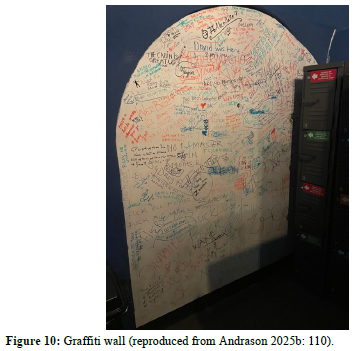
Indeed, the graffiti wall constitutes a distinctive element in the entire locker-room space. It is two meters high and densely filled with short messages in different colours, font sizes, and writing styles (Figure 10). This wall is a kaleidoscope of letters, forms, and shades of colour. Although I have analysed each message as a sign and a single meaning package, the entire graffiti wall itself can be regarded as a holistic sign that radically contrasts with the remaining part of the locker room, so austere and nearly ascetic.
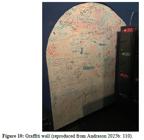
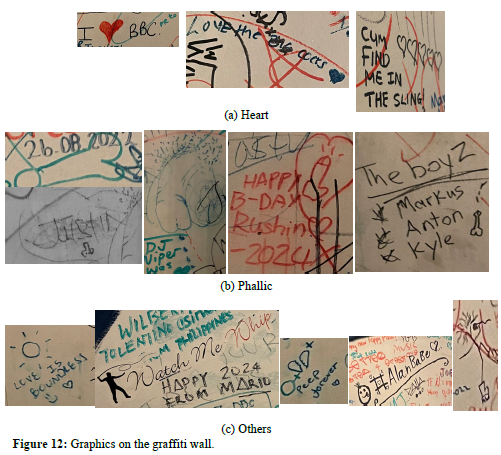
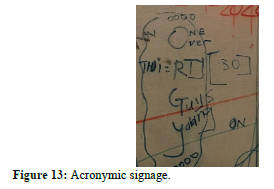
Graffiti is the most transgressive orthographic signage in the sauna. It defies respectability discourses with uncensored, unfiltered, and crude language; especially its vulgar and sexual(ized) style (cf. Sierra Madero 2012: 18; see also Van Mensel et al. 2016: 437). The most evident examples of this are swearwords referring to sex practices (e.g., fucker; love the big cocks; fuck all fuck all; fuck fuck fuck; bitches; I didn't get murdered I got my ass eat; bad bitch delegation; I am the king of fuck; no straight shit; fuck all mother fucker; fuck me I'm famous; be ethical sluts; suck my cock; more glory holes). A few swearwords are written in languages other than English: Afrikaans (mase poes; poes!!!; jou hoer) and Spanish (mariconas deliciosas; ¡A putear zorras!). Other expressions make direct references to private body parts and sexual activities (e.g., take yo panties off; big black penus; uncut), including the risky ones (e.g., [illegible] is the bbest; why don't we have orgies; cum find me in the sling).5 A few signs of this type exploit offensive racial stereotypes and "sexual myths" (Sierra Madero 2012: 23). The most problematic of these are big black penus and I [heart symbol] BBC.6
Graffiti signs may also function as anchors that fasten some visitors in the territory of the sauna (cf. Sierra Madero 2012: 18). This anchoring is achieved by signing with one's name (e.g., The boys Marcus Anton Kyle, Brent, Miguel, Romeo, Wayne). More often, the name appears within a deictic locative expression, placing the author in the sauna (e.g., Armand was here; Fearless was here; Hennie was here). Sometimes these expressions also are accompanied by the date the author visited the bathhouse (e.g., David was here 2 April 2021; Dashmiel was here oct 2022; Dlis was here 2024). Most signatures preserve the anonymity of their authors (cf. Sierra Madero 2012: 27). They contain first names or nicknames (e.g., The nasty) or a combination of these (e.g., dope.kidd.rowen). Nevertheless, there are examples of names and surnames, telephone numbers, Twitter accounts, and OnlyFans addresses that allow one to identify the author.
Another class of graffiti includes signs specifying the origin of their authors in terms of a country or town (e.g., Brasil, Zambia; with love from Zambia).7 This origin may accompany the author's name (e.g., Wilbert from Philippines; David Brussels 2023). Sometimes the origin is more specific and indicates an establishment or institution: f club manila.
A large set of signs informs the reader how the authors experienced the sauna. Most such signs convey positive opinions: […] Loved the place. Best first fuck ever; great place; the cabin is great; wow what a place will return; so much love; fun in 2024!!!; [illegible] is the bbest; [anthroponym] was here and will be back; [toponym] awesome!; [toponym] is the best; we love [toponym]; wow; best ever; love it!; great place 2 be at [toponym]; I like [illegible]; home [heart symbol]; [anthroponym]' second home; happy place!; [illegible] is hot; [illegible] is the best; [toponym] is my new happy place!. Nevertheless, negative comments are found too: niet meer hier [anthroponym]. Some such negative opinions are directed towards concrete persons: [anthroponym] is a drunk; [anthroponym] is a prick.
Several signs serve as publicity and are aimed to attract, negotiate, and exchange sex - whether real or virtual (cf. Sierra Madero 2012: 23). They specify the contact details of the authors by providing their phone numbers, accounts on social medial such as Twitter/X, Instagram, and/or OnlyFans (e.g., @[proper name]; follow me @[proper name]; (just for funs [proper name]). Often such adverts exploit a hyperbolic style overvaluing some qualities of their authors: No 1 master in mother city, I am the king of fuck.
Less commonly, graffiti is employed to convey messages related to social debates, identity and sexuality politics, and the (broadly understood) rights of homosexual and other LGBTQIA+ persons (cf. Sierra Madero 2012: 28). In one type of such signs, the customers express general opinions about homosexual life: love is boundless; gay sex is life. They also provide some suggestions on meeting practices in the homosexual community: guys let's stick to our types; stick to your preference plzzz; keep it real no fake models pls!!. Several signs concern general lifestyle, emphasizing the importance of a positive attitude: love yourself; be cool; leave a little sparkle wherever you go; you are loved remember that; just B yourself and enjoy. One message encourages the visitors to be ethical sluts. Another one consists of the single word morality!; given the lack of context, it is difficult to understand the intended meaning of this sign.
Several graffiti signs have an "interactive dialogic dimension" (Sierra Madero 2012: 28) by "creat[ing] social bonds [and] establish[ing] relations" (ibid.: 19).8 A large part of such signs are commands formulated in the imperative mood: class! repeat after teacher; find me; fuck me; suck my cock; follow me @[proper name]; cum find me in the sling. Some signs are questions, rhetorical or eliciting answers: why don't we have orgies; whos you daddy. A few others express celebratory wishes: happy b-day; Happy 2024 from Mario. This dialogical character is visible through the common use of second-person pronouns: love yourself; stick to your preference plzzz; leave a little sparkle wherever you go; whos you daddy; fuck yo all mother fuckers; just B yourself and enjoy; if it makes you happy keep quiet; you are loved remember that. A few graffiti form genuine dialogues with one sign responding to another: 1) I [heart symbol] BBC, 2) me too; 1) big black penus, 2) so over rated; 1) BMW was here the [anthroponym] (from finance), 2) really???
The collaborative nature of the graffiti wall means that new signs are sometimes written on top of older ones, rendering the latter poorly legible, entirely illegible, or erased. Figure 11 exemplifies this phenomenon. The original graffito likely read more glory holes. However, someone - perhaps even the author themself - has obscured the reading by writing over this text. This susceptibility to being re-edited and/or replaced by new signs renders the graffiti signage in the sauna "ephemeral […], fleeting, [and] furtive" (Sierra Madero 2012: 17).
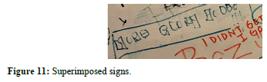
In contrast with all the other sauna areas, the graffiti wall is multilingual. However, even here the extent of multilingualism is limited with only five languages represented in graffiti signs. English is a dominant language, as can be deduced from the examples quoted above. Other languages include Afrikaans, Spanish, Dutch, and Portuguese. Afrikaans transpires through both swearwords (mase poes; poes!!!; jou hoer) and non-offensive expressions (e.g., lekker gurl lekker meisie). Spanish is only visible through swearwords: mariconas deliciosas; ¡A putear zorras! Dutch is used in one graffito: niet meer hier. Lastly, Portuguese features in the single word Brasil. Local African languages are not featured on the graffiti wall (see below in this section). There are no examples of genuine language mixing or translanguaging. While the Afrikaans example lekker gurl lekker meisie could, in principle, suggest some type of mixing, this need not be the case. Indeed, the word gurl is well entrenched in gay slang in South Africa, extending far beyond English. It belongs to the gay-ish repertoire of Afrikaans and isiXhosa speakers, too.
Apart from the orthographic signs discussed above, the graffiti wall also contains graphics. A heart symbol is the most common graphic element (Figure 12a). A phallic symbol (12b) is also frequent and further contributes to the "audacious" and "transgressing" nature of the graffiti (cf. Sierra Madero 2012: 18). As Sarduy (1982: 76; in Sierra Madero 2012: 18) eloquently observed, "the brush in hand" - in our case, a pen - becomes the "metonymy of the phallus". Other graphics include depictions of the sun, a man with a whip, a broken heart, the Venus symbol of femininity, hashtags, face emojis and smileys, and the silhouette of a person singing (12c). Graphics often contribute something to the text, such that the two are inseparable (cf. Pennycook 2008; Cocq et al. 2020).
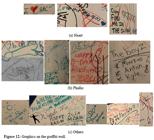
One sign (Figure 13) is a spatial composition of four words: one over; thi=rty [30]; guys; young. These words yield the acronym ORGY.
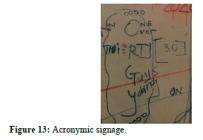
Because of its transgressive nature, graffiti constitutes a standard tool in various forms of contestation and resistance, including a linguistic one (Van Mensel et al. 2016: 437). Being the researcher and the subject of my research, I decided to contribute to the graffiti wall of the sauna and marked the space with a sign in an Indigenous South African language that I know - isiXhosa. This text reads ndibhalele ngesiXhosa! (write to me in isiXhosa). Although I wrote this sign during my first visit at the beginning of January, no one responded until my final visit in April.
4. Evaluation and results
My experiences at the sauna described in the previous section largely corroborate the claims that have been made in the (very sparse) literature on LLs and (male) homosexuality:
(a) The signage of the sauna indexes and manifests homosexual semiotics and, at the same time, produces a homospace and homosexual identities. That is, signage exploits homosexual rituals, symbols, imagery, and culture and harnesses them as resemantization devices that mark the geography of the place as homosexual and counter-normative (cf. Baudinette 2017; Lucido Santos & Saisuwan 2023; Motschenbacher 2020; Sierra Madero 2012). Signage also does so with the people placed within the sauna. It allows them to explore, enjoy, and embrace their counter-normative sexuality and "tags" them as sauna-goers - one of the most radical tribes within the LGBTQIA+ community. Non-permanent signs and graffiti (which also constitutes a more furtive sign type) that are placed inside and, therefore, invisible to the general public, as well as intramural multimodal signage and the signs found online, are the most critical for the resemantization of the space. This signage draws on transgressive material that allows the centring of counter-normative homosexual subjects and subversively reappropriates the area as a counter-normative island within the broader heteronormative context - and thus queers it. In contrast, signs that are located on permanent supports and/or, by appearing outside, are visible to a non-LGBTQIA+ audience - all of which are orthographic or at least visual - avoid any disruption of the hegemonic heteronormativity of the area or challenge it subtly and usually within the norms of decorum (cf. Baudinette 2017). This external concealment and resultant invisibilization of the sauna and its radical counter-normativity in the neighbourhood are the manifestations of heteronormativity and an apparent lack of tolerance for those homosexual identities that are perceived as excessively disruptive because they are disclosed openly and unapologetically.
(b) While the signage of the sauna constitutes a demarcation strategy that differentiates it from its heteronormative surroundings, it also has a restrictive effect (cf. Baudinette 2017; Lucido Santos & Saisuwan 2023; Sierra Madero 2012). This concerns both the geography of the space and the identities of the attendees:
(i) Signs stratify the geography of the sauna by dividing it into separate areas, each characterized by a distinct level of sexual explicitness and behaviour patterns/expectations. The LL of the various parts of the sauna and its overall spatial organization determine how one can behave and reveal one's body and desire (cf. Bain & Nash 2006; Evangelista 2014). Each area is governed by rules that condition customers' presence and interactions. Overall, this architecture yields a path of increasing eroticism, exposure, and counter-normativity, leading from the entrance/counter (minimally erotic) to the locker room (semi-erotic/covert), and eventually the cruising zone (highly erotic/overt). The landscape of the cruising area itself is also arranged deliberately. Its various parts promote a similar increase in less normative sexual practices, additionally offering a post-climactic relaxation, all of which is organized in the following order: glory holes, steam room, corridor, and cubicle maze (tension) > dark room and sling (climactic main event) > bar/sundeck (rest) (cf. Evangelista 2014: 52).
(ii) Signage normalizes some homosexual identities and masculinities and marginalizes others (cf. Baudinette 2017; Motschenbacher 2020). First, it privileges those homosexual identities that approximate hegemonic (hyper)masculinity and match most closely a heteronormative male body: muscular, lean, with facial hair, and projecting a strong masculine demeanor (cf. Evangelista 2014). Second, the signage centres homosexual identities that are non-romantic, sexually casual, and leisure oriented. Indeed, except for the graffiti wall, signs are apolitical and do not concern ethical, social, and/or legal issues. They thus contribute to the eroticization of the male body and its commercialization, objectification, and commodification (cf. Baudinette 2017; Lucido Santos & Saisuwan 2023; Motschenbacher 2020). The body is treated as a product sold, served, and consumed. Third, to some extent, homosexual desire is stratified racially. Whiteness and White men are given more prominence in signage than those who are of Black and Brown (i.e., Multiracial or Coloured) races, although the latter ones are represented as well (cf. Baudinette 2017; Milani 2013). Fourth, the signage centres a global pink culture that originates in the global North and draws on Western (in particular Anglo-Saxon and American) cultural elements, and engaging in sex in the sauna is equated with being gay (cf. Baudinette 2017; Lucido Santos & Saisuwan 2023; Sunagawa 2015). In contrast, local elements related to Indigenous African cultures are absent. They fail to be exploited even in a tokenistic manner. This means there are no examples of glocalization (cf. Lucido Santos & Saisuwan 2023).
(c) English entertains a leading position in the signage, with other languages (Afrikaans, Spanish, Dutch, and Portuguese) present minimally and only on the graffiti wall. Indigenous African languages (e.g., isiXhosa, isiZulu, isiNdebele, seSotho, sePedi, siSwati, seTswana, xiTsonga, tshiVenda) do not feature in the signage, even on the graffiti wall. This means that the degree of multilingualism is minimal, and monolingualism predominates (cf. Baudinette 2017; Lucido Santos & Saisuwan 2023). Since English is one of the official languages in South Africa, the sauna could be viewed as conforming to the monolingual tendency of homoscapes in English-speaking countries (cf. Motschenbacher 2020). Nevertheless, the area where the sauna is located is highly multilingual with English L1 speakers constituting only 60% of the neighbourhood population; if the entire city is concerned, this number is significantly lower. This marginalization of Indigenous African languages further contributes to the perceived Whiteness of the space and its globalized Western character explained above. The language employed in the English signage is colloquial and makes abundant use of first- and second-person pronouns, which mark belonging to the community (cf. Motschenbacher 2020).
(d) Signage is multimodal (cf. Baudinette 2017; Holmes et al. 2007; Milani 2014; Motschenbacher 2020; Sierra Madero 2012; Tewksbury 1996, 2002). Orthographic texts - excluding graffiti - are of three main types: directive, informative, and prohibitive. All visual signs may draw on features such as font size, style, and colours. Other graphic elements are photos, drawings, and gestures, including whole-body movements and facial expressions. A highly relevant visual feature concerns the intensity of lights, that is, its obscurity or brightness. Non-visual modes pertain to auditive, olfactory, and tactile stimuli (cf. Holmes et al. 2007; Sierra Madero 2012). Auditive non-verbal signs involve music, bodily noises, and sounds produced by tools and accessories, with silence constituting another important auditive signage type (cf. Holmes et al. 2007; Perez Toledo 2023; Sierra Madero 2012; Tattelman 1999). The physique of the human body itself, both depicted and experienced in situ, plays a vital role in the LL of the sauna, communicating meaning and conditioning behaviours (cf. Baudinette 2017; Lucido Santos & Saisuwan 2023). Signs range from those accessible to the general audience to those cryptic and decipherable by insiders only, with non-orthographic signs generally being known to experienced sauna attendees solely (cf. Motschenbacher 2020).
(e) Graffiti is the most transgressive orthographic signage type used in the sauna. By allowing for anonymity - although not always preferred and/or respected - and the use of vulgar and sexual references, graffiti challenges societal norms and violates respectability discourses. Nevertheless, it is more vocal about sexual and human rights than any other signs in the sauna. Graffiti is also the most interactive and dynamic signage, allowing for genuine dialogical exchanges. It often uses a publicity style and may draw on racist and sexist stereotypes that are aimed at attracting and negotiating sex and facilitating its exchange (cf. Leap 1996; Sierra Madero 2012).
The above observations mean that the LL of the homoerotic space analysed in this article does not drastically differ from the homoscapes in other countries described in scholarship thus far. Nevertheless, certain important differences can also be noticed.
The most evident peculiarity of the South African homoscape is the absolute absence of any reference to local Indigenous African cultures and languages, hence, any trace of glocalization. While South Africa is an English-speaking country with a considerable White population - which makes English and Western elements local to some extent, although certainly (epi)colonial - most inhabitants are Indigenous African (Black and Multiracial). South Africa recognizes several Indigenous African languages as official, and the majority of speakers have an African language as their mother tongue, or first language. As explained above, in the city and neighbourhood where the sauna is located, multiculturalism and the use of local Indigenous African languages are pervasive. Therefore, one would expect at least a minimal presence of African cultures and languages in the LL of the sauna. This is not the case in light of my data. The dominance of English and Western features is likely related to the Whiteness of the homosexual culture in South Africa and the scarcity of intersectional awareness in LGBTQIA+ movements apart from globalizing tendencies. The homosexual person who can enjoy their rights and some respect in South Africa tends to be White and middle-class (cf. Disemelo 2015; Matebeni 2018; Milani 2015; Reygan 2016; Tucker 2009: 50-55, 65-66; Vanyoro 2021; Visser 2003: 185). This generally translates into being a fluent English speaker (either L1 or L2) with minimal knowledge of Indigenous African languages. The racialized other faces many more challenges: social, economic, educative, and labour-related, as well as linguistic ones. Accordingly, "the old, racial apartheid [is] translated into a new, economic apartheid [that] characterize[s] most other spaces for the LGBT[QIA+] community" (the One in Nine statement as cited in Milani 2015: 443). This new Apartheid type "excludes Black and/or poor gays" (Vanyoro 2021: 3; see also Tucker 2009: 50-55; Visser 2003: 185) and their languages. The LL of the sauna seems to match this racial imbalance with Whites and their cultural and linguistic characteristics still occupying a privileged position and thus reflects and replicates the post/epi-coloniality of contemporary life in South Africa.
The results of my study also contribute to the four main areas of LL research: multilingualism, language imbalance, language contestation, and mobility. As explained above, the minimal multilingualism of the sauna contrasts with the multilingual character of South Africa, the city and the neighbourhood in which this establishment is located, and the multilingual signage that is common in these other spaces and scapes (Adekunle, Mheta & Rapeane-Mathonsi 2019; Andrason 2025b; Du Plessis 2011; Dyers 2008; Kayam, Hirsch & Galily 2012; Peck & Stroud 2015; Stroud & Mpendukana 2009). In fact, my study demonstrates that the sauna's signage is monolingual except for the graffiti wall, where a few signs in other languages are found. On this wall, however, none of the four main manners of language coexistence (i.e., full, partial, and overlapping translations, as well as complementary messages) is attested, and no case of translanguaging is present. Instead, each sign (i.e., each graffito) is written in a different language and conveys its own complete and self-contained message. English is, again, the dominant language in this only multilingual platform. Other South African languages are not featured except for Afrikaans. This means that the colonial languages, especially English and much less Afrikaans, prevail while Indigenous African languages, even though official, statal, and spoken by the majority of the country, are underrepresented both on the graffiti wall and in the sauna overall. While a similar linguistic imbalance permeates the reality of South Africa and the South African LGBTQIA+ community (see the previous paragraph), the sauna exaggerates it considerably. In a struggle over the radical homospace, the (epi)colonial English system wipes out all the other Indigenous varieties. Significantly, there are no examples of linguistic consciousness and awareness of the role of Indigenous languages. The only instance of language contestation was my act of microresistance and use of isiXhosa. Instead of language contestation, the homoscape - in fact, only its graffiti wall - manifests the mobility of the clients and their Belgian, Brazilian, Philippine, Spanish, Dutch, and Zambian origin. While the dominance of English may be interpreted as a manifestation of globalization, English is one of the official languages in South Africa. Therefore, in further agreement with what I argued, its dominant position in the sauna reflects the (epi)colonial reality of the country rather than international mobility only or principally. Overall, the homoscape acts as a barometer that reveals struggles in the South African LGBTQIA + community and the South African society at large.
5. Conclusion
This article studied a homoscape, or the LL of a homosexual space, specifically a gay sauna located in a major city in South Africa, one of two openly homosexual male bathhouses in Africa. By using the embodied type of an autoethnographic method and couching the observations within the broader scholarship of LLs, I demonstrated that the South African homoscape complies with several characteristics of the homoscapes located in other countries and analysed in scholarly literature thus far. That is, signage indexes homosexual semiotics and produces a homosexual space/identity; signage has a restrictive effect on the homosexual landscape/identities; English entertains a leading position in the signage; signage is multimodal (i.e., visual, auditory, olfactory, gustatory, and tactile); and graffiti is the most transgressive orthographic signage type used. Nevertheless, certain differences between the South African homoscape and the homoscapes documented in scholarship were also observed. The most important differences are the absence of glocalization and the lack of any reference to local African cultures and indigenous languages, resulting in a barely noticeable extent of multilingualism.
In addition, my study shows that the bodies of the attendees of gay bathhouses, both clothed and naked - including the body of a researcher such as myself - can form part of the LL of radical homospaces. In fact, the contribution of my own body to the South African homoscape I visited and described was not limited to adjusting to the environment and following its rules. Although a customer and, by definition, associated with a more passive role in the landscape (not with regard to sexuality but rather in terms of the ability to intervene within it), I assumed an active role. That is, by choosing a particular outfit, preparing and disclosing my nudity in a determined way, and selecting how my body would interact with other signs and behave in the sauna and its proximities, I became a co-creator of the LL of this establishment. This active participation and agency stemmed from the deliberation with which I intervened and repossessed the sauna's space as mine. I not only indexed some aspects of homosexual culture but also selectively marked the space by these traits of homosexual identity that I considered appropriate and necessary. Specifically, I gave prominence to an alternative type of homosexual masculinity: less hegemonic, testosteronal, and aggressive, mimicking less the heteronormative (hyper)masculine canon and instead the more delicate, gentle, compassionate, and, overall, somewhat epicene. I also intervened linguistically: I altered the linguistic diversity of the establishment by leaving the only inscription in isiXhosa and an African language overall.
The analysis brings me to the following conclusion: I have no doubts that, as researchers, we should become the objects of our research. I not only mean that reflexivity and autoethnography constitute powerful methodological tools allowing us to gain a deeper understanding of social phenomena. The necessity of including ourselves in research has an ethical foundation, too. I am convinced that we are morally obliged to become participants in our research to experience on our skin what it means to be an informant, an interviewee, and/or a datapoint. Being reduced to data hurts. Disclosing my private life and showing vulnerability exposes me to potential homophobic attacks - and I have indeed suffered them during this research too. But hasn't this been experienced by the many participants involved in scientific research? Why should we, researchers, be exempt from this suffering? In my opinion, we should suffer as anyone else. This is the least we can do while scavenging on other people's knowledge, experiences, and lives. The shame, hurt, and suffering I have experienced only reassures me of the appropriateness of the autoethnographic methodology employed in this study and the disclosure of my homosexual self in all its nakedness, imperfection, and rawness.
Lastly, as explained above, although the disclosure of my body and sexuality renders me more vulnerable, the same embodied autoethnographic research on (the LL of) radical homospaces can constitute a praxis that is profoundly liberating, too. I argued in my article that the architectures of LGBTQIA+ places and establishments, including the homosexual sauna described here, tend to be masked in their heteronormative surroundings. Similarly, the linguistic scholarship about homosexual issues often conceals - in fact, silences - the voices of homosexual subjects, keeping them behind the walls of respectability and decorum. As with many other social issues, "to be present in a research ecosystem, the voice of 'the [homosexual other]' must be paraphrased with the more palatable voice of the elite, often by means of a more sophisticated, theory-laden and citation-rich jargon" (Andrason & Matutu 2025: 14). To me - and I dare to say to several others - homosexuality in the academy (and of course in life as well) has been a violent act of finding oneself at the margins of what the world perceives as normative. Each time I was allowed to be homosexual at university, this was invariably on heteronormativity's terms: I was accepted as long as my homosexuality was discreet and matched heteronormative schemas. Therefore, I view the present text as a manner with which a homosexual subject - me - reclaims their scholarly space and discourse. This implies embracing homosexuality in academic writing in all its aspects, including the rejection of puritanism. Indeed, I have disclosed my (sexual) experiences, (eroticized) emotions, and (naked) body not only to provide richer data, to acknowledge my subjectivity and positionality, and to be a more ethical researcher, but also to regain and repossess my homonarrative. Put differently, this article, including the research I conducted, the words I used, and the images I evoked, constitutes one of the strategies with which I aim to liberate myself from heteronormative oppressions. It is the Molotov cocktail thrown at the heteronormative reality in which I have had to exist. By openly writing about (radical) homosexual erotic practices and, more importantly, celebrating them openly, I seize and occupy the scholarly space from which such positive and unapologetic homosexual discourses have traditionally been expelled. In so doing, I not only tell my story, I remake myself as well. I travel back to my youth, to Mouhcine and the boy I used to be: "provocative, iconoclastic, raw, and vulgar - yet graceful, sensitive, fragile, and lyrical" (Andrason 2025a: 74). I want the linguist I am now to be this boy again. I want to blend science with literature and poetry with porn (ibid.). Perhaps, above all, I want to see human language as a tongue - Mouhcine's tongue. A tongue that is not confined to sounds but reaches optic, olfactive, gustatory, and tactile dimensions, too. After all, like Mouhcine's tongue, language has a body - it is flexible and strong, but also gentle; it has aroma - it smells the human breath, full of purity and charm but also resentment; it has a flavour - it tastes all the sweetness of saliva but also the sourness of sweat; and it has a skin through which we feel our fellow human beings - this crust that separates us from the other.

Acknowledgments
This article was created within the project "Multilingual worlds - neglected histories. Uncovering their emergence, continuity and loss in past and present societies." This project has received funding from the European Research Council (ERC) under the European Union's Horizon 2020 research and innovation programme (grant agreement no. 101002696).
References
- Adekunle, Temitope, Gift Mheta & Maleshoane Rapeane-Mathonsi. 2019. Exploring linguistic landscapes in selected South African universities: A case study of the University of Cape Town and the University of the Western Cape. Stellenbosch Papers in Linguistics Plus 56: 123-153. https://doi.org/10.5842/56-0-803
- Andrason, Alexander. 2025a. Language repertoire as radical queer love: A boy's journey. Boyhood Studies 18(1): 67-97. https://doi.org/10.3167/bhs.2024.1126OF2
- Andrason, Alexander. 2025b. Reclaiming multilingualism: African languages in the linguistic landscape of Cape Town (Observatory, Salt River and Woodstock). Asian and African Studies 34(1): 91-139. https://doi.org/10.31577/aassav.2025.34.1.07
- Andrason, Alexander & Haile Matutu. 2025. Reflections on (our research on) human-to-animal communication (in Africa): Anthropocentrism, posthumanism, and white crisis. Journal of Postcolonial Linguistics 12: 1-30.
- Backhaus, Peter. 2007. Linguistic landscapes: A comparative study of urban multilingualism in Tokyo. Clevedon: Multilingual Matters.
- Bain, Alison & Catherine Nash. 2006. Undressing the researcher: Feminism, embodiment and sexuality at a queer bathhouse event. Area 38: 99-106. https://doi.org/10.1111/j.1475-4762.2006.00663.x
- Baudinette, Thomas. 2017. The spatialisation of desire in a Japanese gay district through signage. ACME: An International Journal for Critical Geographies 16: 500-527.
- Baudinette, Thomas. 2018. Cosmopolitan English, traditional Japanese: Reading language desire into the signage of Tokyo's gay district. Linguistic Landscape 4(3): 238-256. https://doi.org/10.1075/ll.18004.bau
- Ben-Rafael, Eliezer, Elana Shohamy, Muhammad Hasan Amara & Nira Trumper-Hecht. 2006. Linguistic landscape as symbolic construction of the public space: The case of Israel. In Durk Gorter (ed). 2006. Linguistic landscape - A new approach to multilingualism, 7-30. Clevedon: Multilingual Matters. https://doi.org/10.21832/9781853599170-002
- Blackwood, Robert & Stefania Tufi. 2012. Policies vs. non-policies: Analysing regional languages and the national standard in the linguistic landscape of French and Italian Mediterranean cities. In Durk Gorter, Heiko F. Marten & Luk Van Mensel (eds). 2012. Minority languages in the linguistic landscape, 109-126. Basingstoke: Palgrave Macmillan. https://doi.org/10.1057/9780230360235_7
- Blommaert, Jan. 2010. The sociolinguistics of globalization. Cambridge: Cambridge University Press.
- Blommaert, Jan. 2016. The conservative turn in linguistic landscape studies. Tilburg Papers in Culture Studies 156: 1-10.
- Canakis, Costas & Roswitha Kersten-Pejanić. 2016. Spray-canned discourses: Reimagining gender, sexuality, and citizenship through linguistic landscapes in the Balkans. In Sebastian Goll, Martin Mlinarić & Johannes Gold (eds). 2016. Minorities under attack: Othering and right-wing extremism in Southeast European societies, 129-160. Wiesbaden: Harrassowitz Verlag. https://doi.org/10.2307/j.ctvc770t5.10
- Cenoz, Jasone & Durk Gorter. 2006. Linguistic landscape and minority languages. International Journal of Multilingualism 3: 67-80. https://doi.org/10.21832/9781853599170-005
- Cocq, Coppélie, Lena Granstedt, Eva Lindgren & Urban Lindgren. 2020. Developing methods for the study of linguistic landscapes in sparsely populated areas. Gerum - Geografisk Arbetsrapport 1-32. http://hdl.handle.net/10138/326397
- Coupland, Nikolas. 2010. Welsh linguistic landscapes 'from above' and 'from below.' In Adam Jaworski & Crispin Thurlow (eds). 2010. Semiotic landscapes: Text, image, space, 77-101. London: Continuum.
- Dangerous Bedfellows. 1996. Policing public sex. Boston: South End Press.
- Diao-Klaeger, Sabine & Rosalie Zongo. 2019. Slogans as part of Burkina Faso's linguistic landscape during the insurrection in 2014. In Martin Pütz & Neele Mundt (eds). 2019. Expanding the linguistic landscape: Linguistic diversity, multimodality and the use of space as a semiotic resource, 180-202. Bristol: Multilingual Matters. https://doi.org/10.21832/9781788922166-012
- Disemelo, Katlego. 2015. Black men as pink consumers?: A critical reading of race, sexuality and the construction of the pink economy in South African queer consumer media. Johannesburg: University of Witwatersrand MA thesis.
- Du Plessis, Theodorus. 2011. Language visibility and language removal: A South African case study in linguistic landscape change. Communicatio: South African Journal for Communication Theory and Research 37(2): 194-224. https://doi.org/10.1080/02500167.2011.604170
- Dyers, Charlyn. 2008. Truncated multilingualism or language shift? An examination of language use in intimate domains in a new non-racial working class township in South Africa. Journal of Multilingual and Multicultural Development 29(2): 110-126. https://doi.org/10.2167/jmmd533.0
- Edwards, John. 2010. Minority languages and group identity: Cases and categories. Amsterdam: John Benjamins.
- Ellis, Carolyn. 2008. Autoethnography. In Lisa Given (ed). 2008. The SAGE encyclopedia of qualitative research methods, 48-51. Thousand Oaks: Sage. https://doi.org/10.4135/9781412963909.n29
- Franceschini, Rita. 2009. Genesis and development of research in multilingualism: Perspectives for future research. In Larissa Aronin & Britta Hufeisen (eds). 2009. The exploration of multilingualism: Development of research on L3, multilingualism and multiple language acquisition, 27-61. Amsterdam: John Benjamins.
- Francis, Denis. 2023. Queer activism in South African education. Disrupting cis(hetero)normativity in schools. New York: Routledge.
- Gorter, Durk & Jasone Cenoz. 2024. A panorama of linguistic landscape studies. Bristol: Multilingual Matters.
- Hennen, Petter. 2005. Bear bodies, bear masculinity: Recuperation, resistance, or retreat? Gender & Society 19(1): 25-43. https://doi.org/10.1177/0891243204269408
- Holman-Jones, Stacy. 2005. Autoethnography. In Norman Denzin & Yvanna Lincoln (eds). 2005. The SAGE handbook of qualitative research, 763-790. Thousand Oaks: Sage.
- Hoppe, Trevor. 2011. Circuits of power, circuits of pleasure: Sexual scripting in gay men's bottom narratives. Sexualities 14(2): 193-217. https://doi.org/10.1177/1363460711399033
- Huebner, Thom. 2006. Bangkok's linguistic landscapes: Environmental print, code mixing, and language change. International Journal of Multilingualism 3: 31-51. https://doi.org/10.1080/14790710608668384
- Jaworski, Adam. 2010. Linguistic landscapes on postcards: Tourist mediation and the sociolinguistic communities of contact. Sociolinguistic Studies 4(3): 469-594. https://doi.org/10.1558/sols.v4i3.569
- Jaworski, Adam. 2019. X. Linguistic Landscape 5(2): 115-141. https://doi.org/10.1075/ll.18029.jaw
- Jaworski, Adam & Crispin Thurlow. 2010. Introducing semiotic landscapes. In Adam Jaworski & Crispin Thurlow (eds). 2010. Semiotic landscapes: Language, image, space, 1-40. London: Continuum.
- Juffermans, Kasper. 2015. Local languaging, literacy and multilingualism in a West African Society. Bristol: Multilingual Matters.
- Kayam, Orly, Tijana Hirsch & Yair Galily. 2012. Linguistic landscape: Investigation of linguistic representations of Cape Town. International Journal of Linguistics 4: 71-77. https://doi.org/10.5296/ijl.v4i3.2197
- Landry, Rodrigue & Richard Bourhis. 1997. Linguistic landscape and ethnolinguistic vitality: An empirical study. Journal of Language and Social Psychology 16: 23-49. https://doi.org/10.1177/0261927x970161002
- Leap, William. 1996. Word's out: Gay men's English. Minneapolis: University of Minnesota Press
- Legère, Karsten & Tove Rosendal. 2019. Linguistic landscapes and the African perspective. In Martin Pütz & Neele Mundt (eds). 2019. Expanding the linguistic landscape: Linguistic diversity, multimodality and the use of space as a semiotic resource, 153-179. Bristol: Multilingual Matters. https://doi.org/10.21832/9781788922166-011
- Lucido Santos, Joey & Pavadee Saisuwan. 2023. "Dream Boy" and "Hotmale". The semiotic landscape of queer space in Bangkok. MANUSYA: Journal of Humanities 26: 1-22. https://doi.org/10.1163/26659077-25010025
- Marten, Heiko, Luk Van Mensel & Durk Gorter. 2012. Studying minority languages in the linguistic landscape. In Durk Gorter, Heiko Marten & Luk Van Mensel (eds). 2012. Minority languages in the linguistic landscape, 1-18. Basingstoke: Palgrave Macmillan. https://doi.org/10.1057/9780230360235_1
- Matebeni, Zethu. 2018. Ihlazo: Pride and the politics of race and space in Johannesburg and Cape Town. Critical African Studies 10(3): 315-328. https://doi.org/10.1080/21681392.2019.1610008
- Mendisu, Binyam Sisay, David Malinowski & Endashaw Woldemichael. 2016. Absence from the linguistic landscape as de facto language policy: The case of two local languages in Southern Ethiopia. In R.J. Blackwood, Elizabeth Lanza & Hirut Woldemariam (eds). 2016. Negotiating and contesting identities in linguistic landscapes, 117-130. London: Bloomsbury. https://doi.org/10.5040/9781474295352.ch-008
- Mercer, John. 2017. Gay pornography. Representations of sexuality and masculinity. London: I.B. Tauris & Co.
- Milani, Tommaso. 2013. Expanding the queer linguistic scene: Multimodality, space and sexuality at a South African university. Journal of Language and Sexuality 2(2): 206-234. https://doi.org/10.1075/jls.2.2.02mil
- Milani, Tommaso. 2014. Sexed signs: Queering the scenery. International Journal of the Sociology of Language 228: 201-225. https://doi.org/10.1515/ijsl-2014-0011
- Milani, Tommaso. 2015. Sexual cityzenship: Discourses, spaces and bodies at Joburg Pride 2012. Journal of Language Politics 14(3): 431-454. https://doi.org/10.1075/jlp.14.3.06mil
- Milani, Tommaso & Holly Cashman. 2024. Why should we care about multilingualism, gender, and sexuality? International Journal of Bilingual Education and Bilingualism 27(5): 1-12. https://doi.org/10.1080/13670050.2024.2309529
- Milani, Tommaso & Erez Levon. 2016. Sexing diversity: Linguistic landscapes of homonationalism. Language & Communication 51: 69-86. https://doi.org/10.1016/j.langcom.2016.07.002
- Motschenbacher, Heiko. 2020. Walking on Wilton Drive: A linguistic landscape analysis of a homonormative space. Language & Communication 72: 25-43. https://doi.org/10.1016/j.langcom.2020.02.002
- Parr, Hester. 1998. Mental health, ethnography and the body. Area 30: 28-37. https://doi.org/10.1111/j.1475-4762.1998.tb00045.x
- Pascoe, Cheri. 2005. "Dude, you're a fag": Adolescent masculinity and the fag discourse. Sexualities 8(3): 329-346. https://doi.org/10.1177/1363460705053337
- Peck, Amiena & Christopher Stroud. 2015. Skinscapes. Linguistic Landscape 1: 133-151. https://doi.org/10.1075/ll.1.1-2.08pec
- Pennycook, Alastair. 2008. Linguistic landscapes and the transgressive semiotics of graffiti. In Elena Shohamy & Durk Gorter (eds). 2008. Linguistic landscape: Expanding the scenery, 342-352. New York: Routledge. https://doi.org/10.4324/9780203930960-29
- Pennycook, Alastair. 2019. The landscape returns the gaze: Bikescapes and the new economies. Linguistic Landscape 5(3): 217-247. https://doi.org/10.1075/ll.18027.pen
- Piller, Ingrid. 2010. Sex in the city: On making space and identity in travel spaces. In Adam Jaworski and Crispin Thurlow (eds). 2010. Semiotic landscape: Language, image, space, 123-136. London: Continuum.
- Pütz, Martin & Neele Mundt. 2019. Multilingualism, multimodality and methodology: Linguistic landscape research in the context of assemblages, ideologies and (in)visibility: An introduction. In Martin Pütz & Neele Mundt (eds). 2019. Expanding the linguistic landscape: Linguistic diversity, multimodality and the use of space as a semiotic resource, 1-22. Bristol: Multilingual Matters. https://doi.org/10.21832/9781788922166-003
- Reh, Mechthild. 2004. Multilingual writing: A reader-oriented typology - with examples from Lira municipality (Uganda). International Journal Sociology of Language 170: 1-41. https://doi.org/10.1515/ijsl.2004.2004.170.1
- Reygan, Finn. 2016. Black lesbian (non)representation in 'gay' media in Cape Town: Constructing a globalized white, male, affluent, gay consumer. African Identities 14(1): 85-98. https://doi.org/10.1080/14725843.2015.1100105
- Sarduy, Severo. 1982. La simulación. Caracas: Monte Ávila Editores.
- Sánchez, Francisco J., F. Javier Blas-Lopez, Maria José Martínez-Patiño & Eric Vilain. 2016. Masculine consciousness and anti-effeminacy among Latino and white gay men. Psychology of Men & Masculinities 17(1): 54-63. https://doi.org/10.1037/a0039465
- Scollon, Ron & Suzie Scollon. 2003. Discourses in place: Language in the material world. London: Routledge.
- Shohamy, Elena. 2015. LL research as expanding language and language policy. Linguistic Landscape 1(1-2): 152-171. https://doi.org/10.1075/ll.1.1-2.09sho
- Shohamy, Elena. 2019. Linguistic landscape after a decade: An overview of themes, debates and future directions. In Martin Pütz & Neele Mundt (eds). 2019. Expanding the linguistic landscape: Linguistic diversity, multimodality and the use of space as a semiotic resource, 25-37. Bristol: Multilingual Matters. https://doi.org/10.21832/9781788922166-004
- Shohamy, Elena & Shoshi Waksman. 2009. Linguistic landscape as an ecological arena: Modalities, meanings, negotiations, education. In Elena Shohamy & Durk Gorter (eds). 2009. Linguistic Landscape: Expanding the Scenery, 313-331. New York: Routledge. https://doi.org/10.4324/9780203930960-30
- Siebetcheu, Raymond. 2016. Semiotic and linguistic analysis of banners in three European countries' football stadia: Italy, France and England. In Robert Blackwood, Elizabeth Lanza & Hirut Woldemariam (eds). 2016. Negotiating and contesting identities in linguistic landscapes, 181-194. London: Continuum. https://doi.org/10.5040/9781474295352.ch-012
- Sierra Madero, Abel. 2012. Walls talk. Homoerotic networks and sexual graffiti in public washroom in Havana. Sexualidad, Salud y Sociedad - Revista Latinoamerica 12: 13-36. https://doi.org/10.1590/s1984-64872012000600002
- Stroud, Christopher & Sibonile Mpendukana. 2009. Towards a material ethnography of linguistic landscape: Multilingualism, mobility and space in a South African township. Journal of Sociolinguistics 13: 363-386. https://doi.org/10.1111/j.1467-9841.2009.00410.x
- Stroud, Christopher & Sibonile Mpendukana. 2012. Material ethnographies of multilingualism: Linguistic landscapes in the township of Khayelitsha. In Sheena Gardner & Marilyn Martin-Jones (eds). 2012. Multilingualism, discourse, and ethnography, 151-164. New York: Routledge. https://doi.org/10.4324/9780203143179-22
- Sunagawa, Hideki. 2015. Tayō na shihai, tayō na teikō (Diverse domination, diverse resistance). Gendai Shisō (Contemporary Thought) 43: 100-106.
- Tattelman, I. 1999. Speaking to the gay bath house: Communicating in sexually charged spaces. In William Leap (ed). 1999. Public sex / gay space, 71-94. New York: Columbia University Press.
- Tewksbury, Richard. 1996. Cruising for sex in public places: The structure and language of men's hidden, erotic worlds. Deviant Behavior 17(1): 1-19. https://doi.org/10.1080/01639625.1996.9968012
- Trinch, Shonna & Edward Snajdr. 2018. Mothering Brooklyn: Signs, sexuality, and gentrification under cover. Linguistic Landscape 4(3): 214-237. https://doi.org/10.1075/ll.18012.tri
- Van Mensel, Luk & Jeroen Darquennes. 2012. All is quiet on the Eastern front? Language contact along the French-German language border in Belgium. In Durk Gorter, Heiko Marten and Luk Van Mensel (eds). 2012. Minority languages in the linguistic landscape, 164-180. Basingstoke: Palgrave Macmillan. https://doi.org/10.1057/9780230360235_10
- Van Mensel, Luk, Mieke Vandenbroucke & Robert Blackwood. 2016. Linguistic landscapes. In Ofelia García, Nelson Flores & Max Spotti (eds). 2016. Oxford handbook of language and society, 423-449. New York: Oxford University Press. https://doi.org/10.1093/oxfordhb/9780190212896.013.5
- Vanyoro, Kudzaiishe. 2021. An analysis of the intersections between race and class in representations of black and white gay men in QueerLife. Image and Text 35: 1-23. https://doi.org/10.17159/2617-3255/2021/n35a8
- Visser, Gustav. 2003. Gay men, tourism and urban space: Reflections on Africa's 'gay capital'. Tourism Geographies: An International Journal of Tourism Space, Place and Environment 5(2): 168-189. https://doi.org/10.1080/1461668032000068261
- Winder, Terrell. 2023. The discursive work of "bottom shaming". Sexual positioning discourse in the construction of black masculinity. Gender & Society 37: 774-799. https://doi.org/10.1177/08912432231186999
2 Other sexuality-related LL scholarship concern Brooklyn, USA (Trinch & Snajdr 2018); university restrooms in Rio de Janeiro, Brazil (de Vasconcelos Barboza & Borba 2018); travel-related places in Basel, Switzerland (Piller 2010); graffiti in Athens, Greece and Belgrade, Serbia (Canakis & Kersten-Pejanić 2016); and gym facilities in New Zealand (Kerry 2016). For a more in-depth review, consult Milani (2014), Motschenbacher (2020), and Lucido Santos and Saisuwan (2023). Broadly speaking, 'cruising' refers to "seeking sexual partners, often in public places" (Tewksbury 1996: 2).
3 LLs have of course been analyzed in several African countries such as Uganda, Rwanda, and Tanzania (Reh 2004; Legère & Rosendal 2019), Burkina Faso (Diao-Klaeger & Zongo 2019), Ethiopia (Mendisu, Malinowski & Woldemichael 2016; Woldemariam & Lanza 2012), Gambia (Juffermans 2015), and many others. Research dedicated to South African LLs is especially common and advanced. See for example the study of billboards in the township of Khayelitsa and their socioeconomic stratification as "sites of luxury" and "sites of necessity" (Stroud & Mpendukana 2009: 367, 373; see also Stroud & Mpendukana 2010, 2012); the study of the skin-landscape of tattoos in Cape Town (Peck & Stroud 2015); the study of the top-down and bottom-up status of street and commercial signs as well as public notices in the Cape Town city center and the neighborhood of Newlands (Kayam, Hirsch & Galily 2012); the study of LLs and language policies/practices at two Western Cape universities: the University of Cape Town and the University of the Western Cape (Adekunle, Mheta & Rapeane-Mathonsi 2019); and the study of changes in LLs and alternations in language visibility/removal and their power status as dominating or subordinating (Du Plessis 2011; Dyers 2008).
4 The examples of orthographic texts are quoted in italics and preserve their original spelling and format.
5 The acronym bb stands for 'barebacking' or unprotected (generally anal) sex.
6 In gay slang as well as straight lingo, the acronym BBC stands for big black cock.
7 Brasil is a Portuguese spelling of Brazil.
8 This is also true of signs that function as adverts and provide specific contact details.