
 Foreground and background in the narrative discourse of Luke's Gospel: Some remarks on the function of the Greek imperfect and pluperfect indicative tense-forms
Abstract
The distinction between foreground and background in narrative discourse is a pervasive phenomenon in the literatures of the world, and languages have a variety of devices to indicate this distinction. The use of the tense-forms of the verb for this purpose has been studied in a variety of languages, including the Greek of the New Testament. The aim of this study is to explore, describe, and classify the functions of the imperfect and pluperfect indicative in the Gospel of Luke's narrative discourse. The study is restricted to narrative proper (which includes embedded narratives, such as the parables of Jesus), but excludes direct and indirect discourse, and comments by the author of the Gospel. The findings are that the main function of the imperfect in the Gospel of Luke's narrative discourse is to provide background information. This is related to the imperfect's "imperfective" aspect and its characteristic linking to another verbal utterance, which also promotes cohesion in the text. The imperfect's main specific use is to provide background information in the form of setting the scene for events that follow in the main storyline. It is also used in the introduction of participants in a scene, to provide supplementary details, in epilogues, and in explanatory clauses. In a few instances, the imperfect expresses foreground information. The pluperfect is always used for background information. This is related to its characteristic of describing a continuing state in the past which is the result of an event in the past. The pluperfect's specific uses are to set the scene for mainline events that follow, together with the imperfect; to provide supplementary details about persons, events, etc. in the main storyline; and to explain the reason for events in the main storyline.
narrative discourse; imperfect indicative; pluperfect indicative; Greek; New Testament
3.2 Introduction of participants
The introduction of participants, which is also by nature a non-event and as such background information, is done in a number of ways in the NT.24 Levinsohn (2000: 134) points out that in cases where a participant is introduced in a new section of an ongoing story, a sentence with presentational articulation is most often used. Cf. his example from Acts 9:10a-b: ΉνδέτιςμαθητήςένΔαμασκώόνόματιΆνανίας, και"ειπενπρόςαυτόνένόράματιόκύριος·Άνανία... ("Now there was a certain disciple in Damascus, named Ananias; and the Lord said to him in a vision, 'Ananias'..."). Ananias is introduced in 9:10a, ΉνδέτιςμαθητήςένΔαμασκώόνόματιΆνανίας("There was a certain disciple in Damascus, named Ananias"), as a participant in the new scene (9:10-18). The sentence in 9:10a has presentational articulation, and the tense-form used is the imperfect ήν("there was").
The introduction of participants by means of a sentence with presentational articulation in which the imperfect is used, also occurs in Luke, for example, in 2:36a: ΚαιήνΆνναπροφήτις, θυγάτηρΦανουήλ, έκφυλήςΆσήρ("And there was a prophetess, Anna, the daughter of Phanuel, of the tribe of Asher"). This is followed in 2:36b and 37 by the setting for the main events in v. 38.25
In the following example from Luke 2:8, the situation is slightly different: Καιποιμένεςήσανέντηχώρατηαυτηάγραυλουντεςκαιφυλάσσοντεςφυλακάςτήςνυκτόςέπιτήνποίμνηναυτών("And there were shepherds in the same region staying out in the fields and guarding their flock by night"). This sentence has presentational articulation and contains two periphrastic imperfects - ήσαν. άγραυλουντες. φυλάσσοντες("they were staying out and guarding"). In this case, the introduction of the main participants (the shepherds) and the setting for the mainline story in vv. 9-18 are done in the same sentence.26
In some instances, the attention prompter ιδού("look") is used together with the imperfect in a sentence with presentational articulation, and serves to highlight the introduction of a participant,27 as in Luke 2:25a: ΚαιΙδού "άνθρωποςήνένΙερουσαλήμφόνομαΣυμεών("And look, there was a man in Jerusalem called Simeon"). The introduction of Simeon and the first part of the setting are again done in the same clause (2:25a). The rest of the setting occurs in 2.25b-c, and 2:26. In 2.25c, the imperfect ήν("he [Simeon] was") is used, and in 2:26, the periphrastic pluperfect ήν. κεχρηματισμένον("it had been revealed"). The imperfect in v. 25c is progressive, indicating a state ongoing at the time, and the pluperfect is extensive, meaning that the emphasis is on the "completion of an action in past time, without as much [original italics] on the result" (Wallace 1996: 585).28
3.3 Providing supplementary details
The imperfect and pluperfect often occur in expressions which provide supplementary detail These expressions differ in several respects from those occurring in the setting for a narrativ For example, they occur inside the body of the narrative, and usually refer back to persons, event etc. in the main storyline. They are usually short, and sometimes parenthetic, expressions. Som of the examples could also be classified as setting the scene. Consider the following passage:
Luke 5:8-10b:
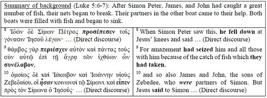
In this passage, v. 8, which contains the aorist indicative προσέπεσεν("he [Simon Peter] fell down"), continues the main storyline. Vv. 9 and 10a, which give an explanation for Simon Peter's behaviour and words in v. 8, are a non-event and as such background information. The appositive relative clause of ήσανκοινωνοίτωΣίμωνι("who were partners of Simon") in v. 10b provides brief supplementary details on the preceding antecedent, ΙάκωβονκαιΊωάννην("James and John"). Thereafter, the main storyline, which contains the aorist indicative ειπεν("he [Jesus] said"), continues in v. 10c: καιειπενπρόςτόνΣίμωναόΊησοΰς... ("but Jesus said to Simon ...").
In some instances, the mainline story is briefly interrupted by supplementary details on persons who were not the main actors in the scene up to that point, whereafter the focus returns to the mainline story and main actors. Cf. the following passage:
Luke 4:16c-21
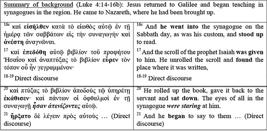
In the first part of the mainline story (Luke 4:16c-20a), Jesus is the main actor. In this part, five aorist indicatives are used as main verbs: εισηλθεν("he went into", v. 16c), άνέστη("he stood up", v. 16c), έπεδόθη("it [the scroll] was given to", v. 17a), εύρεν("he found", v. 17b), and έκάθισεν("he sat down", v. 20a). But before the sermon starts in v. 21, the focus moves briefly away from Jesus to the other people in the synagogue in the sentence καιπάντωνοιοφθαλμοίέντησυναγωγήήσανάτενίζοντεςαύτω("and the eyes of all in the synagogue were staring at him", v. 20b). The sentence contains the periphrastic imperfect ήσανάτενίζοντες("they were staring at"), which is progressive, indicating an event taking place at the same time. The function of the sentence is to give supplementary information relating to the behaviour of the other people in the synagogue, and also to introduce them as participants in the rest of the story. Thereafter, the focus returns to the main actor, viz. Jesus, in v. 21.
The pluperfect also occurs a few times in Luke in similar situations, for example, in Luke 23:711. In vv. 7-9, the focus is on Herod as the main actor. In v. 10, εΐστήκεισανδεοιάρχιερεΐςκαιοιγραμματείςεύτόνωςκατηγοροΰντεςαύτοΰ("The chief priests and experts in the Law stood there, vehemently accusing them"), the focus turns briefly to the chief priests and experts in the Law, and then back to Herod again in v. 11. The pluperfect ειστήκεισαν("[the chief priest and experts in the Law] stood there") and the participial phrase εύτόνωςκατηγοροΰντεςαύτου("vehemently accusing him") in v. 10 give brief background information on the behaviour of the chief priests and experts in the Law. The verb ειστήκεισαν("stood") belongs to the category of verbs of which the pluperfect has the force of a simple past tense (cf. Wallace: 1996: 586). However, since it is lexically stative, it denotes background information. The same applies to ειστήκει("[the crowd] stood") in Luke 23:35a, which appears together with the imperfect έξεμυκτήριζον("[the rulers] ridiculed").
In some instances, a passage contains more than one construction for indicating supplementary details. Cf. the following passage:
Luke 23:50-53
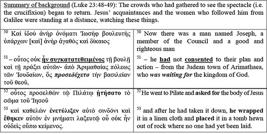
In Luke 23:50, the attention prompter Ιδού("look") highlights the introduction of Joseph, who is a new participant in the story. The flow of the sentence is then interrupted in v. 51a by the parenthetic sentence ούτοςουκήνσυγκατατεθειμένοςτη ~βουλη ~και \η~ πράξειαυτών("he had not consented to their plan and action"),29which refers back to Joseph and provides important supplementary details about his actions. The periphrastic pluperfect ήνσυγκατατεθειμένος("he consented") in v. 50 could be classified as extensive.
In Luke 23:51c, supplementary details are also given, this time by the appositive relative clause οςπροσεδέχετοτήνβασιλείαντου~ θεου~ ("who was waiting for the kingdom of God"). This clause contains the imperfect προσεδέχετο("he [Joseph] was waiting for"), which refers back and provides details on Joseph in the form of an ongoing state.
It should be noted that, in both instances of supplementary detail in v. 51, the information does not merely refer back to Joseph as a person, but also provides the background for his subsequent actions described in vv. 52-53 by the aorist indicatives ήτήσατο("he asked for"), ένετύλιξεν("he wrapped"), and εθηκεν("he placed").30
Although the imperfect and pluperfect often occur in expressions which provide supplementary details, the aorist indicative is also occasionally used, for example, in Luke 6:16 - έγένετο("he [Judas] became"), 17:12 - εστησαν("they [the lepers] stood"), 24:19 - έγένετο("he [Jesus] was"), etc. See also Acts 1:23 - έπεκλήθη("he [Barabbas] was also called").
3.4 Explanation31
Explanation in narrative is by nature a non-event and as such provides background information. Both the imperfect and the aorist indicative are often used in explanatory clauses in Luke. Cf. the following passage:
Luke 9:13-14
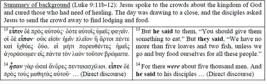
The discussion between Jesus and the disciples, which is the mainline story, continues in v. 13, where two aorist indicatives, ειπεν("he said") and ειπαν("they said"), are used to introduce Jesus' words and the disciples' answer, respectively. This is followed by the short sentence in v. 14a, ήσανγάρώσειάνδρεςπεντακισχίλιοι("for there were about five thousand men"), in which the imperfect ήσαν("there were") is used.32The sentence explains the reason for the disciples' reaction (v. 13d) to the instruction Jesus gave them (v. 13a).33Thereafter, the discussion continues in v. 14b, where the aorist indicative ειπεν("he said") introduces Jesus' further instructions to the disciples.34
The only example of a pluperfect in an explanatory clause in Luke's narrative proper seems to be ηδεισαν("they knew") in 4:41 - the verb σιδα("I know") belongs to the group of verbs of which the perfect and pluperfect tenses do not have the usual aspectual characteristics, but have a simple present and past force. Since ηδεισαν("they knew") is lexically stative, it denotes background.35
The aorist indicative is also used in a number of explanatory expressions in Luke, for example, in 5:9, 8:29a, 10:42b, 20:19c, and 22:2b. The aorist indicative differs from the imperfect as the former merely states the occurrence of the event of explanation in the past, whereas the latter signifies an event, state, etc. which is in progress in the past.
3.5 Use in epilogues36
An epilogue in narrative discourse is also a non-event by nature and presents background information. The imperfect, but not the pluperfect, occurs in several instances in Luke with this function. Cf. the following passages:
Luke 2:39-40
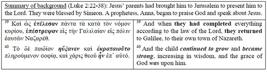
The mainline story continues in Luke 2:39, signalled by the use of two aorist indicatives -έτέλεσαν("they completed") and έπέστρεψαν("they returned"). In the epilogue of the story (v. 40), a summary is given of Jesus' youth in which three progressive imperfects are used - ηυξανεν("he continued to grow"), έκραταιουτο("he was becoming strong"), and ήν("it [the grace] was").
The use of the imperfects in the epilogue also creates an expectation of something about to happen, and thus promotes cohesion in the text. The events below in Luke 2:41-52, which is about the boy Jesus in the temple, take place 12 years later, and give an example of Jesus' growth and wisdom. This fulfils part of the expectations created by the use of the imperfects in Luke 2:40. However, the structure of the epilogue in this passage is somewhat different.
Luke 2:51-52
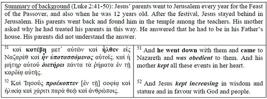
The coordinate sentence καικατέβημετ' αυτώνκαι * ήλθενειςΝαζαρέθ("and he went down with them and came to Nazareth") in Luke 2:51 is the last part of the mainline story that began in Luke 2:41, and contains the aorist indicatives κατέβη("he went down") and ήλθεν("he came"). The epilogue of the story begins with the sentence καιήνύποτασσόμενοςαυτοΐς("and he was obedient to them") in Luke 2:51 and ends at the end of v. 52. The epilogue consists of two parts. The first part contains two post-resolution comments about characters in the preceding story, viz. Jesus and Mary. The first comment, καιήνύποτασσόμενοςαυτοΐς("and he was obedient to them"), refers to Jesus' behaviour towards his parents after their return to Nazareth, in the aftermath of the events in Jerusalem. The second comment is about Mary - καιήμήτηραυτουδιετήρειπάντατάρήματαέντη"καρδίααυτής("and his mother kept all these events in her heart").37The second part of the epilogue (Luke 2:52) contains a summary of the next period in Jesus' life. The use of the imperfects creates an expectation of something about to happen and promotes cohesion in the text by keeping the story about Jesus running in the background during the following scene where the focus temporarily swings back to John the Baptist (Luke 3:1-20). The story about Jesus is picked up again in v. 3:21 with his baptism 18 years later.
This part of the epilogue is similar in content to the epilogue in Luke 2:40 discussed above, as well as the one in Luke 1:80a - Τόδεπαιδίονηυξανενκαιέκραταιουτοπνεύματι("and the child continued to grow and became strong in spirit") - which follows on the story about the birth of John the Baptist (Luke 1:57-66) and Zechariah's song (Luke 1:67-78).
Only imperfects are used as main verbs in both parts of the epilogue: ήνύποτασσόμενος("he [Jesus] was obedient") and διετήρει("she [his mother] kept") in the first part of the epilogue (v. 51), and προέκοπτεν("he kept increasing") in v. 52. The imperfects are all progressive, indicating states continuing in the past. This fits well with the provision of background information in the epilogue.
4. The function of the imperfect to indicate foreground information
All the examples discussed so far illustrate the imperfect's ability to indicate various types of background information in Luke's narrative proper. However, there are instances where the imperfect seems to denote foreground. Levinsohn (2000: 174) regards the use of the imperfects in Luke 2:38 as an example of this, and points out that although the imperfect tends to correlate with background information in narrative, "it is not [original italics] a signal that the information concerned is necessarily of a background nature". Luke 2:38 is discussed below in the broader context of Luke 2:36-39.
Luke 2:36-39
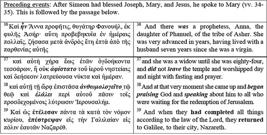
A new scene begins in v. 36 in which Anna, the prophetess, is the main actor, and it ends in v. 38. Thereafter, the focus shifts to Joseph, Mary, and Jesus' return to Nazareth (v. 39). In the story about Anna (vv. 36-38), all the verbs in the indicative mood are imperfects: v. 36a: ήν("there was"), v. 37b: άφίστατο("she left"), and v. 38: άνθωμολογεΐτο("she began praising") and έλάλει("she began speaking"). In v. 36a, the imperfect ήν("there was") is used in the introduction of a new participant in the story - viz. the prophetess, Anna - and to set the first part of the scene for the events in v. 38. The scene is further set in v. 36b by means of αυτηπροβεβηκυΐα38ένήμέραιςπολλαΐς(lit. "she was advanced in many days") and ζήσασαμετάάνδρόςετηέπτάάπότήςπαρθενίαςαυτής("having lived with a husband seven years since the time she was a virgin"). In v. 37, the last part of the scene is set by means of the main clause καιαυτήχήρα "εωςέτώνόγδοήκοντατεσσάρων39("and she was a widow until she was eighty-four") in 37a, and the relative clause ήουκάφίστατο40τουίεροΰνηστείαιςκαιδεήσεσινλατρεύουσανύκτακαιήμέραν(lit. "who did not leave the temple and worshipped day and night with fasting and prayer").
In v. 38, two imperfects occur, viz. άνθωμολογεΐτο("she began to worship") and έλάλει("she began to speak"). These are best taken as ingressive, stressing the beginning of the action in the past, with the implication that the action continued for some time.41Levinsohn is correct in viewing these imperfects as denoting foreground, especially in view of the fact that v. 38 is the last part of the story about Anna. The events in v. 38 could even be regarded as the climax of the story.
The following are further examples where the imperfect seems to denote foreground in Luke: 1:58: συνέχαιρον("they were rejoicing"), 1:65: διελαλεΐτο("[the things] were being talked about"), 9:43: έξεπλήσσοντο("[all] were amazed"), 18:43: ήκολούθει("he started following"), and 23:42: ελεγεν("he said").42
These examples support the view that the relationship between the imperfect and background information in narrative proper in Luke is one of correlation rather than strict equivalence.43
5. Findings
5.1 The imperfect
The imperfect is the primary tense-form used in Luke's narrative discourse to give background information. This is related to the imperfect's "imperfective" aspect and characteristic linking to another verbal utterance, which also promotes cohesion in the text. The imperfect gives foreground information in a few instances. This supports the view that the relationship between the imperfect and background information in narrative discourse in Luke is one of correlation rather than strict equivalence.
Setting the scene for events that follow in the mainline story seems to be the main specific use of the imperfect for background information in Luke. A narrative pattern that often occurs in Luke is the setting of the broader scene by one or more imperfects, followed by an έγένετο-construction which indicates a transition and narrows down the setting to more specific circumstances. Thereafter, the mainline story begins, carried by aorist indicatives and/or historical presents. The correlation between the imperfect and background information is particularly strong in cases where the scene is set.
The imperfect is often used to provide supplementary details about persons, events, etc. in the main storyline in the form of short, sometimes parenthetic, expressions which refer back to persons, places, etc. Some of these expressions could also be classified as setting the scene or providing an explanation. They usually do not appear at the beginning of a scene, but inside the body of the main narrative. In a few instances, the mainline story is briefly interrupted by supplementary details about persons who were not the main actors up to that point, whereafter the focus returns to the mainline story and main actors. The aorist indicative is also occasionally used in expressions in Luke that provide supplementary information.
The imperfect also occurs in sentences with presentational articulation to introduce participants in the story. The attention prompter ιδού("look") sometimes co-occurs with the imperfect in order to highlight the introduction. In a few instances, the introduction of a participant and the (first part of the) setting are done in the same sentence at the beginning of a scene.
The imperfect occurs only in a few instances in epilogues in Luke. Again, these are non-events by nature and present background information. The epilogues either consist of post-resolution information about characters in the preceding story, or give a summary of what took place afterwards. In some instances, both elements form part of the same epilogue. All the imperfects in the epilogues indicate states that continued in the past. The use of the imperfect in these cases also creates an expectation of something about to happen and thus promotes cohesion in the text.
The imperfect is sometimes used in explanatory clauses. Explanation in narrative is by nature a non-event and as such also provides background information.
5.2 The pluperfect
The pluperfect occurs only 16 times in Luke, and indicates background information in all cases. This is related to the pluperfect's characteristic of describing a continuing state in the past which is the result of an event in the past. The pluperfect has the following specific background uses:
(i) It occurs in a few instances together with one or more imperfects in setting the scene for the mainline events that follow;
(ii) It is used in a number of instances to provide supplementary details about persons, events, etc. in the main storyline. In this use, the pluperfect always refers backwards, for example, when it occurs in an appositive relative clause. In a few instances, the pluperfect provides supplementary details about persons who were not the main actors in the story up to that point, whereafter the focus returns to the mainline story and actors;
(iii) The only example of the use of the pluperfect in an explanatory clause in Luke seems to be ηδεισαν("they knew", Luke 4:41). This verb indicates background information, not on account of the pluperfect's usual aspectual characteristics, but because ηδεισαν("they knew") is lexically a stative verb.
Aland, B., K. Aland, J. Karavidopoulos, C.M. Martini, and B.M. Metzger (eds.) in cooperation with the Institute for New Testament Textual Research, Münster. 2012. Nestle-Aland Novum Testamentum Graece, 28th Revised Edition. Stuttgart: Deutsche Bibelgesellschaft.
References
- Bakker, W.F. 1966. The Greek imperative. An investigation into the aspectual differences between the present and aorist imperatives in Greek prayer from Homer up to the present day. Amsterdam: Hakkert.
- Blass, F. and A. Debrunner. [1913] 1967. A Greek grammar of the New Testament and other early Christian literature. [Translation and review of the 9th-10th German edition, Grammatik des neutestamentlichen Griechisch by R.W. Funk, incorporating supplementary notes of A. Debrunner.] Chicago, IL: The University of Chicago Press / Toronto: The University of Toronto Press.
- Brewer, W.F. 1985. The story schema: Universal and culture-specific properties. In D.R. Olson, N. Torrance, and A. Hildyard (eds.) Literacy, language, and learning: The nature and consequences of reading and writing. Cambridge: Cambridge University Press. pp. 167-194.
- Callow, K. 1974. Discourse considerations in translating the Word of God. Grand Rapids, MI: Zondervan.
- Campbell, C.R. 2007. Verbal aspect, the indicative mood, and narrative: Soundings in the Greek of the New Testament. New York: Peter Lang.
- Campbell, C.R. 2008. Verbal aspect and non-indicative verbs: Further soundings in the Greek of the New Testament. New York: Peter Lang.
- Decker, R.J. 2013. The function of the imperfect tense in Mark's Gospel. In S.E. Porter and A.W. Pitts (eds.) The language of the New Testament: Context, history and development. Leiden: Brill. pp. 347-364. https://doi.org/10.1163/9789004236400015
- Die Bybel: 1933/1953 translation. Kempton Park: Bible Society of South Africa.
- Die Bybel: 1983 translation. Kempton Park: Bible Society of South Africa.
- Dooley, R.A. and S.H. Levinsohn. 2000. Analyzing discourse: A manual of basic concepts. Dallas, TX: SIL International.
- Dry, H.A. 1992. Foregrounding: An assessment. In S.J.J. Hwang and W.R. Merrifield (eds.) Language in context: Essays for Robert E. Longacre. Dallas, TX: Summer Institute of Linguistics and University of Texas at Arlington. pp. 435-440.
- Du Toit, H.C. 2017. The function of the imperfect tense-form in the narrative discourse of John's Gospel: Some remarks. Neotestamentica 51(2): 209-234. https://doi.org/10.1353/neo.2017.0012
- Fanning, B.M. 1990. Verbal aspect in New Testament Greek. Oxford: Clarendon.
- Fleischmann, S. 1985. Discourse functions of tense-aspect oppositions in narrative: Toward a theory of grounding. Linguistics 23(6): 851-852. https://doi.org/10.1515/ling.1985.23.6.851
- Grimes, J.E. 1975. The thread of discourse. The Hague: Mouton.
- Hopper, P.J. and Thompson, S.A. 1980. Transitivity in grammar and discourse. Language 56: 251-299. https://doi.org/10.2307/413757
- Johnson, C.E. 2010. A discourse analysis of the periphrastic imperfect in the Greek New Testament writings of Luke. Ann Arbor, MI: UMI Dissertation Publishing.
- Levinsohn, S.H. 2000. Discourse features of New Testament Greek: A coursebook on the information structure of New Testament Greek. Dallas, TX: SIL International.
- Levinsohn, S.H. 2005. Self-instruction materials on narrative discourse analysis. Available online: https://www.sil.org/resources/archives/68643. (Accessed 11 July 2020).
- Levinsohn, S.H. 2006. The relevance of Greek discourse studies to exegesis. Journal of Translation 2(2): 11-21.
- Mathewson, D.L. 2008. Verbal aspect in the Apocalypse of John: An analysis of Revelation 5. Novum Testamentum 50(1): 58-77. https://doi.org/10.1163/156853607x186013
- Mathewson, D.L. 2010. Verbal aspect in the Book of Revelation: The function of Greek verb tenses in John's Apocalypse. Leiden: Brill.
- McKay, K.L. 1994. A new syntax of the verb in New Testament Greek: An aspectual approach. New York: Peter Lang.
- New American Bible. 2010. Washington, DC: Confraternity of Christian Doctrine.
- Newman, B.M. and E.A. Nida. 1972. A translator's handbook on the Acts of the Apostles. London: United Bible Societies.
- Nuwe Testament en Psalms: 'n Direkte Vertaling. 2014. Bellville: Bible Society of South Africa.
- Pennington, J.T. and G. Van Court. 2006. Aspectual Prominence in Matthew. Paper presented at the Society of Biblical Literature conference, Washington, DC, 18-21 November.
- Porter, S.E. 1989. Verbal aspect in the Greek of the New Testament, with reference to tense and mood. New York: Peter Lang. https://doi.org/10.3726/978-1-4539-0994-2
- Porter, S.E. 1994. Idioms of the Greek New Testament. Sheffield: Sheffield Academic Press.
- Rijksbaron, A. 1988. The discourse function of the imperfect. In A. Rijksbaron, H.A. Mulder, and G.C. Wakker (eds.) In the footsteps of Raphael Kühner. Proceedings of the International Colloquium in commemoration of the 150th anniversary of the publication of Raphael Kühner 's 'Ausführliche Grammatikder GriechischenSprache, II. Teil: Syntax'. Amsterdam: J.C. Gieben. pp. 237-254.
- Robertson, A.T. 1919. A grammar of the Greek New Testament in the light of historical research. Cambridge: Cambridge University Press.
- Seiler, H. 1952. L 'aspect et le temps dans le verb néo-grec. Paris: Belles Lettres.
- Talmy, L. 1978. Figure and ground in complex sentences. In J.H. Greenberg (ed.) Universals of human language Vol. 4: Syntax. Stanford, CA: Stanford University Press. pp. 625-649.
- The Holy Bible: English Standard Version. 2011. Wheaton: Good News Publishers.
- The Holy Bible: King James Version. [1611], 1769. Copyright © 1988-1997 by the Online Bible Foundation and Woodside Fellowship of Ontario, Canada.
- The Holy Bible: New International Version. 2011. Grand Rapids, MI: Zondervan Publishing House.
- The Holy Bible: New King James Version. 1982. Nashville, TN: Thomas Nelson Inc.
- The Holy Bible: New Living Translation. 2007. Wheaton, IL: Tyndale House Publishers.
- The Holy Bible: New Revised Standard Version of the Bible. 1989. Peabody, MA: Hendrickson Publishers.
- The New American Standard Bible. 1995. La Habra, CA: The Lockman Foundation.
- The New English Translation. 2006. Richardson, TX: Biblical Studies Press, LLC.
- The New Jerusalem Bible. Reader's Edition. 1990. New York: Doubleday.
- Wallace, D.B. 1996. Greek grammar beyond the basics: An exegetical syntax of the New Testament. Grand Rapids, MI: Zondervan Publishing House.
2 Cf. Campbell (2007: 215-217).
3 Quoted by Levinsohn (2000: 169).
4 Cf. also Dry (1992: 441).
5 Cf. Hopper and Thompson (1980: 252, in Dooley and Levinsohn 2000: 41).
6 Cf. Grimes (1975: 51-70).
7 Hopper (1979b: 219-234, in Du Toit 2017: 212, fn. 9).
8 Cf. Porter (1994: 23), Levinsohn (2000: 169-196), and Campbell (2007, 2008).
9 Cf. Pennington and Van Court (2006) on the Gospel of Matthew; Mathewson (2008) on Revelation 5 and Mathewson (2010) on Revelation; Johnson (2010) on the Gospel of Luke and Acts; Decker (2013) on chapters 1 to 8 of the Gospel of Mark; and Du Toit (2017) on the Gospel of John.
10 See also Campbell (2007: 77-79).
11 For more information on Seiler's view, see Du Toit (2017: 215-216).
12 See Du Toit (2017: 218) for literature on the different views.
13 The view of the pluperfect as indicating past time is not shared by those linguists who view the Greek verb-tenses as indicating aspect only, not time as well. For example, according to Campbell (2007: 237), the pluperfect "semantically encodes imperfective aspect and heightened remoteness".
14 The view of the pluperfect's aspect as indicating a state is also shared by Porter (1989: 289) and McKay (1994: 322).
15 Statistics based on Campbell (2007: 111).
16 Statistics based on Campbell (2007: 79).
17 These figures include narratives embedded within direct discourse, such as parables. Cf. Luke 15:11-32, 16:1931, 18:2-5, and 19:12-27.
18 The term "setting" is used here to describe the time, place, or circumstances of the mainline events of a narrative (Grimes 1975: 63).
19 The translations of the Greek text in this example and others in the paper are my own. The following translations were consulted as part of the translation process: The Holy Bible: King James Version ([1611], 1769), Die Bybel: 1933/1953 translation, The Holy Bible: New King James Version (1982), Die Bybel: 1983 translation, The Holy Bible: New Revised Standard Version of the Bible (1989), The New Jerusalem Bible: Reader's Edition (1990), The New American Standard Bible (1995), The New English Translation (2006), The Holy Bible: New Living Translation (2007), New American Bible (2010), The Holy Bible: English Standard Version (2011), The Holy Bible: New International Version (2011), and Nuwe Testament en Psalms: 'n Direkte Vertaling (2014).
20 There is no evidence in Luke, as in the Gospel of John, that the imperfect tense-forms of the verb ειμί("I am"), which is morphologically deficient, are aspectually vague. For more information, see Du Toit (2017: 220, fn. 25).
21 The verb έγένετο("it happened") is frequently used in Luke (69 times). According to Newman and Nida (1972: 93), the use of έγένετο("it happened") is "one of Luke's favorite devices for marking a transition in an episode". Cf. Levinsohn (2000:177-179) for a more detailed discussion of the έγένετο-construction. The particle δέ("and") in Luke 16:22a also signals "a new step or development in the author's story or argument" (Levinsohn 2000: 72).
22 Other examples of the use of infinitival constructions to indicate specific background circumstances after έγένετο("it happened") occur in Luke 3:21b, 22a, and 22b. Cf. also Acts 9:32, 9:37, 11:26b, and 14:1. The construction is not common in Luke, as pointed out by Levinsohn (2000: 177-178); a sentence with an indicative is preferred for this purpose, as in e.g. 1:8-9, 2:6, and 8:22, etc. Cf. also Mark 1:9 and 4:4.
23 The same narrative pattern also occurs in Acts. See e.g. 2:1-4 and 9:31-34. In the Gospel of John, there are considerai fewer occurrences of έγένετο("it happened") - 17 in total -, but an example of the pattern occurs in 3:23-36.
24 Cf. Levinsohn (2000: 134-135) for a brief discussion of the various ways in which participants are introduced.
25 See section 3.1 of this paper for a discussion of the function of the imperfects in v. 38.
26 For other examples of sentences with presentational articulation with an imperfect as main verb, cf. Luke 2:36a, 13:1, 16:19, and 18:2b.
27 Cf. Levinsohn (2000: 135).
28 For some more examples of the extensive pluperfect in the NT, cf. Mark 14:44: δεδώκει("[the betrayer] had given"), 15:46: ~ήνλελατομημένον("[tomb which] had been hewn"); John 9:22: συνετέθειντο("[the Jews] had agreed"), 11:13:'ειρήκει("[Jesus] had spoken"); and Acts 9:21: έληλύθει("he had come").
29 This sentence is indicated as a parenthesis in the Nestle-Aland 28 text used here, as well as in The Holy Bible: King James Version ([1611], 1769), Die Bybel: 1933/1953 translation, The New English Translation (2006), and The New American Standard Bible (1995). Cf. Blass and Debrunner (1967: 243) on parenthetic remarks. Cf. also the reference to Robertson (1919: 904-905, in Wallace 1996: 585, fn. 36) with regard to the use of the pluperfect in the Gospel of John: "John does, as a matter of fact, use the past perfect [pluperfect] more frequently than do the Synoptists. He uses it to take the reader 'behind the scenes', and often throws it in by way of parenthesis". Wallace (ibid.) continues: "More recent grammarians would describe this usage as backgrounding [original italics] tense usage".
30 Appositive relative clauses with an imperfect (or pluperfect) as main verb are often used in Luke to give supplementary detail on persons, time, the physical environment, etc. For example, 4:16 (pluperfect), 5:3 (imperfect), 8:2b (pluperfect), 8:3 (imperfect), 8:38 (pluperfect), 9:30 (imperfect), and 23:55 (periphrastic pluperfect). Cf. also the examples in Acts 9:33 (periphrastic pluperfect) and 18:7 (periphrastic imperfect). The Gospel of John often uses short, independent sentences with an imperfect for this purpose, for example, 1:39: ώραήνώςδεκάτη("it was the tenth houf), and 18:10: ήνδεόνοματώδούλωΜάλχος("the slave's name was Malchus"), etc.
31 The term "explanation" could be defined as information that "clarifies and explains the events of a narrative" (Levinsohn 2005: 69).
32 Some translations treat Luke 9:14a as a parenthesis, enclosing it in brackets. Cf., for example, The New American Standard Bible (1995), New English Translation (2006), and The Holy Bible: The New International Version (2011).
33 The function of the connective γάρ("for") is "to signal that what follows strengthens a preceding assertion" (Levinsohn 2006: 19).
34 Other examples of the use of the imperfect in explanatory clauses in Luke are 4:32b, 6:19b, 9:14a, and 19:3b. Cf. also the following examples from the Gospel of John: (i) 2:21: Here, the sentence containing the imperfect ελεγεν("he was talking") explains the content of Jesus' words in v. 19b (Du Toit 2017: 226); and (ii) 8:6: the sentence with the imperfect ελεγον("they were saying") explains the reason for the words of the scribes and Pharisees to Jesus in vv. 4b-5 (Du Toit 2017: 227).
35 See Wallace (1996: 586).
36 The term "epilogue" or "coda" refers to a final, non-event section "that makes a meta-comment on the story, gives a summary, or gives some post-resolution information about the characters" (Brewer 1985: 183, in Dooley and Levinsohn 2000: 54).
37 For a similar comment about Mary, cf. Luke 2:19.
38 The verb ήν("she was") is understood. The phrase ήνπροβεβηκυΐα("she was advanced") is an intensive periphrastic pluperfect denoting background information.
39 The verb ήν("was") is also understood here.
40 The imperfect άφίστατο("she left") denotes habitual action, as does the imperfect participle λατρεύουσα("worshipping").
41 Cf. Wallace (1996: 544).
42 According to Wallace (1996: 542), ελεγεν("he said") is in this case an example of the rare instantaneous imperfect with the meaning of an aorist indicative. He continues: "The imperfect is used [here] to introduce a vivid, emotionally-charged statement. As such, it may be termed a dramatic [original italics] imperfect" (Wallace 1996: 543).
43 Cf. also Hopper (1979b: 215-216, in Levinsohn 2000: 174).
