The South African Military Deployment on the Italy-France Alpine Border in June-July 1945: Military, Political and Environmental Contexts
Abstract
This article reports on the South African military deployment on the Italy-France border in June and July 1945. The purpose of the study on which this article is based, was to ascertain the military, political and environmental experiences of the First City/Cape Town Highlanders battalion, together with other units, that safeguarded the alpine border. The context was an illegal French military occupation of the valley, despite Allied Military Government instructions and international law. The literature review is limited as the event is not well known. There are, however, a number of secondary sources and the memoirs of veterans who served on the particular border. The methodology was to construct a historiographical narrative by securing and analysing the relevant primary sources. These dealt with the experiences of the First City/Cape Town Highlanders battalion and other units on the Italy-France frontier in June and July 1945; the way the troops coped with the environmental conditions on the frontier; and the way a timeline of events led to normalcy and peace on the frontier. The primary sources, primarily war diaries, showed that the units were highly efficient in their core task of safeguarding the upper Val d'Aosta, and tactful in their interactions with the Italians and the French. A map and timeline were produced to indicate dispositions of the battalion and key events.
Second World War; Italy-France Border; Val d'Aosta; Alps; South African Army; Peacekeeping; Environmental Contexts; Political Contexts; Military Contexts
Introduction
The Second World War saw a protracted conflict between the Allies and the Axis in Europe and the Mediterranean littoral, and the Far East theatres of operations. The Allies initially comprised Britain, France and Commonwealth states, South Africa included, while Germany and Italy formed the Axis powers. After the Japanese attack on Pearl Harbour, the United States of America joined the Allies, drastically affecting the strategic balance of forces against the Axis. After the Axis defeat in North Africa in mid-1943, operations shifted to the Italian mainland, which culminated in the German surrender of all forces in Italy in early May 1945. After the German surrender, operations shifted to a peacekeeping footing in two areas of northern Italy, the Trieste area where Yugoslav forces threatened the city, and the Val d'Aosta1 where France, a fellow member of the Allies, wished to annex the area.2 At the beginning of June 1945, South African (SA) forces, part of the 6th South African Armoured Division, found themselves engaged in a peacekeeping operation in the latter area in order to retain the area for Italy.
At the time, South Africa did not have a single unit of specially trained and equipped mountain infantry or artillery. This can be contrasted with countries, such as Italy, France and Germany. From time to time, however, military units operating in South Africa had been called to deploy in mountainous areas, such as the Langalibalele Pass in the Drakensberg where the Royal Engineers and a local colonial unit were involved in 1873.3This was to stop anti-colonial resisters under the leadership of Langalibalele from escaping to the then Basutoland (now called Lesotho).4 This incident has also been covered in a noted history of the range.5 During the invasion of Italian-occupied Ethiopia, SA troops performed well at Combolica and Amba Alagi (a mountain stronghold in Ethiopia) in 1941, which was the definitive mountain warfare experience for SA forces during the Second World War.6 It must be pointed out, however, that the experience of SA troops in the Italian Apennines between Florence and Bologna in the brutal winter of 1944-1945 should also be considered. The troops gained experience in sub-zero temperatures, which included patrols operating in thick snow, which necessitated the use of snowsuits and snowshoes.7 Notable battles with German forces (among other the Schutzstaffel or SS) included Monte Stanco (in October 1944) and Monte Sole (in April 1945).8
South African troops aided in securing the borders around Courmayeur, north-western Italy, in 1945, something which, to this day, this remains a little-known fact. This was a culmination of a very long journey during the Second World War that started in East Africa, moved to the Western Desert of Egypt and Libya, and finally ended fighting in Italy from Cassino to Turin. The researcher learnt about this involvement while perusing the role of the Cape Town Highlanders in the Italian Apennines. The Alpine experience appeared also in the Orpen publication.9 The First City/Cape Town Highlanders (FC/CTH) infantry regiment (constituted then as a battalion) was stationed at and around Courmayeur, the uppermost part of the Val d'Aosta. It had full responsibility for guarding the Alpine border, adjacent to the upper Val d'Aosta, between Italy and France, for almost eight weeks in June and July 1945. The battalion was part of 12 SA Motorised Brigade, which was a major part of the 6 SA Armoured Division, which found itself in the Turin area during May 1945, after hostilities had ceased in Italy. Another two infantry battalions, the Witwatersrand Rifles/De La Rey (WR/DLR) which took control of the middle Val d'Aosta, and the Royal Durban Light Infantry (RDLI) which oversaw the lower Val d'Aosta border with Piedmont. The 11 SA Armoured Brigade also assisted in the peacekeeping operation by overseeing the Swiss border, while 13 SA Motorised Brigade had responsibility for the Turin military area.10 The division's availability and location enabled it to play a role in pacifying any potential hostility on the Alpine frontier, not far from Turin.11
The deployment of the South Africans in this role in Val d'Aosta is not mentioned in guidebooks or other publications, such as the book by Frison-Roche, which was published 16 years after the event.12 It was relatively unusual that an SA battalion with no mountain infantry training was sent to the location instead of a bespoke mountain infantry unit, such as the one belonging to the 10th US Mountain Division. It also seems strange that a country, such as South Africa on the far periphery of the then British Commonwealth, should have found itself guarding and securing the borders between two European economic powerhouses. In addition, this peacekeeping mission predates the peacekeeping missions of the successor to the Union Defence Force (UDF), the South African National Defence Force (SANDF), which has been involved in attempting to restore peace in various areas across sub-Saharan Africa.13 The Monte Bianco (Mont Blanc) area has been, however, within the ken of SA climbers who have had a history of ascent on both the Italian and French sides and, regrettably, some local climbers have met their end on the massif, as can be seen in the journals of the Mountain Club of South Africa.14 Reynolds mentions that the objective dangers to be faced on the massif, including lower-lying areas, such as rockfalls and snow displacement, have translated into injuries and fatalities affecting a number of SA climbers over the years.15
With reference to the expertise and experience of SA troops in mountain infantry roles, Kleynhans and Katz, in their account of the Combolica and Amba Alagi battle, write:
For the South African troops this would be their first real experience of mountain warfare since the establishment of the defence force in 1912. Without specialized troops and training, and lacking both actual experience and institutional expertise, the UDF would have to adapt quickly to new demands.16
This experience led a senior officer in the then UDF to suggest a collaboration with the British Indian Army to gain experience and expertise, '[a]s a matter of long-range policy, Pienaar suggested that it would be beneficial to attach South African officers and men to units of the Indian Army serving in the North-West Frontier region in India.'17
Armiero discusses the forced Italianisation of place names of the Val d'Aosta region during the Fascist period, which understandably would have led to local resentment, given that the local inhabitants primarily spoke a variant of French as their mother tongue.18 There had been fighting across the Colle del Piccolo San Bernardo ("Little St Bernard") Pass in June 1940, when the Italians attacked French lines to claim a measure of spoils during the German defeat of France, and which Mussolini visited afterwards in supposed triumph.19 A writer of the Mont Blanc area, Frison-Roche, writes about the common characteristics of the people living on both the northern and southern slopes of Mont Blanc but does not add the necessary historical context related to the deployment of the Allied forces.20 Frison-Roche gives a French-centric slant to his statements and lists the traces of past conflict in the upper Veny Valley to the south of Mont Blanc (the route up to Col de la Seigne).
The history of the Allied deployment in the Val d'Aosta has been covered in a number of military histories as well as popular non-fiction books. Military histories include both United States (US) and SA accounts. The Allied unit responsible for first entering and stabilising the valley was a reconnaissance unit of the 1st US Armored Division.21 APE,22in a study on the autonomy of the valley, does not mention the SA role in stabilising the valley.23 Street does mention the French incursion, under General de Gaulle, in 1945 which he notes was subsequently withdrawn.24 Harris writes that French forces penetrated the valley, including the town of Aosta, where the French forces stipulated that they be given accommodation.25 However, Harris also states that the Italian Prefect managed to delay the French officer-in-charge until US forces had already occupied the valley. Wildgen writes that this caused the Italians considerable relief. French forces did, however, penetrate as far as Ivrea.26 Harris states that the Army Group in overall charge (the 15th Army Group)27estimated the strength of French forces in the valley as five infantry battalions.28 Harris then also alludes to the environmental conditions around the valley, in particular the late snowfalls that occurred. These rendered the passes impassable and thus limited the number of troops the French could move across the frontier. Wildgen also considers the inflamed political atmosphere in the valley.29 There is no mention of the SA contribution, which appears to have been airbrushed out of history by either Harris30 or Wildgen who writes, [t]he job of prying the French forces out of Aosta was left to the Americans.'31 It was however incontrovertible that without US political and economic pressure, in particular an ultimatum from President Truman to General Charles de Gaulle on 7 June 1945 for the French to vacate the Val d'Aosta, the French would have caused a lot more difficulty in the valley.32 Wildgen pays tribute to the British contribution (which occurred after the SA involvement). Mathieu, in an environmental history of the Alps, details the desire for some kind of autonomy and even annexation by France among the inhabitants of the valley, which subsided after autonomy had been granted. Mathieu, however, only recognises the American contribution, and not also the contributions made by South Africa or Britain.33
The official chronicler of the SA effort in Italy, Orpen, introduces the context of the subsequent SA deployment during which the 12th SA Motorised Brigade was given responsibility for the Val d'Aosta.34 In his book, Orpen describes the fraught situation, with the potential for serious danger, due to French claims to Italian territory. The environmental conditions that prevailed during the employment of part of the FC/CTH battalion are well described by Orpen, in that heavy snow was still present and mules were needed for the transport of supplies. He also noted the tricky diplomatic issues at stake, between former Allies. Orpen does not specify why the South Africans were given responsibility for the Val d'Aosta, only that they had been given responsibility for the Turin military area and that orders for a deployment to the Val d'Aosta were received on 29 May 1945 for the relief of the US Army unit.35 The relief and occupation proceeded smoothly, and good relations were re-established with the French, to the extent that some of the South Africans attended a course in mountaineering organised by a French mountain infantry regiment. Apparently, the South Africans made a good impression in terms of their presentation and behaviour, not only on the French but also on the local inhabitants. Finally, after about eight weeks, as Orpen reports, control of the border was transferred to the Italian authorities.36 This account is essentially reproduced in the official SA history of the war in Italy.37 Monick, in the official history of the Witwatersrand Rifles, states, 'one of the Battalion's major functions in Aosta was the prevention of assassination and internecine strife; a constant danger in view of the deep hostility between former partisans (many of whom retained their arms) and former Fascist sympathisers'.38 This particular battalion shared the town of Aosta with a French mountain infantry battalion.39 Veterans of the conflict in Italy have also written about the deployment. Ford documents the highly fortuitous opportunity the French had to regain territory they contended was theirs. He also emphasises that the role of the SA forces was peacekeeping, requiring them to employ tact, sound behaviour and diplomacy to persuade the French to leave. Ford served at St Rhemy and the summit of the Gran San Bernardo (Great Saint Bernard) Pass on the border with Switzerland, and he also reports on the good and collegial relations established with Swiss border troops at the top of that pass.40 Another veteran, Eglin, recalls his time in the Val d'Aosta where he was stationed in the Val Ferret amid an atmosphere of great tension occasioned by the French claim to Italian territory.41
Malaspina writes as follows, regarding the present-day dispute over the national border on Mont Blanc, which has echoes of the 1945 impasse:
Originating from the application of an 1860 international treaty, the controversy over Mont Blanc persists between two Schengen countries over an area of less than half a square kilometer. France asserts that the principal peaks on the Mont Blanc massif lie in French territory, while Italy maintains that the summits are shared. The issue does not involve only the symbolic value of national sovereignty over a mountain. It has led, especially from 2015 to 2020, to a series of diplomatic incidents involving the movement of border markers and setting off-limits areas between neighbouring municipalities. The problem is further exacerbated by climate change, causing glaciers to melt throughout the Alps and consequently shifting mountain borders.42
The quotation above reflects the ongoing diplomatic tension and discomfort over the high alpine border between Italy and France, albeit restricted to a small area on the highest peak of the Western Alps.
Sources, Time and Historical Space
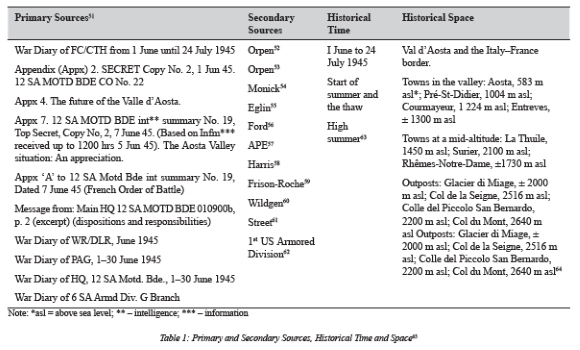
The study on which this article reports, primarily hinged on the experiences of peace-keeping on a mountain frontier as contained in the records of a particular SA light infantry battalion, the FC/CTH. The records box of the FC/CTH Regiment was sourced from the Department of Defence Archives. Six primary sources from the box were used, including the War Diary.43 Following review, it was decided to include the war diaries of other units involved in the Val d'Aosta deployment. This was to broaden and deepen the data collection for the entire valley. The units referred to were the Witwatersrand Rifles/De la Rey (WR/DLR), Prince Alfred's Guard (PAG), the 12 South African Motorised Brigade Headquarters (12 S.A. Motd.44 Bde), and the G Branch of the 6th South African Armoured Division (6 S.A. Armd Div.).45
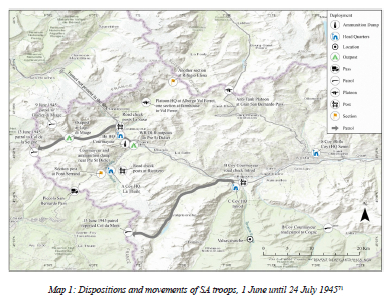
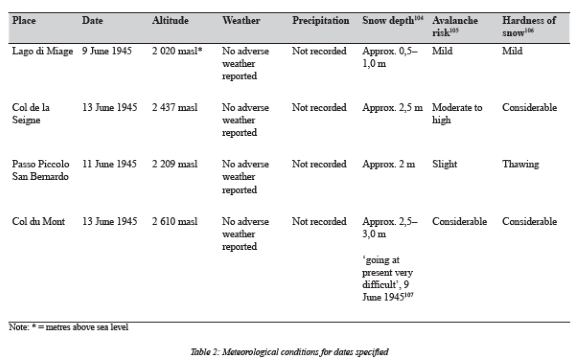
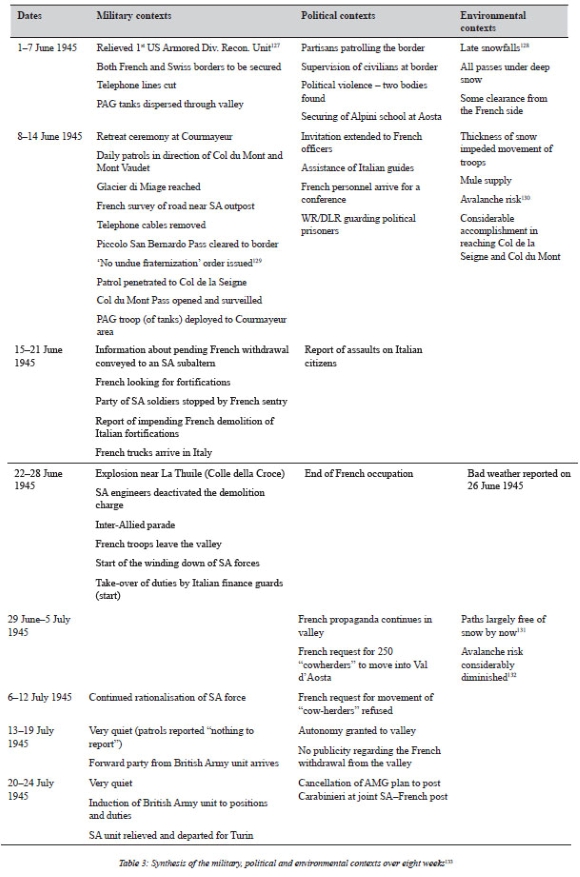
The literature review covered primary and secondary sources. Chapter 8 (the historical research chapter) in Leedy and Ormrod was used to inform the methodology. The analysis of historical evidence, comprising primary sources, secondary sources, historical time and historical space as key historical signifiers, is discussed.46 These signifiers are indicated in Table 1 below. In the main, the methodology comprised a historiographical narrative of the units involved using the available primary sources.47 Secondary sources and historical time and space48 were used for cross-comparison and thematic analysis. Key themes pertaining to the military, political and environmental contexts were determined. Spatial analysis, for example of locations and altitude, aided in the analysis of historical space.49 A map was produced showing the dispositions of the SA units and their associated movements. Historical time comprised the eight weeks (in June and July 1945) the SA units spent in the valley. A timeline of key events was also produced. Table 2 below shows the meteorological conditions pertaining to the area at the time. A third table, Table 3 below, was devised to show a synopsis of the military, political and environmental contexts over the eight weeks of the deployment. In the discussion, the primary sources were compared to the secondary sources as detailed in the literature review. The external and internal evidence pertaining to historical documents has been validated, and the context of historical time and place established.50
All necessary ethics conventions were adhered to.66
Historiographical Narrative
The historiographical narrative, which is firstly a summary of the War Diary67 of the FC/ CTH battalion, is as follows. On 1 June 1945, the battalion arrived in Courmayeur where they established their headquarters and dispersed their companies to strategic points in the valley:
□ A company headquarters (HQ) was positioned in La Thuile;
□ C company HQ in Introd;
□ D company HQ in Le Pont and
□ S company HQ in Senin.
The battalion's primary duty was to assume responsibility over approximately 225 km of the French and Swiss borders, comprising all known passes and entry and exit points. All incoming and outgoing civilians and French troops were to be checked. Environmentally, all the connecting passes were deep under snow and it appeared that the French were busy clearing their side of the passes. The telephone line to D Company at Le Pont was severed.
On 4 June 1945, another company (company B) arrived in Courmayeur. On the same day, a significant number of French troops (76) entered Italy via the Piccolo San Bernardo Pass, with a greater number (130) leaving via the same route. It was noted that a number of French personnel (four, including one officer) from a mountain infantry unit also crossed into France using the cableway over the Mont Blanc massif. Political normality was restored to the Alpini (Italian mountain infantry) training school at Aosta on 7 June 1945 when S company disarmed the partisans guarding the political prisoners there.68 On the next day, evidence of sound relations with the French occurred with a retreat ceremony in Courmayeur, which was attended by the local French military leadership. Evidence of the equal treatment of both borders occurred on the same day with an anti-tank platoon being stationed and replacing the partisans on the Gran San Bernardo Pass on the Swiss border.69 Penetration by FC/CTH patrols occurred on 9 June 1945 with sallies (excursions) towards Col du Mont and Mont Vaudet ('going at present very difficult'). On the same day, a D company patrol reached the Lago di Miage in the Val Veny, and reported that the border was porous and possible to cross. Reports of patrols being established at Cogne and road patrol between Introd and Valsavaranche to Degoiz were recorded.
Another SA battalion (the WR/DLR) replaced S company at or near Pré-Saint Didier, which indicates a reinforcement of SA troops. The next day (10 June), it was reported that the Piccolo San Bernardo Pass was almost open (45 m of pass to the French border remained under snow) and that French troops had been surveying the road near the SA position at Ricovero (this had be the road to Surier from Arvier). The significance of the snow depth and cover is that it stopped the movement of vehicles over the pass. On 11 June 1945, the Piccolo San Bernardo Pass was finally opened, and it was reported that additional French surveying occurred along the road that day. In another sign of reinforcement, a section post was established by the FC/CTH battalion at Pont Serrand, to the west of La Thuile on the Piccolo San Bernardo Pass. Much activity occurred on 12 June 1945 with road checks being established (at Ricovero and La Saxe), and D company intending to patrol daily to Caserna Col de la Seigne from their outpost at the Lago di Miage. Two French parties arrived at the Lago di Miage post (three Italian guides were stationed there as well) who then departed for Col de la Seigne. A length of telephone cable (almost nine9 metres) was removed in the La Thuile area, presumably by French military forces. On the same day, the battalion commanding officer held an order group where it was announced that 'NO undue fraternization with the French' was to occur.70 This was a clear sign that patience was wearing thin and that firmer measures were under consideration.
The next day (13 June 1945), D Company reported that a patrol had reached Col de la Seigne and had patrolled the border for about 3,2 km. No French presence was found. The Col du Mont Pass was also reported open and under observation by a forward patrol (of B Company). Three-ton vehicles were reported to be entering Italy via the Piccolo San Bernardo Pass. On 14 June 1945, in a clear sign that consultations were going to be held, a number of senior French military personnel entered Italy via the Piccolo San Bernardo Pass. In a sign of healthy relationships between French and SA officers, a French subaltern (or junior officer) at Entreves told his SA colleague on 18 June 1945 that French troops were going to leave the Val d'Aosta in a week's time. On the same day, however, French soldiers were spotted surveilling for fortifications in the Piccolo San Bernardo Pass area. The War Diary reports that on 19 June 1945, the road between Rhêmes-Notre-Dame and Introd was expected to be passable (i.e. cleared of snow) by 25 June 1945. Later that day, it was however reported that a party of SA soldiers was apprehended in an ambush position by an armed French sentry with others in attendance, but allowed to proceed. Another report (from the Allied Military Government [AMG]) indicated that the French were planning to explode Italian fortifications in the La Thuile area.
The next day (20 June 1945), in a clear sign that the situation was changing, a convoy of 21 French trucks (with no passengers) entered Italy. This de-escalation continued on 21 June 1945 with a French post (at Ricovero) being evacuated. Disturbing reports concerning assaults on Italian civilians were however also received along with assurances that these would be investigated by the AMG at Courmayeur. On 22 June 1945, C Company left the Val d'Aosta for the coastline for rest and recreation, but on the same day, an explosion was heard at a fortification in the La Thuile surrounds. A French interpreter there freely admitted that French engineers had done this and would continue destroying Italian military fortifications along the border. The next day, SA engineers deactivated an explosive charge at the said fortification.
The denouement of the French military presence in the valley occurred on 24 June 1945 when an inter-Allied parade was held in Aosta, and subsequently over 700 French troops in almost 40 trucks left for France via the Piccolo San Bernardo Pass. By 27 June 1945, the SA troop dispositions were either being considerably reduced (from company to platoon level) or plans were being made for troop withdrawals the next day. Italian Finance Guards (Guardia di Finanza abbreviated as GdiF), the border police of Italy, were also tasked to take over positions on the borders. The Gran Paradiso area was to be patrolled by a sister battalion to FC/CTH (WR/DRLR) as their zone of responsibility. On 28 June 1945, most of the battalion congregated at Courmayeur, except for minor units (sections and platoons) at certain strategic points, such as the Piccolo San Bernardo Pass and Pré-Saint-Didier. On 30 June 1945, it was reported however that 'French subversive propaganda' continued to occur in the valley.
On 1 July 1945, the withdrawal of the companies into Courmayeur and the handing over of duties to the Italian Finance Guards continued. Significant exceptions were platoon presence at the lower and upper cable stations, the Piccolo San Bernardo Pass (anti-tank) and the Pré-Saint-Didier (ammunition). The GdiF was deployed at strategic points, such as Colle del Gigante (upper cableway), Col de la Seigne, and La Thuile. The de-escalation continued with depleted and shared presence at places, such as Pré-Saint-Didier and the Piccolo San Bernardo Pass (on 6 and 7 July 1945). Daily contact patrols continued to places, such as the upper cableway station and Col de la Seigne. On 12 July 1945, it was reported that the battalion (FC/CTH) was reduced to 300 men, concentrated at Courmayeur. On the same day, it was reported that a British Army brigade would take over the valley in due course. Patrols had nothing to report on 13 July 1945, a sure sign that stability was returning to the valley.
On 18 July 1945, it was reported that a British army reconnaissance party had arrived at the Courmayeur HQ. Autonomy for the valley was announced by the then Italian government. On 21 July 1945, diplomatic finesse was exercised when the battalion leadership asked the AMG to cancel a planned posting of Carabinieri (Italian military police) to the Piccolo San Bernardo Pass hospice, as French and SA troops were both present at the place. The winding down of the SA presence in the valley was consolidated on 22 July 1945 when British Army personnel were inducted into their planned positions and duties. Finally, on 24 July 1945, the SA troops were officially relieved by the British Army unit at 08:00 and they left at 08:30 for Turin, ending what can only be considered a highly successful peacekeeping deployment.72
From a political and military standpoint, the appendices to the War Diary elucidate the multiple contexts of the situation in the valley. Appendix 2 (which is an order from the SA brigade commanding officer) speaks of the conduct to be expected in an area of Allied troops (eight stipulations on how to behave in a diplomatic and non-escalatory manner are posted). Appendix 4 is on the future of the Valle d'Aosta, and was issued by a US Army intelligence unit. This covers the geographic (the passes are only open for five months a year due to snowfall), economic (food having to be imported and hydro-electric significance73), and political (evidence of French machinations) contexts of the valley. The absolute determination of the Allies not to allow the French to annex the valley is highlighted in this sentence, '[t]he cession of the Valle d'Aosta from Italy to France would create a very serious sore spot, a threat to the peace of Europe.'74 The next appendix of importance is 7, which is a highly secret intelligence summary issued by the 12 SA Motorised Brigade (12 SA Motd. Bde). This up-to-date military appreciation (written 36 hours beforehand) covers the French occupation of the valley, and the repeated disobedience of Allied orders by the French. It also covers the American occupation (by an armoured cavalry unit) of the valley on 4 May 1945, which caused major consternation to the French. Information on French forces is given, especially their numbers and the fact that they had no heavy equipment with them. The report ends with a summation of SA military strength ('In any game of bluff we hold most of the winning cards')75 but states, 'for political reasons unknown to ourselves, we have been forbidden the use of our strong military power in enforcing our policies'.76 Exact copies of the document were noted (this was the second copy) and the instruction was to burn after reading. The attached appendix (A) gives the order of battle of French forces, as of 5 June 1945, a clear sign that all relevant preparations were being made for any contingency. The French order of battle comprised three mountain infantry battalions in the main, with battalion headquarters at Pré-St-Didier, La Thuile and Ste. Fey (the combined semi-brigade was headquartered at Aosta). The last appendix is a message from the brigade (12 SA Motd. Bde) headquarters, which details the dispositions of the three infantry battalions and one armoured squadron in the valley. The RDLI was stationed to the southwest at Pont S. Martino (at the entrance to the valley), the FC/CTH at Courmayeur and the WR/DLR at Aosta. The significance of this message is that a contingency detachment of a troop (typically 14) of (M4 Sherman) medium tanks from A Squadron, PAG (an armoured regiment) was stationed on standby in Aosta, indicating that absolutely nothing had been left to chance, including armour support, to secure the Val d'Aosta.77
The War Diary of WR/DLR does not indicate anything untoward during the time the battalion was in Aosta until 30 June 1945 except that on 7-8 June 1945 'Tps (troops) warned to avoid incidents.' On 10 June 1945, it is noted that 'the pl (platoon) at 824053 being used to guard political prisoners awaiting trial, while other pls being used to form road blocks and patrols to the border at 990236 and 856234.' Bad weather is indicated for 26 June 1945.78
Regarding the armoured unit, the War Diary of PAG notes on 13 June 1945, 'A Sqn receives orders to place 1 Tp. (troop) of tanks at road blocks at COURMAYEUR, at the foot of MONT BLANC.' No other reports of significance regarding the deployment are made.79
The War Diary of 12 S.A. Motd. Bde HQ contains a message dated 7 June 1945 in which FC/CTH reports that partisans are conducting daily and nocturnal patrols along the Swiss-Italian border at Colle di Gran San Bernardo Pass. Notice is also given of the French intention to reinforce their demi-brigade (semi-brigade) to a full one, and to hold a parade in Aosta. In another message specified as 120900B, it is indicated that PAG reports that posts have been established with two light tanks each at Libergogne and Morgeaux, as well as at Pré-Saint-Didier, where one light tank and two light armoured cars were stationed (in the log dated 3 June 1945 it is indicated that medium tanks were at Aosta). In the message specified as 130900B, FC/CTH reports that a French soldier killed a partisan leader by shooting in Introd, and that Carabinieri had found a dead body (believed to be a released political prisoner) in Pré-Saint-Didier Snow was reported to be falling in a particular area by WR/DLR in the message specified as 140900B. In a further message specified as 150900B, FC/CTH reports that one troop of PAG A Squadron tanks was stationed at Troop HQ at Courmayeur with one tank at La Thuile (on the route to Piccolo San Bernardo Pass) and another tank at a particular bridge. FC/CTH reported in a further message (180900B) that a detachment of SA combat engineers (12 Field Squadron) was to be stationed in Rhêmes-Notre-Dame. In a subsequent message (230900B), FC/CTH reported that an explosion was heard south of La Thuile, and that a patrol had found that a magazine had been exploded. The battalion also reported that 'all line communications have been dismantled and removed and all road blocks removed', a sure sign that de-escalation was in progress. In a follow-up message (250900B), presumably the next day, FC/CTH reports that 'the position in the Valley of AOSTA now is that all French troops have crossed the frontier into France except for a few who have been specially authorized to carry out certain essential duties.'80
The log of the brigade, dated 4 June 1945, states that all units had been advised regarding saluting French officers. The log for 18 June 1945 mentions Corps policy regarding a possible exodus of pro-French Italians over the French border, stating that existing frontier rules will apply. Interestingly, as the same name appears in the literature review, a Lt Frison Roche is mentioned in the log for 19 June 1945 regarding a mountaineering course. In an intriguing entry, the brigade log for 24 June 1945 states, 'gave explanation re WR/ DLR soldier hitting Carabinieri (see serial 393) Maj. Howitt states Maj. i/c Carabinieri has made light of the affair'. The log for 27 June 1945 states, '2 Honey tks (light tanks) back in AOSTA. 1 with engine trouble, not expected back until tonight', in a clear sign of de-escalation and winding down of measures.81
The War Diary of the brigade also mentions that on 4 July 1945, FC/CTH was tasked with investigating a report of French troops on the Italian side of the Piccolo San Bernardo Pass. According to a report the next day, these turned out to be hospital admissions and discharges in La Thuile. On 6 July 1945, in a clear sign that there was still major sensitivity over border crossings, the division stated that recruitment of 250 cowherders from France may proceed but 'NO persons may be removed from ITALY.' A curfew was still in existence on 7 July 1945, as the War Diary reports that WR/DLR patrol found two Italian civilians out after curfew the night before. The curfew in Aosta was cancelled on 9 July. Regarding the 'cowherders', on 9 July 1945, the Division stated that the movement was not to go ahead until 1V Corps had approved it. On the next day, 10 July, 1V Corps cancelled the movement of the cowherders across the border, citing suspicion of intention.82
From a divisional command perspective, the War Diary of the 6th SA Armoured Division (G Branch) states that on 12 June 1945, the '[General Officer Commanding] GOC attended IV Corps Conference on French Situation'.83 Further on in the War Diary, a record of the lunch the GOC had with General (Gen.) Doyen, his French counterpart, and Gen. Crittenberger in Aosta on 24 June 2025 (the day the French left) is mentioned. 84 In a message from IV Corps HQ on 22 May 1945, it is stated, 'in dealing with those accompanying French troops, no force will be used, nor incident created'.85 Interestingly, it is noted in a message from the Division (Appx G), 'A sqn PAG COURMAYEUR C5513', signifying that tanks were not only stationed in Aosta.86 In another message, Appx H, it is mentioned that the PAG squadron set up road blocks using light tanks while their medium tanks were concentrated at Aosta.87 In Appx A1, a division message on 16 June 1945 states, under Information, 'French tps stationed in the AOSTA Valley are being relieved by 6 SA Armd. Div. Relief is being completed by 25 June 45.'88 Notably, under 9. Security, the message states, 'NO publicity will be given to this relief and NO communique will be issued by any HQ concerned.' In Appx G (6 SA ARMD DIV 00 NO 7/45), dated 15 July 1945, notice was given of the relief by 7 AGRA of 12 SA Motd. Bde, and that the relief would commence on about 26 July 1945.89
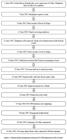
A timeline has been constructed to show the key events between 1 June 1945 and 24 July 1945.
Discussion
Ten key events up until 24 June 1945 when the French left the Val d'Aosta and only one incident after that date, which was the discovery of a propaganda leaflet found on 30 June 1945, are of significance. In this latter case, a seditious leaflet had replaced the boots on the ground of the adversary. By 12 June 1945, the South Africans were experiencing exasperation, resulting in a 'no fraternization' order.91 The passage of four French officers and a civilian across the border on 14 June 1945 signified military and political consultations about to occur. By this date, the French realised they had been boxed in, the only possible trekking route over Col de la Seigne had been closed off (Map 1), and there was no option but to leave. The French position had, in any event, become militarily untenable as their heavy equipment was at Bourg-Saint-Maurice on the western side of the national border at the Colle di Piccolo San Bernardo Pass. Of interest is the evidence of contradictory messaging where good relations were evident between French and SA troops on 18 June 1945 but on the very next day, an SA unit was held up in an ambush position by French troops in an attempt to exert French authority over the valley. The desire of the French to make the most of the opportunity extended to them led to them exploding a minor magazine (on an artillery gunsite) at the Colle della Croce to the east of La Thuile on 22 June 1945.92 This was done in order to destroy Italian military fortifications before they withdrew to France.
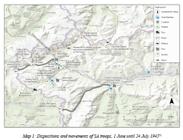
In terms of adaptation to a mountainous environment, it appears that the SA troops handled this with aplomb. In a relatively dangerous environment, no accidents or fatalities among SA troops were recorded in the various war diaries. Orpen describes the use of mules to supply the outposts of the troops.93 Of all the journeys and destinations of this time, the one up to Col du Mont would have been the most dangerous and arduous because of slope and depth of the snow. The War Diary, for instance, mentions on 9 June 1945 that 'the going at present [is] very difficult' for patrols exploring up to Col du Mont.94 This route would have required ice axes and crampons in early June 1945 (Map 1).95 This was a notable accomplishment by troops who were not trained mountain infantry. The pass to Col de la Seigne is fairly steep over the last two kilometres (a gradient of one in ten or 10%).96 Reynolds, detailing the ascent to the Col de la Seigne, states, 'the final slopes may well be covered with late-lying snow or even patches of ice, in which case caution is advised'.97 Orpen writes that in June 1945, 'snow still lay thick on the mountain slopes'.98 Reynolds, writing about the present-day Tour de Mont Blanc, states:
Since the TMB [Tour de Mont Blanc] trekker has to negotiate several passes where avalanche could be a distinct possibility if attempted too soon, the end of June or the first week of July is probably the earliest time to start. By then paths are largely snow-free.99
Climate change effects, primarily temperature, snow cover, glacial retreat and permafrost melting, have been prominent in the Western Alps of Europe since the end of the nineteenth century.100 It is likely, therefore, that the temperatures in June and July 1945 were on average about two degrees cooler than they are in 2026 (see Table 2). As Mourey et al. state, climate change has led to an increase in temperature of 2°C in Alpine areas from the last years of the nineteenth century to the start of the twentieth century, including a pronounced increase from the 1990s.101 The glaciers closest to the route between Lac de Combal and Col de la Seigne, namely Glacier de la Lex Blanche and Glacier d'Estellette, appear to have been considerably affected by global warming over approximately the last 80 years.102 Price writes, 'in temperate mountains, the glaciers of the Alps are losing 2 to 3 per cent of their area and volume each year'.103
The intelligence reports embedded in the War Diary convey a note of frustration with the French military forces and the inability of the SA forces to use their superior military power to expel the French from the valley. The germane reports are Appx 4, issued by 2677th Regiment,108 Office of Strategic Services (OSS), US Army, and Appx 7 issued by 12 SA Motd. Bde. Both reports are well reasoned and explicate the legal and military situation of French forces in the Val d'Aosta. The US Army report mentions 'a threat to the peace of Europe' if the current illegal situation is maintained.109 No stronger language can express the determination of the Allied Military Government to overturn the illegal French occupation of the valley. The SA report is more understated but outlines in a professional way the historical, legal and military standpoints. Crucially, the report also depicts the military disadvantage of the French forces and the fact that Allied forces held most of the 'winning cards' in any possible future confrontation. The note of frustration in the SA report is that 'we have been forbidden the use of our strong military power in enforcing our policies'.110 Another intelligence report is Appx A to the previously mentioned Appx 7, which is the disposition of French Forces in the Aosta Valley, namely an order of battle. An order of battle is issued to military units before a commencement of hostilities, so its importance cannot be overstated. This particular order of battle calmly contrasted the strengths and weaknesses, chiefly the geographical and light-arms status, of the French military forces. It also showed that the South Africans were prepared in all respects for possible conflict with the French (see the order of 'no undue fraternization with the French' issued on 12 June 1945).111 This preparation was further evidenced in the message from the Main Headquarters of 12 SA Motd. Bde to its constituent parts, describing the geographic responsibility of the three SA battalions in the Val d'Aosta. Significantly, it included reference to a troop of 14 Sherman tanks in Aosta, ready for any contingency.112
The experiences of the SA units in an alpine environment show multi-branch efficiency in terms of infantry, armour, intelligence and engineers.113 All valleys, settlements and military installations were efficiently garrisoned by SA troops right through the deployment.114 The multi-branch efficiency is also evidenced by the speed with which engineers defused and removed the demolition charge the French had placed on an Italian artillery piece on 23 June 1945. Armour deployments were strategically positioned, in particular placing light tanks in La Thuile and at a nearby bridge. Intelligence reports were of the highest possible standard and showed almost real-time information (a matter of 48 hours in Appx A, the order of battle).115 Good conduct by troops in an area was emphasised (see Appx 2), leading to positive outcomes in that the appearance and efficiency of the battalion were remarked upon even by possible adversaries.116 Diplomacy and tact on the part of the battalion were in evidence throughout the experience.117 French officers were invited to ceremonies, such as the retreat ceremony on 8 June 1945 (no doubt this was also intended to impress the French).118 Ford writes of positive relationships with Swiss border troops, and Orpen mentions the French offering of a mountaineering course to the South Africans.119 Minor acts of harassment, such as the cutting of telephone lines and the illegal surveying of Italian property (and possibly SA posts), were not escalated.120 Political violence, in particular the discovery of two bodies, appears to have been brought under control.121 Significantly, on 21 July 1945, the South Africans avoided possible conflict between French guards and a planned Italian Carabinieri contingent by requesting the Allied Military Government (AMG) to cancel the plan. This illustrates the highest tact. There was some evidence of understanding between the French and the South Africans, at least regarding junior officer ranks, such as a French lieutenant informing a SA platoon commander of withdrawal plans on 18 June 1945.122 This was probably linked to French military frustration with French politicians who wanted to annex the valley despite their military situation having become untenable since the American reconnaissance unit arrived in early May 1945.123 An attempt at possible subterfuge, with regard to the requested deployment of250 "cowherders" in the Val d'Aosta by the French, was handled adroitly.124 Table 3 and Map 1 show how the various contexts (military, political and environmental) were handled by the South Africans with aplomb, tact and efficiency.
Ironically, there was still a dispute between Italy and France in 2024 on the national borders adjacent to the Val d'Aosta, this time dealing with the contested summit. As a rule, borders in mountainous regions follow the watershed between countries.125 The French, however, maintain that the whole of the Mont Blanc summit, and not just the watershed, belongs to France, and the Italian border should straddle a lesser peak at a lesser altitude than the summit of Mont Blanc. The Rando Éditions map clearly shows the watershed line and a canton boundary (which is indicated by a line, three dots, line ...) on the summit of Mont Blanc but the state border (demarcating France and Italy) appears at a lower altitude and downslope from the summit.126 The deliberate movement of border markers as reported in 2024 appears to echo the cutting of SA telephone lines in the valley 79 years earlier.
Conclusion
It appears as if the French had something of a proprietorial and seignoriali attitude regarding the Val d'Aosta. Traces of this attitude also appear in the current dispute over the summit of Mont Blanc. There were a number of events and experiences during the SA deployment in the Val d'Aosta in June and July 1945 such as cutting of telephone lines and the hold-up of some troops in an ambush position that had the potential to destabilise matters even further. The Allies were very careful in their dealing with such situations and the way they handled the illegal French occupation of the valley. Acts of sabotage and very possible subterfuge were not retaliated or escalated in any way. Firstly, the 1st US Armored Division wasted no time in establishing American joint control over the valley; authority was then passed to a highly experienced SA motorised infantry brigade, after which a British Army artillery brigade took over.
The SA experience on a contested alpine frontier can be seen as a case study on peace-keeping in a mountainous environment. As an aside, the current research also adds valuable context for peacekeeping operations on the part of the SANDF since 1994, although it has to be noted that 1945 marked the last time SA troops operated in Europe. Management decisions were highly nuanced and diplomatic, resulting in the ultimate aim being realised, namely the French being eased over the frontier without a shot having been fired. It was an inspired choice to send an SA brigade and battalion to the valley, since its soldiers were bound to be impartial in matters concerning Italy and France. Every side valley of the main Val d'Aosta had been garrisoned by SA troops, and this included securing trekking passes from France into the valley. The military and political aspects of the deployment were thus handled with aplomb. South African troops quickly adapted to the environmental conditions, despite not being a bespoke mountain infantry unit. It has to be noted, however, that they had acquired mountain warfare experience in Ethiopia and the Apennines of Italy. It can be argued that adaptability was a key strength of SA soldiers during the Second World War. Nothing was left to chance in all their actions and preparations, either geographically or militarily. The Allied forces were fortunate in that there were late snows that year; this prevented early use of the Piccolo San Bernardo Pass for heavy equipment by the French. After 1945, it appears as if a veil of silence descended regarding the Allied deployment in the valley as it would not have suited either of the two main parties, i.e. the French or the Italians, to publicise it. To some extent, it can be argued that this also happened in South Africa, with a new government in 1948 keen to forget the role of South Africa in a contested war overseas.134
Endnotes
* Born and raised in Cape Town, South Africa, Dr Gavin Heath graduated from the University of Cape Town with a Bachelor of Arts in 1989, a Higher Diploma in Education in 1990, and a Master of City and Regional Planning in 2000. Dr Heath taught English and Geography in South Africa and the United Kingdom up to 1998. He started lecturing at the former University of Natal in 2002; in 2021 he was awarded his Doctorate of Philosophy (in Education) by Rhodes University, Makhanda. Dr Heath is married to Bronwen, who shares his love for the outdoors.
i Seignorial refers to the lordly or dominant position, especially in feudal times, of one party compared to the other, which occupies a subaltern or inferior position.
1 The Italian place name for places in the state of Italy is used throughout; the same convention applies to French place names.
2 CRS Harris, Allied Military Administration ofltaly, 1943-1945 (Vol. 1) (London: HM Stationery Office, 1957), 317-325.
Acknowledgements
Department of Defence Archives, 34 Saturnus Road, Irene, Centurion, South Africa. Dewald Nel of Nel Militaría.
Literature Review
- 3 R Pearce, Barrier of Spears: Drama of the Drakensberg (Durban: Art, 2006), 306-329.
- 4 The conflict between the colonial power of Natal and the Hlubi, led by Chief Langalibalele, originated due to a Natal Government directive for all firearms to be registered. The refusal on the part of the Chief to aid in the registration of the weapons subsequently led to the flight of the Hlubi across north-western Natal and up the ramparts of the Drakensberg. A colonial unit, the Natal Carbineers, was fired upon by elements of the Hlubi at the summit of Bushman's Pass, leading to some fatalities. After colonial reprisals against the Hlubi, Langalibalele surrendered in a Lesotho village in December 1873; see J Wright & A Mazel, Tracks in a Mountain Range (Johannesburg: Wits University Press, 2007).
- 5 Wright & Mazel, Tracks in a Mountain Range, 97-109.
8 G Butler, Bursting World: An Autobiography 1936-45 (Cape Town: David Philip, 1983), 290-293; J Holland, Italy's Sorrow: A Year of War, 1944-1945 (London: Harper Press, 2008), 400-405, 411-412, 435-437.
9 N Orpen, The Cape Town Highlanders 1885-1970 (Cape Town: The Cape Town Highlanders History Committee, 1970), 318-319.
10 Orpen, Victory in Italy, 309.
11 Orpen, Victory in Italy, 309-310.
12 R Frison-Roche, Mont Blanc and the Seven Valleys (London: Nicholas Kaye, 1961), 77-89.
13 A van Nieuwkerk, 'South Africa and Peacekeeping in Africa', African Security, 5, 1 (2012), 44-62.
14 Mountain Club of South Africa, 'In Memoriam', Journal of the Mountain Club of South Africa, 77 (1975), 141-142.
15 K Reynolds, Tour of Mont Blanc (Kendal: Cicerone, 2015), 168-177.
16 Kleynhans & Katz, 20 Battles, 115.
17 Kleynhans & Katz, 20 Battles, 126.
18 M Armiero, A Rugged Nation: Mountains and the Making of Modern Italy: Nineteenth and Twentieth Centuries (Cambridge: The White Horse Press, 2011), 153-154.
19 J Gooch,Mussolini's War: Fascist Italy from Triumph to Collapse 1935-1943 (London: Penguin, 2020), 98-104.
20 Frison-Roche, Mont Blanc.
21 1st U.S. Armored Division, 'History of the 1st Armored "Old Ironsides" Division'. 2008. <https://www.custermen.com/ItalyWW2/Units/FirstArmd.htm> [Accessed on 13 April 2026].
22 Only the initials of the author are given at the end of the article.
23 APE, 'Autonomy in the Val d'Aosta', The World Today, 1946, 256-268.
24 JD Street, 'French in the Valle d'Aosta: The Illusion and the Agony', Contemporary French Civilization, 10, 1 (1986), 119-133.
25 Harris, Allied Military Administration of Italy.
26 JK Wildgen, 'The Liberation of the Valle d'Aosta, 1943-1945', The Journal ofModern History, 42, 1 (1970), 21-41.
27 From January 1944, the Allied 15th Army Group comprised the British 8th Army and US 5th Army; see Holland, Italy S Sorrow.
28 Harris, Allied Military Administration of Italy.
29 Wildgen, 'The Liberation of the Valle d'Aosta'.
30 Harris, Allied Military Administration of Italy.
31 Wildgen, 'The Liberation of the Valle d'Aosta', 39.
32 Wildgen, 'The Liberation of the Valle d'Aosta'.
33 J Mahieu, The Alps: An Environmental History (Cambridge: Polity Press, 2019), 139-140.
34 Orpen, The Cape Town Highlanders.
35 Orpen, Victory in Italy.
36 Orpen, The Cape Town Highlanders.
37 Orpen, Victory in Italy.
38 S Monick, A Bugle Calls: The Story of the Witwatersrand Rifles and Its Predecessors 1899-1987 (Germiston: Witwatersrand Rifles Regimental Council, 1989), 483.
39 Monick, A Bugle Calls.
40 K Ford, From Addis to the Aosta Valley (Solihull: Helion, 2012), 168.
41 C Eglin, Crossing the Borders of Power: The Memoirs of Colin Eglin (Johannesburg: Jonathan Ball, 2007), 30.
42 P Malaspina, 'Franco-Italian Mont Blanc Dispute and Climate Change: Policy Perspectives after the Quirinal Treaty', Borders in Globalization Review, 5, 2 (2024), 49-59.
43 Department of Defence Archives (hereafter DOD Archives), Union War Histories (Military) (hereafter UWH Military), Box WD 635, War Diary, First City/Cape Town Highlanders (hereafter FC/CTH), June-July 1945.
44 MOTD is not typically an abbreviation for motorised units, instead the abbreviations MOTR, MOT or MTR are used. However, the author decided to maintain the preference as used in the actual primary source for consistency and to assist future researchers in locating it.
45 The last-named unit was the general staff branch of the division, and as such responsible for supporting units in the field. DOD Archives, UWH Military, Box WD 595 A3, War Diary, 6 SA Armoured Division ("G" Branch) (hereafter 6 SA Armd. Div. "G" Br.), June 1945.
46 PD Leedy & JE Ormrod, Practical Research: Planning and Design (Boston: Pearson, 2010), 164-177.
47 Leedy & Ormrod, Practical Research.
48 Historical time refers to the timeframe in which the particular historical events occurred, while historical space refers to the spatial area in which the historical events occurred.
49 Rando Éditions, Pays duMont Blanc, A1, 1:50 000 (Grenoble:Rando Éditions & IGN, 2003);Google, 'Google Earth View of Upper Aosta Valley', n.d. <https://earth.google.com/web/ @ 45.75949705,6.93479067,2646.78616301a,73369.36496336d,35y,0h,0t,0r/data=CgRCAggBOgMKATBCAggASggIv8SK4QQQAA> [Accessed on 30 July 2025].
50 Leedy & Ormrod, Practical Research.
51 DOD Archives, UWH Military, Box WD 635, War Diary, FC/CTH, June-July 1945.
52 Orpen, The Cape Town Highlanders.
53 Orpen, Victory in Italy.
54 Monick, A Bugle Calls.
55 Eglin, Crossing the Borders of Power
56 Ford, From Addis to the Aosta Valley.
57 APE, 'Autonomy in the Val d'Aosta'.
58 Harris, Allied Military Administration of Italy.
59 Frison-Roche, Mont Blanc.
60 Wildgen, 'The Liberation of the Valle d'Aosta'.
61 Street, French in the Valle d'Aosta.
62 1st U.S. Armored Division.
63 Orpen, The Cape Town Highlanders.
64 Rando Éditions, Pays du Mont Blanc; Google, 'Google Earth View of Upper Val d'Aosta'.
65 Compiled by author from DoD Archives, UWH Military, Box WD 635.
66 The University of KwaZulu-Natal Research Office number for exemption from ethics review is 00027470.
67 For this reason, only one reference is given for this section.
68 These political prisoners would have been Italian Fascist members and/or sympathisers, sworn enemies of the left leaning or communist partisans.
69 There would have been a concern that a possible French armoured thrust through neutral Switzerland could have occurred. There is no explicit reference to this effect but the War Diary of FC/CTH does deal with preparation for all possible contingencies. The platoon was from WR/DLR, which assumed responsibility for the town of Aosta and the Swiss border.
70 DOD Archives, UWH Military, Box WD 635, War Diary, FC/CTH, June-July 1945.
71 B Gijsbertsen, Geography Department, UKZN Pietermaritzburg; DOD Archives, UWH Military, Box WD 635, War Diary, FC/CTH, June-July 1945.
72 DOD Archives, UWH Military, Box WD 635, War Diary, FC/CTH, June-July 1945.
73 The Val d'Aosta has plentiful rainfall and suitable areas and gradients for the generation of hydro-electric power.
74 DOD Archives, UWH Military, Box WD 635, War Diary, FC/CTH, June-July 1945
75 DoD Archives, UWH Military, Box WD 635, War Diary, Appendix 7, First City/Cape Town Highlanders, June-July 1945.
76 DoD Archives, UWH Military, Box WD 635, War Diary, Appendix 7, First City/Cape Town Highlanders, June-July 1945.
77 DOD Archives, UWH Military, Box WD 635, War Diary, FC/CTH, June-July 1945.
78 DoD Archives, UWH Military, Box WD 649 A6, War Diary, Witwatersrand Rifles/De La Rey (hereafter WR/DLR), June 1945.
79 DoD Archives, UWH Military, Box WD 639 B11, War Diary, Prince Alfred's Guard (hereafter PAG), 1-30 June 1945.
80 DoD Archives, UWH Military, Box WD 610 A3, War Diary, HQ - 12 SA MOTD BDE, 1-30 June 1945.
81 DOD Archives, UWH Military, Box WD 610 A4, War Diary, HQ - 12 SA MOTD BDE, 1-30 June 1945.
82 DOD Archives, UWH Military, Box WD 610 A5, War Diary, HQ - 12 SA MOTD BDE, 1-13 July 1945.
83 DOD Archives, UWH Military, Box WD 595 A3, War Diary, 6 SA Armd. Div. "G" Br., June 1945.
84 DOD Archives, UWH Military, Box WD 595 A3, War Diary, 6 SA Armd. Div. "G" Br., June 1945.
85 DOD Archives, UWH Military, Box WD 595 A3, War Diary, 6 SA Armd. Div. "G" Br., June 1945.
86 DOD Archives, UWH Military, Box WD 595 A3, War Diary, 6 SA Armd. Div. "G" Br., June 1945.
87 DOD Archives, UWH Military, Box WD 595 A3, War Diary, 6 SA Armd. Div. "G" Br., June 1945.
88 DOD Archives, UWH Military, Box WD 595 A3, War Diary, 6 SA Armd. Div. "G" Br., June 1945.
89 DOD Archives, UWH Military, Box WD 595 A3, War Diary, 6 SA Armd. Div. "G" Br., June 1945.
90 DOD Archives, UWH Military, Box WD 635, War Diary, FC/ CTH, June-July 1945.
91 DOD Archives, UWH Military, Box WD 635, War Diary, FC/CTH, June-July 1945.
92 DOD Archives, UWH Military, Box WD 635, War Diary, FC/CTH, June-July 1945.
93 Orpen, The Cape Town Highlanders.
94 DOD Archives, UWH Military, Box WD 635, War Diary, FC/CTH, June-July 1945.
95 Reynolds, Tour of Mont Blanc.
96 Rando Éditions, Pays du Mont Blanc.
97 Reynolds, Tour of Mont Blanc, 175.
98 Orpen, The Cape Town Highlanders, 318.
99 Reynolds, Tour ofMont Blanc, 23.
100 RG Barry, Mountain Weather and Climate (Cambridge: Cambridge University Press, 2008), 474-494.
101 J Mourey, M Marcuzzi, L Ravanel & F Pallandre, 'Effects of Climate Change on High Alpine Mountain Environments: Evolution of Mountaineering Routes in the Mont Blanc Massif (Western Alps) over Half a Century', Arctic, Antarctic, andAlpineResearch, 51, 1 (2018), 176-189.
102 Rando Éditions, Pays du Mont Blanc.
103 MF Price, Mountains: A Very Short Introduction (Oxford: Oxford University Press, 2015), 102.
104 Orpen, The Cape Town Highlanders; Reynolds, Tour ofMont Blanc.
105 Reynolds, Tour ofMont Blanc; Google, 'Google Earth View of Upper Val d'Aosta'.
106 Reynolds, Tour ofMont Blanc; Google, 'Google Earth View of Upper Val d'Aosta'.
107 DOD Archives, UWH Military, Box WD 635, War Diary, FC/CTH, June-July 1945.
108 This was a special operations and intelligence unit of the United States Army. The report of this unit provides essential military and strategic context for the narrative.
109 DOD Archives, UWH Military, Box WD 635, War Diary, FC/CTH, June-July 1945
110 DOD Archives, UWH Military, Box WD 635, War Diary, FC/CTH, June-July 1945
111 DOD Archives, UWH Military, Box WD 635, War Diary, FC/CTH, June-July 1945
112 DOD Archives, UWH Military, Box WD 635, War Diary, FC/ CTH, June-July 1945.
113 DOD Archives, UWH Military, Box WD 635, War Diary, FC/CTH, June-July 1945.
114 Orpen, The Cape Town Highlanders; Eglin, Crossing the Borders of Power; Ford, From Addis to the Aosta Valley.
115 DOD Archives, UWH Military, Box WD 635, War Diary, FC/CTH, June-July 1945.
116 DOD Archives, UWH Military, Box WD 635, War Diary, FC/CTH, June-July 1945; Orpen, The Cape Town Highlanders.
117 Orpen, The Cape Town Highlanders; Ford, From Addis to the Aosta Valley.
118 DOD Archives, UWH Military, Box WD 635, War Diary, FC/CTH, June-July 1945.
119 Ford, From Addis to the Aosta Valley; Orpen, The Cape Town Highlanders.
120 DOD Archives, UWH Military, Box WD 635, War Diary, FC/CTH, June-July 1945.
121 DOD Archives, UWH Military, Box WD 610 A4, War Diary, HQ - 12 SA MOTD BDE, 1-30 June 1945.
122 DOD Archives, UWH Military, Box WD 635, War Diary, FC/CTH, June-July 1945.
123 APE, 'Autonomy in the Val d'Aosta'; 1st U.S. Armored Division; Orpen, The Cape Town Highlanders.
124 DOD Archives, UWH Military, Box WD 610 A4, War Diary, HQ - 12 SA MOTD BDE, 1-30 June 1945.
125 University of Cape Town, Regional Planning Theory (ARP427F) Course Notes, 1999.
126 Rando Éditions, Pays du Mont Blanc.
127 1st U.S. Armored Division.
128 Harris, Allied Military Administration of Italy.
129 DOD Archives, UWH Military, Box WD 635, War Diary, FC/CTH, June-July 1945
130 Reynolds, Tour ofMont Blanc.
131 Reynolds, Tour ofMont Blanc.
132 Reynolds, Tour ofMont Blanc.
133 All attribution to DOD Archives, UWH Military, Box WD 635, War Diary, FC/CTH, June-July 1945, unless otherwise specified.
134 This was due to the Herenigde Nasionale Party (Reunited National Party) and the Afrikaner Party, which had opposed South African participation in the War, winning the national election in 1948.