General Systems Meta-Theory Intervention Strategy for Combat-Related PTSD in the SANDF - A Case Study
Abstract
South Africa has a long history of military contribution throughout both world wars, and specifically the generational Southern African Border War (1966-1989). More recently, the South African National Defence Force as part of the United Nations, African Union and Southern African Development Community has been mandated to participate in peace support operations across the African continent. Modern peace support operations function in hostile theatres, where they must confront violent extremism, suffer attacks from armed groups, and face mass atrocities or war crimes in hazardous conditions, as experienced in historical wars. Research indicates that almost half of all military veterans and the South African National Defence Force soldiers participating in peace support operations that were exposed to combat trauma, experience some form of post-traumatic stress reaction and/or mental health issue. Post-traumatic stress disorder rates in military veterans that fought in the Southern African Border War are approximated at 33 per cent, and a survey on United Nations peacekeepers reflected 20 per cent post-traumatic stress disorder rates, as well as 22 per cent for depressive disorders and 18 per cent for anxiety-related disorders. Following the study on which this article is based, a short-term intervention strategy for military veterans and soldiers diagnosed with combat-related post-traumatic stress disorder is proposed. General systems meta-theory and interactional pattern analysis were utilised to formulate and inform an effective intervention strategy. The variables of "lack of control" and "isolation" were identified through interactional pattern analysis as perpetuating and maintaining factors for the development of combat-related post-traumatic stress disorder, and are highlighted in the intervention strategy. The intervention strategy includes a sequenced five-step process and was effectively applied to two case studies.
PTSD; Combat Trauma; Military Veterans; General Systems Theory; Interactional Pattern Analysis; Isolation; Control; Guided Imagery
Introduction
The twentieth century has been recorded as the bloodiest age in history and is often referred to as the "Century of War". It encompassed two world wars and the Cold War, while amassing a staggering number of deaths and injury to military personnel and the civilian population.1 A United Nations (UN) report has shown that, although the world experienced some decline in war-related casualties since 1946, armed conflict requiring military intervention continued unabated. Since 2016, countries around the world have been facing more violent conflict than at any point during the previous 30 years.2
The South African (SA) military contribution to both world wars is well documented, and the country has a long history of ongoing military involvement.3 The main generational conflict of the former SA Defence Force (SADF) was the Southern African Border Wars (SABW) (1966-1989), with an estimated cost of more than 700 lives.4 After 1994, the post-apartheid government rebranded the military as the SA National Defence Force (SANDF). The SA government then created legislation, through the Military Veterans Act (No. 18 of 2011), to define a military veteran in section 1 of the act. A military veteran is defined as an SA citizen who provided military service to any statutory or non-statutory military organisation, which include the Union Defence Force before 1961, members who served on both sides of the SA liberation war between 1960 and 1994, or who had joined the SANDF after 1994. A military veteran also refers to a person who completed military service or was honourably discharged. Section 3 of the act highlights the significant physical and mental sacrifices of military veterans during their service.5 New roles for the SANDF as a member of the United Nations, African Union (AU) and the Southern African Development Community (SADC), mandated participation in peace support operations (PSOs) to assist with peace and stability across the continent.6 The SANDF has consequently been involved in 14 PSOs between 1999 and 2019,7 with the addition of the recent SADC mission to Mozambique (2021-2024).8 These obligations reflect the high demand to assist with UN and AU military operations on the African continent and beyond. At least a third of military veterans9 and a quarter of SANDF peacekeepers (collectively referred to as "military personnel" in this article) involved in these military operations experienced profound and debilitating physical and personal trauma.10 This trauma can be viewed as an assault on the mind and body that causes disruption in the physiological, neuro-psychological and emotional-social systems.11
Dr Allan Horwitz a medical sociologist, however, explains that, before the 1860s, there were no cultural norms or medical framework that considered that combat-related trauma could elicit lasting mental consequences. He argues that the convergence of three factors set history on a path towards recognising post-trauma consequences as a potential mental disorder. First, in the aftermath of the brutal American Civil War (1861-1865), physicians hinted at psychological interpretations of wartime trauma. Second, due to increased industrialisation, rising railway accidents prompted British surgeon John Erichsen to develop the first medical diagnosis of "Railway Spine" in 1866. Erichsen linked the trauma of railway accidents to spine compression and eventual emotional challenges. Last, the work of Jean-Martin Charcot (neurologist) and Sigmund Freud (neurologist, psychoanalyst) linked traumatic experiences to the concept of hysteria in the 1890s, shifting the understanding by the medical fraternity of trauma from a purely organic cause to include psychological trauma.12
During the First World War (1914-1918), thousands of British service members returned from the front lines with unexplained and varied trauma symptoms, overwhelming base hospitals that were treating psychiatric battle casualties. British medical officer and psychologist, Charles Myers, first employed the term "shell shock" in 1915. He initially associated shell shock, which was still poorly defined at the time, to the physical impact of shelling, but in 1916 started to link it to the devastating consequences of war.13 This concept was further informed through the term "combat exhaustion" during the Second World War (1939-1945). A concerted effort was made in the development of screening, treatment and research of soldiers, ever expanding the psychiatric understanding of post-traumatic effects. It was, however, not until 1980, that post-traumatic stress disorder (PTSD) was formalised as a mental disorder in the third edition of the Diagnostic and Statistical Manual of Mental Disorders (DSM).14 The diagnosis of PTSD has been revised multiple times in the twenty-first century, but the core concepts that link exposure of a qualifying trauma to post-trauma symptomology remain.15 This diagnosis gives validity to the suffering experienced by military personnel over the last century.
DSM-5-TR PTSD Diagnostic Criteria
Post-traumatic stress disorder (PTSD) is currently informed by the fifth edition of the DSM (DSM-5-TR). The DSM-5-TR was first published by the American Psychiatric Association in 2013 and revised in 2022 to serve as the psychiatric standard universally, involving more than 200 experts. Post-traumatic stress disorder is viewed as a mental disorder, and is defined by five diagnostic criteria, eliciting characteristic symptoms persisting for more than one month.16 The first criterion specifies that an individual should have experienced or witnessed actual or threatened death, serious injury or sexual violence directly.17 The second criterion indicates that individuals re-experience their trauma events through recurrent, involuntary and intrusive memories, nightmares or dissociative flashbacks. This causes individuals to constantly relive the experienced or observed threat.18 The third criterion relates to the persistent avoidance of the intrusive threat. The function of the avoidance symptom is to distance oneself physically or psychologically from perceived danger through any means possible. This includes avoiding memories, thoughts, feelings, situations or any internal or external trauma-related cues.19 The fourth criterion describes the resulting negative alterations of cognition and mood related to the traumatic event. A negative alteration is a persistent and exaggerated adverse belief about the self and others, and views the world as a constant threat. Negative alteration can elicit decreased participation in the world and even escalate to a subjective experience of detachment. The fifth criterion refers to a change in the levels of arousal and reactive behaviour linked to a traumatic event. This state of altered emotional and physical reactions includes hypervigilance, exaggerated startle responses, reckless behaviour and unprovoked anger outbursts.20 Moreover, PTSD is associated with co-morbidities, such as depression and anxiety-related disorders,21 as well as personality and psychotic-related disorders.22
Combat-Related PTSD
The DSM-5-TR explains that the highest prevalence of PTSD, based on United States (US) population samples, is present in military veterans and survivors of military combat.23 Combat-related trauma thus has specific contextual variables that significantly heighten the risk for the development of PTSD.24 Military personnel, for example, witness and experience multiple and continuous life-threatening traumatic events in war-related conflict, and they participate in perpetrations of violent acts during combat.25 Military personnel participating in the atrocities of war can suffer significant psychological trauma during or immediately after combat. This is referred to as combat stress reaction (CSR), which acutely incapacitates the functional and operational duties of the afflicted soldier.26 "Combat stress reaction" refers to a psychological wound, often accompanied by physical injury that induces a state of shock, emotional detachment, confusion and dysfunction. This type of stress reaction can immobilise a soldier, even in life-threatening situations. An additional component to war-related trauma is that military personnel can be involved in substantial physical or emotional harm and injury to others, especially civilians. These actions elicit a weight of internal moral conflict and guilt, as well as compound traumatic effects and the consequent severity of post-trauma symptoms.27 Military personnel, however, often negate, avoid or simply do not recognise these effects, and their post-combat trauma tends to remain hidden and invisible wounds of war.28
Negating these post-trauma symptoms exacerbates barriers to help-seeking behaviour. Many military personnel consequently aim to avoid psychological assistance by attempting to manage and continue to negate their own distress until a crisis point is reached.29Additionally, psychological intervention as part of standard demobilisation is often ineffective as the afflicted military personnel have not yet fully integrated or interpreted their trauma effects. This gives rise to progressive distress and instability of post-traumatic symptoms after their return.30 A study into the Iraq (2003-2011) and Afghanistan (2001-2021) wars approximated that a tenth of US veterans, for example, surrendered to alcoholism and substance abuse causing destructive symptomatic behaviour.31
Another challenging variable is the strength of the familial bond that is created between members of a combat unit. A combat soldier's bond, based on the unique shared experiences of military training, mobilisation and combat, can create an interdependence essential for survival. Losing this bond makes returning home distressing.32 As a result, military personnel may struggle to connect to or share common contexts with their civilian family members. They subsequently experience an unfamiliar environment that finds it difficult to understand the effect and consequences of their traumatic combat experiences.33 Military personnel who experience PTSD symptoms are associated with numerous destructive consequences in civilian contexts leading to a substantial burden on their family, marital and societal relations.34 This is aggravated by psychiatric disorders, such as anxiety, depression,35 as well as suicidal behaviour linked to alienation and rejection from civilian life.36
Military personnel with PTSD symptoms therefore suffer in isolation where they retreat into their protective shells in an effort to deny their trauma. They subsequently assess the world through hypersensitivity to any threatening internal or external cues that could lead to volatile behaviour. This behaviour is intertwined with a subjective experience of helplessness, caught between endlessly reliving the intense threat of war through intrusion symptoms and attempted avoidance of any related thoughts, feelings or actions.37 This is often accompanied by a destructive internal dialogue of self-criticism and harsh rebuke in which military personnel are entrapped in a cycle of self-blame, shame or guilt.38 The process is also perpetuated by negative alteration in cognition and mood. This aggravates the reckless and self-destructive behaviour of individuals with PTSD, that is not only self-isolating, but also creates a substantial risk for themselves and others.39 Lastly, the concern of escalating arousal symptoms in military personnel is that military training negatively influences a soldier's ability to delay anger impulses towards violence.40 Learned responses to environmental dangers during war necessitates reactive and hypervigilant observation of surroundings. These responses are required for survival, but are excessive and destructive in a civilian, post-war context. This consequently creates an imbalance between expected social behaviour and destructive behaviour spawned by wartime trauma.41
Studies on the prevalence of PTSD in SADF military veterans since their return from the SABW in 1989 are limited.42 This scarcity in research can be attributed to a national amnesia related to the secrecy in which the SABW was conducted and because SADF military veterans were discredited as part of the apartheid regime.43 The apartheid regime enforced a veil of silence on SABW security matters that lasted well into post-apartheid South Africa after 1994, and SADF military veterans felt compelled to suppress the war experiences, which they cannot forget.44 A master's study by Martin Connell took the first step in doing research to ascertain the prevalence of PTSD in SADF military veterans who had fought in the SABW between 1975 and 1988. The study suggested that approximately 33 per cent of SADF military veterans experienced PTSD.45 Although the results should be considered carefully, it is comparable to studies of PTSD in veterans of major international wars. A study of the Vietnam War (1955-1975), focusing on 1964 to 1975, found a lifetime prevalence of PTSD of 30,9 per cent in male and 26,9 per cent in female US veterans respectively. Additionally, a lifetime prevalence of partial PTSD was found in 22,5 per cent of male and 21,2 per cent of female US Vietnam veterans.46Research done in 2003 on US veterans from the Iraq and Afghanistan wars reported PTSD prevalence between 9 per cent and 17 per cent.47
At the conclusion of the Border War in 1989 and the subsequent end of apartheid in the early 1990s, South Africa transitioned to a constitutional democracy in 1994. This allowed the country to enter the global stage and move from a regional power to a contributing force on the continent, focusing on international security, conflict resolution and peacekeeping.48 Peace support operations (PSOs) focus mainly on promoting stability, peace and security in collaboration with the local community and security forces, primarily through a defensive posture.49 Modern UN PSOs however go far beyond traditional peacekeeping and increasingly function in hostile theatres where peacekeepers must confront violent extremism and attacks from armed groups and face mass atrocities in perilous conditions.50 Peacekeepers thus endure context-specific psychological stressors that are not confined to a conventional war situation.51 A survey on UN PSOs in 2015 and 2016 indicated that almost half of all peacekeepers exposed to combat trauma experienced some form of post-trauma stress reaction and/or mental health issue. Additionally, UN peacekeepers reported 20 per cent PTSD rates, as well as a 22 per cent rate for depressive disorders and 18 per cent for anxiety-related disorders.52 Limited data are however available on the prevalence of PTSD specific to SANDF peacekeepers involved in PSOs. A preliminary study identified PTSD prevalence of 26 per cent in the SANDF regular force during the initial phases of PSOs in the early 2000s, which is comparable to the UN PSO surveys mentioned above.53
Therapeutic Paradigm and Variables
Existing literature provides a staggering amount of research, approaches and strategies to intervene in PTSD, diagnosed in the civilian54 and mainly Western military context.55 This includes the use of traditional psychological theories, integrative approaches, as well as emerging and modern intervention strategies, such as virtual reality technology. Despite this plethora of literature, there is still a great need for continuous exploration and expansion of effective, contextualised PTSD intervention strategies.56 Limited research however exists on intervention strategies specific to PTSD in the SANDF.
The paradigm used to underscore the intervention strategy in the current study was applied general systems theory (GST) utilised as a meta-theory.57 A meta-theory is important, as it creates a foundation and context, with specific rules and principles, in which the intervention strategy can be applied. The meta-theory thus creates a coherent, logical and interrelated system of ideas that allows for vast conceptual exploration while it limits conceptual confusion.58 A relational model, such as GST, is suitable as a meta-theory because it distinctly allows for a flexible theoretical framework in which all theoretical approaches can be logically integrated.59 Systemic principles permit this level of integration because systems are hierarchically structured. This allows systems within systems that are interdependent through recursive patterns of interaction.60 Next, meta-theory allows a process of punctuation in observing the recursive patterns across various subsystems.61 Depending on the punctuation, elements within a system can be viewed both linearly and circularly, or intra- and inter-psychic, without leaving the foundational GST or its systemic principles. For example, punctuation can move from a systemic focus on the interactional patterns between members of a system to punctuating deeper in the system on the linear stimulus and response process of an individual aligning to behaviourist approaches. Still deeper punctuation can be applied to the internal intrapsychic processes of an individual focusing on psychodynamic principles, all while remaining in the larger systemic framework.62 The whole is thus bigger than the sum of its parts,63 allowing the integration of various interventions into the GST meta-theory.
The foundational principle of GST is primarily a move from an intra to an inter-psychic perspective. The focus shifts from an individual's subjective experience to observable behaviour64 of relational patterns between individuals in the here and now.65 Second, there is an advance from lineal to non-lineal causality.66 "Lineal causality" refers to processes where one event causes the other independently, or where A causes B. In non-lineal causality, elements in a system impact each other through reciprocal influencing, or A causes B and B causes A in a circular manner.67 A system can thus be defined as a set of elements in interaction with each other to create a whole. Each element is interdependent and does not function in isolation, which means that change in one element creates change in all the elements of the system. Examining one element in the system thus requires consideration of the entire interconnected whole.68 Next, due to reciprocal influencing, interpersonal communication between individuals in a system creates relationship rules that produce observable rigid, self-perpetuating patterns of interaction. These patterns create a stable and balanced norm or homeostasis through circular feedback loops in the system.69 Lastly, the principle of cybernetics explains that these feedback loops are cycles of reciprocal influencing in which information of past patterns of behaviours is fed back into the system in a circular manner. This process allows the rule-bound system to identify any changes or error states from the norm through a self-regulating system. The system enables corrective measures to maintain stability in the system.70 Cybernetics can thus be viewed as an error-activated, self-correcting feedback loop that self-regulates a system to maintain dynamic equilibrium.71
If individuals are dissatisfied with rigid rules, definition of relationships or ineffective interactional patterns in a system, reciprocal influencing could elicit positive feedback loops.72 Positive feedback loopsii amplify change in a system, often with destructive potential.73 This change elicits symptomatic behaviour, which is viewed as a way of handling a relationship, and serves a specific function. The system then adapts to create a new status quo, which maintains the symptom and its function, no matter how damaging. To identify the symptomatic behaviour, its function and how it is maintained, the total system thus needs to be considered to identify the nodal point where therapeutic change can occur. Symptomatic behaviour across contexts and not specified in terms of an identified system, context or relationship, is considered pathological.74 An example is a family system that displays stable interactional patterns, rules and homeostasis. If a family member experiences combat trauma that greatly affects their interactional patterns on return, reciprocally, all members of the family system will be affected. This will trigger a positive feedback loop, and a new potentially destructive norm will develop. Change in one individual thus changes the interactional patterns, rules and homeostasis of the entire family system. The effect of PTSD-related symptoms, such as substance abuse, isolation or aggression, elicits a new harmful interactional pattern and status quo that are maintained and perpetuated by the family system. This serves a specific function for the individual, family and society that can be observed directly.
In addition to GST, the interactional pattern analysis (IPA) was developed by Prof. Charl Vorster, an SA clinical psychologist and leader in the field of interactional therapy.75 Interactional pattern analysis functions as a psycho-diagnostic approach and tool for interactional therapy.76 Such analysis highlights the unique context and interactional pattern of each individual client to develop a logical, clear and systemic formulation and intervention strategy. Interactional pattern analysis subsequently links an individual's context to the presenting complaint and various interpersonal variables that maintain the interactional pattern, symptomatic behaviour and function of the symptom within a specific system.77 This assumption is closely aligned to the thinking of Carl Rogers (US psychologist and leading figure in person-centred therapy)78 that 'the nature and quality of an individual's interpersonal relationships directly correlate to the individual's mental health'.79
A study of the IPA identified a "lack of control" and "isolation" as the two main variables developing and maintaining PTSD in systemic thinking.80 First, multiple studies link the lack of control81 and external locus of control (LOC) to the development of trauma-related disorders, such as PTSD, after combat exposure.82 Research further connects the variable of control to the DSM-5-TR criteria of PTSD. For example, the threat of death or injury in combat-related trauma is linked to the subjective experience of environmental control during the event, rather than directly to the event itself.83 Similarly, external LOC is uniquely associated with avoidance and numbing symptoms. The subjective experience of being powerless to gain control over intrusive memories, thoughts or environmental cues thus reinforces the military member's immobilisation and subsequent avoidance. The variable of control is thus pertinent in the prevention and intervention of PTSD.84 Additional IPA variables were identified that perpetuate the lack of control in PTSD development. First, individuals will struggle to develop effective control in their family relationships and may either become a victim or ineffectively enforce control in the family system with destructive consequences. Next, a loss of control affects an individual's capacity for adequate problem-solving skills. If an individual thus finds it challenging to negotiate their environmental demands and is unable to resolve tasks as before, they can become immobilised.85
The concept "isolation" is a significant contributing factor to mental health across the psychological spectrum, specifically to military personnel suffering from PTSD.86 Social isolation can be defined ranging from a state of ineffective social interaction to the complete denial of interaction on individual, group or societal level.87 Social isolation is thus closely related to the subjective experience of loneliness, levels of social support, social connectedness or emotional closeness versus distance in relationships.88 In 2023, Dr Vivek Murthy, surgeon general of the United States, released an advisory explaining the challenges isolation holds for general mental health.89 Isolation affects cognitive decline,90anxiety, depression-related disorders,91 as well as escalated suicide risk.92 The familial bond and shared experiences of military personnel in their units make returning home a threat, and cause great loss and isolation.93 Military personnel struggle to connect or share common contexts with their civilian family members, which reinforces their isolation and estrangement.94 Additional IPA variables were identified that perpetuate isolation and maintain PTSD symptoms. Individuals with PTSD receive limited empathy and are easily judged, which reinforces their isolation and does not allow them to vent traumatic experiences. These individuals also express their emotional needs ineffectively. When their needs are expressed, it is communicated through anger, aggression or judgement. This keeps their needs unfulfilled. The eventual consequence of their ineffective, rigid and linear patterns of interaction is rejection by their family system, support structures and environment, perpetuating their isolation and maintaining their PTSD.95
Method
The next section describes the five-step method that formed part of the intervention strategy used in the presented case studies. The section further provides a discussion on the theoretical underpinnings of each step and the process related to the core variables of a "lack of control" and "isolation".
Step 1: Person-Centred Therapy
The first logical step towards a therapeutic formulation and intervention strategy through the GST meta-theory and IPA is person-centred therapy (PCT), whose core variables form part of IPA sub-variables.96 Person-centred therapy was developed by Rogers during the mid-twentieth century, and is based on the concepts of the humanistic school of thought, also considered "the third force" in psychology.97 Rogers defines an organism (individual) as the sum of their subjective experience, known as the phenomenological field, of both the internal and external world. The individual subsequently interacts with this field and differentiates part of it as the structure of the self.98 Interacting with the external world imposes conditions of worth on an individual, which are then internalised and affect their self-concept. These conditions of worth either support or impair an individual's inherent need to self-actualise and reach their full potential.99 Rogers consequently created core conditions to be met in a therapeutic context, which will allow an individual to develop their real and authentic self.100
The first core condition of congruence refers to a therapist who communicates in an authentic, transparent and integrated manner within the therapeutic relationship, where their internal experience aligns with their outward expression.101 Secondly, unconditional positive regard means that the therapist will hold no judgement or conditions towards the subjective experience of the client and accepts them in totality in the given context. Lastly, empathy is the therapeutic skill to observe accurately and to understand the subjective experience, feelings and personal meanings (inside and outside of awareness) of the client and, importantly, to communicate this understanding. Rogers thus believes that, if the therapeutic climate includes these core conditions, change can occur.102 Numerous studies advocate for the benefits of empathy to the general improvement and quality of life of a client, encapsulated by improvement in health,103 well-being and resilience.104
Person-centred therapy is a powerful tool, but its power is a by-product of the relational process.105 Therapeutic change is subsequently represented by the communication value and impact of the core conditions within a client-therapist relationship. If the therapeutic conditions are effective, i.e. the therapist provides empathic understanding of the client's frame of reference with unconditional acceptance in a congruent manner, and the client accepts these conditions, the client will have a subjective experience of understanding and acceptance of his or her challenges.106 This entrenches increased levels of trust and emotional closeness to create a strong relational bond and coalition that underpin therapeutic progress.107 The value of the relationship achieves the main objective of starting to break the client's isolation.108 The second important process commences when the client openly and vulnerably shares their emotional impressions and experiences in an empathic therapeutic relationship. This reinforces therapeutic engagement and change.109 As a third step, PCT activates the actualisation tendency, which moves the client towards independence, autonomy, appropriate levels of flexibility, self-acceptance and personal growth.110 The consequent environmental and personal control facilitated by the actualisation tendency underpins the second main variable, namely a "lack of control".
Lastly, the Wits trauma intervention model (WTIM)iii relates specifically to trauma management within the SA context.111 It highlights the importance of telling and re-telling detailed, multi-sensory and sequenced trauma events, which focus on thoughts, feelings and sensations. The aim is thus to express negated trauma experiences, align time, and transform sensory and episodic memory for active reflection. The re-telling method contains the client and helps to confront rather than avoid challenging trauma recollections, which reduce anticipated anxiety associated with trauma stimuli. This process allows the therapist to identify the most severe trauma scenes in the narration for later use in the technique.112 The first step subsequently serves as the first narration of the combat trauma, which allows for the congruent, empathic and unconditional venting of emotional reactions, in an effective, emotionally close therapeutic relationship. This permits the therapist to obtain uncontaminated interactional and systemic information to complete a therapeutic formulation informed by the IPA.113 The PCT foundation is consequently created to break the client's isolation and develop internal LOC.
Step 2: Clay Art Therapy
The second step in the intervention strategy process is using clay art therapy (CAT) as a distinct art therapy medium. Clay art therapy applies the malleable properties of clay to create unique shapes and patterns that represent a client's emotional experience and emotive-cognitive interactions.114 The tactile and sensory experience of physically interacting, creating and deconstructing the clay, gives emotional expression through kneading, throwing and squeezing, which can elicit an emotional catharsis. This type of therapy is thus used as a tool to explore and express deep emotional, unconscious and internal symbols through visual and physical representation.115 Within the context of PTSD, CAT allows the arousal response and subsequent avoidance symptomatic behaviour to be decreased and regulated.116 Further, because trauma memory is often stored in a dissociated and fragmented manner without context, art therapy principles offer a unique process through which non-verbal, image-based, sensory-perceptual and emotional variables allow memory integration.117
The CAT process allows for a second re-telling of the trauma experience with deeper emotional and non-verbal expression. This permits the client to vent and continue the process of breaking their isolation. The client may however still struggle to use social support structures outside the therapeutic process. The client is then asked to take the clay home and utilise the CAT process whenever the post-traumatic effects or symptomatic behaviour is triggered to aid self-expression and social connection.118 The physical manipulation of the clay also creates and reinforces a level of control for the client in dealing with his or her post-traumatic effects and symptomatic behaviour.119
Step 3: Self-Distancing through Guided Imagery
Self-distancing is a cognitive process to promote adaptive self-reflection. The process allows individuals to analyse emotional influences of past events through an observer state. Individuals can thus gain insight into their own functioning and reframe how past events mentally represent distressing memories.120 This technique is a deeper punctuation that moves an individual beyond the basic recounting of experiences.121 Self-distancing in isolation is however ineffective, and could lead to rumination, which would reinforce dysfunctional thinking patterns. Self-distancing should thus not only focus on what happened in a distressing memory, but also why there was a specific emotional reaction.122Evidence suggests that the technique of self-distancing is useful in analysing emotional content in trauma experiences.123 Self-distancing within the context of guided imagery as a therapy technique offers unique access to cognitive structures in ways that linear and analytical verbal techniques cannot.124
In the therapeutic process implemented in this study, the technique of self-distancing was utilised through guided imagery as an instrument to focus the client on a specific trauma memory. The trauma memory, identified in the first two steps, represented the scene that formed the foundation of the client's intrusive memories and flashbacks that elicited the highest level of emotional distress.125 The therapist guided the imaginal trauma scene and narrated the agreed-upon trauma event.126 The self-distancing technique was then applied to assist the client to view his or her behaviour and functioning during the specified trauma scene through a third-person perspective. The client's effective and adaptive behaviour was highlighted, which allowed them to utilise their internal resources and skills to deal with the traumatic event in the most effective manner possible for the context.127 This enabled the client to reframe positively how and why they reacted in a specific manner to the trauma context. This step allowed for the third re-telling of the traumatic event from a controlled externalised point with the aim of reframing behaviour.
Step 4: Guided Imagery
Mental imagery is a simulation or re-creation of perceptual and sensory experiences closely aligned to a real experienced event.128 The value of this technique is that the vividness and accurate perceptual and visual images that are created closely resemble the actual experienced event. Similar emotional and physiological responses are thus activated in the overlapping neuro-circuitry.129 Subsequently, mental imagery connects the emotional, physiological, perceptual and important memory component with the event as experienced. In the context of PTSD, mental imagery offers a pathway to bridge the experience, memory and intrusive recollection of a trauma event for therapeutic purposes.130 Since trauma memory is not contextually bound, it is easily cued by emotional and sensory stimuli from the environment, which trigger intrusive trauma images and elicit the resultant trauma-related symptomatic behaviour.131 Intrusive memories activated by traumatic events will rarely reflect the full memory,132 but it will trigger trauma memories that cause the most intense and distressing images, identified as hotspots.133 In a therapeutic context, the vividness of identified hotspots can be adjusted to increase tolerability and decrease the intensity of the intrusive memories. Motor or motion imagery was also identified as an important component in addressing hotspots,134 which allowed for the collaborative use of visual-spatial tasks, such as CAT.
Underpinned by imaginal intervention strategies is imaginal exposure under the broader term of "exposure therapy".135 "Imaginal exposure" refers to the strategy of reducing excessive and unrealistic anxiety by incrementally confronting anxiety-provoking stimuli through re-experiencing the traumatic event in an imaginal scene. This also assists the individual to process and organise trauma memory emotionally.136 In isolation, exposure therapy is however questionable in its effectiveness, especially when applied to PTSD.137A necessary addition to the therapeutic process of guided imagery is thus introduced to amplify its effectiveness. Guided imagery is described as a behavioural technique where the therapist specifically directs the images created. The intervention goal is to create and manipulate mental representations to achieve therapeutic change.138 In line with the guided imagery process, the technique of imagery re-scripting can be used to assist the client to transform intrusive imagery directly to an adaptive outcome,139 which decreases emotional and cognitive distress related to the intrusive memories.140 The theoretical mechanism of imagery reprocessing was applied in the current study to change the nature and semantic meaning of intrusive memories to reduce the maladaptive response.141
In the therapeutic approach used in the current study, a therapist-led guided imagery process was initiated. The trauma hotspot, eliciting intrusive memory and consequent PTSD symptomatic behaviour, was targeted through imagery re-scripting to modify the mental representation of the event to produce an adaptive outcome.142 The imaginal trauma scene (hotspot) was created by re-creating the perceptual experience, and was generated and maintained through multi-sensory input of short- and long-term memory.143The context, content and multi-sensory input should be easily repeatable to recreate the trauma scene. In the current study, the scene was constructed to start in relative safety with limited trauma stimuli, and progressed towards the trauma hotspot, then moved back towards relative safety.144 The safe space that was created assisted with containment of the emotional effects, helping to prevent emotional flooding.145 The details and process of the imaginal scene were confirmed with the client. This was repeated in the following guided scenes.
The ensuing process was guided and implemented under the stewardship of Dr Alda de Wet, an SA clinical psychologist who studied under the tutelage of Prof. Charl Vorster.146
In the second created guided scene, the therapeutic aim was first, to create distance from the hotspot incrementally. This process was an adaptation of the concepts of Richard Bandler, who originated the process of reconsolidation and creating dissociation from trauma by using an imaginal movie theatre.147 The newly created image models a safe space148 for the client where he or she feels in control but which can also be easily re-constructed. In the current study, an imaginal space that modelled the client's television (TV) room was effortlessly created and the image was anchored in memory, multi-sensory stimuli149 and placement familiarity that remained throughout the process. A distancing variable was used by placing the trauma scene on a big screen TV with bright, clear colour and sound. The client was then guided through the trauma scene as he or she watched it on the TV screen. This served as one logical level of distance removed. The third time the scene was repeated, additional re-scripting was applied. The same scene was created in the client's TV room with repeated multi-sensory stimuli. The trauma scene was again shown on the TV, but was downgraded to an old analogue model, still in colour and with sound, but with decreased clarity. This served as the second distance in logical levels. By applying guided imagery, a TV remote was placed in the room, and the client was assisted to utilise the remote to fast forward and rewind during the guided trauma scene on the TV.150 Operating the remote provided the client with the second aim of control, which increased mastery over the trauma scene and intrusive images.151
In the fourth repeat of the imagery process, the image was further re-scripted. The trauma scene was shown on the TV screen that was further downgraded to a smaller analogue model that had no colour or sound. This created added distance from the trauma scene. The remote was again utilised to facilitate control over the scene. The client was then guided through the trauma images, although with significantly decreased visibility and no sound, incrementally diminishing the impact of the hotspot. The same pattern was followed in the fifth imagery process, but the trauma scene was shown on an analogue model with no colour or sound, and the picture was becoming increasingly blurred. As the client was guided through the trauma scene, the hotspot only became outlines and blurred, faded images that could not be recognised, significantly decreasing its vividness and distressing effect.152 This process thus incrementally created distance from the trauma scene and faded out the hotspot, while providing control over the intrusive images and memories.
This technique fulfils numerous functions in the therapeutic process. First, the trauma scene is retold numerous times, venting trauma impacts and breaking isolation. Second, incrementally moving through the guided trauma scene serves the process of exposure therapy and image re-scripting. The trauma scene and hotspot are therefore distanced from the client, decreasing its potency and effect.
In addition, the client is placed in control of the trauma scene and intrusive images. Belleruth Naparstek, a US psychotherapist and pioneer in the field of mental imagery, explains that 'helping survivors reclaim a sense of control is the first step in trauma recovery. Guided imagery facilitates and enhances this sense of inner control as the user decides when, how, and what they want to experience at any time'.153 Lastly, the hotspot of the intrusive images is faded and blurred, decreasing its vividness, rendering the image impotent and negating its distressing emotional impact.154
Step 5: Corrective Emotional Experience
The term and phrase "corrective emotional experience" was initially coined within the psychodynamic and intra-psychic context. The basic premise of this construct is that a process that is facilitated within an empathic therapeutic environment, as created in the first step, has the aim of working through and resolving past maladaptive and destructive emotional influences. This process will facilitate new adaptive and effective emotional impressions of a specific event. This new adaptive, subjective experience elicits therapeutic change and has an influence on symptomatic behaviour.155
The five steps and intervention strategy outlined in the methodology were applied to the case studies, as described in the following section, and the process outcomes will be discussed.
Case Studies
This section discusses the therapeutic process, the application and the outcomes of the outlined intervention strategy within a case study format. The method and short-term intervention strategy comprised a novel and unique process that highlighted the core variables of a lack of control and isolation as perpetuating and maintaining factors in PTSD. The five-step method explored within the GST meta-theory also expands systemic thinking through the utilisation of the IPA and its application in military psychology. The development of an effective short-term intervention strategy specific to combat-related PTSD in military personnel in the SA context will firstly give credence and relief to generational suffering. Secondly, it allows effective service delivery to the SANDF regular force members to produce a healthy military community, ever expanding the psychological capability of the SA Health Services (SAMHS).
The intervention strategy was applied using two military clients diagnosed with combat-related PTSD in a therapeutic process. These two clients were identified for discussion in the study as the IPA clearly identified the core variables of a lack of control and isolation in their case formulations, maintaining their PTSD, and confirmation that they would benefit from the process. The case studies are thus presented, according to the methodology outline, to highlight the therapeutic process of each step. Both cases will also be presented concurrently to demonstrate the focus of the specific step, and how it affected not only the core variables, but also each client's unique process.
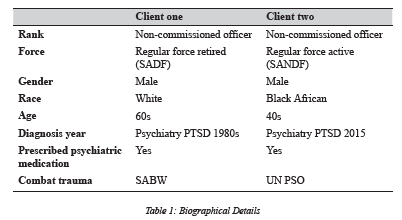
Following a process through the SAMHS Research Ethics Committee and Defence Intelligence, the following information was authorised for release:
During the study, both clients were active psychiatric patients at a military hospital, which forms part of the SAMHS. Both clients were diagnosed with combat-related PTSD at the psychiatric clinic and both presented with active post-traumatic symptoms. These clients were referred by the psychiatric clinic for psychological assistance to an Area Military Health Unit in 2022. The clients subsequently started a therapeutic process with a clinical psychologist in a therapeutic, military context. Client 1 was a military veteran serving in the SADF and taking part in the Border Wars during the 1980s, where he was directly involved in combat and observed war atrocities. He was diagnosed with combat-related PTSD and placed on psychiatric medication after his return from active duty. Client 2 was an active SANDF regular force member who participated in a UN PSO in Africa and was exposed to direct contact with rebel forces. This client was diagnosed with combat-related PTSD in 2015, and placed on psychiatric medication upon his return from the mission area and peacekeeping duties. The process set out in the methodology was followed during the therapy sessions of each case, and additional information and progress are described below.
Step 1: Person-Centred Therapy
Person-centred therapy was the starting point for both clients in the first session, which set the foundation to complete an IPA and formulate the cases through the GST meta-theory. The IPA indicated that the combat-related PTSD of both clients was maintained and perpetuated by ineffective interactional patterns in the family system, specifically linked to the variables of isolation and a lack of control. Both clients presented patterns of self-isolation. Client 1 isolated by physically and emotionally distancing from his family system and broader community. He negated his trauma effects and withdrew from the world to such an extent that he avoided crowded spaces or social gatherings, reinforcing his levels of isolation. Client 2 isolated through self-criticism and self-judgement, reinforcing his levels of shame and guilt. This created low levels of self-esteem and a subjective experience of being worthless, also withdrawing from his family system and his community. Both clients negated any empathy related to the combat trauma, and would respond with immediate withdrawal and self-isolation from the trauma content. A new destructive pattern of interaction and norm was then created, where the family system eventually stopped giving empathy and accepted that the trauma injury is off limits. With the emotional distance in their relationships, the clients could not vent their trauma effects, which maintained their emotional distress and avoidance behaviour.
In addition to the self-isolation, avoidance and disengagement from their environment, both clients also presented with loss of control. Client 1 presented with an external LOC and was overwhelmed by and struggled to negotiate with his environmental demands. This elicited ineffective assertion of his needs through anger, which only prompted rejection, reinforcing his disengagement from the world. Client 2 defined himself in a one-down powerless position and negated his own needs. Through his external LOC, he was also overwhelmed by his environmental demands, reinforcing his self-isolation. Both clients consequently had a subjective experience of being powerless and immobilised in responding to their intrusive memories, thoughts and feelings, as well as trauma cues from the environment. The isolation and lack of control symptomatic behaviour subsequently became rule-bound. The new systemic rules were destructive but maintained and perpetuated the isolation and lack of control by both the clients and their family systems. The function of the symptomatic behaviour was to protect the clients but paradoxically maintained their distress. The IPA thus identified the nodal point of control and isolation as variables that required change.
Person-centred therapy allowed the therapist to develop congruent, empathic and unconditional therapeutic relationships characterised by strong emotional closeness and trust with both clients. In both cases, this was the first time since their trauma event that they could share their horrific combat experiences and related emotional consequences of anger, fear, guilt and powerlessness in such a vulnerable and safe therapeutic environment. The process provided great emotional relief.
Person-centred therapy thus assisted the clients to start breaking their isolation. This created a new norm to share openly and vulnerably, and produced an emotional connection that could function as an emotional outlet in the therapy context. At the same time, changes in the clients' interactional styles could be extended to their family systems. Emotionally engaging with the family system instead of withdrawing from them reduced rejection by the family. This allowed the client to vent and to receive emotional support from the family. Decreased emotional distress also allowed the clients to improve their capacity to deal with their environmental demands and consequently increased their levels of control. The PCT process had an immediate influence on the nodal point of isolation and control and started to change the destructive interactional patterns and norms entrenched in maintaining and perpetuating their combat-related PTSD.
Step 2: Clay Art Therapy
In the second session, CAT was utilised in both cases as a multi-sensory tool to express their combat trauma and emotional effects verbally and non-verbally. Client 1 utilised kneading, pressing, tearing and squashing the clay as non-verbal expression of his combat trauma. During this process, he verbally expressed increased levels of anger and frustration, as well as a subjective experience of his powerlessness, isolation and traumatic pain. As Client 1's verbal expression escalated, his non-verbal expression and intensity in squashing the clay in a fist also increased. Eventually a catharsis point was reached, and he experienced substantial relief. Client 1 was given the clay used in the session, which was now defined as a therapeutic tool for emotional expression, to take home. He continued using the clay when his trauma symptoms increased due to interpersonal or environmental triggers. Engaging with the clay served the function of communicating with his family that he is in distress and allowed them to provide empathy and to connect. Throughout the therapy process, Client 1 reported that using the clay as directed, provided him with increased control over his symptomatic behaviour. It also assisted him with verbal and non-verbal expression of emotional effects, as well as a tool for increasingly sharing and connecting with his family system. Asserting this level of control over his symptomatic behaviour and engagement with his family system was not possible before, and provided great relief.
Client 2 used a different method of engaging with the clay. While verbally sharing his combat trauma, he utilised the clay to re-create and re-enact the trauma scene. Client 2 explained that playing out the trauma scene with the clay provided him with a tool not only to vent his trauma effects, but also to give contextual non-verbal expression of his subjective pain and turmoil. The client thus developed a skill for engagement rather than avoidance and distancing. Creating the scene and being able to manipulate his clay representation also allowed the client meta-control over the combat trauma scene. The clay was again defined as a therapeutic tool for verbal and non-verbal expression. Client 2 also took the clay home and used it as a venting tool in the face of trauma symptoms and interpersonal or environmental triggers. Client 2 used his clay re-enactment to give context to and to share his subjective trauma effects with his family system. The clay thus gave him a voice and method to express his internal distress, which significantly broke his isolation and facilitated emotional relief. The meta-control obtained through manipulating the trauma scene further provided increased control over his general environment and symptomatic behaviour.
Step 3: Self-Distancing through Guided Imagery
During the third session, the self-distancing technique was applied through a therapist-led guided imagery process for the identified hotspots of both clients. Self-distancing allowed the clients to reframe, redefine and re-evaluate their behaviour during the combat trauma incident.156 Client 1 recreated a subjective experience of being powerless and immobilised during the combat scene with elements of guilt in letting down his unit during an attack. Client 2 recreated a combat scene with a subjective experience of shame, guilt and self-criticism, and subsequently being ineffectual and worthless as a soldier. This internalised view served as a large part of his self-identification that maintained and perpetuated his post-traumatic symptomatic behaviour. The self-distancing technique allowed both clients to reframe their subjective experience of the specified trauma scene. Both clients could observe from a third-person perspective their behaviour as effective as possible in impossible circumstances. This highlighted where they applied effective skills, adaptive behaviour and, importantly, why they chose certain actions in a specific context. Client 1, for example, observed where he took effective control and how his behaviour and decisions saved lives. Client 2 observed his bravery and courage in the combat situation, highlighting his worth as a soldier. This reframing provided both clients with great relief and a significant reframing in self-perception, which held them hostage to their post-traumatic symptomatic behaviour. The ability of the therapist to narrate and guide the trauma scene also reinforced deep levels of empathy and understanding beyond empathic listening.
Step 4: Guided Imagery
During the fourth session, the process of guided imagery and imagery re-scripting was utilised, fading the hotspots of the intrusive memories until it became powerless. The process was applied to both cases as set out in the method discussed above. Client 1 reported that he had a long history of experiencing nightmares and flashbacks related to the hotspot every night at a specific time, and that he would wake up with a subjective experience of fear and dread as he relived the trauma scene. His intrusive memories have thus become a crystallised pattern. Client 2 also experienced a pattern of flashbacks and nightmares, although not as frequent as Client 1, with a similar subjective response. After the hotspot had been blurred out, Client 1 reported an interesting phenomenon. He explained that he still experienced the process of the flashbacks and nightmares every night, as it was a crystallised pattern. The intrusive image was however blurred and faded with no emotional consequences. The hotspot or trauma scene had lost all its power and became irrelevant. As it lost its function, the symptomatic behaviour was no longer required, and Client 1 experienced no disruption during sleep after a short while. Client 2 reported a significant decrease in intrusive memories, although some trauma effects of the flashbacks and nightmares remained. Client 2 however used the imagined TV remote to gain control over any intrusive memory. This elicited a subjective experience of control, negating the influence of the intrusive memories. Both clients thus regained control and generalised this control over their broader environment.
Step 5: Corrective Emotional Experience
In session four, a corrective emotional experience was required as the last step for both clients. For Client 1, image re-scripting was utilised to embed a new image in place of the previously imposed trauma image. An image where the client had a subjective experience of control, safety, relaxation and calmness was requested, and this was created by using guided imagery. The image was discussed and co-created with the client to ensure that it aligned with his needs and was already established in his long-term memory for ease of access. The image provided showed the client relaxing at home on his garden bench in the shade of a large tree, reading a book on a warm summer's day. This image was embedded, and served as a corrective emotional experience to the trauma image, and created significant levels of control, safety, security and a sense of calm for the client, which he had not experienced since his combat trauma.
For Client 2, the most important aspect requiring a corrective emotional experience was his subjective experience and image of being ineffectual, powerless and worthless as a soldier who did not fulfil his duty during the mission. Again, the image chosen and created was in collaboration with the client to ensure it aligned with his needs. By applying guided imagery and image re-scripting, the now familiar image in step four of the client's TV room was used. This image was chosen, as it elicited a subjective experience of control, safety and a shared connection with his family system. The image was re-scripted to one where the client hanged a portrait of himself, in uniform on a PSO, in his TV room. In the image, he explains to his children and family how brave and courageous he was as a soldier on the battlefield. This served as an effective corrective emotional experience to the client. When Client 2 perceived himself as a soldier, he now did so with pride and social engagement, instead of shame and self-criticism. The process of both clients was reinforced not only through imagery, but also through real-life application, which strengthened the corrective emotional experience.
Discussion
This research article presented a discussion of two case studies of a short-term intervention strategy for combat-related PTSD within the SANDF context. The GST meta-theory was used in collaboration with the IPA to allow for the unique formulation of PTSD and its subsequent function of symptomatic behaviour. Punctuation within the GST meta-theory allows for the logical utilisation of integrated intervention strategies as presented in the therapeutic process.157 The core variables identified through the IPA were "lack of control" and "isolation", which maintained and aggravated the post-trauma symptomatic behaviour.158 Studies pertaining to combat-related PTSD in military veterans further highlight the variables of "control"159 and "isolation" as perpetuating factors.160 The intervention strategy of five sequenced steps comprising PCT, CAT, self-distancing, guided imagery, and creating a corrective emotional experience was subsequently developed to address the core variables. The intervention strategy served multiple functions. First, it broke down the client's isolation and helped to develop an increased internal locus of control. Second, it assisted the client to vent trauma effects, which decreased avoidance not only verbally,161 but also through non-verbal expression.162 Next, the process aided the clients to reframe the trauma effect in an adaptive way,163 and blurred out the trauma hotspot to negate its influence completely. Finally, a corrective emotional experience was facilitated. This process addressed the nodal point and made the function of the PTSD symptomatic behaviour immaterial, creating a new adaptive homeostasis in the family system.
The strength of the intervention strategy was that it was completed successfully over four sessions and specifically addressed combat-related PTSD through a full therapeutic course. This was in comparison to front-line PTSD treatments,164 such as prolonged exposure therapy (nine to twelve sessions),165 cognitive processing therapy (twelve sessions)166 and eye-movement desensitisation and reprocessing (EMDR). Research in terms of EMDR proposes three to six sessions for single-incident trauma and up to twelve sessions for multiple combat traumas.167 The case studies were completed across a four- to six-week period, dependent on client availability. Additionally, two therapeutic follow-ups were completed after three and six months. After concluding the intervention strategy, clinical records were compared, and functioning on relevant IPA variables was re-evaluated to assess therapeutic progress. It became evident that both clients presented a significant decrease in post-trauma symptomatic behaviour, to the point where no further therapeutic input or psychiatric medication was required. This progress was maintained after their third and final follow-up after a one-year period.
In GST, an individual does not function in isolation but, for example, forms part of a family system. Change in one part of the family system will thus elicit change in the total family system through circular feedback loops.168 Within the therapeutic process, effective change in the client's interactional style will thus change the impact on the family system, and create a more adaptive environment. Consequently, in the therapy process, PCT allowed the clients to self-actualise and break their isolation, not only in terms of their interaction with the therapist, but also in interaction with their core family system. This allowed them to re-engage with their family and to vent their trauma effect congruently and vulnerably, consequently creating emotionally close relationships and reforming support structures.
The CAT allowed non-verbal trauma expression. The clients took the clay home, which allowed for non-verbal emotional expression when verbal expression was ineffective. Engaging with the clay became a tool to create control over an object representing their combat trauma. Interacting with the clay also provided a visual representation of the client's emotional distress and allowed the family system to connect and offer emotional support, further breaking their isolation. These steps negated avoidance symptoms and allowed the clients to deal actively with trauma effects. The self-distancing technique further assisted the clients to reframe their behaviour during the trauma event, and specifically resolved any guilt or shame. Negating self-criticism and personal rebuke allowed the clients to provide empathy and confirmation for themselves, and was another step away from avoidance behaviour towards interpersonal connection and control. Moreover, in the guided imagery process, the client's trauma hotspot was re-scripted and blurred out to the point where the intrusive memories became powerless. When the clients experienced flashbacks as a continued conditioned response, only a blurred image with no emotional influences was presented. The guided imagery process also provided control over intrusive memories, negating its influence.
In the last step, when a memory is blurred out, it must be replaced with an adaptive scene. This is where the corrective emotional experience created an effective adaptive scene, based on the client's personal needs. A new effective pattern of interaction was created with an adaptive homeostasis perpetuated by the family system. The clients reported a significant improvement in their quality of life, and they could complete activities that previously seemed impossible, such as going into noisy crowded spaces, using underground parking, and engaging socially.
It is noteworthy to consider the important differences in age, race, length of diagnosis and, especially, the variance between trauma effects of a military veteran engaging in war, compared to an SANDF regular force peacekeeper in a PSO. The significance is that these variances become immaterial if the nodal points of isolation and a lack of control are identified to maintain and perpetuate the PTSD symptoms. The identified intervention strategy can then be used effectively to resolve combat-related PTSD symptomatic behaviour in a short time. The GST meta-theory framework, in collaboration with the IPA, also allows the intervention process to be replicated easily.
Suggestions for further research are, first, to replicate the current study with a bigger and more uniform sample to create a standardised process. This includes forming specified inclusion and exclusion criteria and a control group to ensure validity. Second, the intervention strategy can be streamlined, and the sessions can potentially be completed over a shorter period. The goal of the current research was to create an effective, standardised short-term intervention strategy for operational use in the SANDF. If this is achieved, significant relief can be brought to military veterans and active soldiers diagnosed with combat-related PTSD.
Limitations
The limitation of this research was that the therapist was dealing with a random sample of clients, based on referrals received from psychiatry within a specific time frame. This led to the explorative nature of this qualitative study with the sample at hand and allowed for the variance in the cases presented. Future research would require more directive inclusion and exclusion criteria for specific case parameters, as well as a bigger and more uniform sample that would also allow for a control group. This would allow the therapist to refine the reviewed intervention strategy.
Policy Implications
The SANDF and the Department of Military Veterans place great value on identifying and providing multi-professional support to military veterans and active SANDF soldiers diagnosed with combat-related PTSD. The therapeutic method in the current study can be a starting point to inform SAMHS policy in order to create an effective, standardised and contextualised short-term intervention strategy for combat-related PTSD. A standardised process for mental health care further allows the SAMHS to train psychologists in a homogenous process that can be easily replicated and applied with limited resources in various military contexts. This process thus has implications to maintain psychologically healthy and prepare combat-ready soldiers.
Conclusion
The outlined therapeutic intervention strategy highlighted a short-term process of four sessions to resolve combat-related PTSD in military veterans and active SANDF soldiers effectively. The intervention strategy of five sequenced steps comprising PCT, CAT, self-distancing, guided imagery and a corrective emotional experience was subsequently developed to address the core variables of control and isolation. This process however still needs to be researched further to ensure a standardised intervention strategy.
Endnotes
* Dale Haarhoff is a clinical psychologist in the South-African Military Health Services (SAMHS) and has worked at Area Military Health Unit Gauteng Psychology Department since 2012. He has served as an operational psychologist in the SAMHS for more than 10 years, which includes completing a United Nations Peace Support Operation to Sudan and participating in numerous military exercises. His interest involves dealing with severe PTSD and combat-related trauma of military veterans and personnel. In addition, he functions as a trainer and mentor in the Military Psychology Internships and as a psychotherapist for a wide variety of presenting complaints for military members and their families.
i Keeney explains that punctuating is a process to delineate arbitrary points of sequencing within a system to create distinctions about how certain variables are understood and interpreted. In a family system, one can thus punctuate on the interaction between family members, or the individual within the system, or the internal functioning of the individual, depending on the aim.
ii Jackson describes how information is fed back into a system through feedback loops. Negative feedback loops maintain stability and negate deviation from the homeostasis (e.g. maintain family rules). Alternatively, positive feedback loops amplify change with loss of stability and homeostasis (e.g. change family rules).
iii The WTIM was developed by Prof. Gillian Eagle, Dr Merle Friedman and Prof. Diana Shmukler as an integrative approach in short-term treatment of psychological trauma in the SA context. Prof. Eagle (Department of Psychology, University of Witwatersrand, South Africa) formalised this approach with her article in 2000.
References
- 1 JV Denson, A Century of War: Lincoln, Wilson & Roosevelt (Alabama: Ludwig Von Mises Institute, 2006), 17.
- 2 United Nations, 'UN75 2020 and Beyond: A New Era of Conflict and Violence', United Nations Digital Library, 2020. <https://digitallibrary.un.org/record/3898923> [Accessed on 10 April 2024].
- 4 A Wessels, 'Half a Century of South African "Border War" Literature: A Historiographical Exploration', Southern Journal of Contemporary History, 42, 2 (2017), 24-47.
5 Section 1,3 of the Military Veterans Act (No. 18 of 2011), 2 December 2011, Government Gazette, 34819, 558, 5 December 2011.
6 Stapleton, A Military History ofSouth Africa, 193.
7 G Martin, 'SANDF Peacekeeping Efforts Continue in Africa', defenceWeb, 24 April 2019. <http://www.defenceweb.co.za/joint/diplomacy-a-peace/sandf-peacekeeping-efforts-continue-in-africa/> [Accessed on 10 April 2024].
8 M Svicevic & R Teixeira, 'Feature: SADC's Withdrawal from Mozambique: Has SAMIM Fulfilled its Mandate?', defenceWeb, 3 May 2024. <https://defenceweb.co.za/african-news/feature-sadcs-withdrawal-from-mozambique-has-samim-fulfilled-its-mandate/> [Accessed on 10 February 2026].
9 MA Connell, O Omole, U Subramaney & S Olorunju, 'Post Traumatic Stress Disorder and Resilience in Veterans Who Served in the South African Border War', African Journal of Psychiatry, 16, 6 (2013), 441-446.
10 S Seedat, C le Roux & DJ Stein, 'Prevalence and Characteristics of Trauma and Post-Traumatic Stress Symptoms in Operational Members of the South African National Defence Force', Military Medicine, 168, 1 (2003), 71-75.
11 DS Paulson & S Krippner, Haunted by Combat: Understanding PTSD in War Veterans Including Woman, Reservists and Those Coming Back from Iraq (London: Praeger Security International, 2007), 1.
12 AV Horwitz, A Short History of PTSD (Baltimore: John Hopkins University Press, 2018), 21, 28, 34.
13 E Jones & S Wessely, Shell Shock to PTSD: Military Psychiatry from 1900 to the Gulf War (New York: Psychology Press Taylor & Francis Group, 2005), 17-18.
14 Horwitz, A Short History of PTSD, 1, 68, 70.
15 C North, AM Suris, RP Smith & RV King, 'The Evolution of PTSD Criteria Across Editions of DSM', Annals of Clinical Psychiatry, 28, 3 (2016), 197-208.
16 American Psychiatric Association (hereafter APA) (ed.), Diagnostic and Statistical Manual of Mental Disorders (5th ed., text revision) (hereafter DSM-5-TR) (Washington, DC: American Psychiatric Association Publishing, 2022), 301.
17 APA, DSM-5-TR, 305.
18 APA, DSM-5-TR, 306.
19 SS Weaver, EB Kroska, MC Ross, A Sartin-Tarm, KA Selnow, K Schaumberg, KA Kiehl, M Koenig & JM Cisler, 'Sacrificing Reward to Avoid Threat: Characterising PTSD in the Context of a Trauma-Related Approach-Avoidance Conflict Task', Journal of Abnormal Psychology, 129, 5 (2020), 45 7-468.
20 APA, DSM-5-TR, 307.
21 D Horesh, SR Lowe, S Galea, AE Aiello, M Uddin & KC Koenen, 'An In-Depth look into PTSD-Depression Comorbidity: A Longitudinal Study of Chronically Exposed Detroit Residents', Journal of Affective Disorders, 208 (2017), 653-661.
22 E Compean & M Hamner, 'Posttraumatic Stress Disorder with Secondary Psychotic Features (PTSD-SP): Diagnostic and Treatment Challenges', Progress inNeuropsychopharmacology & Biological Psychiatry, 88 (2019), 265-275.
23 APA, DSM-5-TR, 308.
24 C Xue, Y Ge, B Tang, Y Liu, P Kang, M Wang & L Zhang, 'A Meta-Analysis of Risk Factors for Combat-Related PTSD Among Military Personnel and Veterans', Public Library of Science Journal, 10, 3 (2015), e0120270.
25 K Robjant, S Schmitt, A Chibasimba, S Carleial, T Elbert & A Koebach, 'Trauma, Aggression, and Post-conflict Perpetration of Community Violence in Female Former Child Soldiers: A Study in Eastern DR Congo', Frontiers in Psychiatry, 11, 533357 (2020), 1-10.
26 A Bleich & Y Melamed, 'Post-Traumatic Emotional Damage and Impairment Following Military Service', Journal of Medicine and Law, 37 (2007), 37-44, cited in I Keynan, Psychological War Trauma and Society: Like a Hidden Wound (New York: Routledge: Taylor & Francis Group, 2012), 5.
27 Keynan, Psychological War Trauma and Society, 5.
28 WF McDermot, Understanding Combat-related Post-traumatic Stress Disorder (London: McFarland, 2012), 5.
29 C Hitch, P Toner & C Armour, 'Enablers and Barriers to Military Veterans Seeking Help for Mental Health and Alcohol Difficulties: A Systematic Review of the Quantitative Evidence', Journal of Health Services Research & Policy, 28, 2 (2023), 197-211.
30 Paulsen & Krippner, Haunted by Combat, 44, 45, 48.
31 KH Seal, G Cohen, A Waldrop, BR Cohen, S Maguen & L Ren, 'Substance Use Disorders in Iraq and Afghanistan Veterans in VA Healthcare 2001-2010: Implications for Screening, Diagnosis and Treatment', Drug Alcohol and Dependence, 116, 1-3 (2011), 93-101.
32 JY Stein, 'The Veteran's Loneliness: Emergence, Facets and Implications for Intervention', in L Rudolf (ed.), Psychology of Loneliness: Psychology of Emotions, Motivations and Actions (New York, Nova Science, 2017), 1-36.
33 A Demers, 'When Veterans Return: The Role of Community in Reintegration', Journal of Loss and Trauma, 16, 2 (2011), 160-179.
34 LA Palinkas, 'Long-Term Trajectories and Service Needs for Military Families', Clinical Child and Family Psychology Review, 16, 4 (2013), 376-393.
35 VA Stander, CJ Thomsen & RM Highfill-McRoy, 'Etiology of Depression Comorbidity in Combat-Related PTSD: A Review of the Literature', Clinical Psychology Review, 34, 2 (2024), 87-98.
36 CR Brewin, R Garnett & B Andrews, 'Trauma, Identity and Mental Health in UK Military Veterans', Psychological Medical, 41, 8 (2011), 1733-1740.
37 Keynan, Psychological War Trauma and Society, 167, 175.
38 M Singer, 'Shame, Guilt, Self-Hatred and Remorse in the Psychotherapy of Vietnam Combat Veterans Who Committed Atrocities', The American Journal of Psychotherapy, 58, 4 (2004), 377-385.
39 APA, DSM-5-TR, 307.
40 McDermot, Understanding Combat-related PTSD, 108.
41 Paulsen & Krippner, Haunted by Combat, 3, 16.
42 MA Connell, Prevalence of Post-traumatic Stress Disorder, and Coping Strategies, Among Former South African National Servicemen (MA Thesis, University of Witwatersrand, 2011), 8-9.
43 Connell et al., 'Post Traumatic Stress Disorder and Resilience in Veterans', 442.
44 G Baines, 'SADF Soldiers' Silences: Institutional, Consensual and Strategic', Acta Academica, 47, 1 (2015), 78-97.
45 Connell et al., 'Post Traumatic Stress Disorder and Resilience in Veterans', 441.
46 RA Kulka, WE Schlenger, JA Fairbank, RL Hough, BK Jordan, CR Marmar & DS Weiss, Contractual Report of Findings from the National Vietnam Veterans Readjustment Study (North Carolina: Research Triangle Institute, 1988), 5-8.
47 CH Hoge, CA Castro, SC Messer, D McGurk, DI Cotting & RL Koffman, 'Combat Duty in Iraq and Afghanistan: Mental Health Problems, and Barriers to Care', The New England Journal of Medicine, 351 (2004), 13-22.
48 Stapleton, A Military History of South Africa, 193.
49 United Nations, 'United Nations Peacekeeping', 2024. <https://peacekeeping.un.org/en/military> [Accessed on 12 April 2024].
50 N di Razza 'Mental Health in UN Peace Operations: Addressing Stress, Trauma and PTSD Among Field Personnel', International Peace Institute, December 2020. <https://www.ipinst.orgwp-content/uploads/2020/12/2012_Mental-Health-in-Peace-Operations.pdf> [Accessed on 1 November 2025].
51 N Visagie, RA du Toit, S Joubert, D Schoeman & D Zungu, 'Comparing Deployment Experiences of South African National Defence Force Personnel During Peace Support Missions: Sudan vs Democratic Republic of Congo', Scientia Militaría: South African Journal of Military Studies, 50, 2 (2022), 127-154.
52 Di Razza, 'Mental Health in UN Peace Support Operations', 1.
53 Seedat et al., 'Prevalence and Characteristics of Trauma', 72.
54 DJA Edwards, 'Treating Post-Traumatic Stress Disorder in South Africa: An Integrative Model Grounded in Case-Based Research', Journal of Psychology in Africa, 19, 2 (2009), 189-198.
55 T Carlton, 'Evidence Integration Review of Multimodal Interventions for PTSD, Social Reintegration, and Economic Stability in Veterans', Journal of Veterans Studies, 11, 2 (2025), 15-27.
56 E Bomyea & AJ Lang, 'Emerging Interventions for PTSD: Future Directions for Clinical Care and Research', Neuropharmacology, 62 (2012), 607-616.
57 C Vorster, General Systems Theory and Psychotherapy: BeyondPost-Modernism (Bloemfontein: Satori, 2003), 110.
58 WF Overton & U Muller, 'Metatheories, Theories, and Concepts in the Study of Development', in RM Lerner, MA Easterbrooks, J Mistry & IB Weiner (eds), Handbook of Psychology: Developmental Psychology (2nd ed.) (New Jersey: Wiley, 2012), 19-58.
59 Vorster, General Systems Theory, 110.
60 HA Simon, 'The Architecture of Complexity', American Philosophical Society, 106, 6 (1962), 467-482.
61 BP Keeney, Aesthetics of Change (New York: Guilford Press, 1983), 28, 31.
62 Vorster, General Systems Theory, 111-115.
63 L von Bertalanffy, General Systems Theory: Foundations, Development, Applications (New York: George Braziller, 1968), 54-55.
64 WD Phipps & C Forster, 'Narrative Therapy: A Return to the Intrapsychic Perspective?', South African Journal of Psychology, 39, 1 (20 09), 32-45.
65 C Vorster, Impact: The Story of Interactional Therapy (Pretoria: Satori, 2011), v.
66 Phipps & Vorster, 'Narrative Therapy', 34.
67 DS Becvar & RJ Becvar, Family Therapy: A Systemic Integration (8th ed.) (Harlow: Pearson Education, 2014), 69.
68 LL Hecker, GA Mims & SR Boughner, 'General Systems Theory, Cybernetics and Family Therapy', in LL Hecker & JL Wetchler (eds), An Introduction to Marriage and Family Therapy (New York: Routledge Taylor & Francis Group, 2013), 39-58.
69 DD Jackson, 'The Individual and the Larger Context', Family Process, 6, 2 (1967), 139-147, cited in C Vorster, General Systems Theory, 6-7.
70 H Goldberg & I Goldberg, Family Therapy: An Overview (8th ed.) (Belmont: Brooks/Cole Cengage Learning, 2013), 20-21.
71 F Heylighen & C Joslyn, 'Cybernetics and Second-Order Cybernetics', in RA Meyers (ed.), Encyclopaedia of Physical Science & Technology (3rd ed.) (New York: Academic Press, 2001), 155-170.
72 Vorster, General Systems Theory, 6, 11.
73 P Watzlawick, JH Beavin & DD Jackson, Pragmatics of Human Communication: A Study of Interactional Patterns, Pathologies and Paradoxes (New York: Norton, 1967), 31.
74 Vorster, General Systems Theory, 11-12.
75 Vorster, Impact, v.
76 K du Plooy, 'The Use of the Interactional Pattern Analysis as a Tool for Effective Short-Term Psychotherapy Among Students at South African Tertiary Institutions', Journal of Counselling and Development in Higher Education Southern Africa, 2, 1 (2014), 27-40.
77 Vorster, General Systems Theory, 101-103.
78 S Nash, 'The Place of Person-Centred Counselling in Humanistic Psychology', in R House, D Kalisch & J Maidman (eds), Humanistic Psychology: Current Trends and Future Prospects (New York Routledge, 2018), 83-106.
79 Vorster, Impact, 85.
80 MA Swart, An Investigation into the Interactional Patterns of English-speaking South African Adults Diagnosed with Post-Traumatic Stress Disorder (MA Thesis, University of Limpopo, 2014), 99-101.
81 L Hancock & RA Bryant, 'Perceived Control and Avoidance in Post-Traumatic Stress', European Journal of Psycho-Traumatology, 9, 1 (2018), 1468708.
82 NB Smith, LM Sippel, C Presseau, D Rozek, N Mota, C Gordon, M Horvath & I Harpaz-Rotem, 'Locus of Control in US Combat Veterans: Unique Associations with Posttraumatic Stress Disorder 5-factor Model Symptom Clusters', Psychiatry Research, 268 (2018), 152-156.; K Karstoft, C Armour, A Elklit & Z Solomon, 'The Role of Locus of Control and Coping Style in Predicting Longitudinal PTSD Trajectories After Combat Exposure', Journal of Anxiety Disorders, 32 (2015), 89-94.
83 Karstoft et al., 'The Role of Locus of Control', 13.
84 Smith et al., 'Locus of Control', 153-154.
85 Swart, An Investigation into the Interactional Patterns, 98.
86 JY Stein & Z Solomon, 'The Lonely Side of War's Aftermath: Traumatization and Isolation Among Veterans', in O Sagan & E Miler (eds), Narratives of Loneliness: Multidisciplinary Perspectives from the 21st Century (London: Routledge, 2018), 1-22; G Wilson-Menzfeld, M Hill & MD Kiernan, 'Loneliness and Social Isolation of Military Veterans: Systematic Narrative Review', Occupational Medicine, 68, 9 (2018), 600-609.
87 MR Masoom, 'Social Isolation: A Conceptual Analysis', Research Journal of Humanities and Social Sciences, 7, 4 (2016), 241-249.
88 J Wang, B Lloyd-Evans, D Giacco, R Forsyth, N Nebo, F Mann & S Johnson, 'Social Isolation in Mental Health: A Conceptual and Methodological Review', Social Psychiatry and Psychiatric Epidemiology: The International Journal for Research in Social and Genetic Epidemiology and Mental Health Services, 52, 12 (2017), 1451-1461.
89 VH Murthy, Our Epidemic of Loneliness and Isolation: The U.S. Surgeon General's Advisory on the Healing Effects of Social Connection and Community, US PHS (2023), 8. <https://www.ncbi.nlm.nih.gov/books/NBK595227/pdf/Bookshelf_NBK595227.pdf> [Accessed on 10 June 2024].
90 J Salinas, AS Beiser, JK Samra, A O'Donnell, CS DeCarli, MM Gonzales, HJ Aparicio & S Seshadri, 'Association of Loneliness with 10-year Dementia Risk and Early Markers of Vulnerability for Neurocognitive Decline', Neurology, 98, 13 (2022), 1337-1348.
91 F Mann, J Wang, E Pearce, R Ma, M Schlief, B Lloyd-Evans, S Ikhtabi & S Johnson, 'Loneliness and the Onset of New Mental Health Problems in the General Population', Social Psychiatry and Psychiatric Epidemiology, 57 (2022), 2161-2178.
92 C Motillon-Toudic, M Walter, M Séguin, J Carrier, S Berrouiguet & C Lemey, 'Social Isolation and Suicide Risk: Literature Review and Perspectives', European Psychiatry, 65, 1 (2022), 1-22.
93 Stein, 'The Veteran's Loneliness', 12-13.
94 Demers, 'When Veterans Return', 171-173.
95 Swart, An Investigation into the Interactional Patterns, 92.
96 Vorster, Impact, 85, 96.
97 G Corey, Theory and Practice of Counselling and Psychotherapy (9th ed.) (Belmont: Brooks/ Cole Cengage Learning, 2013), 174-176.
98 R Rogers, Client-centred Therapy (Boston: Houghton Mifflin, 1951), 497-499.
99 L Seligman & LR Reichenberg, Theories of Counselling and Psychotherapy: Systems, Strategies, and Skills (4th ed.) (New Jersey: Pearson Education, 2013), 149.
100 R Rogers, A Way ofBeing (Boston: Houghton Mifflin, 1980), 115-117.
101 Corey, Theory and Practice of Counselling, 180.
102 Rogers, A Way ofBeing, 115-117.
103 J Decety & A Fotoppoulou, 'Why Empathy has a Beneficial Impact on Others in Medicine: Unifying Theories', Frontiers in Behavioural Neuroscience, 8, 457 (2015), 1-11.
104 S Weilenmann, U Schnyder, B Parkinson, C Corda, R von Känel & M Pfaltz, 'Emotion Transfer, Emotion Regulation, and Empathy-Related Processes in Physician-Patient Interactions and Their Association with Physician Well-Being: A Theoretical Model', Frontiers in Psychiatry, 9, 189 (2018), 1-18.
105 MC Witty, 'Client-Centred Therapy', in N Kazantis & L L'Abate (eds), Handbook of Homework Assignments in Psychotherapy: Research, Practice, Prevention (New York: Springer Science & Business Media, 2007), 35-50.
106 Corey, Theory and Practice of Counselling, 180-181.
107 MJ Lambert & DE Barley, 'Research Summary of the Therapeutic Relationship and Psychotherapy Outcome', Psychotherapy: Theory, Research, Practice, Training, 38, 4 (2001), 357-361.
108 T Hu, X Zheng & M Huang, 'Absence and Presence of Human Interaction: The Relationship Between Loneliness and Empathy', Frontiers in Psychology, 11, 768 (2020), 1-11.
109 S Iwakabe, K Rogan & A Stalikas, 'The Relationship Between Client Emotional Expressions, Therapist Interventions, and the Working Alliance: An Exploration of Eight Emotional Expression Events', Journal of Psychotherapy Integration, 10, 4 (2000), 375-401.
110 Rogers, A Way of Being, 43-14.
111 GT Eagle, 'The Shattering of the Stimulus Barrier: The Case for an Integrative Approach in Short-Term Treatment of Psychological Trauma', Journal of Psychotherapy Integration, 10, 3 (2000), 301-323.
112 M Bean, A Multiple Case Study Exploration of the Implementation of the WITS Integrative Trauma Counselling Model (MA Thesis, University of Witwatersrand, 2008), 24.
113 Vorster, General Systems Theory, 101-103.
114 JKM Nan & WWT Wong, 'A Qualitative Analysis of a Clay Art Therapy Project in Enhancing Emotion Regulation Among Secondary School Youth in the Context of Socio-Political Unrest', Journal of Clinical and Developmental Psychology, 3, 1 (2021), 27-44.
115 M Sholt & T Gavron, 'Therapeutic Qualities of Clay-Work in Art Therapy and Psychotherapy: A Review', Art Therapy: Journal of the American Art Therapy Association, 23, 2 (2006), 66-72.
116 K Collie, A Backos, C Malchiodi & D Spiegel, 'Art Therapy for Combat-related PTSD: Recommendations for Research and Practice', Art Therapy: Journal of the American Art Therapy Association, 23, 4 (2006), 157-164.
117 D Avrahami, 'Visual Art Therapy's Unique Contribution in the Treatment of Post-Traumatic Stress Disorders', Journal of Trauma & Dissociation, 6, 4 (2005), 5-38.
118 Sholt & Gavron, 'Therapeutic Qualities', 67.
119 Nan & Wong, 'A Qualitative Analysis', 30.
120 E Kross & O Ayduk, 'Self-distancing: Theory, Research and Current Directions', in JM Olsen (ed.), Advances in Experimental Social Psychology (Vol. 55) (London: Academic Press, 2017), 81-136.
121 O Ayduk & E Kross, 'From a Distance: Implications of Spontaneous Self-Distancing for Adaptive Self-Reflection', Journal of Personality and Social Psychology, 98, 5 (2010), 809-829.
122 E Kross, O Ayduk & W Mischel, 'When Asking "Why" Does not Hurt: Distinguishing Rumination from Reflective Processing of Negative Emotions', Psychological Science, 16, 9 (2005), 709-715.
123 Kross & Ayduk, 'Self-distancing', 97.
124 DJA Edwards, 'Cognitive Restructuring Through Guided Imagery: Lesson from Gestalt', in A Freeman, KM Simmons, LE Beutler & H Arkowitz (eds), Comprehensive Handbook of Cognitive Therapy (New York: Plenum Press, 1989), 283-297.
125 N Grey & EA Holmes, '"Hotspots" in Trauma Memories in the Treatment of Post-Traumatic Stress Disorder: A Replication', Memory, 16, 7 (2008), 788-796.
126 P Marudhar & M Bano, 'Guided Imagery Technique', International Journal for Research Trends and Innovation, 4, 5 (2019), 46-50.
127 Kross & Ayduk, 'Self-distancing', 85.
128 DG Pearson, 'Mental Imagery and Creative Thought', in I Roth (ed.), Imaginative Minds (London: Proceedings of the British Academy, 2007), 187-212.
129 J Pearson, 'The Human Imagination: The Cognitive Neuroscience of Visual Mental Imagery', Nature Reviews Neuroscience, 20, 10 (2019), 624-634.
130 IA Clark & CE Mackay, 'Mental Imagery and Post-Traumatic Stress Disorder: A Neuroimaging and Experimental Psychopathology Approach to Intrusive Memories of Trauma', Frontiers in Psychiatry, 6, 104 (2015), 1-12.
131 CR Brewin, 'Coherence, Disorganization and Fragmentation in Traumatic Memory Reconsideration: A Response to Rubin et al.', Journal of Abnormal Psychology, 125, 7 (2016), 1011-1017.
132 Brewin, 'Coherence, Disorganization and Fragmentation', 15-16.
133 Grey & Holmes, '"Hotspots"', 1.
134 JM Hoppe, 'Emotional Mental Imagery and the Reduction of Fear Within the Mind's Eye (PhD Thesis, Uppsala University, 2021), 50-52.
135 Hoppe, Emotional Mental Imagery, 13.
136 CP McLean & EB Foa, 'Prolonged Exposure Therapy for Post-Traumatic Stress Disorder: A Review of Evidence and Dissemination', Expert Review of Neurotherapeutics, 11, 8 (2011), 1151-1163.
137 A Arntz, 'Imagery Rescripting as a Therapeutic Technique: Review of Clinical Trials, Basic Studies, and Research Agenda', Journal of Experimental Psychopathology, 3, 2 (2012), 189-208.
138 JL Straus, P Calhoun & CE Marx, 'Guided Imagery as a Therapeutic Tool in Post-Traumatic Stress Disorder', in PJ Shiromani, TM Keane & JE LeDoux (eds), Post-Traumatic Stress Disorder: Basic Science and Clinical Practice (New York: Humana Press, 2009), 363-373.
139 R van der Wijngaart, Imagery Rescripting: Theory and Practice (West-Sussex: Pavilion, 2021), 10.
140 N Morina, J Lancee & A Arntz, 'Imagery Rescripting as a Clinical Intervention for Aversive Memories: A Meta-Analysis', Journal of Behaviour Therapy and Experimental Psychiatry, 55 (2017), 6-15.
141 Arntz, 'Imagery Rescripting as a Therapeutic Technique', 197-198.
142 F Visco-Comandini, C Papa, A Uvelli, F Mancini & E Pugliese, 'Rewriting Trauma: A Systematic Review of Treatment Effects of Imagery Rescripting for PTSD and Complex PTSD', European Journal of Trauma & Dissociation, 9, 4 (2025), 100609.
143 Pearson, 'The Human Imagination', 6.
144 A Arntz, 'Imagery Rescripting: An Update of the Treatment Protocol', Behaviour, Research and Therapy, 195 (2025), 104913.
145 R Dai, J Kim, H Choi, Y Shin, B Kim, S Kim, K Kim & JS Kim, 'Evaluation of Virtual Reality-Based Guided Imagery Stabilization Intervention for Post-Traumatic Stress Symptoms: A Randomized Controlled Trial', Virtual Reality, 29, 151 (2025), 1-15.
146 A de Wet (clinical psychologist), Supervision Notes, Pretoria, 10 August 2022.
147 R Gray, 'PTSD Extinction, Reconsolidation and Visual-kinesthetic Dissociation Protocol', Traumatology, 18, 2 (2012), 3-16.
148 Gray, 'PTSD Extinction and Reconsolidation', 10.
149 Pearson, 'The Human Imagination', 6.
150 JA Rattel, S Danbock, SF Miedl, M Liedlgruber & FH Wilhelm, 'Hitting the Rewind Button: Imagining Analogue Trauma Memories in Reverse Reduces Distressing Intrusions', Cognitive Therapy and Research, 48 (2024), 932-943.
151 Visco-Comandini et al., 'Rewriting Trauma', 2.
152 Hoppe, Emotional Mental Imagery, 53.
153 B Naparstek, Invisible Heroes: Survivors of Trauma and How They Heal (New York.: Bantam Dell, 2004), cited in L Langstraat, Post-Traumatic Stress Disorder and the Benefits of Guided Mental Imagery in Treatment (MA Thesis, University of Northern Iowa, 2006), 36, Scholar Works Graduate Paper 1077.
154 Hoppe, Emotional Mental Imagery, 53.
155 M Bridges, 'Activating the Corrective Emotional Experience', Journal of Clinical Psychology: In Session, 62, 5 (2006), 551-568.
156 Kross & Ayduk, 'Self-distancing', 85.
157 Vorster, General Systems Theory, 100, 116.
158 Swart, An Investigation into the Interactional Patterns, 99-101.
159 Smith et al., 'Locus of Control', 154.
160 Wilson-Menzfeld et al., 'Loneliness and Social Isolation', 607-608.
161 S Joseph, 'A Person-Centred Perspective on Working with People Who Have Experienced Psychological Trauma and Helping Them to Move Forward to Post-traumatic Growth', Person-Centred & Experiential Psychotherapies, 14, 3 (2015), 178-190.
162 Sholt & Gavron, 'Therapeutic Qualities', 70.
163 Kross & Ayduk, 'Self-distancing', 85.
164 JT Goodson, W Ponder, J Carbajal & CF Cassiello-Robbins, 'Combat Veteran Mental Health Outcomes after Short-term Intervention Counselling Services', Journal of Veteran Studies, 11, 1 (2025), 129-141.
165 M Yoder, PW Tuerk, M Price, AL Grubaugh, M Strachan, H Myrick & R Acierno, 'Prolonged Exposure Therapy for Combat-Related Posttraumatic Stress Disorder: Comparing Outcomes for Veterans of Different Wars', Psychological Services, 9, 1 (2012), 16-25.
166 PA Resick, CM Monson & KM Chard, Cognitive Processing Therapy Veteran/Military Version: Therapist Manual (Washington, DC, Department of Veterans Affairs, 2008), 25.
167 EC Hurley, 'Effective Treatment of Veterans with PTSD: Comparison Between Intensive Daily and Weekly EMDR Approaches', Frontiers in Psychology, 9, 1458 (2018), 1-10.
168 Hecker et al., 'General Systems Theory', 46.