How Environmental Factors Affected Escaped Allied Prisoners of War in the Abruzzo and Molise Regions, Italy, 1943
Abstract
The current study centred on the journey of a party of three Allied prisoners of war (two New Zealanders and one South African), who escaped from the Prigione di Guerra (PG)78/1 camp (henceforth referred to as PG78/1) at Acquafredda near Roccamorice. In this article, the researcher discusses the environmental conditions they faced on their epic journey to British lines near Campobasso. In particular, the bioclimatological factor was examined, as well as other factors, such as river depth, animal presence, and terrain. The literature review employed for the current study comprised memoirs by escaped prisoners of war, popular histories, and recent studies by South African scholars. A mixed-method methodology was adopted, as meteorological data were obtained from the Italian Meteorological Service (Agenzia ItaliaMeteo, henceforth referred to as "ItaliaMeteo"), from enquiries made to a number of organisations, and during a fieldtrip conducted in the Abruzzo and Molise areas of Italy. The meteorological data provided were excellent; indeed, the study stands by these data. River depth and wildlife were not judged to be major impediments. Enquiries to organisations yielded excellent information, and the fieldtrip provided outstanding context and understanding. It was concluded that the escapees were very fortunate with the timing of the Italian surrender in terms of weather extremes as well as the fact that the local people, the Abruzzesi, went out of their way - at great risk to themselves - to assist the escapees.
Prisoners of War; Italy; Second World War; Bioclimatology; Environmental Factors; Maiella
Introduction
On the eve of the Italian armistice in early September 1943, the prisoners of war (POWs) interned at Acquafredda (PG78/1), when instructed by their Italian captors to march to the main camp at Sulmona (PG78), instead rebelled, and made a run for it into the mountains. One of those POWs was the author's father, Private George Edward Heath. His war record states that he was a POW from 20 June 1942 until 19 October 1943.2Heath then escaped together with two New Zealanders (their identities are unknown, and it is not known where exactly they were captured). In the letter, Heath wrote to the Award Publications Ltd in Surrey (applying for the unofficial Prisoner of War Medal), he stated that he was in the Sulmona subsidiary camp, which was occupied mainly by Australians. In the application form, he writes, 'Escaped from St Margerita October 1943. Met patrol Green Howards at Termoli.'3 In reality, he escaped from Acquafredda, the only subsidiary camp to the Sulmona one,4 and met the Green Howards upriver from Termoli, at a place called Petrella Tifernina.5 The camp at Acquafredda is described in this way by a correspondent on WW2Talk, 'Campo PG 78/1, Aquafredda [sic.], was a work camp 2,000 feet up in the hills north east of Sulmona. It was administered from Campo PG 78 at Sulmona.'6 It appears from the discussion that the camp had 250 New Zealand, 50 South African, and several United Kingdom (UK) prisoners.7 A number of photographs still exist, published by the National Library of New Zealand: one shows the hutments, and another, the main gate, of PG78/1 by one HR Dixon.8 These photographs show the dry summer conditions, the beautiful hills around, the threadbare clothes of the POWs, and the double barbed wire fencing around the camp. Mason describes the inmates of the camp as being in a highly favourable location from which to escape, as the camp was isolated from enemy patrols and presence, at the foot of a major mountain range, and had routes to safety southwards.9
While in PG78/1, Heath's group knew that the Allies had landed in the south of Italy and that was where they had to go. While journeying south, the group connected with the Italian partisans (Heath once described to his sons a partisan action in which he took part).10 Gordon Duncan, another New Zealand escapee (not connected with Heath's group), describes a partisan action at Palombaro in early October 1943, 'where a band of Italian patriots had set upon and killed a truck-load of German soldiers'.11 This action would have heightened the enemy presence in the area, especially with regard to taking action against escaping POWs and their helpers. Escaping was an extremely dangerous business: the Sangro River Cemetery 'contains the graves of a number of escaped prisoners of war who died while trying to reach the Allied lines'.12
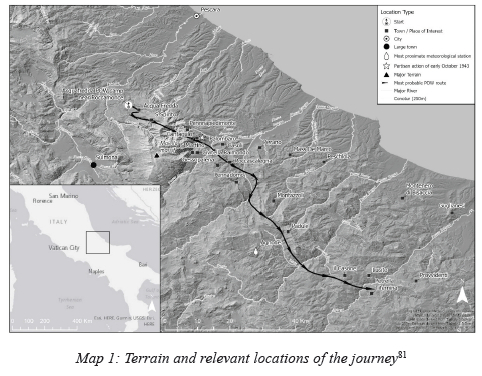
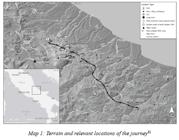
The approximate route the group took from 11 September (after the Italian armistice and capitulation on 8 September 1943) until 19 October 1943, as ascertained from map analysis, is as follows: Acquafredda outside Roccamorice, Passo Lanciano, Pennapiedimonte, Sangro River, Cantagufo, Civitella Raimondo, Gessopalena, Terranova, Pennadomo, Montazzoli, Padule, Trigno River, Trivento, il Casone, Biferno River and Petrella Tifernina (see Map 1).13 This translates to a 75 km straight-line distance (30 cm*2.5 km). Mason writes that New Zealand POWs crossed the Maiella range, to reach Pennapiedimonte and Guardiagrele at its base.14 Finally, on 19 October 1943, Heath's group reached freedom.15For the New Zealanders in Duncan's group who reached Petrella (Tifernina) approximately four days before Heath's group, the route was from Acquafredda to Capolegrotte, to below Palombaro, to Rocca Scalegna, to Bomba, to above Villa Santa Maria, to above Castiglione, to above Salcito, to below Trivento, and to Petrella.16 It is highly probable that this was the route followed by Heath's party too, as this was the route that had proved to be successful and fit to be repeated. As the regimental historian of a British Army regiment17 explains, 'During this period a number of allied prisoners-of-war made their way into the Green Howards lines, as many as seventeen during the course of one night.'18Holland maps the advance of the British XIII Corps (to which the Green Howards would have been attached) across the Biferno between 14 and 27 October 1943.19 Mason writes about significant numbers (50) of New Zealanders from PG78/1 reaching Allied units along the Termoli-Campobasso road in the Biferno valley.20
As far as is known, no study has yet addressed the environmental conditions the POWs faced. Many studies and books deal with the military hazards (for example minefields and other defensive hazards, enemy troops, random artillery shelling) en route to Allied lines but environmental issues are referred to only tangentially.21 The current study was the first that sought to address the environmental conditions from start to finish.
Regarding the historical context of the influence of bioclimatology on escape and evasion in the North African desert (where Heath and his New Zealand fellow escapees had served and where they had been captured), Horn22 relates the immediate experiences of the South Africans after the Tobruk surrender, including the extreme privation they experienced and also some escape attempts in an environment that would kill one if one became lost and ran out of especially water. According to Horn:23
On average, the Tobruk POWs spent five months in North African camps, but this was a long time to live on rumour, hard biscuits and bully beef, and a few POWs decided to escape and take their chances in the desert. Most POWs believed escape would be too dangerous because they did not have sufficient water or food and they were not sure of the local population's loyalties. Failed escapes were also a big deterrent.
Moreover, Kleynhans and Gordon24 write about South African evaders and escapers in the Western Desert of North Africa. While environmental factors were generally tangential to the almost reckless adventure of group escapes, in one case, a South African soldier walked out of a POW camp 'under the cover of a dust-storm'.25 As to be expected in a desert environment, the main challenges were food and water. Kleynhans and Gordon say, 'many South African servicemen chose to set out with insufficient food and water and therefore suffered huge privations during their bids for freedom due to the harsh desert climate and terrain'.26.
The collapse of the Italian fascist regime in July-September 1943 led to the release of thousands of Allied (chiefly British Commonwealth) POWs into the Italian countryside. This has been well documented by authors such as Bosworth, Carver, Deakin, Gooch, Krige, Saunders, Schou and Holland.27 For example, Holland and Duncan write about New Zealand POWs in the mountains outside Pretoro, to the west of Acquafredda, during the last week of September 1943.28 Scherman29 considers the matter from a 2nd South African Infantry Division perspective, and writes,
[W]hen it became known by the prisoners inside Campo No. 78 (Sulmona) that the Germans were planning to move them all northwards into the Third Reich, many of the division's officers decided to try and escape . this sudden desire to escape to prisoner fear. Fear that Germany might continue to resist for years to come or would by some diplomatic manoeuvre with Russia, bring about a peace not so disadvantageous to them.i Additionally, the prisoners believed that the war would ultimately move into Germany itself, nobody wanted to be a prisoner in Germany when it became the main battlefield of the war.
Foot and Langley however write that MI9, the British escape organisation, had issued an order for POWs 'to stay put, to await release; not to attempt to break out of camp, or to assist the Anglo-American air forces in their attacks on the enemy's communications'.30This is corroborated by Krige,31 and by Chutter who was imprisoned at PG21 (Chieti), about 22 km northeast from Acquafredda, who writes, 'Definite orders were received from the War Office that all P.O.W.s were to stay put in their camps and await the arrival of British Staff officers.'32 Chutter, along with his fellow captives (mainly UK and US officers) waited, only to be picked up by German paratroops on 21 September 1943.33Mason,34 in the official New Zealand history of the POWs from that country, writes that the reason for the order was administrative, as POWs in congregated places would be easier to evacuate.
POWs had to cross extremely difficult terrain,35 such as a major mountain range, the Maiella, and four river valleys (i.e. the Sangro, Verde, Sinello and Tremiti), and a variety of environmental conditions to reach Allied lines along the Biferno River, which flows into the sea near Termoli.36 Among these factors would have been bioclimatological challenges, such as altitude, human energy budget, and cold effects, inadequate clothing, weather and other hazards.37 The POWs were dressed in threadbare clothing after more than 15 months of captivity (in the case of Heath), and now had to navigate extremely difficult terrain under a variety of meteorological factors (September and October are autumn months in the northern hemisphere).38 They also had to navigate the enemy's Gustav, Barbara and Volturno defensive linesii safely.39
While the highest point (Monte Amaro) in the Maiella reaches 2 793 metres above sea level (masl)iii and can, in no way, be compared to Himalayan peaks, malnourished and inadequately clad escaped POWs would have battled (and did) on those slopes and peaks.40 The lack of clothing (and food) is mentioned by Foot and Langley as a very serious obstacle to escaping:
Most prisoners of war were simply caught napping by the Italian armistice and change of sides. Those who had not devoted much, if any, thought to escape had neither food nor clothes available with which to sustain themselves on a walk towards the Allied lines, which turned out to be stuck hundreds of miles away.41
Chutter, writing about the PG21 POWs, states, 'clothing seriously inadequate for the rigours of the icy Apennine winds of winter'.42 Carver recounts a story about a British POW who encountered ice on the mountains and lost his footing:
[B]y late November they had reached the rear of the German defences of the GUSTAV line north of the Sangro, by which time the higher mountains were covered with snow and it was no longer possible to live off the country.43
Much to the surprise of the POWs, the local Italian people assisted them with the provision of food and shelter, as well as guiding them safely through the enemy lines.44The independence of the local peasants regarding government authorities headquartered in the plains and cities of Italy has been documented by historians, such as Armiero.45 In part, this independence, as has been shown, was extended to anyone on the run or evading the authorities; hence, the support to the POWs. Other environmental hazards would have included wolves and bears,46 although Duncan makes no mention of them.47 According to Van Gils et al., bears concentrate in beech forests and the southernmost part of the Maiella National Park (MNP) in autumn.48 As these writers explain, 'Our climate-only SDMs [species distribution models] predicted bear presence in areas with relatively low snowfall and temperate temperatures', and 'Bears were predicted in autumn and winter by beech forest, in spring by meadows and in summer by a variety of vegetation categories.'49 The other major mammal, the wolf, is described by Di Francesco et al. who write, 'Based on the last studies, the MNP wolf population is estimated at 90 to 100 animals distributed in 10-11 packs, showing a high population density.'50 The wolves seemed to be concentrated in the north and centre of the park.51 Holland writes about sheepdogs fighting off wolves in 1943, and Haines lists boars and lynxes among those animals sighted (the former quite frequently and the latter very rarely seen).52 Krige tells of an Italian soldier who died crossing the Morrone during a winter in the early 1950s, after being attacked by a wolf.53
The area through which the POWs moved has a history of environmental protection, including a ban on the hunting of bears (the Marsican bear) in a neighbouring national park (the Abruzzo National Park).54 Later, in 1991, the MNP was proclaimed. Topography and powerful winds have been covered by Whitehead,55 and general meteorological conditions by Haines.56 Liberatoscioli et al. detail in depth the multitude of peaks and rivers of the range massif, plus present-day tourist facilities.57
Barron describes at length how the range is perceived by local inhabitants, and uses no fewer than 11 different adjectives to describe the range.58 He writes
For as far as it can be seen, the Majella exerts a strong influence on the Abruzzesi surrounding it - at once protectively welcoming and also ominously threatening them. With good reason they can be commonly heard to exclaim: 'Managgia alla Majella!' (Damn the Majella!) - for the mountain, like a deity, is simultaneously capable of phenomenal beauty and severe destruction.59
Krige's first impressions of the Maiella were essentially the same, 'I looked up at the Maiella its massive bulk, clear of clouds, loomed over us, black and menacing.'60 The same writer also refers to the history of the area regarding people seeking sanctuary, 'from military or police persecution, the Majella retains an aura of shelter'.61
The famous South African writer, Uys Krige, tells how he escaped from the main camp in Sulmona but skirted the Monte Maiella massif by heading to Campo di Giove and then skirting the slopes of Monte Amara [sic.].62 For him, the lack of water was a major environmental factor during his escape from PG78 just on the outskirts of Sulmona, 'Water is the only thing that matters now.'63 He recounts passing through bottlenecks in the mountains, crossing rivers, and passing through forests and olive groves:
We had come out of the forest on to long grassy levels dotted with clumps of bushes and single trees. In front of us lay the white ribbon of road. Slowly it curled up against the mountainside, disappearing into a gap between the two summits. It led through the gap into a valley near Gamberale.64
Near Salcito, on the eastern bank of the Trigno, Krige met Canadian troops.65
Results
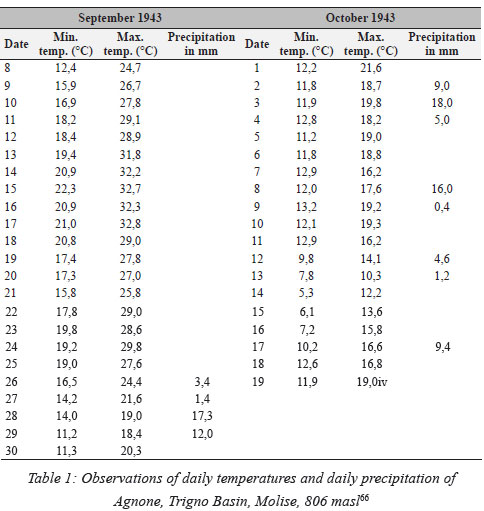
Table 1 covers the meteorological data (minimum and maximum temperatures, and precipitation) for the dates - 8 September until 19 October 1943 - during which Heath's group was underway.
The "Indian Summer" conditions of Agnone, situated at 806 masl, lasted from 8 September 1943 until 26 September 1943 when the first rains fell. The maximum temperature on 26 September 1943 fell by 3,2°C (from 27,6°C the day before) with the minimum falling by 2,5°C (from 19,0°C the day before). Another significant date was 28 September 1943 when heavy rain (17,3 mm) fell, with the maximum temperature dipping below 20°C for the first time that month. Rainfall in September 1943 equated to 34,1 mm, an average of 1,55 mm per day during the time the group was escaping. The period 12-16 October 1943 marked a particularly cold spell when the minimum temperature on 12 October 1943 dipped below 10°C for the first time in September and October 1943 (the decidedly chilly minimum temperatures during this period hovered between 5,3°C and 9,8°C). The maximum temperature during the cold spell hovered between 15,8°C on 16 October and 10,3°C on 13 October 1943, a particularly cold day. Continual rain occurred from 26 until 29 September (a four-day spell) and from October (a three-day spell), 8-9 October, and 12-13 October 1943. Heavy rain (18,0 mm and 16,0 mm) fell on 3 and 8 October 1943. Rainfall between 1 and 19 October 1943 equated to 63,6 mm, an average of 3,34 mm per day for the duration of the escape.
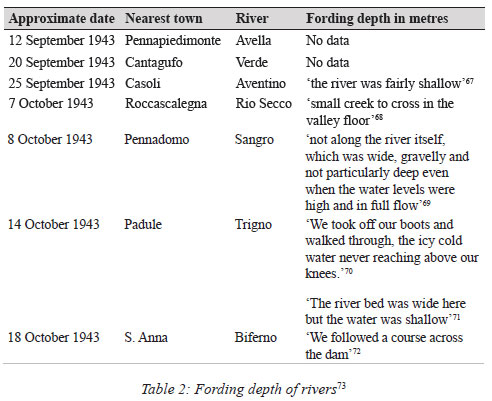
Another environmental hazard to be overcome on the journey was river depth. Table 2 illustrates the depth of the rivers to be crossed on the journey.
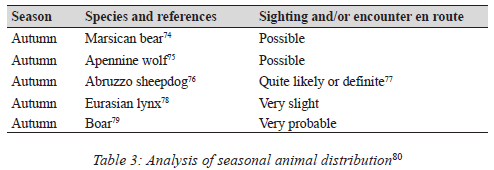
A further environmental hazard was the presence of potentially dangerous animals encountered on the route. Table 3 gives an analysis of animal presence according to the season (autumn) during which Heath's group was underway.
The current author was fortunate enough to visit Italy from 31 August to 16 September 2024. During this period, he was based at Sulmona and was actively assisted by members of the Club Alpino Italiano. In particular, the members of this club took him to the subsidiary POW camp at Acquafredda on 4 September 2024, and on 3 and 7 September 2024, to the main POW camp at Fonte d'Amore. On 11 September 2024, two club members took him to the town in Molise (Petrella Tifernina) where the POW party reached the Allied lines. On the way back to Sulmona, the group visited the Maiella Brigade memorial and the town of Palombaro, as well as Fara San Martino where they walked up part of a gorge, which is one of the access routes into the Maiella. The author also visited Campo di Giove on 6 September 2024, which provided valuable contextual information. He stayed there from 13-15 September 2024. All these visits provided rich contacts and information, which assisted the research on which this article is based.
Map 1 gives the most likely route Heath's group took from the POW camp (PG78/1) in Abruzzo to the town where the group reached Allied lines (Petrella Tifernina in Molise).
Discussion
The POWs who escaped from PG78/1 effectively disobeyed an order to stay put.82This order centred on the general military welfare of the POWs and concern about the implications should a large number of troops escape. The order did not appear to be grounded on any fear of the consequences of the approaching weather in late autumn in mountainous terrain.83 Mason writes that the camp leader took the initiative to apply pressure on the Italian authorities to let the men go free.84 The men were subsequently instructed to escape in small groups into the mountains. It is extremely fortuitous that the armistice and subsequent escape occurred during probably the best weather spell possible, i.e. after the extreme heat of summer and before the rains of late October and the snows of November 1943 onwards.85 During the author's recent fieldtrip, snow fell on the highest peaks of the Maiella outside Campo di Giove during the night of 14 September 2024. If this had occurred during the passage of the POWs over the Maiella in 1943, the outcome of the journey could have been very different. Duncan describes the weather at the start of the escape as 'fine and looked like remaining so for a while'.86 Mason writes that the weather was so good that it caused no difficulty for the escapees to sleep in the open.87In an entry dated 30 November 1943, Holland writes about the 'immense peaks of the Maiella mountains and the 8,000-foot Monte Amaro, snow-capped'.88 It would thus have been completely impossible to have crossed the Maiella between mid-November 1943 and mid-spring 1944, due to the distribution and depth of the snow.89 Leigh explains the difficulties experienced by South African POWs trying to cross snow-covered mountains north of Sulmona (the Gran Sasso d'Italia).90 A member of the Club Alpino Italiano informed the author during the recent fieldtrip that, at Acquafredda, snow reached 2,0 m in the depths of winter. Haines writes, 'in the winter snow down to 500m is common, so paths will be obliterated and rocks icy, and there are fewer daylight hours. Avalanches also occur'.91 Schou recounts being completely snowed in in a cave near Scanno on 31 December 1943:
I realized what had happened: during a heavy storm at night, the wind had driven a lot of snow into the cave. We were trapped at the far end of the cave by four metres of snow, and if we did not get out quickly we would suffocate.92
In his account of the battle of (southern) Italy in 1943, Holland writes that, on 28 September 1943 it 'began to pour with rain' in the Campania region, and he further notes, 'heavy winds' also occurred that day.93 This corroborates the ItaliaMeteo data.94 Duncan additionally comments that, by the end of September and before the Maiella had been crossed, 'the first rains had come and we realized that we could not see through a winter in such a way'.95 Uys Krige writes, 'In the camp we had had a wonderful summer, with no rain. Now it rained almost continually The mountains would be quite impassable, their gulleys torrents, and on those bare peaks we would perish of exposure.'96 Indeed, further on his journey, he writes about 'slithering about in the dark through acres of mud and slush and icy cold water'.97 Holland recounts an American soldier near the Volturno River writing, '[it] rained some' on 2 October 1943 and 'rained again' on 4 October 1943, commenting also on the mud.98 This corresponds to the data supplied by the erstwhile Ministero dei Lavori Pubblici: Servizio Idrografico (Ministry of Public Works: Hydrographic Service) or the modern-day ItaliaMeteo (Italian Meteorology and Climatology Agency) (1953) (see Table 1).99 On the evening of 3 October 1943, two Italian soldiers on the run reached Ripalimosani, north of Campobasso, and 'the rain was driving into them and they were soaked'.100 This driving rain would have meant a wind-chill effect, which in turn would have further affected the human energy budget of the escapees.101 It is reported that 18 mm of rain fell at Agnone that day.102 Paralleling this, the above group of Allied POWs had been captured in the North African desert and had not been issued with wet-weather clothing;103 hence, they would have been very vulnerable to bioclimatological effects.104 As Barry explains, soaked clothing very quickly loses insulation properties even to less than one third of its normal insulation.105 Shelter would have been needed immediately, and some kind of warmth activated (a fire, if possible), as the minimum temperature was below 12°C.106 Krige tells how, on the journey traversing the Morrone mountain range (adjunct to the Maiella, and above 1 800 masl), he and his fellow escapees could not sit for too long as a freezing sensation would soon be felt.107Further on, ascending the Maiella after Campo di Giove, Krige was so cold that he likened himself to 'a block of ice in an impersonal arctic world'.108 Another meteorological hazard, mist, affected Duncan's party on their crossing of the upper Maiella on or around 5 October 1943.109 This hazard, which limited visibility to a few metres, was also experienced by Krige's party.110 Duncan further comments on 'the light drizzle' on or around 6 October 1943, and the bitter cold near Villa Santa Maria during the night of 8-9 October 1943.111Encountering the Molise range before Castiglione on or around 10 October 1943, Duncan remarks on the 'biting wind and swirling mist clouds, damp and clammy'.112 Duncan also mentions the cold on the hillside. At around this date and approaching Campo di Giove, Krige tells of a 'bitterly cold night'.113 Holland writes, with respect to the Americans on the Volturno (to the west of Campobasso), 'with all the rain, General Clark now planned to assault all along the Volturno on the night of Tuesday, 12 and Wednesday, 13 October, when, if the forecasters were right, there would be a pause in the rain'.114 In Agnone, it also rained on those days but lightly (4,6 mm and 1,2 mm respectively).115 Krige's party also had to pass closer to and above Agnone. Bitter cold during the night of 13-14 October 1943 is remarked upon by Duncan.116. To corroborate this, weather data show the temperature dipped to 5,3°C on the morning of 14 October 1943.117
On 19 October 1943, the group reached Petrella Tifernina (see Map 1) and Allied lines. With respect to the jottings of an Indian Army officer north of Foggia, Holland writes, 'the good weather continued'.118 There followed five rain-free days, including and preceding 19 October 2023.119
Another bioclimatological factor would have been the effect of altitude and therefore air pressure and oxygen intake. The escapees would have needed to cross the altipiano (high plain) to safety. This is at a median altitude of around 2 400 masl.120 Barry explains that, at 3 000 masl, there is 30% less air pressure than at sea level.121 There would definitely have been a bioclimatological effect on the malnourished escapees ascending from about 660 masl to over 2 500 masl in their bid for freedom. Another meteorological factor that would have either impeded or helped the progress of the group was thunderstorms. Scherman writes about a thunderstorm on 28 September 1943 near Foggia, which helped a high-ranking officer and his batman get through the enemy lines.122 Leigh also writes about this incident.123 Thunderstorms affect visibility to a marked degree. This would have aided evasion of even quite well-defended lines. Kleynhans and Gordon write about a dust-storm that also reduced visibility and enabled the escape of a serviceman in North Africa.124
Heath's party was extremely fortunate to cross the major rivers before the heavy rains came (Map 1). Krige discusses this, referencing a guide who explained that, as the winter rains had not yet commenced, the rivers could be waded across, instead of swum across.125Holland tells how, during the Allied advance from the south of Italy, the rivers became raging and impassable torrents following heavy rains. For example, Holland recounts how 'on 16 November, when patrols had been due to begin, the Sangro had been too high and fast-flowing to cross'.126
What is not known is the precise distribution and numbers of bears and wolves along the route in the autumn of 1943. Wolves would likely have been encountered in the area around Passo San Leonardo (north of Campo di Giove).127 Bears might have been encountered by the group in beech forests along the route, especially south-east of Sulmona and towards Gamberale.128 Another potentially dangerous mammal, the sheepdog, would have been found along the route too.129 Krige, who encountered a sheepdog on his journey, also comments on this. Holland writes that the Abruzzo sheepdogs still engaged in conflict with wolves in 1943, and presumably still do.130 Boars would have also been encountered within the park boundaries, especially within forests (the author saw a boar in a beech forest from the bus on the road from Sulmona to Campo di Giove on 6 September 2024). The Eurasian lynx would very likely not have been spotted.131 It is, however, known that the POW groups were with the partisans and other Italians for a large part of their journey, and these men would have had a better idea of environmental hazards than the non-nationals.132 Bears, wolves, boars and sheepdogs, while present, would generally not have interfered with POWs who were actively avoiding confrontation and being as quiet as possible. Krige however wrote about the threat of wolves when the snow came, 'And the snow, too, would bring the wolves.'133 He also recounts the danger of sheepdogs, and mentions how the Italian guide told him and his fellow POWs to stay close, 'Then the dogs will see me first, recognize me as a friend and not bite you. For I tell you they are fierce, moltoferoci [very ferocious].'134
The escaped POWs were extremely lucky in terms of the effects of bioclimatology and the timing of the Italian surrender. The highest ground was traversed in mid-September 1943, before the rains and snow came.135 As mentioned before, an earlier than expected snowfall would have scuppered their plans and made passage almost impossible. The first rains arrived at the end of September and early October, by which time the group was on lower ground and reasonably close to human habitation all along the route. Certainly, during the periods 2-4 October and 8-9 October, when heavy rain fell, the POWs would have needed shelter.136 The period 12-16 October 1943, when the minimum temperature dropped to below 10°C, would have also necessitated shelter at night.137
Other environmental factors that played a role in the escape played a minor to marginal role. POWs would have felt the effects of altitude-related air pressure while crossing the altipiano above 2 400 masl, but not at a level to hinder their progress seriously.138 The depth of rivers was not a factor before the serious November rains started; hence, the rivers were not impassable obstacles to the men.
The terrain across which the men moved was very rough and hence arduous. As Krige writes, 'We soon struck across very broken country, going straight down a steep hill in order to cross yet another tributary of the Trigno. We slithered down one donga.'139Before that point on his journey, he remembers being so attuned to walking that he 'found myself falling asleep while sitting bolt upright'.140 Scherman writes about a pair (who slipped through enemy lines under cover of a thunderstorm) who had covered, mainly nocturnally, approximately 250 km in primarily mountainous terrain, and which took '17 gruelling days'.141 Another factor that has to be pointed out is the proximity of PG78/1 to the Maiella range (part of the Apennines), which would have aided concealment and evasion. As Scherman points out, 'proximity to Italy's famous Apennine Mountains, which provided cover and concealment due to their inaccessibility and many hiding areas, also proved decisive in many escapes'.142
Numerous and potentially life-saving mitigation measures were taken by the POWs and their Italian helpers to ameliorate the environmental factors. POW deaths due to exposure are not discussed in POW histories, except for Schou who recounts a near-death experience from a combination of weather factors and pneumonia. If an Italian family had not taken pity on him, he most surely would have died.143 The most important form of mitigation was seeking help from civilians along the way. These people fed, clothed and, most importantly, sheltered the POWs en route through difficult areas.144 Duncan in particular describes how the local people offered shelter, food, clothing and shoes to POWs. They even offered to dry the wet clothing of the escapees, which is critically important in avoiding hypothermia, especially when wind chill is a factor.145 Mason also comments that some men's laundry was done by the local inhabitants.146 Access to food and water was thus not generally an issue. This can be contrasted to the experiences of South African soldiers in the Western Desert;147 however, this changed when the snow started.
Conclusion
The current study essentially drew from the meteorological data provided by ItaliaMeteo. The precision of the data enables one to ascertain the weather all along the route and envisage the measures the escaping men took to cope with the weather. Besides the weather data, memoirs by Allied soldiers, especially Duncan and Krige, provided much needed and valuable background information. Holland also yielded highly relevant data. Krige, a noted South African author, in particular writes about the environment - especially the weather and its effects - to be negotiated and experienced with accuracy and foresight. River depths and animal presence were not rated as significant obstacles to be overcome. These two factors however would have been markedly different had their journey been later in the year, when the snow started falling. The study found how a small party of battle-tested and determined young men coped with arduous and varied environmental conditions, and a hostile enemy presence, to reach the Allied lines safely. The men took every advantage of terrain to conceal themselves and to evade the enemy. Moreover, escaped POWs sometimes took advantage of weather events, such as thunderstorms, to cross enemy lines. The men were highly fortunate with the timing of the Italian surrender, namely after the heat of summer and before the winter snow. The environmental factors besetting the group were mitigated, not least by the local Italian people, the Abruzzesi, without whom the journey of this particular group and that of other groups would not have succeeded.
Club Alpino Italiano (Sezione Sulmona), Via Giuseppe Andrea Angeloni, Sulmona, Italy.
i Erratum. Scherman means "a peace not so advantageous to them".
ii From the Gustav line, the escape route followed the Sangro River, the Barbara line, the Trigno River, the Volturno line, and the Biferno River. Navigating defended lines would have increased the environmental hazards present, for example the time spent in the open.
iii In the context of mountains and geography, masl stands for meters above sea level.
1 Born and raised in Cape Town, South Africa, Dr Gavin Heath graduated from the University of Cape Town with a Bachelor of Arts in 1989, a Higher Diploma in Education in 1990, and a Master of City and Regional Planning in 2000. Dr Heath taught English and Geography in South Africa and the United Kingdom in the 1990s. He started lecturing at the former University of Natal in 2002; in 2021, he was awarded his Doctorate of Philosophy (in Education) by Rhodes University, Makhanda. Dr Heath is married to Bronwen, who shares his love for the outdoors.
2 Department of Defence Archives (hereafter DOD Archives), Second World War Service Record: Heath G.E. (299313).
3 GE Heath, Application Form and Letter regarding Prisoner-of-War Medal to Award Publications Ltd, Surrey, n.d.
ACKNOWLEDGEMENTS
Agenzia ItaliaMeteo, Viale Aldo Moro, Bologna, Italy.
Literature Review
- 4 G Duncan, 'Account of Escape from Camp Concentramento', P.G. 78/1, MS papers 8872 (Wellington: Alexander Turnbull Library, 1998).
- 5 Duncan, 'Account of Escape from Camp Concentramento'; WAT Synge, The Story of the Green Howards 1939-1945 (Richmond: Green Howards, 1952).
- 6 WW2Talk (n.d.). <http://ww2talk.com/index.php7threads/aqua-freeda-pow-camp-italy.83774/> [Accessed on 28 May 2024].
- 7 WW2Talk.
- 8 National Library of New Zealand, The Main Gate of Campo PG 78/1, Aquafredda [sic.], Italy - photograph taken by HR Dixon, n.d.
- 12 Commonwealth War Graves Commission, Sangro River War Cemetery. <https://www.cwgc.org/visit-us/find-cemeteries-memorials/cemetery-details/2021204/sangro-river-war-cemetery> [Accessed on 8 May 2025].
- 13 GE Heath, Letter to Award Publications Ltd, Haslemere, Surrey, UK, n.d.; Parco Nazionale della Majella, Carta Turistica 1:50 000 (Guardiagrele, 2014); Iter Edizioni, Abruzzo Molise Carta Stradale e Turistica 1:250.000 (Roma, 2014).
- 14 Mason, Prisoners of War.
- 15 DOD Archives, Second World War Service Record: Heath G.E. (299313), Prisoner-of-War Letter; Map 1.
- 16 Duncan, 'Account of Escape from Camp Concentramento'.
- 17 The Green Howards (Alexandra, Princess of Wales's Own Yorkshire Regiment). <https://greenhowards.org.uk/aboutus/green-howards-regiment/timeline/> [Accessed on 7 May 2025].
- 18 Synge, The Story of the Green Howards, 245.
20 Mason, Prisoners of War.
21 Holland, The Savage Storm.
22 K Horn, 'Narratives from North Africa: South African Prisoner-of-war Experience Following the Fall of Tobruk, June 1942', Historia, 56, 2 (2011), 94-112.
23 Horn, 'Narratives from North Africa', 109.
24 EP Kleynhans & W Gordon, 'Springbok Escapers and Evaders in the Western Desert, 19411942: An Exploratory Investigation', Journal of African Military History, 6, 1 (2022), 33-67.
25 Kleynhans & Gordon, 'Springbok Escapers and Evaders', 51.
26 Kleynhans & Gordon, 'Springbok Escapers and Evaders', 63.
27 RJB Bosworth, Mussolini's Italy: Life Under the Dictatorship (London: Penguin, 2005); M Carver, The Imperial War Museum Book of the War in Italy 1943-1945 (London: Pan, 2002); FW Deakin, The Brutal Friendship: Mussolini, Hitler and the Fall of Italian Fascism (London: Phoenix Press, 2000); J Gooch, Mussolini's War: Fascist Italy from Triumph to Collapse 1935-1943 (London: Penguin, 2021); U Krige, The Way Out (Cape Town: Maskew Miller, 1983); AL Saunders, A Travel Guide to World War II Sites in Italy (Charleston: Travel Guide Press, 2010); M Schou, Mountains of Freedom: The Incredible Journey of a Young Prisoner-of-war Saved by the Heroic Courage of Italian Peasants (Durban: Martin Schou, 2000); Holland, The Savage Storm.
28 Holland, The Savage Storm; Duncan 'Account of Escape from Camp Concentramento'.
29 J-P Scherman, The Wartime Experiences of the Men of the 2"' South African Infantry Division, 1940-1945 (PhD thesis, Stellenbosch University, Stellenbosch, 2023), 303.
30 MRD Foot & JM Langley, MI9: The British Secret Service that Fostered Escape and Evasion 1939-1945 and its American Counterpart (London: The Bodley Head, 1979), 157.
31 Krige, The Way Out.
32 JB Chutter, Captivity Captive (London: Jonathan Cape, 1954), 84.
33 Chutter, Captivity Captive.
34 Mason, Prisoners of War.
35 Club Alpino Italiano (Sezione di Chieti), Gruppo della Majella, Carta dei Sentieri, Scala 1: 25.000 (Firenze, 2000); S Haines, Walking in Abruzzo (Milnthorpe: Cicerone, 2011).
36 DOD Archives, Second World War Service Record: Heath G.E. (299313); Duncan, 'Account of Escape from Camp Concentramento'.
37 RG Barry, Mountain Weather and Climate (Cambridge: Cambridge University Press, 2008).
38 Duncan, 'Account of Escape from Camp Concentramento'; DOD Archives, Second World War Service Record: Heath G.E. (299313).
39 Carver, The Imperial War Museum Book of the War; Holland, The Savage Storm.
40 Club Alpino Italiano.
41 Foot & Langley, MI9, 162.
42 Chutter, Captivity Captive, 63.
43 Carver, The Imperial War Museum Book of the War, 298.
44 Duncan, 'Account of Escape from Camp Concentramento'; Krige, The Way Out; Schou, Mountains of Freedom.
45 M Armiero, A Rugged Nation: Mountains and the Making of Modern Italy (Cambridge: White Horse Press, 2011).
46 Haines, Walking in Abruzzo.
47 Duncan, 'Account of Escape from Camp Concentramento'.
48 H van Gils, E Westinga, M Carafa, A Antonucci & G Ciaschetti, 'Where the Bears Roam in Majella National Park, Italy', Journal for Nature Conservation, 22 (2014), 23-34.
49 Van Gils et al., 'Where the Bears Roam', 23.
50 CE di Francesco, C Smoglica, B Paoletti, S Angelucci, M Innocenti, A Antonucci, G di Domenico & F Marsilio, 'Detection of Selected Pathogens in Apennine Wolf (Canis lupus italicus) by a Non-invasive GPS-based Telemetry Sampling of Two Packs from Majella National Park, Italy', European Journal of Wildlife Research, 65 (2019), 1.
51 Di Francesco et al., 'Detection of Selected Pathogens', 1-9.
52 Holland, The Savage Storm; Haines, Walking in Abruzzo.
53 Krige, The Way Out.
54 M Armiero, R Biasillo & W Graf von Hardenberg, Mussolini's Nature: An Environmental History of Italian Fascism (Cambridge: MIT Press, 2002).
55 FH Whitehead, 'Ecology of the Altipiano of Monte Maiella, Italy', Journal of Ecology, 39, 2 (1951), 330-355.
56 Haines, Walking in Abruzzo.
57 E Liberatoscioli, G Boscaino, S Agostini, A Garzarella & E Patacca Scandone, 'The Majella National Park: An Aspiring UNESCO Geopark', Geosciences, 8, 7 (2018), 256.
58 P Barron, 'The Majella Massif in Abruzzo, Italy: The Mother of Mountains', Mountain Research and Development, 26, 4 (2006), 367-370.
59 Barron, 'The Majella Massif in Abruzzo', 368.
60 Krige, The Way Out, 167.
61 Barron, 'The Majella Massif in Abruzzo', 369.
62 Krige, The Way Out, 178.
63 Krige, The Way Out, 25.
64 Krige, The Way Out, 188.
65 Krige, The Way Out, 250.
66 Ministero dei Lavori Pubblici: Servizio Idrografico, Sezione Autonoma dl Genio Civile con Sede in Pescara. Per 1. Litorale Adriatico dal Salinello al Fortore. Annali Idrologici 1943 (Roma: Istituto Poligrafico dello Stato Libreria, 1953), 13, 29. ItaliaMeteo, pers.comm., 27 May 2024.
67 Duncan, 'Account of Escape from Camp Concentramento', 9.
68 Duncan, 'Account of Escape from Camp Concentramento', 10.
69 Holland, The Savage Storm, 357.
70 Krige, The Way Out, 240.
71 Duncan, 'Account of Escape from Camp Concentramento', 14.
72 Duncan, 'Account of Escape from Camp Concentramento', 18.
73 Dates are approximate.
74 Haines, Walking in Abruzzo; Van Gils et al., 'Where the Bears Roam', 23-34.
75 Haines, Walking in Abruzzo; Di Francesco et al., 'Detection of Selected Pathogens'.
76 Haines, Walking in Abruzzo; Holland, The Savage Storm.
77 Krige, The Way Out.
78 Haines, Walking in Abruzzo.
79 Haines, Walking in Abruzzo.
80 Sources are stated in the table.
81 Produced by Brice Gijsbertsen, Geography Department, University of KwaZulu-Natal, Pietermaritzburg.
82 Foot & Langley, MIC; Chutter, Captivity Captive.
83 Foot & Langley, MI9.
84 Mason, Prisoners of War.
85 Haines, Walking in Abruzzo.
86 Duncan, 'Account of Escape from Camp Concentramento', 3.
87 Mason, Prisoners of War.
88 Holland, The Savage Storm, 381.
89 Haines, Walking in Abruzzo; Holland, The Savage Storm.
90 M Leigh, Captives Courageous: South African Prisoners of War World War II (Johannesburg: Ashanti, 1992).
91 Haines, Walking in Abruzzo, 34.
92 Schou, Mountains of Freedom, 102.
93 Holland, The Savage Storm, 248, 482.
94 Ministero dei Lavori Pubblici.
95 Duncan, 'Account of Escape from Camp Concentramento', 5.
96 Krige, The Way Out, 74.
97 Krige, The Way Out, 91.
98 Holland, The Savage Storm, 263.
99 ItaliaMeteo, Personal communication.
100 Holland, The Savage Storm, 272.
101 Barry, Mountain Weather and Climate.
102 Ministero dei Lavori Pubblici.
103 Duncan, 'Account of Escape from Camp Concentramento'.
104 Barry, Mountain Weather and Climate.
105 Barry, Mountain Weather and Climate.
106 Ministero dei Lavori Pubblici.
107 Krige, The Way Out, 121.
108 Krige, The Way Out, 181.
109 Duncan, 'Account of Escape from Camp Concentramento'.
110 Krige, The Way Out.
111 Holland, The Savage Storm, 272.
112 Duncan, 'Account of Escape from Camp Concentramento', 13.
113 Krige, The Way Out, 148.
114 Holland, The Savage Storm, 276.
115 Ministero dei Lavori Pubblici
116 Krige, The Way Out; Duncan, 'Account of Escape from Camp Concentramento'
117 Ministero dei Lavori Pubblici.
118 Holland, The Savage Storm, 294.
119 Ministero dei Lavori Pubblici.
120 Club Alpino Italiano (Sezione di Chieti), Gruppo della Majella; Whitehead, 'Ecology of the Altipiano of Monte Maiella, Italy'.
121 Barry, Mountain Weather and Climate.
122 Scherman, The Wartime Experiences, 289.
123 Leigh, Captives Courageous.
124 Kleynhans & Gordon, 'Springbok Escapers and Evaders'.
125 Krige, The Way Out.
126 Holland, The Savage Storm, 359.
127 Di Francesco et al., 'Detection of Selected Pathogens'.
128 Van Gils et al., 'Where the Bears Roam'.
129 Haines, Walking in Abruzzo.
130 Krige, The Way Out; Holland, The Savage Storm.
131 Haines, Walking in Abruzzo.
132 Duncan, 'Account of Escape from Camp Concentramento'.
133 Krige, The Way Out, 111.
134 Krige, The Way Out, 122-123.
135 Club Alpino Italiano.
136 Ministero dei Lavori Pubblici; Holland, The Savage Storm.
137 Ministero dei Lavori Pubblici; Duncan, 'Account of Escape from Camp Concentramento'.
138 Whitehead, 'Ecology of the Altipiano of Monte Maiella'.
139 Krige, The Way Out, 243.
140 Krige, The Way Out, 209.
141 Scherman, The Wartime Experiences, 289.
142 Scherman, The Wartime Experiences, 287.
143 Schou, Mountains of Freedom.
144 Duncan, 'Account of Escape from Camp Concentramento'; Schou, Mountains of Freedom; Carver, The Imperial War Museum Book of the War.
145 Duncan, 'Account of Escape from Camp Concentramento'.
146 Mason, Prisoners of War.
147 Kleynhans & Gordon, 'Springbok Escapers and Evaders'.