
 Hearing God in Our Languages: Strategies for Translating the English/Greek/Hebrew Bible into Tshivenda
Abstract
This article explores the term-creation process as one of the strategies that significantly contributed to the expansion and development of the Tshivenda language. The term-creation process involves forming and incorporating new words into the language. Translators apply this strategy due to the lack of equivalent terms and the existence of a cultural gap between the source and target languages. When confronted with the challenge of a lack of equivalence in the target language, early translators of the Tshivenda Bible (1936) resorted to using the term-creation strategy (that is, semantic shift, borrowing, derivation, and compounding) to resolve this problem. It was largely through Bible translations that some basic words acquired new canonical meanings. Subsequently, new lexical units entered the Tshivenda lexicon. Given this exposition, the article examines Tshivenda terms that attained new meanings through the Bible translation. The article hinges on the qualitative research method as it enabled the researchers to analyse data from the Tshivenda Bible (1936) effectively.
semantic shift; Tshivenda; missionaries; translations; Christianity
Introduction
The translation process involves producing the closest equivalent word in the target language, especially using the formal equivalent approach, which aims to translate in a more literal word-for-word fashion. Translators of the Tshivenda Bible were faced with a challenge of non-equivalence due to the cultural gap between the source languages (Hebrew, Greek, and English) and the target language (Tshivenda). Eugene Nida (1964,130) asserts that differences between cultures "cause many more severe complications than do differences in language structure." Tshivenda, like many other indigenous languages, has undergone difficulties due to a lack of vocabulary. This was due to various reasons; the language lacked equivalent terms (specialised terminology gap) for European languages, in this case, it was Hebrew, Greek, and English, and there was no orthography developed yet during that era. The first recordings of Tshivenda were undertaken by German-speaking Bible translators; during that period, the language only had equivalents for general words, which made it difficult for them to transfer the source language message to the target language. These challenges propelled translators to adopt Term-Formation processes (semantic shift, borrowing, derivation, and compounding) to achieve the equivalent effect.
Historical Background to the Development and Expansion of the Tshivenda Language
Tshivenda is one of the indigenous languages where most of the speakers are concentrated in the Limpopo Province, South Africa. Under Section 6 of the Constitution of the Republic of South Africa (Act 108 of 1996), all 12 languages have official status, including Tshivenda, English, Afrikaans, isiNdebele, Siswati, Sesotho, Sepedi, Xitsonga, isiZulu, Setswana, isiXhosa, and the South African Sign Language (SASL). The Constitution has elevated the indigenous languages, which were historically marginalised by the Apartheid regime as official languages, to official status (Madima et al. 2024).
The elevation of these languages means that they can now be equally used in many aspects of life, such as education, technology, business, and others. Tshivenda speakers form the second smallest official language group in South Africa. It belongs to the larger Niger-Congo language family. Nevertheless, its speakers are considered culturally closer to Shona speakers than any other major group (www.britannica.com).
As Mathivha (1972,8) affirms, Tshivenda is considered a form of Nyanja, Sena, Swahili, Bemba, Shona, and Ndau. He goes on to state that the Vhavenda speech community descended from the people who stayed in the areas where Nyanja, Sena, Swahili, Bemba, Shona, and Ndau were spoken (Mathivha 1972,8). Some speakers of indigenous languages within South Africa consider Tshivenda as complex and fast spoken, which makes it difficult to learn; however, it does not pose the same challenges to Shona speakers. Benson (1979,24) argues that:
Their Language (Luvenda), for example, is related to that of the tribe of Zimbabwe-Rhodesia, finding its closest equivalent in the Kalanga group, where it is sharply distinguished from the languages of Sotho and the Shangaan-Tsonga.
This statement explains that Tshivenda is a unique language in that it does not fall under any group (Nguni or Sotho) of indigenous languages spoken in South Africa. The Sotho group contains Setswana, Sesotho sa Leboa, Sesotho, and the Nguni group comprises isiXhosa, isiZulu, isiNdebele, and siSwati, which makes Tshivenda a distinct language.
Research on the Term-Formation Process
This section reviews the existing literature on the term-formation process applied by translators of various languages in their quest to create new terms. Thus, Ndhlovu (2014), in her article entitled "Term-creation Strategies Used by Ndebele Translators in Zimbabwe in the Health Sector: A Corpus-based Approach," explores strategies used by Ndebele translators to create terms in the health sector. In the article, she notes that in order to fully understand the strategies employed by Ndebele translators from a corpus-based approach using ParaConc (a data analysis tool to analyse translated texts), there is a need to know the prefixal element of Ndebele terms.
Another scholar who contributed to the same discourse is Madonsela (2017), in his article, "Word-formation Strategies and Processes in the Creation of Synsets for the African Wordnet" (referring to a large lexical database of English). He examines a number of synsets (several sets of synonyms) in order to identify the word-formation processes used by various linguists in constructing the AWN. Since the English Princeton wordnet (which refers to publicly available English lexical database developed in Princeton University) was used as the basis for the lexical database in the creation of the African wordnet, various word-formation strategies (derivation, borrowing, compounding, extension of meaning, conversion and reduplication) had to be used to account for lexical items that are not lexicalised in the African languages. Access to the created synsets was gained via a web browser, which is an automated text analysis application.
Research Method
The article adopts a qualitative research method as it enables the researcher to analyse data from the Tshivenda Bibles (Bivhili ya Othe Mariwalo Makhethwa a Testamente ya Kale na a Testamente Ntswa 1936 and Bivhili Khethwa- Mafhungo Madifha 1998 versions). The researchers found the qualitative method appropriate for this study in that it gives the researcher the flexibility to apply translation theories throughout the process. Content analysis as a qualitative research technique will emerge as an analytic technique for analysing data. It is a common technique in qualitative research and can analyse written, vocal, or visual communication signals (Cole 1988). It is about meaning, intention, consequences, and connection. This allows qualitative researchers to structure the data they collect to meet their research goals. The application of this method will also reveal how terms were created during the translation of the Bible into Tshivenda
In this article, the following term-formation processes will be points of discussion: semantic shift, derivation, compounding, and conclusion.
Data Presentation
i. Semantic Shift
Semantic shift is one of the term-creation strategies. Valeontis and Mantzari (2006,7) define semantic shift as a phenomenon whereby a current term in a language changes in form and meaning. According to Madiba (2000, 205), the meaning of indigenous words can be completely altered in form and meaning with methods such as semantic extension (it has to do with a set of meanings a word or sentence extends to), narrowing of meaning (when the meaning of the word shifts from general to a more specific time), and meaning change.
The creation of these terms reveals a significant sociolinguistic advancement in language elaboration. Mochaba (1987,140) indicates that the creation of these terms resembles natural term development as speakers of the languages easily adopt them into their language.
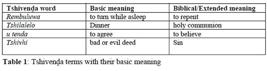
The following examples show Tshivenda terms with their basic meaning, which were expanded to take on new biblical meanings:
(a) tshivhi
From the examples provided above, it is apparent that the extended meanings attached to biblical translations are isolated from their cultural context. For example, the word tshivhi, which literally means "an evil deed," is used by Vhavenda to refer to an unacceptable or anti-social act by a human being. This may be an act of stealing from others, which is regarded as improper by society. It is an anti-social act that sometimes causes chaos among those involved. Those who commit this kind of offence cannot be dealt with by ordering them to pay a fine; usually, they are ostracised and chased out of the community (Van Rooy 1971,181). This clearly means that people who do evil deeds (muvhi or vhavhi) do not deserve to be part of society. However, the biblical aspect of "sin" seems to vary from the Tshivenda one. In the Old Testament, the emphasis is more on the relational aspect of "sin" either with man or to God. This may be observed in the terms used for "sin" in the Old Testament. The most common term cht, chatta't (chatta'ah), which in Greek is translated asἁμαρτάνω (hamartano) and ἁμαρτία (hamartia), meaning "to miss the mark" or "to make a mistake" in both Greek and Hebrew. Another term is עָוֹן / ʿāôn (wh, avown), which is sometimes translated as hamartia, and the other related term in Greek is ανομία (anomia), meaning to be wrong or crooked, which accent strongly on the character of sin and the fault that results from it. The other term 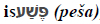 , basically meaning rebellion, being at fault before God and being rebellious, translated in Greek as asebeia, parakoe and hamartia (Van Rooy 1971,183). In the Bible, wrong is wrong, and sin is sin, for example, in:
Genesis 3:5 (1936 version)
Mudzimu a tshi ralo u ḓivha zwa uri musi no ḽa wone, maṱo aṋu a ḓo bonyolowa, na ḓo nga Mudzimu na ḓo ḓivha vhuḓi na vhuvhi (When God says so, He knows that when you eat of it, your eyes will open, and you will know good and evil like God).
Genesis 3:5 (1998 version)
Ndi uri Mudzimu u a ḓivha uri arali na u ḽa ni ḓo bonyolowa na nga Mudzimu na vho ḓivha zwivhuya nazwivhi (it is because God knows that if you eat of it, you will be able to see like God and know good and evil). For God doth know that in the day ye eat thereof, then your eyes shall be opened, and ye shall be as gods, knowing good and evil.
In the case of Vhavenda as indicated above, the word tshivhi is the singular of zwivhi and refers to an "evil deed." The words vhuvhi and zwivhi used in both Tshivenda versions denote an "evil deed;" hence, the word "evil" was used in the English translation.
Genesis 4:7 (1936 version)
Nandi? wá ita zwivhuya, a si hone khofheni hu tshi do tshá naa? Wa hana zwivhuya, vothini hu dzumbama zwivhi; zwo lalela iwe; iwe-ha Uzwi kunde. (But if you do not do what is right, sin is crouching at your door; it desires to have you, but you must rule over it).
Genesis 4:7 (1998 version)
Khezwi u sa iti zwivhuya, wa tanganedzwa. Hone wa sa ita zwivhuya, vhutshinyi ho u lalela vothini lau; vhu toda u u la, hone iwe wo fanela u vhu kunda. (If you do what is right, will you not be accepted? But if you do not do what is right, sin is crouching at your door; it desires to have you, but you must rule over it). The word vhutshinyi is used to describe the act of committing "sin." When one has sinned, in Tshivenda we say o ita "vhutshinyi" (in biblical context).
In this example, the context in which the word "sin" was used, together with its equivalent, clearly illustrates the relational aspect of "sin." This context means that if you do not do good, you are bound or at risk of committing "sin."
In the biblical context, those who do not do good trespass against God's will, automatically making them sinners. The term "sin" has three diagnostic elements, which are essential for comparing it with the Tshivenda term tshivhi:
1. It is a trespass against God.
2. It leads to the breakdown of the relationship between man and God and man and man.
3. It brings about a state of guilt, and it can be expiated (Van Rooy 1971,185).
It can be observed that the meaning of tshivhi is highly limited; it refers to some kind of rebellious or incorrect act. Most Tshivenda speakers can strongly condemn all wrongdoing as tshivhi. In the biblical context and Tshivenda, "wrongdoing" is a relational idea, and tshivhi is not a relational idea. The use of this strategy by translators enabled speakers to isolate the indigenous meaning of the term tshivhi from its social and cultural context to its extended biblical meaning.
(b) rembuluwa
Another term that was given an extended meaning by Tshivenda Bible translators to fit into the biblical context was rembuluwa. The basic meaning of the term rembuluwa in Tshivenda is "turn in a different direction." For example, if one is sleeping facing the east and one turns to the other side, it is referred to as o rembuluwa. This term was used by missionaries and Tshivenda Bible translators to refer to "repent" (Christian salvation where believers accept Christ as their Lord and saviour). Rembuluwa was used in the following Bible verses:
Examples
Luke 13:3
Na khathihi! Ndi ri, na sa rembuluwa ni do lovha nothe u fana navho. (I tell you, no! But unless you repent, you too will all perish).
Acts 2:38
Pitirosi a fhindula a ri, "Rembuluwani, munwe na munwe a lovhedzwe nga dzina la Yesu Khristo uri a hangwelwe" (And Peter said to them, "Repent and be baptised every one of you in the name of Jesus Christ for the forgiveness of your sins, and you will receive the gift of the Holy Spirit.")
Luke 13:5
Na kathihi! Nṋe ndi ri: na sa rembuluwa ni ḓo lovha noṱhe u fana navho. (Unless you repent, you will all likewise perish).
According to the Christian religion, "repenting" refers to forsaking your sinful nature, believing in your heart that God is the only saviour. This involves making decisions for a new life, which starts by forgiving yourself and those who wronged you and turning away from sins. Another meaning attached to the word "repent" in the New Testament means to "change your mind." In the original Greek, the word "μετανοέω," which is a verb, was transliterated to "metanoeó" meaning "to change one's mind or purpose." This change has to do with the inner man, the heart and the perception of a person outside Tshivenda cultural context.
Christians also believe that when one has repented, one becomes a new creature. This is supported by the Scripture below:
2 Corinthians 5:17 (1998 version)
Zwino-ha arali muthu o vha muthihi na Khristo ndi tsiko ntswa; ya kale yo fhela, ho ḓ a ntswa
(Therefore, if anyone is in Christ, he is a new creation. The old has passed away; behold, the new has come).
This phrase means that when you have repented, you start over, turning away from your old ways. It is evident that the application of this strategy in the translation of the Bible into Tshivenda changed the meaning of the terms above in this manner: the indigenous word acquired an extended biblical meaning.
i. Derivation
Derivation is a morphological phenomenon that describes the creation of new words from old words, usually by adding prefixes or suffixes, where new words acquire new meanings (Susilawati and Putri 2018,217). According to Susilawati and Putri (2018,217), an example of this strategy is the formulation of a word like "communication" from a verb "communicate" and affixation. This is one of the common word-formation process strategies adopted by various translators.
Pinchuck (1977,96) posits that a term may change from one word category to another during the derivation process; for example, verbs can be changed into nouns. In Tshivenda, only prefixation and suffixation are used to create terms (Madiba 2000). In the case of Tshivenda Bible translation, new biblical terms were created by altering the form of Tshivenda existing words.
Cluver (1989,279) asserts that the term formation process in African languages uses prefixes more than suffixes. Most terms that are created in the African language during this process tend to be nouns. The examples below demonstrate how prefixes can alter the meaning of Tshivenda words to express new concepts.
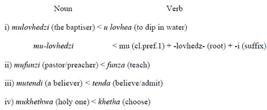
The list of derived forms above shows the shift that occurred during the translation of the Bible into Tshivenda. The above-listed examples of Tshivenda verbs: lovhedza, funza, tenda and khetha were shifted into a new category of nouns, namely mulovhedzi, mufunzi, mutendi, and mukhethwa.
Example 1- lovhea (to dip into water)
When a cloth is dipped in water, be it in a river or container, we speak of u lovhea (to dip into water), and when it involves sprinkling water on one's forehead or immersing the person in water, we talk of u lovhedza (to baptise). This verb was derived from a noun mulovhedzi, meaning the "baptist" or someone who baptises people. This is the Christian religious act of purification, which is normally done when one has repented from one's old ways of living and decides to follow God. The contribution of the term mulovhedzi in the expansion of Tshivenda is evident in this example:
Matthew 3:1
Misi Yeneyo ho da Johanisi Mulovhedzi Phangami ya Judia, a da na pfunzo ine ya ri, "Latani vhuvhi hanu; tshifhinga tsho sendela tsha uri ni vhuswe ngaMudzumu. (In those days John the Baptist came preaching in the wilderness of Judea, and saying, 'Repent, for the kingdom of heaven is at hand!').
I Corinthians 12:13
Zwenezwo riñe rothe ro lovhedzwa ra newa Muya muthihi ra vha muvhili muthihi nga u ralo, hu sa londwi uri u Mujuda kana u Mugiriki kana u phuli, kana u mudilangi; nahone ndi onoyo Muya muthihi we ra mu nwa rothe (For we were all baptised by one Spirit so as to form one body-whether Jews or Gentiles, slave or free-and we were all given the one Spirit to drink).
Example 2 - funza (teach)
The verb funza means to impart knowledge to someone or to teach. The term funza acquired a new part of speech when it was derived to mufunzi, meaning a pastor and its plural form vhafunzi (pastors). The noun mufunzi was formed from the verb funza (teach) by adding the class two prefix [mu] to the verb stem funza and replacing the last vowel [a] with a vowel [i]. The term mufunzi is still used today to address the preacher of the Word. For example:
Luke 4:43
Ene a vha vhudza ari, "Ndo fanela u ya nda funza mafhungo madifha a muvhuso wa Mudzimu na kha minwe midi, vhunga zwi zwone zwe Mudzimu a nthumeli zwone " (But he said, 'I must proclaim the good news of the kingdom of God to the other towns also, because that is why I was sent').
Luke 4:44
Ndi hone a tshi ya a funza sinagogoni dza Judia (And he kept on preaching in the synagogues of Judea).
Example 3 - tenda (agree)
In Tshivenḓa the verb tenda (agree), means having the same opinion as someone about what is being said. For example, ndi khou tenda uri ndo khakha meaning (I admit that I am wrong). A convert or a Christian is referred to as mutendi (a believer), and its plural form is vhatendi. Mutendi is someone who has accepted Jesus as his Lord and saviour by confessing his sins and asking for forgiveness from the Lord. The application of this strategy in the translation of the Bible into Tshivenda has contributed to the growth and development of the language by transforming the verb tenda into the noun mutendi. For example:
Hebrews 11:13
Vhenevho vhothe vho fa vho tenda, vha songo tanganedzwa zwe vha vhavhalelwa (All these people were still living by faith when they died. They did not receive the things promised).
John 4:42
Vhenevho vha vhudza uyo musadzi vha ri, "Zwino a ri tsha tenda nga zwila zwe na tou ri vhudza, ri tenda (believe) nge ra tou di pfela nga rothe a tshi funza; nahone ri vho divha uri vhukuma ndi Ene Mutshidzi wa shango (They said to the woman, "We no longer believe just because of what you said; now we have heard for ourselves, and we know that this man really is the Saviour of the world.")
Example 3 - khetha (choose)
The verb khetha means to choose, select or to vote. For example, ndo khetha u ita zwithu nga ndila yanga (I chose to do things my way). The derivation process that took place during the translation of the Bible into Tshivenda gave khetha a new meaning when it was derived into mukhethwa, meaning "the holy one." The biblical connotation of mukhethwa is being set apart by virtue of being righteous (to be in right standing with God) and pure.
The use of this word formation process in the translation of the Bible into Tshivenda has played a significant role in the development of Tshivenda. The term mukhethwa has since been used for various purposes. For example, Christians use it when praying or preaching, Vha Mudzimu mukhethwa (you are the holy God), and it is also used as a name. To show that it has been accepted by Vhavenda, it is now used to name children.
ii. Borrowing
Borrowed words were used to fill the terminology gap in African languages after the introduction of new vocabulary in these languages. Vinay and Darbelnet (1995,31) define borrowing as term formation, whereby a source word is adopted by the target language. This view is supported by Mafela (2010,691), who points out that borrowing is a linguistic phenomenon in which one language adds words of another language to its lexicon. The nine indigenous languages in South Africa borrow words from one another, and these indigenous languages also borrow words from English and Afrikaans (Mafela 2010,691). In explaining the aim of borrowing, Rao (2018,2) states that "the main reason for borrowing is to provide a word from the source language variety when there is no suitable existing word in the target language." Vinay and Darbelnet (1995,31) assert that the borrowing technique is the simplest kind of translation because the source language word is simply transferred into the target language without being changed. In the case of Tshivenda, several Hebrew and Greek words entered the language when the Bible was being translated. Mafela (2010,692) notes that languages evolve over time, and in this evolutionary process, some words may be added or deleted while new vocabularies are created, and some words will no longer be used and will become obsolete. In Tshivenda Bible translations, some words lack equivalents in the target language, and some of these borrowed words that became part of the Tshivenda lexicon are still in use today, whereas others fell into disuse. Translators also opted for this strategy because of the lack of guiding principles, and the underutilisation of internal term formation strategies of other languages led to borrowing (Madiba 2000,4).
Below are some of the borrowed terms that were used to fill the terminology gap during the process of Bible translation. They were employed in the Bible because Tshivenda vocabulary had no alternative terms to replace them.
Example 1
Sabatha vs Sabbath
The word Sabatha is a Hebrew term that entered the Tshivenda lexicon through the translation of the Bible into Tshivenda. It is the seventh day of the week, which was observed by Jews as a day of rest or worship. Currently, members of the Seventh Day Adventists church are the ones who mostly use this term as they still observe the Sabatha day on Saturdays. Other denominations fellowship on Sundays, and they use the term Sondaha/Swondaha (Sunday). It was God who commanded that the seventh day be observed as a Sabbath; this can be attested in this Scripture from Exodus 20:810:
Elelwa duvha la Sabatha u li ite likhethwa. 9U shume maduvha matanu na lithihi, u khunyeledze mishumo yau yothe, 10hone duvha la vhutanu na vhuvhili ndi duvha la Yahavee Mudzimu wau, ndi la u awela. U songo shuma tshithu nga duvha helo, iwe na nwana wau wa mutuka na wa musidzana na vhashumi vhau vha vhanna kana vha vhasadzi, na zwifuwo zwau na mutsinda ane wa dzula nae. (Remember the sabbath day, to keep it holy. {20:9} Six days shalt thou labour and do all thy work: {20:10} But the seventh day [is] the sabbath of the LORD thy God: [in it] thou shalt not do any work, thou, nor thy son, nor thy daughter, thy manservant, nor thy maidservant, nor thy cattle, nor thy stranger that [is] within thy gates).
Example 2
rabela (pray), thabelo vs rerela
Another word borrowed from another language was rabela (to pray or plead) from rapela in the Sotho languages. The word rabela (pray) and thabelo from thapelo (prayer) have been generally accepted by Vhavenda and obtained a formal range of meanings as could be expected of a borrowed term (Van Rooy 1971). The word which was used by Vhavenda when praying or communicating with their ancestral spirits was rerela (communicate with ancestors). The word rerela was derived from the verb rera meaning "to discuss formally."
The word murero (a proverb) is derived from the verb rera. This practice of u rerela is performed to get rid of the unwanted spirits, to ask for protection and guidance, etcetera. It involves some form of verbal communication and offerings (water or traditional beer); one person, usually makhadzi (aunt) or any elderly person, can communicate with the ancestral spirits on behalf of other family members.
U rabela (to pray) can be associated with communicating with God, submission, and confession of sins, whilst u rerela (gods) is linked with communicating with Midzimu (God), rituals and expectation of benefits (Van Rooy 1971,169). This distinction shows what might have prompted the translators of the Tshivenda Bible to borrow the word rabela from the Sotho languages. The act of submission and confession cannot be aligned with the word u rerela. U rerela is to plead for favours from the ancestors in return for offerings, which differs from the meaning of "pray," where you ask things from God in return for nothing. Although some Christians do promise to give back something to God if their prayers are answered, they are not obliged to do so because it is not prohibited in the Word.
Missionaries regarded the practice of rerela (communicating with ancestral spirits) as evil and not acceptable to God; hence, they found this word inappropriate and not fit enough to be associated with God the creator. Van Rooy (1971,172) reported an event that took place some decades ago, where they were discussing the biblical terms used in the Tshivenda Bible that should be replaced. A proposal to use the term humbela (request) as an alternative for thabelo (prayer) and rabela (pray) was made; however, an educated church member objected to this proposal and suggested that they stick to rabela (pray) and thabelo (prayer). These terms were not replaced because u humbela seems more personal and could be rejected, whereas rabela does not contemplate rejection. Another expression that was proposed for rabela and thabelo was u amba na Mudzimu (to talk to God). This suggestion was dismissed because Mudzimu ha ambi (God does not speak) u tou thetshelesa (he listens), therefore ari koni u amba na muthu a sa ambi (we cannot communicate with someone who cannot speak).
The use of borrowed terms listed above from the Tshivenda Bible shows that various languages were used to put together a complete version of the Tshivenda Bible. This was the most preferred word formation strategy by missionaries, being influenced by the cultural transformation that was taking place in Venda communities due to Westernisation brought by missionaries (Madiba 2000). The use of this strategy helped them towards achieving their goal of uprooting heathenism from the language and culture of Vhavenda.
Cultural practices relating to clothing, belief, worship, and traditional African marriage were changed (Fielder 1996). Another reason that led to the use of this strategy was that they were not trained as terminographers nor translators, which complicated their work of introducing new terminology to a language that was only used for oral communication.
iii) Compounding
According to Hacken (2017,1), compounding is a type of word formation which entails forming new words from a combination of two or more words. In other words, a combination of two or more words creates a new word with a new meaning. Finegan (1994,83) and Nandito (2016,22) define a morpheme as a linguistic basic unit of a word that has a grammatical meaning and is categorised into free and bound morphemes. According to these authors, free morphemes are those morphemes which can stand alone as words. In other words, free morphemes are not attached to any other morpheme. Bound morphemes are those morphemes which occur as a combination (Nandito 2016,22).
Compounding is one of the productive strategies of word-formation processes in Tshivenda; hence, it was employed extensively by the translators of the Tshivenda Bibles, particularly for version 1936. The translators applied various compounding strategies that existed in the language, and in some cases, they created new ones. In compounding, the most significant word-commonly the noun-takes the plural form. The significant word may be located anywhere, either at the beginning, middle, or end of the term.
According to Sager (1997,317), compound words are classified into three categories, namely closed, hyphenated, and open.
1. Closed form
This is a form of compound words whereby different words are combined to form a single word, such as football, downtown, keypad, snowflakes, makeup, rainfall, sunrise, and many others.
2. Hyphenated form
As the name suggests, these are compound words formed by two or more words separated by a hyphen, such as mother-in-law, ready-to-eat, fire-fighters, work-to-rule, high-rise, bluish-grey, well-wishers, semi-colon, baby-shower, and many others.
3. Open form
This form entails those words formed by two words which are separated, such as notary office, upper class, half-moon, stepbrother, Supreme Court, power play, copy editor, apple pie, spin doctor, washing machine, address book, and many others.
Examples:
a) Noun and Noun
When two nouns are used to form a compound, the second one functions as a qualificative because it distinguishes the first one from all other similar references. These compound nouns are formed using a noun and another noun. Consider the following examples:
muya (spirit) + mukhethwa (Holy) = muyamukhethwa (Holy Spirit).
murwa (son) + muthu (person) = murwa-muthu (Son of Man).
mafhungo (news) + ngoho (truth) = mafhungo-ngoho (truthful news).
The compounds above are formed by noun components. The term formation process was used effectively by Tshivenda Bible translators. These examples attest to the productivity of the application of the compounding strategy in the formation of noun components. This is a familiar type of creating compounds in Tshivenda. Tshivenda Bible translators used it effectively. The word muyamukhethwa is an example of a closed compound, while mafhungo-ngoho is an example of a hyphenated form of compound.
b)
Verbal form and NounThe following compounds were formed through a combination of a verb and a noun. This is how translators of the Tshivenda Bible formed compounds in the books of Genesis and Matthew:
mudzia (do always) + mulalo (peace) = mudzia-mulalo (the peaceful one)
vhadzia (do always) + u (to) + tenda (believe) = vhadzia-u-tenda (the ones who believe anythin g)
mudzia (do always) + u + difhura (deceive oneself) = mudzia-u-difhura (the one who deceives her/himself)
vhadzia (do always) + u + kambiwa (drunk) = vhadzia-u-kambiwa (the ones who are forever drunk)
vhadzia (do always) + muthelo (tax) = vhadzia-muthelo (the ones who always pay tax)
mudzia (do always) + u + goda (scorn) = mudzia-u-goda (the one who always ridicules others)
The use of the verb dzia (do always) in these examples illustrates that the action conveyed by the verb is undertaken constantly, and u is an infinitive prefix. Mudzia-mulalo is an example of a hyphenated form of a compound.
c)
DuplicationThese adjectives were created by reduplicating the whole noun.
zwivhili-zwivhili (two two)
vili-vili (trouble trouble)
kule-kule (far far)
The type of reduplication used in the formation of zwivhili-zwivhili and vili-vili is not common on Tshivenda. Usually, reduplicative adjectives are formed in this manner, zwivhilivhili and vilili, the prefix of the second adjective falls away, and the remaining stem is attached to the first adjective.
The examples provided above demonstrate the manner in which translators of Tshivenda Bibles employed compounding while translating. It is apparent that various strategies were used in the translation of Genesi and Mateo (1936 and 1998). The translators applied some of the common strategies in Tshivenda, like reduplication of the same word and combination of two or more words. The three words, namely zwivhili-zwivhili (two two), vili-vili (trouble trouble), and kule-kule (far far), are examples of hyphenated compounds.
Conclusion
The corpus used in this study was from two Tshivenda Bible versions, namely, 1936 and 1998. Term formation strategies applied by translators of the Tshivenda Bible played a major role in the creation of terms that never existed before in the lexicon and in the extension of the meaning of basic terms in Tshivenda. This paper demonstrated that the translators of the Tshivenda Bibles employed some common translation strategies, such as borrowing, compounding, and shift of meaning. The researcher illustrated these strategies with examples from the two Tshivenda Bible versions. The addition of lexical items to a language is vital for the development of the language. The adoption of word formation strategies, as evident in the Tshivenda Bible translations, has contributed enormously to the expansion of the vocabulary.
Written Tshivenda has undergone developmental phases over the years. From the discussions in this paper, it is undoubtedly true that the translation of the Bible into Tshivenda contributed enormously to the growth, development, and intellectualisation of the Tshivenda lexicon. Missionaries reduced spoken Tshivenda to the writing system. Although the Bible translations are controversial, the missionaries provided a foundation for the Tshivenda written literature.
References
- Alberts, M. 2004. Woordvan AFRILEX. Lexikos: Stellenbosch, 14: XII-XV.
- Benson, D.F. 1979. Aphasia, Alexia and Agraphia. New York: Churchill Livingstone.
- Cluver, A.D. 1989. A Manual of Terminology. Pretoria: Human Sciences Research Council.
- Cole, F.L. 1988. Content Analysis: Process and Application. Clinical Nurse Specialist 2:5357.
- Fielder, K. 1996. Christianity and African Culture. Conservative German Protestant Missionaries in Tanzania, 1900-1940. New York: EJ Brill.
- Finegan, E. 1994. Language: Its Structure and Use. San Francisco: Harcourt Brace College Publishers
-
Gumanová, G. 2016. "An Analysis of Term-formation Processes As Employed in English and Slovak Versions of the EU Texts in the Concept of Equivalence (A Case Study). English Matters, Vii: 17-32." http://www.pulib.sk/web/kniznica/elpub/dokument/Strakova3
» http://www.pulib.sk/web/kniznica/elpub/dokument/Strakova3 - Hacken, P. T. 2017. Compounding in Morphology. DOI:10.1093/acrefore/9780199384655.013.251.
- Hadebe, S. 2000. "Developing Terminology in African Languages with Special Reference to Ndebele." In Indigenous Knowledge and Technology in African and Diasporan Communities: Multi-Disciplinary Approaches, edited by E.M. Chiwome, Z. Mguni, M. Furusa and W.A. Little. pp.228-232. Harare: South African Association for Culture and Development Studies.
- Katamba, F. 1994. English Words. New York: Routledge.
- Madiba, M. R. 2000. "Strategies in the Modernisation of Venda." Doctoral Thesis, University of South Africa.
-
Madima S.E, Babane MT, and Klu E.K. 2024. "Language Policy Implementation Challenges in Postcolonial Anglophone Africa: A Case of Limpopo Provincial Legislature in South Africa." Forum for Linguistic Studies 6(2): 1164. https://doi.org/10.59400/fls.v6i2.1164
» https://doi.org/10.59400/fls.v6i2.1164 - Madonsela, S. 2017. "Word-formation Strategies and Processes in the Creation of Synsets for the African Wordnet." Southern African Linguistics and Applied Language Studies 35(2): 201-210.
- Mafela, M. J. 2010. Borrowing and Dictionary Compilation: The Case of the Indigenous South African Languages. Lexikos (AFRILEX-reeks/series 20: 691 -699.
- Mathivha, M.E.R. 1972. "A Survey of the Literary Achievements in Venda: A Descriptive Study from the Earliest Beginning up to 1970." Doctoral Thesis, University of the North.
- Mochaba, M.B. 1987. "Shift of Meaning in Sesotho Modern Terminology. Logos 7(2): 139-146.
- Moropa, K. 2005. "An Investigation of Translation Universals in a Parallel Corpus of English- Xhosa Texts." Doctoral Thesis, University of South Africa.
- Nandito, I. K. 2016. "Derivational and Inflectional Morphemes." International Research Journal of Engineering, IT & Scientific Research 2 (1):22-29.
- Ndhlovu, K. 2014. "Term-Creation Strategies Used by Ndebele Translators in Zimbabwe in the Health Sector: A Corpus-based Approach." Stellenbosch Papers in Linguistics Plus, 43: 327-344.
- Nida, E. A. 1964. Toward A Science of Translating. Leiden: E.J. Brill.
- Pinchuck, I. 1977. Scientific and Technical Translation. Boulder: Westview Press.
- Rao, V. C. S. 2018. "The Significance of the Words Borrowed into English Language." Journal for Research Scholars and Professionals of English Language Teaching 6(2):1-10.
- Sager, J.C. 1997. "Term Formation." In Handbook of Terminology Management: Basic Aspects of Terminology Management, edited by S.E. Wright and G. Budin, pp 25-41. Amsterdam: John Benjamins/.
- Skeat, W. W. 1993. The Concise Dictionary of English Etymology. Wordsworth Editions.
-
Spaull, N. and Mohohlwane, N. 2018. "Investigating the Comprehension Iceberg: Developing Empirical Benchmarks for Early Grade Reading in Agglutinating African Languages." https://www.ekon.sun.ac.za/wpapers
» https://www.ekon.sun.ac.za/wpapers - Susilawati, S. and Putri, F. B. 2018. "Derivation and Affixation Process in Speech of Dananjaya Hettiarachchi." Professional Journal of English Education 1 (3):217-224.
-
The Editors of Encyclopaedia Britannica. "Niger-Congo Languages Summary." Encyclopedia Britannica, 24 Mar. 2003. Accessed 23 October 2025. https://www.britannica.com/summary/Niger-Congo-languages.
» https://www.britannica.com/summary/Niger-Congo-languages - Valeontis, K. and Mantzari, E. 2006. "The Linguistic Dimension of Terminology: Principles and Methods of Term-formation." 1st Athens International Conference on Translation and Interpretation Translation: Between Art and Social Science, pp.1-20.
- Van Rooy, J. 1971. "Language and Culture in the Communication of the Christian Message as Illustrated by the Venda Bible." Doctoral Thesis, University of Potchefstroom.
- Vinay, J.P. and Darbelnet, J. 1995. "Comparative Stylistics of French and English: A Methodology for Translation." Amsterdam: John Benjamins Publishing Company.
