
 Land, Freedom, Church, and Oral History: Retracing General Ndaya during Kenya's War of Independence
Abstract
This article explores the delicate context of the 1950s, when the church was classed with the oppressor, perhaps wrongly, during Kenya's quest for land and freedom (wiyathi na ithaka). Indeed, the antithesis of the church and its perceived engagement with the "intolerant" state in colonial Kenya is epitomised in the life of General Ndaya, the Mau-Mau rebel leader in the then-Embu District (now Kirinyaga and Embu counties). This was communicated when his soldiers attacked and shed blood in an otherwise holy ground, the Roman Catholic Church, Baricho Parish of the present-day Kirinyaga County, in October 1953. Using oral history techniques, such as storytelling, archival sources, and personal communications, among others, the research article focuses on the Kenyan freedom fighter, General Ndaya, whose historicity has failed to gain traction in the national historiographies since the 17th of October 1953, when he was killed after the Battle of River Ragati, along the Nyeri-Kirinyaga County border. In this article, the lifetimes of the pioneer Mau-Mau rebel general are used as the axis through which the concepts of land, freedom, church, and oral history are interfaced in our endeavour to understand the delicate situation where the "reign of terror" triggered the "guillotining" of the "saints." Is oral history the right companion in our endeavour to learn from our past errors?
General Ndaya; freedom; land; Mau-Mau; oral history; politics
Introduction
This research article hypothesises that land politics and/or the quest for land and freedom (wiyathi na ithaka), as a religio-cultural concern, is one of the key factors that rallied the gallant fighters for Kenya's independence (1950s). General Ndaya, who will feature prominently in this treatise, helps us to understand the environment where the church was (perhaps wrongly) seen as dinning with the oppressive colonial system that largely suppressed the Africans on matters to do with the economy, taxation, education, quality of living, arbitrary arrests and killings, police brutality, exclusion in social and ecclesiastical leaderships, inferior education, discriminatory practices on socio-cultural gatherings, racial insensitivity, and in all the religio-cultural elements. Although the four-fold ministry of the 20th century European missionaries introduced education through the establishment of schools, evangelism through the building of churches, healing through the starting of dispensaries, and artisanship through the introduction of technical courses for masons, electricians, tailors, blacksmiths, shoemakers, and carpenters and so on, the dominant perception that they supported colonial injustices could not be easily erased (Nthamburi 1995).
In general, the oppressive colonial environment led to the formation of the Kenya Land and Freedom Army (KLFA), which was derogatorily christened the "Mau-Mau" by its detractors. In rising through the ranks of the KLFA, General Ndaya emerged as a top commander in the military wing of the people's quest for religio-cultural liberation (Itote 1979). With religion, politics, economics, aesthetics, kinship, and ethics, among others, standing out as critical pillars of culture, the struggle for freedom in colonial Kenya in the 1940s and 1950s had a strong religio-cultural background, as Africans had misgivings in virtually all life domains (Kinyatti 2009). Although there were other concerns, the quest for land (ithaka) and freedom (wiyathi) emerged as the most outstanding concern. As the Mau-Mau rebel leaders conducted a ritualistic oath of commitment to the struggle, in a manner akin to mocking the Christian Holy Eucharist, it eventually appeared like a contest between the African indigenous religion and the Christian faith (seen as the religion of the colonial regime) (Gathogo 2017). The overall aim of this research article or study is to establish how Kenya's gallant fighter for religio-cultural independence, General Ndaya, considered the concepts of land and freedom (wiyathi na ithaka), which were the overriding rallying cry in the 1940s and 1950s. In turn, land remains a religio-cultural concern as it gives spiritual contentment in the indigenous peoples' worldview. It is where the African ancestors lie in their unmarked graves, as Jomo Kenyatta (1938) avers. Kenyatta (1938) emphasised the profound connection between land and the well-being of the indigenous peoples. Like other scholars in African studies, Kenyatta (1938) contended that land was not merely a physical resource or mere asset for economic development but a source of mental and spiritual contentment.
Contextual Setting and Conceptual Clarifications
As noted above, the idea of using a meaningless term to describe a religio-cultural movement (Mau-Mau) that sought land and freedom (wiyathi na ithaka) from the British colonial rule (1952-1960) was primarily meant to demean and demoralise the freedom struggle and equate it with terrorist activities. This is well-captured in a Nyakinyua (2023) women's folk song, whose song says, "Twahuragwo tugitagwo-i Mau-Mau...." (Nyakinyua 2023). As the colonial forces ransacked their houses, especially in central Kenya where rebel activities were more explicit, both old and young women were beaten up, sometimes handcuffed and subjected to various forms of torture, as they were told to produce their "terrorist" sons (mainly) and daughters. The song further expresses the oral history of land and freedom (wiyathi na ithaka), thus:
Mwiharirie-i nyumba itu nitukuina (prepare, we are about to prick our own memories by singing).
Nu-u wonirex2 (Who saw it, who experienced it?)
Muthungu mweru aregeire Kenya (The White person had refused to part with the land of Kenya),
Niundu wa tiri wa Kirinyaga ume mbia (the White person wanted to make money out of the land of Kenya while excluding us with impunity).
Nake Kenyatta akiruta Mburi ya mwiri umwe agithaitha Ngai (it was terrible, as only through Jomo Kenyatta, [who ended up as the first African president of Kenya in 1963], who slaughtered a Goat without blemish as appeasing sacrifice to Ngai (God), did we survive the colonial onslaughts) (Nyakinyua 2023, 1).
Thus, the above folksong explains the overall African leader's (Jomo Kenyatta) priestly role of sacrificing an animal without blemish so as to seek God's favour in the Africans' quest for land and freedom. In his priestly duties, Kenyatta played the Abrahamic role, as the latter, in Genesis 15:9, is instructed to bring a heifer, a female goat, and a ram, all three years old, along with a turtledove and a young pigeon, for a covenant ritual with God. Indeed, Leviticus (22:19-21) further clarifies that flock sacrifices, sheep and goats inclusive, had to be "without blemish." In both Kenyatta's indigenous religiosity and Abraham's Judaism, the sacrificial goat or sheep was supposed to be without blemish. The Nyakinyua (2023) women folk dancers thus bring out the religious dimension in Kenya's quest for land and freedom. As General Ndaya and his ilk engaged with the colonial authorities, they had a firm belief that their patriarch's (Kenyatta's) priestly duties had been accepted by God (Ngai).
Although most written histories appear to portray the Mau-Mau War of independence (1952-1960) as a central Kenyan regional affair, it was indeed a national movement. It is worthwhile to set the record straight in concrete terms. In an interview with one of the founders of the movement, General Kassam (real name Patrick Gichimu Njogu), the Kavirondo (Luos, Luhyas, Teso, Gusii, Kalenjins) of western Kenya (and part of the Rift Valley region) had initially embraced the idea of armed struggle, especially after their return from World War 2 (1939-1945) (pers. Comm. with General Kassam Njogu, at Kianyaga, Kenya, 20 May 2008). Put differently, in 1946, virtually all Africans in colonial Kenya were yearning for freedom and the restoration of land that settler farmers had annexed since the so-called Uganda Railway was completed in 1901 and eased their travels from the Coast to the interior of East Africa (Gathogo 2023, 1-25). During this time (1946), youthful men (mainly) and women would meet at the present-day Gikomba Market (which used to be called Majengo area), Nairobi City, after undertaking menial jobs and chit-chatted as they played draughts, also known as checkers. This common village game is a strategy board game for two players, engaged on a checkerboard with pieces that move and capture each other by "jumping." This after-work game, among other activities, would also provide a little "parliament" that addressed contemporary issues such as the analysis of World War 2, the brutality of the European settler farmers, the Harry Truman's Civil Rights committee of 1946, the demystification of their European counterparts, the religio-cultural conflicts, and the current issues that emerged from time to time (Truman 1947, pers. Comm. with General Kassam Njogu, at Kianyaga, Kenya, 20 May 2008). These multi-ethnic meetings, which were candid and enlightening, okayed the armed struggle as the only "realistic" option in dismantling colonial hegemony, and specifically the return of ancestral lands that were systematically annexed since 1902. Kassam could remember meeting prominent leaders of the movement in the post-World War 2 caucuses. Such would include Mathenge wa Mirugi, who was later collated into a Mau-Mau General, Stanley Mathenge (Gathogo 2020, 6). Later on, Kassam could also remember seeing non-central Kenyan leaders such as Hon. Paul Ngei (1923-2004), from lower eastern Kenya, a Kamba from ethnic extraction, giving overt support to the idea of armed struggle to liberate the country. In their conversations, they could discuss global events, including the post-World War 2 era and its implications for Africans in both the diaspora and on the African continent (pers. Comm. with General Kassam Njogu, at Kianyaga, Kenya, 20 May 2008).
In particular, the attendees of Majengo (Gikomba) "people's parliament" were encouraged by Truman's Civil Rights report of 1947, as it became clear that the USA was supporting civil rights in the US as well as African freedom. Thus, the end of World War 2 (1946) witnessed the establishment of "The President's Committee on Civil Rights" (Truman 1947, 1), a phenomenon that also had the freedom of African people under the American capitalist guidance in mind. Indeed, the decolonisation of Asia and Africa was evident as three dozen states gained their independence from their dominant European powers from 1945 to 1960, as US interests remained a factor that pushed this trajectory further. As noted in the Milestones, it is worthwhile to underline that,
While the United States generally supported the concept of national self-determination, it also had strong ties to its European allies, who had imperial claims on their former colonies. The Cold War only served to complicate the U.S. position, as U.S. support for decolonization was offset by American concern over communist expansion and Soviet strategic ambitions in Europe. Several of the NATO allies asserted that their colonial possessions provided them with economic and military strength that would otherwise be lost to the alliance. Nearly all of the United States' European allies believed that after their recovery from World War II their colonies would finally provide the combination of raw materials and protected markets for finished goods that would cement the colonies to Europe. Whether or not this was the case, the alternative of allowing the colonies to slip away, perhaps into the United States' economic sphere or that of another power, was unappealing to every European government interested in post-war stability. (Milestones 2023, 1).
Despite the US's diplomatic gesture, a phenomenon where it did not "force" the European powers to abandon their colonies in Africa and Asia but encouraged negotiations for an early withdrawal from their overseas settlements, the US itself set the pace by granting independence to the Philippines in 1946. In turn, the US had taken over the Philippines after the Spanish-American War of 1898 (Peacock 1987). In this war, Spain, the vanquished, sold the entire Philippine archipelago to the USA for US$20 million. From 1898, the Philippines attained a different "coloniser," the USA. Its freedom was largely a by-product of the US's post-World War 2 policy that urged negotiation with the colonies rather than allowing the communists to aid the colonised as they later fought for their respective self-determination. Indeed, the Cold War competitions guided US policy in the late 1940s and 1950s during Harry Truman's era, whose presidency began in April 1945 and ended in January 1953 and Dwight David Eisenhower's epoch, from 1953 to 1961 (Milestones 2023).
Undoubtedly, the fear of the Soviet Union and its communist allies during these Cold War times led to US interests in the envisaged African freedom. Failure to offer leadership in this critical matter meant that the Soviets would lead the process, win African freedom fighters to communism, and eventually hurt US interests badly. Given this, Truman told the members of his Civil Rights Committee of 1946, thus: "I want our Bill of Rights implemented in fact. We have been trying to do this for 150 years. We're making progress, but we're not making progress fast enough" (Truman 1947, 1). Although Truman's Civil Rights Committee released its report (in 1947), which showed discrimination on matters related to education, voting rights, housing, and public accommodation in American society, it had far-reaching effects on the African continent as well. This is seen in the fact that the USA began to implicitly "create" alternative African leaders in an envisaged free Africa (Milestones 2023). Certainly, the Mau-Mau movement was not part of the American scheme, as it was portrayed as a communist and terroristic outfit, even though it was neither capitalist nor communist. The religio-cultural quest for land and freedom (wiyathi na ithaka) was the single major concern rather than flirting with any of the two ideological blocs that dominated the Cold War world (1917-1989). With some Africans having fought in World War 2 (1939-1945), the European's religio-cultural superiority over other peoples had dwindled significantly in the returnees' minds, as some were able to witness pockets of their fellow soldiers (the Europeans in particular) painting themselves black to look ferocious (pers. Comm. with General Kassam Njogu, at Kianyaga, Kenya, 20 May 2008).
Further, this multi-ethnic support for Mau-Mau also re-emerges after an interview with one of the then-Mau-Mau rebel doctors from the present-day Embu and Kirinyaga counties, which were once a monumental district, from 22 November 1933 to 5 February 1963 (pers. Comm. with Milton Munene Gachau, at Kianguenyi, Kenya, 17 January 2023). From eastern Kenya, Paul Ngei, later Hon Ngei (from the Kamba community), who supported Mau-Mau rebels to the hilt, had already published a newspaper, Wasya waMukamba (The Voice of Kamba), in his indigenous Kamba language (pers. Comm. with Milton Munene Gachau, at Kianguenyi, Kenya, 17 January 2023). In this Wasya wa Mukamba newspaper, he could criticise his own Kamba ethnic group, whom he metaphorically referred to as "cow owners" and whose cows' milk was being drained by the colonial establishment. He would "incite" them to wake up and dance to the rhythms of land and freedom that their neighbouring Embu, Meru, and the Kikuyu ethnic cousins were vouching for. Ngei's newspaper also gave insights into the success of other non-central Kenyan members of the Mau-Mau movement, a phenomenon that underlines its national constituency (Gathogo 2020). Considering that most vernacular newspapers in central Kenya had been banned by 1952, Ngei's newspaper was read by both the eastern and central Kenyan ethnic groups. This also underlines the fact that the Kamba language (Kikamba) is close to her linguistic cousins and neighbours-the Embu, Mbeere, Meru, and the Kikuyu, as each group can read and grasp each other's languages. Indeed, Kamba is a Bantu language largely spoken by the people in the Ukambani region of Kenya (Machakos, Makueni, and Kitui counties) and is closely related to other central Kenyan languages like Kikuyu, Embu, and Meru (Ford 1976). Thus, Ngei's newspaper had a broad spectrum of readership across Kenya.
Through a personal communication with some people who are connected to this topic on land politics and oral history, with reference to General Ndaya's role in the struggle for Kenya's religio-cultural quest for independence, it became clear that Wanjagi wa Ndegwa, aka Muriuki wa Ndegwa, aka Wanjie wa Ndegwa, was also part of the Majengo (Gikomba) "parliament" of 1946-52. In these evening meetings, resolutions to embark on an armed struggle against colonial rule in Kenya were made. Its membership was largely led by the veterans of World War 2, who felt dishonoured, unlike their European counterparts, after they sacrificed their lives for "other people's" wars (World War 1 and World War 2). In considering that our main elements in oral history assignments are personal communication, accessing relevant materials, and preserving, this research article is well-grounded on the trio.
Methodology
a) Study Setting
The study of religio-cultural concern of land and freedom (wiyathi na ithaka) with reference to General Ndaya of Kenya was conducted in Kirinyaga County, Kenya. Since the promulgation of the 2010 Constitution, Kenya, which was made up of eight provinces (western, eastern, Nairobi, central, north-eastern, Nyanza, Rift Valley, and Coast) under one presidential appointee, the provincial commissioner, was now divided into 47 counties, each under one elected governor. Kirinyaga County is one of the 47 counties that emerged after the promulgation of the post-plebiscite Constitution of 27 August 2010 (Kirinyaga 2023). Why focus on Kirinyaga County? The Mau-Mau's General Ndaya emerges as the first collated general from both counties of Embu and Kirinyaga, which were collectively one Embu District before February 1963. Oral history data was largely gathered from Kirinyaga County through personal communication with some of the surviving members of the Mau-Mau, Ndaya's colleagues, siblings, friends, and other eyewitnesses.
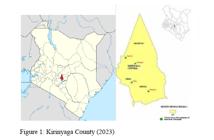
In turn, Kirinyaga County, rich with flora and fauna and one of the country's most biodiverse, consists of five districts: Kirinyaga Central, Mwea West, Mwea East, Kirinyaga West, and Kirinyaga East. The area, which is largely regarded as a "fertile crescent," is served by seven major rivers: Ragati, Rwamuthambi, Rundu, Thiba, Nyamindi, Rupingazi, and Sagana. River Sagana is the longest river in Kenya (about 1, 000 kilometres long). However, it drains its waters to the Indian Ocean under different names, especially as Tana River (pers. Comm. with Milton Munene Gachau, at Kianguenyi, Kenya, 17 January 2023). Tana River donates its name to the Tana River County. Likewise, Ragati is a significant river to this research article as it lies along Kirinyaga-Nyeri County boundaries, though it does not determine the actual county boundary, as Rupingazi separates Kirinyaga and Embu counties on the eastern side.
Ragati is also a very significant river as General Ndaya (from the present-day Kirinyaga West district) was killed during the infamous battle of River Ragati of 16 to 17 October 1953 (pers. Comm. with Milton Munene Gachau, at Kianguenyi, Kenya, 17 January 2023). As the Mau-Mau rebels squared out with the colonial forces, General Ndaya, the top commander, lost his life.
b) Methods and Materials
In seeking to establish how Kenya's leading fighter for religio-cultural independence, General Ndaya, journeyed with the concepts of land and freedom (wiyathi na ithaka) in the dark days of the colonial era, the 1940s and 1950s, the research article utilised oral history techniques, such as storytelling, archival sources, and interviews and/or personal communication schedules, among others. The qualitative data was also established via phone calls with people who were connected to this topic under discussion, and it included General Ndaya's close confidants and friends who battled colonialism with him in the 1950s. Interviews or personal one-on-one communication with family members also proved useful, especially where follow-up consultations were needed. A reading from General Ndaya's senior, General China (real name, Waruhiu Itote), who has devoted several paragraphs to him in his book, Mau Mau in Action (Itote 1979), is another reliable source of data gathering. Besides, archival sources have also aided the authenticity of this research article, as they helped in confirming dates of events (Itote 1979). A case in point is that of the "Handing-Over Report" by Major Wainwright (1956), the then-District Officer of Ndia, who was based at Kerugoya Town, Kirinyaga County, whose write-up helped us to establish the exact time and date of General Ndaya's killing. With some oral sources saying that he was killed in early 1953, the report from the Kenya National Archive, Nairobi, and the personal communications with the immediate family members become the most accurate. Certainly, exploring the contribution of one of the makers of modern Kenya, General Ndaya, whose history has remained suppressed in Kenya's historicity, is a worthy exercise.
Results
Introduction
General Ndaya's real name is Wanjie wa Ndegwa. He was also called by other names, such as Wanjagi wa Ndegwa (the most popular name). According to his younger sister, Cecilia Wanjiku wa Ndegwa, General Ndaya was born around 1920 and was a firstborn in the family of Ndegwa (his father). Others who were born after him, chronologically, were Wangu (a lady who came immediately after Ndaya), Wanjiku (interviewee), Mutero, Gakono, and Leah Muthoni. His step-brothers were Stephen Maguru, Cecilia Wanjiru, Wanjiku, Njoki, and Festus Njomo (pers. comm. with Cecilia Wanjiku wa Ndegwa, 9 February 2019). In this polygamous family, where Ndaya began to practice his leadership skills by default, he was the first-born child of Ndegwa wa Maguru and Maria Wangui (pers., comm., with Cecilia Wanjiku wa Ndegwa, 9 February 2019). During the most memorable Solar Eclipse that hit Kenya and its neighbours, on 24 January 1925, he was just a young boy. According to this explanation, Ndaya, then Wanjagi (the more official name), could not comprehend how the moon, the sun, and the earth, "all lay in the same plane," operated. He could not comprehend how this overlap took more than seven minutes and put the country at a standstill (pers. comm. with Cecilia Wanjiku wa Ndegwa, 9 February 2019). Perhaps, this further aroused his curiosity, which later drove him to engage in religio-cultural agitations that culminated in the armed struggle.
Ndaya the Man
Beyond his obsession with land politics, Ndaya was a polyglot, as he spoke English, Kiswahili, Kikuyu, Kamba, Meru, Embu, Dholuo, and Indian languages fluently, probably learnt during his days of undertaking menial jobs in Nairobi, from 1943 to 1948 (pers. com., with Festus Njomo Ndegwa, Kianjang'a, 9 February 2019). He would purchase clothes and gift them to his younger siblings upon earning a stipend from his menial jobs. He married Wamiricu wa Thirui from Ndigaru, Mwirua location of Kirinyaga County, in 1950. They bore one baby girl called Wathoko, who died in 1952. His wife Wamiricu was arrested at the end of 1952 over her association with Ndaya. She died in early 1952 from torture and other forms of mistreatment as she was being transferred from Kamiti Maximum Prison to Gathigiriri Prison of Mwea, Kirinyaga County. Hence, the General's immediate family vanished with him in December 1953 upon the death of Wathoko, his only daughter (pers. com., with Festus Njomo Ndegwa, Kianjang'a, 9 February 2019).
What's in a Name?
In trying to understand why Wanjagi wa Ndegwa was renamed as General Ndaya in March 1953, it is worthwhile to recall William Shakespeare's famous quote: "What's in a name? That which we call a rose by any other name would smell as sweet" (Shakespeare 1597, 12). Although Juliet in Shakespeare's play, Romeo and Juliet, appears to downplay the value of names by arguing that it doesn't matter that Romeo was from her rival's house of Montague (Shakespeare 1597), it is worthwhile to concede that it matters, especially during wartime. Indeed, the shift from Wanjagi wa Ndegwa to General Ndaya has a huge implication in Mau-Mau historiography. Land politics were too involving and fiercely contested that a name was no longer a name but meant much more than its mere mention. Coupled with this, death was a likely companion while pursuing wiyathi na ithaka (land and freedom). At times, the change of name meant a complete transformation of an individual. In other words, a Montague was not just a Montague, as characters in Romeo and Juliet could as well mean different things altogether: Referring to Lady Montague, Lady Capulet, Juliet's Nurse, Benvolio, Tybalt, and Mercutio (Shakespeare 1597). Equally, Romeo and Juliefs key themes, namely love and hate, fate and free will, conflict and violence, family and societal pressures, and the impulsiveness of youth, imply that the characters involved have different roles, and this may translate to different names and diverse meanings. This confirms that names are not just names. There is more than meets the eye in a name (Shakespeare 1597)-as General Ndaya's case demonstrates.
In striving to understand the change of names for characters during Kenya's war of independence, it is worthwhile to address the key factors that ushered in the new state of things. First, the rank of a general is a military one that the Heka Heka platoon of the present-day Nyeri County, under the overall leadership of General China (real name Waruhiu Itote), gave him after he proved extraordinarily brave and eloquent on land politics matters. By early 1952, Embu and Kirinyaga Counties (which were then one monolithic Embu District, 1933-1963) had not yet formed their own Mau-Mau military platoon (pers., com., with Festus Njomo Ndegwa, Kianjang'a, 9 February 2019). Hence, Wanjagi wa Ndegwa joined the existing platoon and eventually stole the show by becoming the first Mau-Mau general in both Kirinyaga and Embu counties, though he was recruited by Nyeri's Heka Heka Platoon. Second, the word "ndaya," in the local languages of central Kenya, is etymologically derived from the word "tall." Being a physically tall Mau-Mau soldier, who was about six feet in height, he could see far like the proverbial giraffe and advise accordingly. His commanding height (uraya) led his colleagues in the freedom struggle to call him Ndaya (meaning, the tall one); hence, the title of General Ndaya, which came into use in March 1953, meaning the "tall platoon leader." Before joining the Heka Heka platoon of Nyeri in early 1952, he was a returnee from Nairobi who first administered the oath in preparation for "the Great War" that was being discussed in hushed tones (pers. com., with Festus Njomo Ndegwa, Kianjang'a, 9 February 2019).
As noted earlier, veterans of World War 2 met for evening discussions and relaxation in Majengo, Nairobi City. After the day's hustles, they could use this public forum to debate the pros and cons of the armed struggle, among other thematic areas. Hence, Ndaya prepared the villagers for the bush war/guerrilla warfare on his return to Kianjang'a rural village in mid-1948. He did this by first administering the oath of royalty, which he began in mid-1948. Given this, Waruhiu Itote highlights the psychological significance of the binding ritualistic oath, which compelled initiates to guard war secrets, when he says,
The oath did a great job - the colonial government had little chance of survival for there were very few people in the police and the Kings African Rifles [KAR, Army] who had not taken the oath. The person who introduced the oath of Mau Mau was a very wise man and will be remembered forever. Through the oath people became bold (Itote 1979, 194; Gathogo 2024, 4).
Further, pseudonyms were important for Mau-Mau rebels, as they aided in concealing their names. It thus helped them to avoid getting noticed by the colonial authorities, who always wanted to capture them. Being labelled a terrorist demeaned their ontological worth; hence, killing a Mau-Mau rebel was a common trend (pers., com., with Milton Munene Gachau at Kianguenyi, Kenya, 17 January 2023).
Botched Pinnectomy Ritual in Mbeereland
Before the attempted oathing and eventual pinnectomy of the Ishiara-Mbeere people on 12 October 1953, Ndaya told his immediate family members at Kianjang'a that it was better to die in pursuit of religio-cultural freedom rather than remaining a vanquished, colonised person across historical times. Whenever he retreated to the villages at the wee hours of the night, he would always tell his siblings, "Don't worry, we shall win this war of land and freedom. For if we lose, Ngai (God) loses; but Ngai cannot lose" (pers., com., with Cecilia Wanjiku wa Ndegwa, Kianjang'a, 9 February 2019). Certainly, the statement that General Ndaya used: "Ngai ndangihotwo mbaraini" (God cannot lose any contest with human beings) is rooted in Africa's religio-culture, a fact that shows the rebels' religious inclination. Under such convictions, Ndaya's team went to administer the binding oath to the present-day Ishiara trading township, among the Mbeere people, Embu County, with full confidence that they too were still subscribing to the indigenous religious creeds (pers., com., with General Matene, Gitumbi, 17 May 2014). They were surprised to find that they had already moved on to the new religions (mainly the Roman Catholic and the Anglican Christianity) and were largely hopeful that the "teething troubles" in the colonial Kenya did not warrant a military solution. Some could not listen to the Mau-Mau rhetoric of land and freedom, as no land in Mbeere had been taken by the European settlers, nor had they identified the weaknesses of the scattered European missionaries in their locality.
In particular, the Consolata missionaries (the Roman Catholics), who first arrived in central Kenya in 1902 at Tuthu-Murang'a County and celebrated their first mass there on 29 June 1902, were opening up Mbeereland to Western schools, medicine, and religiosity. This had aroused curiosity; hence, the church-state engagements had not been viewed negatively in Mbeereland by 1953, as with her Embu and the Kirinyaga neighbours. Even in the 21st century, both Mbeere North and Mbeere South sub-counties are still considered semi-arid areas with a higher poverty index than their neighbours. Hence, the missionaries and the colonial authorities were reluctant to set up centres there as they did with her neighbours. The coming of the Consolata Fathers and the Anglicans, much later, after the neighbouring Kigari had established a centre as early as 1910, largely gave the much-needed support to the locals (Gathogo and Nthukah 2019). Ndaya's mantra of land politics could not, however, convince them that a military solution was the way to go. Indeed, dialogue was viewed by some as the better option despite its elusiveness (pers., com., Bishop Gideon Ireri, Muraru-Mbeere, 15 June 2019). After failing to convince them, and indeed after meeting resistance from his stubborn audience, General Ndaya dared to order his soldiers to humiliate the "Mbeereland Christians" by commanding his non-medically trained, largely semi-literate soldiers to conduct pinnectomy by forcefully cutting off the left-hand side of the pinna. Ordinarily, pinnectomy is the surgical removal of the pinna (outer ear) and is often done as a result of an injury, skin cancer, or for reconstructive reasons. It is done by a trained surgeon in a standard hospital (Lanz and Wood 2004).
In this botched pinnectomy ritual at Ishiara, Mbeereland, on 12 October 1953, Nyamu wa Muriakori (later General Matene), who was one of Ndaya's soldiers, recalled hearing him command them, thus: "Cut their left side pinna, this is the only indication that they have partaken the oath of commitment to fight for land and freedom" (pers., com., with General Matene, Gitumbi, 17 May 2014). Certainly, this act captured not only the Kenyan media but also the international media, as the tag of "Mau-Mau as terrorists" became the vogue (pers., com., with General Matene, Gitumbi, 17 May 2014). Did Ndaya set his own trap that led to his waterloo on 17 October 1953 after the Battle of River Ragati? Seen as a too-brutal act to the people of Mbeereland who were resisting the Mau-Mau oath, using a knife to chop off their outer pinna was an extreme gesture in the quest for land and freedom. Clearly, Ndaya invited the trouble that followed him to the hilt, as he paid with his own life five days later. Henceforth, his platoon was monitored through diverse tracking systems until he was eliminated at 33 years old. Before the Mbeere attack on 12 October 1953, they first went to Mbogo-ini village of Kianjang'a sub-location, near Baricho Town (10 October 1953). Specifically, they went to the compound of Ndegwa wa Maguru, Ndaya's father. They coerced everyone to undertake the oath, which they readily administered. Those who partook in it included Ndaya's father (Ndegwa), Maria Gathungu (stepmother), Maria Wangui (Ndaya's mother), Stephen Maguru (Ndaya's brother), Sicilia Wanjiku Ndegwa (Ndaya's sister), Sicilia Wanjiru Ndegwa (another Ndaya's sister), Jeremiah Kabuba (brother-in-law to Ndaya), and other members from the locality (pers., com.., with Festus Njomo Ndegwa, Kianjang'a, 9 February 2019). Under the prevailing circumstances, no one would resist taking the Mau-Mau oath, as rebels killed dissenters. By then, it was assumed that those who refused to take the oath were potential betrayers of the quest for land and freedom and were indeed viewed as enemies of Ngai (God). Hence, it was compulsorily administered.
During this 10 October 1953 oath session at Mbogo-ini compound of Ndegwa wa Maguru, Festus Njomo recalled his unpremeditated training by General Ndaya when the latter (his elder brother) posed a question to him, thus: "Do you know me?" Njomo replied, "Yes" (pers., com., with Festus Njomo Ndegwa, Kianjang'a, 9 February 2019). This was followed by a slap from the General. The slap was meant to train Festus to learn to say "No" whenever the colonial operatives inquired about the rebels. Since the Mau-Mau was a secretive movement, a person who had taken the oath swore to keep the fighters' secrets to the bitter end. Ndaya also told Njomo to change his name and revert to his ancestral name, Gaciani, as the latter's name was derived from the freedom hero (Jomo Kenyatta, later president). The change of name, from Gaciani to Njomo/Jomo, came when Jomo Kenyatta, the then-Principal of Kenya African Teachers' College (KATC), 1 Githunguri, Kiambu County, visited Giaciera African Independent School at Mitondo near Kiburu Town, in 1948. The college was sponsored by an African-instituted ecclesiastical outfit, the African Independent Pentecostal Church of Africa (AIPCA), through their educational arm, the Kikuyu Independent Schools Association (KISA). The African independent schools and colleges were, however, banned on 14 November 1952, as they were viewed as breeding grounds for political agitators. As noted in A. S. Adebola (1981),
On October 22, 1952, the colonial administration in Kenya declared a state of emergency over Kikuyu territory. Among other things, virtually all the known leaders of the independent schools movement were arrested and detained. This was followed on November 14, 1952, with the proscription of the two bodies making up the movement for the Kikuyu Independent Schools Association (KISA) and the Kikuyu Karing'a Education Authority (KKEA). Thirty-four of their schools with a total of 11,026 pupils were closed down, while the remaining eighty-four schools with about 30,000 pupils, were given till the beginning of January 1953 to come under the management of either the government-controlled District Education Board (DEB) or the missions. When almost all these schools refused to accept this, they were ordered to be closed down as well (p.53).
Thus, as noted above, the coming of the then-Principal Kenyatta, who was also the overall leader of the Africans in Kenya, had a huge impact on the Mitondo-ini-Kiburu area, as some parents sought to rename their children after him. In the case of Festus Njomo/Jomo, he was born in 1946 and named Gaciani, following the community's religio-culture. Two years later (1948), he was renamed Jomo/Njomo, as noted above. Following the ban on African independent schools and colleges in November 1952, the Roman Catholic and Anglican Church's schools were left to operate in the locality (pers., com., with Festus Njomo Ndegwa, Kianjang'a, 9 February 2019). General Ndaya's rejection of the name Njomo/Jomo was on the basis that it was risky for his brother's existence, as Jomo Kenyatta was equally anti-colonial rule, and had been arrested from 20 October 1952 to 1961.
After the botched pinnectomy at the Ishiara Market, General Ndaya and his boys (a team ranging from 40-60), passed through his father's household (Ndegwa wa Maguru) in the evening of 15 October 1953. An eyewitness recalls that they were well-armed with pangas (machetes) and a few guns. As they took the fermented porridge (Kigagatio), which was stored in the indigenous gourds, they told the Ndegwa's family that they were coming from Mbeere and had conducted a botched pinnectomy, paradoxically as a confirmation of their commitment to the freedom struggle and as a punishment for the rejection of the Mau-Mau oath. Ndegwa wa Maguru's household, though troubled by their increasing extremism, responded by cautioning that they could be shot dead by the colonial government operatives if they kept on sneaking into his compound from time to time (pers., com., with Cecilia Wanjiku wa Ndegwa, Kianjang'a, 9 February 2019).
The Roman Catholic Church Attacks
Perhaps one of the ugliest moments, apart from the Mbeere ritual of pinnectomy, is the Baricho Roman Catholic Church attack of 15 October 1953. It took place after the Mbeere attack of 12 October 1953. Here, Ndaya's boys killed two African Roman Catholic sisters (Mbugua 2020). Why? Reportedly, the sisters were overt in their deep hatred for the Mau-Mau movement and the resultant oath rituals. Equally, the rebels hated the sisters for defying Africa's religio-culture that compels everyone to have a family (polygamy or monogamy) and raise it. They viewed them as a bad example to the community, as their Roman Catholic faith held back the birth rate of their nation. The sisters had also annoyed General Ndaya's rebels by their overt condemnations of the Mau-Mau oath, as it involved the denial of the Roman Catholic faith. The priests and sisters whose heads were literally being sought by the rebels were encouraging their congregants to keep their faith at all costs; hence, "remain faithful unto death" (Rev. 2:10). Those who were coerced to take the rebels' oath were encouraged to come back to sacramental life through a sacrament of reconciliation (Mbugua 2020). The Roman Catholic Church at Baricho was also hosting dozens of speakers who were opposed to the land politics as espoused by the Mau-Mau rebels. The two martyred Roman Catholic sisters were Cecilia Wangechi and Rosetta Njeri, born in 1922 and 1930, respectively. A third sister was shot at but survived the attack. During those attacks, a home guard who came out to help the sisters was also shot dead (pers., com., with Mandarina Wangari Miano, Kianjang'a, 9 February 2019).
Battle of River Ragati and Ndaya's Death
During the Battle of River Ragati on 16 October 1953, the Mau-Mau rebels under General Ndaya captured colonial home guards. They held them captive and forced them to cut a huge Mugumo tree. The idea here was to allow the rebels to cross over the swollen River Ragati, as they were being pursued after the Baricho Roman Catholic attacks. Hence, the Baricho Catholic attacks pushed Ndaya and his team to escape towards the neighbouring Nyeri District. Apart from the Battle of River Ruiru of late 1952, this was another major battle fought during the Mau-Mau insurgency. There were so many casualties on both sides of the divide. Some died instantly from bullet wounds. Others were swept away by the swollen Ragati River. This affected the government side as well as the rebels' side (pers., com., with General Matene, Gitumbi, 17 May 2014).
In the Battle of River Ragati on 16 October 1953, General Ndaya was shot on his left leg, just as he ordered the cutting of the left-hand side of the pinna in Mbeereland and was carried by his soldiers and hidden on the banks of the river (Kibirigwi), in a secluded cave (pers., com., with Festus Njomo Ndegwa, Kianjang'a, 9 February 2019). His boys assigned him a woman rebel who was to take care of him as other rebels fled to safer areas. As the young woman rebel (18 years old) went out of the cave to bask in the morning sun, she saw a team of colonial administrators assessing the spot where military engagements had taken place the previous day. She panicked, as she wrongly feared that they were coming for Ndaya. Besides this, they shot in the air twice to scare her, after which she showed them where the general was hiding. She said, "Don't kill me. Let me show you where he is" (pers., com., with Festus Njomo Ndegwa, 9 February 2019). Indeed, the memory of the swollen River Ragati, which had become reddish during the previous days' battle, was still a traumatic scene for the youthful woman fighter. Hence, her panic can be understood along these lines. Equally, when the wounded General Ndaya finally saw this high-level patrol team surrounding his hiding river cave, he raised his hands as a gesture of surrender and asked the leading policeman, who was his age mate, thus: "Wanyina na tuarua nowe-i ni-ukunjuraga?" (My age mate, whom we got initiated together, will you kill me, though we have been fighting on different sides?). After this, the colonial police officer (a local African, and his age mate) shot him in his chest. Afterwards, the bleeding General Ndaya was carried off and bundled into a Land Rover, bearing the words: "On Her Majesty's Service" (OHMS). The vehicle had been released to the site by the District Officer of Ndia Division (Major Wainwright, nicknamed Kahara by the locals due to his baldness). Ndaya was taken to Baricho Chief s Camp, which was then headed by a senior chief of the area. Upon arrival, he asked for water. Curiously, the leading colonial official hit the handcuffed captive on his head with a huge stone (Ihiga ria gwaka). That became the last straw that broke the camel's back, and the general died instantly, as the surging crowd watched helplessly (pers.., com., with Mandarina Wangari Miano, Kianjang'a, 9 February 2019; pers., com., with Festus Njomo Ndegwa, Kianjang'a, 9 February 2019; and pers., com., with General Matene, Gitumbi, 17 May 2014).
General Ndaya's body was later taken to Embu Town (the then-headquarters) and shuttled later to Kerugoya Town, where it was secretly buried in a prison cemetery. This shuttling of the lifeless body was meant to confuse and scare the would-be admirers of the general and eventually conceal the burial site. Earlier at Baricho chief s camp, a woman who overreacted after seeing the frail general was badly censured by a colonial home guard. Such home guards would play their victims by shooting the already dead general while they were still at Baricho chief s camp. Certainly, it was their way of scaring the crusaders of land and freedom (wiyathi na ithaka) and a tactic of dissuading them from joining the rebel activities (ibid.). Was it a religio-cultural contest turned awry? Before this incident, the local sub-chief (headman) who was part of the operation went to report to Ndegwa's father (Ndegwa wa Maguru), albeit mockingly, thus: "Wiyathi wanyu ni waitika. Mubiciguo nitworaga. Urari wiyathi riu ni maithori" (Your quest for land and freedom is now a pipedream. We have killed your son. You said, it is the quest for land and freedom; but now it is endless tears) (pers., com., with Mandarina Wangari Miano, Kianjang'a, 9 February 2019). Ndegwa then replied, "Muthoniwa uguo niguo wanjira? Ke-imba giku?" (My in-law, is that what you have told me? Where is the corpse?). But the sub-chief replied, "Ke-imba ni kia thirikari" (The dead body of General Ndaya belongs to the government) (pers., com., with Mandarina Wangari Miano, Kianjang'a, 9 February 2019; pers., com., with Festus Njomo Ndegwa, Kianjang'a, 9 February 2019; and pers., com., with General Matene, Gitumbi, 17 May 2014).
Memorising General Ndaya
In 2005, the Mau-Mau Original Trust visited his burial site to conduct religious rituals in his memory. Just as in the case of General Chui wa Mararo, the visit was led by their chairman, General Ngacha Karani. The team also included Major Kabwere (Benson Mwangi Kanyari), General Matene (Mwembe Matuako aka Nyamu wa Muriakori), Brigadier Kubai (Dedan Gituke Kogi) and the Mau-Mau Original Trust Chaplain, Rev. S. Chabangui Ngatunyi of the AIPCA,2 who consecrated the site by conducting rituals in his honour. As the Mau-Mau Original Trust visited Ndaya's burial site in 2005, they could not identify the grave as the suspected burial site (Baricho) was covered with Napier grass. Again, our research has shown that General Ndaya was buried at Kerugoya prison cemetery rather than the Baricho Town graveyard (pers., com., with Milton Munene Gachau at Kianguenyi, Kenya, 17 January 2023).
Conclusion
From the outset, this article sought to explore the delicate context where the church was classed with the oppressor during Kenya's colonial era, a phenomenon that partly triggered the politics of land and freedom (wiyathi na ithaka). It has demonstrated the perceived unholy alliance between the church and the colonial authorities on one hand versus the Mau-Mau rebels and the general society on the other hand, who were seen as two antagonistic groups in the 1940s and 1950s. Further, General Ndaya's lifetime is chronicled to demonstrate the wrong perception that triggered the view that the church and state were birds of the same feather. Given this, the article has demonstrated the religio-cultural contests that pitted the duo. While the Mau-Mau rebels were religio-culturally beholden to the African indigenous religion, the pro-colonial forces viewed the former as wayward Christians, as most of the rebels were largely schooled in the European missionary schools that sought to convert students in the course of learning. Primarily, learners were taught the basics of Christianity and subsequently taught other non-religious subjects (refer to Mathematics, Geography, History, Home Science, General Science, and so on). By retreating to the forest, as guerrilla fighters, the Protestant and Roman Catholic churches were at a loss as their trainees had ironically metamorphosed from "good" pupils to bitter enemies of the same religion that had introduced Western education to their respective localities. In particular, General Ndaya studied at the Upper Baricho Primary School up to Class Four in the late 1930s but began his "decolonisation" of his mind by rejecting Westernisation that went hand-inhand with Christianity, as was propounded by the European missionaries in the mid-20th century. In this Kianjang'a-Baricho area of the present-day Kirinyaga County, the heavy presence of the Anglican and Roman Catholic Christianity was felt during Ndaya's formative stages (1920s and 1930s), as the African-instituted religious outfit, the AIPCA, opened its schools in the mid-1940s, though they were banned by the colonial authorities in late 1952. While the AIPCA encouraged its adherents to embrace some elements of African culture, the missionary schools discouraged it and insisted that school-going pupils had to abandon "pagan practices and rituals" and "embrace Christianity" as they presented it in a Western garb (Kiereini 2020).
Overall, the article has interfaced land, freedom, church, and oral history in its endeavour to understand the intrigues that brought friction among General Ndaya's team (Mau-Mau rebels) and the perceived church and state "dalliances" in colonial Kenya. Did Ubulwane (beastly behaviour) replace Ubuntu (humane ways) during Kenya's quest for religio-cultural independence? And wasn't the Baricho attack on the Roman Catholic Church a huge setback in the "noble" quest for civil liberties in colonial Kenya? Equally, the botched pinnectomy, as a measure of humiliating the "young" Mbeere Christians, is a bizarre act. Likewise, the colonial authorities, who hit Ndaya's head with a stone upon his capture, rather than taking him through the due process of the law, display some unreasonableness in handling the Mau-Mau rebels (the youths). With his wife dying in 1952 due to torture-related concerns, and their only daughter dying in her infancy stages as a result of poverty-related concerns, Wanjagi wa Ndegwa's blood lineage remains invisible in the 20th century, save for a few surviving siblings. As a by-product of the environment within which he grew, he remained truthful to his religio-cultural context and died while trying to preserve it in the most "appropriate" way possible. Certainly, the bizarre activities meted out on the people across the socio-religious divides will always remain a sad chapter in historical times.
References
- Adebola, A. S. 1981. "The Kikuyu Independent Schools Movement and the Mau Mau Uprising." Journal of the Historical Society of Nigeria 10(4):53-71.
- Ford, K. C. 1976. "Tone in Kikamba and the Central Kenya Bantu Languages." Studies in African Linguistics 7(3): 261-293.
- Gathogo, J. 2014. "Mau-Mau War and the Church in Kirinyaga, Kenya: Accounting for the Tension and Conflict (1952-1960)." Studia Historiae Ecclesiasticae 40(2):19-41.
- Gathogo, J. 2017. "Mau-Mau War Rituals and Women Rebels in Kirinyaga County of Kenya (1952-1960): Retrieving Women's Participation in Kenya's Struggle for Independence." Studia Historiae Ecclesiasticae 43 (2):16 pages.
-
Gathogo, J. 2020. "A Brave One-legged General: The Story of Mau Mau General, Kassam Gichimu Njogu." HTS Teologiese Studies/ Theological Studies 76(4): a6155. https://doi.org/10.4102/hts.v76i4.6155
» https://doi.org/10.4102/hts.v76i4.6155 - Gathogo, J. 2023. "Missionaries' Engagement with Science and Technology in the Colonial Kenya (1887-1963)." Journal of Religion in Africa 53:1-25.
-
Gathogo, J. 2024. "Religion, Politics and War: Recollections on General Ndaya and Kenya's Quest for Independence." Theologia Viatorum 48(1):1-11. https://doi.org/10.4102/tv.v48i1.266
» https://doi.org/10.4102/tv.v48i1.266 - Gathogo, J. and Nthukah, M., 2019. A Fallow Goldmine: One Hundred Years of Mbeere Mission in Kenya, 1919-2019. Nairobi: Kairos.
- Kenyatta, J. 1938. Facing Mount Kenya. London: Secker and Warburg.
-
Kiereini, D. 2020. "Rise of African Independent Church Movement in Kenya." Business Daily, 25 December 2020. https://www.businessdailyafrica.com/bd/lifestyle/society/rise-of-african-independent-church-movement-in-kenya-2230622 (accessed 12 June 2025).
» https://www.businessdailyafrica.com/bd/lifestyle/society/rise-of-african-independent-church-movement-in-kenya-2230622 - Kinyatti, M. 2009. Mau Mau: A Revolution Betrayed. Charleston: BookSurge.
-
Kirinyaga. 2023. "About Kirinyaga County." Kirinyaga County. https://opencounty.org/county-about.php?com=8&cid=20 (accessed 23 June 2023).
» https://opencounty.org/county-about.php?com=8& cid=20 -
Lanz, O. I. and Wood, B. C. 2004. "Surgery of the Ear and Pinna." Veterinary Clinics of North America: Small Animals Practice Journal 34(2):567-99. https://orcid.org/10.1016/j.cvsm.2003.10.011
» https://orcid.org/10.1016/j.cvsm.2003.10.011 - Mbugua, H. 2020. "Celebrating our Heroines." Catholic Diocese of Murang'a: Our Lady of Sorrows Baricho Catholic Parish, Unpublished Material, 25 October 2020.
-
Milestones 2023. "Decolonization of Asia and Africa, 1945-1960." Office of the Historian.https://history.state.gov/milestones/1945-1952/asia-and-africa (accessed 5 September 2023).
» https://history.state.gov/milestones/1945-1952/asia-and-africa - Nthamburi, Z. 1995. A History of the Methodist Church in Kenya. Nairobi: Uzima.
-
Nyakinyua. 2023. "Kikuyu Nyakinyua Women Dances." https://youtu.be/TNlDJX5s7tQ (accessed 6 October 2023).
» https://youtu.be/TNlDJX5s7tQ - Peacock, H.L. 1987. A History of Modern Europe 1789-1981. Nairobi: Heinemann.
- Shakespeare, W. 1597. Romeo and Juliet. Barnes and Noble.
-
Truman, H. 1947. "Truman Doctrine (1947)." National Archives 1947. https://www.archives.gov/milestone-documents/truman-doctrine (accessed 23 April 2024).
» https://www.archives.gov/milestone-documents/truman-doctrine - Wainwright, M. 1956. "Handover Report of [2nd July] 1956 for Ndia." The District Officer, Ndia - Materials gathered from the Kenya National Archives, Nairobi.
2 As noted in Gathogo (2014,37), the membership of the Anglican Church "declined considerably [in the 1950s] as people joined AIPCA and the Roman Catholic Church," which were less vocal against the rebels. In June 2013, the African-instituted church, AIPCA, joined the Mau Mau remnants who were suing the British government, the former coloniser, for atrocities meted against them in the 1950s. In joining others to seek compensation for the 1950s' war, it is a clear pointer to their active role in the freedom struggle, as opposed to the missionary churches that insisted on dialogue and an end to the guerrilla war. The AIPCA claimed that most of its institutions, mainly schools, were taken over by the colonial government, even though they were involved in the independence struggle. In their June 2013 requests, the AIPCA was also telling the Kenyan government to return their institutions (schools and colleges) that were taken away by the colonial government or banned altogether on 14 November 1952 or give them alternative land to develop others (Adebola 1981).
