
 Ophir and the Nusantara: Tracing Solomon's Maritime Trade in Southeast Asia
Abstract
This article reassesses the possible identification of the biblical land of Ophir with the Nusantara-particularly Sumatra and Borneo-by foregrounding the triad of commodities most closely associated with Ophir in the Hebrew Bible: gold, apes, and peacocks (1 Kgs 9:28; 10:11, 22; 2 Chr 8:18). Using an interdisciplinary method that integrates biblical studies, historical linguistics, zoology, and maritime history, the study treats these goods as concrete indicators of long-distance interaction with maritime Southeast Asia. Special attention is given to the rare Hebrew term tukkiyim ("peacocks"), a hapax legomenon-a word occurring only once in the Hebrew Bible-whose likely South/Southeast Asian etymology aligns with the distribution of the green peafowl (Pavo muticus). The article also examines the Phoenician maritime network and the three-year cycle of Solomon's fleet (1 Kgs 10:22) to evaluate the plausibility of long-range trade. While ancient authors such as Josephus place Ophir in "India," the term in antiquity could encompass regions reaching to the Far East, plausibly including the Indonesian archipelago. By situating the Nusantara within Old Testament geography, the study challenges West-centric assumptions and presents a plausible, though not definitive, Southeast Asian horizon for Ophir. These findings enrich biblical interpretation and contextual theology for the Global South, underscoring the universal scope of God's redemptive plan.
Ophir; Nusantara; Maritime Southeast Asia; Tarshish ships; tukkiyim
Introduction
King Solomon's wealth is one of the greatest symbols of prosperity in the history of ancient Israel. In the biblical narrative, it is repeatedly mentioned that Solomon received a supply of gold, gemstones, sandalwood, apes, and peacocks from a place called "Ophir" (1 Kings 9:28; 10:11, 22; 2 Chronicles 8:18). Although Ophir is often identified with territory that is not yet known with certainty, this record opens up interesting questions about the geographical scope and trade relations of Israel with the outside world in Solomon's time (10th century BC) (Kitchen 2003, 128-133).
Over the years, the location of Ofir has been interpreted using various approaches: linguistic, archaeological, biblical geography, and even speculative-theological. Most traditional understandings place it in South Arabia or East Africa. However, some of the linguistic clues, flora, and commodities mentioned open up a new possibility that has been underexplored in the academic literature, namely the possibility that Ofir refers to the Southeast Asian region, especially the archipelago (Sumatra and Kalimantan). (Ancrenaz, Marc 2016; Yamauchi 1974).
This article aims to systematically investigate the possibility that the archipelago was part of the land of Ophir mentioned in the Bible through an interdisciplinary approach: biblical interpretation, Hebrew linguistics, tropical zoology, and ancient maritime history. This article does not aim to provide an absolute conclusion. However, it does suggest that this hypothesis deserves to be included in a broader academic discussion of cross-cultural history in the Bible. The study also seeks to challenge traditional interpretations centred in the West and expand global insights into the role of Southeast Asia in the biblical narrative.
With the emergence of new research in the field of maritime archaeology and the ecology of tropical fauna, such as studies by Ancrenaz et al. (2016) on the distribution of orangutans and Kong et al. (2018) on green peacocks, there is a great opportunity to integrate modern data into ancient theological and historical discussions. (Ancrenaz, Marc 2016; Kong 2018) This research is relevant for biblical studies and significantly contributes to the development of contextual theology in the southern hemisphere, especially in Southeast Asia.
Methodology
This study employs an interdisciplinary qualitative research approach that synthesises biblical studies, historical linguistics, maritime archaeology, zoological distribution, and contextual theology (Suria and Ming 2025). The method is structured as follows: 1) Textual Exegesis of Biblical Passages. The research begins with a historical-critical analysis of key biblical texts (e.g., 1 Kings 9:28; 10:11, 22; 2 Chronicles 8:18) that mention Ophir and Solomon's maritime expeditions. This includes examining the literary, historical, and theological contexts of the passages and how they have been interpreted in Jewish and early Christian traditions. 2) Linguistic and Etymological Analysis. Specific Hebrew terms-such as qofim (apes) and tukktytm (peacocks)-are examined using lexical tools and comparative linguistics to trace their potential origins and loanword connections with South and Southeast Asian languages (e.g., Tamil, Sanskrit, Austroasiatic). 3) Comparative Zoological and Ecological Data: Zoological data are used to evaluate the natural habitats and distribution of species mentioned in the biblical texts, especially orangutans and green peacocks. Peer-reviewed ecological studies are consulted to assess the plausibility of these animals originating from the Southeast Asian archipelago. 4) Historical-Maritime Analysis: The study investigates ancient Phoenician maritime capabilities, trade routes, and ship types to evaluate the feasibility of long-distance trade between the Red Sea region and the Indonesian archipelago. Archaeological and historical sources related to trade in the Indian Ocean and Southeast Asia are examined. 5) Archaeological Correlation. Indirect archaeological evidence from Sumatra, Borneo, and related regions is analysed-such as the findings at Barus and depictions at Borobudur Temple-to support the argument of early maritime exchange with West Asia. 6) Contextual Theological Reflection. The theological implications of the identification of Ophir with the Nusantara are explored, especially in relation to the universality of God's mission, the inclusion of the Global South in biblical narratives, and the development of contextual theology in Southeast Asia.
By integrating data from multiple disciplines, this method allows for a robust, multi-angle exploration of the hypothesis that the land of Ophir may be historically and geographically connected to the Southeast Asian archipelago.
Result and Discussion
Biblical Texts and Jewish Tradition
This article uses historical-critical exegesis of biblical texts to understand Ophir's locations historical and geographical context. This technique helps identify the biblical narratives literal and symbolic meanings of geographic references. For example, the name "Ophir" first appears in Genesis 10:29 as part of the genealogy of the descendants of Joktan, a descendant of Shem. This suggests Ophir has fairly old roots, even before Solomon's time.
In the context of 1 Kings 9:28 and 10:11, Ophir is significant because it is said to be the birthplace of 420 talents of gold, an unusually large amount for his day (equivalent to ±15,750 kg ofpure gold). Not just gold, for in 1 Kings 10:22, Solomon's ships-referred to as Tarshish-brought "gold, silver, ivory, apes, and peacocks" every three years. This three-year cycle is important for calculating ancient ships estimated distance and travel time. In this context, the items show wealth and exotic and tropical origins.
The early rabbinic and Christian traditions provide diverse interpretations of Ophir. Targum Jonathan associates Ofir with India, while the Midrash Rabbah sometimes refers to it as a place at the world' s end. Josephus, a first-century Jewish historian, mentions that Ophir was located in the territory of India (Josephus, n.d., chapter 6, section 4). However, in an ancient context, India can refer broadly to the Far East, including the area that is now called the archipelago.
Some early Christian traditions also associate the existence of Ophir with "the far regions of the East" in line with the view that the Messiah and the kingdom of God would reach all nations, including those from the Far East (cf. Matt. Isaiah 60; Psalm 72:10) (Hengel 1989, 22-23)
To explore the possible location of Ophir, this study begins with a historical-critical exegesis of relevant biblical texts. This method helps uncover both the literal and symbolic meanings of geographic references within the narrative, offering insight into the broader historical context of King Solomon's trade networks.
The name "Ophir" first appears in Genesis 10:29, within the genealogy of Joktan, a descendant of Shem. Its early mention indicates that Ophir was known even prior to the time of Solomon, suggesting deep historical roots. This ancient association sets the stage for later references to Ophir as a significant source of wealth during Solomon's reign.
In 1 Kings 9:28 and 10:11, Ophir emerges as a critical trade destination, recorded as the origin of 420 talents of gold-equivalent to approximately 15,750 kilogrammes. This is an unusually large quantity for that period and highlights Ophir's economic importance. Further, 1 Kings 10:22 describes the return of Solomon's fleet every three years with cargo that included gold, silver, ivory, apes, and peacocks. The specificity and rarity of these items not only reflect extraordinary wealth but also suggest exotic, tropical origins likely located far from Israel.
The diverse interpretations of Ophir found in early Jewish and Christian traditions provide additional clues. For instance, Targum Jonathan links Ophir to India, while Midrash Rabbah describes it more vaguely as a land at the world's end. Likewise, the Jewish historian Josephus identifies Ophir with the territory of India (Antiquities, Book VIII, Chapter 6). However, it is important to note that in the ancient context, the term "India" could refer broadly to the Far East, potentially encompassing parts of what we now recognise as the Southeast Asian archipelago.
Similarly, early Christian traditions often viewed Ophir as symbolising "the far regions of the East," aligning with the eschatological vision that the Messiah's kingdom would extend to all nations. This is echoed in prophetic texts like Isaiah 60 and Psalm 72:10, where distant lands are envisioned as bringing tribute to the divine king. (Hengel 1989, 22-23). These theological motifs reinforce the idea that Ophir could be geographically distant yet theologically central, pointing towards regions such as Southeast Asia as legitimate candidates for its location.
Linguistic and Zoological Evidence of Ofir Commodities
Building upon the biblical references to Ophir, this section turns to linguistic and zoological evidence to explore the geographical plausibility of its Southeast Asian identification. The specific mention of unique and exotic animals-namely apes and peacocks-offers valuable clues regarding the possible origin of these commodities.
Gold, the primary commodity associated with Ophir, serves as a geographic anchor in this discussion. In ancient Indian literature, such as the Ramayana and Mahabharata, the term Swarna Dwipa ("Golden Island") is often used, widely believed by historians to refer to Sumatra. This correlation between Ophir and Swarna Dwipa strengthens the hypothesis that the biblical land may have been part of the Indonesian archipelago, especially given the ancient maritime trade between India and Southeast Asia.
Linguistic analysis deepens this connection. The Hebrew word for "ape" קֹפִי ם (qofim), appears exclusively in the context of Solomon's trade ventures. While often associated with Indian species, it is important to note that orangutans (Pongo pygmaeus and Pongo abelii)-more visually striking and behaviorally distinct-are found only in Borneo and Sumatra. Their unique characteristics and limited habitat provide compelling zoological evidence for Southeast Asia as Ophir;s location.
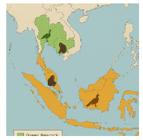
The term תַּּכִיִי (tukkîyim), often translated as "peacocks" is a hapax legomenon (a word or expression that occurs only once in a given body of text), appearing only once in the entire Hebrew Bible. Many scholars believe it is a loanword from Tamil (tokai), Sanskrit (sikhin), or even Austroasiatic roots. This rare term likely refers to the green peacock (Pavo muticus), whose natural distribution includes Indonesia and Southeast Asia, but not Africa or the Middle East. Research by Kong et al. (2018) and others confirms this ecological range.
Taken together, both linguistic and zoological analyses reinforce the argument that the commodities associated with Ophir-far from being generic or symbolic-have specific and traceable Southeast Asian origins. This strengthens the broader hypothesis that the biblical Ophir may correspond to regions within the Indonesian archipelago. One of the main things about Ofir is that it is pure gold in large quantities. This led to the search for an area historically known as a gold producer. In ancient Indian texts such as the Ramayana and Mahabharata, the term "Swarna Dwipa" (Golden Island) is known, and many researchers believe it refers to Sumatra (Donkin 1998, 78). This term later entered the Indian shipping and trade tradition as a centre for gold extraction and rare commodities.
The similarity of characteristics between Ofir and Swarna Dwipa is a strong basis for linking the two, especially since the India-Southeast Asia trade route was active long before the classical era.
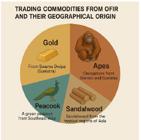
Hebrew linguistic analysis is at the heart of this section. The Hebrew term for "ape" is קֹפִי ם ("qofim"), the plural form of "qof' This only appears in the context of Solomon's ship. Some interpreters call this the "little ape of India" but orangutans (Pongo pygmaeus and Pongo abelii) only live in Borneo and shape, movements, and exoticism of orangutans are much more striking than thso of ordinary apes from India or Africa. Research by Wich, et al. shows that the distribution of orangutans is indeed limited to the region, reinforcing the possibility of the origin of this commodity from the archipelago. (Wich, 2008)
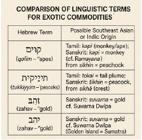
The Hebrew word תֻּכִיִי ם("ukkîyîm") also appears only in the context of Solomon's ship. This is the "hapax legomenon" in the entire Bible. Many scholars believe it is a loanword from Tamil ("Tokai"), Sanskrit ("sikhin"), or even the local Austroasiatic language. The peacock is a typical animal from India and Southeast Asia and is not known in Africa or the Middle East (Zorell 1988,912). Studies by Kong et al. and McGowan and Kirwan confirm the natural distribution of green peacocks (Pavo muticus) in Southeast Asia, including Indonesia, supporting this geographical argument (Kong et.al 2018). This means that this animal is a geographical indicator of trade that does not come from around Israel but from the region further east.
Phoenician Shipping Lines and Ancient Sea Trade
The Phoenicians were known in ancient history as the leading experts in shipping, trade, and shipbuilding in the Middle East region. In 1 Kings 9:26-28, it is mentioned that King Solomon developed a naval fleet from the port of Ezion-Geber, located at the northern end of the Gulf of Akaba, close to the Gulf of Aden and the Red Sea. The fleet operated with the men of Hiram, king of Tyre, the main port city of the Phoenicians (Kitchen 2003,132-135).
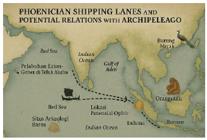
The Phoenicians were known for their seafarers who reached as far west as Spain and Britain and sailed east across the Red Sea and the Indian Ocean. The navigational and logistical capabilities of the Phoenicians allowed for extensive commercial expeditions, including the possibility of reaching Southeast Asia. (Casson 1991, 87).
The port of Ezion-Geber became the launching point for ships to "Ofir." From this port, ships sailed south down the Red Sea, out into the Gulf of Aden and the Indian Ocean. This route proved to be used by Arab, Indian, and East African traders (Yamauchi 1990, 142). Bellina et al. note that the coastal route Semenanjung Thailand-Malaysia has developed as a maritime commodity and cultural exchange region since the beginning of the first millennium (Bellina, Bérénice 2006).
The three-year sailing cycle in 1 Kings 10:22 makes more sense if the shipping route is forwarded to a distant region like Southeast Asia. The trip to South India is expected to take less than a year, so the round-trip and time-consuming cargo collection is possible if the destination is in the archipelago (Bock 2009, 287).
The type of ship of Tarshish mentioned in the Bible text does not refer to the location of Tarshish alone but rather to large ships for long voyages. The Phoenicians commonly used this ship type, which was known to be storm-resistant and could travel distances between continents (Finegan 1969, 62)
The study combined ancient maritime history with archaeological data to understand the possibility of Solomon's fleet reaching Southeast Asia. Solomon's naval fleet, operating from the port of Ezion-Geber, was analysed based on the Phoenicians's shipping technology. The three-year shipping cycle in 1 Kings 10:22 is examined to show that a more distant route, such as Southeast Asia, makes more sense than a closer destination, such as South India. Studies by Bellina et al. (2006) on developing trade patterns in the Thailand-Malaysia Peninsula are also used to support this argument. This approach combines maritime historical analysis with archaeological evidence to build a strong argument. To further evaluate the plausibility of a Southeast Asian Ophir, it is essential to consider the maritime capabilities of the ancient world. The Phoenicians, who partnered with King Solomon, were renowned for their advanced seafaring skills and extensive trade networks.
According to 1 Kings 9:26-28, Solomon's fleet operated from Ezion-Geber, a port on the northern tip of the Gulf of Aqaba. This strategic location allowed access to the Red Sea and, by extension, to broader maritime routes leading to the Indian Ocean. The biblical narrative describes how Solomon's navy, with assistance from Hiram, king of Tyre, embarked on long voyages to acquire gold and other valuable items.
Historical sources and archaeological evidence support the idea that Phoenician ships reached as far as Spain and Britain to the west, and plausibly India and beyond to the east. Maritime historians, such as Casson (1991), emphasise the durability and long-range capacity of Tarshish ships, which were capable of enduring extensive journeys across open waters.
The mention of a three-year sailing cycle in 1 Kings 10:22 implies a destination that was not only distant but required considerable time for round-trip travel and loading of exotic goods. This timeframe makes more sense if the voyages extended beyond India, potentially to Southeast Asia, rather than closer destinations that could be reached within months.
Scholars such as Bellina et al. (2006) have documented the development of trade networks along the Thailand-Malaysia Peninsula, which had already become a hub for cultural and commodity exchange by the early first millennium. This archaeological data aligns with the possibility that Phoenician-connected expeditions could have integrated with these Southeast Asian routes.
Taken together, the maritime capabilities of the Phoenicians and the biblical references to long-distance trade reinforce the viability of a connection between Solomon's fleets and the Southeast Asian archipelago.
Archipelago Maritime Traditions and Indirect Archaeological Evidence
The archipelago, which includes the modern Indonesian archipelago, has been known as one of the world's maritime centres for thousands of years. Its strategic location between the Indian and Pacific Oceans makes the region an important part of the ancient spice trade routes. Ancient Indian texts refer to this region as Swarna Dwipa, or the Golden Island, which many scholars identify as Sumatra (Majumdar 1927, 61-64).
In ancient Indian and Chinese traditions, trade in spices, sandalwood, ivory, and exotic animals from the Southeast Asian region is mentioned. This is reinforced by the records of Arab and Persian sailors and the discovery of trade goods from West Asia at archaeological sites in Barus, Borneo, and Maluku (Manguin 1996, 1-28)
On the west coast of Sumatra, Barus is known in Arabic and Indian chronicles as an important port for camphor, spices, and gold. (Uka Tjandrasasmita, 2009, 45). Archaeological evidence includes old tombs, glass beads, and artefacts from various nations, including Persia and India.
Animals such as orangutans and peacocks mentioned in Solomon's story are only found in the tropics of Asia. This reinforces the possibility that the commodities from Ofir came from the region that is now part of Indonesia (Donkin, 1998, 78).
The relic of the outrigger ship depicted in the relief of Borobudur Temple shows that the people of the archipelago could sail across the ocean long before colonialism arrived (Horridge 1981, 23). Some experts even proposed the possibility of two-way interaction between local merchants and international shipping lanes.
This section integrates archaeological data with maritime historical narratives. Artifact findings from the port of Barus in Sumatra, such as merchandise from Persia, India, and the Middle East, were analysed to support this hypothesis. The relief of the outrigger ship at Borobudur Temple is used as proof of the archipelago people's ability to sail across the ocean in the past. This approach combines material data with historical interpretation to build a strong argument. In addition to external maritime sources, local Southeast Asian traditions also point towards ancient naval sophistication. The Indonesian archipelago has long been recognised as one of the world's great maritime zones, connecting the Indian and Pacific Oceans and serving as a conduit for global trade.
Historical texts from India and China refer to the archipelago as a source of spices, sandalwood, ivory, and exotic animals, reinforcing its reputation as a luxury trade region. The term Swarna Dwipa, mentioned earlier, frequently appears in these sources as an identifier for Sumatra.
Archaeological findings further substantiate these textual references. The port of Barus on the west coast of Sumatra is often cited in Arab and Indian records as a vital hub for the export of camphor, gold, and spices. Excavations have revealed tombs, beads, and imported artifacts, indicating contact with Persian, Indian, and West Asian traders.
Additionally, visual evidence of maritime capability is preserved in the reliefs of Borobudur Temple, which depict outrigger ships with ocean-going design. These ships demonstrate that precolonial Indonesians had already developed the capacity for longdistance maritime voyages, possibly integrating with ancient international trade routes.
By combining local maritime history with archaeological evidence, this section builds on the argument that the Indonesian archipelago was not a passive recipient but an active participant in ancient global trade networks-further strengthening the hypothesis that it may have been the location of the biblical Ophir.
Theological Implications and Contextualisation of Southeast Asia in the Bible
Beyond historical and linguistic arguments, the hypothesis of Ophir's Southeast Asian identity carries profound theological significance. If the archipelago was indeed a source of materials used in the construction of the Jerusalem Temple, it reflects the participation of distant nations in the worship and revelation of the God of Israel.
Psalm 72 and Isaiah 60 both envision a future where kings from distant lands bring tribute to Zion-a vision symbolically realised in Solomon's interactions with Ophir. This narrative expands the theological horizon of inclusion, positioning Southeast Asia not on the margins, but within the divine plan.
Such a possibility reshapes the spiritual identity of Christians in Southeast Asia. Rather than viewing themselves as mere inheritors of Western Christianity, they may perceive their region as embedded in the biblical narrative, enhancing their role in global Christianity. Scholars like Simon Chan and Hwa Yung advocate for a contextual theology that affirms local heritage while remaining faithful to the universal gospel.
The narrative of King Solomon and the land of Ophir is not just an ancient trading account but also has a profound theological dimension. By referring to an exotic and far-flung country like Ophir, the Bible conveys a universal message about God's greatness that transcends Israel's ethnic and geographical boundaries. Psalm 72 and Isaiah 60 show a universal vision of God's kingdom that includes all nations, including those from "distant islands." If Ophir is referring to the Southeast Asian region, then the Bible implicitly includes the nations of the East as part of God's plan of salvation. (Goldingay, 2015, 202)
1. The Universality of God's Plan
The proposition that Ofir was situated within the Southeast Asian archipelago invites a broader understanding of the universality of God's salvific mission. Traditionally, biblical interpretation in the West has emphasised a narrative geographically and theologically centred on the Middle East. However, identifying Ofir with a region as distant as Southeast Asia suggests that divine initiative was not limited to the cultural heartlands of ancient Israel. As Christopher J. H. Wright (2006) articulates in The Mission of God, the biblical narrative consistently frames all nations-not merely Israel or the church-as integral to God's redemptive purposes. The story of Ofir, therefore, functions not merely as a geographic curiosity but as a theological affirmation that God's presence and activity transcend regional boundaries, reaching even the remote islands at the eastern edges of the world (Wright 2006).
Psalm 72:10-11 prophesied:
The kings of Tarshish and the isles will bring offerings; the kings of Sheba and Sheba will offer tribute. All kings will bow down to him, and all nations will be his servants.
Ophir's presence in the biblical narrative symbolised the nation's participation from the "ends of the earth" in the divine project. If Ofir is referring to the archipelago, this region has been implicitly referred to as part of the fulfilment of God's universal promise. This broadened the horizon of mission and faith from the Israelites to the rest of the world.
2. Spiritual Identity of Christians in Southeast Asia
If this hypothesis holds, it invites Christians in Southeast Asia to see themselves not merely as recipients of a Western faith tradition but as integral participants in the Bible's overarching narrative. Simon Chan (2006), in his influential article "Theology in the Context of World Christianity, " argues that the Asian church must cultivate a contextualised theology that draws from its own cultural heritage and historical experience. In this light, the identification of Ofir with Southeast Asia offers more than geographical speculation-it provides a historical-theological anchor upon which regional churches can construct a more rooted and confident spiritual identity. Furthermore, it challenges the common assumption that Christianity in the region is solely a product of European colonialism, suggesting instead that its foundations may reach deeper into antiquity (Chan 2006).
3. Contextual Theology in Southeast Asia
Contextual theology is among the most significant contributions of churches in the Global South, including those in Southeast Asia. As Stephen Bevans (2002) explains in Models of Contextual Theology, authentic theology is not abstract or universal in a detached sense-it is always shaped by the cultural, historical, and experiential realities of the communities that live it (Bevans 2002, 38). From this perspective, the hypothesis that Southeast Asia may have played a role in the biblical narrative-through its possible identification with Ophir-offers a compelling opportunity. It encourages the Southeast Asian Church to re-examine its own culture and history through the lens of the Gospel, not as secondary to Western expressions of Christianity, but as a vibrant and rooted theological tradition in its own right
4. The Temple and the Nations
The Temple in Jerusalem was embellished with sandalwood from Ophir, gold, and diamonds. This illustrates how the nations helped to establish God's presence among His people. Isaiah 60:6-11 describes how the nations praised the Lord in Zion while bringing gold and incense. Solomon's building of the Temple was a typological fulfilment of this image.
Therefore, this location is not only a part of the history of trade but also of the work of revelation and worship of the God of Israel if goods from the archipelago are involved in this endeavour. This offers a solid theological basis for comprehending how the countries of the East relate to the divine plan of redemption.
Gold, gemstones, and sandalwood from Ophir were used to adorn the Temple in Jerusalem, symbolising how the wealth of the nations contributed to establishing the place of God's presence among His people. This theme echoes in Isaiah 60:6-11, where the nations bring gold and incense to glorify the Lord in Zion-a prophetic vision that finds typological fulfilment in Solomon's temple. If, as some propose, these precious materials originated from the Southeast Asian archipelago, then the region's role extends far beyond commerce. It becomes part of the biblical narrative of revelation and worship. For the reader, this reframes Southeast Asia not merely as a geographic footnote in ancient trade but as a meaningful participant in the unfolding of God's redemptive plan. Such a perspective offers a robust theological foundation for reimagining the relationship between the peoples of the East and the divine mission of salvation.
5. Development of Ecological Theology
Moreover, the Ophir hypothesis opens new avenues for developing ecological theology. The inclusion of commodities such as orangutans, peacocks, and gold in the biblical account points to a deeper connection between humanity, nature, and God. These elements are not merely trade goods-they symbolise the richness of creation participating in God's purposes. Tite Tiénou (2001), in his article "Theological Education in Africa," emphasises the significance of viewing creation as integral to God's redemptive plan (Tiénou 2001, 232-239). Building on this insight, churches in Southeast Asia can draw theological inspiration from the Ophir narrative to cultivate a deeper environmental consciousness-especially vital in light of the growing threats to biodiversity in the tropical regions. This approach offers a compelling framework for connecting faith, creation care, and regional identity.
6. Local Church Empowerment
Finally, the Ophir hypothesis carries practical implications for the local church in Southeast Asia. If the region holds a historical connection to the biblical narrative, this realisation can foster a deeper sense of belonging to Scripture among local congregations. Such a perspective not only affirms their place within the biblical story but also strengthens their sense of ownership and responsibility in the global mission of the Church. As Hwa Yung (2008) argues in Mangoes or Bananas? The Quest for an Authentic Asian Christian Theology, the Asian church must become the subject-not merely the object-of theological reflection (Hwa, 2008). In this light, the Ophir hypothesis offers a compelling foundation for cultivating a more inclusive and contextual theology, rooted in the history, culture, and spiritual agency of Southeast Asia.
Conclusion
This study has explored the possibility that the land of Ophir, referred to in the Bible as a source of gold, apes, and peacocks-commodities used in the construction of the Temple by King Solomon-may refer to the archipelago, particularly Sumatra and Borneo. Through an interdisciplinary approach that includes the exegesis of biblical texts, Hebrew linguistic analysis, the study of tropical zoology, and ancient maritime historical data, it was found that this hypothesis has a viable argumentative basis for inclusion in the academic discourse of theology and global biblical history.
Commodities such as orangutans, peacocks, and large amounts of gold show linkages to the Southeast Asian region. The name Swarna Dwipa, which is used in ancient Indian sources, archaeological finds in Barus and Borneo, and Phoenician shipping lanes, reinforces the possible historical connection between Solomon;s kingdom and the region now Indonesia.
Theologically, this affirms the universality of God's work and the involvement of the nations of the East in the plan of salvation. It also reinforces the spiritual identity of Asian Christians as part of the larger narrative of Scripture.
Further studies in maritime archaeology, Ancient Asian linguistics, and contextual theology are needed to explore the relationship between the Bible and Southeast Asia. This hypothesis is not dogmatic but opens up a deeper and wider space for reflection on faith and history.
References
-
Ancrenaz, Marc, Oram Felicity, Nardiyono, Silmi Muhammad, Jopony Marcie E. M, Voigt, Maria, Seaman Dave J. I., Sherman Julie, Lackman Isabelle, Traeholt Carl, Wich Serge A., Santika Truly, Struebig Matthew J, Meijaard Erik. 2016. "The Importance of Orangutans in Small Fragments for Maintaining Metapopulation Dynamics." PLOS ONE 11(5). https://doi.org/10.1371/journal.pone.0152567
» https://doi.org/10.1371/journal.pone.0152567 -
Bellina, Bérénice, Praon Silapanth, Boonyarit Chaisuwan, Cholawit Thongcharoenchaikit, Jane Allen, Vincent Bernard, Brigitte Borell, Phaedra Bouvet, Cristina Castillo, Laure Dussubieux, Julie Malakie LaClair, Sachipan Srikanlaya, Sophie Peronnet, Thomas Oliver Pryce. 2006. "The Development of Coastal Polities in the Upper Thai-Malay Peninsula." Journal of Southeast Asian Studies 37(1): 1-27. https://doi.org/10.1017/S0022463406000054
» https://doi.org/10.1017/S0022463406000054 - Bevans, Stephen B. 2002. Models of Contextual Theology. Maryknoll, NY: Orbis Books.
- Bock, Darrell L. 2009. Zondervan Illustrated Bible Backgrounds Commentary: Old Testament, Vol. 3. Grand Rapids, MI: Zondervan.
- Casson, Lionel. 1991. The Ancient Mariners. Princeton: Princeton University Press.
- Chan, Simon. 2006. "Theology in the Context of World Christianity." Asia Journal of Theology 20: 293-305.
- Donkin, Robin A. 1998. Beyond Price: Pearls and Pearl-fishing: Origins to the Age of Discoveries. Philadelphia: American Philosophical Society.
- Finegan, Jack. 1969. Archaeology of the New Testament. Princeton: Princeton University Press.
- Goldingay, John. 2015. Isaiah for Everyone. Louisville: John Knox Press.
- Hengel, Martin. 1989. The Hellenization of Judaea in the First Century after Christ. London: SCM Press.
- Horridge, Gordon A. 1981. The Prahu: Traditional Sailing Boat of Indonesia. Kuala Lumpur: Oxford University Press.
- Hwa, Yung. 2008. Mangoes or Bananas? The Quest for an Authentic Asian Christian Theology. Cambridge: Cambridge University Press.
- Josephus, Flavius. 1987. Antiquities of the Jews. Translated by William Whiston. Peabody, MA: Hendrickson.
- Kitchen, Kenneth A. 2003. On the Reliability of the Old Testament. Grand Rapids, MI: Eerdmans.
-
Kong, Dejun, Wu Fei, Shan Pengfei, Gao Jianyun, Yan Dao, Luo Weixiong and Yang Xiaojun. 2018. "Status and Distribution Changes of the Endangered Green Peafowl (Pavo muticus) in China over the Past Three Decades (1990s-2017)." Avian Research 9(1). https://doi.org/10.1186/s40657-018-0110-0.
» https://doi.org/10.1186/s40657-018-0110-0 - Majumdar, R. C. 1927. Ancient Indian Colonies in the Far East, Vol. 1. Calcutta: Indian Culture Society.
-
Manguin, Pierre-Yves. 1996. "The Archaeology of Early Maritime Polities of Southeast Asia." Journal of Southeast Asian Studies 27(2): 241 -262. https://doi.org/10.1017/S0022463400013456.
» https://doi.org/10.1017/S0022463400013456 - Suria, Isak and David Ming. 2025. "Semantic, Pragmatic, and Hermeneutic Approaches to Linguistic Analysis of Mene Mene Tekel Upharsin in Aramaic." Journal Name 106(1): 1-15.
- Tiénou, Tite. 2001. "Theological Education in Africa." Evangelical Review of Theology 25(3): 232-239.
- Tjandrasasmita, Uka. 2009. Arkeologi Islam Nusantara. Jakarta: Gramedia.
-
Wich Serge A, Meijaard Erik, Marshall Andrew J, Husson Simon, Ancrenaz Marc, Lacy Robert C, van Schaik, Carel P, Sugardjito Jito, Simorangkir, Togu, Traylor-Holzer Kathy, Doughty Matt, Supriatna Jatna, Dennis Rona, Gumal Melvin, Knott Cheryl D, Singleton Ian. 2008. "Distribution and Conservation Status of the Orangutan (Pongo spp.) on Borneo and Sumatra: How Many Remain?" Oryx 42(3): 329-339. https://doi.org/10.1017/S003060530800197X
» https://doi.org/10.1017/S003060530800197X - Wright, Christopher J. H. 2006. The Mission of God: Unlocking the Bible's Grand Narrative. Downers Grove, IL: IVP Academic.
- Yamauchi, Edwin M. 1974. "The Archaeological Background of 1 & 2 Kings." Bibliotheca Sacra 131: 89-106.
- Yamauchi, Edwin M. 1990. Persia and the Bible. Grand Rapids, MI: Baker Book House.
- Zohary, Daniel. 2012. Domestication of Plants in the Old World. Oxford: Oxford University Press.
- Zorell, Franz. 1988. Lexicon Hebraicum etAramaicum Veteris Testamenti. Rome: Pontifical Biblical Institute.
