Akorino Music As a Tool of Resistance in Kenya: A Theo-historical Review
Abstract
This article sets out to explore how the Akorino Church, whose official name is the Holy Ghost Church of East Africa, has used music as a tool of resistance since the 1920s, when it began as an African-instituted ecclesiastical outfit. Were its forms of resistance set against Westernisation of Christianity, spiritual decay, ecclesial lukewarmness, acculturation, hegemonic politics, and neo-colonialism, among other societal malpractices within and beyond Kenya's territorial space? Were its general forms of resistance holistic and an all-rounded appeal to the vicissitudes of life? In utilising a theo-historical design, this article seeks to understand how the Akorino adherents have used music in their religio-cultural discourses since its establishment as an African-instituted church. The main concern is: How has the Akorino music expressed itself as a tool of resistance within the ecclesiastical circles and in the larger society? In its methodology, the study uses a qualitative meta-synthesis approach, which synthesises epistemologies from multiple qualitative studies and phenomenology to produce new, interpretive, and actionable knowledge, often transforming fragmented data into a comprehensive theoretical model. Ripples are that it strives to transform the fragmented data on the Akorino music, which is viewed in this article as a tool of holistic resistance. It comprehensively documents it for broader consumption in academia.
Akorino Church; community building; music; resistance
Introduction and Historical Background
Throughout global history, music has consistently served as a powerful tool of resistance used to mobilise societies, express dissent, challenge undemocratic regimes, create "rallying calls for people to take action together" (Woo 2024,1), and provide direction on the way forward. Undoubtedly, the muzzled voices have always found themselves expressing their fears, pains, hopes, and counter-strategies through music, which inspires change and transforms diverse peoples. In ancient Greece, music was not just for entertainment; it was also seen as a powerful tool for resistance against societal anomalies, the big man's syndrome, and authoritarianism (Sokolon 2008). Generally, Greek songs played a critical role in uniting citizens for a cause and indeed expressed national identity, especially when people were resisting foreign occupation and political mayhem. And although the ancient Greek music was initially known for its impact on theatre and religious festivals, it later developed into folk music (Demotiko) and other captivating music styles such as Rebetiko1 and Laika2 that conveyed resistance messages (Sokolon 2008; Woo 2024). Indeed, Greek songs promoted positive social change as they urged patriotism among its citizenry, among other themes. Undoubtedly, they acted as bulwarks against the extremism of the ruling authorities as well as their rogue neighbours. In particular, ancient Greek philosophers such as Plato and Aristotle held the view that music could shape a person's moral character. They went on to suggest that music could be used to inculcate values of resistance and rebellion against unjust authority (Sokolon 2008; Woo 2024).
In American history, music has been a powerful tool for resistance, as it served as a means of communicating dissent, mobilising communities, and advocating for social change. From coded messages in spirituals3 during slavery to the protest songs of the Civil Rights Movement, music has consistently provided a voice for marginalised groups and catalysed social movements (Garratt 2019). Enslaved people used spirituals and work songs to express their longing for freedom and to communicate secretly about escape plans. In the case of the American Civil Rights Movement of the 1950s and 1960s, the key concerns for African-Americans were discrimination and racial segregation, voting rights, equal opportunities in education, employment, and housing (Garratt 2019; Hartford 2011; Routledge 2017). Although they pursued these concerns through non-violent protests, advocacy, and legal contests, freedom songs became the "psychic threads that bound the Movement into a tapestry of purpose, solidarity, hope, and courage" (Hartford 2011, 1). Songs inspired and strengthened the solidarity of African-Americans in their marches, protests, and everyday struggles. Some of the key songs that heavily fuelled and/or inspired their protests against the American establishment in the 1950s and 1960s were: "Blowin' in the Wind," "A Change is Gonna Come," "This Little Light of Mine," and "We Shall Overcome" (Garratt 2019; Routledge 2017). These powerful anthems of struggle for a just society for all were largely rooted in the Gospel of Christ and spiritual traditions. The song "This Little Light of Mine" was directly taken from the Church and climaxed in the stanza: "We've got the light of freedom; we're going to let it shine" (Hartford 2011, 1). Equally, "We Shall Overcome" was sung by over 150, 000 attendees during the final rites of the slain civil rights leader, the Rev. Dr Martin Luther King Junior, on 9 April 1968 at his hometown, Atlanta, Georgia. It has roots in the days of slavery and the slave trade, when slaves sang as they worked. Besides Civil Rights samples, songs like "Wade in the Water" contained coded messages about how to evade capture during the Underground Railroad. In the 1960s, the anti-war movement used music to communicate its message, with artists like Joan Baez and Phil Ochs using their music to protest the Vietnam War (Garratt 2019; Routledge 2017).
The history of ancient Africa is culturally rich with diverse ways in which music served a powerful form of resistance against various forms of oppression (Kirui 2025; Woo 2024). This includes resisting colonialism, internal injustices, and the collapse of societal norms, especially as indigenous peoples interacted with alien cultures. The powerful vocals and rhythmic patterns of spirituals also served as a form of emotional release and community building. Examples include spiritual songs that served as coded messages during the colonial era and the social commentaries that emerged in post-colonial contexts (Kirui 2025; Woo 2024; Mbiti 1969; Mbiti 1975). Characteristically, these protest songs incorporated indigenous rhythms and melodies. In the case of the so-called social commentary songs in post-colonial Africa, the individual musicians have characteristically used their songs to fight neo-colonialism from their own African elite-liberator-turned oppressors, general inequality across gender and ethno-racial divides, poverty, and human rights concerns; and eventually catalyse religio-social consciousness (Kirui 2025). In Kenya, a Kikuyu musician, Joseph Kamaru, is one such post-independence musician whose songs addressed religio-socio-political issues. Kamaru follows in the league of Fela Kuti of Nigeria, a pioneer of Afro-beat, whose music offered a postcolonial critique of the Nigerian governments and the military regimes that ruled from time to time since the 15th January 1966, when General Johnson Thomas Umunnakwe Aquiyi-Ironisi (1924-1966) seized power as the first military dictator and Head of State (Gathogo 2001; Gathogo 2022). Similarly, Ras Kimono, a Nigerian reggae musician, used his songs to protest against police brutality and other societal concerns. Likewise, songs such as "Shosholoza" turned out as anthems of protests against the apartheid system during the dark days of South Africa's history. This article endeavours to establish the nature of Akorino music with a bias to the songs of resistance since the 1920s, when this African-instituted church began in Kenya. This will enable us to understand their key areas of protest evident in their forms of music. How transformative is their music? Are their protests merely focused on spiritual decay? Were their forms of protest merely geared towards Western Christianity that went hand-in-hand with the colonial-imperialistic tendencies across religio-social domains? In view of this, the research article seeks to address its main concern: How has the Akorino music expressed itself as a tool of resistance within the ecclesiastical circles and in the larger society?
Methodology
The article employs qualitative meta-synthesis research to understand how the Akorino adherents have utilised music as a form of protest since the 1920s, when they began as an African-instituted church. In turn, qualitative meta-synthesis is a research method that systematically integrates and interprets findings from multiple qualitative studies (Timulak 2009). This is geared towards developing a deeper and more comprehensive understanding of a given phenomenon. In this case, the Akorino's utilisation of music as a tool of protest is the phenomenon that this article seeks to comprehend in concrete terms. It goes beyond summarising individual studies, but strives to generate new insights and interpretations by synthesising the data across studies. Beyond summarising Akorino and the general socio-ecclesial forms of protests, this article, in employing this method, goes beyond what is already known about the subject under consideration (Beck 2022; Levitt 2018). Rather, it aims to build new epistemologies and interpretations by drawing from various patterns and connections across the Akorino studies. In light of this, the article focuses more on the exploration of the meaning and interpretation of Akorino experiences as a "singing church." Originating from a continent described by the celebrated Nigerian scholar, Bolaji Idowu (1973, 84), as an "always singing" continent, the Akorino discourses can be understood from this backcloth. In Idowu's (1973) understanding, Africans' deep love for songs, dance, and poetry makes singing the authentic avenue of expressing Africa's fears, sorrows, hopes, joys, and the future.
Idowu (1973, 84) further explains that when music is linked to rituals, it conveys "the faith of worshippers from the heart-faith in the Deity, belief in and about divinities, assurance and hopes about the present and with regard to the hereafter." Rather than just quantifying data by means of converting descriptive or non-numerical information (qualitative data) into numerical or measurable data (quantitative) (Levitt 2018; Timulak 2009), this article explores the perspectives, meanings, and experiences of the Akorino in their utilisation of music as a tool of resistance. This qualitative meta-synthesis research method acts as a bridge, bringing diverse trends in Akorino ecclesiology together in order to bring out a symphonic concerto of meaning and understanding of music as a tool of protest.
Theoretical Framework and Theories of Resistance
This article is theoretically informed by James Campbell Scott's theory of resistance. Scott (1936-2024), a polished American scholar, was a keen researcher on comparative agrarian and non-state societies. In his book, Weapons of the Weak: Everyday Forms of Peasant Resistance, Scott (1985) demonstrates how peasants in a Malaysian village resist dominant power structures through subtle, often unseen, acts rather than open rebellion. Such subtle forms of resistance can be in the form of feigned ignorance, spreading destructive gossip, petty pilfering, sabotage, disguised resistance, false compliance, non-compliance, dissimilation, slander, arson, hidden transcripts like jokes, songs and coded words and gestures, and foot-dragging. Scott (1985) went on to describe these subtle forms of resistance, thus:
They require little or no coordination or planning; they often represent a form of individual self-help; and they typically avoid any direct symbolic confrontation with authority or with elite norms …. To understand these commonplace forms of resistance is to understand what much of the peasantry does 'between revolts' to defend its interests as best it can …. Everyday forms of resistance make no headlines …. There is rarely any dramatic confrontation, any moment that is particularly noteworthy … And whenever, to pursue the simile, the ship of state runs aground on such a reef, attention is typically directed to the shipwreck itself and not to the vast aggregation of petty acts that made it possible. It is only rarely that the perpetrators of these petty acts seek to call attention to themselves. Their safety lies in their anonymity. It is also extremely rarely that officials of the state wish to publicize the insubordination (p.29, 36).
In his hidden transcript as a form of resistance, Scott (1985) clearly describes music as a critical tool capable of triggering change and/or social transformation. In his view, any resistance where the downtrodden resist without elaborately confronting the powerful is potent, as it finds the dominant ones unaware. The other danger comes in the fact that such subtle forms of resistance are overlooked by the traditional socio-political analysis, which focuses more on the visible forms of resistance, like open rebellions. In such subtle ways, Scott (1985) shows that peasants utilise "everyday forms of resistance" which remain simple but effective against the dominant power structures.
Upon Scott's death in 2024, Walter Brueggemann (1933-2025), an American theologian and an Old Testament specialist, eulogised him by contending that Scott's (1985, 1990) works also "illuminate the Bible because so many of these texts emerge from the underside of history" (Brueggemann 2024, 1). He went on to explain that Scott was able to point out correctly how ordinary people can mount a serious resistance in simple ways, where music is a part. In Brueggemann's (2024) observation, Scott did not just conduct his research on resistance by merely sampling Southeast Asia, including Burma and Malaysia, for his fieldwork. He also collaborated with various individuals and institutions. In particular, he was influenced by his encounters with Malay farmers and had to work hand-in-hand with the Central Intelligence Agency (CIA). His works became authoritative as he also utilised archival sources and equally interacted with the local communities.
In his book, Domination and the Arts of Resistance: Hidden Transcripts, Scott (1990) identifies the "hidden transcript" where he argues that the dominant class will not comprehend it as the ordinary citizens keep it under lock and key. This "hidden transcript" is only interpreted and performed by the vulnerable citizens in a society. It is reflected with time despite the sufferings and humiliations that some undergo in society, and is characteristically oral and partly coded (Brueggemann 2024; Scott 1990). Its key motive is to ensure that the vulnerable ones are encouraged to uphold the tempo of change and eventually uphold the psycho-social well-being of their respective communities.
In his book, Against the Grain: A Deep History of the Earliest States, Scott (2017) contends that the 21st century has seen the ruling compradors taking monopoly of the grain, its production, distribution, and consumption, in the now so-called organised state power. He hypothesises that these organised regimes are focusing on grain as a mode of power and wealth, as grain, as opposed to other agricultural yields, is storable, shipped, traded, bought, sold, and leveraged as a long-lasting product. Scott (2017) then points out that the ruling compradors' accumulation of wealth and power could equally trigger resistance when peasants and ordinary workers are mishandled in the course of their being mobilised. In light of this, Walter Brueggemann (2024, 1) makes a biblical connection by arguing that Joseph, the
Prime minister to Pharaoh, accomplished a monopoly of grain for Pharaoh who could then manage, as he chose, the administration of grain for needy peasants amid famine (Genesis 47). And just after Joseph, in the Book of Exodus, the Hebrew slaves were given the task of building 'supplies cities' where Pharaoh's grain could be stored (Exodus 1:11).
Besides, Brueggemann (2024) takes the case of an "oppressed" person who would offer his or her resistance by walking very slowly so as to make the limousine of a rich and influential member of the ruling compradors unnecessarily wait. In such a scenario, grain consumers and exploiters cannot punish the slow walker who crosses the street, as we may not have a body speedometer to base our legal-social position on. Hence, despite our inability to punish the slow walker, his or her effort is a powerful weapon for interrupting the dominant class.
In resisting colonialism, neo-colonialism and spiritual decay, Akorino adherents fit within James Scott's (1985, 1990, 2017) theory of resistance. It also resonates with the Italian scholar, Antonio Gramsci's (1891-1937) concept of counter-hegemony and the French scholar, Michael Foucault's (1926-1984) theories of power and resistance. It is also in continuum with other theorists of resistance in the West such as the American political scientist, Erica Chenoweth (1980- ), and the French sociologist, Pierre Bourdieu (1930-2002), just as it does with resistance theorists from Africa such as Ngugi wa Thiong'o (1938-1925) from Kenya, Amilcar Cabral (1924-1973) from Guinea-Bissau and Cape Verde, and Franz Fanon (1925-1961) from the Caribbean island of Martinique (Ugwanyi 2023). The latter's works explore diverse forms of resistance from socio-cultural imperialism and offer strategies for decolonisation.
The Akorino
As an African-instituted ecclesiastical outfit, Akorino or Akurinu are interchangeably used by diverse researchers to describe the Holy Ghost Church of East Africa. Its origin can be traced to the Limuru area of present-day Kiambu County of Kenya since the early 1920s. In the 21st century, however, there are over 20 Akorino denominations or sects in Kenya, each of which displays some unique characteristics. While it is not the concern of this write-up to analyse each of them, it is critical to concede that each sect comes out uniquely to an extent that some have historically created a puzzle, as some scholars wonder whether some are ecclesiastical outfits or cultural movements (Muthuma 2020). Specifically, Gitau Muthuma (2020, 59) explains that they are largely found among the ethnic Kikuyu-dominated areas of Central and Rift Valley regions of Kenya, and "have not attracted adherents from other segments of society," and this "raises the question as to whether they may not also be a cult or a cultural movement."
As a hybridity of Afro-Pentecostalism and African-instituted church models, the Akorino outfit, whose co-founders include Joseph Ng'ang'a and Elijah Kinyanjui, among others, insists on the baptism of the Holy Spirit, speaking in tongues, and interpreting dreams and visions (Murray-Brown 1972; Del Curatolo 2022). This runs concurrently with the tendency to incorporate indigenous practices such as ancestral veneration, circumcision rituals, ritual cleanliness, and polygamy, among other cultural elements. As noted in Philemona Mwaura (2018, 1),
The Akorinu Church claims to be guided by the Holy Spirit and the Spirit of Elijah. It mainly bases its teaching on Acts 2:17, Joel 2:28, and Hebrews 8:1, 10, 13. … And re-interpret the Bible to accommodate the African people's socio-religio-cultural practices. They pray facing Mt. Kenya and believe that God lives on Mt Kenya. The Akorinu Church has had an impact on Kenyan society because of their work ethic, humility, honesty, and a spirituality derived from the African religious worldview. It has given rise to various churches like the Holy Ghost Church of East Africa, God's Word Holy Ghost Church, Foundations of the Prophet Church, Chosen Church of Holy Spirit, Holy Spirit Church of Zion, African Holy Ghost Christian Church, and African Mission of the Holy Ghost Church of East Africa.
Further, despite their collective blending of Christian beliefs with indigenous African practices, their tendency to shun publicity (though a dying trend), their signature turbans and modest attire for men, white headscarves and ankle-length dresses for women, emphasis on humility, purity, justice and fairness, and strict adherence to the biblical traditions, their diverse sects distinguish themselves through dissimilar dresses, unique rituals, and in their hermeneutics. Some sects insist on the 1920s attire of white robes and turbans, as others adopt modern dress codes (Muthuma 2020; Del Curatolo 2022).
Various Akorino groups also differ on matters related to the role of women, baptismal practices, and attitudes towards modern medicine. These distinctions and/or sectarianism trace their roots to the early 1900s, as some felt called as prayer warriors for the "troubled" country; others felt called to dream for the country (Aroti group), as others became freedom fighters (Itungati), and others became seers (Arathi) who prophesied for the nation (Kinyanjui 1973).
The source of the word akurinu or akorino remains ambiguous, though it's orally traced to a question posed in the local Kikuyu language in 1918, thus Nuu (who is) the Mukuri (the redeemer/liberator/saviour)? (Muthuma 2020; Kinyanjui 1973). Another theory holds that the word akorino or akurinu comes from the sounds that the pioneer Kikuyu members of the African-instituted churches were making as they got possessed by the spirit, an act that was termed as gukurina, or act of simultaneous employment of fillers (like hmm, uh, ah and so on); and Christological appeals like where are you the saviour/liberator (mukuri) amidst the repressive colonial situation. A third theory comes from Jomo Kenyatta's (1938) authoritative book, Facing Mount Kenya. In this book, Kenyatta (1938) describes the holistic nature of African religion, a phenomenon where sacrifices to Ngai (God) earned its fulfilment after its adherents faced Mount Kenya (indigenously called Mount Kirinyaga).4 The fourth theory comes from one of its founding leaders (Elijah Kinyanjui 1973), who confessed that they received the "call" in around 1918; and due to their publicity-shy mien personalities, they weren't noticed immediately until the late 1920s when the colonial government began to persecute them for fear of their seeming cultic-secretive operations, among other considerations (Murray-Brown 1972). It was only in 1959 that they were registered as the Holy Ghost Church of East Africa (del Curatolo 2022).
It was believed that God resided on the elevated sacred mountain and had his dwelling place there (Mount Kirinyaga). Kenyatta (1938) also brings out another dimension of the new religions that had entered his locality, Central Kenya, by the 1930s. Besides the European missionary societies and churches (refer to the Roman Catholic Church and the Protestants such as the Gospel Missionary Society, the African Inland Mission, the Church of Scotland Mission, the Church Missionary Society, the Seventh Day Adventists, the Friends Africa Mission, and the German Lutheran Mission) (Gathogo 2010), Kenyatta (1938) brings out a unique religiosity that was also evident in central Kenya by 1930s, the Akurinu/Akorino who viewed themselves as Aroti and Arathi (Dreamers or Diviners).
As adherents of an African-instituted ecclesiastical outfit, they are largely non-violent, uphold some indigenous practices and beliefs, embrace some elements of Pentecostalism, employ a unique form of worship marked by music (songs and dances), and constantly perform in open-air spaces (Kinyanjui 1973; Waigwa 2011). Besides, the entire membership is distinctively identified by its white turbans and robes, which can also be viewed as a form of resistance, as they make themselves distinct from the mainline churches where only clerics wear the white collar and robes, and eventually "fail" to uphold the New Testament doctrine of the priesthood of all believers5 (Dreyer 2020; Kinyanjui 1973; Waigwa 2011).
Persecutions as a Background of Protest Music
Among the most dominant Akorino groups in the 1920s were the Aroti (dreamers) and the Arathi (seers/diviners). According to Elijah Kinyanjui (1973, 126), a co-founder, the early members of the group who kept "bows and arrows, and carried their quivers with them while travelling, and two-bladed swords" were reacting to a prophecy that a great war was in the offing. Hence, they armed themselves as they upheld their faith in the God of victory. In particular, the dreamers (Aroti group), "the People of the Holy Spirit," or simply the prophetic group, received their call to prophecy in 1918 but became visible in the early 1920s. Their unique hermeneutics on Isaiah 5:29-30 cannot go unnoticed. It says, "their roar is like that of the lion, they roar like young lions; they growl as they seize their prey and carry it off with no one to rescue." In their hermeneutics, they viewed their roaring lions as the Aroti (Dreamers) themselves, the "roaring prophets" of God whose words were divinely sanctioned (Kinyanjui 1973, 126). Between 1927 and 1948, the Aroti (Dreamers) and the Arathi (Seer/Diviners) groups were heavily persecuted. From time to time, they would receive senseless beatings. As Kinyanjui (1973) recalled,
We were thrown into prison and some of us were locked up in dungeons (read: Luke 21: 12-20; Revelation 3: 10-13; Matthew 10: 22). The members of the church of the Akurinu rejoiced in these tribulations and trials, and, as Jesus and his disciples did, they preached the Word and prayed to God with one heart … In February 1934, three of our Akurinu were killed at Ndaragwa Forest in a clash with the British Administration; they were Samuel Muinami, Joseph Ng'ang'a, and John Mung'ara. After their deaths, there arose many difficulties, and severe ones, from the Administration. The District Commissioners gave orders to the Chiefs and to the tribunal court elders, and also to the tribal police who guarded the villages, to be on the alert concerning the aims and objectives of the church of the Holy Spirit, because the Akurinu used to travel with Bows and Arrows in those days….For fifteen years after these three Akurinu were killed by the British Administration in Kenya, there came about even worse trials and temptations, but the Akurinu overcame them by faith and prayer. God helped them to take courage and have patience; He gave them the Holy Spirit; they increased in numbers; and those who repented of their sins and believed [and] were baptised in the name of the Father, the Son, and the Holy Spirit (p.126).
Equally, the Arathi (Seers/Diviners) group advocated a return to the Kikuyu culture and religion. They pointed out that those who would resist the move would be brought down by God's Sword (Ruhiu rwa Jehova). Their protests went a notch higher when they rejected European schools, hospitals, and clothes. They preferred to wear hides and animal skins, as some lived in Caves-a phenomenon that was later adopted by the Mau Mau rebels (freedom fighters) during the Kenyan war of independence (1952-1960). There were those of the Arathi group who equated themselves with the lost tribe of Israel and insisted that no bullet would penetrate their bodies as Jehovah (God) protected them. As they encountered some confrontations with the colonial police, scores were damaged during this "reign of terror" (1927-1948). Others were imprisoned, as their activities were banned (Murray-Brown 1972). In light of this, some of the Akorino music is rooted in such punitive moments of persecution and uncertainty.
Music among the Akorino
From participant observation, it is clear that Akorino music features African indigenous tunes and melodies and is often accompanied by drums and other percussive instruments. Ideally, their music serves as a means of connecting with their faith, preserving their cultural identity, and transmitting their beliefs through generations. It can be categorised into two main styles, namely: the traditional and the contemporary (Gathogo 2014; Muthuma 2020). The traditional Akorino music relies heavily on the Kikuyu hymns and spiritual songs that are often accompanied by drums, the karing'aring'a (a metallic ring), and other indigenous instruments (Gathogo 2008). Contemporary Akorino music integrates current instruments such as drum sets, keyboards, and has sometimes seen some influences from hip-hop and pop genres, including "jukebox" hard beats and danceable climaxes (Muthuma 2020).
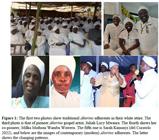


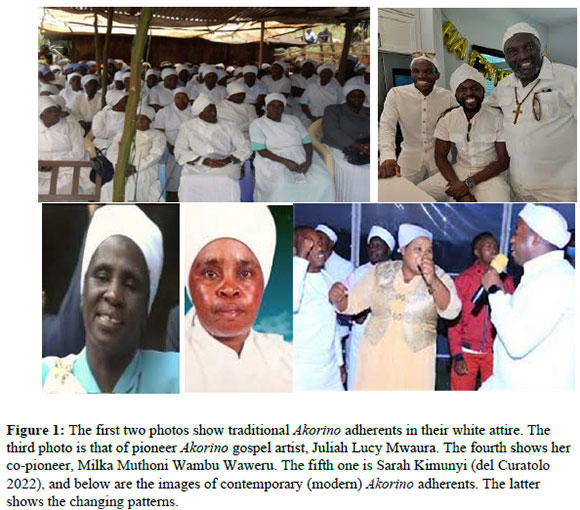
While the songs of pioneer Akorino gospel artists, Milka Muthoni (1948-2009) and Juliah Lucy Mwaura (1947-2021), belong to the traditional Akorino music, Hezeh Ndung'u, Allan Aaron, Bilhah Maina, Symo K, and Dan Gift showcase the contemporary trend. Further, although the former nominated Member of County Assembly (MCA, 2017-2022) of Kiambu County, Hon Sarah Kimunyi, came to the limelight as a spellbinding Akorino gospel artist at the beginning of the 21st century, she belongs in the traditional Akorino trend (Muendo 2021). Her song, "Tutituragio ni maundu" (we don't just live by what we physically experience, but by faith, cf. Jn.20:29), protests against treasuring material possessions without regard to spiritual resources. She protests against the general overdependence on material resources across the religio-social divides.
Besides, Akorino music has remained an oral enterprise since the 1920s. In 1971, however, Julia Lucy Mwaura broke the pattern by recording an album whose first song was "Muthenya uria ngakua" (the joy of my death's day). Likewise, Milka Muthoni released her first recorded album in 1972, and her first song was entitled "Ndaturaga thi-ino ndarii ta mugendi" (meaning "I had lived in this disingenuous world like a stranger before I encountered the saviour") (Gathogo 2014; Muthuma 2020). This shift from mere oral songs to recorded tracks that would be played in the national vernacular radio stations and were sold off as radio cassettes changed the theo-social landscapes of Akorino musicology and the larger Kenyan state. It was able to reach out to its targeted audiences faster and addressed critical societal themes. Such concerns included moral-ethical living, eschatological hope, dimensions of sin, holistic salvation, God and humanity, marriage, holiness and healing, deceptive human heart, causes of church conflicts, material mindedness, courage to face societal evils, greed, corruption, drunkenness, prodigality, theodicy, the true meaning of the cross, God's nature, ecumenism, neo-colonialism, hypocrisy in the church and society and the state of the nation among other themes (Gathogo 2014; Muthuma 2020). Subsequently,
[they] were widely hailed as heroines and heroes - something that encouraged [them] to understand that music can be used to communicate one's theological standpoints and eventually transform the general society]; and thereby address the globalized African public space. Undoubtedly, it became a major turning point for their lifetimes; particularly when these songs hit the market; for they were well received in the vast regions of central, eastern Kenya and in various parts of the Rift Valley where members of the Gikuyu, Embu and Meru linguistic groups reside (Gathogo 2014, 195).
As more people joined the gospel music industry that is largely flooded in the 21st century Kenya, one cannot fail to retrace the various steps in Akorino musicology and spirituality. Indeed, it is worthwhile to appreciate the power of their music in the religio-socio-spiritual transformation of Kenya. In other words, despite their artists being barely trained in theology or not trained at all, they have largely shaped the theo-social landscape of a huge section of Kenya's territorial space. As noted in James Scott's (1985) theory of resistance, such marginal of society utilise hidden transcripts, as in the case of jokes, songs, figurative language, idioms, and coded words and gestures in communicating their messages of resistance. The Malaysian peasants, as Scott (1985) has noted, resisted dominant power structures through subtle, often unseen, acts rather than open rebellion. Likewise, the Akorino music, since the colonial era, has utilised diverse figures of speech (metaphors, similes, personification, and hyperboles, alliteration, onomatopoeia, oxymoron and irony among others) and/or coded language to educate, entertain, caution, alert on the dangers of colonialism, cultural captivity, hypocrisy of the religious institutions, and Westernisation of the God-head, oppression, injustices, missionary and state engagements, and selfishness among other vices, without necessarily offering an open protest that would have invited open confrontations and/or counter-reactions.
Some Specific Cases of Resistance
In the early 1980s, Julia Lucy Mwaura attacked her fellow Afro-Pentecostals in a song "Mwaragia thiomi ciaki?" (Why do you speak in tongues even when one does not possess the gift of interpreting them?). In this song, she boldly says in part,
As I go through the vicissitudes of life, I uphold justice perpetually, and as I interact and make ethical decisions; I still uphold justice even when I am engaging my fellow believers. One who has ears, let him/her hear what I am about tell you. In all areas that I reach out to, I walk justly and truthfully. In some places, I employ a 'whip' to whip-up [and/or protest against] those who have lost their moral compasses. To the most hospitable and just, I visit their houses with warmth of love. I say this because a human being is nothing before God. Whoever thinks that he or she is anything must know that even if one is given wings to fly, he or she cannot reach out to God while still carrying hypocritical baggage. Now, I ask: why do you speak in tongues when you know well that you don't have the gift of interpreting it? Do you do it to impress or frighten other human beings? Don't you know that a person who communicates in a language that he or she is not proficient contradicts oneself? [Hence, a person is worse off when he or she pretends what he or she is not] (Mwaura 1980:1).
In another song, "Ngurugama na kihoto kiria kiahotanire" (I will uphold justice and truth as was the case with the triumphant Christ and Moses), Julia Lucy Mwaura (1975) protests against inconsistent and unprincipled living in the newly independent nation. In this, she is protesting against the moral decay that greeted the country; hence, it translated into unreliability, corruption, lack of integrity and intellect, weak leadership, and indecisiveness. In other words, she is cautioning against the tendency to pursue expediency in the place of posterity across the social-ecclesial divides. In the case of economic expediency, tax plans in a country can be made out of political convenience or ideology, as opposed to economic expediency, and this ends up in failure (Ikome 2010). Her viewpoint is in continuum with Nelson Mandela's caution that "Anybody who changes his [or her] principles depending on whom he [or she] is dealing with … is not a [person] who can lead a nation" (Mandela 1994,89). It also resonates with Mandela's favoured axiom of the regent that "a leader is like a shepherd. He [or she] stays behind the flock, letting the most nimble go out ahead, whereupon the others follow, not realising that all along they are being directed from behind" (Mandela 1994, 22). In this case, the artist becomes the shepherd who employs Scott's (1985) hidden transcripts in his or her leadership that is exercised through music.
In her song, "Ngurugama na kihoto kiria kiahotanire" (I remain just and principled to the very end), Julia Lucy Mwaura (1975, 1) says in part,
I will gallantly uphold justice and truth as I abhor lies and deceptions; lies and dishonesty are bad, and are ironically the paths that have been pursued by the bigger number. These wicked ways [corruption and greed] are making so many people to abandon God and serve the evil one. This is equivalent to abandoning light and ironically pursuing darkness. I will uphold justice and truth that Christ pursued to the bitter end. It is the same trajectory that Moses pursued as he vouched for the liberation of the enslaved Hebrews in Egypt. Christ was not bothered by those who were downplaying his redemptive agenda from the sidelines. I will follow his example and consistently track justice and truth without feeling intimidated. Let's reason together and walk the walk through this path …. Let's say no to pettiness that creates divisions amongst us… Let's imitate Christ who pioneered this principled living. …. Ignore those who are drunk with wickedness right from their family levels… We now need a turning point as the suckling child has to mature up at some stage… Thank you God for enabling our perseverance even within the deserts and other unpleasant places. Christ, you overcame through your consistence in pursuing justice and truth. You did not pursue pettiness; rather, you remained focussed like the prophets of the Old Testament, and even surpassed all…
In Milka Muthoni's song, "Mitharaba ni itatu" (There are three crosses), she protests against the situation where the cross of Christ is peripherally recognised in African Christianity. While she blames her 1980s situation, where she felt the emphasis and symbolism of the cross was peripheral in comparison to the intense focus on the resurrection, power, and the living Christ, it is worthwhile to appreciate that the theology of the cross is being actively reinterpreted and contextualised in Africa to directly address issues of suffering, injustice, and community. Thus, while she does not dwell deeply on the symbolism and theology of crucifixion and resurrection, she compares the other two crosses as those of the two thieves who were crucified with Christ (Lk 23:42). Her view of the majority of the human society as those who carry the "wrong crosses" (of the two thieves) is certainly debatable, particularly if we take Karl Rahner's theory of the "anonymous Christian"6 (Rahner 1968, 545-554; 1970, 498ff).
Apart from Julia Lucy Mwaura, Sarah Kimunyi, and Milka Muthoni Wambu, other famous Akorino artists and performers include Chege Wa Willy, whose 2018 song, Guoko kwa Jehovah (The enabling hand of God and its holistic healing), can be considered his most famous song as it had accumulated over 10 million views on YouTube by January 2026 (Willy, 2026). Further, Martin wa Janet falls in this league and are known for a variety of Kigooco (modernised Akorino worship) songs, which include: "Kigongona Njaririria" (God's Altar be my defender), "Ndugethe Githina Giaku Haraya" (Do not allow your sufferings to last long), "Ni Mehia Matumire" (Sin causes punishment), and "Muhoreria Makumbi" (Jesus is the source of peace during turbulent times) (Janet 2025). Other contributors in Akorino musicology include, but are not limited to: Ruth Wa Mum, who is known for her contributions to Nyimbo cia Mahoya (prayer songs); Karangu Wa Muraya, who is a prominent figure in the genre; Bilha Maina, who is known for Kigooco (praise) songs; Loise Mwangi, who is known for the hit "Tha na Utugi" (hospitality of God) (Kamburi 2023). On the flip side, most of these talented Gospel artists are rarely trained in theology; hence, the danger of their oral theologies turning heretical, in some cases, remains real.
In utilising such Akorino songs to protest against poor leadership of the 1980s, and by implication the 21st-century leadership, music becomes the new school that extends beyond the four corners of the traditional classrooms. And with Kenya of the 1970s and 1980s facing a myriad of challenges such as corruption, single-party dictatorships, the big man's syndrome politics, political opportunism, societal "illnesses," blind denominationalism that doesn't find anything good in others, mutations and splits among afro-Pentecostalism who were registering new outfits at a suspiciously high rates, and economic meltdown, the Akorino songs of protest were proving to be the de-facto consciences of the Kenyan nation.
A Critical Analysis
As insights from a study of Akorino music of resistance, we gather that three key aspects will always emerge (Garratt 2019; Kirui 2025). First, songs of resistance will always display emotional resonance, the ability to evoke strong emotions. This would in turn create a sense of solidarity among its audiences, mobilise and inspire change. This has largely been achieved by Akorino music since the 1920s when its moving tones kept the buoyancy of hope among the disenfranchised citizenry. A second key aspect of music as resistance is accessibility (Garratt 2019; Kirui 2025). This means music can be shared easily and disseminated. This makes it accessible to a huge constituency irrespective of the different levels of education, gender, status, or other considerations. In the larger part of central Kenya, the Akorino music was indeed accessible and impactful as it employed diverse tools to not only communicate spiritual needs but also social concerns. This was done in a manner that was too captivating, particularly as the musical instruments were contextually used. Not even the mainline churches could ignore the Akorino music. Indeed, some of the most touching songs by the pioneer and leading Akorino gospel artists have been used whenever there are leadership transfers among church leaders or politicians. This includes "Ngoro ya Mundu ni imuhenagia" (Human heart is the most deceitful of all, and desperately wicked, cf. Jer. 17:9-10), "Mutongoria Aimaga na Iguru" (A leader is ordained by God) by Julia Lucy Mwaura and "Tigai Kumumunyana ta Judasi Musikariot" (stop betraying one another like little Judases) by Milka Muthoni (Gathogo 2014). During the preparatory moment for Kenya's war of independence, the Mau Mau rebel movement (1940s and 1950s) corrupted some of their protest songs and conveyed freedom messages.
A third key aspect of music as resistance is historical memory (Garratt 2019; Kirui 2025). Indeed, music serves as a powerful form of historical memory. It preserves stories of struggle, resistance, and hope for the future. Considering that the first Akorino Church was officially registered in 1959 as the Holy Ghost Church of East Africa (del Curatolo 2022), historical memory kept it afloat since 1918, when it was revealed to the Aroti (the dreamers), the pioneers. Further, considering that the first recorded Akorino music was produced in 1971, it is logically clear that historical memory kept it going since its conception.
Nevertheless, the Akorino music is weakened by the poor theological training among its leading artists. With some of their songs being seen as dualistic, especially where some give an impression of the two contesting kingdoms of God and Satan. Another key weakness in Akorino musicology is the scope of resistance. In other words, were these songs intended to resist the enemies of African culture (the European missionaries and the colonisers) and wouldn't this be too limiting? During the 100-year centennial celebration of Akorino movement (1922-2022), Raila Odinga (former Kenyan Prime Minister) remarked thus: "The Akorino were born as a freedom-fighting group. Some died because of their religious beliefs, while others fought for independence. Their generations have prospered and continue to spread the gospel. Our founding father, Jomo Kenyatta, showed us the significance of the Akorino" [in his book, Facing Mount Kenya (1938), which describes the Aroti (dreamers) and Arathi (Seer/Prophets) groups] (del Curatolo 2022,1). The problem with the perception that the Akorino church and its resultant musicology is merely a cultural-political movement is that it drives one to wonder when it became a "genuine" Church of Christ for the propagation of the Great Commission (Mt. 28:17-20). Can their protest music be utilised again to counter such conceptions or affirm it altogether? With most of the Akorino songs being seen as reactionary, hence protest music, does this justify their being seen as an ecclesiastical outfit? Nevertheless, some of the best music that can be said to have uplifted the socio-spiritual well-being of central Kenyan peoples (in both the mainline churches and the Afro-Pentecostal wing) since the 1920s is certainly the Akorino music. This is evidenced by the fact that it has been readily received across the denominational divides and in the public square.
Conclusion
The research article is based on the premise that Akorino church music, since its inception, has been a protest music, from colonial injustice, neo-colonialism, our sinful nature, societal malpractices, to the spiritual decay. In light of this, the article set out to understand how Akorino music expressed itself as a tool of resistance within the ecclesiastical circles and in the larger society. This drove us to understand the historical background that helped us to conceptualise resistance as a theo-socio-historical construct; hence, the global nature of resistance across theo-historical times aids our understanding of the Akorino context of resistance. Certainly, the colonial environment and the cultural suppression within the missionary churches fuelled the spirit of Akorino resistance, though partly. In its methodology, it has employed a qualitative meta-synthesis, which is a research method that systematically integrates and interprets findings from multiple qualitative studies. In its theoretical framework, it is informed by James Scott's (1985, 1990, 2017) theory of resistance that shows how ordinary people resist dominant power structures in subtle ways, as opposed to an open rebellion. It establishes that despite their use of music for diverse reasons, including resistance against colonial rule, spiritual expression, community building, and adaptation and innovation, the theme of resistance overrides all. On the whole, this article appreciates that this is not an in-depth research on the Akorino Church, nor has it exhausted her protest music. Rather, it has opened up further studies on the latter.
References
- Beck, C. T. 2022. "A Meta-Synthesis of Qualitative Research." MCN: The American Journal of Maternal/Child Nursing 27(4): 214-221.
-
Brueggemann, W. 2024. "The Legacy of James C. Scott," Church Anew, 8 August 2024. https://churchanew.org/brueggemann/legacy-of-james-c-scott
» https://churchanew.org/brueggemann/legacy-of-james-c-scott - Dreyer, W. 2020. "The Priesthood of Believers: The Forgotten Legacy of the Reformation." HTS Teologiese Studies/Theological Studies 76(4): 1-7.
- Garratt, J. 2019. Music and Politics: A Critical Introduction. Cambridge: Cambridge University Press.
- Gathogo, J. 2001. The Truth About African Hospitality: Is There Hope for Africa? Mombasa: Salt.
- Gathogo, J. 2008. "The Quest for Religious Freedom in Kenya (1887-1963)." Studia Historiae Ecclesiasticae 34(1): 1-26.
- Gathogo, J. 2010. "The Early Attempts at Ecumenical Co-operation in East Africa: The Case of the Kikuyu Conference of 1913." Studia Historiae Ecclesiasticae 36(2): 73-93.
- Gathogo, J. 2014. "Extremist or An Enculturationist? Retrieving Milkah Muthoni's (1948-2009) Afro-Pentecostalism." Studia Historiae Ecclesiasticae 40(1): 191-214.
- Gathogo, J. 2022. "John Mbiti's Ubuntu Theology: Was It Rooted in His African Heritage?" Studia Historiae Ecclesiasticae 48 (2): 1-22.
-
Hartford, B. 2011. "The Power of Freedom Songs", Civil Rights Movement Archive: A Project of Bay Area Veterans of the Civil Rights Movement." https://www.crmvet.org/info/fsongs.htm
» https://www.crmvet.org/info/fsongs.htm - Idowu, B. 1973. African Traditional Religion: A Definition. London: Student Christian Movement Press.
- Ikome, F. 2010. "Political Expediency and the Rule of Law in Africa: A Focus on Selected Cases." Africa Insight 39(4): 1-22.
-
Janet, M. 2025. "Martin Janet, HSC." Official YouTube https://www.youtube.com/channel/UCBulH-2xve49t32rJC7wisw
» https://www.youtube.com/channel/UCBulH-2xve49t32rJC7wisw -
Kamburi, D. 2023. "Kamburi Daniel, Bilha Maina and Other Akorino Artists." Akorino Kigooco Video Mix 2023. https://youtu.be/qcN1woOgHbY
» https://youtu.be/qcN1woOgHbY - Kirui, A. K. 2025. "Music Dualism: Political Intolerance in Kenya and the Gen Z Movement." Journal of Music and Creative Arts 4(1): 1-15.
- Levitt, H. M. 2018. "How to Conduct a Qualitative Meta-Analysis: Tailoring Methods to Enhance Methodological Integrity." Psychotherapy Research 28(3): 367-378.
- Mandela, N. 1994. Long Walk to Freedom: The Autobiography of Nelson Mandela. 1st ed. New York, NY: Hachette Book Group.
- Mbiti, J.S.1969. African Religions and Philosophy. Nairobi: East African Education Publishers.
- Mbiti, J.S. 1975. An Introduction to African Religion. London: Heinemann.
-
Muendo, S. 2021. "Mt Kenya Artistes and Businesses Look to Reap Big from Mashujaa Day Celebrations." The Standard, 13 October 2021, https://www.standardmedia.co.ke/article/2001426066/excitement-as-mt-kenya-artistes-and-town-businesses-look-to-reap-big-from-mashujaa-day-celebrations
» https://www.standardmedia.co.ke/article/2001426066/excitement-as-mt-kenya-artistes-and-town-businesses-look-to-reap-big-from-mashujaa-day-celebrations - Muthuma, G. 2020. "Contemporary Aesthetics of the Akurino: A Religion or a Cultural Movement?" AM Journal of Art and Media Studies 21(1): 59-69.
-
Mwaura, J. L. 1975. "Ngutura na Uhoro Wama." Mama Julia Lucy Official Youtube. https://www.youtube.com/watch?v=KGuioN7elCo
» https://www.youtube.com/watch?v=KGuioN7elCo -
Mwaura, J. L. 1980. "Thiaga na kihoto." Mama Julia Lucy Official Youtube. https://youtu.be/c7uV42-K9cQ?list=RDc7uV42-K9cQ
» https://youtu.be/c7uV42-K9cQ?list=RDc7uV42-K9cQ -
Mwaura, P. 2018. "African Initiated Churches Originating in Kenya." Dictionary of African Christian Bibliography. https://dacb.org/histories/kenya-aic/#akorinu
» https://dacb.org/histories/kenya-aic/#akorinu - Rahner, K. 1968. Spirit in the World. Revised edition by J. B. Metz. Translated by William V. Dych., New York: Herder and Herder.
- Rahner, K. 1970. The Trinity. Translated by Joseph Donceel, New York: Herder and Herder.
- Routledge, P. 2017. Space Invaders: Radical Geographies of Protest. London: Pluto Press.
- Scott, J. C. 1985. Weapons of the Weak: Everyday Forms of Peasant Resistance. New Haven: Yale University Press.
- Scott, J. 1990. Domination and the Arts of Resistance: Hidden Transcripts. New Haven: Yale University Press.
- Scott, J. 2017. Against the Grain: A Deep History of the Earliest States. New Haven: Yale University Press.
- Sokolon, M. K. 2008. "The Iliad: A Song of Political Protest." New Political Science 30(1): 49-66.
- Timulak, L. 2009. "Meta-analysis of Qualitative Studies: A Tool for Reviewing Qualitative Research Findings in Psychotherapy." Psychotherapy Research 19(4-5): 591-600.
- Ugwanyi, D. M. 2023. "Disillusionment and the Parable of Political Resistance in Ngugi waThiong'o's Matigari." ANSU Journal of Language and Literary Studies 2(3): 180-204.
- Waigwa, S. 2011. "Bridges of Understanding: Shared Elements of Faith and Practice between Anglicans and Akorino in Kenya." Anglican and Episcopal History 80(3): 266-283.
-
Willy, C. 2018, "The Enabling Hand of God and its Holistic Healing." Chege wa Willy Official YouTube, 4 June 2018. https://youtu.be/GtQO6oXttxI
» https://youtu.be/GtQO6oXttxI - Woo, D. 2024. "The Role of Protest Music in Social Movements and Youth Activism Across Eras." Journal of Student Research 13(4): 1-7.
2 Laiko is one of the popular songs in Greece that tells stories of love and Greek identity; it often resembles rebetiko, as the duo had similar melody structures (Sokolon 2008, Woo 2024).
3 Spirituals are religious folk songs created by enslaved African Americans in the 18th and 19th centuries, blending African musical traditions with Christian hymns. They served as vital expressions of faith, sorrow, and hope, often containing hidden messages about freedom and resistance (Garratt 2019).
4 As the Kikuyu offered prayers and sacrifices while facing Mount Kirinyaga (Kenya), they believed that they were directly addressing Ngai (God) (Kenyatta 1938).
5 Rooted in Old Testament ideas of a priestly nation, the New Testament doctrine of the priesthood of all believers is distinctively developed through the writings of the Apostle Paul and Peter. It asserts that all Christians, by virtue of their faith in Jesus Christ, have direct access to God and are called to serve Him. This challenges the traditional hierarchical structure of the church, emphasising the equality of all believers in their relationship with God. In light of this, Wim Akkerhuys Dreyer (2020) explains why the New Testament doctrine of all believers, which was a cornerstone of Martin Luther's ecclesiology, disappeared from the reformed vocabulary. He explains that the proliferation of churches and sects during the 16th century is largely to blame for this. Like most of the early African instituted ecclesiastical outfits, most of these churches and sects claimed to have had charismatic gifts and divine epistemologies that were channelled through the Holy Spirit. This triggered blind denominationalism, a phenomenon where formal theological education was now seen as unnecessary, as they were "trainees" of the Holy Spirit. To this end, they were viewed suspiciously, and were sometimes clobbered to death and/or ridiculed, as martyrdom became their defining characteristic in the last part of the 16th century Europe. Anabaptists like Baltazar Hübmaier were, however, unique as they were highly educated in the Roman Catholic traditions as well as the Lutheran doctrine. Despite all his advanced knowledge in theo-doctrinal matters, Hübmaier was burned at the stake in Vienna in 1528. This "burning at the stake" or death by burning, was an execution method that utilised fire.
6 An anonymous Christian is a person who, while not explicitly professing Christian faith, is nonetheless justified by the grace of Christ through their hidden, implicit faith. Karl Rahner's (1968, 1970) theology of the "anonymous Christian" posits that individuals who have not heard the explicit Gospel, yet live in accordance with their conscience and God's grace, can receive salvation. It is an inclusivist, hopeful framework suggesting that saving grace is universal and that true, sincere faith in goodness can be an implicit acceptance of Christ.