Hymns and Spiritual Songs in Times of War: Contemplating Lyrics of Suffering and Sustainment Published in the DRC Newsletters and Journals during the Anglo-Boer War, 1899-1902
Abstract
The impact of music, songs, and singing on the well-being of individuals and groups is amply documented, indicating that music/song could benefit those dealing with trauma. However, less researched is the actual song lyrics used and if/how the meaning of these words contributes to the release of trauma. In this article the following question is addressed: Did the lyrics of songs used during the Anglo-Boer War (ABW) (1899-1902) contribute to trauma release and sustainment of those interned in prisoner of war (POW) and concentration camps, and if so, how? Two additional questions were addressed in an overview of six historical Dutch Reformed Church (DRC) newsletters/journals published in this period: What were the main traumatising factors impacting on those interned during the war? What light do these publications shed on if/how these songs/lyrics aided/sustained individuals and groups during the traumatic events of the ABW? The journals were: De Vereeniging, published in Pretoria as newsletter for the DRC congregations in the ZA Republic; Mission News Letter (and the Dutch versions De Zendingbode/De Koningsbode), published as informative letters/journals on mission education, activities, and reporting on "internal and external" mission work and stations; and De Wekker, described as "ene stichtelijke tijdschrift," which was founded, published, and edited by Rev Jan Neethling in Stellenbosch. The in-depth analysis focused on De Strever. Founded and published during the ABW by the prisoners of war in the Diyatalawa Camp, De Strever was "the mouthpiece" for the Christelijke Strever Vereeniging (Christian Endeavor Society). It featured a wide array of "official" and personal contributions from POWs, family members interned in the concentration camps, and other interested parties. The analysis of the song lyrics and the clarifying context provided in personal letters, articles, and even advertisements extracted from De Strever indicated that singing (or writing) song lyrics provided a broad spectrum of benefits to those affected by the war.
song; trauma; suffering; sustainment; Anglo Boer War (ABW); church newsletters/journals
Introduction
Given the ample evidence regarding the benefits of music, songs/hymns, and, particularly, singing (Betterhelp Editorial Team 2025; Flanagan n.d.; Hamilton et al. 2013; Hicks 2023; Marich 2021; Mehnert 2021; Murray 2024, 156, 159-160) when dealing with trauma, this article focuses on the perceived benefits of songs, and particularly song lyrics, for those impacted by the Anglo-Boer War (1899-1902).
A number of questions are considered: Did the lyrics of songs used during the Anglo-Boer War (1899-1902)-documented in the various historical Dutch Reformed Church (DRC) publications-contribute to trauma release and sustainment of those interned in prisoner of war (POW) and concentration camps? How did the war effort contribute to the traumatisation of those interned? Does music/singing feature as one of the coping mechanisms developed? What proof is there that the actual song texts, gleaned from DRC-related publications (specifically De Strever), influenced or impacted on the individuals?
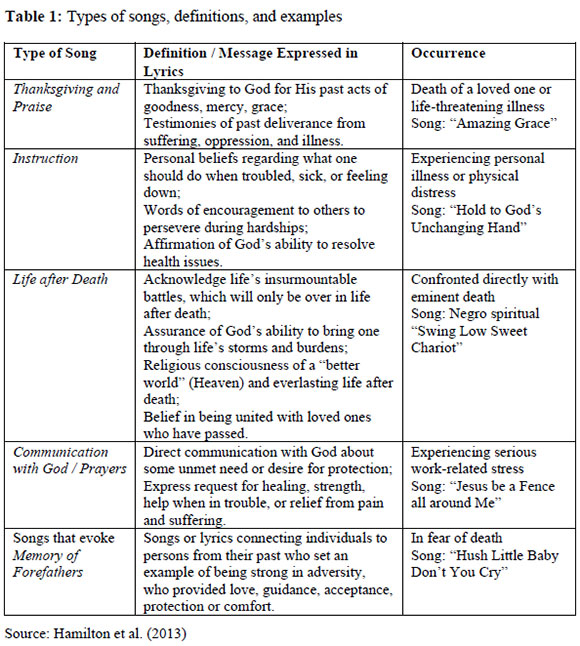
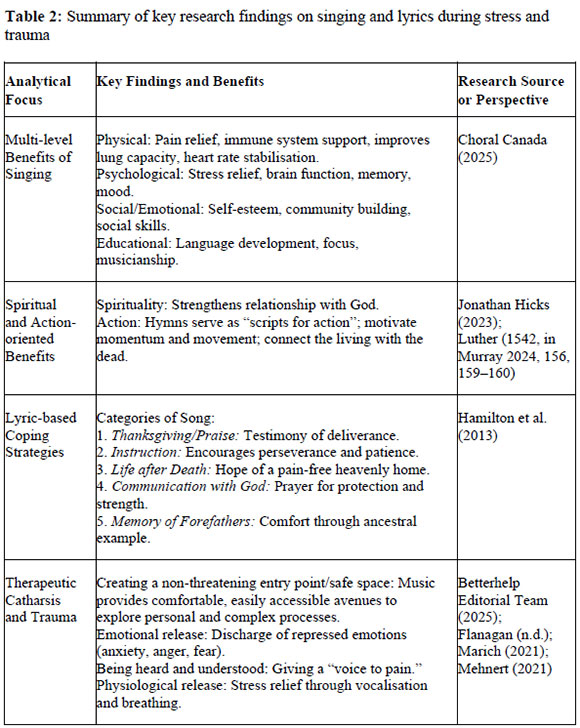
Introductory remarks on the DRC's church music history and sources are followed by a brief overview of recent findings on the benefits of music, song, singing, and lyrics (either written or sung) for people suffering from trauma (Table 2). Table 1 depicts the five categories of song identified by Jill B. Hamilton et al. (2013),1 and Figure 1 illustrates the comprehensive benefits of singing identified by Choral Canada (2025).

The contextual sketch of the South African or Anglo-Boer War (ABW), 1899-1902 is augmented with extracts from personal letters, articles, and even advertisements published in De Strever (1900-1903). The focus then shifts to a deliberation of the actual lyrics and direct reports (i.e., letters, excerpts, concert programmes, etc.) published in the De Strever as one example of diverse DRC journals and newsletters published during the ABW-period.
Introductory Remarks on the DRC's Archival Church Music History and Sources
Findings on the impact of music and songs/singing on the well-being of individuals and groups have been documented over decades. Yet, little attention has been given to the lyrics contained in these songs or "how individuals express religious beliefs through religious songs and their perceptions of the effectiveness of these songs in response to life problems" (Blazer 2007 quoted in Hamilton et al. 2013, 26).
One factor prohibiting studies of this nature could be the lack of relevant and easily accessible data. For example, prior to the cataloguing (2022-2024) of the DRC Archives of South Africa Church Music Collection,2 documentation relevant to the history of music-"hidden" in private collections, personal diaries, letters, and decades of DRC publications-were not freely accessible to researchers.
Yet, since the late 1800s and early 1900s, these publications provided a platform for the "ordinary church members" to give voice to their inner longings, and to share songs of praise or declarations regarding life and death. Consequently, these publications are a significant source of information on the input and value of music for the common church member.
The personal dagboek (diary/memoire) of Moeder Anna Margaretha Sophia Kriel (née Nel) (1867-1941), a survivor of the Anglo-Boer War, is one example found in the DRC Archives.3 It provides ample personal context, song texts, and witness to the impact of song lyrics. At the outbreak of the ABW in October 1899, Dirk Kriel was ordered to report to the commandos on the southern border of the Free State Republic. Anna remained alone on the farm with Dirk (7 yrs.) and Hester (2 yrs.), while the three older children were at school at Welgestreden in the Ladybrand district. Anna recalls her sadness when, several months later, her husband came to visit for a few days and had to leave again (Kriel quoted in Murray 2024, 520-521; paraphrased/translated, Isabel Murray [IM]):
The farewell was again very hard for me and the children. Yet, I found comfort in the song: [Lied 120, De Kinderharp, 1882]:
Ik hoorde Jesus' zachte stem:
"Kom tot mij en rust,
Leun aan Mijn boezem, moederziel,
Daar word uw leed gezust."
(I heard Jesus' soft voice:
"Come to me and rest,
Lean on My bosom, mother's soul [dear
mother], There your sorrow will be soothed.")
Early in the morning of May 19, 1900, 9 Khakis arrived on the farm. The officer commanded my two oxen wagons with 2 teams of oxen, draft goods and box of tarpaulins. The oxen wagons were loaded with oat sheaves and seed oats … My children cried loudly when they saw the two fully loaded wagons and oxen of their father leaving … After the turbulent and sad day, this song of comfort came to my mind:
Troost allen die in nood en smart
Tot U verheft het angstig hart;
Maakt ons in tegenspoed stil,
Hoor ons, O God, om Jesus wil.
(Comfort all those in need and sorrow
Until You lift up the anxious heart;
Make us quiet in adversity,
Hear us, O God, for Jesus' sake.)
They tried to get compensation for the food and wagons taken, but were sent away empty handed (Kriel quoted in Murray 2024, 520-521; paraphrased/translated, IM):
When I got outside, my heart was very hurt to see all my cattle standing in the street and to hear them bellowing and bleating from hunger and thirst. In my mind I prayed: "Oh Lord, you alone deserve vengeance". Once more, Gezang 28:5 and 6 was a comfort to me:
Weg dan met uwe bang zorgen
Volg gehoorzaam zijn gebod.
Vrees niet voor den dag van morgen
Laat Hom, uwen Vader zorgen.
(Flee then, oh anxious care
Obey His command.
Fear not for the day of tomorrow
Let your Father provide for you.)
Given the importance of determining the context of those who wrote, sang, and were sustained through music, five church-related newsletters and journals, published during the period of the South African War (the Second Freedom or Anglo-Boer War) 1899-1903 were utilised in this study. Each of these publications represents a different grouping or "fragment" of the Dutch Reformed Church at the time: De Vereeniging, published in Pretoria as newsletter for the DRC congregations in the ZA Republic (1893-1910); Mission News Letter (and the Dutch versions De Zendingbode/De Koningsbode), published as informative letters/journals on mission education, activities, and reporting on "internal and external" mission work and stations; and De Wekker, which described itself as "ene stichtelijke tijdschrift," founded (1859), published, and edited by Rev. Jan Neethling in Stellenbosch. After his death (1904), co-writer Ella Neethling became the editor (1905-1925).
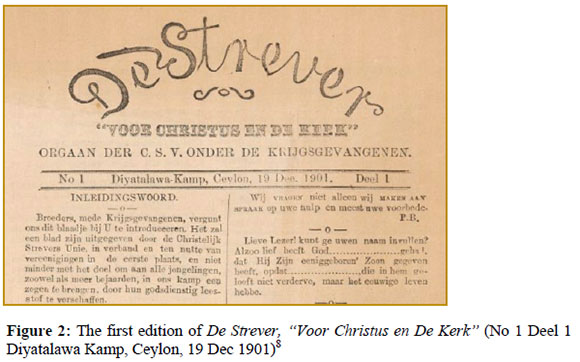
De Strever, the focus of this article, is unique in that it was founded in 1901, edited, initially handwritten, and later typed on Remington typewriters, and published during the ABW by the prisoners of war in the Diyatalawa Camp, Ceylon (De Strever 19 Dec 1901, 1). De Strever served primarily as "the mouthpiece" for the Christelijke Strever Vereeniging (Christian Endeavor Society),4 with the goal to uplift the spirit of the prisoners and to provide a link between the prisoners and those at home or elsewhere in POW camps. Occasionally, copies were sent to other POW camps (St Helena, Portugal, and India), the prisoners' families (e.g., women in the concentration camps in South Africa), hospitals, church officials, and other interested individuals. It featured a wide array of "official" and personal contributions from POWs, family members interned in the concentration camps, and other interested parties. The analysis of the song lyrics and the clarifying context provided in personal letters, articles, and even advertisements extracted from De Strever, indicate that singing (and writing) song lyrics provided a broad spectrum of benefits to those affected by the war.
I now turn to relevant research findings to help us answer the question: How do we measure the benefits of song lyrics for traumatised people?
Relevant Findings on Singing and Song Lyrics (or Type of Song) in Times of Stress or Trauma
Singing Could Be Beneficial on Multiple Levels
Music, and more specifically song, has been proved to aid human well-being on multiple levels, as demonstrated in Figure 1 (compiled by Choral Canada), and the brief exploration to follow.
Based on the findings of numerous studies, singing provides positive gains on the following levels:
Psychological level: stress release, improved brain functioning, and memory and mood booster; physical level: pain relief, improved immune system, improved lung capacity, stabilisation of heart rate, and improved speech; social/emotional level: improved self-esteem/identity, community building, empowerment, improved social skills, and overall well-being; educational level: improved language development; focus, and musicianship. This range of benefits led to the conclusion that in essence, group singing could be seen as "medically beneficial" to such a degree that the organisation wants to "promote the idea of group singing as a social prescription for the medical community" (Choral Canada 2025).
Not mentioned as such in the above study are the benefits on a spiritual level. Jonathan Hicks (2023) argues that the singing of hymns can be exceptionally beneficial, since it adds a dimension of singing for a purpose. This argument is in line with the thinking of Martin Luther (1542, in Murray 2024, 156, 159-160), namely that singing is a powerful component in one's relationship of connecting with and acting upon God's will. Hicks (2023) explains:
[I]n addition to conveying texts and ideas, [hymns] provide scripts for action ... Hymns require at least some level of attention and awareness to be performed. This basic requirement to engage means that hymns-perhaps marching hymns especially-can do things [motivate people] … [e.g. singing] "Onward, Christian Soldiers" … not only got characters from A to B but also asserted connections between inside and outside, the ground and the air, even the dead and the living.
In other words, because singing requires people to participate, breathe, raise one's voice, form and think about the words, hymns spur people into action on many levels. Indeed, Hamilton et al. (2013) found that people tend to choose specific song lyrics to sustain them in times of stress and trauma.
Song Lyrics Could Invite Various Supportive Responses
Song lyrics, seen by an individual as meaningful, were found to contribute positively to stress release:
Religion expressed through song was a coping strategy for participants experiencing stressful life events who described feelings of being comforted, strengthened, able to endure, uplifted, and able to find peace by turning to … religious songs. (Hamilton et al. 2013, 37)
The research team (comprised of a theologian, a musicologist, therapists, and a medical doctor) defined five categories of song utilised by the research population as indicated in Table 1. The "song type" (or category) was determined by the "message expressed" (i.e., the nature of the communication between the subject and God, others, or self). "Occurrence" indicates under which personal circumstances the songs featured most frequently, with songs mentioned most often (Hamilton et al. 2013, 30-33).
As reflected in Table 1, Hamilton et al. (2013) concluded that religious songs and rituals served as one critical coping strategy, providing comfort and strength and allowing individuals to endure stressful life events.
Singing Could Promote Therapeutic Catharsis during Trauma
According to Betterhelp Editorial Team (2025), people enduring traumatic experiences such as war need some form of emotional relief. Catharsis, or the discharge of repressed emotions (anxiety, anger, fear) linked to traumatic experiences, could provide this. Catharsis can be facilitated through participation in music-making, singing, writing, and rituals by releasing sadness and creating space for positive emotions.
Marich (2021) argues that singing adds a physiological dimension-releasing stress through vocalisation and breathing-while providing the relief of being heard and understood by others. Historian Kasia Flanagan (n.d.) points to expressive writing as therapy, stating that writing (journals, poetry, lyrics, a personal journal, or even contributions to newsletters) provides a "voice to one's pain" and helps unburden the individual from unspoken trauma. Citing the work of James Pennebaker (psychologist and pioneer in the field of expressive writing), Marich (2021) notes that expressive writing significantly improves mental and physical health, including immune system boosts. Furthermore, the writing of a song and the actual singing of it-embodying the words through breathing and vocalising-provide the release of built-up stress and the experience of relief at being heard and, hopefully, understood and supported (Marich 2021).
In conclusion, there is ample evidence of the benefits of creative involvement (i.e., in music, singing, writing, rituals) as a catalyst for catharsis, resulting in positive outcomes for those exposed to trauma-as summarised in Table 2 below.
These findings provide a framework for analysing how the singing of hymns could speak to and touch people-e.g., hymns could provide both an outlet for deeper thought and experiencing emotions; they could allow a deepening of religion and/or spiritual connection on various levels; and they spur people into action. In the next sections, these guidelines are utilised in the analysis of the AWB context, lyrics, letters, and personal accounts printed in De Strever (1900-1903) to determine to what degree hymns benefitted those involved.
The South African War or Second Freedom War or Anglo-Boer War: 1899-1903 as Context for this Study
The South African or Anglo-Boer War (1899-1902) between the Boers in the two Boer Republics (the Zuid-Afrikaanse Republic and Orange Free State) and the British Empire brought about unprecedented and enduring psychological and physical trauma to the country. Wessels (2001, 5-7; 2003, 7, 154-167) and Smith (2013) identify the following key areas and incidents of impact:
• The unexpected duration of the war: What was initially believed would be a brief encounter between the Boers in the two Boer Republics and the British Empire extended over almost four years, necessitating the Boers' prolonged war involvement, isolation from family, and loss of income (most were farmers) (Wessels 2001).
• The staggering number of soldiers who died: More than 22 000 British soldiers and an unknown number of black and coloured people who served with the British Army died.
• The ravages left by Lord Kitchener's "scorched earth" policy: Approximately 40 towns were destroyed; 30 000 Boer farmsteads were burnt down, fields destroyed, the livestock carried off or killed, systematically annihilating the Boer Republics' means of subsistence and forcing the commandos to surrender through starvation (Wiid in Smith 2013, 25-30).
• The vast numbers of Boers interned: Approximately 25 000-28 000 Boers were interned in prisoner of war camps on distant islands such as St. Helena, the Bermudas, Ceylon (Sri Lanka), and India, leading to 6 000 more deaths (Wessels 2003).
• The unprecedented number of deaths amongst Boers and supporters who were interned in concentration camps: About 100 000 women and children as well as an unknown number of elderly men and black civilians were interned. This led to approximately 27 000 deaths of women and children, and at least 23 000 deaths amongst black civilians (Wessels 2003).
• The dire and dehumanising situation in the concentration camps: The women were mostly forcefully removed from their homes and farms, allowing a minimum of belongings-often only the clothes they were dressed in and household goods they could carry. They were then escorted by soldiers, travelled for days on end-on foot, in open train trucks or overloaded ox wagons-to so-called refugee camps (generally conceived by the Boers as "death camps").6 Most of these camps were overpopulated, with inadequate infrastructure, administrative and medical services, food shortages, and contaminated water. In addition, poor postal services contributed to limited information of their loved ones. All of which led to their loss of dignity and heightened desolation (Smith 2013, 25-30).
• The escalation of social/behavioural patterns-established prior to the war-during the protracted war and internment: The Boer farmers mostly lived in relative isolation, deprived of social and cultural development; involvement in incidents of inter-racial conflict occurred quite frequently; they developed a high level of independence, answering to only themselves and God as their Creator. War incidents such as deprivation of basic necessities (food, medical care, etc.), exposure to inter-racial atrocities, exile as prisoners of war under British authority, and the final loss of their freedom having to sign over the Boer Republics to the British strengthened these behavioural patterns, causing further inter-racial tension and disregard for the authority (Wessels 2001, 2003).
• Drought, famine, and empty promises: Towards the end of the war, Rev. P.J.G. Meiring refers to an unusually severe drought, leaving the dams empty, causing crops to fail and the demise of what was left of the cattle. The Boers' struggle for survival was further aggravated by the Government's failure to honour promises of compensation for transport, grain, and animals confiscated during the war (Meiring's letter dated 3 July 1902, in De Vereeniging 1903 No. 3 Deel 3, 6-7).
In addition, "eye witness accounts," i.e., published historical letters, articles, and reports (De Strever, Zendingbode, Vereeniging 1900-1903) indicate that the disparity in the daily living conditions of the men in the POW camps and that of the women and children in concentration camps significantly contributed to the trauma experienced by all involved.
What Were These Differences in Daily Living Conditions that Caused Further Trauma?
As indicated in the foregoing discussion, the POW camps were generally described as "satisfactory." For instance, Mike Harman (2017) reports that Diyatalawa (Ceylon) was custom built by British engineers to home the prisoners of war and offered facilities such as huts, streets, fencing (for safety), open spaces for sports, mountainous surroundings, and a view described as magnificent, basic facilities fitted for medical, educational, and religious activities, as well as an effective and humane administrative and disciplinary system (Harman 2017). In fact, Diyatalawa was seen as more than satisfactory by some, such as the young POW who wrote, "the most delightful days I have ever spent. The exile to Ceylon was a truly good school of learning for me" (Henning quoted in Smith 2013).
In direct contrast to this, the vrouwen kampen (women's camps) or concentration camps were (especially initially) described as vastly to totally inadequate in terms of facilities, food and water supply, medical services (leading to endemic illnesses such as dysentery), administrative services (including postal services), great lack of safety and disciplinary structures, and hardly any opportunity for education, income-generation, social interaction and relaxation, or even religious or spiritual practices (Smith 2013, 25-30).
The men were confronted with knowing their loved ones were severely ill-treated, and wanted to help; yet they were held captive thousands of miles away. The women suffered daily, but did not want to add to the men's inability to provide for their families. Witnessed in the personal letters, reports, and short articles published in De Strever (1900-1903) are feelings of distress, concern for the others' health and lives, a sense of helplessness, and even guilt for not being able to be there for one another.
An abstract from a wife's letter to her husband in Sri Lanka follows: "Ik denkt veel aan u, lieve, en wensch u van harten terug, maar nu zijn wij gescheiden … Hier loopen onze paaden uit elkander" (De Strever 5 Juli 1902, 163). A doodsbericht (death notice) mentions the untimely death due to fever of a 27-year-old POW, urging the readers to pray for his young wife in the Transvaal, whose father and three brothers were all interned (De Strever 26 Juli 1902, 184).
The men's cross to bear was equally devastating. When news was received of more losses, Rev. Thom, who was in Hambantota, acknowledged their trauma and urged the men to humble themselves before God:
Velen van onze broeders hier hebben treurige tijden ontvangen, vooral van kinderen die opgeroepen zijn. De heer L. Engelbrecht ... heeft ook zijn vrouw verloren. De Heer geve dat wij onder het kruis, verbroken van hart, en verslagen van geest, God wil boven onzen wil stellen en ... ons voor Hem steeds verootmoedigen mogen. (De Strever 19 Dec 1901, Deel 1 No. 1, 1)
The above events and circumstances greatly contributed to a deep psycho-emotional scarring of those involved-across race, age, culture, or political affiliation. One "outsider" who recognised the deep psycho-emotional scarring among those interned in the concentration camps was Emily Hobhouse. In December 1900, Hobhouse, as British representative of the South African Women and Children's Distress Relief Fund, visited several of the camps "set up by the British military to accommodate Boer civilians displaced by the war, particularly by their 'scorched earth' policy of farm-burnings" (Wessels 2001, 12). She gave a public voice to the trauma of these women by publishing their letters, extracts from letters, inserts on incidents during the war, and her correspondence with Lord Milner and other British officials, under the title The Brunt of the War and Where It Fell in 1902.7 In her own words: "All I wanted was to put down the facts as plainly and simply as I could." She reflected later of The Brunt, "It seems to me a matter of first importance that English men and women should know in this way, from the lips of the victims, what a war of conquest urged by a Christian nation really means" (Dampier and Gill 2023, 351).
What Coping Mechanisms Did These Men and Women Develop to Deal with the Challenges of War and Interment?
Even before Hobhouse's ground-breaking publications, those affected developed their own spiritual, creative, and intellectual pursuits as coping mechanisms, such as self-initiated publication of the various newsletters, founding and operating of religious and cultural organisations and events. The men, especially, were also able to practise various skills, e.g. tailoring, cobbling, photography, painting, production of various kitchen and household utensils and furniture, or baking and selling pancakes, bread, and even cake. Numerous crafted artistic curios were sold to alleviate the plight of the women and children back home (De Strever 19 Dec 1901, 3-4).
Spiritual Awakening, Finding Deeper Spiritual Meaning, e.g., Writing Poems or Teaching Sunday School
Featured most frequently in the sample publications are accounts of a personal and collective focus on finding deeper spiritual meaning, i.e., "giving themselves to God," often including Scripture or song lyrics. The following letter extracts are from the daughters, sisters, mothers, or wives of the POWs, now interned in the vrouwen kampen or concentration camps (De Strever 1900-1903):
On 10 May 1902, Salie Swanepoel in Kraaifontein Kamp writes to tell her father that both her sister, Sannie, and she have given themselves to Jesus, remarking, "Ik hebt nooit gedacht dat het zoo heerlijk is een ware kind van Jezus te zijn … Vader, bid toch veel voor ons" (De Strever 5 Juli 1902, 164).
From the vrouwen kamp in East London comes an account of many surrendering themselves to God: "Velen zielen in de kamp zijn tot ontwaken gekommen en hebt haren Heiland gevinden ... Ach, het was Zondag so aangenaam velen te hooren getuigen" (De Strever 26 Juli 1902, 188).
Large numbers of women immersed themselves in religious activities or rituals, such as participating in Nachtmaal (the sacrament of Holy Communion), with women even taking on the role of deacons:
Mevrou van der Merwe, Port Elizabeth camp skrijft: "Op Zondag den 11 Mei vierden wy den Heilig Avondmaal. Het was zeer plechtig. Twee onzer zusters, Mev. van Niekerk en Mev. Geel, dienend als diakenen. Wy zyn zonder 'n herder en toch niet herderloos, want Mev Hauptfleisch regelt onze bidstonden altyd." (De Strever 26 Juli 1902, 188)
Others gathered the children in the tents or the open air, teaching Sunday school and singing songs from De Kinderharp, De Zionsliederen, and the old Psalm and Hymn Book. In March 1902 Miss Lenie van Dijk wrote from Winburg Kamp, thanking her friend (interned on Ceylon) for sending copies of the De Strever. She expressed her appreciation for the publication and its contents such as a "wonderful poem," the powerful "Strever's Lied," and the song "God hoort het gebed"-a song which, she says, they frequently sing. She continued:
Wij hebben over de 900 kinderen in de Zondagschool. Ik het in mij lijn 42 kinderen en drie assistenten, die mijn helpen. Ja, werk voor den Heer is hier genoeg te doen ... Iederen morgen hebben wij biduur, iederen avond dienst. Geregeld worden gedurende de week in de tente biduren gehouden [en gezingen]. Wij hebben ook weer een koor onder de leiding van ons ouden koormeester. (De Strever 7 Juni 1902)
More "good news" regarding coping in the concentration camps was received from Miss Mara Lubbe from Jacobsdal Kamp (De Strever 3 Mei 1903; direct translation, IM):
The recently founded Christelijke Strever Vereeniging (Christian Endeavor Society) for the youth shows a daily increase in membership. To meet the members' need to belong and make a contribution, five kommissies (committees) were instituted, each allocated specific supportive tasks: Biduur (Prayer hour) inviting members to the prayer meetings; Uitkyk (Scouting) reminding individuals to attend the CSV meetings; Zieken (Patient care) visiting and caring for all the ill in the camp, Zang (Song leader) choosing, practising and performing songs according to the theme for each meeting, and Gezellig (Hosting) preparing the place of meeting and welcoming all visitors and new members. (De Strever 3 Mei 1903, Deel 1 No. 20, 114)
In the POW camps, even the earlier reports indicated a larger degree of group cohesion and activities, as well as a spiritual upsurge-which led to the establishment of Christian associations (such as the CJV [Christelijke Jongelieden Vereeniging] and CSV [Christelijke Strever Vereeniging]), regular Bible and catechism classes, and a focus on "living for Christ." This is illustrated in these extracts from De Strever (24 Mei 1902):
Miss Santie Swanepoel from Kraairivier Kamp wrote to express her gratefulness on the news of her father and brother (interned on Ceylon) being saved: "Duizendmaal dank ik den heer dat Hij u en Boetie beiden als kinderen aangenomen Heeft ... Hier [Kraaifondtein] bestaat ook een C.S.Vereeniging en een Zangkoor."
Rev. Viljoen, from Ahmednagar, India, sent a message of spiritual awakening and the formation of a mission training class: "De Zendinggeest is ook in dit kamp ontwaakt. Zoowat 20 jongelingen hebben besloten zich aan het Zendingwerk te wijden. Eene Zendingklas is er gevormd, met den heer Dijkman als onderwijzer."
On the other hand, the news shared by Rev. D. J. Malan from the large Pietermaritzburg camp on the homefront was less heartening. He described people of all character gathered in the camp-some abiding, but many others hardened, with some "nemen in hun wanhoop de vlucht tot onmatig drinken en andere zonden" (turning to drinking and sin) (De Strever 24 Mei 1902).
Educational Activities such as Founding and Teaching in Sunday and Day Schools
By mid-1902, there are more frequent referrals to improved organisational structure, organised schools with large numbers of children and teachers, and even some workshops erected, as in Kraairivier Kamp, Aliwal Noord (De Strever 3 Mei 1903, Deel 1 No. 20, 113; direct translation, IM):
Rev Johannes du Plessis reports that during the first week of the new year (1902), many in the camp, especially mothers, received the "eeuwig licht", i.e. came to Christ-resulting in the extension of the Sunday School, where 600 children are now accommodated by 40 teachers. A CSV branch was founded to accommodate the older young Christians. The day-school accommodates 1 300 children in two daily sessions, under the guidance of the principal, Mr. G. A. Dijkman and 19 teachers. Together with work opportunities created at the recently opened carpenter's and cobbler's shops, there is very little room for "leeglopery de duivels oorkussing" or laziness, the devil's weapon, since "war was declared against it."
The Printed Word, Poetry, and Prayer
Despite the frequently referred to "general low level of education prevalent among the POWs" (Brohier 1946; Van der Wall 1929), creative arts and poetry flourished in these camps, with hundreds of poems written, such as the following short meditative prayer by an anonymous author, reminding of God as ever present (De Strever 3 Mei 1902, Deel 1, No. 20,10; direct translation, IM):
Gedichje
God van buiten, God van binnen,
God voor oogen, God in 't hart,
God in voorspoed, God in smart,
God ten gids van ziel en zinnen,
God in licht en duisternis;
Of er grooter rykdom is.
-Anoniem
Poem
God without, God within,
God before the eyes, God in the heart,
God in prosperity, God in sorrow,
God as guide of soul and senses,
God in light and darkness;
Is there greater wealth?
-Anonymous
Mauritz, of whom multiple contributions are seen in De Strever, reflects on God as one who cares and who can be seen in nature. Given the view of the beautiful mountains surrounding the Diyatalawa Camp-likened to the mountainous part of the Orange Free State which was home to many of the prisoners-it is not far-fetched to read this poem as both a longing for home and a re-affirmation of God's presence (De Strever 21 Juni 1902, 156; direct translation, IM):
Psalm 32 v. 11
De mensch die hier inzonderheid
Bestemd is voor Gods heerlikheid?
Ja, gij die hier op aarde leeft,
Denk aan de vreugd die Jezus geeft,
Denk aan Zijn grootheid en Zijn macht,
Denk aan Zijn vrede, zoet en zacht.
Verblijd u dus ten allen tijd,
Met vroom oprechte dankbaarheid!
O! Banneling, hier op Ceylon,
Verblijd u in de Levensbron.
Diyatalawa, Mei 22, 1902.
-Mauritz
Psalm 32:11
Is the human being here especially
Destined for God's glory?
Yes, you who live here on earth,
Think of the joy that Jesus gives,
Think of His greatness and His power,
Think of His peace, sweet and gentle.
So rejoice always,
With devoutly sincere gratitude!
Oh! Exiled, here in Ceylon,
Rejoice in the Fountain of Life.
Diyatalawa, May 22, 1902.
-Mauritz
The following poem, also by Mauritz, is quite lengthy and more complex, yet it is an excellent example of creative poetry, setting personal experiences, inner struggle, and striving into words and "giving oneself a voice" by admitting it for publication. The poem seems to have a three-fold focus: opening with a personal statement of struggle, discouragement and remorse, flowing into confession of guilt, followed by a sketch of the reality of men in captivity (in the flesh and spirit), while the last verses seem to be words of instruction and encouragement to others, leading into a confession of faith and a yearning to be close to God (De Strever Mei 1902, 130):
Gedig van "Mauritz", Diyatalawa, Mei 1902
Ik was dan schaars bij vrienden weer,
Of zie zij stonden daar,
En vroegt: wat Mauritz? Wat zeg jij,
Een strever ook voorwaar?
Die letters fraai, uit been gezaagd,
Laat ons dit zoo verstaan,
Of hoe, ou maat, of het jij maar Dit net vir 'n grap gedaan?
"Ik streef ook," zei de een aan mij,
"Maar niet zoo's julle soort.
Ik streef naar grootheid, geld, en eer,
Al zuchtend, zwoegend voort;
Doch vind geen rust in's werelds vreugd;
Al lijk ik welgemoed,
Is er toch in mijn boezem iets,
Dat steeds onrustig woedt.
Helaas! Ik zag toen, wat ben ik,
Een zwak en treurig iets,
Een drager van Gods beeld, zoo slecht;
Zij zagen in mij niets,
Dat hen getuigde, dat ik ben
Een werkend lid en meer,
Een strijden strever in het veld,
Nu vechtend voor zijn Heer.
Ik kon slechts bidden: maak mij Heer
Zoo als ik wezen moet,
Een fakkel brandend, helder en schoon
Verlicht door 'n Hemelsch gloed,
Dat ik zoo door mijn voorbeeld hier
Mijn vriendin op kan wekken
Om hen door woord en wandel zelf
Tot aan uw voeten trekken.
-Mauritz
Clearly, the "printed word" seems to have been a valuable soundboard and vehicle of the "public voice" of those interned in the POW and concentration camps. Weekly or monthly publications, such as De Strever, De Krijgsgevangenen, and Kampkrummels, were founded, compiled, edited, handwritten or typed, printed and published in the camps, offering an immediate platform for creative and journalistic writing. These publications and "the printed word" were deeply valued by those involved, as can be seen in a De Sterver advertisement offering a special "Curio book binding service" available at the "Strevers Drukkerij" to ensure one's copies of De Strever can be taken home as a valuable keepsake (De Strever 12 Juli 1902).
In addition, these publications were highly valued as a direct line of communication between the POWs and those interned in the concentration camps "at home," as can be "witnessed" in many letters and inserts in De Strever, such as the following letter from Miss Lettie Ackermann, Wakkerstroom Parsonage, Z.A.R. to her POW-friend in Diyatalawa. She bids him to send "Strever pins" for use by their C.S.V. branch in the concentration camp. She then gives feedback on reading from De Strever and praying for the POWs during their C.S.V. meetings. She closes with a blessing, pointing out that though far apart, they gather around the same Throne, held in God's grace and deliverance:
Ik wil u vragen om, als 't u blieft, 1½ dozijn C.S. spelden voor mij te krijgen ... Wij hebben elken Woensdag n.m. om 4 uur onze C.S.V. en wij denken aan u allen, en bidden God, u genade en tevredenheid te schenken in uw lot en dat de tijd uwer verlossing toch zeer spoedig moge komen ... Wij hebben ... voorgelezen uit "De Strever" ... ik kan u verzekeren, het deed onze harten goed te zien hoe goed God voor u zorgt in een vreemde land.
Ja, al zijn wij ver van elkaar verwijderd, wij vergadere allen rondom denzelfden genade-troon, en dat moet reeds voor ons tot grooten troost zijn. Laten wij maar aanhouden, op Zijnen tijd zal Hij ons verlossen. (De Strever 21 Juni 1902, 155)
Song Lyrics and the Role of Singing during the ABW
The songs and contextual information encountered in the diverse DRC journals and newsletters encompass almost all aspects discussed: Songs which could be typified as songs of Praise and Thanksgiving, Instruction, Communication with God, and songs of Life after Death were identified. Interestingly, the category Remembrance of Forefathers did not feature-perhaps the reality of war/death was in itself reminder enough. Furthermore, the range of DRC publications, serving various groups or interests, provided sufficient information to gather exactly where and why these lyrics were sung and how they benefitted those who wrote or sang them. With regard to the actual singing (especially in Diyatalawa), Smith's observations are of interest (in Smith 2013 referring to Gray 2005; direct translation, IM):
Church music was practised and promoted with great enthusiasm [albeit] slow, unmusical and mournful [...] The sounds [were] not harmonious, as the Boers are generally not musical people, but they sang with great inspiration and the effect thereof at night and in such circumstances was powerful.
Fortunately, there were talented musicians in some of the camps, giving musical concerts-with detailed Concert Programma. Diyatalawa POW camp even had its own orchestra, the "Boeren Muziekgeselschap"-founded by a German non-commissioned officer, and received the cooperation of European-trained musicians (Smith 2013, 25-30, referring to Cillié 2000, 83).
There is no doubt that the people gained much from singing the songs of their choice. Smith is of the opinion that especially the "revival songs" from the 1860s played a significant role in the lives of those in the commandos, the prisoners of war, and the women and children in the camps. A number of reasons contributed to the popularity of these songs, but the foremost seems to be the "sing-ability" of these songs: The tunes are easy to remember and sing, especially for those with little or no musical/singing training. The tunes carried the words, which spoke to the dire needs and longing and suffering of the people. These songs were also used widely in youth and other associations-thus for group or choir singing. Smith (2013, 25-30; direct translation, IM) continues:
Many choirs were formed. Leadership of the choirs was usually taken by older members without formal musical training (Cillié, 2000: 13). A few choirs were named after districts in the Free State and Transvaal, such as the "Zastron Zang Choir" and the "Wepener Choir" from the Diyatalawa camp (Sri Lanka) (Cillié, 2000: 52). Members carefully wrote out the words and music of the Psalms and Hymns in simple exercise books, as printed hymnbooks were probably not allowed in the camps.
Melodies from collections such as De Kinderharp, Zionsliederen and Sankey's Sacred Songs and Solos were used for the singing of Psalms and Hymns. It is interesting that these Pietistic tunes were used, since many choirs only used the texts from the official hymnbook. One explanation for this may be that these melodies were very easy to learn.
Analysing Song Lyrics and Stories Published in De Strever
"De Strever Voor Christus en De Kerk" was the mouthpiece of the Christelijke Strever Vereeniging-an interdenominational union or movement for the prisoners of war. The Ceylon C.S. Society was founded in 1900 by Rev. George Murray, a pastor in the DRC Congregation, Oudtshoorn, Cape Colony, who volunteered to serve on the island. On Rev. Murray's return home, the prisoners of war took on the responsibility of launching a newspaper, De Strever. The four-to-six-page courant (newspaper) was compiled, handwritten or typed, and printed in the prisoner of war camp Diyatalawa in Ceylon on a weekly basis. News and contributions covered not only the camp and places of interest in South Africa, but were gleaned from international sources. Astonishingly, some copies seem to have been distributed to many of the so-called "refugee camps for women" and even to POW camps internationally. De Strever served the purpose of uplifting the spirit of the prisoners and carried news and contributions from the various camps and individuals from all over the world, including South Africa, Portugal, and India-providing "fresh news" and information regarding the well-being of the dispersed Boer nation. In addition, it provided the prisoners of war (and other contributors) with a platform to publish their creative writing, stories, or, oftentimes, extracts from personal letters written or received.
An extract from the editorial (signed "P.B.") of the first edition provides interesting information regarding the purpose and the context of this publication (De Strever 19 Dec 1901; direct translation, IM):
INTRODUCTORY WORD.
Brothers, fellow Prisoners of War, please allow us to introduce this magazine. It will be a small journal [blaadjie] published by the Christian Prisoners of War, primarily in connection with and for the benefit of our Society, and no less with the aim of bringing a blessing to all young men, as well as the elderly, in our camp, by providing them with religious reading material.
"De Strever" hopes to achieve this goal by including spiritual and religious articles provided by brothers in this camp; by borrowing or translating such articles from other religious magazines and books. It will also include Church News Reports from South Africa. Correspondents have been sought in many parts of the world, and especially from prisoner-of-war camps around the world …
We have made it our goal to "practise the truth in love" … [W]e do not desire the popularity that must be sought by giving up the truth. We also do not covet the fame that is acquired by giving unnecessary offense or causing great harm.
Our first desire and our main endeavour will be to make it our service to the salvation of immortal souls by showing sinners the way to Christ, that is, the way of conversion, and by being a help and refreshment to believers. Through all this, we believe we are fulfilling the purpose for which the Lord had our Society in Diyatalawa … with approximately 700 members … We intend the Lord's honour, and if there is a penny left over, it will be used for charitable purposes. We not only ask for your help, but we also appeal to your support and, especially, your prayers. P.B.
With the main intention clearly of evangelisation and providing spiritual support, De Strever was still open enough to allow the advertising of business ventures. It also proved to be a good vehicle for the advancement of an enterprising spirit. Every edition contained personal advertisements for food such as milk tart, coffee, fresh fruit; photography-either portraits or "good quality photos of graves"; small hand tools and a range of wood for making curios; letter writing, watercolours-either landscapes or portraits ("to send to your loved ones"); and chopped wood or "tins prepared for cooking" (De Sterver 1900-1903).
As a side benefit, De Strever served the important dual purpose of providing stimulating work opportunities for quite a number of POWs, and being an outlet for creative endeavours. For instance, it advertised business names such as "Shamrock Cafee" or "Hoor! Hoor!!" (Hear! Hear!!)-a "Banana Shop where one can find nice rusks and cake, bread and warm coffee" and "Strauss & Cie Horloge maker" (watch maker) who also provides a "praat machine" (phonograph) for 5 cent per voice recording (De Strever 1900-1903).
Lastly, De Strever often carried programmes for a variety of activities such as conferences, concerts, meetings, sports events (e.g. rugby matches, boxing) or music making. Death notices and news about patients in hospital can be seen in every edition, e.g., an insert on Mount Lavinia Hospital (De Strever 5 Juli 1902) and the death notice of the well-known composer, organist, and music teacher, Rocco Cartorzina de Villiers of Paarl, who died on 21 May 1902 at the age of 64, after a lengthy period of painful suffering (De Strever 26 Juli 1902).
Songs and Song Lyrics Published in De Strever
The first "song" found in De Strever was part of the Christmas sermon, calling to mind Jesus, the Shepherd, leading us, his children, to goodness. The preacher reminded the listener (reader) to give the gift of self to others, since we were given the gift of God's Son: Live the next year of your life as if it is the birth day of Christ (De Strever 19 Dec 1901; direct translation, IM):
Laat ons met de herders
gaan 't Heilig Kind begroeten,
Zijgend bij zijn kribbe staan,
Knielend aan Zijn voeten.
(Let us go with the shepherds
to greet the Holy Child,
standing silent by his manger,
kneeling at his feet.)
From accounts written by individuals who met some of the Boer POWs on Ceylon, it is apparent that many did not understand or appreciate the Boers' childlike and trusting relationship with their Bible and God. They were frequently ridiculed and labelled as uncultured, agterlike (boorish) old men with long beards who, stumbling childlike, tried to find their guidance in the Bible, while trying to abstain from "normal enjoyable" activities such as drinking, concerts, and literature. In the words of E.H. van der Wall (1929): "And so they were-simple, unsophisticated farmers most of them, deeply religious. It was pathetic to see them at camp poring over the Bible, drawing inspiration and comfort from its pages."
It is therefore the more significant that De Strever's editorial team continuously and conscientiously stuck to their original goal: "intending to bring a blessing to all young men, as well as the elderly, in our camp, by providing them with religious reading material. … Our goal is neither temporary advantage nor to gain human favour and influence. We intend the Lord's honour, and if there is a penny left over, it will be used for charitable purposes" (Editorial, De Strever 19 Dec 1901, No1 Deel 1, Diyatalawa Kamp, Ceylon; direct translation, IM).
With these gaols in mind, each edition featured, apart from a sermon and brief reflective pieces (oordenking), an outline for Bible study and questions as well as hymns to sing during Strever group meetings (smaller groups would meet in specific huts, similar to the modern practice of cell or small groups). De Strever also carried uplifting real-life stories and many quotes deemed helpful:
Wij weten dat wij overgegaan zijn uit de dood in het leven. De Apostel Johannes. (De Strever 24 Mei 1902, 120)
Dat is de werken van Jesus: Laten wij as wij in moeilikheid vallen, laten wij gauw naar Jesus gaan en Hij zal ons helpen, maar dan moeten wij oprecht bidden. Jan Hartman (die alhier op 16 April dit leven vaarwel zei). (De Strever 5 Juli 1902)
Additionally, it provided "lyrics of instruction" hoping to steer and support those going through hard times to make the correct choices-similar to those identified by Hamilton et al. (2013) (De Strever 5 Juli 1902; direct translation, IM):
En kies gij uw vrienden in 't leven
Zoek het die oprecht zijn en trouw!
Sta hen dan ook bij in beproeving,
Opdat men ook vast op u bouw!
Als slechte gezellen u nooden,
De plaats de vermaaks te betreên,
De beker der zonde te drinken,
Wees moedig, mijn jongeng, zeg neen!
(And choose your friends in life
Seek those who are sincere and
faithful!
Stand by them in trial,
So that they may also rely on you!
If bad companions invite you,
To enter the place of pleasure,
To drink the cup of sin,
Be brave, my boy, say no!)
Peace was declared on 31 May 1902.9 In the editions of De Strever published after that date, the focus seems to shift even more to "words of instruction," i.e., what to do and think to enable one to keep focused on and trust in the will and providence of God. The letter of Mrs van der Merwe to her son (De Strever 5 Juli 1902) provides news, expresses caring and longing, but above all, the absolute certainty that God is in control and holds our life/path on this earth, and thereafter, in His hand. The lyrics/poem could have been either from a Dutch author or song collection such as De Halleluja (although it could not be identified in a search) or written by the mother herself.
Uit alle Oorden (From All Over) (De Strever 5 Juli 1902, 163-164; direct translation, IM):
Newton Kamp, Kimberley, May 20, 1902. Mrs. M.S. van der Merwe writes to her son in Hut 67, Diyatalawa: "You're looking for news from us. Well, here are a few lines to tell you that we're doing well. How long we will have to stay here is impossible to say with certainty; perhaps we will have to leave soon. God alone, who controls all things, knows best. I think of you often, my dear, and wish you back with all my heart, but now we are separated in the path of God's providence. Here our paths diverge. It is always like this on earth."
Onze levenspaden loopen
Grillig door elkander heen,
Vallen in een richting samen
En gaan later weer uitéén.
't Is ontmoeten en 't is scheiden,
"Welkom" is het en "Vaarwel",
Vele tochtgenooten Heden,
Morgen schier geen metgezel.
Immers rustloos als golven
In den wijden oceaan;
Zoo in 't gewoel der
menschenkindren
Is't maar "komen" en weer "gaan".
En zoo gaat het met ons menschen
Op den tocht hier over de aard,
Maar één troost: aan alle plaatsen
Worden wij door God bewaard.
Abraham in de een richting
En naar de andere zijde Lot,
Maar ter rechter en ter linker
Leeft en heerscht dezelfde God.
En Die brengt een onze baned,
Hoe die liepen en waarheen,
Als wij maar Zijn lijden volgen,
In Zijn Vaderhuis bijeen.
(Our life paths run
erratically through each other,
converging in one direction And later diverging again.
It's meeting and it's parting,
"Welcome" it is and "Farewell,"
Many travel companions today,
Tomorrow almost no companion.
Constantly restless as waves
In the vast ocean;
So in the commotion of humankind
It's always "coming" and "going."
And so it is with us humans
On our journey across the earth,
But one comfort: in all places
We are kept by God.
Abraham in one direction
And Lot in the other,
But the right and the left
Lives and reigns the same God.
And He guides our paths,
How they go and where they go,
If only we follow His guidance,
To reunite in His Father's house.)
I won't write much more today: later, Lord willing, I'll write again. Thank you for the portraits. Illness and deaths have greatly decreased.
Give my love to the teachers, to the young people, and to those friends in your household [tent]. I and the children are all doing well.
May the peace of God guard your hearts and minds in the Lord Jesus Christ!
A song focusing on "Life after Death" (Table 1) and the God who protects and provides is the following rather childlike song, probably from either De Kinderharp or De Halleluja. Those who sing it are counselled to see themselves as God's children, under His care and provision (shelter, food, clothing), being looked upon with friendly eyes, being found when in need, being guided when faltering. Finally, they are instructed to give thanks for all they receive. It is a song to sustain those who are downhearted, doubting, feeling isolated and forgotten. It may be one of the songs suggested for the week's Bible study or simply as a reminder of God as Father of all his children small and tall (De Strever 5 Juli 1902, 165; direct translation, IM):
God, der Kinderen Vader
Uit zijn Hemelboogen
Ziet de lieven Heer,
Steeds met vriend'lik ogen,
Ook op de kinderen neer.
Aan hun stille bede
Geeft Hij graagt gehoor
En hun zwakste schrede,
Leid Hij zacht in't spoor.
Door zijn Vaderzorgen,
Vinden klein en goot
Ied'ren nieuwen morgen,
Woning, kleed en brood.
Wees dan, Kind'ren, blijde,
Dat een Vader leeft,
Die ten allen tijde
Zooveel goeds uw geeft.
God, Father of Children
From His Heavenly Arches
The dear Lord still looks
Down with friendly eyes,
Also, upon the children.
To their silent prayers
He gladly responds
And their weakest step,
He gently guides in the path.
Through His Fatherly care,
Small and grown-up
Find each new morning,
Home, clothing, and bread.
Be glad then, Children,
That a Father lives,
Who at all times
Gives you so much good.
In a letter from Hambantota, Ceylon, written shortly after peace was declared, Geo Thom reflected on their stay there and expressed praise and thanksgiving by referring to Psalm 118:12 (De Strever 26 Juli 1902; direct translation, IM):
Reflecting back over the nine months we spent here, many memories come before us, memories that brings thankfulness … the degree of health we experienced here … no fatalities … most ill who were sent here, now almost completely recuperated.
But most of all, we are grateful for the spiritual privileges we enjoyed here. Every day during the mornings and evenings, we could get together undisturbed, to entrust our families, far removed from us, and our people in these dark days, into God's care. This Wednesday we had the opportunity to unite with some many thousands in various locations to pray for God's Kingdom; and this Sunday, while the heathen around us were making noise, our psalms resounded even more joyfully during our public Sunday services:
Psalm 118:12
Dit is de dag, de roem der dagen,
Dien Israels God geheiligd heeft;
Laat ons verheugd, van zorg ontslagen,
Hem roemen, die ons blijdschap geeft.
Och HEER, geef thans Uw zegeningen;
Och HEER, geef heil op dezen dag;
Och, dat men op deez' eerstelingen
Een rijken oogst van voorspoed zag.
"This is the day, the most blessed day, Made holy by the God of Israel. Thank the LORD for all He has done." Fare thee well, Hambantota! Geo Thom. (De Strever 26 Juli 1902)
Noticeable in this reflection is the focus on "the other": "We were able to pray morning and night for our families, our people during their dark days," while the "joyful psalm-singing" adequately expressed their praise and thanksgiving to God. It is clear from Geo's words that this focus enhanced their well-being, gave them a sense of unity with many thousands of others praying-and quite possibly contributed largely to the recuperation of the ill and good health of those in the camp.
Conclusion
Utilising "spiritual songs" invites us to function on a spiritual level. This, in turn, enables us to make meaning of individual human experience through dimensions of connectedness: intrapersonal (within oneself), interpersonally (to others and the environment), or transpersonal (to God or another higher power). This article has illustrated that song lyrics used during the traumatising environments and circumstances of the Anglo-Boer War enhanced the connectedness of individuals, and enabled them to transcend everyday lived experiences to an existence that is meaningful and empowered.
In De Strever, there are "first-hand" examples of elders giving "spiritual" or "wisdom" council to the youth. Maybe, in the light of all the losses and trauma endured, that is what was left: to try to secure the future of the youth. And songs seemed to be one of the most viable vehicles to convey this. In closing, then, I provide one such "poem of teaching" (De Strever 26 Juli 1902), "helping the young people to change their story." Apparently written by one of the older prisoners of war in the Diyatalawa Camp, the lyrics instruct the youth on how to live: Those who give their strength to sin may expect sorrow, while those who honour God and live accordingly in their youth may bear the brunt of others, but will live their old age free from worry, and will receive God's goodness and respect (De Strever 26 Juli 1902; direct translation, IM).
"Voor jongelingen in Diyatalawa Kamp." Ingezonden door H. J. Storm
Die in de jeugd
Het pad der deugd
Heeft ingeslagen,
En't goede doet,
Wacht welgemoed,
Zijn oude dagen.
Maar die den tijd
Onnut verwijld
De frisscend krachten
Der zonde geeft
Moet, afgeleefd,
Verdriet verwachten.
Laat, lieve jeugd!
Het pad der deugd
U vroeg behagen.
Dan slijt gij blij,
Van wroegen vrij,
Uw'oude dagen.
Al zijt z' een spot
Van hen, die God
Te stont verachten.
Gij hebt veel meer
Dan goed of eer
Van Hem te wachten.
Die God bemint
Die is Zijn kind:
en moet hij sterven,
't Zij vroeg of spat [?],
Hij zal gena
bij God verwerven.
(He who in youth
Has taken
the path of virtue
And does good,
Waits cheerfully
In his old age.
But he who idles
Time away
With the refreshing powers
Of sin
Must, in old age,
Expect sorrow.
Allow, dear youth!
The path of virtue
To please you early.
Then you will pass away happily,
Free from remorse,
Your old age.
Though you may be mocked
By those who
scorn God.
You have much more
Than good or honour
To expect from Him.
Whoever loves God
Is His child:
and should he die,
Be it early or late [?],
He will obtain grace
from God.)
References
-
Betterhelp Editorial Team. 2025. "Finding Cathartic Release: 16 Examples of Catharsis Psychology." Updated March 20, 2026. Accessed July 15, 2025. https://www.betterhelp.com/advice/psychologists/16-examples-of-catharsis-psychology/.
» https://www.betterhelp.com/advice/psychologists/16-examples-of-catharsis-psychology/ -
Brohier, R. L. 1946. "The Boer Prisoner of War in Ceylon (1900-1902)." In Journal of the Dutch Burger Union of Ceylon July 1946, 36 (1), transcribed by Pieter van der Merwe, "Boere krygsgevangenes in Ceylon-'n Samestelling van artikels uit die Journal of the Dutch Burger Union of Ceylon." Accessed November 10, 2025. https://www.cdbooks-r-us.com/freebies/boer_Ceylon.pdf.
» https://www.cdbooks-r-us.com/freebies/boer_Ceylon.pdf -
Clarke, Francis E. 1895. "The Christian Endeavor Movement." The North American Review 161 (466): 287-296. https://www.jstor.org/stable/25103578.
» https://www.jstor.org/stable/25103578 -
Choral Canada. "Benefits of Singing." Accessed May 9, 2025. https://www.choralcanada.org/en/benefits-of-singing.
» https://www.choralcanada.org/en/benefits-of-singing -
Dampier, Helen, and Rebecca Gill. 2023. "Constructing a Humanitarian Self: Emily Hobhouse's Auto/Biographical Traces, 1899-1926." In "Biography and Humanitarianism," edited by Helen Dampier and Rebecca Gill, special issue, Cultural and Social History: The Journal of the Social History Society 20 (3): 349-366. https://doi.org/10.1080/14780038.2022.2147411.
» https://doi.org/10.1080/14780038.2022.2147411 -
Flanagan, Kasia. n.d. "The Hard Times: How to Write about Traumatic Experiences." Everyday Legacies. Accessed August 5, 2025. https://www.everydaylegacies.com/healing-through-words-writing-through-traumatic-experiences.
» https://www.everydaylegacies.com/healing-through-words-writing-through-traumatic-experiences -
Hamilton, Jill B., Margarete Sandelowski, Angelo Moore, Mansi Agarwal, and Harold G. Koenig. 2013. "'You Need a Song to Bring You Through': The Use of Religious Songs to Manage Stressful Life Events." The Gerontologist 53 (1): 26-38. https://doi.org/10.1093/geront/gns064.
» https://doi.org/10.1093/geront/gns064 -
Harman, Mike. 2017. "POW Camps in Ceylon during the Boer War: Diyatalawa Camp, Ceylon." Libcom.org, March 6. Accessed November 6, 2025. https://libcom.org/article/pow-camps-ceylon-during-boer-war.
» https://libcom.org/article/pow-camps-ceylon-during-boer-war -
Hicks, Jonathan. 2023. "Whither Christian Soldiers? Metaphor and Momentum in the Mid-Twentieth-Century Reception of a Victorian Hymn." In "Hymns beyond the Congregation II," special section, Yale Journal of Music and Religion 9 (1): 7. https://doi.org/10.17132/2377-231X.1254.
» https://doi.org/10.17132/2377-231X.1254 - Hobhouse, Emily. 1902. The Brunt of the War and Where It Fell. London: Methuen and Co.
- Hobhouse, Emily. 1927. War without Glamour: Or, Women's War Experiences Written by Themselves, 1899-1902. Translated by Emily Hobhouse. Bloemfontein: Nasionale Pers Beperk.
- Kriel, A. M. S. 1902. Dagboek van "Moeder" A. M. S. Kriel 1899-1902. Typed and self-published by her daughters, Hester van Heerden, Grieta Kriel, and Lena Kriel at "Sonnelus," Putney Road 28, Brixton. April 1975. DRC Archives, B 10155, Stellenbosch.
-
Marich, Jamie. 2021. "God Is in the Music." The Institute for Creative Mindfulness Network, December 10. Accessed August 5, 2025. https://www.instituteforcreativemindfulness.com/icm-blog-redefine-therapy/god-is-in-the-music-by-dr-jamie-marich/.
» https://www.instituteforcreativemindfulness.com/icm-blog-redefine-therapy/god-is-in-the-music-by-dr-jamie-marich/ - Mehnert, Taylorlyn N. 2021. "The Role of Music in the Trauma Narrative and 'Storytelling': Perspective of Clinicians." MMus. diss., Western Michigan University.
- Meiring, P. J. G. 1903. "Letter Regarding Dire Circumstances among the Boers, dated 03 July 1902." De Vereeniging 1903 No. 3 Deel 3, 6-7. DRC Central Archive, Stellenbosch.
-
Müller, Retief. 2022. "A Precarious Hybridity: War, Mission, Nationalism, Anti-Nationalism and the Murray Family of South Africa." Stellenbosch Theological Journal 8 (3): 1-25. https://doi.org/10.17570/stj.2022.v8n3.a1.
» https://doi.org/10.17570/stj.2022.v8n3.a1 - Murray, Isabel. 2024. De Kinderharp, Hallelujas en Afrika Nyimbo's: Verborge liedereskat in die NG Kerk Argief 1824-2024. Wellington: Clairvaux Uitgewershuis. DRC Archives: Commemorative Book Collection, Stellenbosch.
- P. B., ed. 1901. "De Strever 'Voor Christus en De Kerk.'" No 1 Deel 1 Diyatalawa Kamp, Ceylon, 19 Dec 1901. DRC Archives Journal Collection, Stellenbosch.
-
Smith, Aletta Margaretha (Marga). 2013. "Afrikaanse liederwysies:'n Bestekopname." MA diss., Stellenbosch University. Accessed April 6, 2025. https://www.academia.edu/114210783/Afrikaanse_liederwysies_n_bestekopname.
» https://www.academia.edu/114210783/Afrikaanse_liederwysies_n_bestekopname -
Van der Merwe, Pieter. 2025. "Boere krygsgevangenes in Ceylon-'n Samestelling van artikels uit die Journal of the Dutch Burger Union of Ceylon." Accessed November 10, 2025. https://www.cdbooks-r-us.com/freebies/boer_Ceylon.pdf.
» https://www.cdbooks-r-us.com/freebies/boer_Ceylon.pdf -
Van der Wall, E. H. 1929. "The Boers at Diyatalawa." In Journal of the Dutch Burger Union of Ceylon, January 1929, 18 (3). Transcribed by Pieter van der Merwe, "Boere krygsgevangenes in Ceylon-'n Samestelling van artikels uit die Journal of the Dutch Burger Union of Ceylon." Accessed November 10, 2025. https://www.cdbooks-r-us.com/freebies/boer_Ceylon.pdf.
» https://www.cdbooks-r-us.com/freebies/boer_Ceylon.pdf -
Wessels, André. 2001. "Die traumatiese nalatenskap van die Anglo-Boereoorlog se konsentrasiekampe." Southern Journal for Contemporary History 26 (2): 1-20. https://doi.org/10.38140/sjch.v26i2.3956.
» https://doi.org/10.38140/sjch.v26i2.3956 -
Wessels, André. 2003. "The British View of a War in South Africa (1899)." Southern Journal for Contemporary History 28 (2): 153-167. https://doi.org/10.38140/sjch.v28i2.374.
» https://doi.org/10.38140/sjch.v28i2.374
DRC Archives Collection of Archival Newsletters and Journals in Stellenbosch
Available editions for the years 1889-1903 of the following journals were utilised:
De Koningsbode
De Strever
De Vereeniging
De Wekker
De Zendingbode
Mission News Letter
1 The goal of Hamilton et al.'s (2013) study was to explore how religious songs were used by older African Americans to cope with stressful life events and the religious beliefs associated with these songs. Data collection was done by means of open-ended, semi-structured interviews, followed by qualitative content analysis.
2 For more information, see Murray (2024).
3 Mother Kriel wanted her youngest children, born after the war, and her grandchildren to know her story. The diary, partly written during the war and completed shortly afterwards, was subsequently typed and self-published in 1975 by her daughters-who presented the DRC Archives with a copy.
4 Retief Müller provides background information on the Christelijke Strever Vereeniging: the South African branch of the American-originating Christian Endeavor Society, locally named De Christelijke Strever Vereeniging, which was ostensibly brought to South Africa by Rev. (later Dr) Andrew Murray, who was also its first local president. In the prisoner of war camps on Ceylon and St. Helena, viewed as "islands of exile by the Boers, the Strevers [Society] played an important role in evangelising and providing spiritual nourishment, as well as envisioning a future goal for many of the prisoners, post-war" (Müller 2022, 14.) The founder, Rev. Francis E. Clark, refers to the Christian Endeavor organisation as an "interdenominational fellowship or movement," emphasising the inherent inclusiveness. He describes the conventions as "mass meetings for inspiration and fellowship, and not for business or politics," and since there is "no boss or dictator in Christian Endeavor," it follows that "Christian Endeavorers are enjoying Christian union, without saying much about it" (Clark 1895, 293-296).
5 Benefits of Singing is a project by the Choral Canada Advocacy Committee, which is interested in promoting community health by sharing research on the benefits of singing together, educating the public on the benefits, and providing toolkits for choral leaders, to recruit singers, build connections with decision- and policy-makers, and attract donors and supporters, etc. in order to strengthen choral communities in Canada. Finally, they promote the idea of group singing as a social prescription for the medical community (Choral Canada 2025).
6 Depending on whether you were a Boer or a "Brit," the perspective on the camps were either one of "murder camps" or "refugee camps." Marga Smith (2013, 27) explains: "The Brits refer to these as refugee camps to which the women came voluntary. In some camps they did contribute positively, e.g., allowing the teaching of Sunday School classes in tents and in the open air. Children (in concentration camps) could attend singing classes."
7 Emily Hobhouse first published her personal accounts and findings regarding the dire conditions of women and children in British concentration camps on 18 June 1901, in England, through her 40-page document titled "Report of a Visit to the Camps of Women and Children in the Cape and Orange River Colonies." She later detailed these experiences in her books The Brunt of the War and Where It Fell (1902) and War without Glamour: Women's War Experiences Written by Themselves, 1899-1902 (1927).
8 De Strever, DRC Archives, Journal Collection. Digitalised copies are available on the Nuuseum website: https://argief.nuuseum.media/koerante-1/de-strever.
9 The two Boer Republics became British Crown Colonies under Milner, and the Declaration of Peace was signed on 31 May 1902.