
 Unveiling the Veil of Silence: Culture, Secrecy, and Pastoral Care in Botswana's Naomi/Laban Showers
Abstract
Botswana's cherished cultural tradition, the Naomi/Laban showers, conceals a pervasive culture of silence concerning family matters, secrecy, and gender roles. Employing qualitative research methods like interviews, participant observations, and document analysis, this study explores the multifaceted impact of this culture of silence. It delves into the cultural and symbolic significance of draping a white shawl or blanket during these showers, signifying a vow of silence. Additionally, it investigates how this culture of silence shapes family dynamics, communication, and gender roles within Botswana's socio-cultural context. The role of pastoral caregivers and the Christian church in navigating this silence and providing support is also examined. Balancing the preservation of cultural traditions with addressing contemporary challenges is a central theme. This research aims to uncover pastoral care strategies that encourage healthy communication, gender equality, and family unity while respecting cultural norms. It seeks to deepen our understanding of the intricate relationship between culture, secrecy, and pastoral care during Naomi/Laban showers.
Culture of Silence; Naomi/Laban Showers; Pastoral Care; Gender Roles; Family Communication
Introduction
In Botswana, particularly in urban areas, there has been a notable rise in the popularity of bridal, baby, Naomi, and Laban showers, forming a robust woman-centered movement. These gatherings, held almost every weekend, are dedicated to expectant mothers, engaged brides-to-be, and their parents. Organisers actively plan and coordinate these showers during times when the events themselves are not taking place. Naomi//Laban showers specifically centre around gendered celebrations organised by women for a mother or father expecting a daughter or son-in-law. Bridal showers are organised for engaged women, while baby showers are organised for women on the brink of motherhood. These events have become common female-centered practices in Botswana's major cities, ostensibly reflecting the Botho//Ubuntu ethic, and are seen as a means to counter isolation and alleviate poverty exacerbated by the challenges of urbanisation, where the community spirit from rural areas can be replaced by isolation, individualism, and pockets of poverty.
Botswana's Naomi and Laban showers are deeply entrenched in the nation's cultural identity, but they are accompanied by a culture of silence surrounding family matters, secrecy, and gender roles. This paper endeavours to explore the perpetuation of this silence, the cultural and symbolic significance of draping a white shawl during these celebrations, and the influence of this culture of silence on family communication and gender dynamics. This culture of silence in Botswana is, in part, a consequence of deeply rooted patriarchal norms that normalise gender-based violence and deter survivors from reporting it (Mookodi 2000). Societal expectations place a significant burden on women to prioritise family unity and protect their reputation, which discourages them from seeking help (Maluleke & Nadar 2002a). Moreover, the lack of trust in the justice system further solidifies this culture of silence as survivors often fear that seeking justice will result in further harm or bias within the legal system (Maluleke & Nadar 2002b).
Cultural beliefs also play a pivotal role in upholding this culture of silence. Traditional beliefs often view gender-based violence as a private matter or as a consequence of women's behaviour, perpetuating victim-blaming and dissuading survivors from seeking help (Mookodi 2004a). Within church communities, the phenomenon of discouraging women from leaving abusive spouses and encouraging them to salvage marriages is prevalent, adding another layer to the culture of silence (Maluleke & Nadar 2002a; Phiri 2002a). Pastoral caregivers and counselling within religious and cultural contexts have been extensively studied. Their role aligns with the principles of pastoral counselling, making it essential to comprehend how they navigate this culture of silence (Clinebell 1992; Patton 1993). This paper aims to deepen the understanding of the challenges and opportunities faced by pastoral caregivers in fostering open and healthy family communication while respecting cultural heritage.
Unveiling the Culture of Silence: A Review of Botswana's Cultural Studies
Scholars and anthropologists have conducted extensive research shedding light on Botswana's cultural identity and the phenomenon known as the "culture of silence." Mookodi, (2004b) in their work "Botswana: Culture and Society", explore the historical, linguistic, religious, and gender-related dimensions of Botswana's culture, providing insights into the cultural foundations of the culture of silence. Comaroff and Comaroff (1987) analyse postcolonial Botswana in "The Politics of Silence: Symbolic Power and Political Process in Postcolonial Botswana," examining how power structures, political processes, and historical legacies contribute to the culture of silence. They highlight the roles of traditional authorities and colonial influences in shaping this phenomenon.
Mookodi & Ngoepe (2017) investigate the culture of silence surrounding sexual abuse against children with disabilities in Botswana, emphasising the impact of cultural factors, societal norms, stigma, and lack of awareness on reporting and addressing such cases. In a related study, Mookodi (2004b) focus on the culture of silence surrounding sexual abuse against children in Botswana, exploring cultural intricacies contributing to underreporting and advocating for culturally sensitive strategies to break this silence.
Ntseane (2004) provide insights into the culture of silence surrounding violence among Setswana-speaking youth in Botswana. They analyse how cultural norms, peer pressures, and societal expectations perpetuate violence and hinder reporting, emphasising the significance of cultural interventions for youth development. These sources collectively offer a comprehensive overview of cultural studies in Botswana, highlighting the intricate interplay of cultural factors contributing to the culture of silence, including issues related to gender roles, political processes, and child protection.
Traditional Gender Roles and the Culture of Silence in Botswana
In Botswana, traditional gender roles have long assigned specific societal responsibilities to men and women. Women have traditionally been socialised to view their primary role as caretakers, responsible for their family's well-being. However, this perception of caregiving as a maternal duty can reinforce traditional gender roles, potentially contributing to the culture of silence, as women might hesitate to voice their needs or concerns (Mookodi 2004b). Men, on the other hand, have typically been seen as the primary decision-makers and household leaders, with women providing emotional support (Madigele et al 2020a). This division of roles can create imbalanced power dynamics and hinder open communication.
Boys are taught from a young age to assume leadership roles and engage in tasks associated with providing for the family, emphasising their traditional roles as leaders and breadwinners (Hitchcock & Gibson 2006). Girls, conversely, are socialised to fulfil caregiving and homemaking roles. They learn skills like cooking and childcare to prepare for their future responsibilities, which include caring for their husband's family (Ntseane 2004). This societal structure extends to the broader community, where girls tend to adopt caretaker identities, focusing on caregiving and household duties.
I.A. Phiri (2002), referencing Musimbi Kanyoro, suggests that culture has silenced many African women, preventing them from fully experiencing God's liberating promises. While Botswana's culture has aspects that promote women's well-being, it also features practices that diminish women, positioning them as objects of cultural preservation. Such practices can perpetuate the culture of silence, suppressing women's voices and concerns (Phiri 2002). For instance, the deeply ingrained gender norm of women being responsible for all family members' needs can lead to challenges in accepting assistance, affecting their psychosocial well-being. In this context, the culture of silence, a prevalent phenomenon in Botswana, often presents gendered dimensions that influence communication patterns within families and communities, potentially leaving elderly caretakers, mainly women, suffering in silence due to cultural norms that dictate their roles as primary caregivers (Shaibu 2013).
Pastoral care and its relevance in a cultural context
In the context of Botswana's Naomi/Laban showers, which are deeply rooted in the nation's cultural fabric, the application of the seven functions of pastoral care is highly relevant. These functions, originally articulated by Clebsch and Jaekle (1964) and expanded upon by Clinebell (1992a) and Lartey (2003), provide a comprehensive framework for addressing the pervasive culture of silence regarding family matters, secrecy, and gender roles within these cultural ceremonies. The first function, healing, involves active and empathetic listening to restore individuals to a state that they may have lost (Clebsch & Jaekle 1964). In the context of Naomi/Laban showers, this function can help break the silence by providing victims of domestic violence a safe space to express their experiences and emotions. The second function, sustaining, supports individuals in finding inner and external sources of strength and support when immediate healing is not possible (Clebsch & Jaekle 1964). Victims of domestic violence in the context of Naomi/Laban showers can benefit from this function as it helps them cope effectively with deeply ingrained cultural norms.
Guiding, the third function, offers guidance and support to individuals in making confident and truthful choices (Clinebell 1992b). In the context of Naomi/Laban showers, it can help individuals navigate the complexities of cultural expectations and gender roles, enabling them to make informed decisions about their relationships. Reconciling, the fourth function, seeks to restore broken relationships, not only between individuals but also between individuals and their cultural or religious beliefs (Clebsch & Jaekle 1964). In the context of Naomi/Laban showers, this function may be essential in promoting harmonious relationships within the framework of cultural traditions.
Additionally, Clinebell (1992a) introduces nurturing as the fifth function of pastoral care, promoting personal and societal growth through caring and confrontation. Within the context of Naomi/Laban showers, nurturing can address cultural norms perpetuating silence and secrecy, fostering personal and communal growth. Lartey (2003) expanded the functions by adding liberating and empowering as the sixth and seventh functions. Liberating involves raising awareness about the sources of oppression and suffering, encouraging transformation (Lartey 2003). In the context of this paper, it can challenge cultural norms perpetuating domestic violence. Empowering, the seventh function, aims to raise awareness of individuals' capabilities and talents for personal well-being (Lartey 2003). In the context of Naomi/Laban showers, empowering individuals to break the silence and seek help is crucial.
Emmanuel Lartey's (2003) intercultural approach to pastoral care and counseling, emphasising contextuality, multiple perspectives, and authentic participation, is highly relevant within the context of Botswana's Naomi/Laban showers. Contextuality requires an examination of the social, cultural, and gender-related contexts contributing to the culture of silence surrounding family matters and domestic violence. Self-silencing, a response to abuse, is deeply ingrained in societal norms, predominantly affecting women and children in African contexts (Chisale 2016:72-78). This cultural attitude of respect is enforced, particularly within the marital context, where women are encouraged to keep marital issues hidden (Jack 1991).
Feminist scholars argue that this culture of silence can hinder women's liberation and well-being (Oduyoye 2005; Kanyoro 1996), so they call on the church to address perpetrators of violence (Haddad 2003). Within the context of Naomi/Laban showers, it becomes crucial to explore the struggles faced by silenced women in Christian marriages and discuss how pastoral caregivers can extend their care to these women, respecting their cultural and religious backgrounds.
Methodology
This study employs a qualitative research approach to explore the culture of silence within Botswana's Naomi/Laban showers. Qualitative research is well-suited for examining complex cultural phenomena and allows for a deep understanding of participants' experiences and the socio-cultural context (Creswell & Poth 2018).
Semi-structured interviews were conducted with Pentecostal pastoral counsellors who have experience in pre-marital pastoral counselling during Naomi/Laban showers. These interviews aimed to capture the counsellors' perspectives on the culture of silence, values, ethics of Botho/Ubuntu, and their manifestation within a traditional society. Open-ended questions encouraged counsellors to share their insights freely (Patton 2015). Quantitative data were collected from 66 Naomi/Laban pastoral counsellors who participated in the study in Gaborone and surrounding semi-urban villages between August 1, 2016, and March 31, 2017. This data may include demographic information, quantitative assessments of values and ethics, and other relevant quantitative measures.
Participants were selected using purposive sampling, focusing on Pentecostal pastoral counsellors who had experience in conducting pre-marital counselling during Naomi/Laban showers. This sampling approach aimed to gather insights from individuals with direct involvement in the cultural context of the showers.
Ethical considerations were prioritised throughout the study. Informed consent was obtained from all participants, outlining the study's purpose, confidentiality measures, and voluntary participation. Participants had the right to withdraw from the study at any point without facing repercussions. Anonymity and the use of pseudonyms were employed to protect the identities of participants. Ethical approval was sought from the relevant institutional review board to ensure that the study adhered to ethical guidelines (Creswell & Creswell 2017). The combination of qualitative interviews and quantitative data collection allowed for a comprehensive exploration of the culture of silence, values, ethics of Botho/Ubuntu, and their implications for gender dynamics within Botswana's Naomi/Laban showers.
Cultural Significance of Naomi/Laban Showers
The cultural significance of Naomi/Laban showers in Botswana is deeply ingrained in the country's social fabric and encompasses a rich tapestry of traditions, rituals, and communal gatherings. These showers serve as important markers of major life events and transitions in Botswana's culture, playing a vital role in preserving cultural values and fostering a strong sense of community.
One of the key aspects of the cultural significance of Naomi/Laban showers lies in their communal nature. These events bring together not only immediate family members but also extended family, friends, and well-wishers. For instance, during a wedding shower, it is common to see relatives from both the bride's and groom's sides, neighbours, and community members come together to celebrate the union. This communal participation highlights the importance of collective support and reinforces the idea that these life events are not just individual milestones but community celebrations.
Rituals and symbolism are central to the cultural significance of Naomi/Laban showers (Comaroff & Comaroff 1987). For example, the act of draping a white shawl or blanket during these events carries profound cultural and symbolic meaning. It symbolises a vow of silence, which reflects the prevailing culture of silence in Botswana regarding family matters. These rituals connect participants to their cultural heritage and often have spiritual dimensions, underscoring the deep-rooted traditions that continue to shape Botswana's cultural identity. During the data collection period, counsellors in Kanye performed a ritual of the white shawl. A white shawl was wrapped around the waist of a "mother-in-law" who was made to embrace her daughter-in-law. The facilitator recites, "I put this white shawl around you - so that you receive Maduo with a pure, loving heart. Welcome Maduo, receive." Whiteness is a sign of purity. Therefore, a "mother-in-law" was advised to have a pure heart and receive her daughter-in-law with gladness.
At Phakalane, however, a "mother-in-law" was clothed with a blanket. Go apesa mosadi kobo (clothing a woman with a blanket) is a symbol of taking a vow of silence about one's family matters. A "mother-in-law" was advised to learn to keep family secrets, not to share them with other people. Mothers were taught not to trust other people but God with their marital problems. The picture below shows a woman dressing the mother of the groom with a shawl at Phakalane.
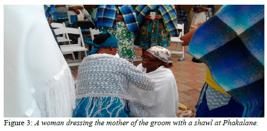
The narrator was reciting the following words as she was dressing her; -
"O mmaagwe bana. Otlile go nna nkuku wa bana. Mme kgang ya gago e tona, re go apesa tjale e gore ka ha teng ga tjale ena, diphiri tsa lelapa la ga Dipuo tse di tlisiwang ko wena di helela hela ka ha. Wena o bo o diisa kae? ko Modimong." This means that as a mother, you are going to mother all children, and as a mother of all, you will be loaded with lots of the secrets of those that you are mothering, including your grandchildren. You should take all those secrets to God. Therefore, wrapping the shawl or gathering it around her shoulder and locking it using a safety pin (Sekopelo) is a symbol of taking a vow of silence, especially on matters of her family. Women are responsible for holding the family together, just like a shawl that is draped around her shoulder. They are expected to develop solid relationships with their children and other family members to maintain unity.
Therefore, they should develop a mature character. The Ledumadumane shower placed more emphasis on the change of character; the marital bride was advised to be humble and have a godly character. In another instance, Kgalemang (personal communication; 06/05/2017) reported that during Naomi-Laban showers at Kanye, women made it clear that a woman who had gone through shawl wearing and pinning should rutubala/imamela. Rutubala means relax or take it easy or be calm and collected at all times. This means that as someone who has the responsibility of handling everyone's problems, she should be calm at all times, not only for the sake playing her role effectively, but that should also be seen in her character.
Naomi/Laban showers are observed during key life events, such as weddings, childbirth, and other significant milestones. For instance, during a baby shower, the community comes together to celebrate the impending arrival of a new family member. This event not only marks the transition to parenthood but also emphasises the communal support and shared responsibility in raising children. These showers also serve as platforms for imparting wisdom and cultural knowledge. Elders often play a prominent role in these gatherings, sharing their experiences and offering guidance to the younger generation. This transmission of cultural values and teachings helps preserve the cultural identity of the nation and fosters a sense of continuity between generations.
Furthermore, Naomi/Laban showers emphasise the concept of Botho/Ubuntu, highlighting the interconnectedness of individuals within the community (Shaibu 2013). These gatherings showcase the importance of community support, where neighbours, friends, and relatives come together to celebrate and provide assistance when needed. This sense of communal unity reinforces the idea that individuals are part of a larger collective, and their well-being is intricately tied to the well-being of the community.
In summary, the cultural significance of Naomi/Laban showers in Botswana encompasses communal celebrations, rich rituals and symbolism, marking life milestones, preserving cultural values, fostering community support, and imparting cultural knowledge. These showers are a testament to the enduring cultural traditions that continue to shape Botswana's social landscape and play a central role in the lives of its people (Mogopodi & Ngoepe 2020).
The Culture of Silence and Its Impact
Botswana's Naomi/Laban showers encompass rituals that hold profound symbolism, primarily signifying a commitment to silence regarding family matters. Through qualitative research methods such as interviews and observations, this study has provided valuable insights into how these rituals contribute to and perpetuate the prevalent culture of silence in Botswana. Central to Naomi/Laban showers is the ritual of draping a white shawl or blanket over the honoured, be it a bride or expectant mother. This seemingly simple yet highly symbolic gesture serves as a visual representation of a solemn vow of silence, particularly concerning personal family affairs (Madigele et al 2020b). It conveys the idea that certain aspects of one's life, especially those pertaining to family matters, should remain private and unspoken. This act underscores the cultural norm of keeping sensitive issues within the family circle, thereby reinforcing the culture of silence in Botswana (Ramsay & Werbner 2006).
The involvement of elders in Naomi/Laban showers is pivotal, as they impart wisdom and guidance to the younger generation. Interviews with these elder participants revealed their steadfast belief in the necessity of safeguarding family matters from public scrutiny. They emphasise the importance of not airing family grievances or issues in public, aligning with the cultural imperative of preserving the family's reputation (Madigele et al 2020a). These insights highlight how the older generation actively contributes to the perpetuation of the culture of silence.
Community members who partake in these celebrations also hold a collective understanding of unspoken boundaries. While Naomi/Laban showers are characterised by communal joy, there exists an implicit agreement that certain topics, especially those related to family conflicts or personal challenges, should not be openly discussed (Madigele et al 2020b). These interviews illuminate how these rituals reinforce the culture of silence by fostering an environment where discussions of such sensitive matters are discouraged.
Moreover, the interviews conducted with participants underscore the paramount importance of upholding Botho/Ubuntu values. These values emphasise respect, empathy, and interconnectedness within the community. Participants acknowledged that openly discussing family issues during these celebrations could potentially lead to discord and disrupt the communal harmony. Therefore, the commitment to silence during these rituals aligns with the overarching cultural value of preserving respect and unity, even at the expense of avoiding discussions on sensitive matters.
The rituals associated with Naomi/Laban showers serve as tangible manifestations of a vow of silence deeply embedded in Botswana's cultural fabric. Insights gleaned from interviews and observations shed light on how these rituals reinforce the culture of silence, with a particular emphasis on symbolism, the wisdom of elders, communal boundaries, and the preservation of Botho/Ubuntu values. These findings contribute to a more profound understanding of the cultural dynamics at play within these celebrations and their profound impact on family communication patterns.
Role of Pastoral Care
The role of pastoral care within the context of Naomi/Laban showers in Botswana is multifaceted and deeply rooted in the cultural and spiritual aspects of these celebrations. Pastoral care providers, often Pentecostal pastoral counsellors, play a vital role in offering emotional and spiritual support to individuals and families during these events.
Pastoral care providers offer spiritual guidance and support to individuals and families as they navigate significant life transitions. During Naomi/Laban showers, these counsellors draw from their religious and biblical knowledge to offer prayers, blessings, and words of encouragement (Lartey 2003). They emphasise the importance of faith and spirituality in strengthening family bonds and fostering unity. In my interviews with pastoral counsellors, it became evident that their role extended beyond traditional counselling. They shared how they invoke religious teachings to reinforce the importance of forgiveness, reconciliation, and mutual respect within families.
Pastoral care providers operate within a culturally sensitive framework, acknowledging and respecting the cultural traditions and practices of Naomi/Laban showers. They recognise that these celebrations are deeply rooted in Botswana's cultural heritage and tailor their support accordingly (Patton 2006). This approach ensures that pastoral care aligns with the cultural norms and values of the community. Pastoral counsellors often incorporate traditional cultural elements, such as proverbs and folk stories, into their counselling sessions to connect with participants and convey important messages about family unity and harmony.
Moreover, conflict within families is not uncommon, and pastoral care providers are equipped to facilitate conflict resolution and mediation. They encourage open communication among family members and provide a safe space for individuals to express their concerns (Lartey 2003). By addressing conflicts, they contribute to breaking the culture of silence surrounding family issues. Pastoral counsellors shared anecdotes of mediating family disputes during Naomi/Laban showers. They emphasised the importance of addressing conflicts promptly to prevent them from escalating and causing long-term rifts within families.
Celebrations like Naomi/Laban showers can evoke a wide range of emotions, from joy and excitement to anxiety and apprehension. Pastoral care providers offer emotional support by lending a listening ear, providing comfort, and offering guidance on coping with emotional challenges (Patton 2006). Interviews with participants revealed that pastoral counsellors played a crucial role in helping individuals manage their emotional responses during these celebrations. They provided reassurance and encouragement, particularly to brides and expectant mothers.
Pastoral care providers actively promote the preservation of family values and the Botho/Ubuntu ethos within the community (Hadebe 2002). They stress the importance of mutual respect, empathy, and interconnectedness among family members. By reinforcing these values, they contribute to fostering healthier family dynamics. Pastoral counsellors often share stories and teachings that highlight the significance of family unity and the responsibilities of family members toward one another.
In summary, pastoral care within Naomi/Laban showers in Botswana encompasses spiritual guidance, cultural sensitivity, conflict resolution, emotional support, and the preservation of family values. Pastoral care providers serve as a bridge between religious and cultural traditions, offering valuable insights and support to individuals and families as they navigate important life events. Their role is instrumental in promoting open communication, breaking the culture of silence, and nurturing strong family bonds within the community (Akinnifesi 2013).
Balancing Tradition and Contemporary Challenges
Balancing the preservation of Botswana's cultural traditions, such as the Naomi/Laban showers, with contemporary challenges presents a complex endeavour. The influence of globalisation and urbanisation has significantly impacted younger generations, leading to a shift in values and customs, potentially eroding the significance of traditional rituals (Hadebe 2016). To address this challenge, pastoral care approaches must evolve to foster understanding and communication between generations.
Pastoral caregivers, deeply rooted in their cultural traditions, play a pivotal role in bridging the gap between tradition and modernity (Akinnifesi 2006; Lartey 2003). Facilitating intergenerational dialogue is a proactive approach. This involves creating spaces for respectful conversations between older generations, who hold cultural knowledge, and younger generations with questions or concerns about their heritage. Through these discussions, pastoral caregivers can dispel misunderstandings, cultivate appreciation for cultural practices, and encourage the integration of tradition into contemporary life (Patton 2011). Flexibility within cultural values is another essential aspect. Couples should be encouraged to adapt traditional practices to align with their preferences and circumstances. For example, the act of draping a white shawl during a Naomi/Laban shower, symbolising silence, can become an opportunity for couples to discuss its significance with pastoral caregivers and find ways to incorporate it while maintaining open communication.
Within the culture of silence surrounding Naomi/Laban showers, contemporary issues often remain unaddressed, including gender inequality and communication challenges. Pastoral care, influenced by Patton's contextual care and Lartey's intercultural approach, should promote healthy communication, teaching effective skills rooted in cultural understanding. Furthermore, pastoral caregivers should be well versed in contemporary challenges such as mental health, substance abuse, and domestic violence, offering emotional and spiritual support while connecting individuals and families with relevant resources and services.
In conclusion, balancing tradition and contemporary challenges during Naomi/Laban showers in Botswana necessitates adaptable pastoral care approaches. This balance allows Botswana to honor its cultural heritage while embracing the complexities of the modern world.
Pastoral Care Strategies and Interventions
The role of pastoral care in addressing the culture of silence within Botswana's Naomi/Laban showers is multifaceted and deeply rooted in the principles of pastoral care functions, an intercultural approach to pastoral care and counseling, insights from African women theologians, and the findings from the research paper "Unveiling the Veil of Silence: Culture, Secrecy, and Pastoral Care in Botswana's Naomi/Laban Showers."
Pastoral care functions, as conceptualised by Clebsch and Jaekle (1964), encompass healing and sustaining. In the context of Naomi/Laban showers, pastoral caregivers play a crucial role in actively listening to individuals and offering support. They address the emotional wounds caused by the culture of silence by providing a safe space for individuals to express their thoughts and feelings (Clebsch & Jaekle 1964:4). Additionally, when healing may not be immediately possible, pastoral caregivers sustain individuals by journeying with them, helping them find inner strength and support to cope with their situation (Clebsch & Jaekle 1964:42).
Guiding, another pastoral care function, takes into account the contextuality and multiple perspectives recommended by Lartey (2003). It seeks to assist individuals in making confident and truthful choices regarding their situations (Lartey 2003:65). In the context of Naomi/Laban showers, pastoral caregivers guide individuals in breaking the silence imposed by cultural norms, encouraging them to engage in open and healthy communication about family matters. Reconciliation, as a pastoral care function, aims to restore broken relationships and promote harmonious connections (Clebsch & Jaekle 1964). In the context of the culture of silence within Naomi/Laban showers, pastoral caregivers work toward reconciling individuals with their own voices and emotions, as well as with their families and communities. This involves addressing the tensions created by the vow of silence and fostering understanding and unity.
Lartey (2003) introduced the pastoral care functions of liberating and empowering, which are highly relevant in contexts where individuals, particularly women, have silenced themselves due to cultural norms and expectations (Lartey 2003:67-68). Pastoral caregivers, drawing from the insights of African women theologians, can conscientise individuals about the sources of their suffering and oppression, helping them seek viable solutions and personal transformation. The intercultural approach to pastoral care and counseling, as advocated by Lartey (2003), emphasises contextuality, multiple perspectives, and authentic participation. In the context of Naomi/Laban showers, pastoral caregivers must consider the cultural, social, and familial contexts that contribute to the culture of silence. They should engage in authentic dialogue that respects the perspectives of individuals while encouraging them to challenge harmful cultural norms (Lartey 2003:33-34).
Moreover, Insights from African women theologians highlight the detrimental effects of silencing women in contexts of abuse and oppression. Pastoral caregivers should draw from this wisdom to challenge the perpetuation of silence within Naomi/Laban showers and empower women to break free from oppressive norms.
Conclusion
This paper has explored the multifaceted aspects of this culture of silence, its manifestations during Naomi/Laban showers, and its impact on individuals and families. One significant finding is that Naomi/Laban showers symbolise a vow of silence regarding family matters, with rituals like draping a white shawl serving as visible representations of this commitment. Elders and community members actively contribute to the perpetuation of this culture of silence by emphasising the importance of keeping family grievances and issues private. While these traditions align with the overarching cultural value of preserving respect and unity, they also present challenges, particularly in addressing contemporary issues such as gender inequalities and communication challenges.
Pastoral caregivers, rooted in their cultural traditions, must adapt their approaches to navigate the delicate balance between tradition and contemporary challenges. Incorporating intergenerational dialogue, promoting flexibility, and addressing pertinent issues are essential steps. This requires pastoral caregivers to be well-informed about contemporary challenges faced by families in Botswana, such as mental health, substance abuse, and domestic violence, while providing emotional and spiritual support and connecting individuals with relevant resources and services. In the context of Naomi/Laban showers and the broader cultural landscape of Botswana, pastoral care must evolve to promote open communication, understanding, and the preservation of cultural heritage while embracing the opportunities and complexities of the modern era. By striking this balance, Botswana can continue to honour its rich cultural tapestry and ensure that its traditions thrive in the face of contemporary challenges. This exploration of the culture of silence during Naomi/Laban showers underscores the importance of cultural sensitivity and adaptation in pastoral care. It also highlights the need for ongoing research and dialogue to better understand and address the intricate dynamics of culture, secrecy, and pastoral care within Botswana and similar cultural contexts. In moving forward, Botswana's cultural heritage can be celebrated and preserved, not in spite of contemporary challenges, but in harmony with them, fostering a sense of continuity, community, and resilience.
Bibliography
- Akinnifesi, F. 2006. Pastoral care in African Christianity: Cherry on top or essential ingredient? Scriptura 93:390-406.
- Bird, P. 1993. To play the harlot: An inquiry into an Old Testament metaphor. In Gottwald, N.K. (ed.), The Bible and liberation (Chap. 2). New York: Orbis.
- Berman, S. K. (2012). Batswana men's masculinities from men's interpretation of Hosea 1-3: A case study of the Africa Evangelical Church. In World Council of Churches (ed), Redemptive masculinities: Men, HIV and religion (Chap. 9). Geneva: WCC Publications.
- Chisale, S.S. 2016. Love, discipline, punishment or wife battering: A view from Ubuntu, Gender and Behaviour 14(2): 7275-7283.
- Clebsch, W. A., & Jaekle, C. R. 1964. Pastoral care in historical perspective. Prentice Hall, Upper Saddle River.
- Clebsch, W., & Jaekle, C. 1994. Pastoral care in historical perspective. Rowman & Littlefield Publishers, Inc.
- Clinebell, H. J. 1992a. Basic Types of pastoral care and counseling: Resources for the ministry of healing and growth (2nd ed.). Nashville: Abingdon Press.
- Clinebell, H. J. 1992b. Understanding and counseling the alcoholic through religion and psychology. Abingdon Press.
- Comaroff, J. L., & Comaroff, J. 1987. The madman and the migrant: Work and labor in the historical consciousness of a South African people, American Ethnologist 14(2): 191-209.
- Creswell, J. W., & Creswell, J. D. 2017. Research design: Qualitative, quantitative, and mixed methods approaches. London: Sage publications.
- Creswell, J. W., & Poth, C. N. 2018. Qualitative inquiry and research design: Choosing among five approaches. Washington DC: Sage publications.
- Hadebe, N. 2016. African pastoral care and the middle axis of traditions in society, Acta Theologica 36(2): 51-72.
- Hitchcock, R. K., & Gibson, D. 2006. Botswana: Culture and society. In Culture and Customs of Botswana. Westport: Greenwood Press.
- Jack, D. C. 1991. Silencing the self: Women and depression. Cambridge: Harvard University Press.
- Kanyoro, M. 1996. Feminist theology and African culture. In Wamue, G. and Getui, M.N. (eds), Violence against women: Reflections by Kenyan woman theologians (pp. 4-12). Nairobi: Acton Publishers.
- Lartey, E. Y. 2003. In living color: An intercultural approach to pastoral care and counseling. Jessica Kingsley Publishers.
- Madigele, T. J., Dube, M., Motswapong, E., Kebaneilwe, M. D., Setume, D., Gabaitse, R., Modie-Moroka, T., & Kgalemang, M. 2020. Prospects and potential in pastoral theological counselling approaches and implications on premarital counselling during Naomi/Laban Bridal showers in Botswana Journal of African Interdisciplinary Studies 4(11): 109-121.
- Madigele, T. J., Motswapong, E., Kebaneilwe, M. D., Setume, D., Gabaitse, R., Modie-Moroka, T., & Kgalemang, M. 2020. Pre-marital pastoral counselling/go "Laa on issues of gender and human sexuality: Naomi//Laban Showers in Gaborone, Botswana, The International Journal of African Catholicism 10(1): 177-201.
- Maluleke, T. S., & Nadar, S. 2002a. Breaking the covenant of violence against women, Journal of Theology for Southern Africa 114(Nov): 5-18.
- Maluleke, T. S., & Nadar, S. 2002b. Guest editorial, Journal of Theology for Southern Africa 114(Nov): 3-4.
- Mookodi, G. (2000). The complexities of female headship in Botswana. Pula: Botswana Journal of African Studies 14(2): 148-164.
- Mookodi, G. 2004a. Male violence against women in Botswana: A discussion of gendered uncertainties in a rapidly changing environment, African Sociological Review 8(1): 118-138.
- Mookodi, G. 2004b. The dynamics of violence against women in Botswana, Pula: Botswana Journal of African Studies 18(1): 55-64.
- Mookodi, G., & Ngoepe, M. 2017. Culture of silence: A barrier to reporting sexual abuse against children in Botswana, Journal of Child Sexual Abuse 26(3): 314-329.
-
Ntseane, P. G. 2004. Cultural dimensions of sexuality: Empowerment challenges for HIV/AIDS prevention in Botswana. UNESCO Special Issue on HIV/AIDS. Online: http://www.unesco.org/education/uie/pdf/ntseane.pdf
» http://www.unesco.org/education/uie/pdf/ntseane.pdf - Oduyoye, M. A. 2005. Daughters of Anowa: African women and patriarchy. Maryknoll, NY : Orbis Books.
- Patton, J. M. 1993. Pastoral care in context: An introduction to pastoral care. Louisville: Westminster/John Knox Press.
- Patton, M. Q. 2015. Qualitative research & evaluation methods: Integrating theory and practice. New Delhi: Sage publications.
- Phiri, I. A. 2002. Why does God allow our husbands to hurt us? Overcoming violence against women, Journal of Theology for Southern Africa 114(Nov): 19-30.
- Ramsay, J., & Werbner, R. 2006. The culture of silence: Violence among Setswana-speaking youth in Botswana, Journal of Southern African Studies 32(2): 369-387.
- Shaibu, S. 2013. Experiences of grandmothers caring for orphan grandchildren in Botswana, Journal of Nursing Scholarship 45(4): 363-370.
