Predictive values of serum nutritional indices for early postoperative wound infections in surgically treated closed femoral fractures
Abstract
BACKGROUND: Laboratory assessments of nutritional status consisting of evaluation of serum albumin and total lymphocytes count (TLC) are valid tests of a patient's nutritional status. This study evaluated these indices and the findings were correlated with the occurrence of early surgical site infection (SSI). METHODS: This was a prospective study conducted on 100 patients with closed femoral fractures for a period of ten months. Blood samples were taken to determine levels of serum albumin, total lymphocytes count and for human immunodeficiency virus (HIV). Postoperatively, body mass index (BMI) was calculated and wounds were examined regularly for signs of SSI. RESULTS: On the basis of the albumin index, 25% of the patients had malnutrition and the infection rate in this group was 28%. Malnutrition as per TLC was 3% with an infection rate of 33.3%. Only one patient was malnourished when both albumin and TLC indices were considered and this patient developed SSI. Risk of developing SSI was about 10 times in those with albumin depletion, four times in those with reduced TLC and 12 times when both indices were low. Significant association was seen in low albumin levels (P = 0.000). CONCLUSIONS: Patients at risk of SSI can be identified pre-operatively using relatively inexpensive laboratory tests of nutritional parameters such as serum albumin. Preventive measures like nutritional support and prophylactic antibiotics can then be initiated.
Introduction
Trends towards changing the management of fractures of the shaft of femur advocate operative treatment as it facilitates early ambulation and reduced length of hospital stay.12345
Materials and methods
A prospective study was conducted from March to December on patients aged 13 years and above who had closed femoral shaft fractures and were operated within a week from when the injury was sustained. A total of 100 patients were recruited after applying the Kirkwood formula for the sample size at a significance level of 95%, the proportion of malnourished patients with femoral shaft fractures was 58.6%6
The operation site was inspected pre-operatively for signs of skin infection. About 3 ml of blood was drawn from all eligible patients to determine levels of serum albumin, TLC and for HIV. Open reduction and internal fixation operations were performed by trauma surgeons who were also involved in the confirmation of the type of fracture according to the X-ray films. All patients had their operations done in the same theatre which was equipped with laminar flow, and similar standardised protocols were followed.
Ceftriaxone injections at a dose of 1 gram once daily for three days were prescribed. The first dose was given within 24 hours postoperatively. Assessment for surgical wound status was done daily from the third postoperative day when in-patient, and once per week after discharge. This follow-up continued for the first 30 postoperative days; and diagnosis for the presence of infection was based on the Centre for Disease Control (CDC) criteria. Neither culture nor Gram staining was done; the finding of a purulent discharge at the operation site was considered the determinant for the presence of infection. Malnutrition was considered to exist when a patient had values of serum albumin of < 3.5 g/dl and/or TLC < 1 500 cells/ml. The rapid method for HIV testing was used. The initial negative results were considered negative while positive results were repeated with the same rapid method. Negative results for the second test were concluded as negative and positive results as positive. Height and weight measurements were taken as soon as the patient started to ambulate while still being an in-patient and the body mass index (BMI) was calculated. A BMI of less than 18.5 was regarded as underweight, while a BMI of greater than 24.9 was considered overweight and above 29.9 obese.
All eligible patients gave written consent for their participation and ethical clearance was obtained from the research and publication committee of the local university.
Statistics
The Chi-square test was applied to check for the associations where statistical significance was accepted for p<0.05. The risk for infection in malnourished individuals was identified by a relative risk of greater than 1.
Results
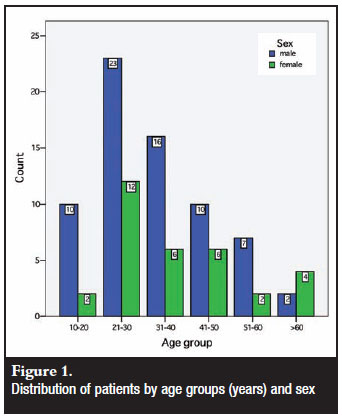
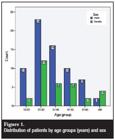
All 100 patients who were followed up had a mean age of 36.11 years with a standard deviation of 14.38. The oldest patient was 77 years old and the youngest was 13 years old. The peak age group was 21-30 years accounting for 35.0% of the study population. The age group above 60 years accounted for the least number of patients (6.0%). There were 68 males and 32 females, giving a male to female ratio of approximately 2:1 (Figure 1).
Forty patients (40.0%) had mid-shaft fractures; 28 patients (28.0%) had fractures of the proximal third and 32 patients (32.0%) had distal third fractures.
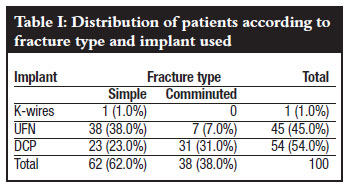
Fractures with comminution were seen in 38 patients (38.0%); and the rest were simple fractures. Of all the patients, plating with a broad dynamic compression plate (DCP) was done in 54 patients (54.0%) and nailing by open method using universal femoral nails (UFN) in 45 patients (45.0%). A boy with a supracondylar fracture was managed with crossing Kirschner wires (K-wires) (Table I).
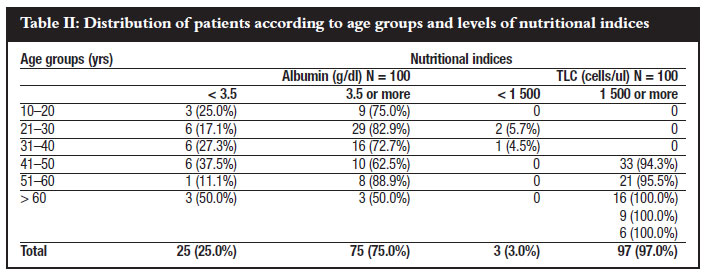
Seventeen males (25.0%) and 8 females (25.0%) were malnourished as per the albumin parameter. Considering the lymphocytes count criteria, there were 2 males and 1 female. The highest percentage of malnutrition occurred in the age group > 60 years according to albumin values and age group 21-30 years based on lymphocytes count (Table II).
On average albumin levels in patients who developed wound infection were low (mean 3.1 g/dl, std deviation 0.56) compared to those who had no wound infection (mean 3.9 g/dl, std deviation 0.56). To the contrary, lymphocyte counts in patients who developed wound infection averaged higher (mean 2 641.0 cells/ml, std deviation 582.39) than in those without wound infection (mean 2 587.8 cells/ml, std deviation 687.93).
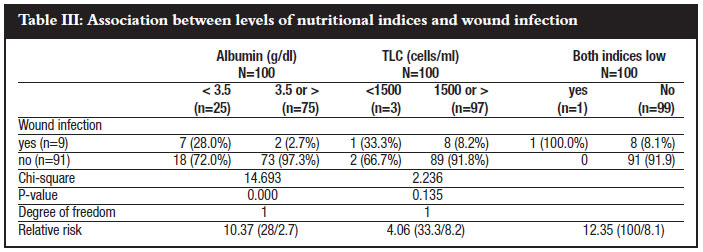
Out of 25 patients who had an albumin level < 3.5g/dl, seven patients (28.0%) acquired wound infection. Patients with low albumin had a 10 times increased risk of developing wound infection, and the association found was significant (P=0.000). Of the three patients who had lymphocytes count < 1 500 cells/ul, one patient developed wound infection. The risk of getting wound infection with low TLC was 4 times, but the association was not statistically significant (P=0.135). The only patient who had both albumin and TLC low developed wound infection. The risk of developing wound infection with an albumin < 3.5 g/dl and a TLC < 1 500 cells/ul was 12 times higher. (Table III).
There were 8(8%) HIV-infected patients. Of these, only 1 patient developed wound infection. The association found was not significant (P = 0.718). About half of the study population had normal weight (52%) and the infection rate in this group was 7.7% (4 patients). Underweight and overweight accounted for 26 (26% ) and 17 (17%) patients respectively, with an infection rate of 15.4% (4 patients) in the underweight group and 5.9% (1 patient) in the overweight group. There were 5 obese patients and none of them developed wound infection. The association found was not statistically significant ( P = 0.552).
There was no significant association between operation time and occurrence of wound infection (P = 0.576). Forty-four patients, who were in the majority, were operated within the interval of 61-90 minutes. Wound infection in this time interval occurred in five patients (11.4%). Most wound infections occurred in the interval of 91-120 minutes where out of 21 patients, 3 patients (14.3%) developed wound infection.
Discussion
In developing countries malnutrition is a major concern and is one of the most difficult problems to solve. It is not only a medical problem, but a complex social problem as well. In this study, the prevalence of malnutrition found in an orthopaedic patient population differed with individual indices of malnutrition. These differences are explained by the fact that each test reflects the status of a different metabolic function or body compartment or both. Other studies have reported different prevalence rates of malnutrition using albumin and TLC indices. Koval et al.7et al.8
Malnutrition in general is widely reported in the literature as a predisposing entity towards development of peri-operative complications.9
However, exogenous infection of clean wounds can occur following contamination as a result of sloppy nursing on postoperative wound care. Such poor nursing care can be attributed to early discharge from hospital as it appeared in this study where those who developed wound infections had shorter postoperative hospital stay (mean 3.44 days) compared to their counterparts (mean 4.00 days). Discharged patients are instructed to attend nearby health facilities to have their wounds attended to while awaiting the date of their follow-up at clinics. Some of these health facilities face a shortage of nurses and have no reliable access to sterile dressing kits. As a result they fail to observe antiseptic methods during wound care. The overall prevalence of wound infection found in this study was 9.0%. This rate is beyond the acceptable limits of the expected rates of postoperative wound infection of clean surgical procedures, which is 1-5%.10111213
As it was found to be predictive to SSI in this study, low albumin has also been reported in other studies to be predictive of a number of postoperative outcomes. Koval et al.714
The increased risk to the development of wound infection in patients with TLC of < 1 500 observed in this study closely correlates to findings in other studies.14
The ability of the co-existence of low levels of both albumin and TLC in predicting postoperative wound infection has been reported in the Koval et al. study.7
SSI is influenced by a variety of factors which include morbid obesity, prophylactic antibiotic use, operation time, and HIV status. Derangement of a single factor may not cause significant adverse effects to the surgical wound as it appeared in this study, where none of the obese developed wound infection postoperatively. Such findings are comparable to those obtained in research done at Jinnah Hospital Lahore, Pakistan.1516171819
Limitations of this study include failure to evaluate other factors that influence the occurrence of wound infection, such as surgical technique in relation to type of implant, soft tissue handling, maintenance of aseptic state and level of energy transfer.11
In conclusion, patients at risk of SSI can be identified pre-operatively using relatively inexpensive laboratory tests of nutritional parameters. Preventive measures like nutritional support and prophylactic antibiotics can then be instituted. A parameter predictive of postoperative wound infections is hypoalbuminaemia. However, a larger study group with greater variance is necessary to be able to analyse both parameters statistically.
Above all, I am indebted to patients who volunteered for the study. Patients in general are the purpose of our care, the source of our quests and the inspiration of our daily work. To them, I give my heartfelt thanks.
Acknowledgement
I would like to extend my sincere gratitude to the whole team working at Muhimbili Orthopaedic Institute including specialists, residents, registrars, interns and laboratory technicians who assisted me in one way or another in making this work possible.
References
- 1. Brumback RJ, Toal TR, Murphy-Zane, MS et al. Immediate weight bearing after intramedullary nailing of comminuted femoral shaft fractures; Presented at the annual meeting of the orthopaedic trauma association, October 9, 1998, Vancouver, Canada.
- 2. Schneider SM, Veyres P, Pivot X, Soummer AM, Jambou P, Filippi J, Van Obberghen E, Hebuterne X. Malnutrition is an independent factor associated with nosocomial infections. British Journal of Nutrition 2004;92(1):105-11.
- 3. Haley RW, Schaberg DR, Crossley KB. Extra charges and prolongation of stay attributable to nosocomial infections: a prospective interhospital comparison. Am J Med 1981; 70(1):51-58.
- 4. Presidio Sanitario, San Camillo. Positive association between total lymphocytes count and femur bone mineral density in hip-fractured women. International Journal of Experimental Clinical and Behavioural Gerontology 2002;48(3).
-
5. CDC definitions for surgical site infection; 1999. http://www.qiproject.org/public data/CDCsurgical.asp.
» http://www.qiproject.org/public data/CDCsurgical.asp - 6. Cuthbertson DP. Further observations of the disturbance of metabolism caused by injury, with particular reference to the dietary requirements of fracture cases. Br J of Surg 1936.
- 7. Koval, Kenneth J; Maurer, Stephen G; SU, Edward T, et al. The effect of nutritional status on outcome after hip fracture. Journal of Orthopaedic Trauma 1999;13(3):164-69.
- 8. Schneider SM, Veyres P, Pivot X, Soummer AM, Jambou P, Filippi J, Van Obberghen E, Hebuterne X. Malnutrition is an independent factor associated with nosocomial infections. British Journal of Nutrition 2004;92(1):105-11.
- 9. Herrman FR, Safran C, Levkoff SE, Minaker KL. Serum albumin level on admission as a predictor of death, length of stay and readmission. Arch Intern Med 1992;152:125-30.
- 10. Garner JS. Hospital Infections Program Centers for Infectious Diseases Center for Disease Control. Guideline for Prevention of Surgical Wound Infections, 1985.
- 11. Finn Gottrup, Andrew Melling, Dirk A. Hollander. An overview of surgical site infections: Etiology, incidence and risk factors. September 2005.
- 12. Rangel-Frausto MS, Morales Garcia D, Barez-Martinez R, Ibarra-Blancas J, Ponce de Leon-Rosales S. Evaluation of a nosocomial infection surveillance program. Salud Public Mex 1999;41(Suppl)1:S59-63.
- 13. Murthy R, Sengupta S, Maya N, Shivanada PG. Incidence of postoperative wound infection and their antibiogram in a teaching and referral hospital. Indian J Med Sci 1998;52(12):553-5.
- 14. Greene KA, Wilde AH, Stulberg BN. Preoperative nutritional status of total joint patients. Relationship to postoperative wound complications. J Arthroplasty 1991;6:321-25.
-
15. Role of preoperative nutritional assessment on early postoperative wound infection. SHL Lahore Pakistan; from 26thInternational Symposium on Intensive Care and Emergency Medicine. Brussels, Belgium. Critical Care 2006;10(Suppl 1):211. http://ccforum.com/supplements/10/S1.
» http://ccforum.com/supplements/10/S1 - 16. Umeh O, Berkowitz LB. Klebsiella infections. eMedicine Journal, November 2002.
- 17. Cruse PJE, Foord RRN. The epidemiology of wound infection. A 10 year prospective study of 62,939 wounds. Surg Clin North AM 1980;27-40.
- 18. Tanzania commission for AIDS; HIV/AIDS indicator survey 2003-04. National Bureau of statistics and ORC Macro. 2005. Calverton, Maryland U.S.A: Pg 73-81.
- 19. Luck JV jnr, Logan LR, Benson DR, Glasser DB. Human immunodeficiency virus infection. Complications and outcome of orthopaedic surgery. JAM Acad Orthop Surg 1996;4:297-304.

 Reprint requests:
Dr DM Masatu
PO Box 260
Iringa/Tanzania
Tel: +255-026- 2702264/Cell: +255-0753- 938702/Fax: +255-026-2702264
E-mail: deomanyama@yahoo.com