A retrospective comparison of the diagnostic accuracy of CT-guided percutaneous core needle and open biopsy for musculoskeletal tumours
Abstract
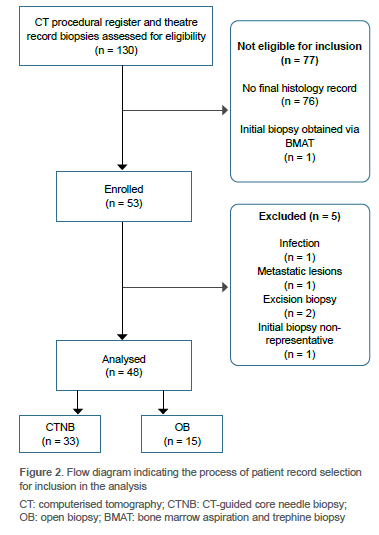
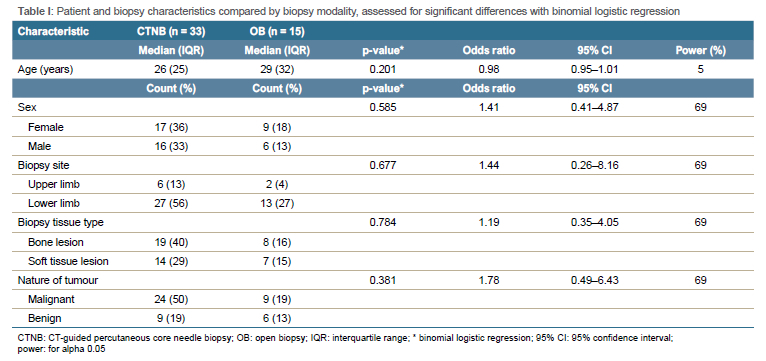
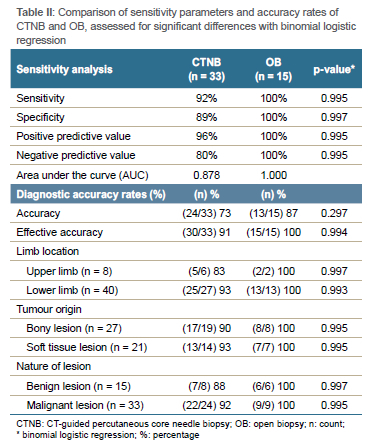
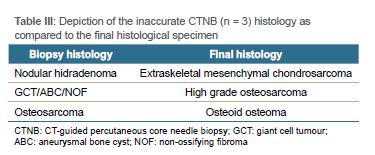
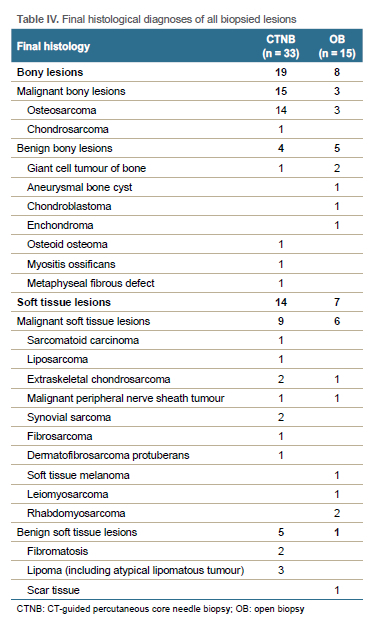
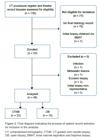
BACKGROUND: An accurate histological diagnosis is imperative for directed management of musculoskeletal tumours. Globally there has been a shift from open biopsies to less invasive computerised tomography (CT)-guided percutaneous core needle biopsies for diagnosis. Literature suggests comparable diagnostic accuracy with the two modalities. This investigation aimed to evaluate the diagnostic accuracy of CT-guided percutaneous core needle biopsy (CTNB) compared to open biopsy (OB) in musculoskeletal tumours at a South African training hospital. METHODS: A retrospective review of patients' histological records was conducted for patients who underwent either CTNB or OB for a primary musculoskeletal tumour, followed by definitive surgical resection. Patients of any age who had a biopsy between January 2017 and December 2021, whose biopsy was not excisional nor performed during a definitive procedure for a pathological or impending fracture, were eligible for inclusion. Biopsies of metastatic lesions were excluded. Biopsy results were compared to final histopathological diagnoses to determine diagnostic accuracy. Sensitivity, specificity and predictive values were calculated. Logistic regression was conducted to determine if significant differences in accuracy were present between the biopsy techniques. RESULTS: Forty-eight patients met inclusion criteria, of which 33 had a CTNB (69%) and 15 an OB (31%). Patients had a median age of 26 years, and 54% were female. There were 33 malignant lesions (69%) and 15 benign lesions (31%). Most were primary bone lesions (27, 56%) of the lower limb (40, 83%). Diagnostic accuracy was 73% for CTNB and 87% for OB. Statistical significance could not be determined due to the limited sample size. The ability to distinguish between benign and malignant lesions was 91% for CTNB and 100% for OB. The sensitivity and specificity for detecting malignancy utilising CTNB were 92% and 89%, respectively, whereas for OB, both sensitivity and specificity were 100%. CONCLUSION: CTNB and OB in this setting have acceptable sensitivity and specificity profiles for distinguishing benign from malignant lesions. Although this study could not confirm equivalence due to limited power, the results suggest CTNB is a viable alternative to incisional biopsy. Larger local prospective studies are needed to determine if both biopsy types are equivalent for future diagnostic practices. Level of evidence: 4
biopsy; musculoskeletal tumour; CT-guided percutaneous core needle biopsy; open biopsy; histopathological diagnostic accuracy
 Thumbnail