The mechanical testing of a novel interlocking forearm nail
Abstract
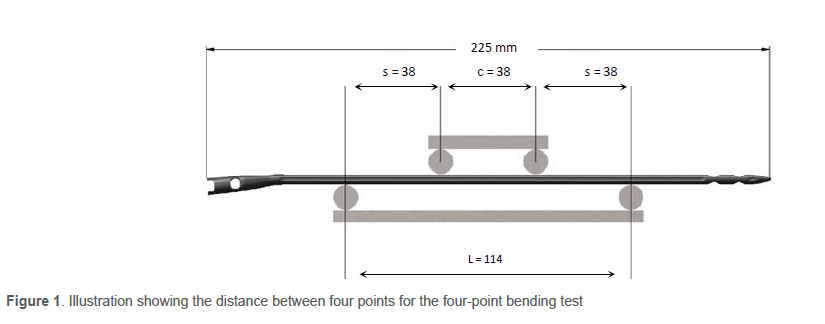
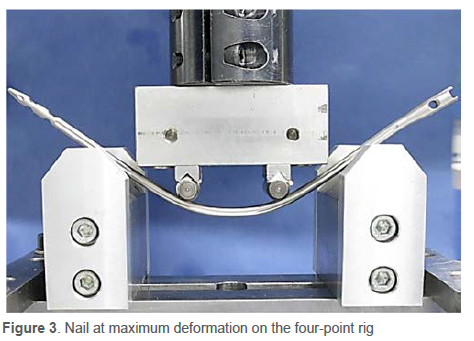
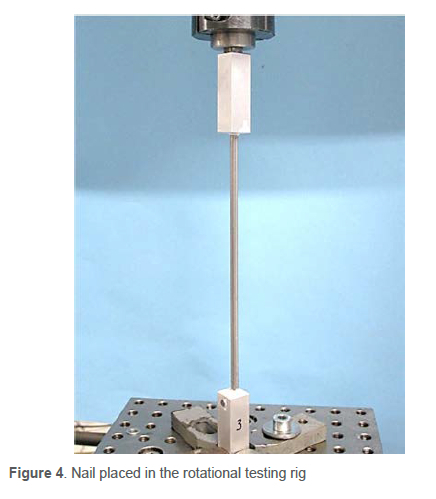
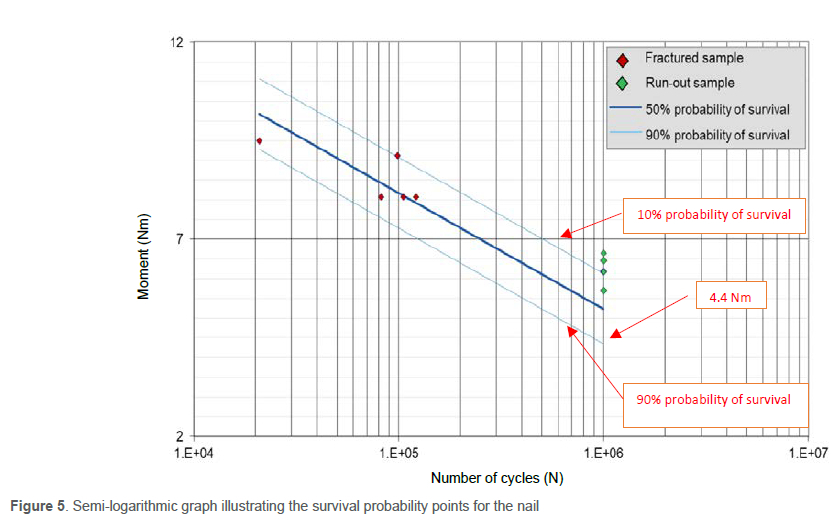
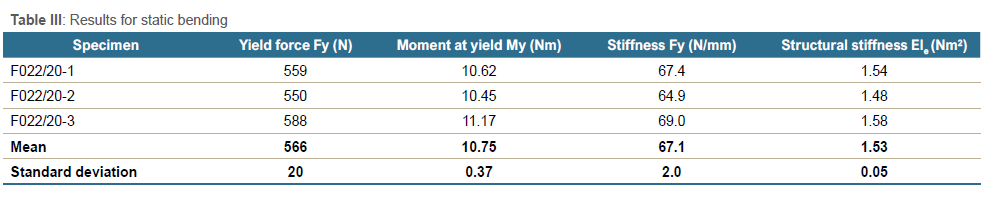
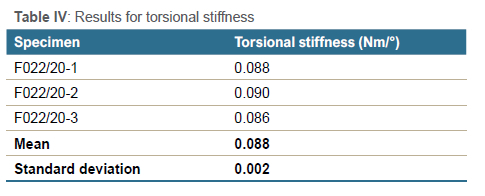
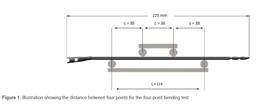
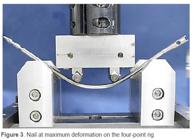
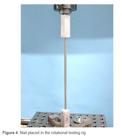
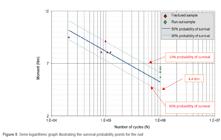
BACKGROUND: Mechanical testing of newly designed implants provides valuable insight into their mechanical properties. This provides surgeons with information about implant choice for the treatment of fractures and the effect of the implant's mechanical properties on fracture healing METHODS: A novel interlocking forearm nail was subjected to standardised mechanical testing according to the Standard Specification and Test Methods for Intramedullary Fixation Devices (ATSM 126416), using static and dynamic four-point bending and static torsion (ASTM STP 588). Three nails were used for the static bending and torsion and nine for the dynamic bending tests. All nails were catalogued, numbered and photographed before testing RESULTS: The mechanical testing results showed a mean force yield (Fy) of 566 ± 20 N, a moment of yield (My) 10.75 ± 0.37 Nm, a stiffness of 67.10 ± 2 N/mm and structural stiffness of 1.53 ± 0.50 m2. The torsional stiffness of the nail was 0.088 ± 0.002 Nm/°. The four-point dynamic bending test showed a fatigue strength of 5.23 Nm. This value was determined using the semi-log moment/ number of cycles (M-N) diagram and showed a 50% failure at a million cycles. If the moment were reduced to 4.4 Nm, mathematically, the survival rate would improve to 90% CONCLUSION: The results from this mechanical testing show that this novel intramedullary forearm nail can resist mechanical forces experienced during fracture healing and could potentially be used in future clinical studies Level of evidence: Level 4
mechanical testing; ASTM; load; yield; stiffness; fatigue strength
 Thumbnail
 Thumbnail
 Thumbnail
 Thumbnail
 Thumbnail