Treatment outcomes of civilian gunshot tibia fractures at a major trauma centre
Abstract
BACKGROUND: The aim of this retrospective longitudinal study was to describe the overall burden and outcomes of surgically managed gunshot tibia fractures at a major trauma centre. Secondary objectives were to identify possible risk factors for complications including non-union and infection and to highlight any differences in outcomes between treatment modalitiesMETHODS: All consecutive patients who sustained gunshot injuries to the tibia between January 2014 and December 2017 including children and multiple gunshots injuries were considered for inclusion. Information related to patient demographics, injury characteristics, treatment information and treatment outcomes with respect to rate of fracture union and occurrence of infection were obtained from patient records. All patients with insufficient medical records were excludedRESULTS: The records of 197 patients who sustained gunshot tibia fractures were reviewed. The mean follow-up was 4.1 months (interquartile range [IQR] 2.5-6.8). The majority of cases were young males (89%) with a mean age of 29.2±10.2 years. Extra-articular diaphyseal fractures were observed in the majority of cases (91%). Definitive treatment included formal debridement in theatre and plaster cast immobilisation (44%), intramedullary nail fixation (27%), circular external fixation (22%) and plate fixation (7%). The study revealed an overall fracture-related infection (FRI) rate of 11% and bone union rate of 91%. Circular external fixation showed the lowest fracture union rate (86%) and highest FRI rate (21%) of the modalities included in this study. No associations between independent risk factors and presence of complications were identifiedCONCLUSION: The study reports encouraging outcomes for tibia fractures caused by civilian gunshot injuries. Various definitive surgical stabilisation techniques showed high proportions of union and low burden of FRILevel of evidence: Level 4
tibia; gunshot; fracture; outcome
Introduction
Trauma accounted for 8.5% of global deaths as indicated in the 2015 Global Burden of Disease study.123
Insight into the South African burden of gunshot-related injuries on orthopaedic services was reported by Engelmann et al. who reviewed 294 extremity gunshot injuries seen at a tertiary trauma centre in Cape Town over an 11-month period between June 2015 and April 2016, and reported that tibia fractures accounted for the majority (42.2%) of lower extremity injuries.456
Gunshot-induced tibia fractures are often associated with a myriad of complications presenting greater challenges to clinicians. Gunshots involve the transfer of blast energy to the bone and soft tissue resulting in cavitary tissue damage and a large zone of injury.88
Several controversies regarding the management of gunshot-induced tibia fractures persist as a result of the heterogeneity of these injuries. Management of these injuries can range from conservative management to formal debridement and skeletal stabilisation either in a single setting, or as a staged approach.9 101011
The present study aims to describe the treatment outcomes of civilian gunshot tibia fractures at a major trauma centre.12
Methods
A retrospective review of clinical records and serial radiographs of all patients who sustained gunshot tibia fractures between January 2014 and December 2017 was conducted. Institutional ethics committee approval and hospital board approval was obtained prior to commencement of data collection.
Medical records of all adult and paediatric patients presenting with tibia fractures as a result of gunshot injuries in the study period were reviewed by the authors. Demographic information of all included patients was recorded, and patient records were assessed to identify the extent of soft tissue injury and presence of associated injuries. Patients that did not require surgical intervention, as well as all patients with incomplete medical records, were excluded. Tibia fractures were classified according to the Muller AO Classification13
As per international protocol, intravenous antibiotics (cephazolin) were administered on presentation14
Radiographs were reviewed to determine time to radiological union based on the Radiographic Union Score for Tibia fractures (RUST Score).1516
Data was analysed using STATISTICA version 13.5 (StatSoft Inc., Tulsa, OK, USA) and data is presented as means ± standard deviations or median (interquartile range [IQR]), depending on the distribution, while categorical data is presented as frequencies and counts. Associations between risk factors, including age, sex, HIV status, injury location and delay to surgical management, and known outcomes, specifically presence of i) non-union or ii) infection, were investigated using an independent t-test or Mann-Whitney U test for continuous data, while a Pearson's chi-square test or a Fisher's exact test was used for categorical data.
Results
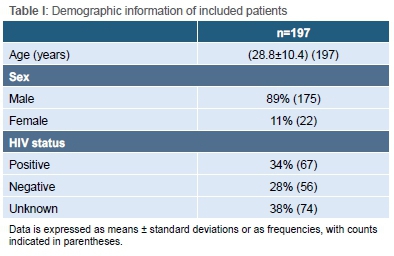
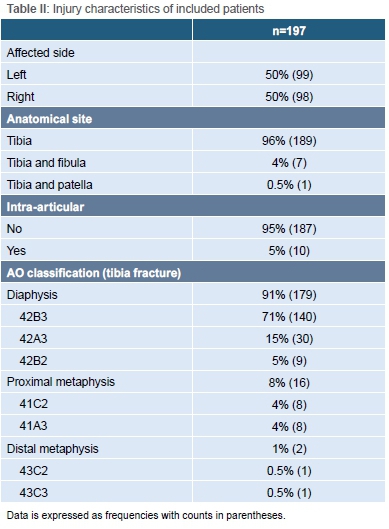
A total of 213 patients who sustained gunshot tibia injuries were reviewed. Sixteen patients who did not require surgery or had incomplete medical records were excluded. The final cohort therefore included 175 male patients (89%) and 22 female patients (11%) with a mean age of 28.8±10.4 years (Table I). Isolated tibial injures represented 96% of cases (n=189). The majority of injuries (91%, n=179) were diaphyseal fractures while 9% (n=18) were peri-articular injuries (Table II).
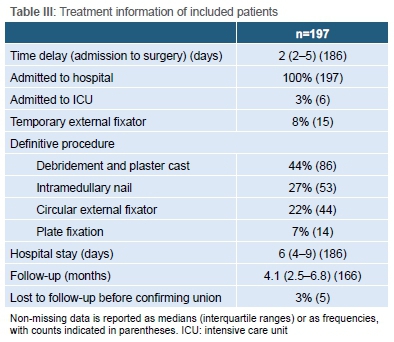
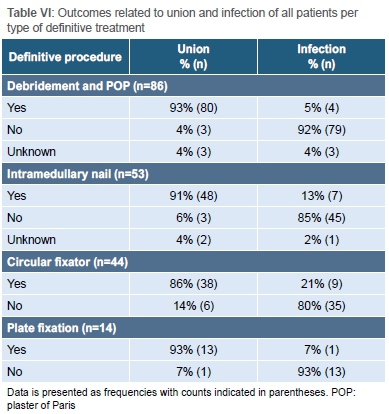
Patients underwent surgery at a median of 2.0 (IQR 2.0-5.0) days following admission. The majority of fractures were managed by fixation including IMN fixation (27%, n=53), circulator external fixation (22%, n=44), and plate fixation (7%, n=14) while remaining fractures were managed through formal debridement and plaster cast immobilisation (44%, n=86). Definitive soft tissue and fracture management was performed during a single theatre visit in all patients. Median length of stay in hospital was 6.0 (IQR 4.0-9.0) days. Patients were followed up for a median of 4.1 (IQR 2.56.8) months. Five (3%) patients were lost to follow-up prior to confirmation of union (Table III).
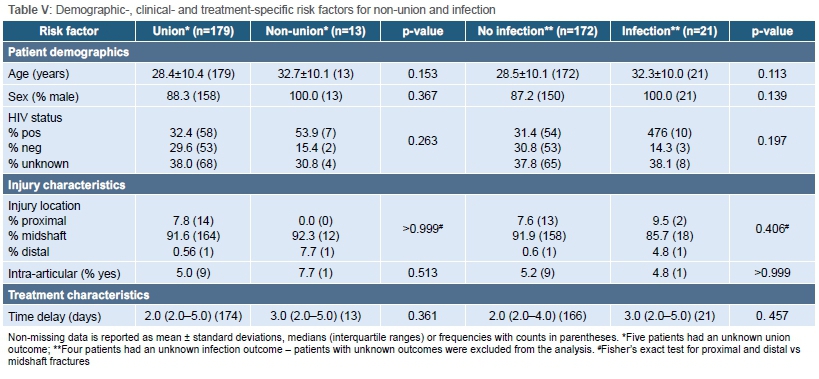
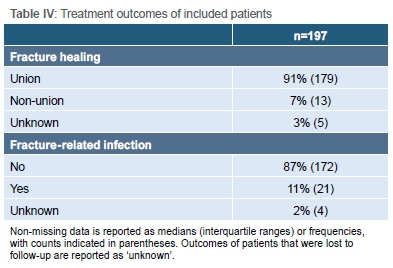
Bony union was achieved in 179 patients (91%) after the initial fixation. A total of 21 patients (11%) in the entire cohort developed FRIs (Table IV). No associations between demographic or treatment-related risk factors and treatment outcomes were observed (Table V).
All definitive fixation procedures showed high proportions of union, with circular external fixators having the lowest union rate (86%). Similarly, the presence of FRI was highest in the circular fixation group (21%) (Table VI).
Discussion
The first finding of this study was the demographic sample and the predominant involvement of young males (89% male with a mean age of 29.2±10.2 years), which is similar to previous published reports on orthopaedic injuries following civilian gunshots.3,6,8 A recent study conducted in South Africa reported a higher rate of intentional and gang-related violence together with the use of alcohol and illegal drugs among young, gunshot-injured males.5
The second important finding relates to our individualised approach to fracture management that produced an overall union rate of 91% and an FRI rate of 11%. A recent retrospective study by Metcalf et al. investigated the surgical outcome of tibia fractures managed with intramedullary nail fixation and observed a 30% nonunion rate and 9% infection rate for civilian gunshot tibia fractures which was comparable to our findings.1718
There were no associations noted between the demographic or treatment-specific risk factors and the clinical outcomes. No associations between clinical outcome and HIV status were observed. Very few studies have investigated the association between HIV and bone healing and this relationship remains poorly understood and unclear. An ongoing study investigating the association between union and HIV infection is nearing completion, and should provide important information on the effect of HIV on bone healing.19
Patients in the present study waited a median of two days for surgery (IQR 2-5 days). This delay is attributed to the high burden of trauma cases at South African hospitals which hampers the ability of providing immediate surgery on admission.320
Various definitive skeletal stabilisation procedures were included in this study. Formal debridement followed by cast immobilisation, as well as plate fixation, showed the optimal union and lowest infection rates in the present study. There was no association of FRI and union rates with length of stay. Minor complications, such as the presence of pressure sores, were not recorded as part of this investigation. Obvious selection bias for cast immobilisation of stable fracture patterns, isolated fractures, low energy transfer injuries and lower grade wounds should, however, be borne in mind when interpreting these results. For this reason, no statistical analysis was performed to investigate associations between treatment modality and outcome, because this relationship would be confounded by the differences in injury characteristics which guides clinical decision-making with regard to treatment modalities. IMN fixation showed outcomes comparable to a previous publication by Hilton et al. who reported a 76.9% initial union rate following intermedullary nailing for gunshot tibial shaft fractures, with three patients developing osteomyelitis.8
Circular external fixation was generally reserved for patients who had complex fractures, significant soft tissue damage and delays to surgery, and showed lowest union rate when compared to other definitive fixation methods. A study conducted by Van der Walt and Ferreira however reported higher union rates of 100% using circular external fixators in their gunshot-induced tibia fracture sample.2122
The major study limitations include the retrospective design and single centre cohort which resulted in, albeit a large cohort compared to previous reports, too small a sample to detect large differences between sub-groups. The short follow-up period reported in this investigation is another limitation: we report a median follow-up time of 4.1 months, while these injuries should ideally be seen over a longer follow-up period. Lost to follow-up is however a notorious problem in our setting that has previously been described by Badenhorst et al.,23
Conclusion
Tibial fractures caused by civilian gunshots remain challenging injuries to manage. This study found that an individualised approach to the treatment of these fractures can produce a satisfactory union rate with minimal complications if managed during a single stage by intramedullary nails, plate fixation or cast immobilisation. While the complications were higher in patients managed with circular external fixation, these devices were generally reserved for more severe injuries.
Ethics statement
The authors declare that this submission is in accordance with the principles laid down by the Responsible Research Publication Position Statements as developed at the 2nd World Conference on Research Integrity in Singapore, 2010.
Ethical approval for this study was obtained from the Stellenbosch University Ethics Committee, S18/07/139.
All procedures were in accordance with the ethical standards of the responsible committee on human experimentation (institutional and national) and with the Helsinki Declaration of 1975, as revised in 2008.
Declaration
The authors declare authorship of this article and that they have followed sound scientific research practice. This research is original and does not transgress plagiarism policies.
Author contributions
MG: Study conceptualisation, data capture, data analysis, first draft preparation, manuscript revision and approval of final manuscript
SJ: Data capture and approval of final manuscript
MvH: Data capture and approval of final manuscript
NlR: Data capture and approval of final manuscript
SvdM: Data capture and approval of final manuscript
OM: Data capture and approval of final manuscript
GdP: Data capture and approval of final manuscript
MB: Data analysis, manuscript revision and approval of final manuscript
NF: Study conceptualisation, data analysis, first draft preparation, manuscript revision and approval of final manuscript
ORCID
Gerafa M https://orcid.org/0000-0002-6028-0759
Jakoet S https://orcid.org/0000-0002-0009-2203
Van Heukelum M https://orcid.org/0000-0001-9160-7796
Le Roux N https://orcid.org/0000-0001-9115-7254
Van der Merwe S https://orcid.org/0000-0001-6892-4582
Makhubalo O https://orcid.org/0000-0003-0085-0876
Burger M https://orcid.org/0000-0003-2831-4960
Ferreira N https://orcid.org/0000-0002-0567-3373
References
- 1. Nunes ED. United Nations Office on Drugs and Crime (UNODC). Global study on homicide: trends, context, data. Vienna: UNODC; 2011. Ciência & Saúde Coletiva. 2012;17:3447-9.
-
2. Haagsma JA, Graetz N, Bolliger I, et al. The global burden of injury: incidence, mortality, disability-adjusted life years and time trends from the Global Burden of Disease study 2013. Inj Prev. 2016;122:3-18. https://doi.org/10.1136/injuryprev-2015-041616.
» https://doi.org/10.1136/injuryprev-2015-041616 -
3. Zaidi AA, Dixon J, Lupez K, et al. The burden of trauma at a district hospital in the Western Cape Province of South Africa: prospective observational study. Afr J Emerg Med. 2019:191:4-20. https://doi.org/10.1016/j.afjem.2019.01.007.
» https://doi.org/10.1016/j.afjem.2019.01.007 -
4. Engelmann EW, Maqungo S, Laubscher Μ, et al. Epidemiology and injury severity of 294 extremity gunshot wounds in ten months: a report from the Cape Town trauma registry. SA Orthop J. 2019;182:31-6. https://doi.org/10.17159/2309-8309/2019/v18n2a3.
» https://doi.org/10.17159/2309-8309/2019/v18n2a3 -
5. Martin C, Thiart G, McCollum G, Roche S, Maqungo S. The burden of gunshot injuries on orthopaedic healthcare resources in South Africa: retrospective review. S Afr Med J. 2017;107:626-30. https://doi.org/10.7196/SAMJ.2017.v107i7.12257.
» https://doi.org/10.7196/SAMJ.2017.v107i7.12257 -
6. Jakoet MS, Burger M, Van Heukelum M, et al. The epidemiology and orthopaedic burden of civilian gunshot injuries over a four-year period at a level one trauma unit in Cape Town, South Africa: a retrospective review. Int Orthop. 2020;121:8. https://doi.org/10.1007/s00264-020-04723-6.
» https://doi.org/10.1007/s00264-020-04723-6 -
7. Sathiyakumar V, Thakore RV, Stinner DJ, et al. Gunshot-induced fractures of the extremities: a review of antibiotic and debridement practices. Curr Rev Musculoskelet Med. 2015;182:76-89. https://doi.org/10.1007/s12178-015-9284-9.
» https://doi.org/10.1007/s12178-015-9284-9 -
8. Hilton TL, Kruger N, Wiese KR, Martin CW, Maqungo S. Gunshot tibia fractures treated with intramedullary nailing: A single centre retrospective review. SA Orthop J. 2017;163:2-8. https://doi.org/10.17159/2309-8309/2017/v16n1a4.
» https://doi.org/10.17159/2309-8309/2017/v16n1a4 -
9. Cross III WW, Swiontkowski MF. Treatment principles in the management of open fractures. Indian J Orthop. 2008;37-7. https://doi.org/10.4103/0019-5413.43373.
» https://doi.org/10.4103/0019-5413.43373 -
10. Fang X, Jiang L, Wang Y, Zhao L. Treatment of Gustilo grade III tibial fractures with unreamed intramedullary nailing versus external fixator: a meta-analysis. Med Sci Monit. 2012;18(4):49-56. https://doi.org/10.12659/msm.882610.
» https://doi.org/10.12659/msm.882610 -
11. Su CA, Nguyen MP, O'Donnell JA, Vallier HA. Outcomes of tibia shaft fractures caused by low energy gunshot wounds. Injury. 2018;49(7):1348-52. https://doi.org/10.1016/j.injury.2018.05.006.
» https://doi.org/10.1016/j.injury.2018.05.006 -
12. Hardcastle T. The 11 P's of an Afrocentric trauma system for South Africa: time for action. S Afr Med J. 2011;101(3):160-2. https://doi.org/10.7196/SAMJ.4578.
» https://doi.org/10.7196/SAMJ.4578 - 13. Müller ME, Nazarian S, Koch P. The comprehensive classification of fractures of long bones. Springer-Verlag: Berlin; 1990.
-
14. Papasoulis E, Patzakis MJ, Zalavras CG. Antibiotics in the treatment of low-velocity gunshot-induced fractures: a systematic literature review. Clin Orthop Relat Res. 2013;471-12:3937-44. https://doi.org/10.1007/s11999-013-2884-z.
» https://doi.org/10.1007/s11999-013-2884-z -
15. Whelan DB, Bhandari M, Stephen D, et al. Development of the radiographic union score for tibial fractures for the assessment of tibial fracture healing after intramedullary fixation: retrospective review. J Trauma Acute Care Surg. 2010;168:629-32. https://doi.org/10.1097/TA.0b013e3181a7c16d.
» https://doi.org/10.1097/TA.0b013e3181a7c16d -
16. Metsemakers WJ, Morgenstern M, McNally MA, et al. Fracture related infection: a consensus on definition from an international expert group. Injury. 2018;149:505-10. https://doi.org/10.1016/j.injury.2017.08.040.
» https://doi.org/10.1016/j.injury.2017.08.040 -
17. Metcalf KB, Smith EJ, Wetzel RJ, Sontich JK, Ochenjele G. Comparison of clinical outcomes after intramedullary fixation of tibia fractures caused by blunt trauma and civilian gunshot wounds: a retrospective review. J Orthop Trauma. 2020;134:208-13. https://doi.org/10.1097/BOT.000000000000170.
» https://doi.org/10.1097/BOT.000000000000170 - 18. Abghari M, Monroy A, Schubl S, Davidovitch R, Egol K. Outcomes following low-energy civilian gunshot wound trauma to the lower extremities: results of a standard protocol at an urban trauma center. Iowa Orthop J. 2015;35:65-9.
-
19. Graham SM, Harrison WJ, Lalloo DG, et al. HOST Study-HIV in Orthopaedic Skeletal Trauma Study: protocol for a multicentre case-cohort study. SA Orthop J. 2018;17:53-8. https://doi.org/10.17159/2309-8309/2018/v17n3a7.
» https://doi.org/10.17159/2309-8309/2018/v17n3a7 -
20. Kale AR, Sonawane CS, Waghmare VU, Kalambe H. Open fractures and incidence of infection in tertiary care government hospital. Int J Sci Stud. 2017;5(5):24-8. https://doi.org/10.17354/ijss/2017/386.
» https://doi.org/10.17354/ijss/2017/386 -
21. Van der Walt N, Ferreira N. An audit of circular external fixation usage in a tertiary hospital in South Africa: retrospective review. SA Orthop J. 2018;17:14-21. https://doi.org/10.17159/2309-8309/2018/v17n4a1.
» https://doi.org/10.17159/2309-8309/2018/v17n4a1 -
22. Sitnik AA, Beletsky AV. Minimally invasive percutaneous plate fixation of tibia fractures results in 80 patients: retrospective review. Clin Orthop Relat Res. 2013;1471:2783-9. https://doi.org/10.1007/s11999-013-2841.
» https://doi.org/10.1007/s11999-013-2841 -
23. Badenhorst DH, Van der Westhuizen CA, Britz E, Burger MC, Ferreira N. Lost to follow-up. Challenges to conducting orthopaedic research in South Africa: retrospective review. S Afr Med J. 2018;108:917-21 https://doi.org/10.7196/SAMJ.2018.v108i11.13252.
» https://doi.org/10.7196/SAMJ.2018.v108i11.13252
Accepted: November 2020
Published: May 2021
Editor: Prof. Leonard C Marais, University of KwaZulu-Natal, Durban, South Africa
Funding: No funding was received for this study.
Conflict of interest: The authors declare they have no conflicts of interest that are directly or indirectly related to this research.