Seroprevalence of HIV in acute orthopaedic trauma at the Charlotte Maxeke Johannesburg Academic Hospital
Abstract
AIM: The aim of the study was to establish the human immunodeficiency virus (HIV) seroprevalence in an acute orthopaedic trauma setting in an urban teaching hospital. METHODS: All patients admitted at the Orthopaedic Trauma Unit of the academic hospital during a six-month period from 1 July 2008 to 31 December 2008 were counselled and an informed consent for HIV testing was obtained. Only acute orthopaedic trauma patients aged 18 years and above, with a Glasgow Coma Scale of 15/15 and competent to give consent were recruited for the study. Where the consent was given blood samples were analysed by way of a rapid HIV test followed by a confirmatory ELISA when the rapid HIV tested positive. Those patients who tested positive for the virus were then counselled and offered referral to an HIV centre for follow-up. RESULTS: A total of 797 patients were admitted during the study period. One-hundred-and-fifty-nine patients (20%) did not meet the inclusion criteria. A total of 638 patients were therefore eligible for recruitment. Two-hundred-and-forty-six patients (38%) consented and signed the informed consent form. Of those that were tested, 57 (23%) tested positive and were followed up accordingly. CONCLUSION: Seroprevalence in an acute orthopaedic trauma setting in an urban teaching hospital was found to be high in this study. The power of this study was weakened by the low percentage of eligible patients who consented to be tested.
HIV seroprevalence; acute orthopaedic traumas
Introduction
The UNAIDS/WHO AIDS epidemic update of December 2009 reported that a total of 33.4 million people were living with HIV in the world.1
In South Africa, most HIV epidemiologic studies have extrapolated data from antenatal clinic (ANC) surveys for national prevalence estimates. The South African Department of Health Study conducted in 2009 estimates that 29.4% of pregnant woman were living with HIV.2et al reported on a community-based study of 10 197 randomly selected households; 7 249 (71.1%) of the selected households were included in their study.33et al sampled 537 patients out of a possible 1 000 surgical patients at the CH Baragwanath Hospital in Soweto, South Africa.4etal in 2002 reported a 27% rate of HIV rate in major trauma patients admitted to the level 1 Trauma Unit at the CM Johannesburg Hospital.5et al.6
To the best of the authors' knowledge, at the beginning of this study there had not been any reports on the epidemiology and rate of HIV in an acute orthopaedic trauma setting in South Africa. This was the reason for the commission of this study.
Materials and methods
This study was carried out in the Orthopaedic Trauma Unit at the Charlotte Maxeke Johannesburg Academic Hospital from 1 July 2008 to 31 December 2009. Patients were recruited to the study after admission to the Orthopaedic Trauma Unit or to the Surgical Trauma Unit (in cases of polytrauma). The inclusion criteria were:
• acute orthopaedic trauma patients requiring admission
• Glasgow Coma Score of 15/15
• age above 18 years and competent to give consent for the study
The patients' cognitive function was assessed using the Glasgow Coma Scale and documented to be 15/15. The aims and the need for the study were explained to the patient and pre counselling for HIV testing was offered by the first author. A wish to know or be blinded to the result was communicated and documented. A successful recruitment was then followed up by a signed and witnessed consent form and blood sampling. Samples were analysed by way of a rapid HIV test and a confirmatory ELIZA if positive. Those patients who tested positive for the virus were then counselled and offered referral to an HIV centre for treatment and follow-up.
Results
A total of 797 patients were admitted to the Orthopaedic Trauma Unit during the study period. One-hundred-and-fifty-nine patients were excluded because they did not meet the inclusion criteria. That left 638 patients eligible for the study. The average age of the eligible patients was 37 years with an age range of 18 to 92 years. Sixty-five per cent (414) were male and 35% (224) were female. Of the 638 eligible patients only 246 (39%) agreed to be tested. The reasons given for refusing to test were:
• Already tested and negative
• Can we do this once we have treated the injury?
• Have to think about it
• Don't want to know
• Too painful to consider
• Of the 246 patients who agreed to be tested, 71 (27%) said they did not want to know the results. Fifty-seven (23%) of the patients who were tested were found to be HIV seropositive.
Discussion
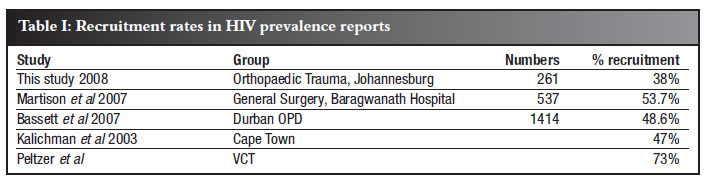
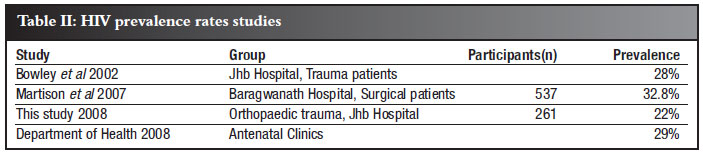
HIV seroprevalence in South Africa is high.1-5 Many studies of prevalence are hampered by the low recruitment rate (Table I). This can have a bearing on the interpretation of results obtained. The prevalence will be different in different population groups (Table II). High risk groups have been reported as young women and men between the ages of 20 and 49 years with a mean age of 34. This is the population group that normally would present to a casualty after an acute traumatic event. This study and the reports from Martison45
Since 1986 when Aids was first identified, and the isolation of the virus thereafter, every medical discipline has been faced with challenges in managing HIV/Aids patients. HIV/Aids presents specific challenges in the discipline of orthopaedics.7,8 Patients who are HIV positive have been shown to develop aggressive malignant tumours affecting bones.910
The incidence of osteonecrosis or avascular necrosis (AVN) of the hip in HIV-positive patients is reported to be 45 times greater than in the normal population.11
In orthopaedic trauma the biggest concern is postoperative infection. The infection rate of open fractures in HIV-positive patients has been reported to be as high as 42%.121314
In this study 62% of eligible patients did not consent to be tested. This low recruitment rate was experienced in a number of other studies (Table I). Several factors have been postulated and they range from indifference, the stigma attached to seropositivity, inadequate counselling and apathy. The national drive to know your HIV status and the utilisation of trained counsellors may improve the acceptance rate for testing. There have been several studies that have reported on the efficacy of voluntary counselling and testing (VCT) but the main problem has always been the low rate of recruitment of eligible candidates who are prepared to offer informed consent. Hutchinson and Mahlalela 2006,15et al 200716et al 200317et al reported a 73% capture.18Table I clearly shows the huge discrepancies in the response rate between studies that were VCT aligned and those in which the researcher also doubled as the counsellor. Rate (of non-response) from this study is a case in point: a 38% recruitment rate compared to 73% in the Karl Peltzer study.
Conclusion
There was a high HIV seroprevalence (23%) in our academic hospital's Orthopaedic Trauma Unit. The low recruitment rate decreased the power of this study.
VCT is a gateway to both prevention and treatment of HIV. VCT interactions can also serve as important conduits of health information and promotion, encouraging changes in risky behaviours for those not infected and modifications in behaviour for discordant couples and those already infected.
References
-
1. UNAIDS/WHO AIDS epidemic update available at: http://www.unaids.org/en/media/unaids/contentassets/dataimport/pub/report/2009/jc1700_epi_update_2009_en.pdf.
» http://www.unaids.org/en/media/unaids/contentassets/dataimport/pub/report/2009/jc1700_epi_update_2009_en.pdf -
2. South Africa HID and AIDS Statistics from: http://www.avert.org/safricastats.htm.
» http://www.avert.org/safricastats.htm - 3. Connolly C, Colvin M, Shisana O, Stoker D. Epidemiology of HIV in South Africa: a result of a national, community-based survey. South African Medical Journal. 94(9):776-81.
- 4. Martison N, Omar J, Gray G, Vermaak J. High rates of HIV in surgical patients in Soweto, South Africa: Impact on resource utilization and recommendations for HIV testing. Transactions of the Royal Society of Tropical Medicine and Hygiene. Feb 2007;101(2):176-82.
- 5. Bowley DM, Cherry R, Synman T et al. Seroprevalence of human immunodeficiency virus in major trauma patient in Johannesburg. South African Medical Journal 2002 Oct;92(10):792-93.
- 6. Yeung S et al. Paediatric HIV infection in a rural South African district hospital. Journal of Tropical Pediatrics 2000 46(2):107-10.
- 7. Govender S, Harrison WJ, Lukhele M. Impact of HIV on bone and joint surgery. Best Practice & Research Clinical Rheumatology. 2008;22(4):605-19.
- 8. Biviji AA, Paiement GD, Steinbach LS. musculoskeletal manifestations of human immunodeficiency virus infection. J Am Acad Orthop Surg 2002;10:312-20
- 9. Bayley AC. Surgical pathology of HIV infection: lessons from Africa. British Journal of Surgery 1990;76(8):863-68.
- 10. Barnes PF, Bloch AB, Davidson PT et al. Tuberculosis in patients with human immunodeficiency virus infection. New England Journal of Medicine. 1991;324(23):1644-50.
- 11. Brown P, Crane L. Avascular necrosis of bone in patients with human immunodeficiency virus infection: report of 6 cases and review of the literature. Clinical Infectious Disease. 2001;32(8):1221-26.
- 12. Harrison WJ, Lewis CP, Lavy CB. Wound healing after implant surgery in HIV-positive patients. Journal of Bone and Joint. British 2002;84(6):802-806.
- 13. Brijlall S, Lioma ID and Govender S. Implants sepsis in the HIV-infected patients. South African Orthopaedic Journal 2003;2(3):26-30.
- 14. Bahenbeck J, Handy Eone D, Ngo Nonga B et al. Implant orthopaedic surgery in HIV asymptomatic carriers: management and early outcome. Injury, Int J Care Injured 2009;40:1147-50.
- 15. Hutchinson PL, Mahlalela X. Utilization of voluntary counseling and testing services in the Eastern Cape, South Africa. AIDS Care 2006;18:446-55.
- 16. Bassett IV, Giddy J, Nkera J et al. Routine voluntary HIV testing in Durban, South Africa: The experience from an outpatient department. J Acquir Immune Defic Syndr 2007;46(2):181-86.
- 17. Kalichman SC, Simbayi LC. HIV testing attitudes, AIDS stigma, and voluntary HIV counseling and testing in a black township in Cape Town, South Africa. Sex Transm Infect 2003;79:442-47.
-
18. Peltzer K, Matseke G, Mzolo T, Majaja M. Determinants of knowledge of HIV status in South Africa: results from a population-based HIV survey. BMC Public Health 2009, 9:174. Availble at: http://www.biomedcentral.com/1471-2458/9/174.
» http://www.biomedcentral.com/1471-2458/9/174
Dr TI Sefeane
Division of Orthopaedics Room 4M12 Wits Medical School
Parktown
Email:

No benefit of any form was or will be received from a commercial party related directly or indirectly to the subject of this article.