Mycobacterium fortuitum as infectious agent in a septic total knee replacement: Case study and literature review
Abstract
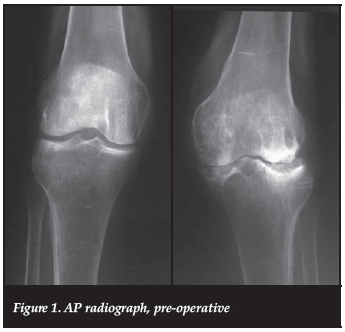
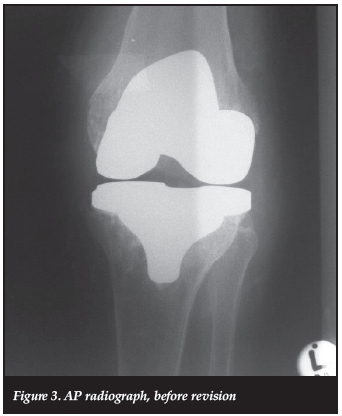
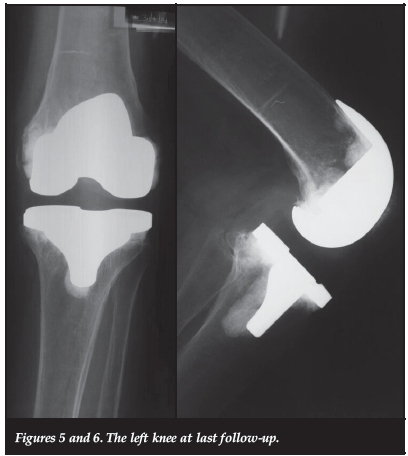
Infection of prosthetic joints with non-tuberculous mycobacteria (NTM) is rare. The rapidly growing mycobacteria (RGM) are a subgroup of NTM. They are not very virulent organisms, found ubiquitously in the environment, and most infections in humans are due to direct inoculation of the organism into a joint or soft tissue. We describe a 70-year-old patient, who developed an infection with Mycobacterium fortuitum after primary knee arthroplasty, one of only a handful described in the literature. Peri-prosthetic infections with RGM are a challenge because there is a lack of data guiding management, and because the diagnosis is often delayed. Routine cultures of joint effusions or tissue are often discarded before the non-tuberculous mycobacteria have a chance to culture (in our case, 14 days). Principles of treatment include: making a diagnosis from tissue culture, staged revision surgery with aggressive surgical debridement of the joint and high dosages antibiotics (for at least six weeks, treating empirically initially until a sensitivity profile for the organism is available). The second stage of the revision should be delayed by 3-6 months. In our case the removed implant was autoclaved and re-implanted loosely with antibiotic-loaded cement as part of the first-stage revision.
total knee replacement; peri-prosthetic joint infection; septic arthritis; rapidly growing mycobacteria; non-tuberculous mycobacteria; Mycobacterium fortuitum; Mycobacterium abcessus; Mycobacterium chelonae; Mycobacterium smegmatis; Mycobacterium kansasii; Mycobacterium goodii
 Thumbnail
 Thumbnail
 Thumbnail