Infection prevention in shoulder arthroplasty: current practices among South African orthopaedic surgeons
Abstract
BACKGROUND: Periprosthetic joint infection (PJI) following shoulder arthroplasty is costly and difficult to treat. Effective perioperative infection prevention is thus of utmost importance. Recent years have seen advances in the scientific literature pertaining to infection prevention in shoulder arthroplasty, including an International Consensus Meeting (ICM). However, little is known about infection prevention practices in South Africa and to what extent they reflect the latest evidence. Therefore, the aim of this study was to investigate the current perioperative infection control practices for primary total shoulder arthroplasty among South African orthopaedic surgeons METHODS: This cross-sectional study involved a survey conducted at the annual South African Shoulder and Elbow Surgeon Society Congress in 2023. The survey was developed based on the study aim and the existing literature. Surveys were distributed to delegates in paper-based form, and responses captured electronically for descriptive analysis RESULTS: Fifty-two of 75 (69%) orthopaedic surgeon delegates completed the survey. Forty-one (79%) were in full-time private practice. Among preoperative measures surveyed, 30 of 47 (64%) respondents used chlorhexidine only as a preadmission skin preparation, 46 of 51 (90%) used cefazolin only as a preoperative antibiotic, and 28 of 51 (55%) used 0.5% chlorhexidine gluconate in 70% isopropyl alcohol as a pre-incision skin scrub. Among intraoperative measures, 51 of 52 (98%) used double gloving, 26 of 52 (50%) used iodine-impregnated adhesive drapes, 37 of 52 (71%) always used tranexamic acid (TXA), 42 of 52 (81%) always used antibiotic impregnated cement, and 37 of 52 (71%) always redosed antibiotics for procedures > 2 hours. Postoperatively, 41 of 46 (89%) administered antibiotics for up to 24 hours CONCLUSION: There was a majority response for most of the items surveyed, indicating reasonable consensus in shoulder arthroplasty infection prevention practices. Most responses were generally in keeping with ICM recommendations, except routine use of TXA and antibiotic-impregnated cement. These measures were deemed by the ICM to have insufficient evidence. A minority of respondents indicated practices that show room for improvement in reducing periprosthetic joint infection risk LEVEL OF EVIDENCE: 3
shoulder arthroplasty; periprosthetic joint infection; infection prevention; perioperative
Introduction
Widened indications for shoulder arthroplasty, along with ageing populations, have led to an exponential rise in shoulder arthroplasty surgeries over the last decade, especially those involving a reverse prosthesis.1-3 Like all orthopaedic surgeries, shoulder arthroplasty carries a risk of complications, including infection.2,4,5 The reported incidence of periprosthetic joint infection (PJI) following primary shoulder arthroplasty has varied from 0.08% to 5%, according to different diagnostic criteria and follow-up periods.62,7 Thus, precautions to minimise the risk of infection form a vital part of perioperative care.7-9
Historically, the evidence for infection prevention in shoulder arthroplasty has lagged behind that of hip and knee arthroplasty, with evidence from other joint replacement literature simply extrapolated to the shoulder.8,10 However, this has changed in recent years.11-13 A number of randomised controlled trials on infection prevention in shoulder PJI have now been conducted, allowing for robust evidence syntheses such as systematic reviews and meta-analyses.11-13 A further notable development has been the 2nd International Consensus Meeting (ICM) on Orthopedic Infections, held in Philadelphia, United States, in 2018.141010
In South Africa, little is known about shoulder arthroplasty infection prevention practices and to what extent these reflect the latest international literature. It was envisaged that assessing current practices within our setting would provide insight into the level of professional agreement on this topic, as well as identify possible areas for improvement. Therefore, the aim of the study was to investigate current perioperative infection control practices for primary total shoulder arthroplasty among South African orthopaedic surgeons.
Methods
This cross-sectional study involved a survey conducted at the annual South African Shoulder and Elbow Surgeon Society (SASES) Congress, which was held in Cape Town in May 2023. To be eligible for the study, individuals were required to be orthopaedic surgeons currently practising shoulder arthroplasty in South Africa. While the exact number of orthopaedic surgeons practising shoulder surgery in South Africa is unclear, SASES delegates provided a large and accessible representation of this group.
Data collection and analysis
To our knowledge, there were no existing survey instruments which suited the purpose of the current study. Thus, a short survey was developed based on the study aim and the existing literature on the topic. In addition to items related to infection prevention, the survey included basic professional details to allow for a description of the respondents. Three shoulder surgeons reviewed the face and content validity of the survey, and suggested changes were incorporated.
The survey was distributed at the congress in paper-based form and was briefly introduced from the podium. All surveys were completed anonymously. Responses were captured into an Excel spreadsheet using drop-down menus to facilitate accurate data entry.
Categorical responses were reported as counts and percentages. Categories with very low response rates were pooled in certain cases. Analyses were conducted using jamovi version 1.6 (www.jamovi.org) and GraphPad Prism version 9.2.0 for Mac OS, GraphPad Software, San Diego, California USA, www.graphpad.com.
Results
The 2023 SASES Congress was attended by 75 orthopaedic surgeon delegates, of whom 52 completed the survey: a response rate of 69%. The characteristics of the respondents are shown in Table I. Certain participants elected not to respond to some of the survey questions, thus respondent numbers out of a possible 52 are specified per item throughout the results.
Preoperative measures
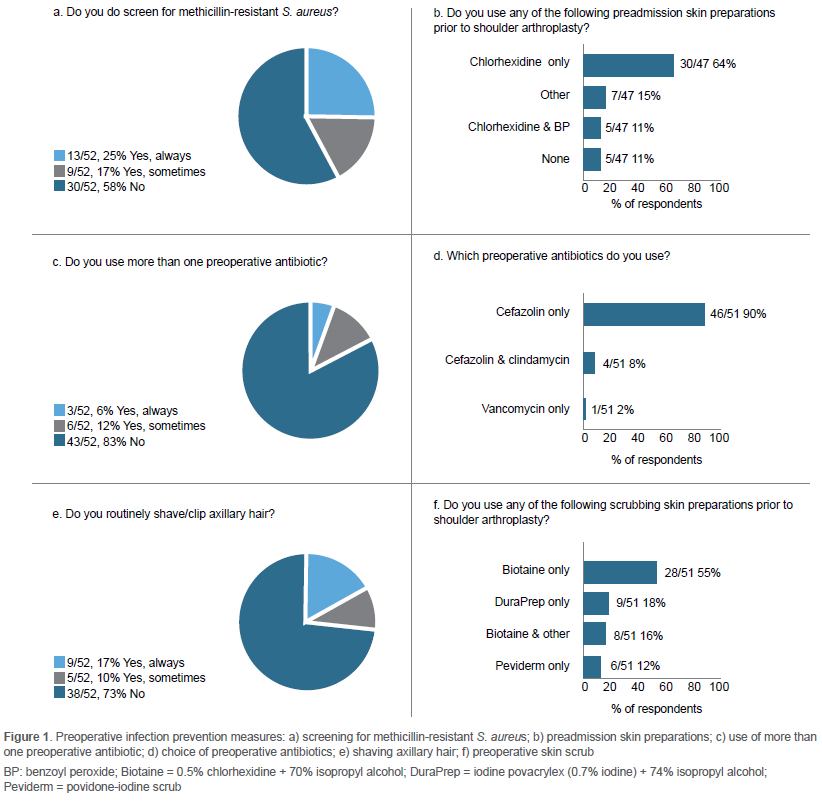
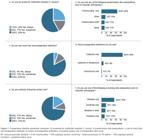
There were seven survey questions pertaining to preoperative measures for infection prevention. All questions elicited one majority response, with the size of the majority ranging from 55% to 90%. Prior to conducting a primary shoulder arthroplasty, 34 of 52 (65%) respondents said they would wait at least three months following an intra-articular steroid injection, with a further 17 of 52 (33%) indicating that they would wait at least one month. Responses to the remaining six questions are shown in Figure 1. Chlorhexidine only was the most common preadmission skin preparation, used by 30 of 47 respondents (64%). Eight respondents (17%) utilised benzoyl peroxide (BP) for preadmission skin preparation, including five who used both chlorhexidine and BP, two who used BP only and one who used chlorhexidine, BP and 60% isopropyl alcohol (e.g. Dermaprep®).
Intraoperative measures
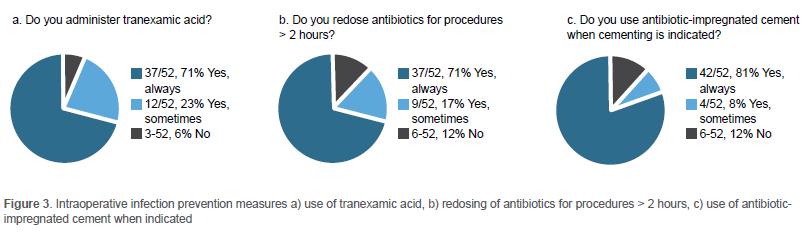
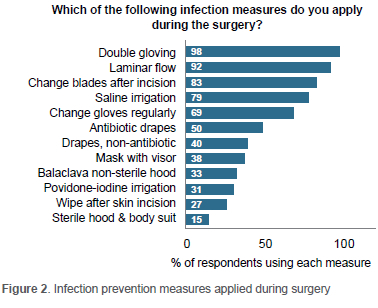
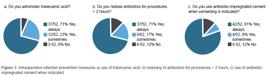
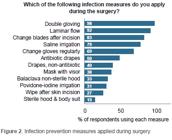
There were seven questions related to intraoperative infection prevention measures. First, respondents were asked to select from a list all the measures they currently used, with responses shown in Figure 2. Double gloving, laminar flow, saline irrigation, changing blades and changing gloves were practised by the majority of respondents (≥ 69%), whereas measures such as a mask and sterile hood were less prevalent. When questioned specifically about the use of TXA, redosing of antibiotics for procedures longer than two hours and use of antibiotic-impregnated bone cement, ≥ 71% of respondents always used each of these measures (Figure 3).
Measures used before wound closure was the only survey item not to elicit one majority response. The largest proportion of respondents used povidone-iodine irrigation only (18 of 39; 46%) (Figure 4a). However, there was notable heterogeneity in the remaining responses, with 13 of 39 (33%) respondents using one alternate agent only (vancomycin powder, gentamicin-impregnated collagen sponges [Garacol®], gentamicin powder, chlorhexidine gluconate or saline only), five of 39 (13%) respondents using two or more agents in combination, and two respondents indicating 'none' to measures used before wound closure. Methods of skin closure showed strong consensus with 44 of 51 (86%) using absorbable sutures only (Figure 4b). The final question of the section related to wound dressing and had a response rate of only 36 out of 52 participants. Of these, 12 (33%) used silver-impregnated dressings sometimes or always, three (10%) sometimes used vacuum dressings, and 21 (58%) reported using some other, conventional dressing only.
Postoperative measures
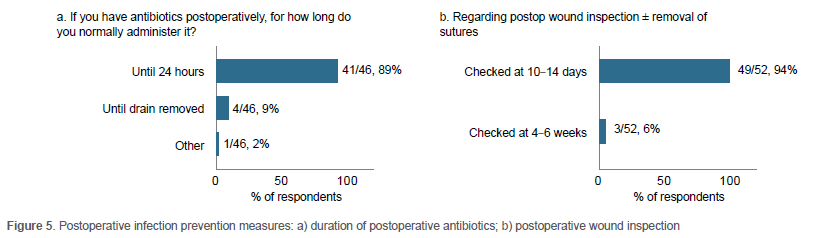
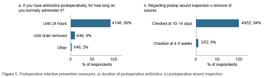
There were three questions related to postoperative infection measures. Only 27 of 52 participants responded to the question, 'If you use a postoperative drain, when do you normally remove it?'. Nineteen (70%) indicated that they removed the drain within 24 hours, seven of 27 (26%) removed the drain when less than a certain amount of fluid was draining, and one respondent indicated 'other' for determining when the drain was removed. Responses regarding the duration of postoperative antibiotics and wound inspection are shown in Figure 5. Both items showed a large majority response for continuing antibiotics for 24 hours and checking the wound at 10-14 days postoperatively. Of 49 respondents with wound checking at 10-14 days, 44 performed the check personally and five asked a wound care nurse or general practitioner to perform the check.
Discussion
The first finding of the study was that there was a majority response (55-90%) for most of the items surveyed. This suggests reasonable consistency and professional agreement in shoulder PJI prevention approaches in our setting. At present, the only international best practice guidelines that specifically address PJI in shoulder arthroplasty are the proceedings of the ICM, which was held in 2018.10
Preoperative measures
The second finding of the study was that the majority of respondents (55-90%) were in keeping with ICM recommendations regarding the use of chlorhexidine as a home-based skin preparation, cefazolin as a preoperative antibiotic, and 0.5% chlorhexidine gluconate + 70% isopropyl alcohol (e.g. Biotaine) as a pre-incision skin preparation.1010
Two-thirds of respondents (65%) indicated waiting at least three months following an intra-articular steroid injection before performing shoulder arthroplasty. The ICM noted that multiple injections or a short time period between a steroid injection and shoulder arthroplasty may increase the risk of PJI but did not provide a recommended waiting time.10151515,16
Most respondents (58%) indicated that they did not perform MRSA screening. While evidence specific to shoulder surgery is lacking, a meta-analysis involving knee and hip arthroplasty found that colonisation with Staphylococcus aureus was associated with increased risk of surgical site infection.17179
Approximately two-thirds of respondents (64%) prescribed a chlorhexidine product only as a home-based skin preparation, in keeping with the ICM recommendation of at least two applications of chlorhexidine gluconate showers or wipes to reduce the incidence of skin culture positivity.10Cutibacterium acnes,18C. acnes resides.
C. acnes has been found to be the most common causative agent in postoperative shoulder infection.4C. acnes to the incidence of PJI is still lacking, skin colonisation has been associated with contamination of the surgical field, and reducing the skin burden of C. acnes is thought to be important.4,19,20 BP has shown promise in this regard with a systematic review concluding that topical BP is effective in reducing colonisation of C. acnes prior to shoulder surgery.13C. acnes skin and wound colonisation than a chlorhexidine product.191413,18,19 Use of BP was relatively low among survey respondents (17%); more widespread use in skin preparation protocols may help to reduce shoulder PJI risk in our setting. Of concern was a minority of respondents who indicated that they did not use any preadmission skin preparation. This constitutes a missed opportunity to likely reduce the risk of PJI at relatively low cost and risk.
There was strong agreement around preoperative antibiotic prophylaxis: 90% of respondents indicated using cefazolin only. This approach aligned with the ICM recommendation of weight-based cefazolin, in the absence of β-lactam allergy, administered within 30 minutes of incision.102110
Perioperatively, 55% of respondents used Biotaine (0.5% chlorhexidine gluconate + 70% isopropyl alcohol) only as a pre-incision skin preparation. This choice reflects the ICM recommendation,1022222222
Finally, 73% of respondents indicated that they did not routinely shave or clip axillary hair. A Cochrane review published in 2021 concluded that there was moderate-certainty evidence that shaving increased the risk of surgical site infections compared to clipping or to no hair removal in a variety of surgeries.23232423,24
Intraoperative measures
The third finding of the study was that although a large majority of respondents used TXA (94%, always or sometimes) and antibiotic-impregnated cement (88%, always or sometimes) in primary shoulder arthroplasty, the ICM was reticent about these measures, stating that there was insufficient evidence to make a recommendation.1010
Double gloving was practised by most respondents (98%), although only two-thirds (69%) reported changing gloves during the surgery. A Cochrane review found that double gloving significantly reduced perforation of the inner gloves, and a systematic review found that changing gloves significantly reduces contamination rates.25,26 It was recommended that gloves be changed after draping, before handling implants, in the event of visible perforation and, over and above the former reasons, at least once an hour.2626
Other measures intended to reduce contamination intraoperatively include adhesive drapes.27272727
As with the use of drapes, changing blades was very common, with 83% of respondents applying this measure. There is limited available evidence for changing blades to reduce infection risk, especially specifically relating to shoulder arthroplasty. Two studies found that C. acnes was cultured from the incision blade in 10-12% of patients undergoing shoulder arthroplasty, despite a rigorous infection prevention protocol.28,29 While stronger evidence is required,2129
TXA was widely utilised among respondents, with only 6% indicating that they did not use this agent. There is high-quality evidence that use of TXA reduces blood loss in shoulder arthroplasty.3031321031,32 as practised by 71% of the survey respondents.
Regarding intraoperative antibiotic prophylaxis, redosing of antibiotics for procedures greater > 2 hours and routine use of antibiotic-impregnated cement were practised by 71% and 81% of respondents, respectively. Redosing antibiotics is in keeping with the following recommendation from an international working group: additional antibiotics should be given for procedures exceeding two antibiotic half-lives (a time period of four hours for cefazolin) or procedures involving blood loss > 1.5 L.3310,34 Further studies are available in the context of hip and knee arthroplasty.33,35 However, recent critical analysis of this evidence concluded that further research is required to justify routine prophylactic use of antibiotic-impregnated cement, especially from a cost-effectiveness perspective.36,37 This aligns with the ICM's conclusion that there is insufficient evidence to determine whether this measure should be used in shoulder arthroplasty.10
Finally, there was no predominant approach to the use of topical intrawound antibiotics prior to wound closure among survey respondents, with povidone-iodine lavage receiving the most responses (46%). The ICM noted that, based on evidence from other orthopaedic surgeries, there may be a role for povidone-iodine lavage and for vancomycin powder in patients deemed at high risk of PJI.103839
Regarding the method of wound closure, 86% of respondents used absorbable sutures only. A meta-analysis which compared sutures of various types to staples following orthopaedic surgery found no difference in surgical site infection.40
Postoperative measures
The fourth finding of the study was that there was strong respondent consensus for continuing antibiotics until 24 hours postoperatively (89%), which was directly in keeping with the ICM recommendation.1033,35 A meta-analysis found a significant reduction in the incidence of PJI when patients received a single dose versus extended antibiotic prophylaxis in hip and knee arthroplasty.3535
Regarding drains in shoulder arthroplasty, respondents were not asked whether they used a postoperative drain but rather, if they used one, when did they remove the drain. Most respondents (70%) indicated removing the drain within 24 hours postoperatively. The ICM found insufficient evidence to make a recommendation regarding postoperative drains.104142
There are limitations to this study. Although the survey included a large proportion of South African shoulder arthroplasty surgeons, it was not a random sample, and the extent to which the findings can be generalised to the total population of South African shoulder arthroplasty surgeons is unclear. It is also acknowledged that surveys may be subject to certain types of bias such as recall bias, which may affect the responses provided. Finally, low response rates to questions on antibiotics before wound closure, the duration of antibiotics postoperatively and removal of postoperative drains limited interpretation of these findings.
Conclusion
This survey on infection prevention measures in primary shoulder arthroplasty found a majority response for most items, indicating reasonable consensus among the participating South African orthopaedic surgeons. The majority response was generally in keeping with ICM recommendations, with the exception of routine use of TXA and antibiotic-impregnated cement. These measures were very common among respondents but were deemed by the ICM to have insufficient evidence. A minority of respondents indicated practices that may have room for improvement in reducing PJI risk. Improvements include waiting three months instead of one month between an intra-articular steroid injection and shoulder arthroplasty, and using a chlorhexidine product instead of a povidone-iodine product for pre-incision skin preparation. In future, widespread engagement with the South African Orthopaedic Registry may allow research into the incidence of shoulder PJI in our setting - the true indicator of effective infection prevention.
Ethics statement
The authors declare that this submission is in accordance with the principles laid down by the Responsible Research Publication Position Statements as developed at the 2nd World Conference on Research Integrity in Singapore, 2010.
Prior to commencement of the study, ethical approval was obtained from the following ethical review board: Health Research Ethics Committee of Stellenbosch University (reference number N23/03/018). All procedures were in accordance with the ethical standards of the responsible committee on human experimentation (institutional and national) and with the Helsinki Declaration of 1975, as revised in 2008. Participation in the study was voluntary and entirely anonymous. Completion of the survey was taken as consent to participate in the study.
Declaration
The authors declare authorship of this article and that they have followed sound scientific research practice. This research is original and does not transgress plagiarism policies.
Author contributions
RK: study conceptualisation, study design, data capture, first draft preparation
TNM: study conceptualisation, study design, data analysis, manuscript preparation
CA: study design, manuscript revision
JFdB: study design, manuscript revision
ORCIDKriel R https://orcid.org/0000-0002-2099-7018
References
- 1. Wagner ER, Farley KX, Higgins I, et al. The incidence of shoulder arthroplasty: rise and future projections compared with hip and knee arthroplasty. J Shoulder Elbow Surg. 2020;29:2601-609.
- 2. Familiari F, Rojas J, Doral MN, et al. Reverse total shoulder arthroplasty. EFORT Open Rev. 2018;3:58-69.
- 3. Kozak T, Bauer S, Walch G, et al. An update on reverse total shoulder arthroplasty: current indications, new designs, same old problems. EFORT Open Rev. 2021;6:189-201.
- 4. Foster AL, Cutbush K, Ezure Y, et al. Cutibacterium acnes in shoulder surgery: a scoping review of strategies for prevention, diagnosis, and treatment. J Shoulder Elbow Surg. 2021;0: 410-22.
- 5. Contreras ES, Frantz TL, Bishop JY, Cvetanovich GL. Periprosthetic infection after reverse shoulder arthroplasty: a review. Curr Rev Musculoskelet Med. 2020;13:757-68.
- 6. Egglestone A, Ingoe H, Rees J, et al. Scoping review: diagnosis and management of periprosthetic joint infection in shoulder arthroplasty. Shoulder Elbow. 2019;11:167-81.
- 7. Hackett DJ, Crosby LA. Infection prevention in shoulder surgery. Bull Hosp Jt Dis (2013). 2015;73 Suppl 1:S140-4.
- 8. Bents EJ, Harmsen S, Denard PJ, Lederman ES. Preventing infection in shoulder arthroplasty: Navigating the minefields. Seminars in Arthroplasty JSES. 2017;28:145-49.
- 9. Clark JJC, Abildgaard JT, Backes J, Hawkins RJ. Preventing infection in shoulder surgery. J Shoulder Elbow Surg. 2018;27:1333-41.
- 10. Garrigues GE, Zmistowski B, Cooper AM, et al. Proceedings from the 2018 International Consensus Meeting on Orthopedic Infections: prevention of periprosthetic shoulder infection. J Shoulder Elbow Surg. 2019;28:S13-31.
-
11. Longo UG, Candela V, Facchinetti G, et al. Antibiotic prophylaxis in primary and revision shoulder replacement: a systematic review. BMC Musculoskelet Disord. 2020;21. https://doi.org/10.1186/S12891-020-03332-Z
» https://doi.org/10.1186/S12891-020-03332-Z -
12. Seok HG, Park JJ, Park SG. Risk factors for periprosthetic joint infection after shoulder arthroplasty: systematic review and meta-analysis. J Clin Med. 2022;11. https://doi.org/10.3390/JCM11144245
» https://doi.org/10.3390/JCM11144245 - 13. Green N, Jordan RW, Maclean S, et al. Preoperative topical benzoyl peroxide treatment is effective in reducing Cutibacterium acnes in shoulder surgery: a systematic review. J Shoulder Elbow Surg. 2023;2: 213-22.
- 14. Garrigues GE, Zmistowski B, Cooper AM, Green A. Proceedings from the 2018 International Consensus Meeting on Orthopedic Infections: rationale and methods of the shoulder subgroup. J Shoulder Elbow Surg. 2019;28:S4-7.
-
15. Schoell K, Crabb R, Simpson E, et al. Preoperative corticosteroid injections are associated with a higher periprosthetic infection rate following primary total shoulder arthroplasty: a systematic review and meta-analysis. J Shoulder Elbow Surg. 2024. https://doi.org/10.1016/j.jse.2024.05.025
» https://doi.org/10.1016/j.jse.2024.05.025 - 16. Werner BC, Cancienne JM, Burrus MT, et al. The timing of elective shoulder surgery after shoulder injection affects postoperative infection risk in Medicare patients. J Shoulder Elbow Surg. 2016;25:390-97.
- 17. Lin L, Ke ZY, Wang Y, et al. Efficacy of preoperative screening and decolonization for staphylococcus aureus in total joint arthroplasty: A meta-analysis. Asian J Surg. 2021;44:807-18.
- 18. Sagkrioti M, Glass S, Arealis G. Evaluation of the effectiveness of skin preparation methods for the reduction of Cutibacterium acnes (formerly Propionibacterium acnes) in shoulder surgery: a systematic review. Shoulder Elbow. 2022;14:583-97.
- 19. Symonds T, Grant A, Doma K, et al. The efficacy of topical preparations in reducing the incidence of Cutibacterium acnes at the start and conclusion of total shoulder arthroplasty: a randomized controlled trial. J Shoulder Elbow Surg. 2022;31:1115-21.
- 20. Torrens C, Bellosillo B, Gibert J, et al. Are Cutibacterium acnes delivered from skin to deep tissues in primary reverse shoulder arthroplasty? A prospective study. Arch Orthop Trauma Surg. 2024;144:635-40.
- 21. Marigi EM, Bartels DW, Yoon JH, et al. antibiotic prophylaxis with cefazolin is associated with lower shoulder periprosthetic joint infection rates than non-cefazolin alternatives. J Bone Joint Surg Am. 2022 May 18;104(10):872-80.
- 22. Saltzman MD, Nuber GW, Gryzlo SM, et al. Efficacy of surgical preparation solutions in shoulder surgery. J Bone Joint Surg Am. 2009;91:1949-53.
-
23. Tanner J, Melen K. Preoperative hair removal to reduce surgical site infection. Cochrane Database of Systematic Reviews 2021; 2021. https://doi.org/10.1002/14651858.CD004122.pub5
» https://doi.org/10.1002/14651858.CD004122.pub5 - 24. Marecek GS, Weatherford BM, Fuller EB, Saltzman MD. The effect of axillary hair on surgical antisepsis around the shoulder. J Shoulder Elbow Surg. 2015;24:804-808.
- 25. Tanner J, Parkinson H. Double gloving to reduce surgical cross-infection. Cochrane Database Syst Rev. 2002:(3):CD003087.
- 26. Kim K, Zhu M, Munro JT, Young SW. Glove change to reduce the risk of surgical site infection or prosthetic joint infection in arthroplasty surgeries: a systematic review. ANZ J Surg. 2019;89:1009-15.
- 27. Mundi R, Nucci N, Ekhtiari S, et al. Do adhesive drapes have an effect on infection rates in orthopaedic surgery? a systematic review and meta-analysis. Clin Orthop Relat Res. 2022;480:551-59.
- 28. Falconer TM, Baba M, Kruse LM, et al. Contamination of the surgical field with Propionibacterium acnes in primary shoulder arthroplasty. J Bone Joint Surg Am. 2016 Oct 19;98(20):1722-28.
- 29. Shroff JB, Hanna P, Levy BJ, et al. Is there value in the routine practice of discarding the incision scalpel from the surgical field to prevent deep wound contamination with Cutibacterium acnes? An update. J Shoulder Elbow Surg. 2023;32:1924-28.
- 30. Fan DY, Ma J, Zhang L. Tranexamic acid achieves less blood loss volume of in primary shoulder arthroplasty: a systematic review and meta-analysis of level I randomized controlled trials. JSES Rev Rep Tech. 2021 Jul 1;1(4):344-52.
- 31. Rojas J, Srikumaran U, McFarland EG. Inconclusive evidence for the efficacy of tranexamic acid in reducing transfusions, postoperative infection or hematoma formation after primary shoulder arthroplasty: A meta-analysis with trial sequential analysis. Shoulder Elbow. 2021;13:38-50.
- 32. Gorbaty J, Chan PH, McElvany MD, et al. Tranexamic acid is not associated with decreased infection risk after primary shoulder arthroplasty: a cohort study of 9276 patients. J Shoulder Elbow Surg. 2023;32:581-88.
-
33. Sartelli M, Coccolini F, Labricciosa FM, et al. Surgical antibiotic prophylaxis: a proposal for a global evidence-based bundle. Antibiotics. 2024;13. https://doi.org/10.3390/antibiotics13010100
» https://doi.org/10.3390/antibiotics13010100 - 34. Nowinski RJ, Gillespie RJ, Shishani Y, et al. Antibiotic-loaded bone cement reduces deep infection rates for primary reverse total shoulder arthroplasty: A retrospective, cohort study of 501 shoulders. J Shoulder Elbow Surg. 2012;21:324-28.
-
35. Fernandes A, Park JY, Leibovitch L, et al. Single-dose versus extended antibiotic prophylaxis in primary hip and knee arthroplasty: a systematic review and meta-analysis. Cureus 2024; published online Nov 20. https://doi.org/10.7759/cureus.74049
» https://doi.org/10.7759/cureus.74049 - 36. Sultan AA, Samuel LT, Umpierrez E, et al. Routine use of commercial antibiotic-loaded bone cement in primary total joint arthroplasty: a critical analysis of the current evidence. Ann Transl Med. 2019;7:73-73.
- 37. Schwarz EM, McLaren AC, Sculco TP, et al. Adjuvant antibiotic-loaded bone cement: Concerns with current use and research to make it work. J Orthop Res. 2021 Feb;39(2):227-39.
-
38. Kobayashi N, Kamono E, Maeda K, et al. Effectiveness of diluted povidone-iodine lavage for preventing periprosthetic joint infection: an updated systematic review and meta-analysis. J Orthop Surg Res. 2021;16. https://doi.org/10.1186/s13018-021-02703-z
» https://doi.org/10.1186/s13018-021-02703-z -
39. Chambers MM, Namdari S. A review of surgical irrigation solutions for infection prevention in orthopaedic surgery. JBJS Rev. 2023;11. https://doi.org/10.2106/JBJS.RVW.23.00158
» https://doi.org/10.2106/JBJS.RVW.23.00158 - 40. Krishnan RJ, Crawford EJ, Syed I, et al. Is the risk of infection lower with sutures than with staples for skin closure after orthopaedic surgery? a meta-analysis of randomized trials. Clin Orthop Relat Res. 2019;477:922-37.
- 41. Drinkwater CJ, Nell MJ. Optimal timing of wound drain removal following total joint arthroplasty. J Arthroplasty. 1995 Apr;10(2):185-99.
- 42. Trofa DP, Paulino FE, Munoz J, et al. Short-term outcomes associated with drain use in shoulder arthroplasties: a prospective, randomized controlled trial. J Shoulder Elbow Surg. 2019;28:205-11.
Accepted: September 2025
Published: May 2026
Editor: Dr Archie Rachuene, University of Pretoria, Pretoria, South Africa
Funding: No funding was received for this study.
Conflict of interest: The authors declare they have no conflicts of interest that are directly or indirectly related to the research.