Epidemiology of traumatic orthopaedic injuries at Princess Marina Hospital, Botswana
Abstract
BACKGROUND: Traumatic injuries pose a significant and increasing challenge to healthcare systems worldwide. One major type of traumatic injury is the traumatic orthopaedic injury, whose epidemiology is unknown in Botswana. The aim of the study, therefore, was to evaluate the age, sex, type, and determinants of traumatic orthopaedic injuries for inpatients at Princess Marina Hospital from August 2014 to January 2015. METHODS: We performed a descriptive study by retrospectively collecting data on age, sex, date of admission, date of injury, date of discharge, radiological investigation, and injury types and determinants from medical records of patients admitted to orthopaedic wards. RESULTS: The median age of patients with traumatic orthopaedic injuries was 33.5 years (n=372). Males were more frequently injured than females, with a sex ratio of 7:3. Fractures were the most common type of traumatic orthopaedic injury (413 injuries, 75.5%). The most common injury determinants were falls (145 patients/39.0%), road traffic accidents (95 patients/25.5%), and assaults (57 patients/15.3%). CONCLUSIONS: Young adult males were the group most affected by traumatic orthopaedic injuries. Fractures were the most common type of traumatic orthopaedic injuries, with falls being the most common injury determinant. These findings may guide efforts to improve healthcare delivery and public health policy. Level of evidence: Level 4.
traumatic orthopaedic injuries; descriptive study
Introduction
Traumatic injuries pose a significant and increasing challenge to healthcare systems worldwide.12
A large number of traumatic injuries are orthopaedic in n ature. Orthopaedic injuries are injuries that cause damage to the musculoskeletal system, which includes bones, ligaments, joints, tendons, muscles, and nerves.34 56,7
A limited number of studies have been conducted on the epidemiology of traumatic orthopaedic injuries, especially in low- and middle-income countries. In Botswana, a sub-Saharan African upper middle-income country,8910,11 Furthermore, RTAs cause traumatic injuries, which could greatly contribute to the number of traumatic orthopaedic injuries in Botswana.
Studies have shown that RTAs are the most common determinant of traumatic orthopaedic injuries, with a prevalence of 39.1%12713141516-18 Studies have shown that falls are the second most common determinant of traumatic orthopaedic injuries, with a prevalence of 21.8%712
Materials and methods
Study design
We performed a retrospective descriptive cross-sectional study at Princess Marina Hospital, one of two tertiary government referral hospitals in Botswana, located in Gaborone.
Study period
We chose the period August 2014 to January 2015 to include non-festive and festive seasons in Botswana. It was hypothesised that more traumatic orthopaedic injuries would be recorded during the festive season.19
Participants and data collection
Our study population consisted solely of patients with orthopaedic injuries and who had been admitted to male and female orthopaedic wards from 1 August 2014 to 31 January 2015. From those patients, we identified those with traumatic orthopaedic injuries as our sample of convenience. A sample of convenience is very easy to carry out and the cost and time required to perform it are small in comparison to probability sampling techniques.20
Admission and discharge registers from male and female orthopaedic wards were used to obtain the patient's name, age, sex, diagnosis, and medical record number. In the case of patients with no medical record numbers in the registers, their names were used to obtain their medical record numbers through the Integrated Patient Management System (IPMS). The IPMS is a comprehensive, state-of-the-art healthcare information technology system used for capturing healthcare data on a computer.21
The principal investigator and one of the co-investigators independently reviewed the first 20 patients' files to assess the reliability of the data collection methodology. Each study participant was given a unique identification number. A register of the unique identification numbers and patients' names was kept locked separately from the data collected. Missing data were coded as missing after two unsuccessful searches for files. Data were backed up on an external hard drive after each capturing session and kept separately by the principal investigator.
Statistical analysis
Kappa statistics were used to determine the reliability of radiological investigations, and types and determinants of orthopaedic injuries data obtained from the first 20 patients' files between the principal investigator and one of the co-investigators. The data obtained were entered into Microsoft Excel 2010. Stata 13 software was used to perform statistical analysis. For the age of patients enrolled in our study, median and interquartile ranges were calculated and illustrated with histograms. Categorical variables (types of traumatic orthopaedic injuries, their determinants, sex and radiological investigation) were described using frequencies, percentages and bar charts.
Ethics
Before the commencement of the study, ethics approval was obtained from Stellenbosch University (Ethics ref no S15/09/211), the Health Ministry of Botswana (ref no HPD ME 13/18/1X [193]), and the Princess Marina Hospital research committee (ref no PMH 5/79 [224]). Informed consent was waived by the ethics committees since we performed a retrospective chart review and there was no direct contact with the patients.
Results
A total of 693 orthopaedic patients had been admitted to male and female orthopaedic wards at the Princess Marina Hospital during the study period. Files were found for only 506 (73.0%) of patients. The remaining 187 patients (27.0%) were thus excluded as their medical records were still missing after two unsuccessful searches. Of the 506 patients, 372 (73.5%) had been admitted with traumatic orthopaedic injuries and 134 (26.5%) with non-traumatic orthopaedic injuries.
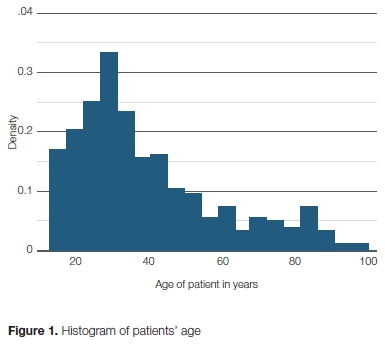
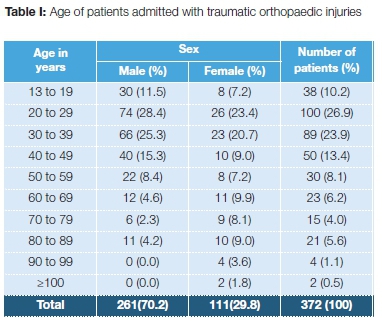
The Kappa statistics for radiological investigations, and types and determinants of orthopaedic injuries data, revealed a statistically significant agreement (p < 0.0001) between the two observers. The median age of the 372 patients with traumatic orthopaedic injuries enrolled in the study was 33.5 years (IQR= 25-50) (Figure 1).
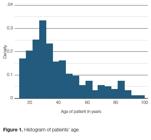
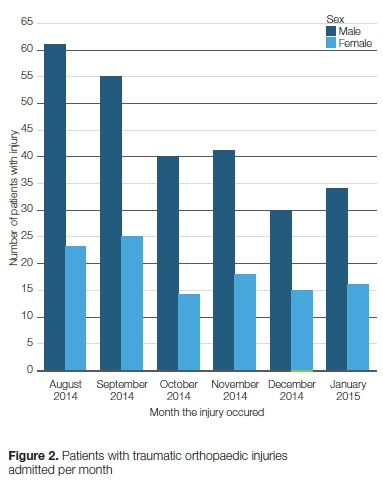
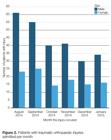
The admission rates were the highest for adults up to the age of 49 years (n=277, 74.5%). The proportion of males admitted was higher than the proportion of females admitted with a sex ratio of 7:3. Younger males were more likely to be admitted than younger females. From 60 years and older, females were more affected than males (Table I). Most patients were admitted in the months of August (84 patients) and September (80 patients). Otherwise, a lower but relatively even number of patients was admitted monthly from October 2014 through January 2015 (Figure 2).
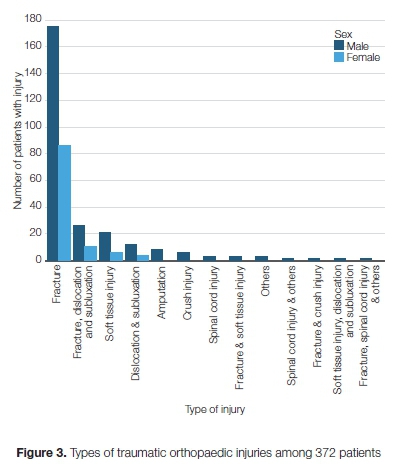
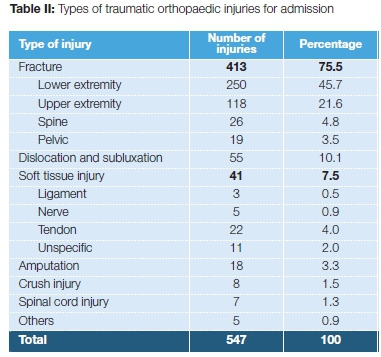
Of the 372 patients admitted with traumatic orthopaedic injuries, 258 patients (69.4%) had fractures only and 38 (10.2%) patients had fractures which were combined with dislocation or subluxation (Figure 3). In total there were 547 cases of injury, with the most common injury being fractures (413 cases, 75.5%) and the most common fracture site being the lower limbs (250 cases, 45.7%), followed by the upper limbs (118 cases, 21.6%) and the spine (26 cases, 4.8%) and pelvis (19 cases, 3.5%). There were 55 cases (10.1%) of various dislocations and subluxations.
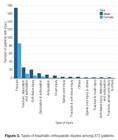
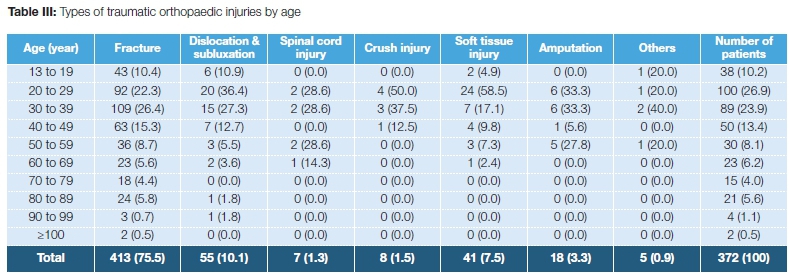
Of the 41 (7.5%) cases of soft tissue injury, 22 (4.0%) were tendon injuries, five (0.9%) were nerve injuries, three (0.5%) were ligament injuries, while 11 (2.0%) were unspecific injuries. There were 18 (3.3%) cases of amputations, eight (1.5%) cases of crush injury, seven (1.3%) cases of spinal cord injury, and five (0.9%) cases with other types of injury (Table II). Our data show that of the 372 patients with traumatic orthopaedic injuries, 307 (82.5%) were aged between 13 and 59 years (Table III).
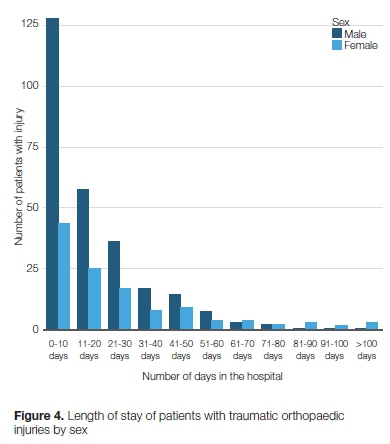
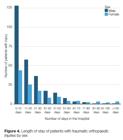
Generally, patients stayed in the hospital for less than a month (305 patients, 82.0%), with more than 50% staying for less than ten days. Two patients remained as inpatients more than 100 days, with one patient staying 107 days and the other 171 days (Figure 4).
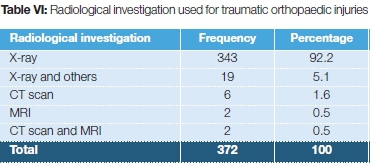
The most common radiological investigation used was X-ray, which was used in 343 patients (92.2%), followed by a combination of X-ray and other investigations (19 patients, 5.1%), computed tomography (CT) scan (six patients, 1.6%), while magnetic resonance imaging (MRI) and a combination of CT-scan and MRI were the least used (two patients (0.5%)) (Table VI). Among the 19 patients who underwent a combination of X-ray and other investigations, there were 14 cases of X-ray and CT-scan, four cases of X-ray and MRI, and one case of X-ray and ultrasound.
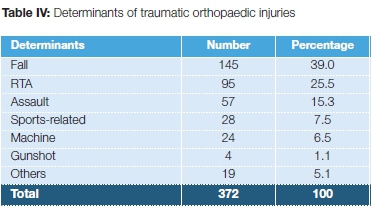
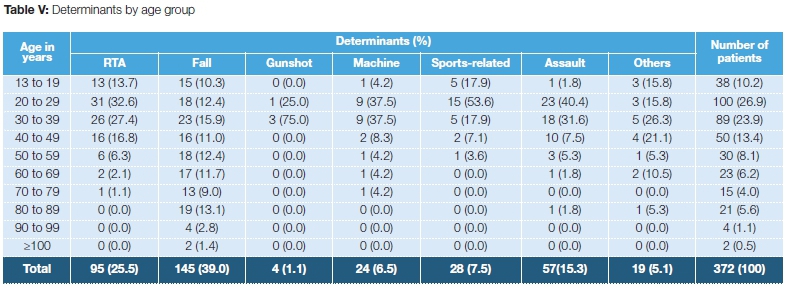
Falls were the most common determinant of traumatic orthopaedic injuries, being responsible for 145 (39.0%) of injuries, followed by RTAs in 95 cases (25.5%). Other determinants were assault in 57 cases (15.3%), sports injuries in 28 cases (7.5%), machine-related injuries in 24 cases (6.5%), gunshot injuries in four cases (1.1%) and others in 19 cases (5.1%) (Table IV). In general, our data showed that the determinants we studied predominantly affected adults aged 13 to 49 years. We note that patients most commonly affected by falls were aged 30 to 39 years (n=23;15.9%), followed by those aged 80 to 89 years (n=19; 13.1%) (Table V).
Discussion
The study aimed to evaluate the epidemiology of traumatic orthopaedic injuries for inpatients at Princess Marina Hospital. The results of our study revealed that the highest number of patients admitted with traumatic orthopaedic injuries were young male adults. Fractures were the most common type of traumatic orthopaedic injury, with falls being the most common determinant of those injuries.
Similar to findings from studies conducted elsewhere,6,7,22,23 our study showed that the majority of patients admitted were males,with a male-to-female ratio of 7:3. The sex difference may be due to the fact that males tend to exhibit more risky behaviour15,16 and are perhaps more involved in outdoor activities than females.
The mean age of patients with traumatic orthopaedic injuries enrolled in our study was 33.5 years, similar to 34.5 years reported by Soleymanha et al.236,7,14 indicating that the majority of people involved in RTAs were in the productive age groups. Both the mean age and disproportionately higher admission rates for younger adults could lead to loss of productivity and negatively impact the economy.
The present study also showed that females aged 60 years and older were more affected by traumatic orthopaedic injuries than males. This finding might be due to a higher rate of osteoporosis in older females when compared to men, as supported by Taylor and Young1924
We identified 547 injuries, with the most common type being fractures (75.5%) and the most common site being the lower limbs, consistent with findings from other studies.6,7,14 The reason for the fractures being the most common traumatic injury is perhaps apparent and due to the forceful injury determinants involved (see below). Extremities are exposed and thus more susceptible to trauma, usually due to direct trauma in vehicle accidents14
Although others found that falls were the second most common determinant of traumatic injuries after RTAs,8et al. reported that the highest frequency of traumatic orthopaedic injuries related to falls (prevalence of 38.3%).231717
We showed that the second most common determinant (25.5%) of traumatic orthopaedic injuries was RTAs, with the vast majority of victims in the 13- to 49-year age group. Our findings are similar to those of Thomas et al.141525
We found that the third determinant of traumatic orthopaedic injuries was assault (15.3%), and that the age group most affected (72%) was 20 to 39 years old. Similarly, Manoharan et al. showed that assault was more common in the same age group in patients with traumatic orthopaedic injuries.2626
We found that the highest admission numbers of patients with traumatic orthopaedic injuries were in August and September. Contrary to expectations, a smaller number of patients was admitted during the festive season (December and January). We think that the lower admission rate may be due to the fact that a large number of Gaborone residents typically travel out of the city for holidays, mostly to their home villages and farms, during this period. In contrast, the highest number of patients with traumatic orthopaedic injuries were admitted in June in a district general hospital in England;1919
Study strengths
We used quick and relatively inexpensive study design and methods. Although we did not find all charts, we were able to locate and review 73.5% of charts for all patients of interest admitted during the study period.
Study weaknesses
Since we collected data retrospectively, we could not always be certain of data accuracy. Furthermore, we do not know how the missing charts may have modified the epidemiologic profile of traumatic orthopaedic injuries and study outcomes.
In addition, a significant number of RTA victims who die before reaching the hospital may have been missed. It is also possible that some patients were admitted under other services, such as general surgery and intensive care, and had orthopaedic injuries, but were discharged from the hospital without being admitted to orthopaedic wards and were thus missed. The collection of data using convenience sampling in a tertiary referral hospital would preclude us from extrapolating findings to a national level.
Conclusion
Young male adults sustained traumatic orthopaedic injuries more than any other group studied. Fractures were the most common type of the injuries, while falls, RTAs, and assaults were the three most common determinants of the injuries. Our results may help guide where efforts to improve healthcare delivery and public health policy should be focused.
Acknowledgements
The authors thank Dr Boikanyo Makubate (biostatistician) for assistance with data entry and data analysis and the orthopaedic and medical record teams at Princess Marina Hospital for their assistance during data collection.
References
- 1. Hanche-Oslen TP, Alemu L, Viste A, Wisborg T, Hansen KS. Trauma care in Africa: a status report from Botswana, guided by The World Health Organization's 'Guidelines for Essential Trauma Care' World J Surg 2012 Oct;36(10):2371 -83.
- 2. Gosselin RA, Spiegel DA, Coughlin R, Zirkle LG. Injuries: the neglected burden in developing countries. Bull World Health Organ 2009 Apr;87(4):246-a.
-
3. Orthopaedics-orthoinfo-AAOS (American Academy of Orthopaedic Surgeons). [online] Available from: http://orthoinfo.aaos.org/topic.cfm?topic=a00099 [cited: August 2014].
» http://orthoinfo.aaos.org/topic.cfm?topic=a00099 -
4. United States Bone and Joint Decade. The burden of musculoskeletal diseases in the United States. Rosemont, IL: American Academy of Orthopaedic Surgeons. Common Injuries. [Online]. Available from: http://www.andrewsinstitute.com/InjuryPrevention/CommonInjuries.aspx., 2008, [cited: on 12 February 2015].
» http://www.andrewsinstitute.com/InjuryPrevention/CommonInjuries.aspx - 5. Gichuchi K. Injury pattern among non-fatal road traffic crash victims. EAOJ, 2007;1(1):23-25.
- 6. Huda N, Gupta P, Pant A, Iqbal A, Julfiqar M, et al. Pattern of orthopaedic injuries among patients attending the emergency department in a tertiary care hospital. An analytical study. Acta Medica international 2014 Jan 1 ;1 (1 ):10.
- 7. Verma V, Singh S, Singh GK, Kumar S, Singh A, Gupta K. Distribution of injury and injury patterns in trauma victims admitted to the trauma Centre of CSMMU, Lucknow. Indian J Comm Health 2013 May 9;25(1):52-60.
- 8. Fasih T, Ballal S, Macdonald K, Mbaya L, Mupimpila C, et al. Botswana - skills for competitiveness and economic growth, Washington, DC: World Bank Group 2014.9.
-
9. World population review (2014): Population of Botswana. [online] Available from: http://wordpopulationreview.com/countries/ Botswana-population [cited: 14 June 2014].
» http://wordpopulationreview.com/countries/ Botswana-population - 10. Sebego M, Nauman RB, Rudd RA, Voetsch K, Delinger AM, Ndlovu C. The impact of alcohol and road traffic policies on crash rates in Botswana, 2004-2011 : a time-series analysis. Accident, analysis and prevention. 2014 Sep 30;70:33-39.
- 11. World Health Organization. Global status report on road safety 2015. World Health organization; 2015 Dec 17.
- 12. Ahmed E, Chaka T. Orthopedic and major limb trauma at Tikur Anbessa University Hospital, Addis Ababa-Ethiopia. East Cent. Afr. J. Surg 2005;10(2):43-50.
- 13. Pan R, Chang N, Chu D, Hsu K, Hsu Y, et al. Epidemiology of orthopedic fractures and other injuries among inpatients admitted due to traffic accidents: a 10-year nationwide survey in Taiwan. Sci World J, 2014 Feb.
- 14. Thomas V, Lavanya, Sridhler. Epidemiologic profile of road traffic accident (RTA) cases admitted in a tertiary care hospital-a retrospective study in Hyderabad, Andhra Pradesh. IJMPS. 2013;3(6):30-36.
- 15. Manna N, Mallik S, Mandal P, Chakraborty D, Sardar JC, et al. Epidemiological factors of road traffic accidents: a study in a tertiary care setting in India. JPMS. 2013;3(1):48-53.
- 16. World Health Organization (WHO). WHO global report on falls prevention in older age. 2007. Geneva (Switzerland).
- 17. Alamgir H, Muazzam S, Nasrullah M. Unintentional falls mortality among elderly in the United States: time for action. Injury. 2012 Dec 31;43(12):2065-71.
- 18. Kalula SZ. A WHO global report on falls among older persons, 2006.
- 19. Taylor A, Young A. Epidemiology of orthopaedic trauma admissions over one year in a district general hospital in England. OJO. 2015;9:191.
- 20. Etikan I, Musa SA, Alkassim RS. Comparison of convenience sampling and purposive sampling. AJTAS. 2016;5(1 ):1 -4.
- 21. Bussmann H, Wester CW, Ndwapi N, Vanderwarker C, Gaolathe T, et al. Hybrid data capture for monitoring patients on highly active anti-retroviral therapy (HAART) in urban Botswana. Bull World Health organ. 2006 Feb;84(2):127-31.
- 22. Lawrence JE, Khanduja V. From Cape Town to Cambridge: Orthopaedic trauma in contrasting environments. WJO. 2016 May 18;7(5):308.
- 23. Soleymanha M, Mobayen M, Asadi K, Adeli A, Haghparast-Ghadim-Limudahi Z. Survey of 2582 cases of acute orthopedic trauma. Trauma Monthly. 2014 Nov;19(4).
- 24. Collinge C, Lebus G, Gardner MJ, Gehrig L. Osteoporosis in orthopaedic trauma patients: a diagnosis and treatment protocol. J Orthop Trauma. 2008 Sep 1, 22;(8):541 -47.
-
25. Pego M. Analysis of traffic accidents in Gaborone, Botswana, 2009. [Online] Available from: http://hdl.handle.net/10019.1/2395 [cited: 3 April 2015].
» http://hdl.handle.net/10019.1/2395 - 26. Manoharan A, Selvaraj P, Vasanthamani P. Epidemiology of orthopedic injuries among patients attending a major trauma centre in Tamilnadu. NJRCM.2016;5(2):126-31.
Dr Manwana M Esperance
Division of Community Health, Faculty of Medicine and Health Sciences, Stellenbosch University
PO Box 241, Cape Town 8000, South Africa
tel: (+27) 21 938 9498
fax: (+27) 21 938 9138
email:

Accepted: October 2017
Published: March 2018
Funding: The lead author conducted the study in partial fulfilment of the MSc Clinical Epidemiology and it was self-funded.
Conflict of interest: The authors of this article confirm no conflicts of interest to disclose. No benefits of any form have been received from a commercial party related directly or indirectly to the subject of this article.