Factors associated with dissemination and complications of acute bone and joint infections in children
Abstract
BACKGROUND: Paediatric bone and joint infections remain common in low- and middle-income countries (LMICs) and may have devastating long-term sequelae. There is a paucity of data from LMICs where the true incidence might be underreported, and delayed presentation is common. Our study aimed to determine the complication rate and incidence of disseminated infection in paediatric bone and joint infections in an LMIC setting. Secondly, we aimed to elucidate factors associated with complications and disseminated disease METHODS: We retrospectively reviewed our paediatric orthopaedic database for children that presented with bone and joint infections between September 2015 and March 2019. Data were extracted from medical records, laboratory results and radiological investigations to identify factors that were associated with the development of complications and disseminated infection at a median follow-up of four months RESULTS: We analysed 49 children. The median age at presentation was 6 years (range 1 month to 12 years). Locally advanced disease, with combined acute haematogenous osteomyelitis (AHOM) and septic arthritis (SA), was present in 13 children (27%). The remaining 36 children were evenly divided (18/49 each, 37%) between isolated AHOM and SA, respectively. Disseminated disease was present in 16 children (33%) and was associated with locally advanced disease, an increase in the number of surgeries and an increased length of stay. Twenty-six complications were documented in 22 (45%) children. Chronic osteomyelitis developed in 15/49 (31%) cases, growth arrest in 5/49 (10%), and pathological fracture, DVT and septic shock in 2/49 (4%) each. Complicated disease was associated with locally advanced disease, a higher number of surgeries, disseminated disease and an increased length of stay. Staphylococcus aureus was the infecting pathogen in 65% of cases (31 MSSA, 1 MRSA), while 25% (12/49) were culture-negative infections. While the median time from admission to surgery was one day, the median time from onset of symptoms to surgery was seven days CONCLUSION: We found a high complication rate despite a short follow-up period. More than a quarter of patients had locally advanced disease, and this was associated with the development of complications and disseminated disease. Further studies are needed to be able to predict which children will have poor outcomes Level of evidence: Level 4
acute haematogenous osteomyelitis; septic arthritis; bone and joint infections; low-and middle-income countries; developing world; resource-constrained
Introduction
Paediatric bone and joint infections are a major burden in low-and middle-income countries (LMICs). Acute haematogenous osteomyelitis (AHOM) has been shown to have an incidence of 8 to 10 per 100 000 in high-income countries while in LMIC countries the incidence is reported to be much higher at 80 per 100 000.1,2 The true incidence may still be underreported. Data from the United States of America (USA) revealed a 2.8-fold increase in the incidence of AHOM from 1982 to 2008, while that of SA has remained unchanged.34
Some of the concerns with musculoskeletal infection include a protracted course of infection leading to severe disease and a poor outcome. Popescu et al. performed a retrospective study to identify the patients with AHOM who are at risk of a poor outcome. They found that a negative outcome was associated with a young age, male sex, rural residence, repeated negative cultures and delayed surgery.55
In Southeast Asia, investigators have found that poor outcomes are associated with a prolonged course of antibiotics (> 30 days), symptom duration of more than one week, younger age, hip joint infection, infection with methicillin-resistant Staphylococcus aureus (MRSA) and delayed administration of antibiotics.6,7 In sub-Saharan Africa, a study by Mamo et al. in Ethiopia found that poor outcomes were associated with the presence of a comorbidity and the use of combination antibiotics (ceftriaxone and metronidazole).8Staphylococcus aureus and Gram-negative bacilli).9
As described earlier, the severity of the infection influences the outcomes. We, therefore, aimed to determine the complication rate and incidence of disseminated infection in paediatric bone and joint infections. Secondly, we aimed to identify factors associated with complications and disseminated disease, and, by extension, the severity of infection. Our results will contribute to the literature that is available in LMICs.
Methods
After obtaining approval from the relevant institutional medical research ethics board, we reviewed our paediatric orthopaedic database to identify all children who presented with acute bone and joint infections, between September 2015 and March 2019, to our paediatric orthopaedic unit. A retrospective review of case medical records, laboratory results and radiological investigations was done, and data were extracted to identify factors that were associated with the development of complications or disseminated disease.
We included all children who were 12 years or younger at the time of presentation with a diagnosis of AHOM and/or SA. We excluded children with acute reactivation of chronic osteomyelitis, pyomyositis without bone or joint involvement, hand infections, pre-patellar abscesses and musculoskeletal tuberculosis (TB).
The following data were recorded from the folders: HIV status, immunisation status, time from onset of symptoms to presentation, length of hospital stay (LOS), intensive care unit (ICU) admission, time from presentation to surgery, diagnosis (septic arthritis and/or acute haematogenous osteomyelitis), initial vitals, inflammatory markers (erythrocyte sedimentation rate [ESR], C-reactive protein [CRP], white cell count [WCC]), and the cultured organism. The number of surgeries was recorded, as well as the development of any complications (e.g., chronic osteomyelitis, pathological fracture, growth arrest, deep vein thrombosis and septic shock). All radiographs were accessed and analysed using our picture archiving and communication system (PACS).
Complications were defined as the development of any of the following conditions: septic shock, deep venous thrombosis, growth arrest, chronic osteomyelitis or pathological fracture. The presence of septic shock was diagnosed using the criteria of the 2005 Pediatric Sepsis Consensus Conference (PSCC).10
Management
The patients were managed according to our departmental protocol on the management of musculoskeletal infection in children. A clinical diagnosis of AHOM and/or SA was made by history and clinical examination. Biochemical inflammatory markers (WCC, CRP and ESR) and X-ray imaging were obtained to confirm the suspected diagnosis and monitor the response to treatment. Ultrasound was used when available to identify joint effusion and/or the location of subperiosteal or other abscess collections. Initial management included empiric intravenous antibiotic treatment with either an anti-staphylococcal penicillin (cloxacillin) or a first-generation cephalosporin (cefazolin), and gentamycin was added in patients aged < 12 months and younger. Analgesia, splinting, emergent surgical drainage, debridement and biopsy also formed part of the initial management strategy. Debridement involved draining any subperiosteal pus collections and removing infected tissues. In cases where there was no subperiosteal collection, an oval window was drilled in the bone to drain any intramedullary collections. Samples (pus, periosteal tissue) were sent for Gram staining, and microscopy, culture and antibiotic sensitivity analysis. Directed antibiotics were started as soon as culture results became available, and intravenous antibiotics were changed to an oral equivalent depending on the clinical response and the CRP level demonstrating a downward trend and dropping to below 20 mg/L.11
Statistical analysis
Statistical analysis was performed using jamovi version 1.2.18.0 open-source software.12
Results
We identified 66 children who were admitted and treated for AHOM and/or SA at our institution during the study period. We were unable to retrieve the records of 17 children and they were excluded. We analysed the records of 49 children.
Thirty-two (65%) of the 49 children were male. The median age of the children was 6 years (IQR 3-9 years, range 1 month to 12 years). Forty-five of the 49 children had a record of their HIV status available in the nursing charts. The recorded HIV infection prevalence was 4% (2/45). The median time between the onset of symptoms and presentation to our institution was seven days (IQR 4.5-13.8 days, range 1 to 30 days).
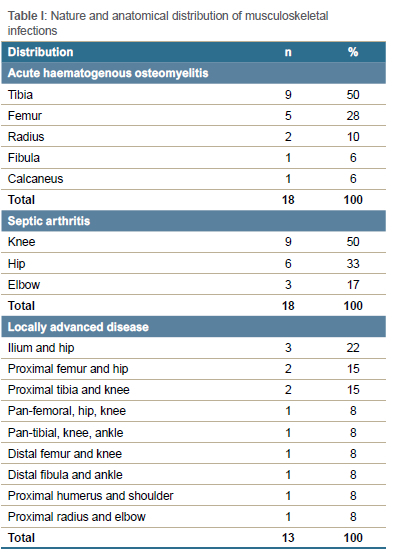
The median CRP was 104 mg/L (IQR 32-193 mg/L, range 1-315 mg/L). Locally advanced disease (combined SA and osteomyelitis) was present in 27% (13/49) of children, while the remaining 36 children were evenly divided between locally isolated AHOM and SA (18/49, 37% each) (Table I). The median CRP in children with locally advanced disease was 152 mg/L, compared to 74 mg/L in children with isolated AHOM or SA (p = 0.060). Disseminated disease was present in 33% (16/49) of children. The median ESR was 92 mm/hr (IQR 59-108 mm/hr, range 7 to 122 mm/hr). The median WCC was 14.2 x 10⁹/L (IQR 9.0-19.2 * 109/L, range 4.9 to 34.7 * 109/L). Two (3.8%) patients met the Pediatric Sepsis Consensus Conference (PSCC) criteria for septic shock. Fourteen per cent (7/49) of patients were admitted to the intensive care unit (ICU) with a mean ICU stay of 8.1 days (SD 7.6 days, range 2-23 days).
While the median time to surgery from admission was one day (IQR 0-1 day, range 0-7 days), the median time to surgery from the onset of symptoms was seven days (IQR 4-14 days, range < 24 hours to 42 days). The median number of surgical procedures required was one (IQR 1-2, range 1-4). The median length of stay (LOS) was 12 days (Q25 7 to Q75 16 days, range 4-82 days). The median follow-up was four months (IQR 1-11 months, range 1-43 months).
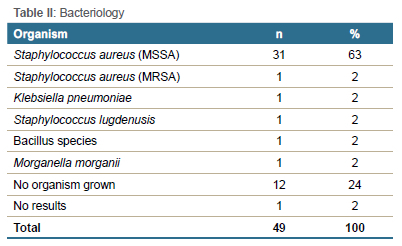
Staphylococcus aureus was responsible for 32/49 (65%) of cases (Table II). There was no statistically significant associa-tion between Staphylococcus aureus and complicated (p = 0.247) or disseminated disease (p = 0.343).
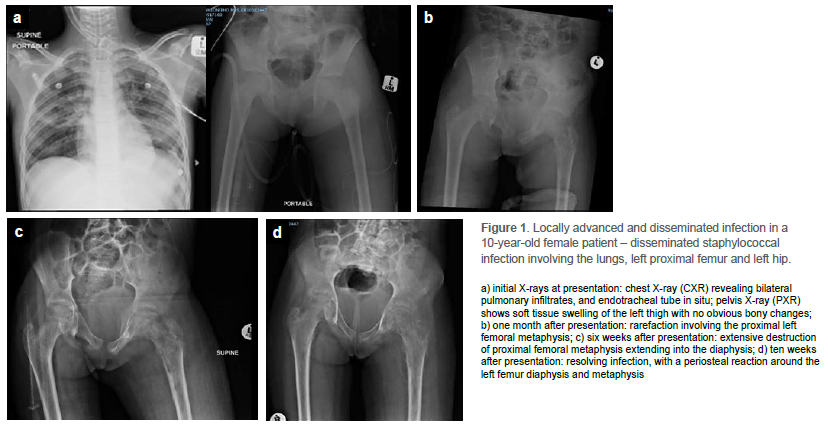
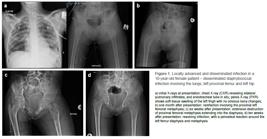
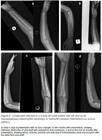
During the hospital stay and follow-up period, 26 complications in 22/49 (45%) patients were documented. Twenty patients developed a single complication, and two patients had three complications. The most common complication was chronic osteomyelitis (n = 15) (Figures 1 and 2).
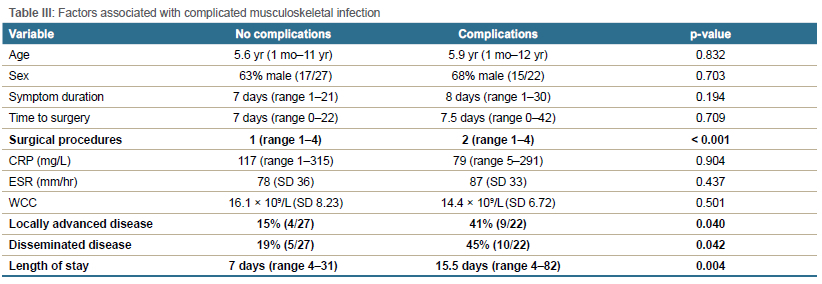
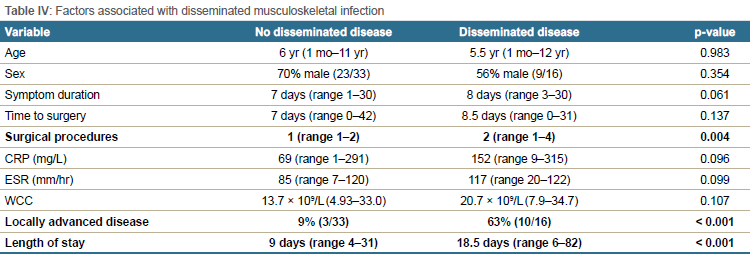
We found a statistically significant association between complicated disease and the presence of locally advanced disease, disseminated disease and the number of surgeries performed (Table III). Patients who developed complicated disease also had a longer hospital stay (median 15 vs 8 days, p = 0.004). Disseminated disease was associated with locally advanced disease, a higher number of surgeries performed, as well as an increased LOS (Table IV).
Discussion
This study aimed to describe bone and joint infections in a cohort of paediatric patients from an LMIC. Furthermore, it aimed to identify factors associated with the development of complications or disseminated disease, and, by extension, the severity of infection.
The median age of our patients was 6 years, similar to Horn et al., but higher than the 2.5 years reported by Robertson et al.13,14 We found a male predilection (65%) for bone and joint infections in our study population. Although Arkader et al. stated that the prevalence is equally distributed among the sexes, our finding was similar to other South African reports and international publications.4,15,16 It has been speculated that this may be due to increased exposure to microtrauma in males.16
The HIV prevalence in our study group was 4% (2/45). This was comparable to the reported HIV prevalence of 2.7% in children between 0 and 14 years in South Africa in 2017.171317
The median CRP on admission was 104 mg/L. This value was similar to Robertson et al. but lower than the median 223.6 mg/L reported by Horn et al.13,14 Rosenfeld et al. found a significantly higher CRP in children with SA and adjacent osteomyelitis.181914
The children in our study were symptomatic for a mean of seven days prior to surgery at our institution. This was a longer period than the symptom duration of three days (range 1-7 days) and five days (range 1-42 days) in the studies by Robertson et al. and Horn et al., respectively.13,14 Nunn and Rollinson reported that in their series the majority of their patients had surgery beyond the recommended five and seven days of symptoms for SA and osteomyelitis respectively. A major finding in their study was a significantly longer duration of symptoms prior to surgery in the children with complications when compared to those without complications.420,21 This intuitively seems correct but was not corroborated by our study or by Robertson et al.13
Staphylococcus aureus was the pathogen found in most of our bacterial cultures (65%) with MSSA predominating (97%) and only one case (3%) of community-acquired MRSA. The low rate of MRSA was similar to the previous studies from South Africa (0-2.4%).13,14 This rate is much lower than the rates of 25% and 29% reported in the USA.22,23 There was a high culture-negative rate in our study (25%, 12/49). Several factors could have contributed, including the fact that a blood culture was not done on admission in all cases, a failure to collect a viable bacterial sample intraoperatively, and the possibility of Kingella kingae infection. Literature has shown an increasing trend in the prevalence of Kingella osteoarticular infections in children between 6 months and 4 years of age.24K. kingae in 48% of musculoskeletal infections in children aged less than 48 months.25 K. kingae in 82% of cases using RT-PCR.26K. kingae infection in our setting.
Children with acute musculoskeletal infection present on a spectrum of severity.2728,29 More severe infection was associated with higher inflammatory markers and specifically the CRP, increased number of surgical procedures and an increased LOS.29,30 Disseminated infection included infection in multiple compartments (e.g. subperiosteal abscess), as well as in children with a combination of SA and osteomyelitis (defined anatomically as complex infections in their study).293132
A more recent observational study based on MRI investigations found that transphyseal spread is considerably more common than once thought.3341820,34 We found an association between locally advanced disease and a higher rate of complications, as well as a higher rate of disseminated disease, highlighting the importance of this diagnosis as a marker of increased disease severity. A timely diagnosis of concomitant SA and osteomyelitis will assist with appropriate management of both sites at the index operation, thus reducing the bacterial burden early and potentially reducing the number of surgeries and positively impact the outcome. Griswold et al. showed that routine MRI investigation in children with suspected musculoskeletal infection reduced repeat surgery from 50% of cases to < 27% (p = 0.009).35
Children in our study who developed complications were more likely to have locally advanced disease, disseminated disease, a longer LOS and more surgical procedures. Similarly, children with disseminated disease were more likely to have locally advanced disease, a longer LOS and a higher number of surgical procedures. Further research is required to develop a locally applicable disease severity classification and to identify factors associated with increased disease severity at presentation.
Our study found a 45% (22/49) complication rate within a median follow-up period of four months (range 1-43 months). The most common complication was chronic osteomyelitis. This relatively high complication rate was similar to the 48% complication rate reported by Horn et al.14
Our study had several limitations. First, we had a small sample size. Contributing to the small sample size, and another limitation impacting the interpretation of our results, was the exclusion of 17 patients. We also did not analyse adolescents between the ages of 13 and 18 years with musculoskeletal infections because they were not managed by our paediatric unit. Our findings may not be representative of all children with musculoskeletal infection, as only the cases referred to our institution that underwent surgical drainage were included in this study. Thirdly, we were unable to record the time to the first dose of antibiotics, as antibiotics were often started at the base hospitals before referral. Another limitation of our study was the short follow-up period. This was because children with an uncomplicated course of infection often failed to attend scheduled follow-up appointments. Despite the short follow-up period, we reported a relatively high complication rate, emphasising the serious consequences of musculoskeletal infections and the importance of further research.
Conclusion
Septic arthritis and acute haematogenous osteomyelitis remain a relevant concern in the developing world. We found a high complication rate despite a short follow-up period. More than a quarter of patients had locally advanced disease, involving combined SA and AHOM, and this was associated with the development of complications and disseminated disease. Further, adequately powered, studies are still needed to be able to predict which children will have poor outcomes.
Acknowledgements
The authors wish to thank Dr Yenziwe N Dlamini for her contribution in assisting with collecting patient files and capturing the data.
Ethics statement
The authors declare that this submission is in accordance with the principles laid down by the Responsible Research Publication Position Statements as developed at the 2nd world Conference on Research Integrity in Singapore, 2010. Prior to commencement of the study, ethics approval was obtained from the University of KwaZulu-Natal Biomedical Research Ethics Committee (BREC/00001084/2020). All procedures were in accordance with the ethical standards of the responsible committee on human experimentation (institutional and national) and with the Helsinki Declaration of 1975, as revised in 2008.
Declaration
The authors declare authorship of this article and that they have followed sound scientific research practice. This research is original and does not transgress plagiarism policies.
Author contributions
VSM: study conceptualisation, data collection, data analysis, manuscript preparation and revision
PHM: study conceptualisation, study design, data analysis, manuscript review and revision
LCM: data review and revision, manuscript review and revision
ORCID
Mdlngi VS https://orcld.org/0000-0001-8867-0700
Maré PH https://orcld.org/0000-0003-1599-7651
Marais LC https://orcld.org/0000-0002-1120-8419
References
- 1. Arnold JC, Bradley JS. Osteoarticular infections in children. Infect Dis Clin North Am. 2015;29(3):557-74.
- 2. Jaramillo D, Dormans JP, Delgado J, et al. Hematogenous osteomyelitis in infants and children: imaging of changing disease. Radiology. 2017;283:629-43.
- 3. Gafur OA, Copley LAB, Hollmig ST, et al. The impact of the current epidemiology of paediatric musculoskeletal infection on evaluation and treatment guidelines. J Pediatr Orthop. 2008;28(7):777-85.
- 4. Nunn T, Rollinson P. Haematogenous pyogenic bone and joint sepsis - reducing avoidable morbidity. S Afr Med J. 2007;97:456-60.
- 5. Popescu B, Tevanov I, Carp M, Ulici A. Acute haematogenous osteomyelitis in paediatric patients: epidemiology and risk factors of a poor outcome. J Int Med Res. 2020;48(4):1-9.
- 6. Stoesser N, Pocock J, Moore CE, et al. The epidemiology of pediatric bone and joint infections in Cambodia, 2007-11. J Trop Pediatr. 2013(1);59:36-42.
- 7. Sukswai P, Kovitvanitcha D, Thumkunanon V, et al. Acute haematogenous osteomyelitis and septic arthritis in children: clinical characteristics and outcomes study. J Med Assoc Thai. 2011;94 Suppl 3:S209-16.
- 8. Mamo MD, Daba FB, Beshir M, Fanta K. Treatment and clinical outcomes of osteoarticular infections among pediatrics admitted to Jimma University Medical Center, Ethiopia: A prospective observational study. Infect Drug Resist. 2021:14 2933-41.
- 9. Mue DD, Salihu MN, Awonusi FO, et al. The epidemiology and outcome of acute septic arthritis: a hospital-based study. J West Afr Coll of Surg. 2013;3(1):40-52.
- 10. Obonyo NG, Schlapbach LJ, Fraser JF. Sepsis: changing definitions, unchanging treatment. Front Pediatr. 2019;6:425.
- 11. Faust SN, Clark J, Pallett A, Clarke NMP. Managing bone and joint infection in children. Arch Dis Child. 2012;97:545-53.
-
12. The jamovi project (2020). jamovi (Version 1.2) [computer software]. Retrieved from https://jamovi.org
» https://jamovi.org - 13. Robertson AJF, Firth GB, Truda C, et al. Epidemiology of acute osteoarticular sepsis in a setting with a high prevalence of pediatric HIV infection. J Pediatr Orthop. 2012;32(2):215-19.
- 14. Horn A, Wever S, Hoffman EB. Complications following acute severe haematogenous osteomyelitis of the long bones in children. SA Orthop J. 2019;18(3):23-29.
- 15. Arkader A, Brusalis C, Warner Jr WC, et al. Update in pediatric musculoskeletal infections: when it is, when it isn't, and what to do. J Am Acad Orthop Surg. 2016;24:e112-21.
- 16. Pããkkõnen M, Kallio MJT, Lankinen P, et al. Preceding trauma in childhood hematogenous bone and joint infections. J Pediatr Orthop B. 2014;23:196-99.
- 17. Human Sciences Research Council (2018). The Fifth South African National HIV Prevalence, Incidence, Behaviour and Communication Surveys, 2017.
- 18. Rosenfeld S, Bernstein DT, Daram S, et al. Predicting the presence of adjacent infections in septic arthritis in children. J Pediatr Orthop. 2016;36:70-74.
- 19. Roine I, Faingezicht I, Arguedas A, et al. Serial serum C-reactive protein to monitor recovery from acute hematogenous osteomyelitis in children. Pediatr Infect Dis J. 1995;14:40-44.
- 20. Dartnell J, Ramachandran M, Katchburian M. Haematogenous acute and subacute paediatric osteomyelitis: A systematic review of the literature. J Bone Joint Surg Br. 2012;94-B:584-95.
- 21. Cole WG, Dalziel RE, Leitl S. Treatment of acute osteomyelitis in childhood. J Bone Joint Surg Br. 1982;64(2):218-23.
- 22. Sarkissian EJ, Gans I, Gunderson MA, et al. Community-acquired methicillin-resistant Staphylococcus aureus musculoskeletal infections: Emerging trends over the past decade. J Pediatr Orthop. Apr-May 2016;36(3):323-27.
- 23. Hamdy R, Dona D, Jacobs MB, Gerber J. Risk factors for complications in children with Staphylococcus aureus bacteremia. J Pediatr Orthop. 2019 May;208:214-220.e2.
- 24. Villani MC, Hamilton EC, Klosterman MM, et al. Primary septic arthritis among children 6 to 48 months of age: implications for PCR acquisition and empiric antimicrobial selection. J Pediatr Orthop. 2021;41(3):190-96.
- 25. Wong M, Williams N, and Cooper C. Systematic review of Kingella kingae musculoskeletal infection in children: epidemiology, impact and management strategies. Pediatric Health Med Ther. 2020:11 73-84.
- 26. Ceroni D, Cherkaoui A, Ferey S, et al. Kingella kingae osteoarticular infections in young children: clinical features and contribution of a new specific real-time PCR assay to the diagnosis. J Pediatr Orthop. 2010;30(3):301-304.
- 27. Athey AG, Mignemi ME, Gheen WT, et al. Validation and modification of a severity of illness score for children with acute haematogenous osteomyelitis. J Pediatr Orthop. 2019;39(2):90-97.
- 28. Copley LAB, Barton T, Garcia C, et al. A proposed scoring system for assessment of severity of illness in paediatric acute haematogenous osteomyelitis using objective clinical and laboratory findings. Pediatr Infect Dis J. 2014;33:35-41.
- 29. Mignemi ME, Benvenuti MA, An TJ, et al. A novel classification system based on dissemination of musculoskeletal infection is predictive of hospital outcomes. J Pediatr Orthop. 2018;38(5):279-86.
- 30. Benvenuti MA, An TJ, Mignemi ME, et al. A clinical prediction algorithm to stratify pediatric musculoskeletal infection by severity. J Pediatr Orthop. 2019;39(3):153-57.
- 31. Trueta J. The three types of acute haematogenous osteomyelitis. J Bone and Joint Surg. 1959;41:4.
- 32. Montgomery CO, Siegel E, Blasier RD, Suva LJ. Concurrent septic arthritis and osteomyelitis in children. J Pediatr Orthop. 2013;33:464-67.
- 33. Gilbertson-Dahdal D, Wright JE, Krupinski E, et al. Transphyseal involvement of pyogenic osteomyelitis is considerably more common than classically taught. Am J Roentgenol. 2014;203(1):190-95.
- 34. Hunter S, Kennedy J, Baker JF. External validation of an algorithm to predict adjacent musculoskeletal infection in pediatric patients with septic arthritis. J Pediatr Orthop. 2020;40(10):e999-e1004
- 35. Griswold BG, Sheppard E, Pitts C, et al. The introduction of a preoperative MRI protocol significantly reduces unplanned return to the operating room in the treatment of pediatric osteoarticular infections. J Pediatr Orthop. 2020;40(2):97-102.
Accepted: September 2022
Published: March 2023
Editor: Prof. Ruan Goller, University of Pretoria, Pretoria, South Africa
Funding: No funding was received for this study.
Conflict of interest: The authors declare they have no conflicts of interest that are directly or indirectly related to the research.