Low dislocation rate one year after total hip arthroplasty at a tertiary hospital in South Africa
Abstract
BACKGROUND: Total hip arthroplasty (THA) is one of the most performed and most researched procedures worldwide, and there is an ever-growing demand for THA in an already resource-constrained system in South Africa. Early dislocation after THA remains a serious and costly problem; however, few THA outcome studies have been performed locally. This study therefore aimed to calculate the incidence of dislocation after THA and to identify risk factors for dislocation after THA in a South African academic hospital METHODS: In this retrospective cohort review, files and radiographs of 543 patients were reviewed for dislocation during the first year after primary THA. The reason for the THA, the surgical data, the implant data, and whether and when dislocation occurred were recorded for each patient. Fisher's exact tests and independent t-tests were done to analyse the association between variables and a patient's odds of experiencing a dislocation after THA RESULTS: Twenty (3.7%) out of 543 THAs dislocated during the first year, 17 of these within the first three months. The surgical approach used was not shown to be a significant risk factor (p = 0.650) for dislocation, although the Hardinge approach had been used for all 20 cases of dislocation. Similar dislocation rates (p = 0.967) were found for THAs done for displaced neck of femur (NOF) fractures (3.6%) and for elective THAs (3.7%). Trauma THAs made up more than half (55%) of our study population. Femoral head sizes < 32 mm (p = 0.390 for neck of femur THA and p = 0.451 for elective THA) and a single mobility design (p = 0.494) both produced a higher dislocation rate, although this was not statistically significant. Surgeon experience did not prove to be significant for our study population (p = 0.570 CONCLUSION: The dislocation rate after THA at our institution is lower than rates reported in the literature for NOF THA and similar to rates reported for elective THA. This was found despite the dislocation rate for the Hardinge approach being nearly eight times higher than expected. Minimal surgeon experience, implant coupling and smaller femoral head size did not prove to be significant risk factors for dislocation after THA Level of evidence: Level 4
total hip replacement; dislocation; South Africa
Introduction
Total hip arthroplasty (THA) is widely considered to be one of the most successful surgical procedures in orthopaedics and the most successful surgery of the 20th century. It is associated with high satisfaction rates in relieving pain and restoring function.14
The second most common complication of THA is dislocation (with aseptic loosening being the most common). Dislocation rates vary from 1% to 5% for elective surgery to as high as 22% for neck of femur (NOF) fractures.4-6 Most dislocations occur shortly after surgery: up to 60% of dislocations occur in the first five weeks and more than 75% in the first year after the index procedure.6-8 A review of revision THA databases suggests that patient-, surgery-and implant-related factors can contribute to the dislocation rate after THA.
Important patient factors include neuromuscular disorders, alcohol abuse, advanced age, female sex and increased body mass index (BMI).2,9 Analysis of indications for THA found a higher incidence of instability when THA was performed for avascular necrosis, rheumatoid and inflammatory arthritis, and trauma, compared with degenerative osteoarthritis.2,6,7
The surgical approach used has a definite influence on the dislocation rate. The most used approaches for THA include the posterior approach, direct lateral approach and direct anterior approach, with the posterior approach being the most used approach worldwide. The dislocation risk has been quoted as 3.23% for the posterior approach, 2.18% for the anterolateral approach, 1.27% for the transtrochanteric approach and 0.55% for the direct lateral (Hardinge) approach.106
Another important surgical factor is implant size. Larger femoral heads have been shown to improve stability by increasing jumping distance and range of motion until impingement.7,11-13 This has led to the use of larger femoral heads internationally. Implant coupling design also needs consideration, as implants with dual mobility coupling significantly reduce dislocation risk compared with single mobility coupling even in high-risk patients.14
Surgeon experience is paramount to the success of THA. Surgeons who have performed fewer than 30 procedures have a markedly increased dislocation rate compared with more experienced and better-trained surgeons.2,6 Dislocation is a dire complication after THA that leads to increased morbidity, mortality and cost of care. Limited data regarding THA in South Africa is available, as most research has been conducted in a developed world setting.15
Methods
This was a retrospective cohort review of all patients who had undergone a primary THA at a single tertiary level hospital, Steve Biko Academic Hospital, from January 2009 to December 2019 and who had at least one year of follow-up. The endpoint of the review was hip dislocation after primary THA. THA patients were identified from the arthroplasty theatre register (name, hospital number, date of the procedure, size of implants). Preoperative radiographs were reviewed by the authors to exclude extracapsular fractures and patients who had undergone surgery prior to the THA. The patients' files were then retrieved from the records department and reviewed by the author and co-author. Patient files and radiographs on the PACS system were used to confirm non-dislocation after THA. Patients who had incomplete clinical follow-up at one year were contacted telephonically to confirm non-dislocation during the first year after THA. Exclusion criteria included extracapsular fracture and failed acetabular or proximal femur open reduction and internal fixation. Patients with less than one-year follow-up, missing files and incomplete follow-up who could not be contacted were also excluded from the study.
The indication for surgery, surgical approach, implant size, implant design (dual mobility coupling vs single mobility coupling), incidence of dislocation and number of days after THA that it occurred, surgical team's rank (consultant or registrar) and patient comorbidities were recorded. Data was captured directly into an electronic database using Microsoft Excel. The data analysis consisted of analytical statistical investigations which aimed to determine the dislocation rate after THA. These consisted of descriptive statistics such as mean (standard deviation) and the range for the quantitative variables and frequencies with percentages to describe the categorical results. Fisher's exact test and the independent t-test were used to evaluate the difference between outcomes. The dislocation rate was measured against the indication for THA, the surgical approach used and surgeon experience to identify risk factors for dislocation after THA.
Results
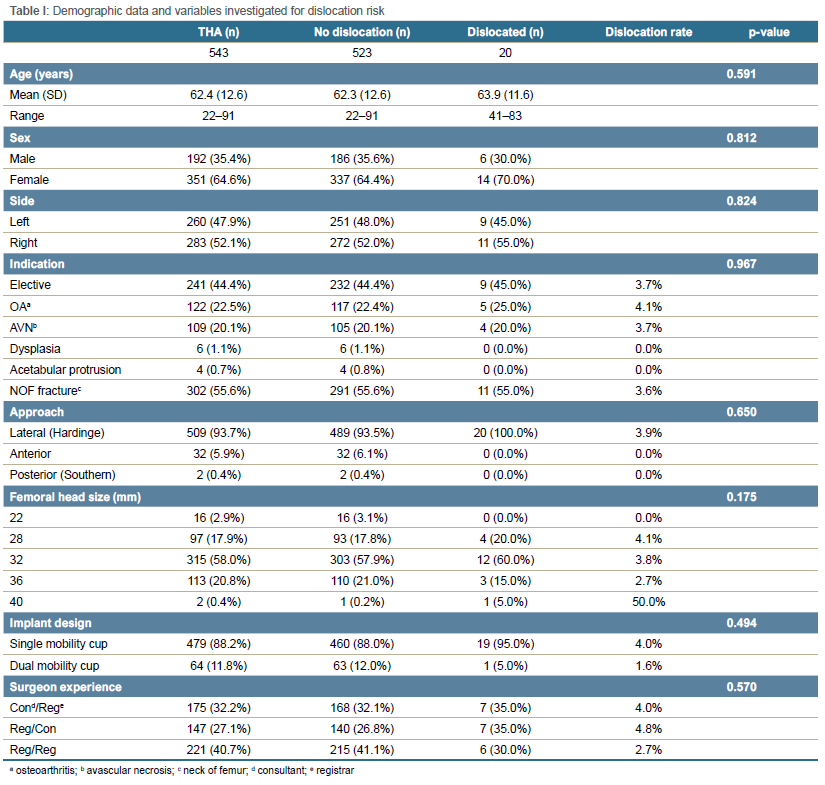
A total of 624 patients were identified for review, and 543 patients with a complete one-year follow-up were included. Eighty-one patients were excluded: 59 patients had missing files and could not be contacted, and 22 patients had incomplete files or follow-up and could not be contacted telephonically. The mean age of the population was 62.4 years (range 22-91), and there were 351 female patients (64.6%) and 192 male patients (35.4%). There was an even distribution of left-sided (260; 47.9%) and right-sided replacements (283; 52.1%) (Table I). This study did not find age (p = 0.591), sex (p = 0.812) or side of THA (p = 0.824) to have any influence on dislocation after THA (Table I). More than half of the patients (302; 55.6%) presented with NOF fractures. Other indications were osteoarthritis (122; 22.5%), avascular necrosis (109; 20.1%), dysplasia (6; 1.1%) and acetabular protrusion (4; 0.7%) (Table I).
The vast majority of THAs (509; 93.7%) were done using the Hardinge (lateral) approach, as is dictated by the departmental protocol. The anterior approach was used in 32 (5.9%) cases: the anterior minimally invasive technique in 30 cases (5.5%) and the Smith-Petersen with conventional technique in two cases (0.4%). The Southern approach (posterior) was used twice (0.4%; Table I). The median femoral head size used was 32 mm (315 THAs; 64.6%), with sizes ranging from 22 mm to 40 mm. Four hundred and seventy-nine THAs (88.2%) were done using single mobility cups and 64 (11.8%) using dual mobility cups.
Surgeon experience was documented according to the highest qualification of the surgeon, as experience could not be controlled for - this was not a significant risk factor for dislocation.
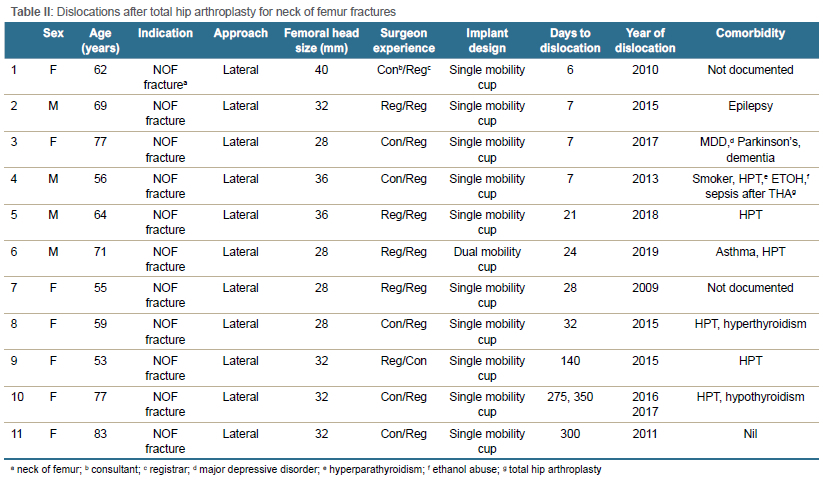
Twenty (3.7%) of the patients had confirmed dislocations during the first year after surgery. Dislocation occurred after one of the 64 THAs performed with dual mobility cup implants (1.5%) and 19 of the 479 THAs performed with single mobility cup implants (3.9%) (Tables II and III).
III
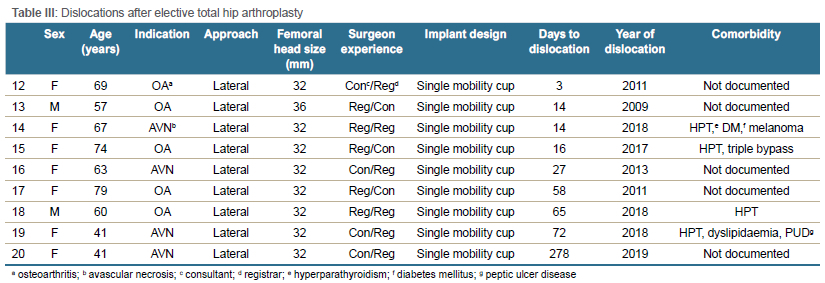
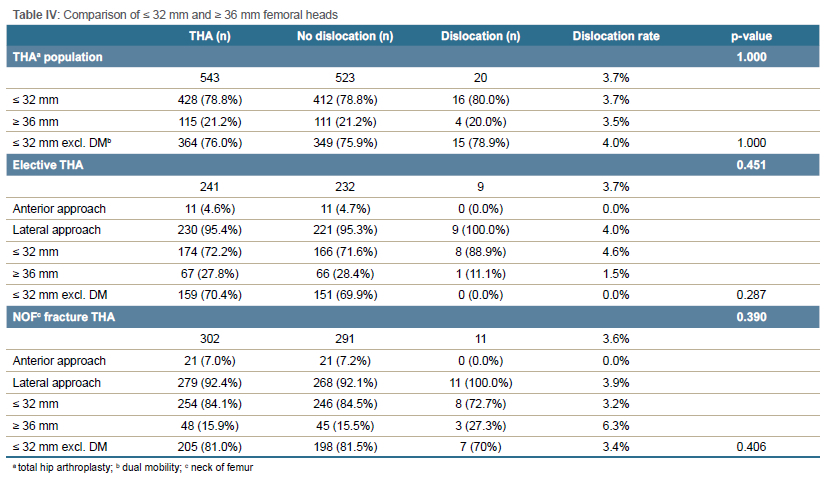
We first compared the < 32 mm group to the > 36 mm group (Table IV), since there was no < 28 mm head dislocation in the elective group to which to compare (Table III). Although not statistically significant, the < 32 mm group had a higher dislocation rate compared with the > 36 mm group for both the elective THA group (p = 0.451) and total sample (p = 1.000).
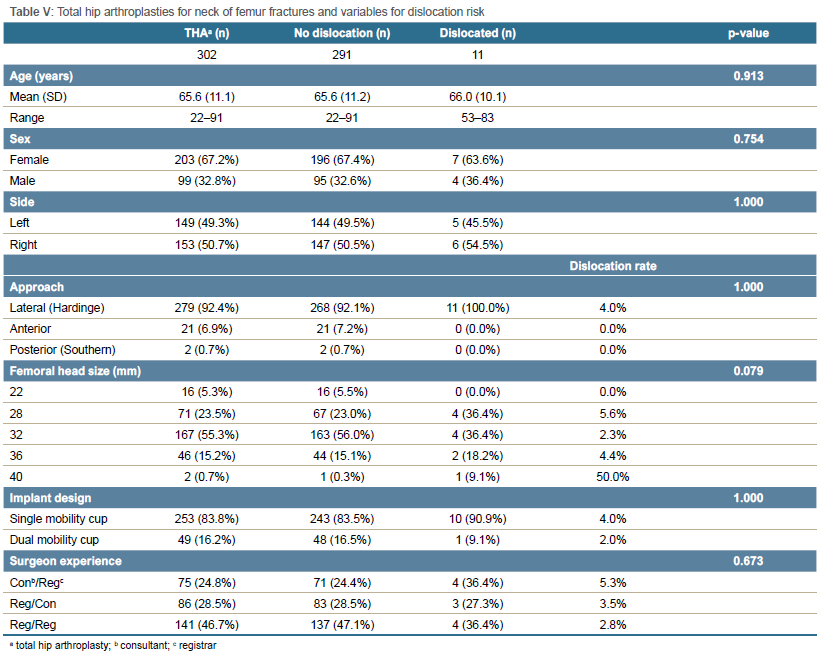
In the NOF fracture group, femoral head size had a greater influence on dislocation risk (p = 0.079; Table V). Contradictory to the elective group and most literature, the outcome for the > 36 mm group was worse, having a dislocation rate of more than 6.25%. Of note is that all three > 36 mm heads in the NOF fracture group dislocated within 21 days of the index procedure, indicating that there were factors besides head size that contributed to dislocation. Patient 1 (Table II) in the dislocated group, with a 40 mm femoral head, suffered dislocation after six days, and this was due to acetabular component mispositioning - an apparent inclination of > 70° and anteversion of > 30°. Patient 4 (Table II), a smoker and ethanol abuser, suffered dislocation after seven days, and this was attributed to sepsis. The third dislocation, in patient 5 (Table II), was attributed to poor patient compliance and an immature scar. Of note: patient 10 (32 mm head - single mobility design) dislocated twice.
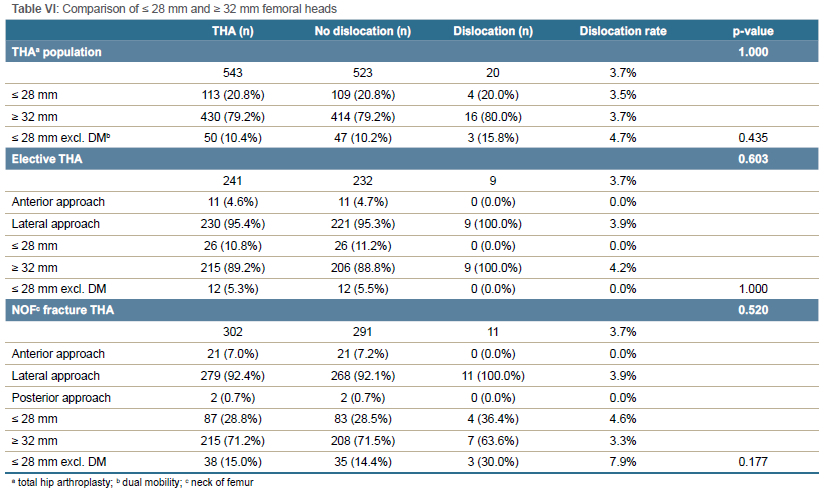
We then compared the < 28 mm femoral head group to the > 32 mm group (Table VI). The dislocation rate was higher in the < 28 mm group for the total sample and the NOF fracture group, but this was not statistically significant (p = 0.520). Forty-nine of the 113 heads in the < 28 mm group were part of a dual mobility coupling implant, and this could explain the lack of significance for this analysis. After exclusion of the dual mobility couplings, the dislocation rate for heads < 28 mm was 7.89% for NOF fracture THAs, more than double that of the > 32 mm group. This demonstrates the benefit of using larger femoral heads.
Post-hoc power analysis revealed that all calculations were underpowered. This was due to the small dislocation group, resulting in effect sizes of less than 0.5 for all variables. For categorical variables the Cramer's Vs were calculated and for age the Cohen's d was used to calculate the effect size.
Discussion
Internationally, THA is a widely researched topic on which much has been published and for which registry data is readily available. Malawi is the only sub-Saharan African country with a national joint registry, and publications and systematic reviews with regard to a South African THA population are scarce.15-17 THA patient, implant, outcome and revision data are vital for efficiently managing limited resources in a public healthcare sector faced with a massive demand for THA.
Advanced age, sarcopaenia and associated fall risk, and insufficient rehabilitation are recognised risk factors for dislocation.2,6,9,18 Gender is a controversial risk factor for dislocation, with older publications claiming an almost twofold higher risk for female patients. Recent reviews have, however, not been able to prove a significant difference between male and female patients.6,19 Cognitive and neuromuscular disorders, dementia and alcohol abuse constitute a fourfold risk of dislocation, mostly owing to poor compliance after THA. A BMI above 30 kg/m26
A review article by Kunutsor et al., and the only available sub-Saharan African systematic review by Davies, both showed avascular necrosis, inflammatory arthritis and osteoarthritis to make up almost 80% of the indications for THA in their respective literature reviews.6,16,19 This is in contradiction to our study, in which more than 50% of the THAs were performed for a NOF fracture (Table I). Avascular necrosis and osteoarthritis did, however, constitute most of the elective THAs (42%). This high percentage of NOF fracture patients also explains the long waiting lists for elective THA at most public hospitals in South Africa.
Avascular necrosis has been shown to be a higher risk factor for dislocation than osteoarthritis.6,20 Dislocation was 200% more likely when THA was performed for avascular necrosis, 400% more likely for NOF fractures and almost 500% more likely in nonunions, malunions and previous THAs. Hermansen et al. found a true cumulative dislocation rate of 3.5% in the first two years after THA performed for osteoarthritis in the Danish national patient register.21
The results from our study further contradict the findings in the international literature with regard to NOF fracture THA. Several international studies have shown NOF fracture THA to be associated with a higher dislocation rate compared with elective THA.2,7,20,22,23 The dislocation rate for NOF fracture THA (3.6%) in our study was lower than for the elective THA patients (3.7%). The indication for surgery (NOF fracture vs elective) did not, however, prove to be a significant risk factor (p = 0.967) for dislocation (Table I).
Along with the indication for surgery, another important factor is the surgical approach preferred by the surgeon. The posterior approach remains the most used approach for THA worldwide despite the slightly higher dislocation risk.4,24,25 This risk can be mitigated with adequate capsular repair and produces dislocation rates of around 1%, similar to the anterolateral and direct lateral approaches.10,24,26,27 The anterior approach is gaining popularity because of its superior stability: muscle attachment around the hip is not disrupted and dislocation rates of 0% to 1% have been reported.28,29 Our results are in keeping with those in the literature for the anterior and posterior approaches, there having been no dislocations for either group. In contrast we found a dislocation rate of 3.9% for the Hardinge approach - nearly eight times higher than expected. Although all 20 detected dislocations were of THAs done through the Hardinge approach, surgical approach was not found to be a statistically significant risk factor for dislocation. All anterior and posterior approach THAs were performed by a consultant orthopaedic surgeon.
THA performed with dual mobility implants has a reported 0% to 5% dislocation risk irrespective of surgical approach, and this does not increase with time or with component wear.3017,31,32 Dual mobility cups have also been proved to have a lower dislocation rate in primary THA done for osteoarthritis.31
Larger femoral heads (e.g. > 36 mm) allow a wider mechanical range of motion compared with smaller head diameters (e.g. < 28 mm) before the neck of the prosthesis strikes the rim of the acetabular component.911-13 The accepted use of larger femoral heads (> 32 mm) reduced the dislocation rate by 35% to 43%.7
Howie et al. found increased risk of dislocation in 28 mm heads compared with sizes 32 mm and larger.113212,33 The median head size in our study population was 32 mm. This finding is in line with international registries.34
In addition to femoral head size, another important implant-related and surgical factor for THA stability is acetabular and femoral component placement.193335
Surgeon volume and experience in terms of the approach and implants used have a definite influence on dislocation risk.6,35,36 The best outcomes are often obtained with the approach and procedure the surgeon is most comfortable with.2637,38 Malik et al. also postulated that arthroplasty fellows trained in 'high-volume centres' may be better skilled and thus achieve better surgical outcomes.361717
Surgeon experience did not appear to be significant in our total study population (p = 0.570) or the higher risk NOF fracture group (p = 0.673) (Table I). In both groups, however, the registrar/registrar teams, that is, low-volume surgeons, achieved the best dislocation rates. Close to 40% of cases were done without a consultant in the surgical team. The difference in dislocation rate is most likely due to the more challenging or high-risk cases being treated by more senior surgeons.
Our study had some limitations. Owing to incomplete and often missing files, patient biometrics (weight, BMI) and comorbidities could not be obtained and adequately analysed. Eighty-one patients (13%) eligible for the study were excluded due to incomplete/incorrect contact details - 57 of these patients were emergency (NOF) admissions. An attempt was made to contact all patients who had incomplete follow-up and incomplete files. This factor could have led to an underreporting of complications in the trauma group. Patients who had presented to a different facility with an acute dislocation are also more likely to default further follow-up appointments compared to patients who had no dislocations.
This study looks at the dislocation rate in the first 12 months following surgery, the period in which 75% of early dislocations occur. The incidence in our study could therefore possibly only reflect 75% of expected dislocations in this cohort. The sample size of the different surgical approaches, as well as of the two implant designs used, was unbalanced and may not be an accurate reflection. Because of the high p-values obtained, and wide confidence intervals, we could not perform further regression analysis, as this would be an inaccurate representation of the data. The predominance of the Hardinge approach (92%) negates any meaningful comparison of surgical approach as a risk factor. Also, implant malplacement was not assessed in this study and is an important limitation.
Post-hoc power analysis revealed that all calculations were underpowered. This was due to the small dislocation group, resulting in effect sizes of less than 0.5 for all variables.39
Conclusion
The dislocation rates after THA at our institution is lower than literature-reported rates for NOF fracture THA and similar to rates reported for elective THA. This was found despite the dislocation rate of 4.0% for the Hardinge approach being nearly eight times higher than expected. South African academic centres can offer outcomes comparable to those reported internationally.
Although surgeon experience, single mobility couplings and smaller femoral head sizes were shown to be associated with dislocation risk, these were not found to be statistically significant risk factors for dislocation after THA.
It is important to consider technical advances in THA. The anterior approach offers promising results and could herald in a new era of THA. Dual mobility coupling and larger femoral head size are literature-proven risk-mitigating factors in high-risk patients and should always be considered. Given the high percentage of THAs done for NOF fractures, preventive strategies can and should be considered to reduce this fracture burden.
Ethics statement
The authors declare that this submission is in accordance with the principles laid down by the Responsible Research Publication Position Statements as developed at the 2nd World Conference on Research Integrity in Singapore, 2010.
All procedures performed in studies involving human participants were in accordance with the ethical standards of the institutional and/or national research committee and with the 1964 Helsinki declaration and its later amendments or comparable ethical standards.
Prior to the commencement of the study, ethical approval was obtained from the following ethical review board: University of the Pretoria's Human Research Ethics Committee and reference number 332/2020.
Informed written consent was not obtained from all patients for being included in the study.
Declaration
The authors declare authorship of this article and that they have followed sound scientific research practice. This research is original and does not transgress plagiarism policies.
Author contributions
PJF: primary author, study conceptualisation, data capture, data analysis RDE: co-author, data collection TB: data analysis
HWJ: conceptualisation, manuscript revision, supervision
ORCID
Fourie PJ https://orcid.org/0000-0002-5362-4197
Erasmus RD https://orcid.org/0000-0001-6206-6687
References
- 1. Goldstein WM, Gleason TF, Kopplin M, Branson JJ. Prevalence of dislocation after total hip arthroplasty through a posterolateral approach with partial capsulotomy and capsulorrhaphy. J Bone Joint Surg Am. 2001;83-A Suppl 2(Pt 1):2-7.
- 2. Lu Y, Xiao H, Xue F. Causes of and treatment options for dislocation following total hip arthroplasty (review). Exp Ther Med. 2019 Sep;18(3):1715-22.
- 3. Ullmark G. The unstable total hip arthroplasty. EFORT Open Rev. 2016;1(4):83-88.
- 4. Zahar A, Rastogi A, Kendoff D. Dislocation after total hip arthroplasty. Curr Rev Musculoskelet Med. 2013;6(4):350-56.
- 5. Devane PA, Wraighte PJ, Ong DCG, Horne JG. Do joint registries report true rates of hip dislocation? Clin Orthop Relat Res. 2012;470(11):3003-3006.
- 6. Kunutsor S, Barrett M, Beswick A, et al. Risk factors for dislocation after primary total hip replacement: a systematic review and meta-analysis of 125 studies involving approximately five million hip replacements. Lancet Rheumatol. 2019;1(2):e111-e21.
- 7. Malkani AL, Ong KL, Lau E, et al. Early- and late-term dislocation risk after primary hip arthroplasty in the Medicare population. J Arthroplasty. 2010;25(6 Suppl):21-25.
- 8. Meek RMD, Allan DB, McPhillips G, et al. Late dislocation after total hip arthroplasty. Clin Med Res. 2008;6(1):17-23.
- 9. Dargel J, Oppermann J, Briiggemann G-P, Eysel P. Dislocation following total hip replacement. Dtsch Arztebl Int. 2014;111:884-90.
- 10. Masonis JL, Bourne RB. Surgical approach, abductor function, and total hip arthroplasty dislocation. Clin Orthop Relat Res. 2002(405):46-53.
- 11. Howie DW, Holubowycz OT, Middleton R. Large femoral heads decrease the incidence of dislocation after total hip arthroplasty: a randomized controlled trial. J Bone Joint Surg Am. 2012;94(12):1095-102.
- 12. Jameson SS, Lees D, James P, et al. Lower rates of dislocation with increased femoral head size after primary total hip replacement: a five-year analysis of NHS patients in England. J Bone Joint Surg Br. 2011;93(7):876-80.
- 13. Stroh DA, Issa K, Johnson AJ, et al. Reduced dislocation rates and excellent functional outcomes with large-diameter femoral heads. J Arthroplasty. 2013;28(8):1415-20.
- 14. Romagnoli M, Grassi A, Costa GG, et al. The efficacy of dual-mobility cup in preventing dislocation after total hip arthroplasty: a systematic review and meta-analysis of comparative studies. Int Orthop. 2019;43(5):1071-82.
- 15. Shituleni S, Maqungo S. Displaced intracapsular neck of femur fractures: Dislocation rate after total hip arthroplasty. SA Orthop J. 2018;17(1):30-34.
- 16. Davies PS, Graham SM, Maqungo S, Harrison WJ. Total joint replacement in sub-Saharan Africa: a systematic review. Trop Doct. 2019;49(2):120-28.
- 17. Erasmus LJ, Fourie FF, Van der Merwe JF. Low dislocation rates achieved when using dual mobility cup hip implants for femur neck fractures. SA Orthop J. 2020;19(2):70-73.
- 18. Esposito CI, Gladnick BP, Lee Y-Y, et al. Cup position alone does not predict risk of dislocation after hip arthroplasty. J Arthroplasty. 2015;30(1):109-13.
- 19. Kunutsor SK, Barrett MC, Beswick AD, et al. Risk factors for dislocation after primary total hip replacement: a systematic review and meta-analysis of 125 studies involving approximately five million hip replacements. Lancet Rheumatol. 2019;1(2):e111-e21.
- 20. Meek RM, Allan DB, McPhillips G, et al. Epidemiology of dislocation after total hip arthroplasty. Clin Orthop Relat Res. 2006;447:9-18.
- 21. Hermansen LL, Viberg B, Hansen L, Overgaard S. 'True' cumulative incidence of and risk factors for hip dislocation within 2 years after primary total hip arthroplasty due to osteoarthritis: a nationwide population-based study from the Danish Hip Arthroplasty Register. J Bone Joint Surg Am. 2021;103(4):295-302.
- 22. Yang S, Halim AY, Werner BC, et al. Does osteonecrosis of the femoral head increase surgical and medical complication rates after total hip arthroplasty? A comprehensive analysis in the United States. Hip Int. 2015;25(3):237-44.
- 23. Stafford GH, Charman SC, Borroff MJ, et al. Total hip replacement for the treatment of acute femoral neck fractures: results from the National Joint Registry of England and Wales at 3-5 years after surgery. Ann R Coll Surg Engl. 2012;94(3):193-98.
- 24. Wayne N, Stoewe R. Primary total hip arthroplasty: a comparison of the lateral Hardinge approach to an anterior mini-invasive approach. Orthop Rev. 2009;1(2):e27.
- 25. Perticarini L, Rossi SMP, Benazzo F. Unstable total hip replacement: why? Clinical and radiological aspects. Hip Int. 2020;30(2_suppl):37-41.
- 26. Kwon MS, Kuskowski M, Mulhall KJ, et al. Does surgical approach affect total hip arthroplasty dislocation rates? Clin Orthop Relat Res. 2006;447:34-38.
- 27. Pellicci PM, Bostrom M, Poss R. Posterior approach to total hip replacement using enhanced posterior soft tissue repair. Clin Orthop Relat Res. 1998(355):224-28.
- 28. Bhandari M, Matta J, Dodgin D. Anterior total hip arthroplasty collaborative investigators outcomes following the single incision anterior approach to total hip arthroplasty: a multicenter observational study. Orthop Clin North Am. 2009;40(3):329-42.
- 29. Tsukada S, Wakui M. Lower dislocation rate following total hip arthroplasty via direct anterior approach than via posterior approach: five-year-average follow-up results. Open J Orthop. 2015;9:157-62.
- 30. Guyen O. Constrained liners, dual mobility or large diameter heads to avoid dislocation in THA. EFORT Open Rev. 2016;1(5):197-204.
- 31. Vajapey SP, Fideler KL, Lynch D, Li M. Use of dual mobility components in total hip arthroplasty: Indications and outcomes. J Clin Orthop Trauma. 2020;11(Suppl 5):S760-5.
- 32. Zijlstra WP, De Hartog B, Van Steenbergen LN, et al. Effect of femoral head size and surgical approach on risk of revision for dislocation after total hip arthroplasty. Acta Orthop. 2017;88(4):395-401.
-
33. AJRR. AJRR Annual Report: AJRR; 2020. Available from: https://www.aaos.org/registries/publications/ajrr-annual-report.
» https://www.aaos.org/registries/publications/ajrr-annual-report - 34. Tsikandylakis G, Mohaddes M, Cnudde P, et al. Head size in primary total hip arthroplasty. EFORT Open Rev. 2018;3(5):225-31.
- 35. Lewinnek GE, Lewis JL, Tarr R, et al. Dislocations after total hip-replacement arthroplasties. J Bone Joint Surg Am. 1978;60(2):217-20.
- 36. Malik AT, Jain N, Scharschmidt TJ, et al. Does surgeon volume affect outcomes following primary total hip arthroplasty? A systematic review. J Arthroplasty. 2018;33(10):3329-42.
- 37. Khatod M, Cafri G, Namba RS, et al. Risk factors for total hip arthroplasty aseptic revision. J Arthroplasty. 2014;29(7):1412-17.
- 38. Kreder HJ, Deyo RA, Koepsell T, et al. Relationship between the volume of total hip replacements performed by providers and the rates of postoperative complications in the state of Washington. J Bone Joint Surg Am. 1997;79(4):485-94.
- 39. Kim H-Y. Statistical notes for clinical researchers: chi-squared test and Fisher's exact test. Restor Dent Endod. 2017;42(2):152-55.
Accepted: June 2022
Published: March 2023
Editor: Prof. Michael Held, University of Cape Town, Cape Town
Funding: No funding was received for this study.
Conflict of interest: The authors declare they have no conflicts of interest that are directly or indirectly related to the research.