Assessing musculoskeletal training in South Africa
Abstract
A familiarity with musculoskeletal disorders is vital for medical school graduates. The purpose of this study was to investigate perceived deficiencies in undergraduate education to provide motivation for a restructuring of the curriculum. A basic competency examination in musculoskeletal medicine was used. Group 1 comprised 79 interns in their first postgraduate year. The recommended passing score for the examination was 73.1%. The score for the interns in Group 1 was 45.3%. Seventy-two (91%) of the 79 interns failed to demonstrate basic competency. The examination was reapplied to 53 interns (Group 2), to establish whether a two-month orthopaedic rotation during internship improved performance. The score for the group was 56.8%. 85.7% (18/21) of those who had completed an orthopaedic rotation and 93.8% (30/32) of those who had not completed an orthopaedic rotation failed the assessment. The additional exposure to musculoskeletal medicine during internship did not show statistical benefit (95% CI 58.0-79.5). In summary, 91% of medical-school graduates failed a basic competency examination, and no benefit was found from completing an internship rotation. We believe that undergraduate musculoskeletal education in South Africa is inadequate and that programmes throughout the country should be reassessed.
Musculoskeletal education; undergraduate curriculum; basic competency examination; orthopaedic
Introduction
Musculoskeletal symptoms account for a quarter of primary care and accident and emergency attendances internationally, and approximately two-thirds of people on long-term sick leave in Europe claim a musculoskeletal problem as the reason.1,2 The economic burden of musculoskeletal illness accounts for 2.5-7.7% of the gross national product of many nations.345678
The provision of musculoskeletal care comes from a broad spectrum of practitioners, with only 6% of musculoskeletal care in the United States being provided by orthopaedic surgeons.91011et al. estimated that 20% of deaths among young adults in developing countries could be prevented by simple surgical interventions.12et al. assessed factors associated with a delay to arthrotomy in paediatric septic arthritis of the hip.1314
Many studies express concern that doctors lack the competency and skills to manage musculoskeletal disorders seen in daily practice. A survey of Ontario physicians found the unnecessary use of diagnostic tests, inappropriate prescriptions and lack of diagnostic suspicion of dangerous muscu-loskeletal conditions to be common problems.1516et al. from Newcastle University assessed confidence in paediatric musculoskeletal assessment.17
Many studies express concern that doctors lack the competency and skills to manage musculoskeletal disorders seen in daily practice
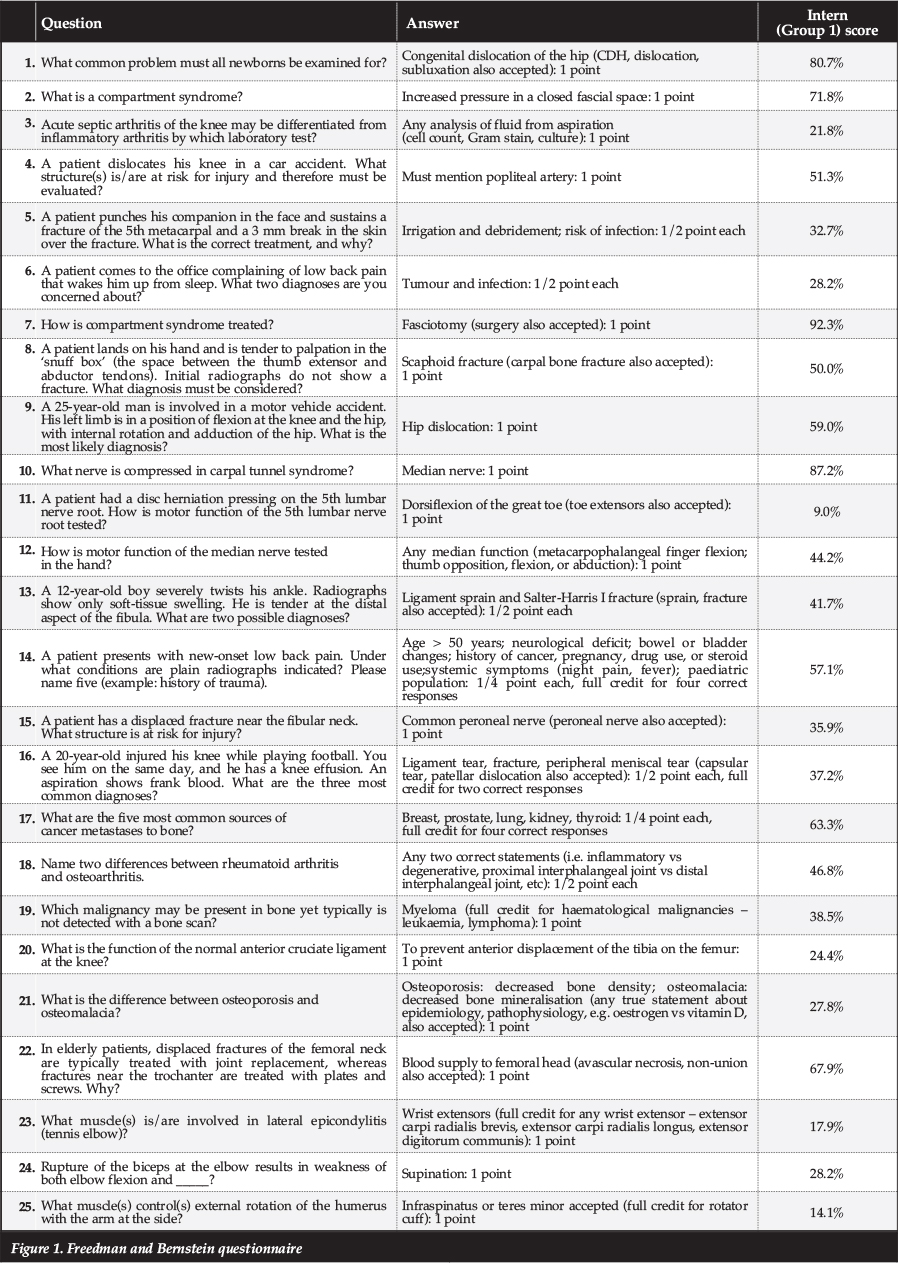
We wanted to quantify this problem in a South African context. A basic competency examination in musculoskeletal medicine was applied to a group of recently graduated doctors (Figure 1).18
Methods
We enrolled interns in their first postgraduate year in 2010 at Groote Schuur and Tygerberg Hospitals (Group 1) and asked them to complete the Freedman and Bernstein Musculoskeletal examination (Figure 1). The test was administered on the first day of each hospital's intern orientation programme. All 79 interns agreed to participate. The cohort included graduates from all eight South African medical schools.
The examination was developed to test medical school graduates' understanding of basic musculoskeletal problems. It was validated by chairs of residency programmes in orthopaedic surgery and internal medicine. The pass mark was set at 73.1% by the 124 chairs of orthopaedic residency programmes, and 70% by the 240 chairs of internal medicine residency programmes. The examination consists of 25 short-answer questions. The questions were also weighted according to importance from 0 to 10 by the orthopaedic chairs. Topics included fractures and dislocations, back pain, arthritis, basic anatomical knowledge, and emergencies that require immediate referral to an orthopaedic surgeon. The examination was scored anonymously according to the validated answer key. In our study, the overall unweighted score was calculated as described in the original paper and the recommended pass mark set at 73.1%. As an additional test of validity, the examination was administered to all registrars in orthopaedic surgery at the University of Cape Town.
To ascertain whether a two-month orthopaedic rotation during internship significantly improved performance in the musculoskeletal assessment, the examination was applied to a second study group (Group 2) consisting of all first and second year interns at Groote Schuur Hospital during 2011. A list of 76 interns was obtained from the intern curator, and the examination was administered via e-mail. The examination was sent out at three-weekly intervals over a four-month period. A final response rate of 69.7% was achieved (53/76). Data was analysed using Stata 11 to estimate percentages and their binomial exact 95 per cent confidence intervals. (Stata 11 was published in 2009 by StataCorp LP.)
Results
Overall unweighted score
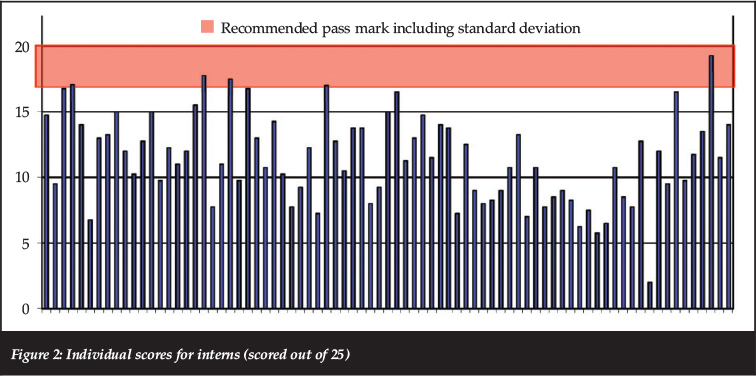
The mean score for the 17 orthopaedic registrars was 96.0%, and that for the 79 interns in their first postgraduate year was 45.3% (8.0-77.0%, 95% CI 42.3-48.4) (Figure 2). Only seven interns (9%) had a score of more than 73.1 ± 6.8% and thus demonstrated basic competency in the examination. The scores for the individual questions ranged from as high as 92.3% to as low as 9.0%.
Weighted score
To examine the hypothesis that the interns may have scored well on the most important questions and poorly on the least important questions, a weighted score was calculated. The overall weighted score for all interns was 47.0% (95% CI 43.9-50.1). Seventy-one (90%) of the 79 interns failed the examination when the questions were weighted according to their attributed importance.
Individual component scores
Anatomy-based questions (Q8, 10, 11, 12, 15, 20, 22, 23, 24, 25) were answered poorly, with an average score of 37.9% (95% CI 33.6-42.3), compared to the overall average score of 45.3%. 'Red flag' questions dealing with orthopaedic emergencies (Q2, 4, 5, 6, 7) were better answered, with an average score of 55.3% (95% CI 50.7-59.8).
Cohen method
A pass mark was calculated using the Cohen method (70% of the 95th percentile).19
In the follow-up study (Group 2) a response rate of 69.7% was achieved (53/76). Unweighted scores were calculated. The mean score for the group was 56.8%. Those who had completed an orthopaedic rotation during their internship (21/53) achieved an average score of 62.4% (35-83%), compared to 54.1% (20-80%) among those who had not yet completed an orthopaedic rotation (32/53). 85.7% (18/21, 95% CI 62.6-96.2) of those who had completed an orthopaedic rotation and 93.8% (30/32, 95% CI 77.8-98.9) of those who had not completed an orthopaedic rotation failed the assessment. The additional exposure to muscu-loskeletal medicine during an internship rotation did not show statistical benefit (95% CI 58.0-79.5).
While our study population was too small to allow any statistically significant sub-analysis, we were able to demonstrate two trends, with the interns who scored higher in the assessment coming from programmes with more time allocated to orthopaedic training and from programmes that included on-call duties for the students.
There are several limitations to this study. Freedman and Bernstein's musculoskeletal examination is the only validated assessment tool available. We used the pass mark of >73.1% established by 124 orthopaedic programme directors instead of that of >70% established by 240 internal medicine programme directors. Selecting the lower pass mark may have changed some of our findings. While the pass mark was validated by 124 programme directors, it is open to criticism. However, using the Cohen method, which uses the top performing students as a point of reference to set a pass mark that reflects the difficulty of the assessment, more than 70% of the interns still failed. Our study may have been limited by sample bias, with participants coming exclusively from two large tertiary hospitals in Cape Town. Our intern group did, however, include graduates from all eight South African medical schools. In the follow-up study the 69.7% response rate may have introduced selection bias. Administering the questionnaire by e-mail introduced two possible limitations. To guarantee anonymity the participants were asked to place their answers in a box at the intern curator's office. However due to logistical factors, most chose to reply via e-mail, thus effectively compromising their anonymity. Participants were asked to answer without the use of textbooks or other resources, but this could not be guaranteed. The second-year interns who responded may have benefited from writing the same test two years earlier. However, on analysing the results, there was no significant difference in the results of this group (57.9%) compared to the overall group average of 56.8%.
The interns who scored higher in the assessment came from programmes with more time allocated to orthopaedic training and from programmes that included on-call duties for the students
Discussion
Our study shows that the majority of newly qualified South African doctors do not have a basic level of competence in musculoskeletal medicine. This is alarming, not only because of the high prevalence of musculoskeletal conditions, but also because a large number of interns, Community Service Officers and Medical Officers in South Africa work in areas without specialist support. It is a major challenge to identify and quantify the specific factors which contribute towards the poor performance of our medical graduates. Factors such as curricular content, time allocation, teaching methods and teacher skills are all likely to contribute.
The majority of South African medical schools have recently restructured their undergraduate programmes, which have been accredited by the Undergraduate Education and Training Committee of the Health Professions Council of South Africa. Our findings suggest that these programmes are not effective in providing adequate undergraduate musculoskeletal training, or are not being applied as intended. We corresponded with our fellow medical schools and collected data relating to the nature of their undergraduate orthopaedic programmes. The national average is between four and six weeks of time allocated to training, which amounts to a approximately 2% of the curriculum. The majority of medical schools combine this time with training in other specialties, effectively reducing the exposure to musculoskeletal medicine even further. Half of our medical schools also do not have on-call duties for their medical students. Orthopaedic Surgery is taught in year 5 of the MBChB programme at the University of Cape Town. It has a Higher Education Qualifications Framework (HEQF) credit value of 7 out of a total of 197 (3.6%) for year 5. This credit value is a useful surrogate marker of perceived importance and time dedicated to a particular discipline. In comparison to Orthopaedic Surgery, Anaesthesia has a HEQF credit value of 19, Public Health/Health Promotion a credit value of 34, and Psychiatry, taught in years 4 and 6, a credit value of 42. Another concerning finding was that most programmes had contact with students only in the final two years of training. This contradicts the concept of early clinical contact, a key strategy of the South African Council on Higher Education for student academic development.20
Williams, from the University Hospitals of Leicester, showed a 6% improvement in performance by undergraduate students when the orthopaedic surgery component of their training was increased by just one week.2122
Most orthopaedic departments have well-established primary-care outreach programmes. Including students in these programmes may be an effective method of exposing them to the common musculoskeletal conditions they will encounter after graduating. The Parallel Rural Clinical Curriculum (PRCC) at Flinders University School of Medicine in South Australia rotates medical students through rural hospitals for a year (their pre-final year).23
We found that among South African medical schools, approximately 60% of group teaching of musculoskeletal medicine consisted of large-group lectures. Costa from Warwick University compared the use of didactic lectures with that of interactive discussion sessions in undergraduate teaching of orthopaedics.2425
Interestingly these findings are far from new. Abraham Flexner, regarded as the first medical educationalist, advised over a century ago that medical training should be 'marked by small classes, personal attention and hands-on teaching'. He believed lectures allowed medical schools to 'handle cheaply by wholesale a large body of students that would otherwise be unmanageable and thus give the lecturer time for research'.2627
The Bone and Joint Decade Undergraduate Curriculum Development Group published recommendations for a musculoskeletal undergraduate curriculum in 2004.28
The focus of their recommendations was on the skills required to diagnose a person with a musculoskeletal problem. As it is a basic skill, they recommend that the musculoskeletal examination be taught early in the curriculum along with the other organ systems. Their second recommendation was the competency to assess urgent problems of the musculoskeletal system. Emergencies may not be common, but it is essential to recognise them and to manage them appropriately. In our study, while the 'red flag' group of questions was answered better than the average (average score of 55.3% compared to the overall average score of 45.3%) this was not reassuring, as only half the candidates knew to look for a vascular injury in a patient with a dislocated knee, and only 13% knew the basic management of an open fracture. In addition, only 6% of the study group considered both tumour and infection in someone with lower back pain that woke them from sleep (Figure 1).
Competency in musculoskeletal medicine must therefore be a requirement before graduating, regardless of further specialisation
Bilderback et al. from Louisiana State University designed a six-week course in musculoskeletal medicine and used Freedman and Bernstein's examination to assess its efficacy.29
At the University of Cape Town, the orthopaedics department has started using the methods described at Louisiana State University to restructure their undergraduate training programme. Orthopaedics is currently taught in fifth year over a four-week block which is shared with both Anaesthetics and Trauma. Teaching the entire curriculum within these time constraints is challenging, and to increase exposure to important musculoskeletal emergencies, students are now rostered into on-call duties and weekend rounds with the attending registrar.
They have also started rotating through the paediatric orthopaedic department to gain exposure to this important aspect of musculoskeletal medicine, and are required to complete a detailed logbook of cases and procedures which they have witnessed or performed to ensure they are gaining appropriate exposure. Students who are interested have also been integrated into research projects currently being run within the department. Because of the limited teaching time available, self-directed learning has been prioritised by upgrading online resources. A series of standardised examination technique videos have been created and are loaded, together with other core topics, onto tablets which the students keep for the duration of the block. Students also meet once a week to provide feedback to the Head of Department, and teachers are now more accountable, as all consultants and registrars are scored by the students at the end of each four-week block. The Department of Orthopaedics is working together with the Department of Anatomy to establish a programme where musculoskeletal anatomy is taught together with the examination of the musculoskeletal system so that a clinical context is provided for their dissection. This strategy will also serve the purpose of establishing earlier clinical contact so that the examination of the musculoskeletal system can be learnt early, revised, and consolidated over years rather than it being an afterthought, taught near the end of the clinical programme. It has been negotiated that from 2014, the allocated four-week block will be shared only with Trauma, and no longer Anaesthetics.
Conclusion
Undergraduate training in musculoskeletal medicine is inadequate in South Africa, and internship programmes do not compensate for this lack. The delivery of musculoskeletal care is not the exclusive domain of the orthopaedic surgeon and is provided largely by other practitioners. Competency in musculoskeletal medicine must therefore be a requirement before graduating, regardless of further specialisation. Ultimately we as the orthopaedic teaching community are responsible for ensuring that we train competent and skilled doctors who will go out into our community and practice good, safe medicine.
No benefits of any form have been or are to be received from a commercial party related directly or indirectly to the subject of the article.
Acknowledgement
Statistical analysis by Mr H Carrara, Analytical Epidemiologist/Biostatistician, School of Public Health and Family Medicine, UCT.
References
- 1. Kahl LE. Musculoskeletal problems in the family practice setting: guidelines for curriculum design. Journal of Rheumatology 1987;14:811-14.
- 2. National National Board of Health and Welfare. Year Book of Health and Medical Care. 2001. Stockholm: Socialstyrelsen.
- 3. Reginster JY. 'The prevalence and burden of arthritis' in Rheumatology (Oxford) 2002;41:Suppl.1:3-6.
- 4. Govender S. Musculoskeletal trauma - are we winning? South African Orthopaedic Journal, 2011;3:8.
- 5. World Health Organization. World Health Report 2002: Statistical annex 3: Burden of disease in DALYs by cause, sex and mortality stratum in WHO regions, estimates for 2001.
- 6. Kobusingye O, Guwatudde D, Lett R. Injury patterns in rural and urban Uganda. Inj Prev. 2001;7:46-50.
- 7. Beveridge M, Howard A. The burden of orthopaedic disease in developing countries. Journal of Bone and Joint Surgery 2004;A6:1819-22.
- 8. SA MRC. Initial burden of disease estimates for South Africa, 2000.
- 9. Karpman RR. Musculoskeletal disease in the United States: who provides the care? Clin Orthop Relat Res. April 2001;385:52-56.
-
10. Health Professions Council of South Africa, http://www.statssa.gov.za.
» http://www.statssa.gov.za. - 11. Krug E. Injury: a leading cause of the global burden of disease. Geneva: World Health Organization. 1999. Document WHO/HSC/PVI/99.11.
- 12. Daar AS, Rizvi SA, Naqvi SA. Surgery with limited resources in Morris, P.J. & Wood, W.C. 2000. Oxford textbook of surgery (2nd ed.) New York: Oxford University Press, p. 3386.
- 13. Nunn TR, Cheung WY, Rollinson PD. A prospective study of pyogenic sepsis of the hip in childhood. J Bone Joint Surg Br. 2007;89-B(1):100-106.
- 14. Williams JR. The teaching of trauma and orthopaedic surgery to the undergraduate in the United Kingdom. Journal of Bone and Joint Surgery [Br] 2000;82:627-28.
- 15. Glazier RH, Dalby DM, Badley EM, Hawker GA, Bell MJ, Buchbinder R, et al. Management of common musculoskeletal problems: a survey of Ontario primary care physicians. Canadian Medical Association Journal 1998;158:1037-40.
- 16. Ahern MJ, Soden M, Schultz D, Clark M. The musculo-skeletal examination: a neglected clinical skill. Australian and New Zealand Journal of Medicine 1991;21:303-306.
- 17. Jandial S, Rapley T, Foster H. Current teaching of paediatric musculoskeletal medicine within UK medical schools - a need for change. Rheumatology 2009;48:587-90.
- 18. Freedman KB, Bernstein J. The adequacy of medical school education in musculoskeletal medicine. J Bone Joint Surg Am. 1998;80:1421-27.
- 19. Cohen-Schotanus J. A standard setting method with the best performing students as point of reference:practical and affordable. Med Teach 2010;32(2):154-60.
- 20. Council on Higher Education. Improving Teaching and Learning Resources. Pretoria: Council on Higher Education, 2004.
- 21. Williams SC. A new musculoskeletal curriculum: Has it made a difference? Journal of Bone and Joint Surgery [Br] 2010;92-B:7-11.
- 22. Kolasinski SL, Bass AR, Kane-Wanger GF, et al. Subspecialty choice: Why did you become a rheumatologist? Arthritis Rheum 2007;57:1546-51.
- 23. Couper ID. Evaluation of the parallel rural community curriculum at Flinders University of South Australia, in the context of the GEMP Year 3. Johannesburg: University of the Witwatersrand, 2006.
- 24. Costa ML. Does teaching style matter? A randomised trial of group discussion versus lectures in orthopaedic undergraduate teaching. Medical Education 2007;41(2):214-17.
- 25. Thompson AE. Improving undergraduate musculoskeletal education: a continuing challenge. J Rheumatol 2008;35:2298-99.
- 26. Wear D. Iconoclast: Abraham Flexner and a Life in Learning' in New England Journal of Medicine 2002;347:2008-2009.
- 27. Archer E. Improving undergraduate clinical supervision in a South African context. African Journal of Health Professions Education December 2011;3(2).
- 28. Woolf AD, Walsh NE, Akesson K. Global core recommendations for a musculoskeletal undergraduate curriculum. Ann Rheum Dis 2004;63:517-24.
- 29. Bilderback K. Design and implementation of a system-based course in musculoskeletal medicine for medical students. J Bone Joint Surg Am. 2008;90:2292-2300.
 Correspondence:
Dr Robert Dachs
H49 Old Main Building
Groote Schuur Hospital
Observatory
7925
Email: