Uncemented long-stemmed hip arthroplasty as a salvage procedure for failed internal fixation of intertrochanteric fractures in elderly patients
Abstract
BACKGROUND: Trochanter fractures after failed osteosynthesis in the elderly population with osteoporosis poses great difficulty to the orthopaedic surgeon. Hip arthroplasty is viewed favourably as an effective solution in these cases but is technically demanding due to difficulties in previous implant removal, poor proximal bone stock, stress risers from previous screw holes, infection, malunion, extensive fibrosis, and scar tissue. The aim of the study was to assess the early outcomes of uncemented long-stemmed bipolar hemiarthroplasty and total hip arthroplasty (THA), both clinically and radiologically, in treating failed osteosynthesis of unstable intertrochanteric (IT) fracture among elderly patients. METHODS: This prospective study included elderly patients with unstable IT fractures and failed internal fixation. Subsequently, they underwent uncemented long-stemmed hip arthroplasty. The patients were recruited over a two-year period in a tertiary care centre. Surgical choice between THA and bipolar hemiarthroplasty was based on acetabular involvement. Standard clinical care and surgical management were followed. Clinical and radiological data were collected at regular follow-up intervals up to 24 months. Functional outcomes were assessed using the Harris Hip Score (HHS) and Visual Analog Scale (VAS), and complications were recorded. Data was analysed using descriptive statistics. RESULTS: The study recruited 58 patients, with a mean age of 74.3 years. Patients with acetabular changes underwent THA (n = 22, 38%) and the remainder underwent bipolar hemiarthroplasty (n = 36, 62%). The complications included dislocation without periprosthetic fractures (n = 2, 3%); superficial infection (n = 2, 3%); bed sores (n = 2, 3%); deep vein thrombosis (DVT) (n = 2, 3%); and urinary tract infection (UTI) (n = 1, 2%), which were treated accordingly. All patients were ambulatory with significant pain relief, except four who had pseudoarthrosis of the greater trochanter (HHS 87.9 [57-89]). Radiographically, we did not observe any migration of the uncemented acetabular components, periacetabular osteolysis, or significant radiolucency around the femoral component at the end of follow-up. There was no mortality by completion of follow-up. CONCLUSION: Although technically demanding, hip arthroplasty can produce predictable outcomes in failed primary intertrochanter fractures in the elderly, with an early mobile pain-free hip joint. Level of evidence: 4
failed internal fixation; arthroplasty; elderly; uncemented
Introduction
Extracapsular proximal femoral fractures are increasingly prevalent as the population ages. These fractures are often treated with osteosynthesis such as dynamic hip screws (DHS), or intramedullary fixation devices like proximal femoral nails (PFN) with good to excellent results. With the existence of multiple comorbidities and the presence of osteoporosis and comminution, these intertrochanteric (IT) fractures pose challenges to treating surgeons. Complications, including implant failure, in these unstable trochanter fractures have been reported to be between 4% and 18%, with penetration of the device in 2-12%, nonunion in over 2-5%, and varus collapse in 5-11%.1-3 The failure rate of DHS was notably higher than that of PFN (PFN/DHS: 6.8-9.8% / 7.1-12.5%).3-6
Due to posteromedial comminution, many of these fractures remain unstable even after reduction. Restoring functional anatomy through osteosynthesis and preserving the natural hip joint poses significant challenges. However, a significant number of cases experience early failure of internal fixation devices.7-10 There are many reasons for these sometimes unpredictable complications.11 1213-15 There are various treatment modalities for these complications. For healthy young adult patients with good bone quality, re-osteosynthesis with internal fixation may be considered.16-20 Elderly patients frequently exhibit significant osteoporosis or osteopenia, resulting in inadequate purchase of the screw threads in the femoral head, which leads to screw cut-out and again implant failure.21 2223 22,24 There are various studies showing significant increase in the mean preoperative Harris Hip Score (HHS) after the intervention.25,26 Various studies have either used only standard femoral stem or very few long femoral stems in their study with different results. In the Indian context, there is limited research on converting failed internal fixation of trochanteric fractures to hip arthroplasty using a long femoral stem exclusively. In this background, the objective of our study was to assess the early outcomes of uncemented long stem bipolar hemiarthroplasty and total hip arthroplasty (THA), both clinically and radiologically, in managing failed osteosynthesis of unstable IT fractures in elderly patients. We also aimed to evaluate the technical challenges encountered during these procedures.
Methods
This was a prospective, observational study, conducted at a tertiary care orthopaedic centre in Eastern India between July 2017 and January 2020.
Patients who presented with trochanter fractures who were treated with either bipolar hemiarthroplasty or THA between July 2017 and January 2020 were eligible to take part in the study.
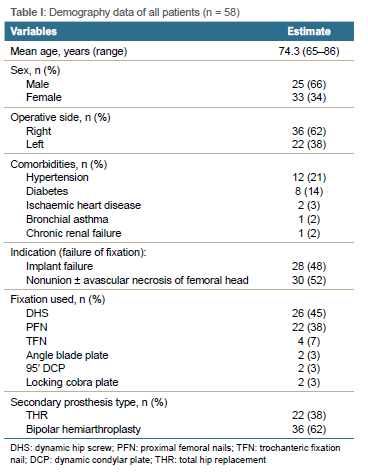
We recruited patients with failed surgeries of trochanteric hip fracture caused by low-energy trauma (AO/ASIF- peri-trochanteric type: 31- A1, A2 and IT type: 31- A3), which includes failed DHS, trochanteric fixation nail (TFN) or PFN, nonunion, improper fixation, implant breakage, peri-implant fracture, avascular necrosis of femoral head, and aseptic loosening. We excluded patients with fractures of neck femur, high-energy fracture, trochanteric fracture with diaphyseal fractures, pathological fractures, young patients, non-ambulatory pre-injury status and presence of infection, senile dementia, and severely moribund and ill patients (Table I). In the majority of cases (52/58), revision surgery was done within the first nine months after primary surgery with a range of 1-16 months. The minimum required sample size was calculated to detect a moderate effect size (Cohen's d = 0.6) in HHS improvement, with 80% power and a 5% significance level (two-sided). Using this assumption, and expecting an attrition of 15%, a minimum of 51 participants was required for the study.
Study procedure
After obtaining approval from the ethical committee, we obtained informed written consent from all the patients for the study. The treating team managed using a DHS (n = 26), PFN (n = 22), TFN (n = 4), angle blade plate (n = 2), 95° dynamic condylar plate (n = 2), and locking Cobra plate (n = 2). Following comprehensive preoperative clinical and medical assessments of their comorbidities, the investigators reviewed the intraoperative notes and preoperative X-rays. A complete blood checkup (CBC), C-reactive protein (CRP) and the erythrocyte sedimentation rate (ESR) was done to exclude any occult infection. The associated comorbidities were hypertension (n = 12), diabetes (n = 8), ischaemic heart disease (n = 2), bronchial asthma (n = 1), and chronic renal failure (n = 1). We performed all surgeries by positioning patients in lateral decubitus position.
Preoperative imaging
We obtained standard anteroposterior (AP) and lateral radiographs of the pelvis and affected hip for all patients to assess implant failure, fracture morphology, bone loss, and acetabular involvement. In cases where radiographs suggested implant loosening, nonunion or occult infection, we performed further imaging such as computed tomography (CT) or magnetic resonance imaging (MRI). CT scans were primarily used to evaluate cortical bone quality, screw hole stress risers, and acetabular defects when planning for THA. Bone scintigraphy or MRI was considered in select patients to rule out occult infection or avascular necrosis when clinical suspicion remained despite normal inflammatory markers.
Anaesthesia protocol
The surgical team performed all surgeries under either spinal or general anaesthesia based on patient comorbidities, clinical evaluation, and the anaesthesiologist's recommendation. In the majority of cases, they preferred spinal anaesthesia due to its favourable safety profile in elderly patients. The team used standard intraoperative monitoring, including ECG, pulse oximetry, and non-invasive blood pressure. They carefully regulated intraoperative fluid management to maintain haemodynamic stability and arranged blood products in advance, anticipating potential transfusion.
Surgical technique
We administered prophylactic antibiotics and applied either spinal or general anaesthesia. One surgeon performed all surgeries using the posterolateral approach. We considered previous surgical incisions wherever possible while planning the new incisions. We removed the implants after dislocating the femoral head; however, when there was implant cut-out, we removed them before dislocating the femoral head. We removed broken screws using a hollow mill and a broken screw removal set. In all cases, we performed bacteriological testing on multiple tissue specimens taken intraoperatively to rule out infection. After dividing the short external rotator muscles and performing a posterior capsulotomy, we extracted the femoral head with the attached neck and inspected the acetabulum for any damage and loose bone fragments. We prepared the femoral canal using a hand reamer. When we encountered nonunion of the greater trochanter, we mobilised it and debrided the margins using a high-speed burr. We used long-stemmed femoral prostheses in all cases, ensuring the distal tip extended about 2-3 cm beyond the last screw hole to bridge them. The stem we used was primarily a metaphyseal-diaphyseal press-fit design. We excised the acetabular labrum in cases where we performed THA. We performed THA in cases with acetabular changes. In 36 patients, we performed bipolar hemiarthroplasty, and 22 patients underwent total hip replacement (THR). We used either a 28 mm metal head or a 32 mm ceramic head. We then reconstructed the greater trochanter using cerclage wires following the tension band principle. We repaired the short external rotators with a transosseous technique, followed by wound closure with a suction drain placed after achieving haemostasis.
Description of the implants
We implanted uncemented, modular, long-stem femoral prostheses in all patients. The stems achieved metaphyseal and diaphyseal press-fit fixation. For THA, we used cementless acetabular cups with either polyethylene or ceramic liners, paired with 28 mm metal or 32 mm ceramic heads, based on intraoperative assessment. In bipolar hemiarthroplasty cases, we used modular bipolar heads with similar femoral stems. We ensured that the distal stem extended approximately 2-3 cm beyond the most distal screw hole or cortical defect to bypass stress risers.
Postoperative care
Postoperatively, we administered intravenous third-generation cephalosporin antibiotics to all patients and continued them until the fifth postoperative day. We provided identical prophylaxis for deep vein thrombosis (DVT) to all patients, consisting of low-molecular-weight heparin and elastic stockings. We maintained limb abduction using either a pillow or an abduction wedge. We checked haemoglobin levels and serum electrolytes on the day after surgery. We assessed perioperative blood loss using a standardised method, calculating total blood loss based on the reduction in haematocrit levels from the day before surgery to the fifth postoperative day, and accounting for all units of packed RBCs transfused during that period. We transfused blood wherever required. On postoperative day 2, we changed dressings, removed drains, and obtained X-rays. We initiated deep breathing exercises along with static quadriceps, calf, and gluteal muscle exercises on the first postoperative day. From the second day after surgery, we encouraged patients to sit upright and stand out of bed three times a day. At this time, we also initiated active and assisted hip range of motion exercises. We commenced gait training on the third postoperative day.
We first ambulated patients with a walker and gradually progressed them to ambulation with a stick and eventually without any support, depending on their recovery. To prevent dislocation, we placed a pillow or an abduction wedge between the thighs at night and used an abduction brace during the daytime in patients who had greater trochanter fixation. We removed stitches on the 12th to 14th postoperative day. We instructed all patients to avoid excessive bending, adduction of the affected limb, internal rotation of the operated leg, and crossing the operated thigh over the normal one.
Follow-up protocol
We followed up all patients both clinically and radiologically for up to two years. Independent observers recorded the HHS, Visual Analog Score (VAS), limb length measurements, and radiological findings. We used the Engh et al.2728
Statistical analysis
Descriptive analysis was performed to report the outcomes. For the categorical variables, frequencies and percentages were used, and for the continuous variables, mean and standard deviations (SD) were used.
Results
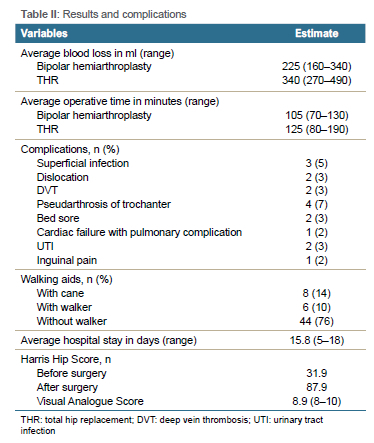
There were 33 females and 25 males with mean age of 74.3 years (range: 65-86 years). All 58 cases were monitored for an average of 24 months, with a range of 13-52 months. Three patients experienced postoperative fever for two days, which eventually resolved. All patients had normal total leucocyte count, differential count, ESR and CRP preoperatively but slightly raised ESR and CRP postoperatively which was insignificant. During intraoperative cultures, all cases were negative except for two instances where E. coli was identified in multiple samples and treated based on culture and sensitivity testing. There were no fatalities observed through the latest follow-up. Complications included two cases of bedsores, two cases of deep vein thrombosis, one case of cardiac failure with respiratory complications, two cases of urinary tract infection (UTI), and a single case of inguinal pain. Notably, there were no occurrences of deep infections, perioperative or postoperative femoral fractures, with two instances of dislocation. Three patients had superficial infection on the fourth postoperative day which healed after debridement and antibiotic as per culture and sensitivity. The average duration of surgery for bipolar hemiarthroplasty was 105 min (70-130) and 125 min (80-190) in THA. The average blood loss in bipolar hemiarthroplasty was 225 ml (160-340), while that for THR was 340 ml (270-490).
Two units of blood per patient were given on an average. The insertion of an acetabular component did not significantly prolong the procedure duration (105 min [range: 70-130] versus 125 min [range: 80-190]). The average hospital stay lasted 15.8 days (range: 5-18). Fifty out of 58 patients reported experiencing mild hip pain or no pain. Out of 30 patients who had trochanteric nonunion preoperatively, four patients had pseudoarthrosis postoperatively, coinciding with pain over the greater trochanter. These patients needed a walker or a stick for ambulation. There was greater trochanteric migration of not more than 12 mm on average postoperatively. Twenty-six patients achieved bony union and were able to walk unassisted or with the aid of a cane (n = 6). All patients were ambulatory with significant pain relief except for four who had pseudoarthrosis of greater trochanter. Forty-four patients were walking without any aid, eight patients with the aid of a cane, and six with the aid of a walker. No patient had pain while sitting and using the lavatory, except two with pseudoarthrosis. Radiographically, we observed neither any migration of the uncemented acetabular components nor periacetabular osteolysis at the end of last follow-up. There was no significant stem subsidence except in three cases where it was 5 mm which did not interfere with ambulation or rehabilitation.
There were four cases of femoral component radiolucencies which were non-progressive on subsequent follow-up and were not associated with any other features of loosening. Four patients had breakage of trochanteric cerclage wires. Heterotopic ossification was not observed in any of our patients. Five patients experienced a postoperative shortening of 1.2 cm (range: 1-1.5 cm). The HHS improved from a preoperative average of 31.9-87.9 (range: 57-89) postoperatively. Patients with greater trochanter nonunion had lower HHS (average: 58.7; range: 52-64). Overall, we achieved good-to-excellent functional outcomes in the majority of cases, with a final follow-up patient satisfaction score of 8.9 (range: 8-10) on the VAS (Table II).
Discussion
The incidence of hip fractures has risen among elderly patients due to advancements in medical care.297,8,10,18 In 0.5-2% of cases, nonunion or otherwise hardware failure following osteosynthesis in trochanteric fractures necessitate revision surgery.1218,20 However, in cases of failed osteosynthesis, revision hip replacement is widely accepted as a treatment option.14,21,25 The number of patients were small in our study with limited follow-up but our aim of the study is fulfilled because the majority of the complications after arthroplasty are encountered with in the first year after surgery. There are many reasons for failed primary surgery. It is difficult to evaluate the fracture pattern and the cause of failure in many cases. The treatment options for these cases that have a good outcome are limited. Performing arthroplasty after unsuccessful treatment of IT fractures presents several technical hurdles.14,17,20,23 In such scenarios, where there is inadequate proximal bone support for implant stability, the use of uncemented long-stemmed implants may be considered to achieve reliable fixation.14,23,26
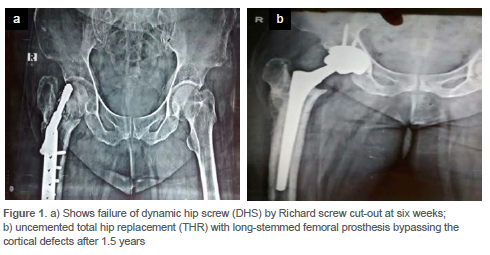
In our study, 36 patients were implanted with a modular bipolar prosthesis, while 22 patients who had erosion of acetabulum underwent THA (Figures 1 and 2). In all cases, long-stemmed uncemented femoral components were utilised to prevent femoral shaft fractures caused by stress risers from holes in previous implants and potential bone cement leakage from screw holes.
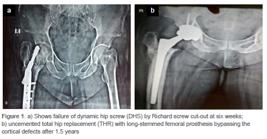
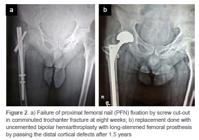
Periprosthetic fractures are one of the main reasons for implant failure in regular-sized stemmed implants.221,14,21,25 Performing arthroplasty after failed internal fixation presents significant challenges and complications compared to primary arthroplasty for arthritic hips. These include issues such as malunion of the femoral neck, trochanteric nonunion, alterations in bony landmarks, fragment displacement, broken implants, and screw holes. Additionally, the procedure often involves operating through the previous incision used for implant extraction.14,26 Careful attention is required to remove any retained failed hardware, such as broken plates, screws, or intramedullary devices, with minimal damage to surrounding tissues and bone. Preoperative osteoporosis and bone loss during implant removal increase the risk of fracture during reaming for canal preparation.14,23,26
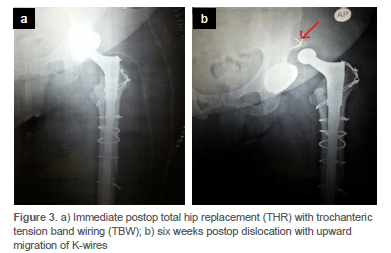
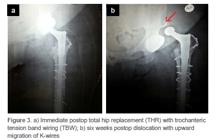
Neocortex formation in intramedullary nails in situ causes difficulties in canal preparation. In patients with extramedullary devices, the canal often becomes obstructed by extensive callus and fibrous tissue due to nonunion, necessitating careful opening. Specialised instrument sets, including hollow mills and high-speed burrs, are available to effectively remove sclerosis around previous screw holes.3014261926 2330 2321,25 We felt that trochanteric union is difficult to achieve in all the cases of nonunion, which is the probable cause of dislocation. However, an intact gluteus medius and vastus lateralis sleeve will not allow the trochanter to migrate and provides stability to fixation.14,20,23,26 Additional stability is obtained by making sure that the posterior capsule is well repaired. The reported dislocation rate ranges widely, from 0-44.5%.20 14,20 In our study, we used tension band wiring to reduce the trochanter in four patients from which two patients later presented with hip dislocation (Figure 3). In the rest of the cases, a sound union was found, which corroborated with other studies.320 16,20 (Table II).
Conclusion
Hip replacement is viewed as a very effective salvage option in trochanteric fractures with unsuccessful internal fixation. Though technically challenging, hip arthroplasty with uncemented long stemmed femoral component in cases with poor proximal bone stock and stress arising from previous screw holes gives predictable results with painless hip joint and good patient satisfaction.
Ethics statement
The authors declare that this submission is in accordance with the principles laid down by the Responsible Research Publication Position Statements as developed at the 2nd World Conference on Research Integrity in Singapore, 2010.
Prior to commencement of the study, the study was approved by IMS & SUM Hospital instructional ethical committee with approval ethical letter reference no. IMS SH/IEC/2017/1955.
All procedures were in accordance with the ethical standards of the responsible committee on human experimentation (institutional and national) and with the Helsinki Declaration of 1975, as revised in 2008. Informed written consent was obtained from all patients for being included in the study.
Declaration
The authors declare authorship of this article and that they have followed sound scientific research practice. This research is original and does not transgress plagiarism policies.
Author contributions
ASS: conceptualisation, patient recruitment, surgery, manuscript drafting
AS: data collection, follow-up assessments, manuscript review
DG: data analysis, literature review, manuscript review
AS: data collection, interpretation of results
KG: surgical management, manuscript review
DK: statistical analysis, manuscript editing
PBD: study conception, supervision, manuscript revision, corresponding author
ORCID
Satapathy AS https://orcid.org/0009-0006-0468-4229
Sharma A https://orcid.org/0009-0006-2629-2568
Goel D https://orcid.org/0009-0006-0270-322X
Senapati A https://orcid.org/0009-0004-5868-7906
Guglani K https://orcid.org/0009-0001-1822-2651
References
-
1. Hoffmann MF, Khoriaty JD, Sietsema DL, Jones CB. Outcome of intramedullary nailing treatment for intertrochanteric femoral fractures. J Orthop Surg Res. 2019 Nov 12;14(1):360. https://doi.org/10.1186/s13018-019-1431-3
» https://doi.org/10.1186/s13018-019-1431-3 -
2. Xu H, Liu Y, Sezgin EA, et al. Comparative effectiveness research on proximal femoral nail versus DHS in patients with trochanteric fractures: a systematic review and meta-analysis of randomized trials. J Orthop Surg Res 17, 292 (2022). https://doi.org/10.1186/s13018-022-03189-z
» https://doi.org/10.1186/s13018-022-03189-z -
3. van der Sijp MPL, de Groot M, Meylaerts SA, et al. High risks of failure observed for A1 trochanteric femoral fractures treated with a DHS compared to the PFNA in a prospective observational cohort study. Arch Orthop Trauma Surg. 2022;142:1459-67. https://doi.org/10.1007/s00402-021-03824-0
» https://doi.org/10.1007/s00402-021-03824-0 -
4. Zhang K, Zhang S, Yang J, et al. Proximal femoral nail vs. dynamic hip screw in treatment of intertrochanteric fractures: a meta-analysis. Med Sci Monit. 2014 Sep 12;20:1628-33. https://doi.org/10.12659/MSM.890962
» https://doi.org/10.12659/MSM.890962 -
5. Klinger HM, Baums MH, Eckert M, Neugebauer R. [A comparative study of unstable per- and intertrochanteric femoral fractures treated with dynamic hip screw (DHS) and trochanteric butt-press plate vs. proximal femoral nail (PFN)]. Zentralbl Chir. 2005 Aug;130(4):301-306. (German). https://doi.org/10.1055/s-2005-836784
» https://doi.org/10.1055/s-2005-836784 -
6. Xu H, Liu Y, Sezgin EA, et al. Comparative effectiveness research on proximal femoral nail versus dynamic hip screw in patients with trochanteric fractures: a systematic review and meta-analysis of randomized trials. J Orthop Surg Res. 2022 Jun 3;17(1):292. https://doi.org/10.1186/s13018-022-03189-z
» https://doi.org/10.1186/s13018-022-03189-z -
7. Tarrant SM, Graan D, Tarrant DJ, et al. Medial calcar comminution and intramedullary nail failure in unstable geriatric trochanteric hip fractures. Medicina (Kaunas). 2021 Apr 1;57(4):338. https://doi.org/10.3390/medicina57040338
» https://doi.org/10.3390/medicina57040338 -
8. Khalil MHAI, Elkalyoby AS. Management of unstable intertrochanteric fractures using proximal femur nail versus proximal femur locking compression plate. Egypt Orthop J. 2019;54(4):335-42. https://doi.org/10.4103/1110-1148.319031
» https://doi.org/10.4103/1110-1148.319031 -
9. Pal AK. Management of unstable trochanteric fracture in elderly. Int J Orthop Surg. 2022;30(2):35-38. https://doi.org/10.4103/ijors.ijors_18_22
» https://doi.org/10.4103/ijors.ijors_18_22 -
10. Saha P, Ayan S, Bandyopadhyay U, et al. Anatomical reconstruction of unstable trochanteric fractures through posterior approach. J Orthop Allied Sci. 2015;3(2):55-58. https://doi.org/10.4103/2319-2585.158516
» https://doi.org/10.4103/2319-2585.158516 -
11. Pires RES, Santana Júnior EO, Santos LEN, et al. Failure of fixation of trochanteric femur fractures: Clinical recommendations for avoiding Z-effect and reverse Z-effect type complications. Patient Saf Surg. 2011;5:17. https://doi.org/10.1186/1754-9493-5-17
» https://doi.org/10.1186/1754-9493-5-17 -
12. Özmen E, Yağci TF, Yildirim AM, et al. Risk factors for early implant failure in geriatric intertrochanteric fractures treated with twin interlocking derotation and compression screw cephalomedullary nail (InterTAN). Acta Chir Orthop Traumatol Cech. 2024;91(5):289-95. English. https://doi.org/10.55095/ACHOT2024/054
» https://doi.org/10.55095/ACHOT2024/054 -
13. Campos HLM, Liebano RE, Lima CA, Perracini MR. Multidimensional investigation of chronic pain experience and physical functioning following hip fracture surgery: clinical implications. Br J Pain. 2020 Feb;14(1):5-13. https://doi.org/10.1177/2049463719861994
» https://doi.org/10.1177/2049463719861994 -
14. Moon NH, Shin WC, Kim JS, et al. Cementless total hip arthroplasty following failed internal fixation for femoral neck and intertrochanteric fractures: A comparative study with 3-13 years follow-up of 96 consecutive patients. Injury. 2019 Mar;50(3):713-19. https://doi.org/10.1016/j.injury.2019.01.018
» https://doi.org/10.1016/j.injury.2019.01.018 -
15. Chen J, Wang X, Qian H, et al. Correlation between common postoperative complications of prolonged bed rest and quality of life in hospitalized elderly hip fracture patients. Ann Palliat Med. 2020 May;9(3):1125-33. https://doi.org/10.21037/apm-20-891
» https://doi.org/10.21037/apm-20-891 -
16. Kalia A, Singh J, Garg S, Singh R. Proximal femoral nonunion with implant failure needs to be managed judiciously and it also discerns the proficiency and skillfulness of operative hands. J Orthop Case Rep. 2020;10(9):80-84. https://doi.org/10.13107/jocr.2020.v10.i09.1912
» https://doi.org/10.13107/jocr.2020.v10.i09.1912 -
17. Zhou X, Du G, Jia J, Xuan Y. Effect of different internal fixation devices on intertrochanteric fractures. Am J Transl Res. 2024 Nov 15;16(11):6779-87. https://doi.org/10.62347/HQJJ4932
» https://doi.org/10.62347/HQJJ4932 -
18. Mittal R, Banerjee S. Proximal femoral fractures: principles of management and review of literature. J Clin Orthop Trauma. 2012 Jun;3(1):15-23. https://doi.org/10.1016/j.jcot.2012.04.001
» https://doi.org/10.1016/j.jcot.2012.04.001 -
19. Kalia A, Singh J, Garg S, Singh R. proximal femoral non-unions with implant in situ treated by revision osteosynthesis: a real challenge. J Orthop Case Rep. 2020 Dec;10(9):80-84. https://doi.org/10.13107/jocr.2020.v10.i09.1912
» https://doi.org/10.13107/jocr.2020.v10.i09.1912 -
20. Shi T, Fang X, Huang C, et al. Conversion hip arthroplasty using standard and long stems after failed internal fixation of intertrochanteric fractures. Orthop Surg. 2022 Nov;14(11):2245-53. https://doi.org/10.1111/os.13574
» https://doi.org/10.1111/os.13574 -
21. Rai AK, Goel R, Bhatia C, et al. Cement augmentation of dynamic hip screw to prevent screw cut out in osteoporotic patients with intertrochanteric fractures: a case series. Hip Pelvis. 2018 Dec;30(4):269-75. https://doi.org/10.5371/hp.2018.30.4.269
» https://doi.org/10.5371/hp.2018.30.4.269 -
22. Thakur RR, Deshmukh AJ, Goyal A, et al. Management of failed trochanteric fracture fixation with cementless modular hip arthroplasty using a distally fixing stem. J Arthroplasty. 2011 Apr;26(3):398-403. https://doi.org/10.10164.arth.2010.01.103
» https://doi.org/10.10164.arth.2010.01.103 -
23. Weiss RJ, Kärrholm J, Hailer NP, et al. Salvage of failed trochanteric and subtrochanteric fractures using a distally fixed, modular, uncemented hip revision stem. Acta Orthop. 2012;83(5):488-92. https://doi.org/10.3109/17453674.2012.733917
» https://doi.org/10.3109/17453674.2012.733917 -
24. Shimasaki K, Nishino T, Yoshizawa T, et al. Stress analysis in conversion total hip arthroplasty: a finite element analysis on stem length and distal screw hole. J Clin Med. 2024 Dec 28;14(1):106. https://doi.org/10.3390/jcm14010106
» https://doi.org/10.3390/jcm14010106 -
25. Shi X, Zhou Z, Yang J, et al. Total hip arthroplasty using non-modular cementless long-stem distal fixation for salvage of failed internal fixation of intertrochanteric fracture. J Arthroplasty. 2015 Nov;30(11):1999-2003. https://doi.org/10.10164.arth.2015.05.041
» https://doi.org/10.10164.arth.2015.05.041 - 26. Pãunescu F, Didilescu A, Antonescu DM. Factors that may influence the functional outcome after primary total hip arthroplasty. Clujul Med. 2013;86(2):121-
- 27. Engh CA, Massin P, Suthers KE. Roentgenographic assessment of the biologic fixation of porous-surfaced femoral components. Clin Orthop Relat Res. 1990 Aug;(257):107-28. Erratum in: Clin Orthop. 1992 Nov;(284):310-12. PMID: 2199114
- 28. Hodgkinson JP, Shelley P, Wroblewski BM. The correlation between the roentgenographic appearance and operative findings at the bone-cement junction of the socket in Charnley low friction arthroplasties. Clin Orthop Relat Res. 1988 Mar;(228):105-109. PMID: 3342551
-
29. Dong Y, Zhang Y, Song K, et al. What was the epidemiology and global burden of disease of hip fractures from 1990 to 2019? Results from and additional analysis of the global burden of disease study 2019. Clin Orthop Relat Res. 2023 Jun 1;481(6):1209-20. https://doi.org/10.1097/CORR.0000000000002465
» https://doi.org/10.1097/CORR.0000000000002465 -
30. Luthringer TA, Elbuluk AM, Behery OA, et al. Salvage of failed internal fixation of intertrochanteric hip fractures: clinical and functional outcomes of total hip arthroplasty versus hemiarthroplasty. Arthroplast Today. 2018 Jul 10;4(3):383-91. https://doi.org/10.1016/j.artd.2018.06.002
» https://doi.org/10.1016/j.artd.2018.06.002
Accepted: November 2025
Published: August 2026
Editor: Dr Jurek Pietzrak, University of the Witwatersrand, Johannesburg, South Africa
Funding: No funding was received for this study.
Conflict of interest: The authors declare they have no conflicts of interest that are directly or indirectly related to the research.