The prevalence of second victim experiences and baseline resilience of South African shoulder and elbow surgeons
Abstract
BACKGROUND: The second victim experience (SVE), defined as the emotional and psychological distress experienced by healthcare workers (HCWs) following adverse medical events, can result in either an individual's growth or in increased staff turnover. Higher levels of resilience, the healthy ability to adapt to stress, has been shown to decrease the SVE. This study aimed to explore the SVE among the members of the Society of South African Shoulder and Elbow Surgeons (SASES), delineate its prevalence, and determine its relationship to resilience. METHODS: This cross-sectional study comprised a retrospective review of a needs assessment survey, conducted in paper-based and online versions, over a six-week period around the SASES annual meeting in May 2023. The survey captured demographic details of members, measured by utilising the Second Victim Experience and Support Tool (SVEST), and the baseline resilience was measured using the 25-item Connor-Davidson Resilience Scale (CD-RISC 25 ©). The prevalence of the SVE and mean resilience were evaluated. Statistical analysis was conducted to test for association between SVEST and CD-RISC 25 © scores. RESULTS: There were 53 respondents of a total 77 SASES members, accounting for a response rate of 69%. All respondents were male (100%) with a median age of 54 years. Most respondents reported working in the private sector (77%) and had been in practice for a median of 18 years. The predominant negative effects of the SVE in respondents were psychological (59%) and physical distress (40%). The mean score for resilience was 75. Increased resilience scores were associated with a reduction in the negative effects of SVEs. CONCLUSION: This study identified that nearly 60% of SASES members who undertook the survey suffered negative psychological effects, while 40% suffered negative physical effects, following an SVE as measured by the SVEST. Their mean baseline level of resilience (75 as measured by CD-RISC 25 ©) is in keeping with South African population norms. Future research should investigate other potential contributing factors to the high SVEST scores of orthopaedic surgeons, as targets for support initiatives to limit the experience. Level of evidence: 4
second victim experience; second victim syndrome; resilience; orthopaedics; South Africa
Introduction
'To err is human', except if you are a healthcare worker (HCW) it would seem. Wu, in his benchmark editorial of 2000 in the British Medical Journal, highlighted that doctors, as a result of societal expectations and personal outlook, presume perfection of themselves with respect to patient management.11111
A second victim is currently defined as: 'Any healthcare worker, directly or indirectly involved in an unanticipated adverse patient event, unintentional healthcare error, or patient injury, and who becomes victimised in the sense that they are also negatively impacted'.2341,4
A systematic review in 2020 outlined common symptoms experienced by second victims including: 'anger toward themselves', 'remorse', 'fear of future errors', and 'sleeping difficulties'.56 7
Resilience, or 'the ability of an individual to respond to stress in a healthy, adaptive way such that personal goals are achieved at minimal psychological and physical cost', is often ascribed to South African citizens, and may contribute to a 'thrive' response in second victims.8910
A review of the literature showed that there is limited knowledge regarding the prevalence of SVEs using a validated SVE scale in surgeons (including orthopaedic surgeons), or evaluations of the relationship between SVEs and resilience. In recent years, the Society of South African Shoulder and Elbow Surgeons (SASES) has noted that several society members have reached out in distress to society leadership for support following an adverse medical event. This prompted a needs assessment, upon which this investigation was based. The aim of the investigation was to quantify the prevalence of SVEs among SASES members, determine how resilient these members are, and to assess if there was a relationship between the two. This information would be invaluable to establish whether support initiatives are in fact required and how to structure these appropriately.
Methods
This cross-sectional study comprised a retrospective review of the anonymous needs assessment survey (online and paper-based) conducted by SASES of its members in May and June 2023. The review was conducted according to the Strengthening the Reporting of Observational Studies in Epidemiology (STROBE) guidelines.11
The survey asked respondents to provide basic demographic details including their age, gender, practice location (private, state or both), and number of years in practice. The SVE was measured using the first component of the Second Victim Experience and Support Tool (SVEST), previously developed and validated by Burlison et al.12121212 13 1313131314
The paper-based survey responses were manually captured on the REDCap® online survey form. These were collated with the online responses, and the data exported to a Microsoft® Excel for Mac (version 16.71) spreadsheet for organisation and the generation of summary statistics. R studio statistical software (version 4+) was utilised for the statistical analysis.
Special considerations were applied to missing data, where a respondent had not answered all questions. Where data were missing for the SVEST questions (a score based on averages which can sufficiently handle missing values without imputation), mean scores were calculated using the remaining values. Given that the baseline resilience score is cumulative, it was important to use imputed values to account for missing data. R studio package 'Multivariate imputation by chained equations' (MICE) was utilised for this purpose. Where answers were missing from the CD-RISC 25 © (question number 20 was omitted from the paper-based survey accounting for 36 individuals' missing responses), the missing values were imputed Ave times (m = 5), with a maximum of 20 iterations. Trace plots were used to assess convergence; convergence occurred between 10 and 15 iterations. The original CD-RISC 25 © results are reported, represented in tables and discussed, and the Ave imputed datasets utilised in a linear regression for each dataset, the results of which are presented as a pooled regression estimate to present the relationship to SVEST scores.
The primary analysis involved descriptive summary statistics of demographic data, determination of the prevalence of negative effects of SVEs among respondents, and the baseline level of resilience. Continuous variables are reported as means (standard deviation [SD], range) or medians (with interquartile range [IQR], range) according to their distributions, and categorical variables as numbers and percentages. Linear regression was performed to test the relationship between SVEST and CD-RISC 25 © scores (with imputed data) with demographic variables as covariates. As a form of sensitivity analysis, a repeat linear regression was performed using only the 16 complete cases (with no missing baseline resilience data) to compare to the results obtained with imputed values. Linear regression results are presented as changes in the outcome variable with 95% confidence intervals (95% CI). All tests were two-sided and the level of significance was set at p < 0.05.
Results
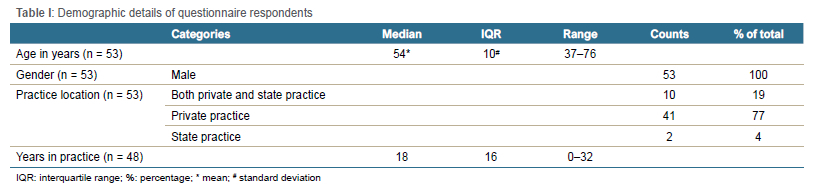
There were 53 respondents of a total 77 SASES members (74 men and three women at the time of running the survey in 2023), accounting for a response rate of 69%. Table I summarises the respondents' demographic details. All respondents were male (100%), with a mean age of 54 years (SD 10, range 37-76). The majority of respondents reported working in the private sector (41 of 53, 77%); only two surgeons worked exclusively in state practice (2 of 53, 4%). Surgeons working exclusively in private practice were on average older (mean 56 years, SD 9, range 38-76) than those in state practice (mean 41 years, SD 5, 37-44). Respondents had been in practice for a median of 18 years (IQR 16, range 0-32).
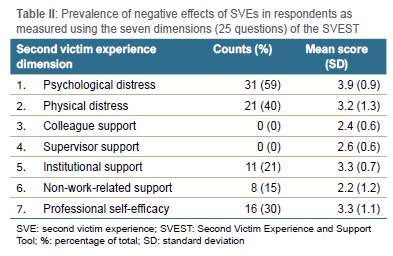
One surgeon had an SVEST score that averaged more than four in all seven dimensions, and a further 12 respondents (12 of 53, 23%) had overall SVE scores which averaged 3.5 or greater. Regarding the individual dimensions, 31 respondents (31 of 53, 59%) scored 4.0 or more for negative psychological effects of SVEs; 21 (21 of 53, 40%) for negative physical effects of SVEs; and 16 (30%) for negative responses regarding professional self-efficacy. Table II outlines the mean scores and the prevalence of negative effects of SVEs for respondents as well as the degree to which support resources are perceived as inadequate. While respondents' mean score for 'non-work-related' support was the lowest of all forms of support measured with the SVEST (suggesting that on average the support of family and friends are the most desirable to respondents during SVEs), this support type showed the greatest variation in response between individuals (SD 1.2). No respondents scored a mean of 4 or greater for colleague or supervisor support (where 15% did for non-work-related support), and thus these support resources seem to be favoured for the majority of respondents.
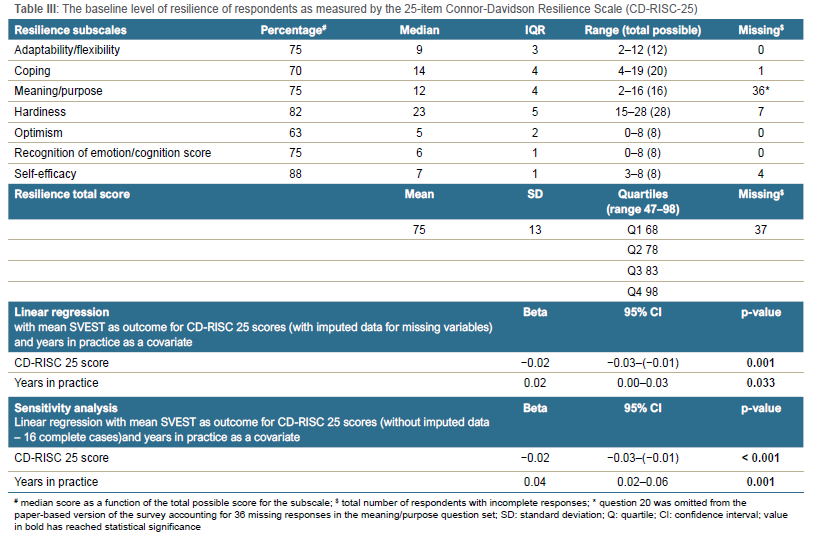
The mean score for resilience, as measured by the CD-RISC 25 ©, was 75 (SD 13, range 47-98). Respondents scored highest in the 'hardiness' and 'self-efficacy' subscales (Table III). Resilience scores were found to be inversely related to SVEST scores; that is, with greater resilience scores, respondents had lower SVE score means. One unit increase in the CD-RISC 25 © score reduced the mean SVEST score by 0.02, and reached statistical significance (95% CI -0.02 - (-0.01); p-value 0.001). The direction of association remained true with the repeated linear regression using the 16 complete cases, where a one-unit increase in the total resilience score was associated with a 0.02 unit decrease in the SVEST mean score (95% CI -0.03 - (-0.01); p-value < 0.001). One covariate, number of years in practice, was also related to the mean SVEST score. For each year increase in number of years practiced, the SVEST scores increased by 0.02, a result which was statistically significant (95% CI 0.00 - 0.03; p-value 0.033), and remained true in the dataset without imputed variables. Data regarding practice location (state, private or both) were inadequately powered to detect a relationship between SVEST scores and practice location.
Discussion
This study aimed to investigate the prevalence of SVEs among SASES society members and its relationship to their baseline level of resilience. One respondent's average SVEST score suggested negative effects in all dimensions. Fifty-nine per cent (mean score of 3.9) of SASES respondents suffered negative psychological effects, and 40% (mean score 3.2) negative physical effects. These mean scores are greater than the scores obtained in Burlison et al.'s validation study of the SVEST (2.6 and 2.3) for psychological and physical distress respectively, and several other investigations that measured SVEST scores of mixed HCW groups.12,15,16 The authors of the present investigation share Han et al.'s sentiment that adverse events causing significant distress are more prevalent than anticipated, particularly in light of comparative SVEST score data and the results of an SVEST investigation performed locally.17 18181817,19,20 It is theorised that the 'high stakes' nature of surgery and the immediately apparent negative consequences of a surgical error place surgeons (likely inclusive of orthopaedic surgeons) at higher risk than other disciplines.17,20 Additionally, surgeons' experiences may be complicated by a pervasive blame culture in some institutions.2021
The negative psychological experiences following SVEs can include guilt, remorse, anxiety, troubling memories, a decrease in job satisfaction, embarrassment and fear of harm to reputation.5,22 Interestingly, two previous studies show that these psychological experiences do not change (get easier) with greater surgical experience (seniority).232425
The concern with greater SVEST scores was highlighted by Burlison et al. who showed that higher scores are associated with absenteeism and increased turnover (quitting or changing job) intentions.26261817,18,23,24 Presumably, a surgical colleague is more likely to understand the situation and its implications, and may have experienced an adverse event of their own. Where family and friends will be sympathetic and readily available (accounting for some desirability), the sympathy may not be valued without comprehension of the gravity to the victim (accounting for the variability in response).18272727 17,20,22,23,28 The surgeon respondents in the present investigation's mean scores for institutional support were 3.3 (a high score that reflects a perceived lack of desire for institutional support). The majority of respondents in the present study are self-employed and may perceive that they have no institutional (in the typical sense, like that of an academic hospital or a university affiliation) support, as opposed to not desiring the support. Respondents may not perceive SASES to be an institution. However, through its parent South African Orthopaedic Association, SASES has an established peer-mentoring programme for its members (to assist with the many challenges faced in practice), and advocates for its members undergoing investigation or litigious processes. Alternatively, though, rather than a lack of perceived support, the high score may mean that surgeons And it difficult to report events to supervisors and organisations, recognising the inherent conflict of interest that reporting an adverse medical event and seeking help may represent. Once disclosed, the supervisor or organisation is compelled to investigate the adverse event, and individuals may fear medico-legal ramifications or that it may reveal weaknesses.17,22,29 Despite these concerns, several institutions have developed programmes to address SVEs in individuals, such as the Resilience In Stressful Events (RISE) programme instituted at the Johns Hopkins Hospital.30
It is for this inherent conflict of interest, the implementation of a resilience (albeit institutional resilience) programme for second victim support, and the previously discussed findings that individuals with greater resilience experience the negative effects of SVEs to a lesser degree, that exploration of resilience alongside the SVEST was prompted. Unlike the limited local investigations utilising the SVEST, extensive investigation has been performed examining resilience (using the CD-RISC 25 ©) in South Africa.10,31,32 Marx et al. provided a mean baseline resilience of a healthy South African cohort at 80.7.1032 33 99343535
Due to its retrospective nature, this investigation was limited. It relied on the findings of a needs assessment survey conducted by the SASES executive committee of its members. Additional data of interest such as the turnover intentions and absenteeism were not included in the survey. Regarding collected variables, there were no female respondents. This partly reflects the small proportion of women SASES members, but also represents a gender bias, limiting the interpretation of the role gender may have had in the results. Also collected and likely of interest to many, the practice location (state, private or both), was inadequately powered to determine if this had an effect on SVEST scores. While online survey responses were complete for most respondents, the lack of complete responses (due to the missing question in the print version) necessitated imputation of variables in order to produce accurate scores for the linear regression model of the association between SVEST and CD-RISC 25 © scores.
Conclusion
This study identified that nearly 60% of the Society of South African Shoulder and Elbow Surgeon's survey respondents have negative psychological effects, and 40% have negative physical effects, following an SVE. Their baseline level of resilience of 75 is in keeping with South African population norms.
Ethics statement
The authors declare that this submission is in accordance with the principles laid down by the Responsible Research Publication Position Statements as developed at the 2nd World Conference on Research Integrity in Singapore, 2010. The study complied with the South African Department of Health ethics guidelines (2015), and the University of KwaZulu-Natal policy on research ethics.
Prior to commencement of this research the appropriate ethical approval was obtained from the Biomedical Research Ethics Committee of UKZN (BREC/00007123/2024). All procedures were in accordance with the ethical standards of the responsible committee on human experimentation (institutional and national) and with the Helsinki Declaration of 1975, as revised in 2008. Informed written consent was obtained from all participants included in the study.
Declaration
The authors declare authorship of this article and that they have followed sound scientific research practice. This research is original and does not transgress plagiarism policies.
Author contributions
MoC: conceptualisation, data curation, writing - original draft, writing - review and editing
CA: writing - review and editing
SR: writing - review and editing
CvdB: writing - review and editing
MM: writing - review and editing
PT: formal analysis, writing - review and editing
LR: conceptualisation, data curation, writing - review and editing
ORCID
O'Connor M https://orcid.org/0000-0001-8864-4916
Anley C https://orcid.org/0000-0002-5983-3520
Roche S https://orcid.org/0000-0002-5695-2751
van den Berg C https://orcid.org/0009-0007-9159-1940
Mulder M https://orcld.org/0009-0003-9286-4614
References
-
1. Wu AW. Medical error: the second victim. The doctor who makes the mistake needs help too. Bmj. 2000;320:726-27. https://doi.org/10.1136/bmj.320.7237.726
» https://doi.org/10.1136/bmj.320.7237.726 -
2. Vanhaecht K, Seys D, Russotto S, et al. An evidence and consensus-based definition of second victim: a strategic topic in healthcare quality, patient safety, person-centeredness and human resource management. Int J Environ Res Public Health. 2022;19(24): 16869. https://doi.org/10.3390/ijerph192416869
» https://doi.org/10.3390/ijerph192416869 -
3. Brennan TA, Leape LL, Laird NM, et al. Incidence of adverse events and negligence in hospitalized patients. New Engl J Med. 1991;324:370-76. https://doi.org/10.1056/nejm199102073240604
» https://doi.org/10.1056/nejm199102073240604 -
4. Sachs CJ, Wheaton N. Second victim syndrome. [Updated 2023 Jun 20]. In: StatPearls [Internet]. Treasure Island (FL): StatPearls Publishing; 2025 Jan-. https://www.ncbi.nlm.nih.gov/books/NBK572094/
» https://www.ncbi.nlm.nih.gov/books/NBK572094/ -
5. Busch IM, Moretti F, Purgato M, et al. Psychological and psychosomatic symptoms of second victims of adverse events: a systematic review and meta-analysis. J Patient Saf. 2020;16:e61-e74. https://doi.org/10.1097/pts.0000000000000589
» https://doi.org/10.1097/pts.0000000000000589 -
6. Seys D, Wu AW, Gerven EV, et al. Health care professionals as second victims after adverse events: a systematic review. Eval Health Prof. 2013;36:135-62. https://doi.org/10.1177/0163278712458918
» https://doi.org/10.1177/0163278712458918 -
7. Scott SD, Hirschinger LE, Cox KR, et al. The natural history of recovery for the healthcare provider 'second victim' after adverse patient events. Qual Saf Health Care. 2009;18:325-30. https://doi.org/10.1136/qshc.2009.032870
» https://doi.org/10.1136/qshc.2009.032870 -
8. Epstein RM, Krasner MS. Physician resilience: what it means, why it matters, and how to promote it. Acad Med. 2013;88:301-303. https://doi.org/10.1097/ACM.0b013e318280cff0
» https://doi.org/10.1097/ACM.0b013e318280cff0 -
9. Hernandez C. The role of resilience on second-victim outcomes: examining individual and external factors of medical professionals. Thesis. University of Central Florida, Orlando, Florida, 2019. https://core.ac.uk/reader/236315318
» https://core.ac.uk/reader/236315318 -
10. Marx M, Young SY, Harvey J, et al. An examination of differences in psychological resilience between social anxiety disorder and posttraumatic stress disorder in the context of early childhood trauma. Front Psychol. 2017;8:2058. 20171211. https://dol.org/10.3389/fpsyg.2017.02058
» https://dol.org/10.3389/fpsyg.2017.02058 -
11. Von Elm E, Altman DG, Egger M, et al. The Strengthening the Reporting of Observational Studies in Epidemiology (STROBE) statement: guidelines for reporting observational studies. J Clin Epidemiol.2008;61:344-49. https://doi.org/10.10164.jclinepi.2007.11.008
» https://doi.org/10.10164.jclinepi.2007.11.008 -
12. Burlison JD, Scott SD, Browne EK, et al. The second victim experience and support tool: validation of an organizational resource for assessing second victim effects and the quality of support resources. J Patient Saf. 2017;13:93-102. https://doi.org/10.1097/pts.0000000000000129
» https://doi.org/10.1097/pts.0000000000000129 -
13. Connor KM, Davidson JR. Development of a new resilience scale: the Connor-Davidson Resilience Scale (CD-RISC). Depress Anxiety. 2003;18:76-82. https://doi.org/10.1002/da.10113
» https://doi.org/10.1002/da.10113 - 14. Jorgensen IE, Seedat S. Factor structure of the Connor-Davidson resilience scale in South African adolescents. Int J Adolesc Med Health. 2008;20:23-32.
- 15. Pelikan M, Finney RE, Jacob A. Use of the Second Victim Experience and Support Tool (SVEST) to assess the impact of a departmental peer support program on anesthesia professionals' second victim experiences (SVEs) and perceptions of support two years after implementation. Aana J. 2023;91:371-79.
-
16. Winning AM, Merandi J, Rausch JR, et al. Validation of the second victim experience and support tool-revised in the neonatal intensive care unit. J Patient Saf. 2021;17:531-40. https://doi.org/10.1097/pts.0000000000000659
» https://doi.org/10.1097/pts.0000000000000659 -
17. Han K, Bohnen JD, Peponis T, et al. The surgeon as the second victim? Results of the Boston Intraoperative Adverse Events Surgeons' Attitude (BISA) study. J Am Coll Surg. 2017;224:1048-56. https://doi.org/10.1016/j.jamcollsurg.2016.12.039
» https://doi.org/10.1016/j.jamcollsurg.2016.12.039 -
18. Mathebula LC, Filmalter CJ, Jordaan J, et al. Second victim experiences of healthcare providers after adverse events: A cross-sectional study. Health SA Gesondheid. 2022(27):a1858. https://doi.org/10.4102/hsag.v27i0.1858
» https://doi.org/10.4102/hsag.v27i0.1858 -
19. Jain G, Sharma D, Agarwal P, et al. 'Second victim' syndrome among the surgeons from South Asia. Indian J Surg. 2022;84:40-46. https://doi.org/10.1007/s12262-021-02793-3
» https://doi.org/10.1007/s12262-021-02793-3 -
20. Pinto A, Faiz O, Bicknell C, et al. Surgical complications and their implications for surgeons' well-being. Br J Surg. 2013;100:1748-55. https://doi.org/10.1002/bjs.9308
» https://doi.org/10.1002/bjs.9308 -
21. Mallon C, Gooberman-Hill R, Blom A, et al. Surgeons are deeply affected when patients are diagnosed with prosthetic joint infection. PLOS ONE. 2018;13:e0207260. https://doi.org/10.1371/journal.pone.0207260
» https://doi.org/10.1371/journal.pone.0207260 -
22. Waterman AD, Garbutt J, Hazel E, et al. The emotional impact of medical errors on practicing physicians in the United States and Canada. Jt Comm J Qual Saf. 2007;33:467-76. https://doi.org/10.1016/S1553-7250(07)33050-X
» https://doi.org/10.1016/S1553-7250(07)33050-X -
23. Patel AM, Ingalls NK, Mansour MA, et al. Collateral damage: the effect of patient complications on the surgeon's psyche. Surgery 2010;148:824-30. https://doi.org/10.1016/j.surg.2010.07.024
» https://doi.org/10.1016/j.surg.2010.07.024 -
24. Yaow CYL, Ng QX, Chong RIH, et al. Intraoperative adverse events among surgeons in Singapore: a multicentre cross-sectional study on impact and support. BMC Health Serv Res. 2024;24:512. https://doi.org/10.1186/s12913-024-10998-x
» https://doi.org/10.1186/s12913-024-10998-x -
25. Miller WR, Seligman ME. Depression and learned helplessness in man. J Abnorm Psychol. 1975;84:228-38. https://doi.org/10.1037/h0076720
» https://doi.org/10.1037/h0076720 -
26. Burlison JD, Quillivan RR, Scott SD, et al. The effects of the second victim phenomenon on work-related outcomes: connecting self-reported caregiver distress to turnover intentions and absenteeism. J Patient Saf. 2021;17:195-99. https://doi.org/10.1097/pts.0000000000000301
» https://doi.org/10.1097/pts.0000000000000301 -
27. Scott SD, Hirschinger LE, Cox KR, et al. Caring for our own: deploying a systemwide second victim rapid response team. Jt Comm J Qual Saf. 2010;36:233-40. https://doi.org/10.1016/S1553-7250(10)36038-7
» https://doi.org/10.1016/S1553-7250(10)36038-7 -
28. Chong RIH, Yaow CYL, Chong NZ-Y et al. Scoping review of the second victim syndrome among surgeons: Understanding the impact, responses, and support systems. Am J Surg. 2024;229:5-14. https://doi.org/https://doi.org/10.1016/j.amjsurg.2023.09.045
» https://doi.org/https://doi.org/10.1016/j.amjsurg.2023.09.045 -
29. Srinivasa S, Gurney J, Koea J. Potential consequences of patient complications for surgeon well-being: a systematic review. JAMA Surg.2019;154:451-57. https://doi.org/10.1001/jamasurg.2018.5640
» https://doi.org/10.1001/jamasurg.2018.5640 -
30. Edrees H, Connors C, Paine L, et al. Implementing the RISE second victim support programme at the Johns Hopkins Hospital: a case study. BMJ Open. 2016;6:e011708.20160930. https://doi.org/10.1136/bmjopen-2016-011708
» https://doi.org/10.1136/bmjopen-2016-011708 -
31. Van Breda K, Collins M, Stein DJ, et al. The COMT val(158)met polymorphism in ultra-endurance athletes. Physiol Behav. 2015;151:279-83. 20150805. https://doi.org/10.1016/j.physbeh.2015.07.039
» https://doi.org/10.1016/j.physbeh.2015.07.039 -
32. Van der Merwe LJ, Botha A, Joubert G. Resilience and coping strategies of undergraduate medical students at the University of the Free State. S Afr J Psychiatr. 2020;26:1471.20200728. https://doi.org/10.4102/sajpsychiatry.v26i0.1471
» https://doi.org/10.4102/sajpsychiatry.v26i0.1471 -
33. Ye ZJ, Zhang Z, Tang Y, et al. Minimum clinical important difference for resilience scale specific to cancer: a prospective analysis. Health Qual Life Outcomes. 2020;18:381. https://doi.org/10.1186/s12955-020-01631-6
» https://doi.org/10.1186/s12955-020-01631-6 -
34. Joyce S, Shand F, Tighe J, et al. Road to resilience: a systematic review and meta-analysis of resilience training programmes and interventions. BMJ Open. 2018;8:e017858. 20180614. https://doi.org/101136/bmjopen-2017-017858
» https://doi.org/101136/bmjopen-2017-017858 -
35. Wilson RM, Michel P, Olsen S, et al. Patient safety in developing countries: retrospective estimation of scale and nature of harm to patients in hospital. BMJ. 2012;344:e832. https://doi.org/10.1136/bmj.e832
» https://doi.org/10.1136/bmj.e832
Accepted: February 2025
Published: May 2025
Editor: Prof. Nando Ferreira, Stellenbosch University, Cape Town, South Africa
Funding: No funding was received for this study.
Conflict of interest: The authors declare they have no conflicts of interest that are directly or indirectly related to the research.