Outcomes of intramedullary nailing for open fractures of the tibial shaft
Abstract
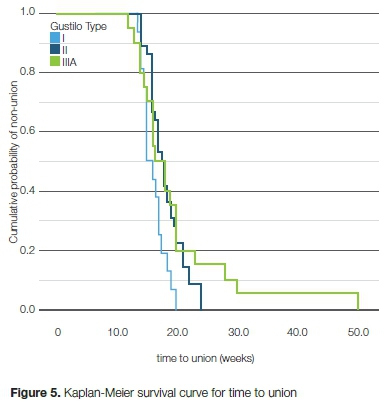
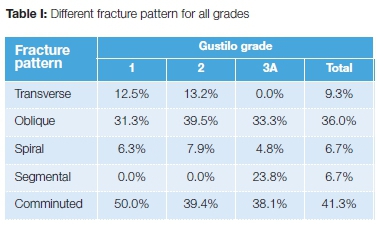
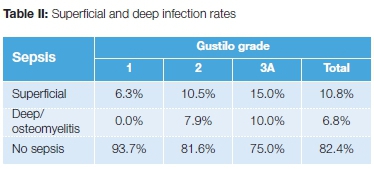
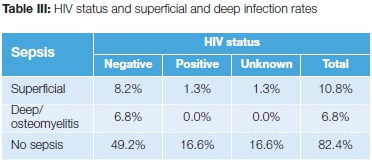
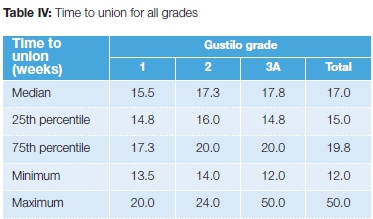
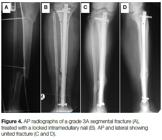
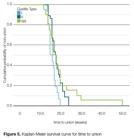
AIM: To establish superficial and deep infection rates and time to union of open tibial shaft fractures treated with primary debridement and locked intramedullary nails. MATERIALS AND METHODS: The clinical records and radiographs were retrospectively reviewed of 74 Gustilo-Anderson grades 1 to 3A open tibial shaft fractures that were treated by initial debridement and intramedullary nail fixation over a two-year period. Sixty-three men and nine women with a mean age of 33 years (range 16-67) were followed up for a mean period of 18 months (range 7-32). RESULTS: Sixteen patients (22%) sustained grade 1 injuries, 38 (51%) grade 2, and 20 (27%) had grade 3A injuries. Thirteen patients (18.1 %) were HIV positive. The mean time to surgery was 28 hours (range 8-112). The overall infection rate was 17.6%. Superficial infection developed in 10.8% and deep infection occurred in 6.8%. There was no association between time to surgery and infection rate (0=0.878). There was no association between HIV status and infection p=0.471). There was no association between type of closure and sepsis (0=0.410). The mean time to union was 17 weeks (range 12-50). Five patients (6.9%) had delayed union and one patient failed to unite without undergoing secondary procedures. CONCLUSION: The management of Gustilo-Anderson grade 1 to 3A open tibial shaft fractures with primary debridement and locked intramedullary nailing shows good short-term results with low infection and non-union rates despite delay in surgical management or HIV infection. Level of evidence: Level 4.
open tibial fractures; intramedullary nails; infection; union
 Thumbnail
 Thumbnail
 Thumbnail
 Thumbnail
 Thumbnail