A retrospective review of adolescent idiopathic scoliosis in a spinal unit in Cape Town, South Africa
Abstract
BACKGROUND: The aim of this study was to retrospectively review adolescent idiopathic scoliosis (AIS) patients treated surgically at a tertiary institution in the Western Cape. Additional objectives were to determine whether clinical parameters prior to surgery are associated with specific peri- and postoperative outcomes, and to determine crude costs of AIS treatment in this spinal unit METHODS: A retrospective observational study of clinical and radiological records was performed for 62 AIS patients treated between 1 January 2011 and 31 December 2019 at a tertiary academic hospital. Patient demographics and clinical characteristics were recorded, and appropriate correlation and associations were investigated, with post-hoc tests being performed where necessary, to investigate differences between multiple groups RESULTS: The median age was 13.5 (interquartile range [IQR] 12-15) years and the cohort included predominantly females. It took a median of 405.5 (IQR 227-1 019) days before patients presented at the spinal clinic, after which they waited a median of 275 (IQR 207-379) days for surgery. The mean Cobb angle at presentation was 63.3° ± 18.5°, compared to 71.2° ± 18.3° prior to surgery, with 18% of participants progressing from a 'non-severe curve' (< 70°) to 'severe' (> 70°) while awaiting surgery. A weak positive correlation was observed between the curve magnitude prior to surgery and the total theatre time, with larger curves requiring more theatre time. As expected, a significant association between the curve magnitude and the number of vertebrae levels requiring fusion (p < 0.001) was observed. The cost of treatment for the total study cohort amounted to more than R9 million, with a crude estimate of R89 807 per patient CONCLUSION: AIS patients treated in this study demonstrated long waiting times for surgery with a significant use of financial and physical resources. Eighteen per cent of patients progressed from a non-severe to a severe curve type due to prolonged waiting times. Early detection of AIS could potentially result in significant reduction of patients requiring surgery and as such, school and other screening programmes should be investigated as a potential tool to identify at-risk patients LEVEL OF EVIDENCE: 4
scoliosis; adolescent idiopathic scoliosis; Cobb angle; spinal deformity
Introduction
Scoliosis is defined as a three-dimensional deformity of the spine with a lateral curve of more than 10° associated with axial rotation.12
Early detection of AIS is essential for the optimum management of patients, subsequently reducing the risk of complications and downstream healthcare expenses.3,4 Conservative treatment, such as bracing, is widely used to minimise the risk of curve progression and thus reduce the eventual requirement for corrective surgery.4,5 However, to employ conservative treatment effectively, it is vital that AIS is detected early. Several factors influence curve progression, including presenting curve magnitude, peak growth velocity, sex and age.67,8 The most important considerations for surgical intervention include failure of conservative management or having a presenting primary curve greater than 40-45°.9
AIS surgery is one of the most common paediatric orthopaedic procedures performed despite only 10% of all cases requiring surgery.1011,12 Takayama et al. performed a survey of quality of life (QOL) after scoliosis surgery and reported that QOL was preserved despite a residual curve following surgery. The authors did, however, report large preoperative curves and positive sagittal balance to affect QOL negatively.131415,16 Complications of scoliosis surgery are, however, generally low with the most disastrous being complete neurological injury accounting for 0.5-1%.11
Even though surgical intervention for AIS is widely successful, the cost of scoliosis surgery is significant, with the United States reporting an annual expenditure of approximately $514 million on AIS surgery. This is second only to appendectomies in patients aged 10-17 years.17181920
In South Africa, to our knowledge, this is the first review of AIS in a tertiary setting focusing on, among others, demographics, curve progression, surgical management and costs. Anecdotal reports by spinal surgeons estimate that approximately 10% of patients with AIS in South Africa will present with a curve where surgery is needed. The primary aim of this study was to retrospectively review AIS patients treated surgically at a tertiary institution in the Western Cape over a nine-year period. A secondary objective was to determine whether clinical parameters prior to surgery are associated with specific peri- and postoperative outcomes. The final objective was to run a crude cost analysis to identify the expenses involved in treating these patients surgically, with specific focus on theatre time, length of hospital stay, and hardware usage.
Methods
A retrospective observational study was conducted and included AIS patients treated between 1 January 2011 and 31 December 2019 at a tertiary institution in the Western Cape province of South Africa. Ethical and institutional approval was obtained.
All patients who were diagnosed with AIS following the initial consultation were either managed conservatively or immediately routed for surgical intervention, which entailed being placed on a waiting list. Those who received corrective surgery as definitive treatment were included. This included patients initially managed nonoperatively. No specific exclusion criteria applied.
Patient records were reviewed, and patient demographic information was collected, including age at presentation, sex, and area of residence. Presenting complaint, as well as delays between symptom onset, first presentation and surgery, were also noted. The number and type of special investigations, including magnetic resonance imaging (MRI), echocardiograms and pulmonary function tests (PFTs) were recorded. All curves were measured and classified according to the Lenke system.21
A direct cost analysis of scoliosis surgery was performed considering theatre usage per minute, hospital stay per day and hardware use. Information was obtained via the 2018 fee schedule and the 2019 hospital implant tender document.22,23 Data on theatre usage was obtained from a study done in a regional public sector hospital in the Western Cape in 2020 on general operating theatre costs.24
Microsoft Excel (Microsoft, Redmond, WA, USA) was used to capture the data, and STATISTICA (version 13.5, TIBCO Software) was used for analysis. Continuous data are described as means and standard deviations or medians and interquartile ranges (IQR) depending on the data distribution. Cobb angle information was dichotomised into two categories, ≤ 70° (i.e. less severe) and > 70° (i.e. severe), in keeping with the categories reported by Tarrant et al.25
Results
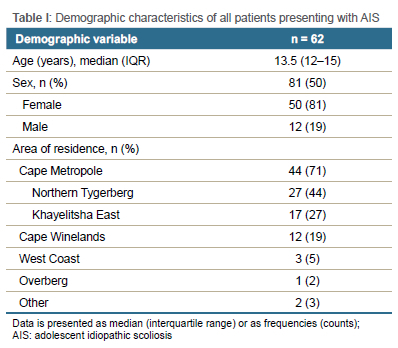
The study extended over a nine-year period from January 2011 to December 2019 and included 62 patients, the majority of which were female (n = 50, 81%), with a median age of 13.5 years (IQR: 12-15) (Table I). The majority of patients were located in the Cape Metropole (n = 45, 73%), of which 60% (n = 27/45) were from the Northern Tygerberg sub-district and 38% (n = 17/45) from the Khayelitsha Eastern sub-district. A total of nine (n = 9 of 62, 15%) patients initially received conservative treatment but were later treated surgically.
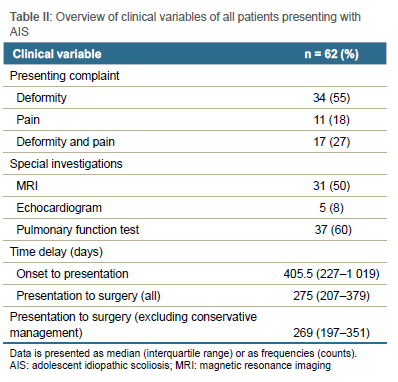
On initial consultation, 55% of patients (n = 34) complained of spinal deformity only, while 27% (n = 17) reported deformity and the presence of pain (Table II). Initial presentation to the spinal clinic took a median of 405.5 (IQR 227-1 019) days after onset of the deformity, while the median waiting time between presentation at the spinal clinic and surgical intervention was 275 (207-379) days. The median waiting time for patients who did not receive conservative intervention was 269 (197-351) days. While awaiting surgery, 50% (n = 31) of patients underwent an MRI which showed no abnormalities. Echocardiograms were performed on 8% (n = 5) of patients, and 37% (n = 27) underwent PFTs. A total of 16% (n = 10) of PFTs were normal, with the most common pathology being a mild restrictive pattern in 15% (n = 9) of patients (Table II).
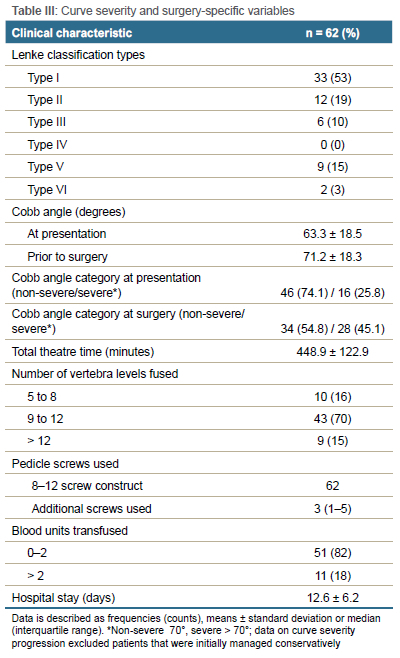
The most frequent curve pattern observed was a Lenke type 1 (53%, n = 33), followed by type 2 (19%, n = 12) (Table III). The mean Cobb angle at presentation was 63.3 ± 18.5°, compared to 71.2 ± 18.3° prior to surgery, with 18% of participants progressing from a 'non-severe curve' (≤ 70°) to 'severe' (> 70°) during the period they awaited definitive surgery. Data on curve severity progression excluded patients that were initially managed conservatively.
Intraoperatively, 60 patients had a mean total theatre time of 448.9 ± 122.9 minutes. All patients had a posterior surgical approach, with the exception of one patient having an anterior approach only. The number of levels fused were categorised as 5-8, 9-12 and > 12 levels fused, with 69% (n = 43) requiring 9-12 levels fused. An 8-12 screw construct was utilised in all patients, with a median of 3 (1-5) additional screws being required. Perioperatively, 18% (n = 11) of patients received > 2 packed red cell (PRC) units and 82% (n = 51) received between 0 and 2 PRC units. The mean length of hospital stay was 12.6 ± 6.2 days (Table III).
A total of six patients (10%) experienced post-discharge complications. Two patients underwent repeat surgery for distal adding-on and another two experienced hardware failure requiring revision. Finally, two patients suffered from wound complications that required additional care.
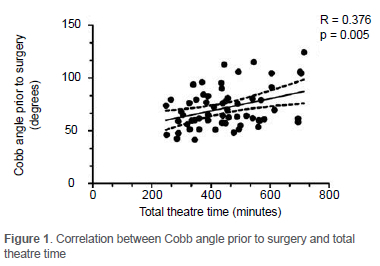
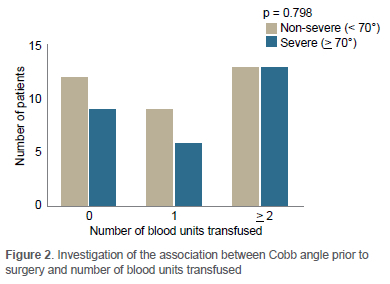
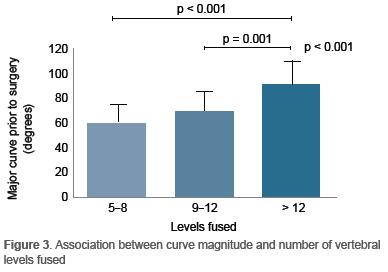
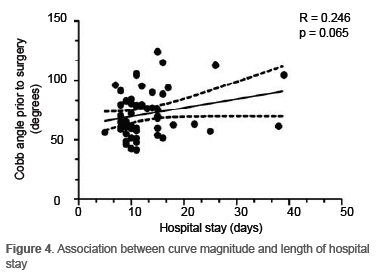
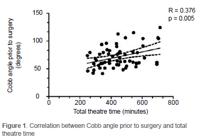
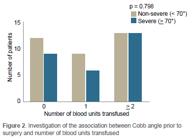
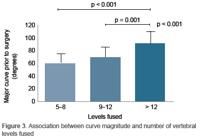
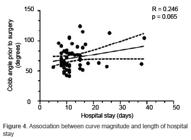
A weak positive correlation was observed between the curve magnitude prior to surgery and the total theatre time, with larger curves requiring more theatre time (R = 0.376, R2Figure 1). No association between severity of the curve and the number of blood units that were transfused was observed (p = 0.727) (Figure 2). A significant association between the curve magnitude and the number of vertebral levels requiring fusion (p < 0.001) was observed (Figure 3). In a post-hoc analysis the differences were observed between the 5-8 and > 12 group, as well as the 9-12 and > 12 group. No relationship was observed between curve magnitude and length of hospital stay (R = 0.246, R2Figure 4).
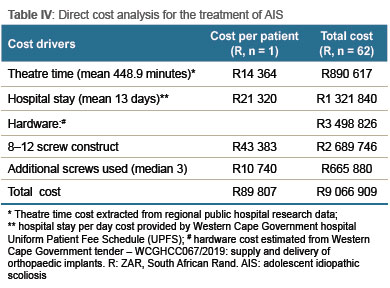
Theatre cost per patient was calculated using a mean of 448.9 min/patient (Table IV) at R32/min.2422Table III), amounted to more than R1.3 million (Table IV). Hardware costs included R43 383 for an 8-12 screw construct with rods, with the additional requirement of a median of 3 (1-5) screws at R3 580 per screw. This amounted to more than R9 million for the total study cohort, with a crude estimate of R89 807 per patient, with a median of 3 (IQR 1-13) extra screws used.
Discussion
The current study was undertaken to review AIS cases managed surgically at a tertiary institution in a South African setting and its impact on resources. Considering the typical age of onset of AIS, screening programmes in primary and high schools are ideally placed to detect this condition early.2627,28 Even with the lack of studies documenting improved outcomes, low positive predictive value and over-referral, the American Academy of Orthopaedic Surgeons recommends screening girls at age 11 and 13 and boys at age 13 or 14 years.29,30
All patients included in the present study were referred by either their local clinics or private general practitioners. Scoliosis school screening programmes are not included in the Integrated School Health Policy by the Department of Health in South Africa,3132,33 Various studies have highlighted the inequities in access to healthcare in South Africa and report that inaccessibility to healthcare facilities remains a barrier, especially in remote, poorly resourced rural areas.18,19 Screening programmes designed to detect major healthcare concerns early are therefore especially beneficial in communities that might not otherwise have easy access to healthcare services.
Our institution serves a population of nearly 3.5 million people. Communities situated in this district experience low socioeconomic circumstances and low employment rates.3432
In the present study, 49 patients at first presentation had a curve that already met the surgical threshold of > 50°, even though they were still classified as being 'non-severe' according to the categories reported by Tarrant et al.2510,25 Curve progression in the present study was therefore a major concern, with a mean Cobb angle increase of 9° degrees during the waiting time until surgery, which resulted in 18% of patients progressing from a 'non-severe' (≤ 70°) to 'severe' (> 70°) curve type. It is very likely that the prolonged waiting time for surgery was directly responsible for this observed curve severity progression. Furthermore, even though we failed to show it convincingly in the present study due to the relatively small sample size, it is not unreasonable to argue that increased curve severity could lead to increased theatre time and the requirement of more spinal vertebra levels needing to be fused. This not only has a more significant effect on the patient, but also results in increased resource use, especially in a resource-constrained setting. Fortunately, no serious direct complications were observed in patients with documented curve progression in the present study. This study did not, however, gauge QOL or any psychological measures.
Preoperative curve magnitude did not influence the need for blood transfusions, major postoperative complications, or length of hospital stay, which is highly reassuring for both patients and surgeons. In 2012, Miyanji et al. similarly reported no association between hospital length of stay and curve magnitude.1515,16 Future longitudinal studies investigating the long-term outcomes and QOL of patients that underwent AIS surgery should be conducted. It is widely known that complication rates in adults are much higher than in children, and when surgery is performed closer to adulthood, the risk of infection and pseudoarthrosis is almost 17%.3310
Besides the impact surgical intervention for AIS has on the patient, AIS corrective surgery also utilised a significant amount of financial resources. With a mean theatre time of 7.5 hours and a crude mean cost of ~R90 000 per patient, the time and financial implications of treating each individual patient are substantial. The spinal unit at our institution has a single theatre slot per week (eight hours) dedicated to elective surgery, which includes other elective surgeries besides AIS. Deformity correction surgeries are often lengthy procedures. At this institution, Miseer et al. reported a deformity elective case to take just over seven hours.201235,36 It is therefore tempting to speculate that a well-versed team, familiar with each other and the surgical procedure, might have a positive influence on the patients and healthcare system.
The most important limitation of this study was the relatively small sample size, even though the study was conducted over a nine-year study period. Future multicentre studies might alleviate some of the limitations associated with small sample sizes. Finally, financial implications of the treatment of AIS between 2011 and 2019 might have differed substantially, especially given that the 2018 and 2019 fee structures were used to estimate cost. However, the type of treatment that patients were provided in the early study years remains comparable to the later study years, and therefore the estimated cost could be argued to still be relevant.
Future research should aim to include multiple study sites and investigate whether the use of static theatre teams could potentially improve service delivery and financial burdens in the treatment of AIS. In addition, longitudinal investigation of patients who underwent AIS corrective surgery would provide more insight into the long-term outcomes of these patients and whether they re-presented at a later stage, in adulthood, for further treatment.
Conclusion
AIS patients treated in this study demonstrated long waiting times for surgery with a significant use of financial and physical resources. Eighteen per cent of patients progressed from a non-severe to a severe curve type due to prolonged waiting times. Early detection of AIS could potentially result in significant reduction of patients requiring surgery and as such, school and other screening programmes should be investigated as a potential tool to identify at-risk patients.
Ethics statement
The authors declare that this submission is in accordance with the principles laid down by the Responsible Research Publication Position Statements as developed at the 2nd World Conference on Research Integrity in Singapore, 2010.
Prior to commencement of the study, ethical approval was obtained from the following ethical review board: Health Research Ethics Committee, University of Stellenbosch, Project ID 1448, and ethics reference number S20/02/028.
All procedures were in accordance with the ethical standards of the responsible committee on human experimentation (institutional and national) and with the Helsinki Declaration of 1975, as revised in 2008.
A waiver of informed consent was obtained for this study.
Declaration
The authors declare authorship of this article and that they have followed sound scientific research practice. This research is original and does not transgress plagiarism policies.
Author contributions
NLA: study conceptualisation, data capture, first draft preparation, manuscript preparation, approval of final manuscript
MCB: study design; data analysis, manuscript preparation, approval of final manuscript
SM: study conceptualisation, data capture, manuscript preparation, manuscript revision, approval of final manuscript
ORCIDAfrika NL https://orcid.org/0000-0001-5789-1770
Burger MC https://orcid.org/0000-0003-2831-4960
References
- 1. Altaf F, Gibson A, Dannawi Z, et al. Adolescent idiopathic scoliosis. BMJ (online). 2013;346:1-7.
- 2. Konieczny MR, Senyurt H, Krauspe R. Epidemiology of adolescent idiopathic scoliosis. J Child Orthop. 2013;7:3-9.
-
3. Adobor RD, Joranger P, Steen H, et al. A health economic evaluation of screening and treatment in patients with adolescent idiopathic scoliosis. Scoliosis. 9. Epub ahead of print 6 December 2014. https://doi.org/10.1186/s13013-014-0021-8
» https://doi.org/10.1186/s13013-014-0021-8 - 4. Shah SA. Nonoperative treatment for adolescent idiopathic scoliosis. Semin Spine Surg. 2015;27:27-32.
-
5. Schiller JR, Thakur NA, Eberson CP. Brace management in adolescent idiopathic scoliosis. Clin Orthop Relat Res. 2010 Mar;468(3):670-78. https://doi.org/10.1007/s11999-009-0884-9
» https://doi.org/10.1007/s11999-009-0884-9 - 6. Tan Ken-Jin et al. Curve progression in idiopathic scoliosis. Spine. (Phila Pa 1976) 2009;34:697-700.
- 7. Weinstein SL, Zavala DC, Ponseti I v, et al. Idiopathic scoliosis: long-term follow-up and prognosis in untreated patients. J Bone Joint Surg Am. 1981 Jun;63(5):702-12.
- 8. Johari J, Sharifudin MA, Ab Rahman A, et al. Relationship between pulmonary function and degree of spinal deformity, location of apical vertebrae and age among adolescent idiopathic scoliosis patients. Singapore Med J. 2016;57:33-38.
- 9. Menger RP, Kalakoti P, Pugely AJ, et al. Adolescent idiopathic scoliosis: Risk factors for complications and the effect of hospital volume on outcomes. Neurosurg Focus. 2017;43:1-13.
-
10. Ahn H, Kreder H, Mahomed N, et al. Empirically derived maximal acceptable wait time for surgery to treat adolescent idiopathic scoliosis. CMAJ; 183. Epub ahead of print 14 June 2011. https://doi.org/10.1503/cmaj.101511
» https://doi.org/10.1503/cmaj.101511 - 11. Stepanovich M, Mundis G, Yaszay B. Complications of the treatment of adolescent idiopathic scoliosis. Semin Spine Surg. 2015;27:58-61.
- 12. Flynn JM, Striano BM, Muhly WT, et al. A dedicated pediatric spine deformity team significantly reduces surgical time and cost. J Bone Joint Surg Am. 2018 Sep 19;100(18):1574-80.
- 13. Takayama K, Nakamura H, Matsuda H. Quality of life in patients treated surgically for scoliosis longer than sixteen-year follow-up. Spine (Phila Pa 1976). 2009 Sep 15;34(20):2179-84.
- 14. Merola AA, Haher TR, Brkaric M, et al. A multicenter study of the outcomes of the surgical treatment of adolescent idiopathic scoliosis using the Scoliosis Research Society (SRS) outcome instrument. Spine (Phila Pa 1976). 2002 Sep 15;27(18):2046-51.
- 15. Miyanji F, Slobogean GP, Samdani AF, et al. Is larger scoliosis curve magnitude associated with increased perioperative health-care resource utilization? A multicenter analysis of 325 adolescent idiopathic scoliosis curves. J Bone Joint Surg Am. 2012 May 2;94(9):809-13.
- 16. Miyanji F, Newton PO, Samdani AF, et al. Impact of surgical waiting-list times on scoliosis surgery: The surgeon's perspective. Spine (Phila Pa 1976). 2015;40:823-28.
- 17. Koo AB, Elsamadicy AA, Kundishora AJ, et al. Geographic variation in outcomes and costs after spinal fusion for adolescent idiopathic scoliosis. World Neurosurg. 2020;136:e347-e354.
- 18. Harris B, Goudge J, Ataguba JE, et al. Inequities in access to health care in South Africa. J Public Health Policy. 2011;32 Suppl 1:S102-23.
- 19. Coovadia H, Jewkes R, Barron P, et al. The health and health system of South Africa: historical roots of current public health challenges. Lancet. 2009 Sep 5;374(9692):817-34
-
20. Miseer S, Mann T, Davis J. Burden and profile of spinal pathology at a major tertiary hospital in the Western Cape, South Africa. SA Orthop J. 2019;18(1). https://doi.org/10.17159/2309-8309/2019/v18n1a4
» https://doi.org/10.17159/2309-8309/2019/v18n1a4 - 21. Lenke LG, Betz RR, Harms J, et al. Adolescent idiopathic scoliosis: a new classification to determine extent of spinal arthrodesis. J Bone Joint Surg Am. 2001 Aug;83(8):1169-81.
-
22. Western Cape Government. Western Cape Government. UPFS Billing Proced. Sched. Full-Paying Patients. Available from: https://www.westerncape.gov.za/general-publication/western-cape-government-hospital-tariffs-overview
» https://www.westerncape.gov.za/general-publication/western-cape-government-hospital-tariffs-overview - 23. Western Cape Department of Health. WCGHCC067/2019: supply and delivery of orthopaedic implants Item Number Description Bidder Pricing Year 1 Pricing Year 2 Pricing Year 3 7.1.1.
- 24. Samuel JP, Reed A. The costing of operating theatre time in a secondary-level state sector hospital: A quantitative observational study. S Afr Med J. 2021 May 31;111(6):595-600.
- 25. Tarrant RC, Queally JM, O'Loughlin PF, et al. Preoperative curves of greater magnitude (>70°) in adolescent idiopathic scoliosis are associated with increased surgical complexity, higher cost of surgical treatment and a delayed return to function. Ir J Med Sci. 2016;185:463-71.
- 26. Labelle H, Richards SB, de Kleuver M, et al. Screening for adolescent idiopathic scoliosis: an information statement by the Scoliosis Research Society international task force. 2013; 1-6. Scoliosis. 2013 Oct 31:8:17.
- 27. Onuoha K, Obong U, Omokore O, et al. Evaluating outcomes following assessment of idiopathic scoliosis. Int J Community Med Public Health. 2022; 9: 2372.
- 28. Toombs C, Lonner B, Fazal A, et al. The Adolescent Idiopathic Scoliosis International Disease Severity Study: do operative curve magnitude and complications vary by country? Spine Deform. 2019;7:883-89.
- 29. Altaf F, Drinkwater J, Phan K, et al. Systematic review of school scoliosis screening. Spine Deform. 2017;5:303-309.
-
30. Grivas TB, Wade MH, Negrini S, et al. SOSORT consensus paper: School screening for scoliosis. Where are we today? Scoliosis; 2. Epub ahead of print 26 November 2007. https://doi.org/10.1186/1748-7161-2-17
» https://doi.org/10.1186/1748-7161-2-17 -
31. Integrated School Health Policy. https://serve.mg.co.za/content/documents/2017/06/14/integratedschoolhealthpolicydbeanddoh.pdf (accessed 13 February 2023).
» https://serve.mg.co.za/content/documents/2017/06/14/integratedschoolhealthpolicydbeanddoh.pdf -
32. Asher MA, Burton DC. Adolescent idiopathic scoliosis: Natural history and long-term treatment effects. Scoliosis. 1. Epub ahead of print 31 March 2006. https://doi.org/10.1186/1748-7161-1-2
» https://doi.org/10.1186/1748-7161-1-2 - 33. Jazini E, Raman T, Bressner J, et al. Adolescent idiopathic scoliosis: considerations for the transition to adulthood. Semin Spine Surg. 2015;27:62-69.
-
34. Western Cape Government Provincial Treasury, https://www.westerncape.gov.za/assets/departments/treasury/Documents/Socio-economic-profiles/2016/City-of-Cape-Town/city_of_cape_town_2016_socio-economic_profile_sep-lg.pdf (accessed 13 February 2023).
» https://www.westerncape.gov.za/assets/departments/treasury/Documents/Socio-economic-profiles/2016/City-of-Cape-Town/city_of_cape_town_2016_socio-economic_profile_sep-lg.pdf - 35. Miyanji F, Greer B, Desai S, et al. Improving quality and safety in paediatric spinal surgery. Bone Joint J. 2018;100:493-501.
- 36. Boissoneau R, Sprengel AD, Snell WE. A national study: The use of specialty surgical teams. Health Mark Q. 1999;17:49-58.
Accepted: July 2025
Published: May 2026
Editor: Dr Johan Davis, Stellenbosch University, Cape Town, South Africa
Funding: No funding was received for this study.
Conflict of interest: The authors declare they have no conflicts of interest that are directly or indirectly related to the research.