Access to reverse shoulder arthroplasty in South Africa's public healthcare system
Abstract
BACKGROUND: Access to healthcare services, particularly surgical interventions, remains a critical challenge in low- to middle-income countries (LMICs). Reverse shoulder arthroplasty (RSA) is the most frequently performed arthroplasty procedure of the shoulder and is recommended for the treatment of complex shoulder conditions in the elderly population. This study investigated the availability and accessibility of RSA within South Africa's public healthcare system, focusing on equity in surgical care provision. METHODS: Using a multifaceted research approach, data were collected from 33 professionals across eight provinces, representing a significant proportion of the population. RESULTS: Results indicate significant disparities in access to RSA, with urban areas and tertiary hospitals having better resources and capacity. The majority of the tertiary level hospitals are easily accessible to urban compared to rural dwellers. Despite the growing need for RSA, particularly among older demographics, the study reveals a scarcity of skilled shoulder surgeons and inadequate infrastructure, especially in rural regions. CONCLUSION: These findings underscore systemic barriers hindering equitable access to RSA and surgical care in South Africa. Recommendations include increasing resources for training, improving infrastructure, and enhancing referral systems to address these disparities and ensure universal access to essential surgical services. Level of evidence: 4
reverse shoulder arthroplasty; accessibility; availability
Introduction
Healthcare access remains a critical concern in many low- to middle-income countries (LMICs), characterised by a myriad of challenges such as financial constraints, inadequate infrastructure and limited capabilities. The concept of healthcare access encompasses various dimensions including affordability, accessibility, availability, acceptability, and quality. The World Health Organization (WHO) has championed the notion of 'universal health coverage,' emphasising the importance of ensuring universal access to essential healthcare services without financial barriers. This paradigm underscores the need for affordable healthcare accessible to all, with a primary healthcare approach tailored to individual needs. Despite global efforts, the Lancet Commission on Global Surgery's 2015 report revealed that approximately 5 billion people lacked access to safe surgical procedures, with LMICs bearing a disproportionate burden.12
In countries like South Africa, historical disparities persist, hindering marginalised groups' access to quality healthcare.34,5
Reverse shoulder arthroplasty (RSA) has emerged as a primary surgical intervention for shoulder disorders, offering relief to a wide range of patients.67,8 In 2017, Miura et al. conducted a study using data from the Australian National Registry to assess the likelihood of requiring a primary shoulder arthroplasty over one's lifetime. They discovered that the risk was 1 in 57 for men and 1 in 35 for women. This is a threefold increase compared to the figures reported in 2008 for males, and more than double for females.9
Methods
To systematically evaluate the availability of RSA within the South African public healthcare system, we adopted a multifaceted research approach. Primary data collection was initiated through web-based searches utilising the official websites of provincial and national health ministries, alongside other reputable organisations. This involved gathering information on the number of hospitals relative to the population size, as documented in government records. Subsequently, a national survey targeting secondary and tertiary level orthopaedic units was conducted, facilitated by a standardised questionnaire distributed via email using Google Docs, along with an accompanying informational leaflet. Ethical clearance for the study was obtained from our institution.
Public health hospitals lacking an orthopaedic facility or department, all private sector institutions, and public health facilities categorised as level 1 (primary healthcare establishments and district hospitals) were excluded from the study. The research aimed to assess a minimum of five out of the nine provinces in the country, each represented by at least two institutions. Medpages, an online directory, was utilised to identify South African and provincial public institutions, cross-referenced with national and provincial health department websites.10
Population statistics for each province, municipality, district and city were retrieved from the most recent data available on the Statistics South Africa website.11
To evaluate the accessibility of RSA, we applied the conceptual framework for evaluating access to health services proposed by Peters et al.12
Procedure availability was assessed based on the number of hospitals offering the service per population and the number of qualified surgeons per district. An estimate of the country's capacity to provide services was determined by calculating the number of procedures performed and the number of centres equipped with adequate resources, relative to the population size served.
Results
Respondents
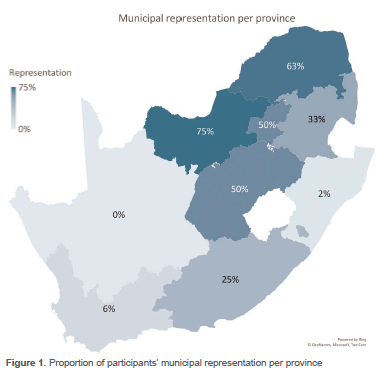
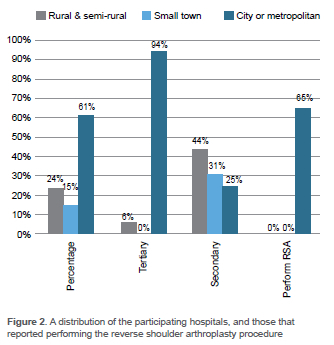
The survey targeted 60 orthopaedic surgeons across all nine provinces of South Africa, with a response rate of 55%, resulting in 33 completed surveys. Two hospitals had multiple respondents (Pietersburg Hospital [in Polokwane] with four respondents and Livingstone Hospital with three), and there were discrepancies in the responses from two of these individuals. To verify the data, the responses were compared with those of other respondents from the same hospitals, and one representative from each hospital was contacted. Eight provinces were represented, with the majority of respondents being orthopaedic surgeons with less than ten years of experience (73%). Gauteng and Limpopo provinces had the highest representation at 27% and 24%, respectively, while no participants were from the Northern Cape. Respondents' municipalities covered 34% of the country's total population (Figure 1). The majority of the respondents' facilities (61%) were located in urban or metropolitan areas, while 39% were situated in rural areas or small towns (Figure 2).
Geographic accessibility
Out of the hospitals surveyed, the vast majority (94%) of tertiary level hospitals are situated in urban regions, such as cities and metropolitans. Only one tertiary level hospital is found in a rural location. No hospitals in small towns and rural areas provide RSA procedures. Although all tertiary level institutions carry out RSA, only 65% of the studied facilities in urban regions perform this treatment. None of the represented hospitals in the Limpopo and North West provinces had a fellowship-trained shoulder surgeon, and they referred their patients to the hospitals in Gauteng.
Availability and capacity
More than half (55%) of the participants reported that their institutions assigned at least one operating room per day specifically for elective orthopaedic surgery. Significantly, the data indicates that a significant percentage of secondary level hospitals (67%) reported having daily availability of only one operating room. On the other hand, tertiary level hospitals showed more capability, with an average of three operating rooms accessible every day, varying from one to five.
There was variation in the number of orthopaedic surgeons in tertiary level departments, with a median of 7 and a range of 2-18. Among these departments, 20% indicated that they had one or two shoulder surgeons who had completed specialised training in fellowships. These surgeons were all based in metropolitan or urban locations. In contrast, secondary level centres had a limited number of orthopaedic surgeons, varying from zero to four, with a median of one. In this category, three departments said they had one subspecialist shoulder surgeon. The study survey suggested that there are 0.5 subspecialist shoulder surgeons per 1 million people in South Africa. Despite having a smaller number of survey respondents, the Free State and Western Cape provinces had higher projected rates of 0.7 per 1 million population. The estimated ratio of shoulder surgeons to population in Gauteng was 0.23 per 1 million individuals.
Indices, utilisation and barriers
The study analysed performance and arthroplasty waiting period indices in participating hospitals, revealing that a significant proportion of respondents (39%) reported arthroplasty waiting periods spanning two to five years, predominantly observed in secondary level institutions (82% of respondents). Additionally, 36% of respondents (82% from tertiary level hospitals) anticipated waiting periods of five to ten years. Regarding RSA, 46% of respondents reported performing RSA in their hospitals, with a lower waiting period compared to hip and knee arthroplasty. Most respondents (50%) reported a waiting period of less than 12 months for an RSA procedure.
Among RSA-performing hospitals, 60% stated indications for surgery were evenly divided between trauma-related and non-trauma-related cases. Challenges in handling glenoid structural bone loss led one facility to refer such cases elsewhere due to expertise limitations. Preoperative planning for glenoid defects primarily involved computerised tomography (CT) scans (54%) or conventional X-ray images (46%) due to limited CT scanner access.
Barriers to accessing RSA were identified, with shortages in skilled surgeons (49%) and allocated theatre time (46%) being predominant. Lack of theatre infrastructure (33%) and RSA prosthesis exclusion from provincial tender systems (22%) were also cited. Moreover, 46% of respondents highlighted the absence of suitable facilities for patient referral, while 27% identified hospitals not offering RSA as their primary referral option.
Discussion
Between 2011 and 2022, South Africa's population experienced a significant 17% growth, reaching a total of 62 million people according to the latest census data.1113
Shoulder complaints are the third most prevalent musculoskeletal complaint, after complaints of the back and knee.14,15 Shoulder arthritis and rotator cuff arthropathy usually affect people aged 60 years and above, including a wide age range. These conditions are frequently responsible for shoulder pain in this demographic. The incidence of symptomatic arthritis and morbidity in these people varies from 7-34%. RSA is the predominant surgical method for shoulder arthroplasty.16,17 This surgery is indicated for a variety of shoulder conditions, from severe arthritis to complicated shoulder injuries.1618,19 Glenoid structural deficiencies or glenoid dysplasia needing correction during RSA are linked to unfavourable results, increased rates of complications, and premature failure of the treatment.6
The WHO has proposed a standard of 20 surgical operations per 1 000 individuals per year as an initial measure for evaluating the surgical capabilities within a healthcare system. The South African surgical workforce is far below the benchmark, with an estimated ratio of 0.11 specialist surgeons per 1 000 people. This is in contrast to a socioeconomically comparable nation such as Brazil, which has a ratio of 0.55 specialist surgeons per 1 000 people.20,21 We estimate that there are 0.05 subspecialist shoulder surgeons per 100 000 people making use of the public sector hospitals, all of them practising in the major cities, highlighting severe lack of access to safe RSA for complex cases in the country. Grimes et al.2223
The hospitals capable of performing the procedure are overwhelmed by the number of patients, limited resources, and traumatic injuries. In complex cases, preoperative planning for this surgery necessitates the use of a CT scan to enhance the accuracy of implant sizes and placement, as well as to optimise the overall success of the treatment. Existing literature indicates that there is a significant disparity in the availability of CT scanners between LMICs and high-income countries (HICs). Specifically, the ratio of CT scanners to population is said to be 1 per 1 million in LMICs, whereas it is 40 per 1 million in HICs.2425
An issue arises within the public healthcare system of South Africa, as the expected expenditure on healthcare amounts to R200 billion, with just 20% of this being allocated to the public health service system, which caters to 80 to 85% of the population.26 27
We acknowledge some inherent limitations to our results due to the study design. The presence of sample bias is acknowledged, since it does not include all of the senior surgeons in their respective departments or those who are active in treating patients requiring shoulder arthroplasty. This issue is exacerbated by non-response bias, since only 55% of the individuals who were invited actually completed the survey. It is crucial to highlight that the respondents in this study represented the majority of the hospitals across various geographic locations and economic classes in the country. Therefore, the information gathered is likely to provide a good indication of the overall condition in the country. Furthermore, while we observed many parameters linked to limited availability of this surgical procedure in our study, it is important to stress that no statistical correlation can be established. Moreover, this study was further constrained by the inability to examine all the constituents of the chosen framework for assessing health accessibility.
Conclusions
The study revealed significant constraints in the accessibility and availability of RSA among South Africans utilising the public healthcare sector. The population dwelling in the undeveloped areas see more pronounced impacts. The main reason was a shortage of skilled shoulder surgeons, closely followed by a lack of resources and infrastructure. Based on the limited availability of training opportunities, the likelihood of the situation improving in the near future is low. Given the increasing demand and importance of this treatment both domestically and internationally, we propose a greater allocation of resources towards enhancing the surgical capabilities of public hospitals in both urban and rural areas, referral systems and providing specialised training in this field.
Ethics statement
The authors declare that this submission is in accordance with the principles laid down by the Responsible Research Publication Position Statements as developed at the 2nd World Conference on Research Integrity in Singapore, 2010.
Prior to commencement, this study received ethical approval from the University of Cape Town Human Ethics Research committee (reference number: 781/2022). All procedures were in accordance with the ethical standards of the responsible committee on human experimentation (institutional and national) and with the Helsinki Declaration of 1975, as revised in 2008. Informed written consent was obtained from all participants in the study.
Declaration
The authors declare authorship of this article and that they have followed sound scientific research practice. This research is original and does not transgress plagiarism policies.
Author contributions
PAR: research ideation, preparation of the manuscript, final approval of the version to be published
RD: data analysis and interpretation and final approval of the version to be published
SS: critical editing and final approval of the version to be published
J-PdP: critical editing and final approval of the version to be published
SJLR: senior author, critical editing and final approval of the version to be published
ORCID
Rachuene PA https://orcid.org/0000-0003-4045-5301
Dey R https://orcid.org/0000-0002-3616-1995
Sivarasu S https://orcid.org/0000-0002-0812-568X
du Plessis J-P https://orcid.org/0000-0001-6469-7765
Roche SJL https://orcid.org/0000-0002-5695-2751
References
-
1. Meara JG, Leather AJM, Hagander L, et al. Global Surgery 2030: Evidence and solutions for achieving health, welfare, and economic development. Lancet. 2015;386(9993):569-624. https://doi.org/10.1016/S0140-6736(15)60160-X
» https://doi.org/10.1016/S0140-6736(15)60160-X -
2. Alkire BC, Raykar NP, Shrime MG, et al. Global access to surgical care: A modelling study. Lancet Glob Heal. 2015;3(6):e316-e323. https://doi.org/10.1016/S2214-109X(15)70115-4
» https://doi.org/10.1016/S2214-109X(15)70115-4 -
3. Harris B, Goudge J, Ataguba JE, et al. Inequities in access to health care in South Africa reforms , and policy implementation in South Africa : Studies and perspectives on the 24th anniversary of the Centre for Health Policy. 2011. pp S102-S123 Published by : Palgrave Macmillan Journals. J Public Health Policy. 2011;32. http://www.jstor.org/stable/20868835?seq=1&cid=pdf-reference#references_tab_contents
» http://www.jstor.org/stable/20868835?seq=1&cid=pdf-reference#references_tab_contents -
4. Kavalier T, Nortje M, Dunn RN. Hip and knee arthroplasty waiting list - How accurate and fair? South African Med J. 2017;107(4):323-26. https://doi.org/10.7196/SAMJ.2017.v107i4.12145
» https://doi.org/10.7196/SAMJ.2017.v107i4.12145 -
5. Scott CEH, MacDonald DJ, Howie CR. 'Worse than death' and waiting for a joint arthroplasty. Bone Jt J. 2019;101 B(8):941-50. https://doi.org/10.1302/0301-620X.101B8.BJJ-2019-0116.R1
» https://doi.org/10.1302/0301-620X.101B8.BJJ-2019-0116.R1 -
6. Rachuene PA, Dey R, Sivarasu S, et al. A narrative review of treatment strategies for major glenoid defects during primary reverse shoulder arthroplasty, with a focus on the use of structural bone graft. EFORT Open Rev. 2023;8(10):759-70. https://doi.org/10.1530/EOR-22-0062
» https://doi.org/10.1530/EOR-22-0062 -
7. Klein SM, Dunning P, Mulieri P, et al. Effects of acquired glenoid bone defects on surgical technique and clinical outcomes in reverse shoulder arthroplasty. J Bone Jt Surg Am. 2010;92(5):1144-54. https://doi.org/10.2106/JBJS.f00778
» https://doi.org/10.2106/JBJS.f00778 -
8. Frankle MA, Teramoto A, Luo ZP, et al. Glenoid morphology in reverse shoulder arthroplasty: Classification and surgical implications. J Shoulder Elb Surg. 2009;18(6):874-85. https://doi.org/10.1016/j.jse.2009.02.013
» https://doi.org/10.1016/j.jse.2009.02.013 -
9. Miura D, Busija L, Page RS, et al. Lifetime risk of primary shoulder arthroplasty over a decade: a population-level analysis. Osteoarthr Cartil. 2020;28(2020):S445. https://doi.org/10.1016/j.joca.2020.02.693
» https://doi.org/10.1016/j.joca.2020.02.693 -
10. Find Hospitals - Public in South Africa. https://www.medpages.info/sf/index.php?page=serviceregion&servicecode=77&countryid=1. Accessed July 19, 2022.
» https://www.medpages.info/sf/index.php?page=serviceregion&servicecode=77&countryid=1 -
11. Statistics South Africa. The South Africa I know, the home I understand. https://www.statssa.gov.za/. Accessed July 19, 2022.
» https://www.statssa.gov.za/ -
12. Peters DH, Garg A, Bloom G, et al. Poverty and access to health care in developing countries. Ann N Y Acad Sci. 2008;1136:161-71. https://doi.org/10.1196/annals.1425.011
» https://doi.org/10.1196/annals.1425.011 -
13. Dell AJ, Gray S, Fraser R, et al. Orthopaedic surgeon density In South Africa. World J Surg. 2018;42(12):3849-55. https://doi.org/10.1007/s00268-018-4709-4
» https://doi.org/10.1007/s00268-018-4709-4 -
14. Urwin M, Symmons D, Allison T, et al. Estimating the burden of musculoskeletal disorders in the community: The comparative prevalence of symptoms at different anatomical sites, and the relation to social deprivation. Ann Rheum Dis. 1998;57(11):649-55. https://doi.org/10.1136/ard.57.11.649
» https://doi.org/10.1136/ard.57.11.649 -
15. James SL, Lucchesi LR, Bisignano C, et al. Morbidity and mortality from road injuries : results from the Global Burden of Disease Study 2017. 2020. https://doi.org/10.1136/injuryprev-2019-043302
» https://doi.org/10.1136/injuryprev-2019-043302 - 16. Millett PJ, Gobezie R, Boykin RE. Shoulder osteoarthritis: diagnosis and management. Am Fam Physician. 2008 Sep 1;78(5):605-11.
-
17. Palsis JA, Simpson KN, Matthews JH, et al. Current trends in the use of shoulder arthroplasty in the United States. Orthopedics. 2018;41(3):E416-E423. https://doi.org/10.3928/01477447-20180409-05
» https://doi.org/10.3928/01477447-20180409-05 -
18. Ma GC, Bradley KE, Jansson H, et al. Surgical complications after reverse total shoulder arthroplasty and total shoulder arthroplasty in the United States. J Am Acad Orthop Surg Glob Res Rev. 2021;5(7). https://doi.org/10.5435/JAAOSGLOBAL-D-21-00146
» https://doi.org/10.5435/JAAOSGLOBAL-D-21-00146 -
19. Franceschi F, Giovannetti de Sanctis E, Gupta A, et al. Reverse shoulder arthroplasty: State-of-the-art. J ISAKOS. 2023;8(5):306-17. https://doi.org/10.1016/j.jisako.2023.05.007
» https://doi.org/10.1016/j.jisako.2023.05.007 -
20. Lestrade-Jefferis J. The South African Labour Market: Selected time-based. https://www.statssa.gov.za/publications/SALabourMarket/SALabourMarket.pdf. Accessed 4 July 4 2025.
» https://www.statssa.gov.za/publications/SALabourMarket/SALabourMarket.pdf -
21. World Health Organization. WHO Guidelines for safe surgery: safe surgery saves lives. https://www.who.int/publications/i/item/9789241598552. Published 2009. Accessed June 20, 2022.
» https://www.who.int/publications/i/item/9789241598552 -
22. Grimes CE, Bowman KG, Dodgion CM, Lavy CBD. Systematic review of barriers to surgical care in low-income and middle-income countries. World J Surg. 2011;35(5):941-50. https://doi.org/10.1007/s00268-011-1010-1
» https://doi.org/10.1007/s00268-011-1010-1 -
23. van Rensburg HCJ, Benatar SR. The legacy of apartheid in health and health care. S Afr J Sociol. 1993;4. https://doi.org/10.1080/02580144.1993.10431680
» https://doi.org/10.1080/02580144.1993.10431680 -
24. Frija G, Blazic I, Frush DP, et al. How to Improve access to medical Imaging In low- and middle-income countries ? eClinicalMedicine. 2021;38:101034. https://doi.org/10.1016/J.ECLINM.2021.101034
» https://doi.org/10.1016/J.ECLINM.2021.101034 -
25. Nyffeler RW, Jost B, Pfirrmann CWA, Gerber C. Measurement of glenoid version: Conventional radiographs versus computed tomography scans. J Shoulder Elb Surg. 2003;12(5):493-96. https://doi.org/10.1016/S1058-2746(03)00181-2
» https://doi.org/10.1016/S1058-2746(03)00181-2 -
26. National Health Act: National Health Insurance Policy: Towards universal health coverage | South African Government. https://www.gov.za/documents/national-health-act-national-health-insurance-policy-towards-universal-health-coverage-30. Accessed July 21, 2022.
» https://www.gov.za/documents/national-health-act-national-health-insurance-policy-towards-universal-health-coverage-30 -
27. Narvy S, Vangsness CT. Analysis of direct costs of outpatient arthroscopic rotator cuff repair. 2016. www.amjorthopedics.com. Accessed July 21, 2022.
» www.amjorthopedics.com
Accepted: January 2025
Published: August 2025
Editor: Dr Cameron Anley, Stellenbosch University, Cape Town, South Africa
Funding: No funding was received for this study.
Conflict of interest: The authors declare they have no conflicts of interest that are directly or indirectly related to the research.